
Full effectiveness and uniform application vs procedural autonomy
- Slides: 18
Full effectiveness and uniform application vs. procedural autonomy Rights, powers and duties of NCAs after Tele 2 Polska and VEBIC Silke Brammer 24 October 2011
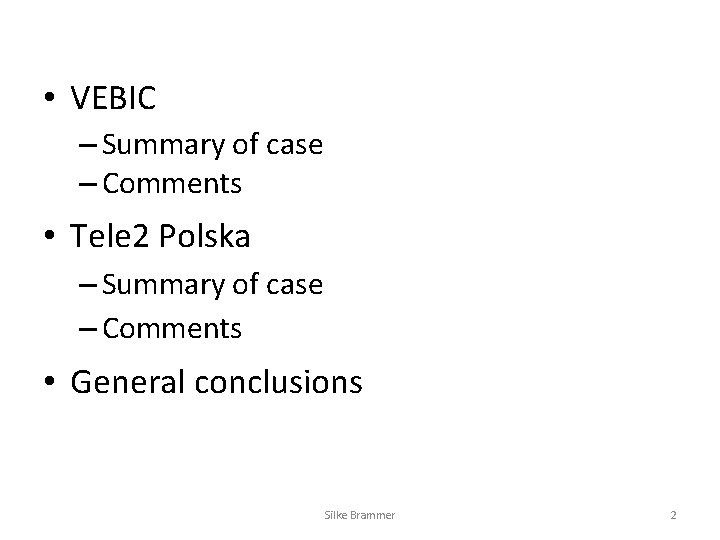
• VEBIC – Summary of case – Comments • Tele 2 Polska – Summary of case – Comments • General conclusions Silke Brammer 2
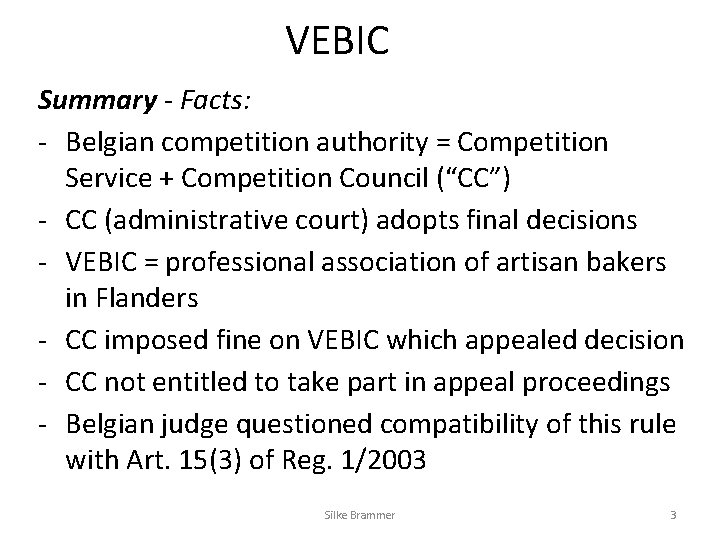
VEBIC Summary - Facts: - Belgian competition authority = Competition Service + Competition Council (“CC”) - CC (administrative court) adopts final decisions - VEBIC = professional association of artisan bakers in Flanders - CC imposed fine on VEBIC which appealed decision - CC not entitled to take part in appeal proceedings - Belgian judge questioned compatibility of this rule with Art. 15(3) of Reg. 1/2003 Silke Brammer 3
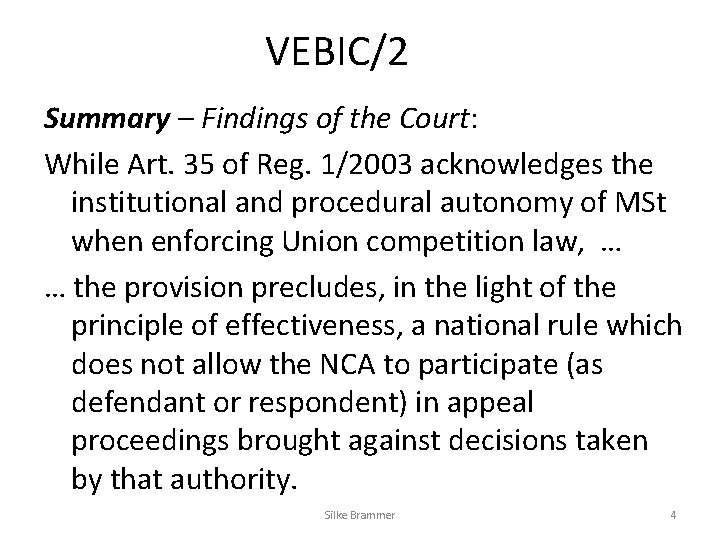
VEBIC/2 Summary – Findings of the Court: While Art. 35 of Reg. 1/2003 acknowledges the institutional and procedural autonomy of MSt when enforcing Union competition law, … … the provision precludes, in the light of the principle of effectiveness, a national rule which does not allow the NCA to participate (as defendant or respondent) in appeal proceedings brought against decisions taken by that authority. Silke Brammer 4
VEBIC/3 Summary – Findings of the Court/2: This does not mean, however, that there is a duty for the NCA to take part in every single review procedure. Only the systematic nonintervention would compromise the effectiveness of Union competition law. Art. 15(3) of Reg. 1/2003 does not provide an alternative means for ensuring that the NCA can take part in appeal proceedings concerning its own decisions. Silke Brammer 5
VEBIC/4 Comments – Admissibility • challenged NCA decision solely based on domestic equivalent to Art. 101 TFEU • VEBIC pleaded inadmissibility (lack of relevance) • Court makes two general statements – review court has unlimited jurisdiction – premise that the practices at issue only had domestic effects “could be rebutted” Silke Brammer 6
VEBIC/5 Comments – Admissibility/2 • no indication that CC had erred, ie that VEBIC’s practices did have an effect on inter-state trade – findings of the CC on the inapplicability of Union competition law not questioned – VEBIC essentially joins local bakeries in Flanders – no specific reason given why review court considered that practices may fall within scope of Art. 101 TFEU • merely abstract possibility that review court could apply Union competition law • arguably, Court answered a hypothetical question Silke Brammer 7
VEBIC/6 Comments – Substance • four precise questions on the interpretation of Reg. 1/2003 – Court lumps them together • Court rejects possibility to resort to Art. 15(3) to allow NCAs to take part in review procedure – simple literal interpretation – no further explanation given – finding contrasts with AG’s opinion and Court’s own ruling in Inspecteur van de Belastingdienst (C 429/07, para. 25) Silke Brammer 8
VEBIC/7 Comments – Substance/2 • Court leaves it to the MSt to designate – which component of the NCA is to assume function of defendant/respondent – in a system where final decisions are taken by a judicial body • Court does not explore other options – possible role of the Minister (who could (regularly) exercise his right to intervene in review proceedings to defend public interest) – possibility to involve Auditoraat (which can be requested by review court to carry out an investigation) Silke Brammer 9
VEBIC/8 Comments – Summing up • The Court easily accepts arguments on the admissibility. – Was there a political or personal motivation to ‘comment’ on the Belgian appeal procedure? • It answers precise questions in fairly general terms, … – The NCA must entitled to defend its decisions in review proceedings. • … but then ‘backs out’ by recalling the procedural autonomy of the MSt – The judgment gives no meaningful answer to the question how the defence of an NCA decision can be organised in a system where such decisions are taken by a judicial body. Silke Brammer 10
Tele 2 Polska Summary - Facts: - Probe into conduct of Polish telecom company - Polish NCA finds no evidence of abuse of dominant position - NCA decision states that - as concerns domestic competition law, no infringement - as concerns Art. 102 TFEU, procedure brought to an end (devoid of purpose) - decision annulled on appeal - NCA should have stated that no infringement of Art. 102 - NCA claims that Reg. 1/2003 does not allow it to adopt such ‘non-infringement decision’ Silke Brammer 11
Tele 2 Polska/2 Summary – Findings of the Court: Art. 5 of Reg. 1/2003 must be interpreted as precluding an NCA from adopting a decision which states that a certain conduct which it has examined does not constitute a breach of Art. 102 TEFEU. Art. 5 of Reg. 1/2003 is directly applicable and precludes the application of a national rule which would require the NCA to take a decision on the merits where it has concluded that there is no infringement. Silke Brammer 12
Tele 2 Polska/3 Comments: • Literal interpretation of Art. 5 of Reg. 1/2003 – list not exhaustive (‘infringement decisions’ not mentioned) – “may decide” suggests that other measures possible – distinction between substantive decisions and procedural measures (only the latter covered by Art. 5) • Uniformity – no prior information duty, but para. 48 Network Notice – why are ‘non-infringement decisions’ such a danger • ‘infringement decisions’ can also be wrong (and cannot be ‘overruled ’ by Commission) • ‘non-infringement decisions’ can be appealed Silke Brammer 13
Tele 2 Polska/4 Comments/2: • No risk that ‘exemption system’ is reintroduced – no ‘application’ by the company concerned – NCA decision preceded by lengthy (ex officio) investigation – legitimate interest of company under investigation to obtain legal certainty – good governance Silke Brammer 14
General Conclusions/1 • Controversial interpretation of Reg. 1/2003 – radical interference with procedural autonomy of MSt – requirements of effectiveness and uniformity used to justify intrusion • Result: approximation of national procedures by way of case law – against explicit wording of Reg. 1/2003 (arguably, VEBIC contradicts Art. 35(3) of Reg. 1/2003) – against implicit will of the MSt (opposed to harmonisation of nat’l procedures) – Union law used as a model (VEBIC) Silke Brammer 15
General Conclusions/2 • Yet no coherent approach? – in Pfleiderer (C-360/09), effectiveness considerations pushed aside – furtherance of civil actions for damages seems overriding interest • Is it time for a more comprehensive approach? – Should the Commission propose a “Regulation on the enforcement of Articles 101 and 102 by the national competition authorities of the Member States”? Silke Brammer 16
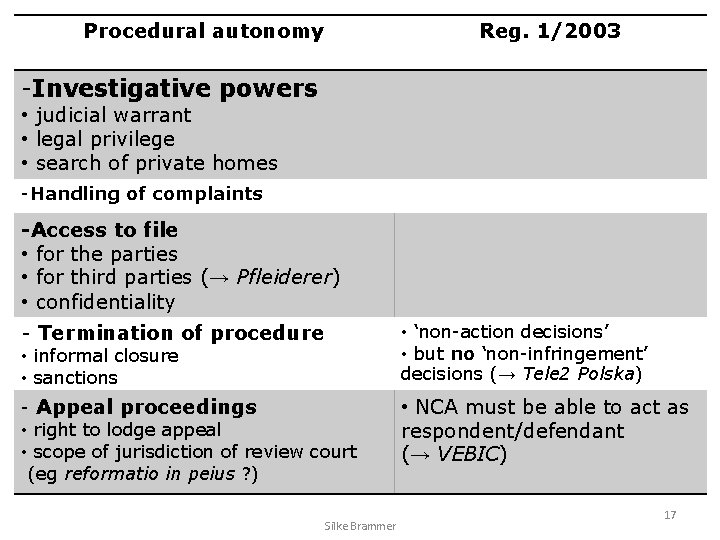
Procedural autonomy Reg. 1/2003 -Investigative powers • judicial warrant • legal privilege • search of private homes -Handling of complaints -Access to file • for the parties • for third parties (→ Pfleiderer) • confidentiality - Termination of procedure • ‘non-action decisions’ • but no ‘non-infringement’ decisions (→ Tele 2 Polska) - Appeal proceedings • right to lodge appeal • scope of jurisdiction of review court (eg reformatio in peius ? ) • NCA must be able to act as respondent/defendant (→ VEBIC) • informal closure • sanctions Silke Brammer 17
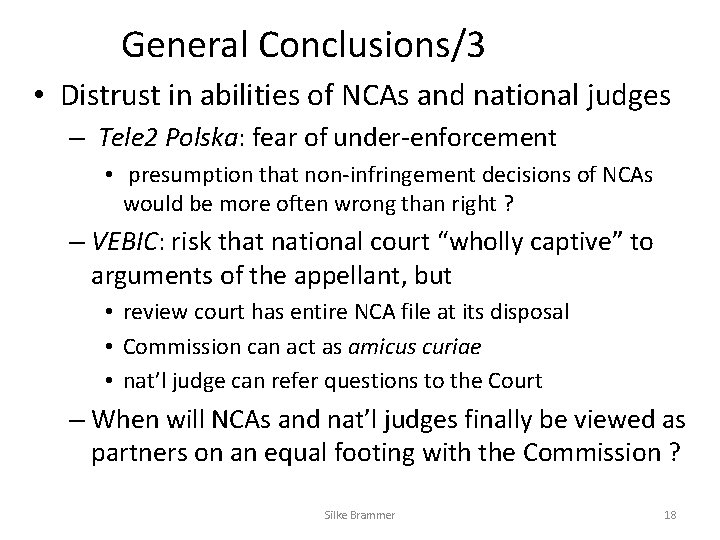
General Conclusions/3 • Distrust in abilities of NCAs and national judges – Tele 2 Polska: fear of under-enforcement • presumption that non-infringement decisions of NCAs would be more often wrong than right ? – VEBIC: risk that national court “wholly captive” to arguments of the appellant, but • review court has entire NCA file at its disposal • Commission can act as amicus curiae • nat’l judge can refer questions to the Court – When will NCAs and nat’l judges finally be viewed as partners on an equal footing with the Commission ? Silke Brammer 18