
FUELS Producer Gas Producer gas is a mixture
- Slides: 11
FUELS
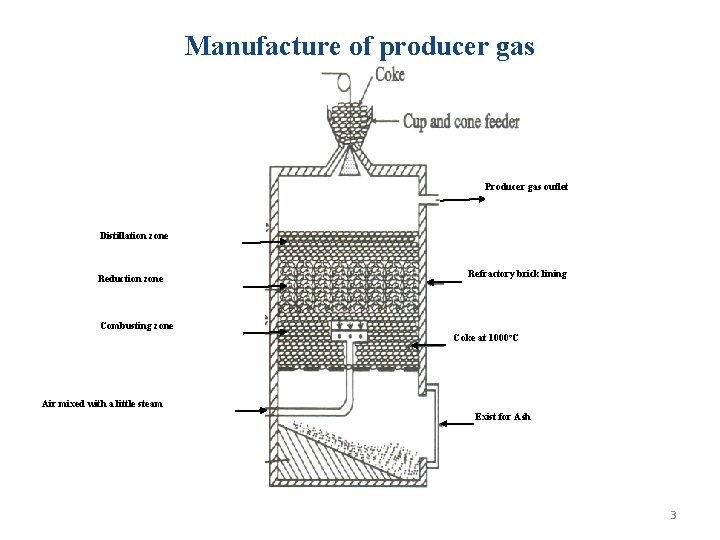
Producer Gas • Producer gas is a mixture of combustible gases, CO(30%) and H 2(15%) with large amount of non combustible gases N 2(56%) and CO 2(3%). Its calorific value is 1300 kcal/m 3 • It is prepared by passing air mixed with a little steam over a red hot coke maintained at about l 100°C in a special reactor called gas producer. It consists of a steel vessel of (3 m in diameter, 4 f m in height) inside lined with refractory bricks. It is provided with cup and cone feeder at the top and a side opening for produced gas exit. At the bottom, it has inlets for passing air and steam. 2
Manufacture of producer gas Producer gas outlet Distillation zone Reduction zone Refractory brick lining Combusting zone Coke at 1000 o. C Air mixed with a little steam Exist for Ash 3
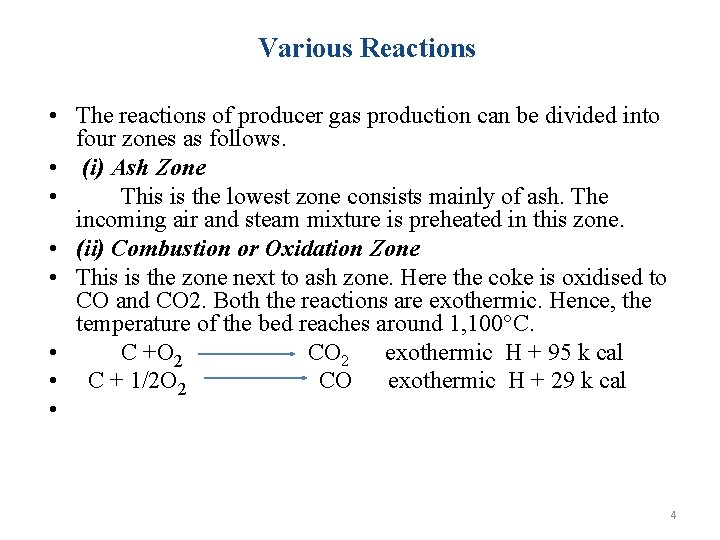
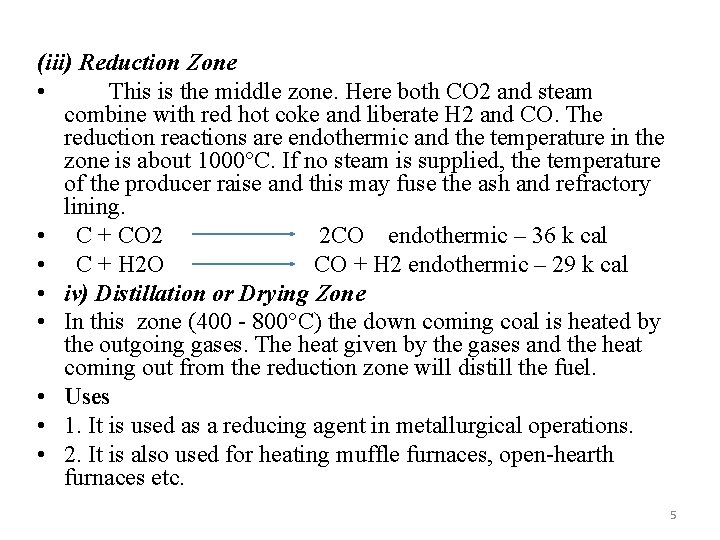
Various Reactions • The reactions of producer gas production can be divided into four zones as follows. • (i) Ash Zone • This is the lowest zone consists mainly of ash. The incoming air and steam mixture is preheated in this zone. • (ii) Combustion or Oxidation Zone • This is the zone next to ash zone. Here the coke is oxidised to CO and CO 2. Both the reactions are exothermic. Hence, the temperature of the bed reaches around 1, 100°C. • C +O 2 CO 2 exothermic H + 95 k cal • C + 1/2 O 2 CO exothermic H + 29 k cal • 4
(iii) Reduction Zone • This is the middle zone. Here both CO 2 and steam combine with red hot coke and liberate H 2 and CO. The reduction reactions are endothermic and the temperature in the zone is about 1000°C. If no steam is supplied, the temperature of the producer raise and this may fuse the ash and refractory lining. • C + CO 2 2 CO endothermic – 36 k cal • C + H 2 O CO + H 2 endothermic – 29 k cal • iv) Distillation or Drying Zone • In this zone (400 - 800°C) the down coming coal is heated by the outgoing gases. The heat given by the gases and the heat coming out from the reduction zone will distill the fuel. • Uses • 1. It is used as a reducing agent in metallurgical operations. • 2. It is also used for heating muffle furnaces, open-hearth furnaces etc. 5
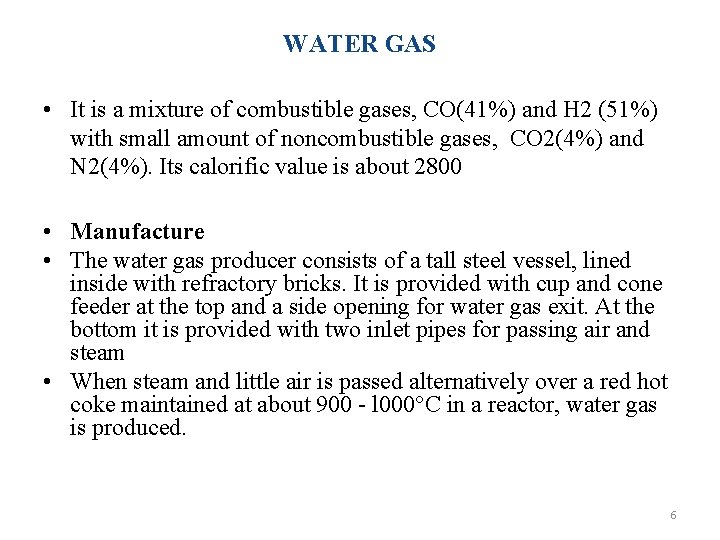
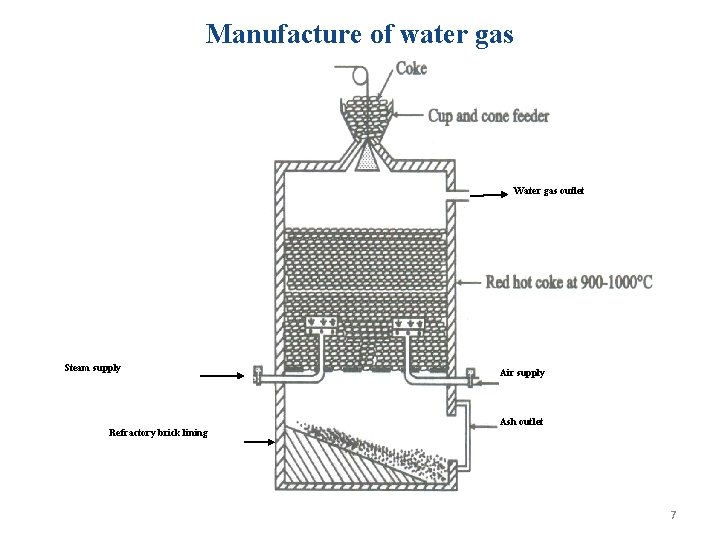
WATER GAS • It is a mixture of combustible gases, CO(41%) and H 2 (51%) with small amount of noncombustible gases, CO 2(4%) and N 2(4%). Its calorific value is about 2800 • Manufacture • The water gas producer consists of a tall steel vessel, lined inside with refractory bricks. It is provided with cup and cone feeder at the top and a side opening for water gas exit. At the bottom it is provided with two inlet pipes for passing air and steam • When steam and little air is passed alternatively over a red hot coke maintained at about 900 - l 000°C in a reactor, water gas is produced. 6
Manufacture of water gas Water gas outlet Steam supply Refractory brick lining Air supply Ash outlet 7
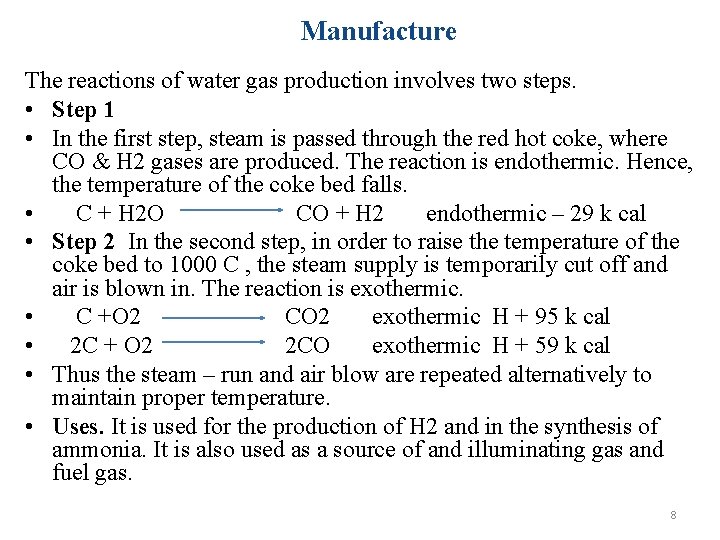
Manufacture The reactions of water gas production involves two steps. • Step 1 • In the first step, steam is passed through the red hot coke, where CO & H 2 gases are produced. The reaction is endothermic. Hence, the temperature of the coke bed falls. • C + H 2 O CO + H 2 endothermic – 29 k cal • Step 2 In the second step, in order to raise the temperature of the coke bed to 1000 C , the steam supply is temporarily cut off and air is blown in. The reaction is exothermic. • C +O 2 CO 2 exothermic H + 95 k cal • 2 C + O 2 2 CO exothermic H + 59 k cal • Thus the steam – run and air blow are repeated alternatively to maintain proper temperature. • Uses. It is used for the production of H 2 and in the synthesis of ammonia. It is also used as a source of and illuminating gas and fuel gas. 8
METALLURGICAL COKE Good coke for metallurgy should possess the following requisites • (1) Purity: It should have moisture, ash, sulphur and phosphorus contents as low as possible. A low percentage of moisture helps in keeping down the heating expenses. Excess of ash hinders the heating and also helps in slag formation, which is not desirable in fuels. According to Dr. Mott, 2% of excess coke is required for the removal of 1 % ash. Presence of S and P gives on burning, undesirable products like SO 2 P 203 and P 2 O 5, which adversely affect the quality of the metal being produced. Moreover, presence of sulphur makes the coke brittle. § (2) Porosity : Coal should be porous, so that oxygen can easily come in contact with the carbon of coke, thereby helping in complete combustion at a high rate. § 9
(3)Strength: The coke should be quite compact, hard, strong to withstand dropping abrasion as well as the pressure of the overburden (ore + fuel + flux) in the furnaces. It would be useless to employ weak coke in blast furnaces, as the weight of ore, etc. , would crush the coke to breeze and thus prevent the essential passage of gases up the furnace. (4) Size: The size of metallurgical coke should be neither too big nor too small. In case the size is too big, the uniformity of heating is never maintained, but on the other hand, if the coke size is too small, choking will result. (5) Cost: Coke should be cheap and easily available near the site of the metallurgical plant, so that the transportation cost is low. (6) Calorific value: The calorific value of coke should be high. (7) Low ash, S and P contents to avoid the incorporation of these in the metal to be extracted. § 10
(8)Combustibility: Coke should burn easily. Combustibility of Coke depends upon the nature of the coal, carbonization temperature and reaction temperature. Cokes obtained from strongly coking coals are not as combustible as those derived from weakly caking and non-caking coals. At a given temperature, cokes obtained by high-temperature carbonization process are less combustible compared to those obtained by lowtemperature carbonization. However, at high combustion temperatures (800° - 900°C), all cokes appears to be equally reactive. At about 1, 000°C, it appears that the rate of combustion depends only on the rate of oxygen/air supply. • (9) Reactivity to steam: Reactivity towards steam increases with the reaction temperature and varies inversely with carbonizing temperature at which the coke was produces. Moreover, coke derived from non-caking coals are more reactive to steam than those derived from taking coals. 11