
Fuel properties affecting the combustion process and emissions
Fuel properties affecting the combustion process and emissions Chapter 8
Cetane Number (CN) for CI engines The cetane number could be defined as the measure of diesel fuel ignitability. Ignitability or auto-ignition is the start and the speed at which the heat is released. In conventional diesel combustion, cetane number covers the physical and chemical parts of auto-ignition. The physical part incorporates • Fuel atomisation, • Evaporation and • Mixing with air The chemical part is the fuel reactivity.
In new diesel combustion strategies, the physical part is very much reduced mainly by • The high injection pressure characteristics of 200 MPa. • A larger number of injector holes, 7 holes, with a smaller diameter of less than 200 µm. • The combustion chamber configuration to support more tumble and swirl.
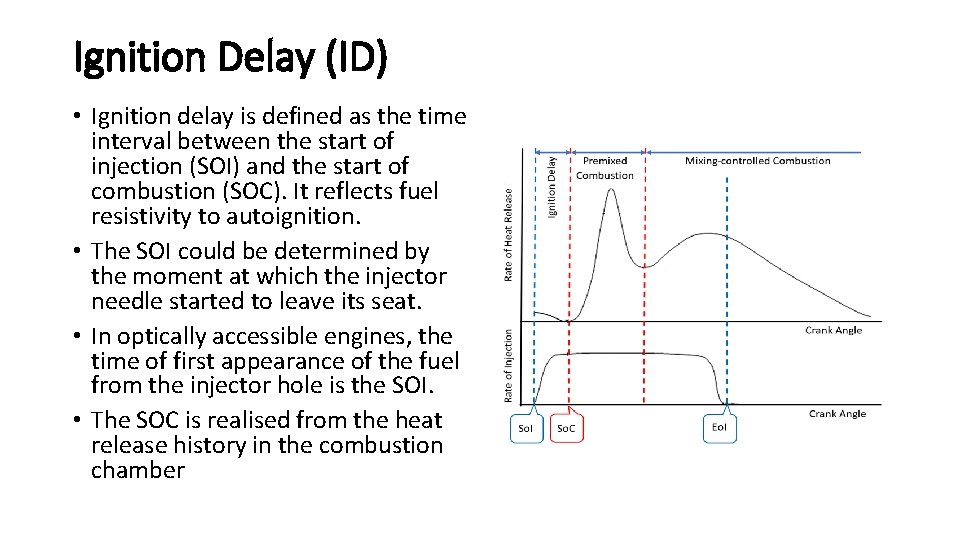
Ignition Delay (ID) • Ignition delay is defined as the time interval between the start of injection (SOI) and the start of combustion (SOC). It reflects fuel resistivity to autoignition. • The SOI could be determined by the moment at which the injector needle started to leave its seat. • In optically accessible engines, the time of first appearance of the fuel from the injector hole is the SOI. • The SOC is realised from the heat release history in the combustion chamber

• As the fuel is injected, the atomised fuel droplets start to evaporate by the heat gain from the hot compressed air, which is in fact a negative heat release. • As the evaporated fuel mixes with air it produces a combustible mixture and starts to ignite, which is considered as a positive heat release. • A visual inspection for the heat release trace or when the derivative of heat release is changed from negative to positive is the SOC.

Scenarios of droplet history in the combustion chamber • Smaller droplets experience • Larger droplets absorb the heat cycles of evaporation and due to the temperature gradient cooling until they vanish. These between the surface and the droplets leave a conical vapour centre of the droplet. Their high in the wake to interfere with inertia make them overtake those of other adjacent droplets. smaller ones for a sudden As this cloud of vapour ignites it explosion with a deeper is called the flame front. penetration in the combustion chamber.
• In fact, the physical delay ends as the fuel air mixture becomes ignitable but the start of the chemical delay is difficult to predict. • During the chemical delay, larger fuel molecules degrade to smaller ones and with the presence of the oxygen, radicals are formed. The rate of chemical reactions increases exponentially with the increase in the amount of radicals formed and the mixture is said to be autoignitable. • The physical delay is controlled by the proper engine and fuel injection system design, while the chemical delay is influenced by the working gas characteristics, the reactivity and chemical characteristics of the fuel.

Direct fuel injection and flame propagation Flame lift-off length The flame lift-off length (FLL) is the axial distance between the injector orifice and the start of the stabilised flame. The longer the FLL the larger the amount of air entrained into the hot vaporised fuel for a better mixture oxidation in the premixed combustion zone and less soot formation.
Recent diesel combustion strategies are based on low temperature combustion LTC at relatively lower compression ratios and much higher injection pressures. • The lower combustion temperature and air density would increase the FLL as they control thermal diffusivity and laminar flame speed. • The high injection pressure provides a higher internal energy to the fuel jet to enhance fuel atomisation and eventually better evaporation and mixing with air. Although the smaller nozzle orifices inversely affect the FLL, it will be compensated by the higher injection pressure which improves fuel atomisation and increases the fuel jet cone angle. Ultimately, the fuel jet will be shorter with a smaller amount of fuel being injected and a longer FLL.
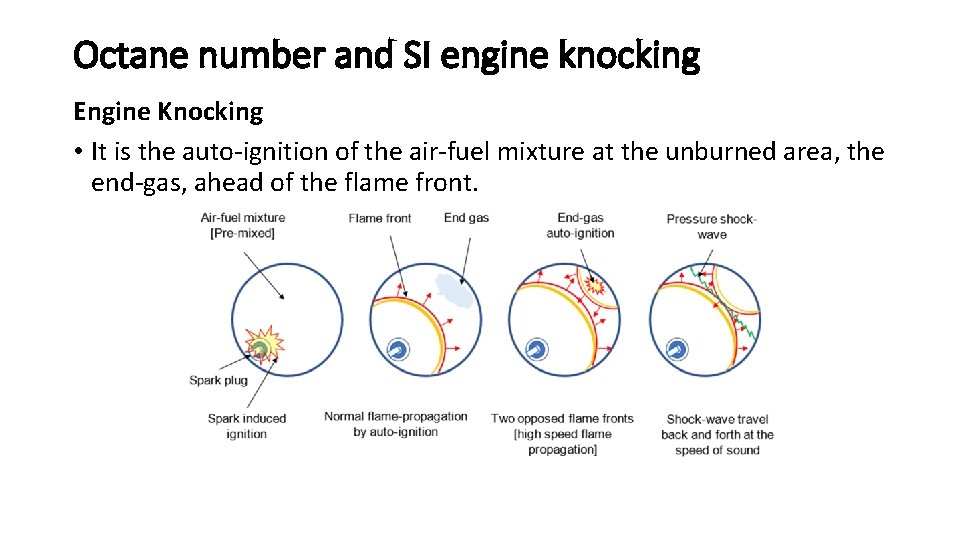
Octane number and SI engine knocking Engine Knocking • It is the auto-ignition of the air-fuel mixture at the unburned area, the end-gas, ahead of the flame front.
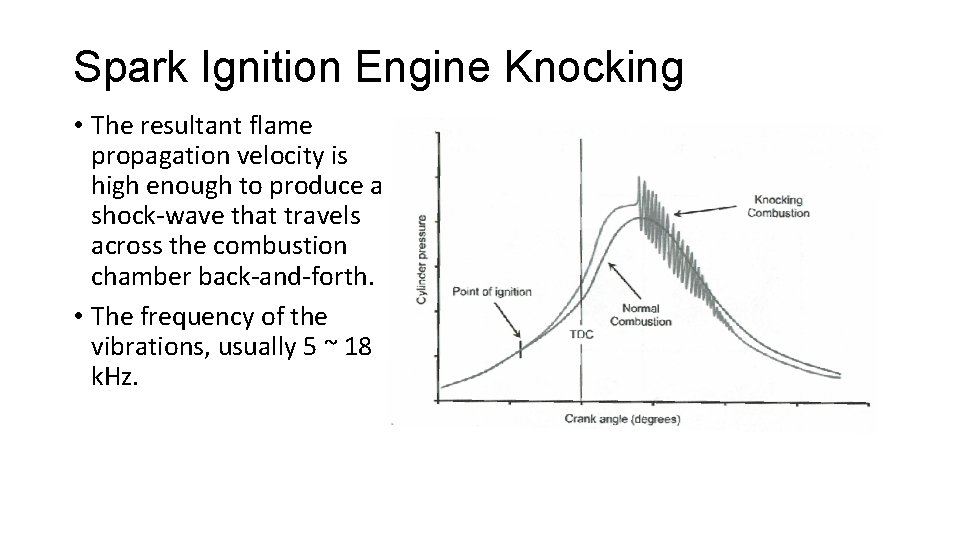
Spark Ignition Engine Knocking • The resultant flame propagation velocity is high enough to produce a shock-wave that travels across the combustion chamber back-and-forth. • The frequency of the vibrations, usually 5 ~ 18 k. Hz.

Octane Scale • Iso-octane (2, 2, 4 trimethylpentane) and • n-heptane where the chosen standard fuels.
The Research Octane Number and the Motor Octane Number RON is more likely related to low speed and mild driving conditions. MON is related to high speed severe driving conditions. Due to • The improvements in engine design. • The propensity to a more aggressive driving behavior.
RON and MON test conditions.
- Slides: 14