
Fuel Ethanol Laboratory Conference Dr Jerry King December
Fuel Ethanol Laboratory Conference Dr. Jerry King December 6, 2016 Omaha, Nebraska
INSTRUMENTS AND ASTM § A “famous” quote: “If you can’t measure it, you can’t manage it” § W. Edward Deming
The role of a laboratory is to “measure” a. process control b. trouble shoot c. innovation Your role is to MANAGE/CONTROL the laboratory
TOOLS OF THE TRADE § Management/owners § Industry standards/regulations § Facility § Instruments § Personnel you work with and over see § Methods § Peers § Professional organizations (e. g. ASTM) § Conferences, webinars, technical reps
DRIVING FORCE(S) § The consumer § Industry § Government § EPA (environment – air pollution) § TTB (treasury – denaturants) § COMMERCE (international trade) § FDA (Food and Drug – FSMA) § DOT (department of transportation)
A CASCADE EFFECT § Regulatory to § Industry to § ASTM to § Plant to § Laboratory to § YOU (buck stops here)
Ultimately, where do you (we) have an impact? ? ?

American Society for Testing and Materials International
TECHNICAL COMMITTEES § ABOUT 155 technical committees § Relevant ones § D 02 - Petroleum Products, Liquid Fuels, and Lubricants § E 48 on Bioenergy and Industrial Chemicals from Biomass § Subcommittees § § § § DO 2. 03 – Elemental analysis D 02. 04 – Hydrocarbon analysis D 02. 04 C – Liquid chromatography D 02. 04 C – Gas chromatography D 02. 08. 0 D – Vapor pressure and V/L ratio D 02. A 0 – Gasoline and oxygenates D 02. A 0. 01 – Oxygenated fuels and components
ASTM SUBCOMMITTEES § Standards § D 4806 – Standard Specification for Denatured Fuel Ethanol for Blending with Gasolines for Use as Automotive Spark-Ignition Engine Fuel § D 5798 – Standard Specification for Ethanol Fuel Blends for Flexible-Fuel Automotive Spark-Ignition Engines § Methods § ASTM D 5501 -12(2016) Standard Test Method for Determination of Ethanol and Methanol Content in Fuels Containing Greater than 20% Ethanol by Gas Chromatography § ASTM D 7795 -15 Standard Test Method for Acidity in Ethanol and Ethanol Blends by Titration § ASTM D 5453 -16 e 1 Standard Test Method for Determination of Total Sulfur in Light Hydrocarbons, Spark Ignition Engine Fuel, Diesel Engine Fuel, and Engine Oil by Ultraviolet Fluorescence
METHOD INFORMATION § 1. The guide on “how-to” § § § a. specifies the apparatus (instruments) b. Specifies reagents and materials c. Specifies to prepare the sample d. Specifies how to process (analyze) the sample e. Provides the calculation(s) f. Specifies the quality control requirements § § 1) the precision 2) the repeatability 3) the reproducibility 4) the bias § 2. Some methods are identified as the “gold standard”
PERFORMANCE BASED METHODS § New approach followed by EPA § Identifies/specifies a “gold standard” method (e. g. ASTM D 7039) § Method selected by the laboratory must meet or exceed the QC requirements of the “gold standard”
ASTM D 4806 -16 a § Standard Specification for Denatured Fuel Ethanol for Blending with Gasolines for Use as Automotive Spark-Ignition Engine Fuel § § § § § Ethanol – 92. 1% by volume minimum Methanol – 0. 5% by volume - max Solvent washed gum – 5. 0 mg/100 m. L max Water, volume % - 1. 0 max Inorganic chloride – 6. 7 mg/kg max Copper – 0. 1 mg/kg max Acidity – 70 mg/kg max p. He – 6. 5 – 9. 0 SU Sulfur – 30 (down to 10 ppm max in denaturant) Existent sulfate – 4 mg/kg max
NONE OF THE PARAMETERS IDENTIFIED IN D 4806 FALL UNDER PERFORMANCE BASED METHODS
CURRENT ASTM D 02 “ISSUES” § Changes to ASTM D 4814 - Standard Specification for Automotive Spark-Ignition Engine Fuel
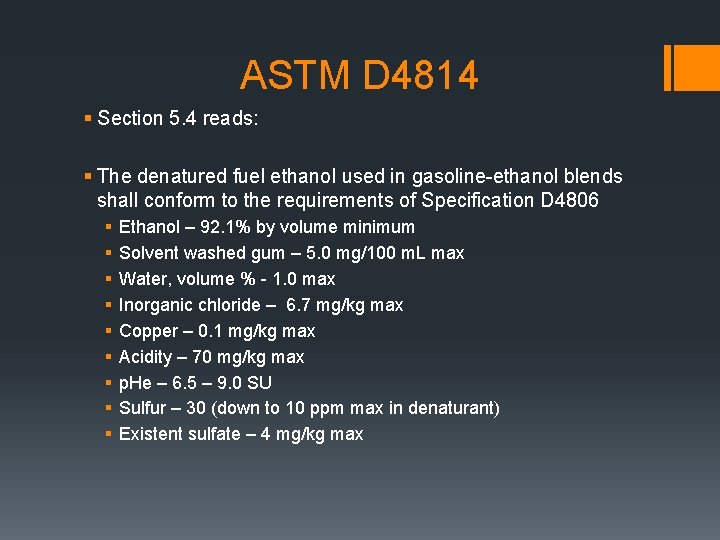
ASTM D 4814 § Section 5. 4 reads: § The denatured fuel ethanol used in gasoline-ethanol blends shall conform to the requirements of Specification D 4806 § § § § § Ethanol – 92. 1% by volume minimum Solvent washed gum – 5. 0 mg/100 m. L max Water, volume % - 1. 0 max Inorganic chloride – 6. 7 mg/kg max Copper – 0. 1 mg/kg max Acidity – 70 mg/kg max p. He – 6. 5 – 9. 0 SU Sulfur – 30 (down to 10 ppm max in denaturant) Existent sulfate – 4 mg/kg max
ASTM D 4814 CONTENTS AND IMPLICATIONS § Very far reaching and significant requirements in this standard § Impacts any automotive spark-ignition engine (cars, boats, motor cycles, lawn mowers, etc. ) § Product (gasoline) is used around the world § Must be functional in a engines with a wide manufacture date § Must be compatible with many old and new alloys (corrosion and deposits) § Functional in different climates/seasons (temperatures) and different altitudes § Reduce pollution (lead, sulfur, “smog”) § Prevent “knocking” and “vapor lock”
CRITICAL ASTM D 4814 ISSUES § Volatility – move from liquid phase to gaseous phase (distillation curve) § Vapor-liquid ratio § Air-fuel ratio (cold start) § Vapor lock § Driveability § Anti-knock additives § Phases § Gasoline is non-polar § Ethanol is polar § Combustion and water are not compatible § Corrosion § Formation of deposits § Blockages and mechanical failures
PETROLEUM INDUSTRY AND ETHANOL INDUSTRY § Ethanol blended fuels (RFS – renewable fuels standard) mandated by congress (the law) § Ethanol-blended fuels have different properties than natural gasoline § Performance must meet ASTM D 4814 requirements § Oxygenate requirements must be met (reduce pollution) § Different states have different requirements for ethanolblended gasoline
OTHER IMPACTED INDUSTRIES § Pipelines § Anti-corrosion § Anti-drag § Truck/rail/tanker transport § Previous cargos § Fuel stations (gas stations) § Storage and delivery § comingling § Refineries § Crude oil source § Social/economical ramifications § Storage facilities § Fuel comingling
THE DESIRED IMPACT § This (ASTM) is where YOU have an impact § 1. determine what works and what does not work § 2. identify innovations and suggestions § 3. identify new methods or standards § Work with your industry (RFA, Growth Energy, corn growers)
INSTRUMENTS
IMPORTANCE OF INSTRUMENTS § The Deming quote: “If you can’t measure it, you can’t manage it” § Must “measure” accurately and precisely (anybody can “measure” with anything
FUNDAMENTALS § Get good equipment (don’t skimp) § This does not pertain to just analytical equipment (e. g. HPLC, GC, LC, etc. ) § § § a. Glassware (class A) b. Balances c. pipettors d. weights e. Ovens § Take care of it!!! (maintenance)
MAINTAIN THE ENVIRONMENT § Temperature extremes § Humidity § Electrical § Pressure
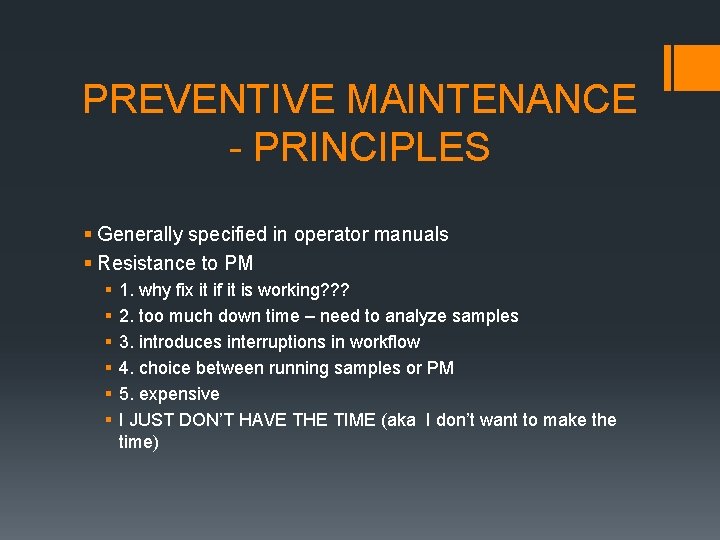
PREVENTIVE MAINTENANCE - PRINCIPLES § Generally specified in operator manuals § Resistance to PM § § § 1. why fix it if it is working? ? ? 2. too much down time – need to analyze samples 3. introduces interruptions in workflow 4. choice between running samples or PM 5. expensive I JUST DON’T HAVE THE TIME (aka I don’t want to make the time)
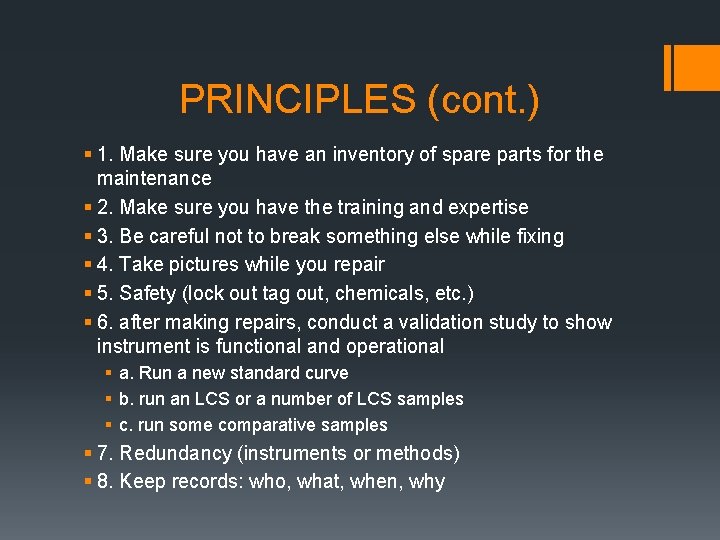
PRINCIPLES (cont. ) § 1. Make sure you have an inventory of spare parts for the maintenance § 2. Make sure you have the training and expertise § 3. Be careful not to break something else while fixing § 4. Take pictures while you repair § 5. Safety (lock out tag out, chemicals, etc. ) § 6. after making repairs, conduct a validation study to show instrument is functional and operational § a. Run a new standard curve § b. run an LCS or a number of LCS samples § c. run some comparative samples § 7. Redundancy (instruments or methods) § 8. Keep records: who, what, when, why
RECORDS – CRITICAL COMPONENT IN GOOD LABORATORY PRACTICES Seeing this in FSMA
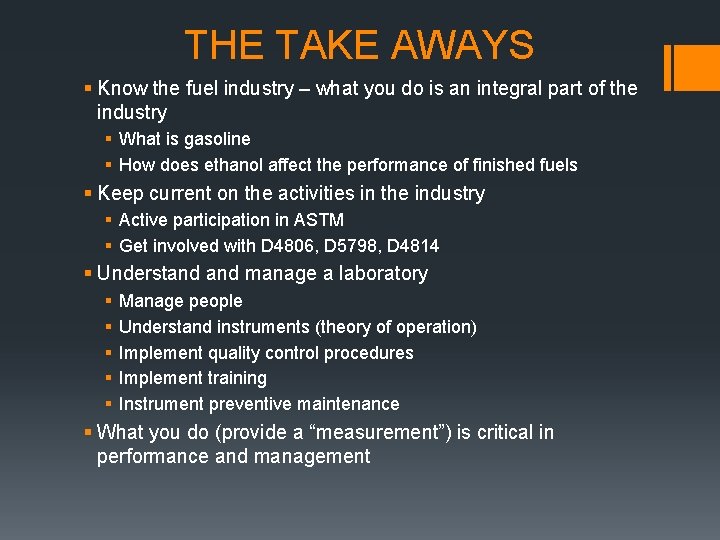
THE TAKE AWAYS § Know the fuel industry – what you do is an integral part of the industry § What is gasoline § How does ethanol affect the performance of finished fuels § Keep current on the activities in the industry § Active participation in ASTM § Get involved with D 4806, D 5798, D 4814 § Understand manage a laboratory § § § Manage people Understand instruments (theory of operation) Implement quality control procedures Implement training Instrument preventive maintenance § What you do (provide a “measurement”) is critical in performance and management
- Slides: 29