
Fuel Cycle Subcommittee Overview and Status FusionFission Hybrid
Fuel Cycle Subcommittee: Overview and Status Fusion-Fission Hybrid Workshop Gaithersburg, MD September 30, 2009 Robert N. Hill Department Head – Nuclear Systems Analysis Nuclear Engineering Division Argonne National Laboratory Work sponsored by U. S. Department of Energy Office of Nuclear Energy, Science & Technology
Overview n A wide variety of hybrid concepts are proposed – Different fuel cycle missions are postulated n Thus, it is important to provide a systematic and well defined framework to categorize – Goals of different fuel cycle approaches – Strategies employed to meet the fuel cycle goals n This is a prerequisite for valid comparisons – (e. g. , a breeder compared to a minor actinide burner should have vastly different performance) Fusion Hybrid Workshop, September 30, 2009 2
Outline of Fuel Cycle Chapter n 3. 1 Fission Fuel Cycles n 3. 2 Fusion Fuel Cycles n 3. 3 Proposed Hybrid Fuel Cycles – Limited input on 3. 3 before workshop! Given that fusion-fission hybrids primarily conceived to deal with fission fuel cycle issues, the focus of this presentation will be on 3. 1 Fusion Hybrid Workshop, September 30, 2009 3
3. 1 Fission Fuel Cycles n Nuclear energy is a significant contributor to U. S. and international electricity production – 16% world, 20% U. S. , 78% France n Given the concern over carbon emissions, there may be significant growth worldwide n In the U. S. , a once-through fuel cycle has been employed to -date – Large quantities of spent fuel stored at reactor sites – Final waste disposal is not secured n With nuclear expansion, this is not a sustainable approach; thus, advanced fuel cycles being explored – two key goals – Waste Management – Resource Utilization Fusion Hybrid Workshop, September 30, 2009 4
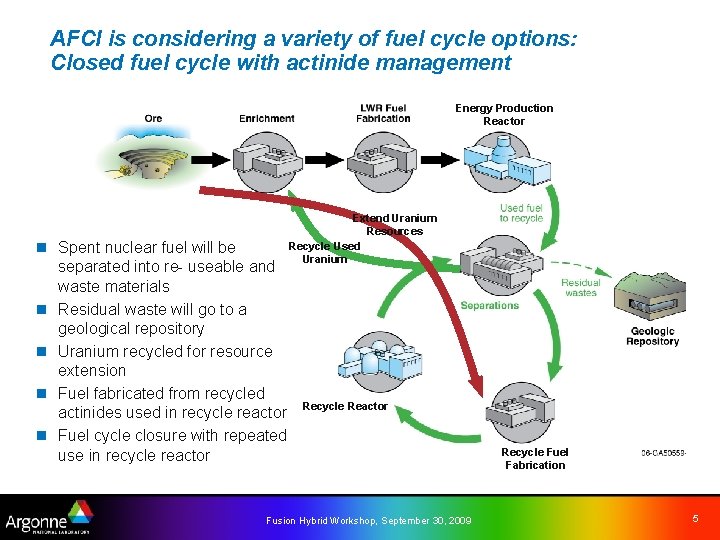
AFCI is considering a variety of fuel cycle options: Closed fuel cycle with actinide management Energy Production Reactor n Spent nuclear fuel will be separated into re- useable and waste materials n Residual waste will go to a geological repository n Uranium recycled for resource extension n Fuel fabricated from recycled actinides used in recycle reactor n Fuel cycle closure with repeated use in recycle reactor Extend Uranium Resources Recycle Used Uranium Recycle Reactor Fusion Hybrid Workshop, September 30, 2009 Recycle Fuel Fabrication 5
Advanced Nuclear Fuel Cycle – Potential Benefits n Reduction in the volume of HLW that must be disposed in a deep geologic disposal facility as compared to the direct disposal of spent nuclear fuel – Factor of 2 -5 reduction in volume as compared to spent nuclear fuel – Intermediate-level (GTCC) and low-level volumes could be large and disposal pathways would have to be developed n Reduction in the amount of long-lived radioactive material (e. g. , minor actinides) that must be isolated in a geologic disposal facility (reduction of source term) – Potential for re-design of engineered barriers – Advanced waste forms could result in improved performance and reduced uncertainty over the very long time periods n Reduction in decay heat allowing for increased thermal management flexibility, potentially increasing emplacement density – Increased loading density - better utilization of valuable repository space Fusion Hybrid Workshop, September 30, 2009 6
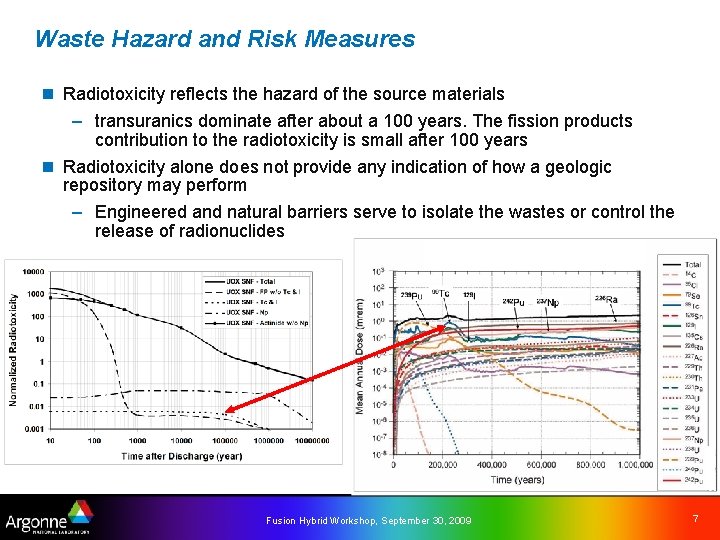
Waste Hazard and Risk Measures n Radiotoxicity reflects the hazard of the source materials – transuranics dominate after about a 100 years. The fission products contribution to the radiotoxicity is small after 100 years n Radiotoxicity alone does not provide any indication of how a geologic repository may perform – Engineered and natural barriers serve to isolate the wastes or control the release of radionuclides Fusion Hybrid Workshop, September 30, 2009 7
Transmutation for Improved Waste Management n Long-term heat, radiotoxicity, and peak dose are all dominated by the Pu 241 to Am-241 to Np-237 decay chain n Thus, destruction of the transuranics (neptunium, plutonium, americium, and curium) is targeted to eliminate all problematic isotopes n Some form of reprocessing is necessary to extract transuranic elements for consumption elsewhere n The transuranic (TRU) inventory is reduced by fission – Commonly referred to as ‘actinide burning’ – Transmutation by neutron irradiation – Additional fission products are produced n This requires the development of transmutation fuel forms – Robust fast reactor fuel form – high reliability – Partial destruction each recycle – high burnup goal n In the interim, the TRU inventory is contained in the transmutation fuel cycle Fusion Hybrid Workshop, September 30, 2009 8
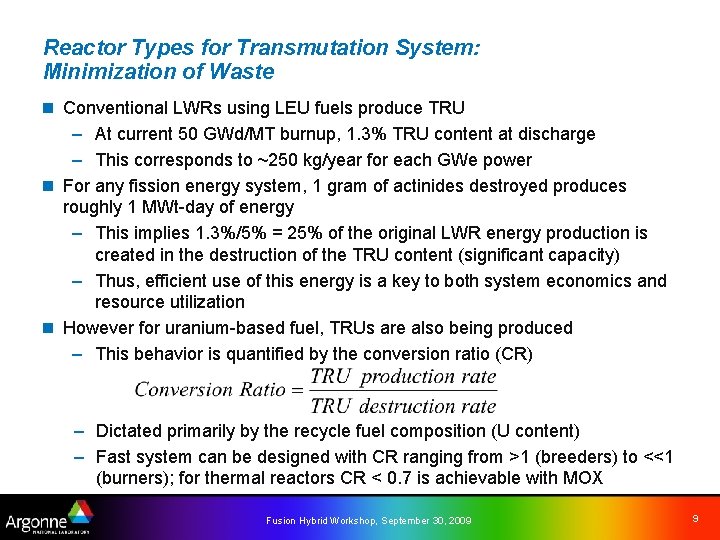
Reactor Types for Transmutation System: Minimization of Waste n Conventional LWRs using LEU fuels produce TRU – At current 50 GWd/MT burnup, 1. 3% TRU content at discharge – This corresponds to ~250 kg/year for each GWe power n For any fission energy system, 1 gram of actinides destroyed produces roughly 1 MWt-day of energy – This implies 1. 3%/5% = 25% of the original LWR energy production is created in the destruction of the TRU content (significant capacity) – Thus, efficient use of this energy is a key to both system economics and resource utilization n However for uranium-based fuel, TRUs are also being produced – This behavior is quantified by the conversion ratio (CR) – Dictated primarily by the recycle fuel composition (U content) – Fast system can be designed with CR ranging from >1 (breeders) to <<1 (burners); for thermal reactors CR < 0. 7 is achievable with MOX Fusion Hybrid Workshop, September 30, 2009 9
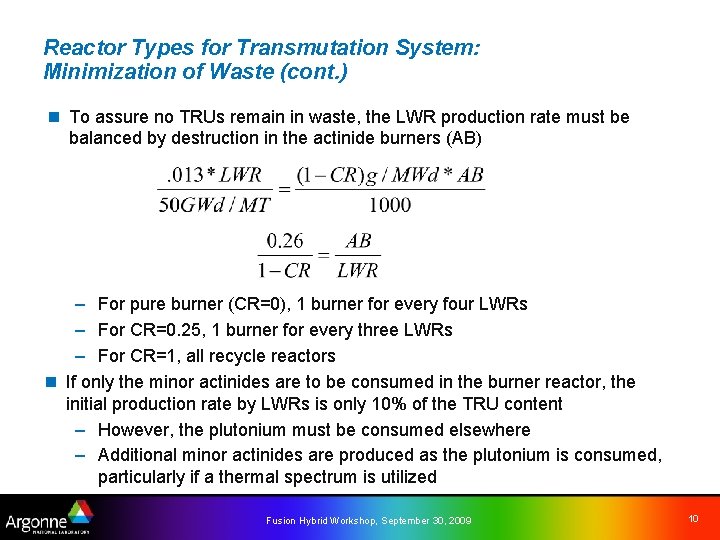
Reactor Types for Transmutation System: Minimization of Waste (cont. ) n To assure no TRUs remain in waste, the LWR production rate must be balanced by destruction in the actinide burners (AB) – For pure burner (CR=0), 1 burner for every four LWRs – For CR=0. 25, 1 burner for every three LWRs – For CR=1, all recycle reactors n If only the minor actinides are to be consumed in the burner reactor, the initial production rate by LWRs is only 10% of the TRU content – However, the plutonium must be consumed elsewhere – Additional minor actinides are produced as the plutonium is consumed, particularly if a thermal spectrum is utilized Fusion Hybrid Workshop, September 30, 2009 10
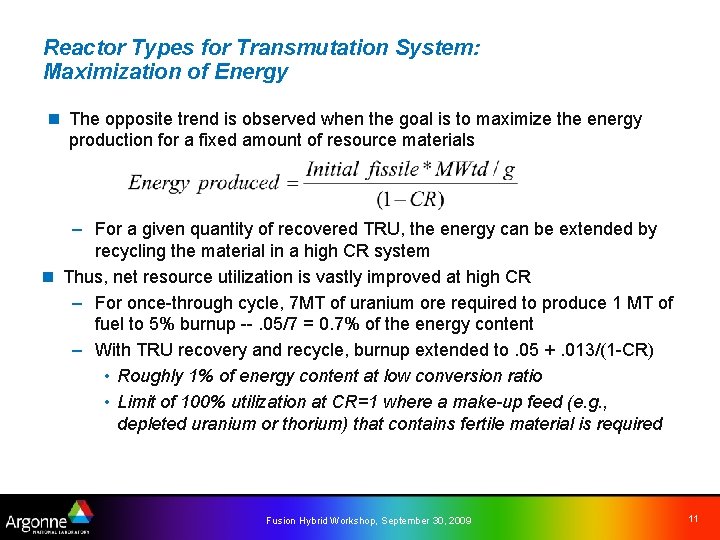
Reactor Types for Transmutation System: Maximization of Energy n The opposite trend is observed when the goal is to maximize the energy production for a fixed amount of resource materials – For a given quantity of recovered TRU, the energy can be extended by recycling the material in a high CR system n Thus, net resource utilization is vastly improved at high CR – For once-through cycle, 7 MT of uranium ore required to produce 1 MT of fuel to 5% burnup --. 05/7 = 0. 7% of the energy content – With TRU recovery and recycle, burnup extended to. 05 +. 013/(1 -CR) • Roughly 1% of energy content at low conversion ratio • Limit of 100% utilization at CR=1 where a make-up feed (e. g. , depleted uranium or thorium) that contains fertile material is required Fusion Hybrid Workshop, September 30, 2009 11
3. 2 Fusion Fuel Cycles n Tritium needs to be produced to sustain the fusion cycle – 14 Me. V neutrons can be used to breed – Typically employ Li-6 capture in fusion blanket n For hybrid, fusion blanket must also be utilized – Wide variety of technology options – Homogeneous or heterogeneous with fission blanket – Neutron balance is enhanced through subcritical multiplication in the fission blanket Fusion Hybrid Workshop, September 30, 2009 12
3. x. 4 Proliferation Issues n The proliferation risks associated with spent fuel reprocessing and recycle continue to be hotly debated – At least partial separation is required • Fission products are waste, actinides recycled • This reduces the radiation barrier – Safeguards employed for material accounting – Physical protection provides additional barriers – Technology misuse is another concern – Enrichment technology may be an easier pathway n Any neutron source can produce fissile material – Fertile targets installed to capture neutrons – This became an issue for ADS concepts Fusion Hybrid Workshop, September 30, 2009 13
3. 3 Hybrid Fuel Cycles n Waste management role – Lack of criticality constraint allows operation on very low reactivity fuels and potentially very high burnup – However, practical operation (e. g. , large power swings) and material (e. g. , radiation damage) challenges exist n Some proposals: – Burn the entire TRU inventory – Target a smaller fleet of minor actinide burners – Sustain “support” of LWR power production or nuclear close-out scenarios (like ADS) n Resource extension role proposals: – Breed fuel for use in fission fuel cycle – Perform an extended in-situ breed and burn – Similar challenges to the burner mode noted above Fusion Hybrid Workshop, September 30, 2009 14
Backup Slides Fusion Hybrid Workshop, September 30, 2009 15
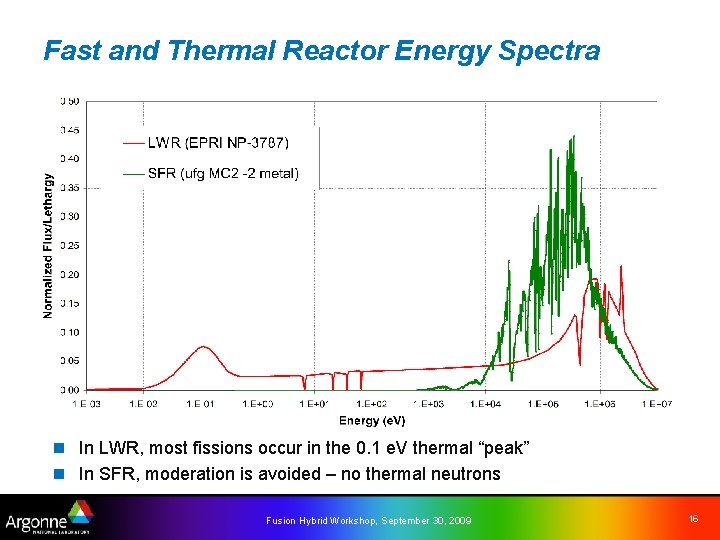
Fast and Thermal Reactor Energy Spectra n In LWR, most fissions occur in the 0. 1 e. V thermal “peak” n In SFR, moderation is avoided – no thermal neutrons Fusion Hybrid Workshop, September 30, 2009 16
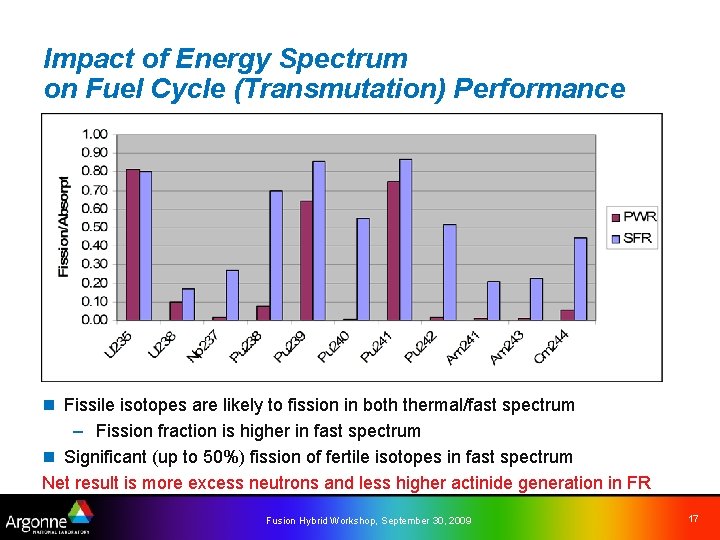
Impact of Energy Spectrum on Fuel Cycle (Transmutation) Performance n Fissile isotopes are likely to fission in both thermal/fast spectrum – Fission fraction is higher in fast spectrum n Significant (up to 50%) fission of fertile isotopes in fast spectrum Net result is more excess neutrons and less higher actinide generation in FR Fusion Hybrid Workshop, September 30, 2009 17
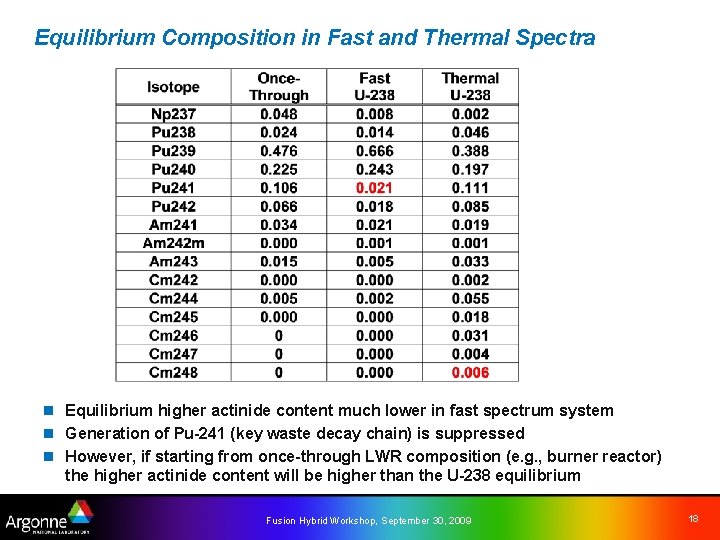
Equilibrium Composition in Fast and Thermal Spectra n Equilibrium higher actinide content much lower in fast spectrum system n Generation of Pu-241 (key waste decay chain) is suppressed n However, if starting from once-through LWR composition (e. g. , burner reactor) the higher actinide content will be higher than the U-238 equilibrium Fusion Hybrid Workshop, September 30, 2009 18
Fuel Cycle Implications The physics distinctions facilitate different fuel cycle strategies n Thermal reactors are typically configured for once-through (open) fuel cycle – They can operate on low enriched uranium (LEU) – They require an external fissile feed (neutron balance) – Higher actinides must be managed to allow recycle • Separation of higher elements – still a disposal issue • Extended cooling time for curium decay n Fast reactors are typically intended for closed fuel cycle with uranium conversion and resource extension – Higher actinide generation is suppressed – Neutron balance is favorable for recycled TRU • No external fissile material is required • Can enhance U-238 conversion for traditional breeding • Can limit U-238 conversion for burning Fusion Hybrid Workshop, September 30, 2009 19
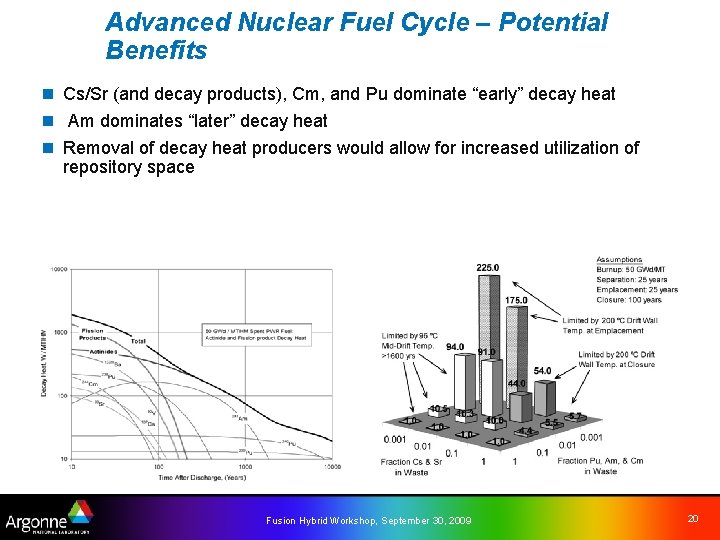
Advanced Nuclear Fuel Cycle – Potential Benefits n Cs/Sr (and decay products), Cm, and Pu dominate “early” decay heat n Am dominates “later” decay heat n Removal of decay heat producers would allow for increased utilization of repository space Fusion Hybrid Workshop, September 30, 2009 20
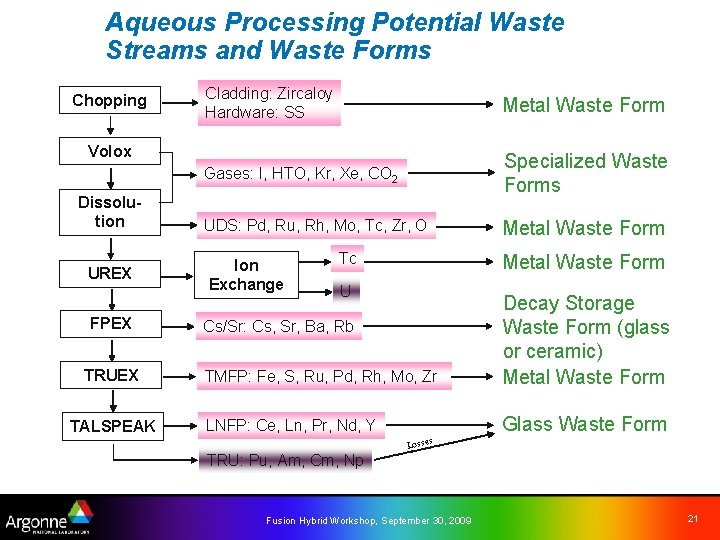
Aqueous Processing Potential Waste Streams and Waste Forms Chopping Cladding: Zircaloy Hardware: SS Metal Waste Form Gases: I, HTO, Kr, Xe, CO 2 Specialized Waste Forms UDS: Pd, Ru, Rh, Mo, Tc, Zr, O Metal Waste Form Volox Dissolution UREX FPEX TRUEX TALSPEAK Ion Exchange Tc Metal Waste Form U TMFP: Fe, S, Ru, Pd, Rh, Mo, Zr Decay Storage Waste Form (glass or ceramic) Metal Waste Form LNFP: Ce, Ln, Pr, Nd, Y Glass Waste Form Cs/Sr: Cs, Sr, Ba, Rb TRU: Pu, Am, Cm, Np Losses Fusion Hybrid Workshop, September 30, 2009 21
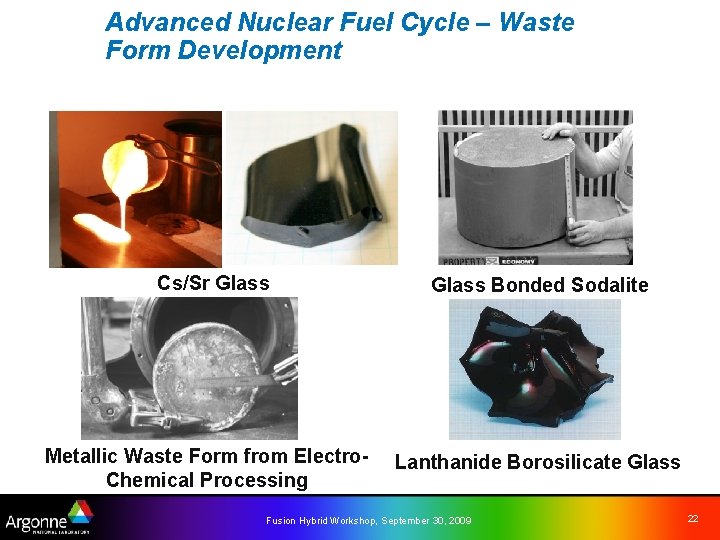
Advanced Nuclear Fuel Cycle – Waste Form Development Cs/Sr Glass Metallic Waste Form from Electro. Chemical Processing Glass Bonded Sodalite Lanthanide Borosilicate Glass Fusion Hybrid Workshop, September 30, 2009 22
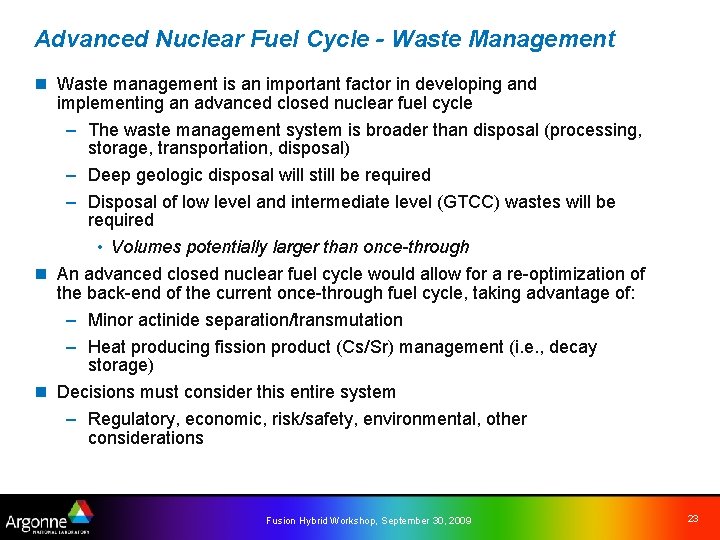
Advanced Nuclear Fuel Cycle - Waste Management n Waste management is an important factor in developing and implementing an advanced closed nuclear fuel cycle – The waste management system is broader than disposal (processing, storage, transportation, disposal) – Deep geologic disposal will still be required – Disposal of low level and intermediate level (GTCC) wastes will be required • Volumes potentially larger than once-through n An advanced closed nuclear fuel cycle would allow for a re-optimization of the back-end of the current once-through fuel cycle, taking advantage of: – Minor actinide separation/transmutation – Heat producing fission product (Cs/Sr) management (i. e. , decay storage) n Decisions must consider this entire system – Regulatory, economic, risk/safety, environmental, other considerations Fusion Hybrid Workshop, September 30, 2009 23
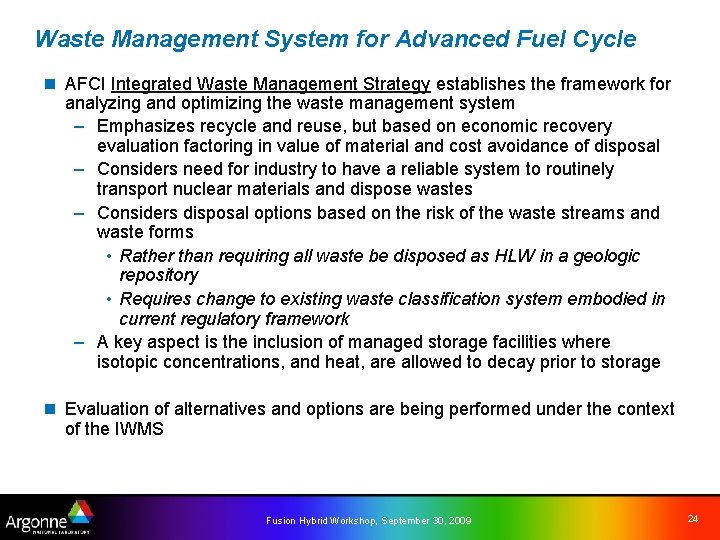
Waste Management System for Advanced Fuel Cycle n AFCI Integrated Waste Management Strategy establishes the framework for analyzing and optimizing the waste management system – Emphasizes recycle and reuse, but based on economic recovery evaluation factoring in value of material and cost avoidance of disposal – Considers need for industry to have a reliable system to routinely transport nuclear materials and dispose wastes – Considers disposal options based on the risk of the waste streams and waste forms • Rather than requiring all waste be disposed as HLW in a geologic repository • Requires change to existing waste classification system embodied in current regulatory framework – A key aspect is the inclusion of managed storage facilities where isotopic concentrations, and heat, are allowed to decay prior to storage n Evaluation of alternatives and options are being performed under the context of the IWMS Fusion Hybrid Workshop, September 30, 2009 24
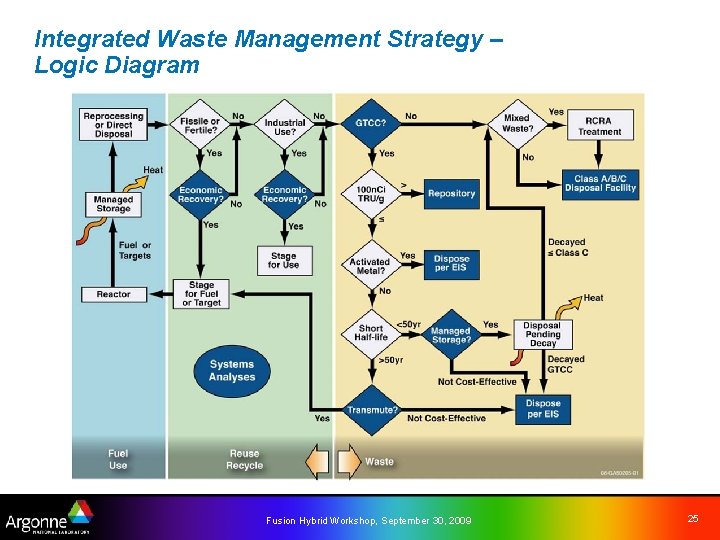
Integrated Waste Management Strategy – Logic Diagram Fusion Hybrid Workshop, September 30, 2009 25
- Slides: 25