
Fuel cells ENE 304 Materials in Energy Technologies



- Slides: 11
Fuel cells ENE 304 Materials in Energy Technologies
Content • Basic principles of Fuel Cells • Historical perspective • What is a fuel cell? • Introduction to fuel cells
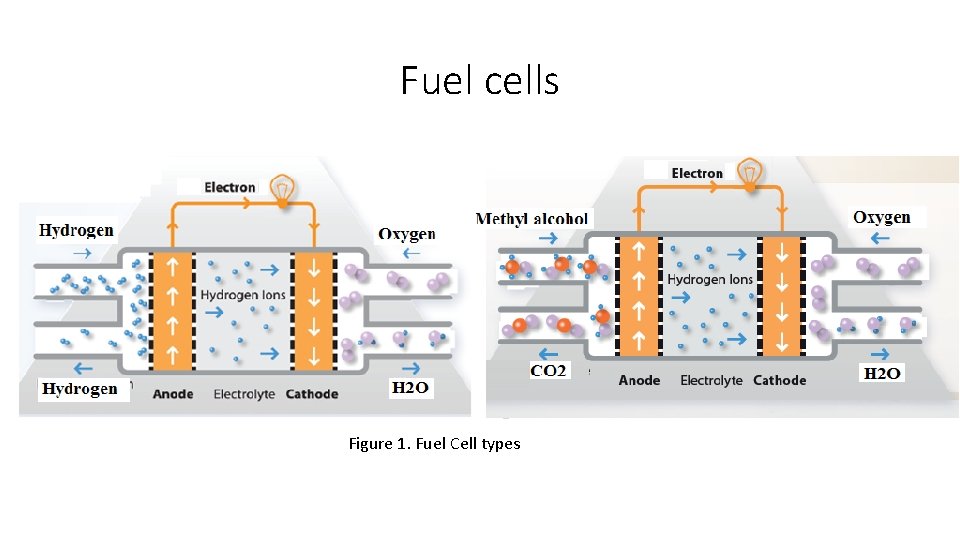
Fuel cells • Fuel cells produce energy from controlled and spontaneous oxidation-reduction reactions. • A fuel cell is a multi-component device with two electrodes separated by an ionic conductive membrane, where a positive anode oxidation reaction occurs and a negative cathode reduction reaction occurs. • As with battery systems, there are several types of fuel cells and each operates somewhat differently, but in general the fuel cell uses hydrogen at the anode and oxygen at the cathode, thus creating electricity. • As noted, a typical fuel cell consists of two electrodes: a positive electrode (or cathode) and a negative electrode (anode) separated by an ion (charge) conducting electrolyte. • In a model system, oxygen is fed to the cathod and hydrogen is fed to the anode.
Fuel cells Figure 1. Fuel Cell types
Fuel cells • By using the catalyst, the activation energy barrier is significantly reduced in order to separate hydrogen atoms from protons (H +) and electrons (e), making them kinetically viable at <80 ° C. • The catalyst reduces the activation barrier for chemical reactions and increases the rate of reaction formation. • Generated electrons are forced into an external circuit that creates an electron stream (electricity). • To complement the charge balance required for redox reactions, protons pass through the electrolyte and react with oxygen and electrons to produce water and heat. • As long as fuel (hydrogen) and air are supplied, the fuel cell will generate electricity.
Fuel cells In summary, within a fuel cell (1) there is no combustion and reduction-oxidationox reactions generate energy, (2) fuel cells are quiet and reliable compared other energy harvesting devives, (3) electricity is generated electrochemically, rather than by combustion reactions; Hence, fuel cells are more efficient in extracting energy compared combustion systems lke combustion engine, (4) the fuel is hydrogen, and the air; the product is the water; Hence, fuel cells are green technologies.
Historical perspective • In 1889, two chemists, Ludwig Mond and Charles Langer, used the term "fuel cell" to try to construct an industrially suitable device using air and industrial coal gas (hydrogen, methane and carbon monoxide). • At the end of the nineteenth century, the widespread use of internal combustion engines and fossil fuels sent the fuel cell in many other inventions and was only curiously described. • There is not much to tell about the fuel cells and their application to more than 50 years of basic science. • In 1932 at Cambridge University in England. Francis Thomas Bacon revived the fuel cell, developed in 1889, with a few changes on the original design. • It often happens that some development in science is forgotten not because of a lack of importance, but rather due to circumstance.
What is a fuel cell? • A fuel cell is like a battery that produces electricity from an electrochemical reaction. • Similar to the battery, the fuel cells convert chemical energy into electricity, and also heat. • However, a battery has a closed energy reservoir, and after discharging it must be recharged using an external electrical source to direct the electrochemical reaction in the reverse direction. • Different from the batteries, fuel cells use external chemical source of energy and can last forever as long as they are supplied with hydrogen and oxygen. • The source of hydrogen is usually called fuel and it gives the name of the fuel cell, with no combustion involved.
Fuel cells basics Introduction to fuel cells • Fuel cells can be classified depending on the type of fuel, the temperature of operation, and the type of electrolyte used as following: (i) proton-exchange membrane fuel cells, (ii) alkaline fuel cells, (iii) phosphoric acid fuel cells, (iv) molten-carbonate fuel cells, (v) solid-oxide fuel cells, (vi) direct methanol fuel cells.
Fuel cells basics Introduction to fuel cells • Fuel cells can also be classified according to their application as given below: (i) automotive fuel cells, (ii) stationary fuel cells, (iii) residential fuel cells, (iv) back-up power fuel cells, (v) portable-power fuel cells.
References • http: //www. fuelcelltoday. com/media/1637138/fc_basics_technology_types. pdf • Shyam Kocha, Bryan Pivovar, and Thomas Gennett, Fuel Cells, in Fundamentals of Materials for Energy and Environmental Sustainability, (Eds. David S. Ginley, David Cahen), Cambridge University Press, 2012.