
Fuel Cell Technology Status Challenges and Opportunities Meilin
- Slides: 20
Fuel Cell Technology Status, Challenges, and Opportunities Meilin Liu School of Materials Science &Engineering Georgia Institute of Technology Atlanta, GA 30332 -0245 Presented to Electrical Energy Systems and Sustainability Workshop Georgia Tech November 29 – December 1, 2000 Georgia Tech - SSI&EC
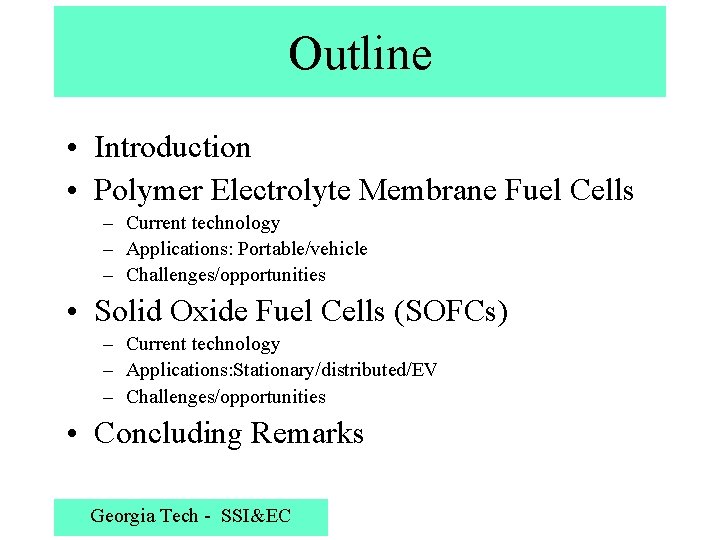
Outline • Introduction • Polymer Electrolyte Membrane Fuel Cells – Current technology – Applications: Portable/vehicle – Challenges/opportunities • Solid Oxide Fuel Cells (SOFCs) – Current technology – Applications: Stationary/distributed/EV – Challenges/opportunities • Concluding Remarks Georgia Tech - SSI&EC
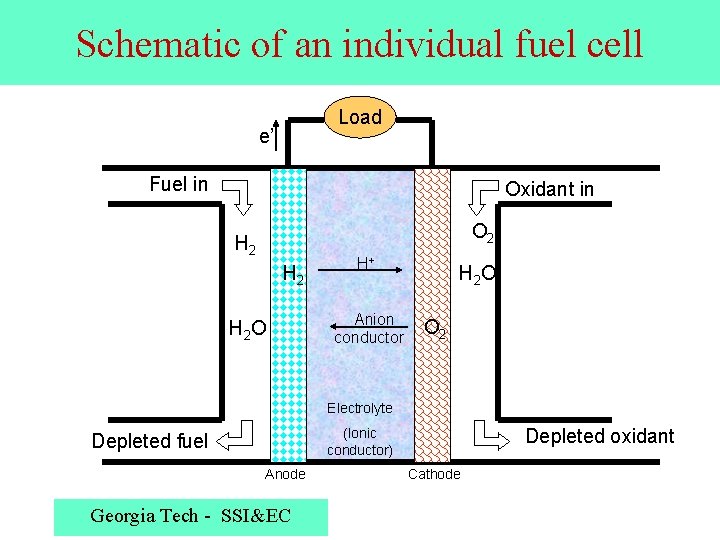
Schematic of an individual fuel cell Load e’ Fuel in Oxidant in O 2 H 2 H 2 O H+ Anion conductor H 2 O O 2 Electrolyte Depleted oxidant (Ionic conductor) Depleted fuel Anode Georgia Tech - SSI&EC Cathode
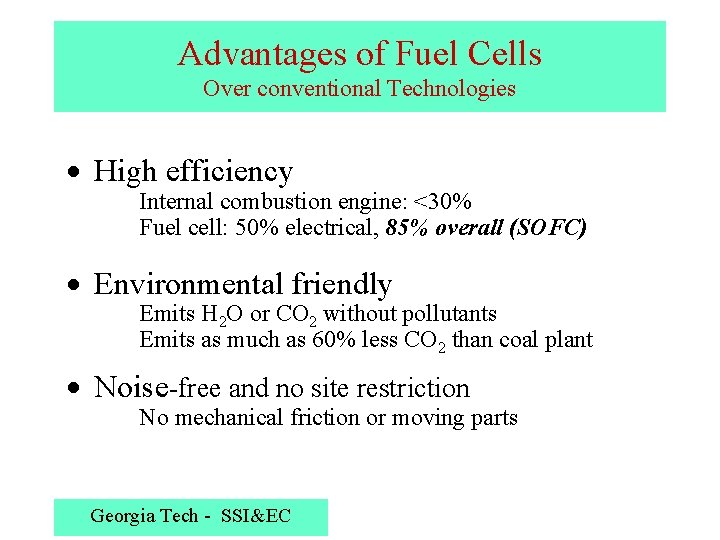
Advantages of Fuel Cells Over conventional Technologies · High efficiency Internal combustion engine: <30% Fuel cell: 50% electrical, 85% overall (SOFC) · Environmental friendly Emits H 2 O or CO 2 without pollutants Emits as much as 60% less CO 2 than coal plant · Noise-free and no site restriction No mechanical friction or moving parts Georgia Tech - SSI&EC
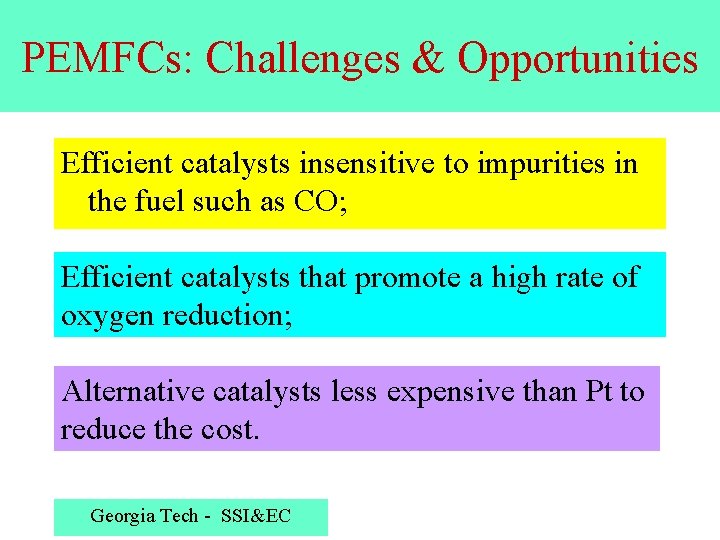
PEMFCs: Challenges & Opportunities Efficient catalysts insensitive to impurities in the fuel such as CO; Efficient catalysts that promote a high rate of oxygen reduction; Alternative catalysts less expensive than Pt to reduce the cost. Georgia Tech - SSI&EC
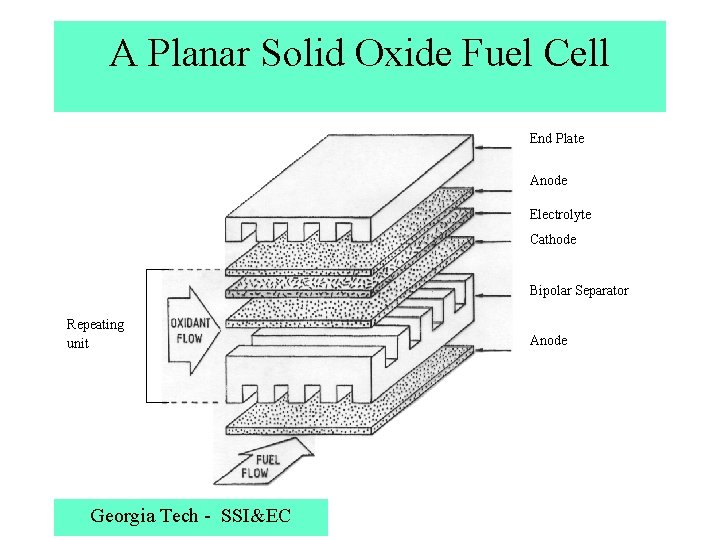
A Planar Solid Oxide Fuel Cell End Plate Anode Electrolyte Cathode Bipolar Separator Repeating unit Georgia Tech - SSI&EC Anode
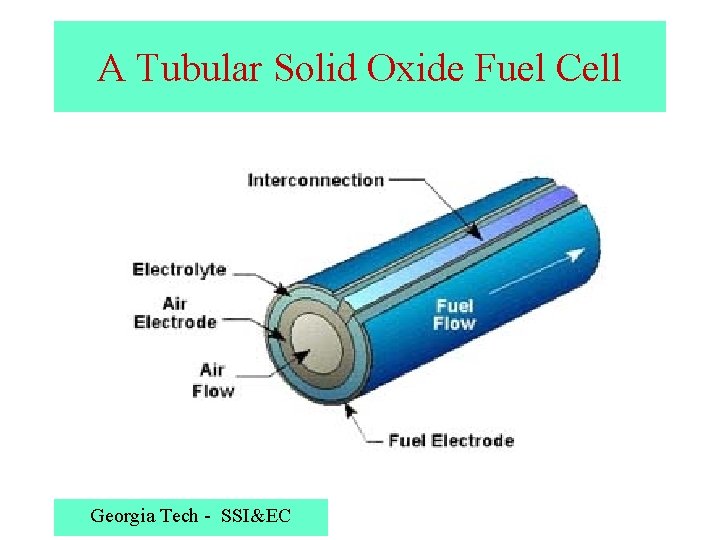
A Tubular Solid Oxide Fuel Cell Georgia Tech - SSI&EC
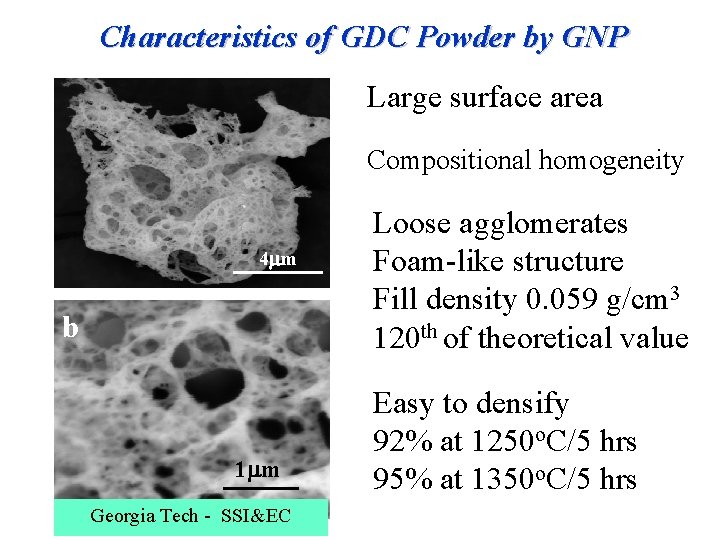
Characteristics of GDC Powder by GNP Large surface area Compositional homogeneity 4 m b 1 m Georgia Tech - SSI&EC Loose agglomerates Foam-like structure Fill density 0. 059 g/cm 3 120 th of theoretical value Easy to densify 92% at 1250 o. C/5 hrs 95% at 1350 o. C/5 hrs
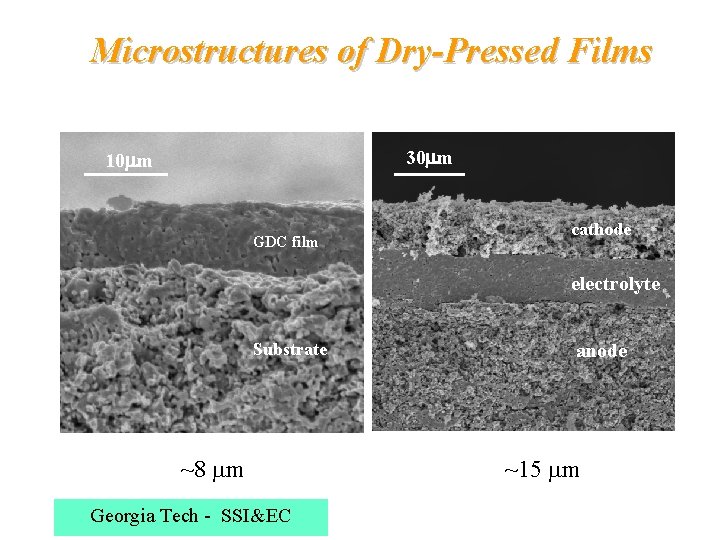
Microstructures of Dry-Pressed Films 30 m 10 m GDC film cathode electrolyte Substrate ~8 m Georgia Tech - SSI&EC anode ~15 m
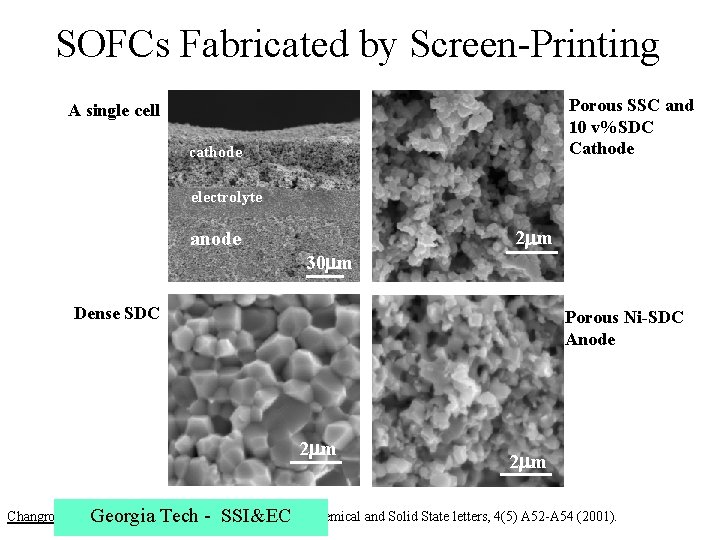
SOFCs Fabricated by Screen-Printing Porous SSC and 10 v%SDC Cathode A single cell cathode electrolyte 2 m anode 30 m Dense SDC Porous Ni-SDC Anode 2 m Changrong Xia, Georgia Fanglin Chen and Meilin Liu, Electrochemical and Solid State letters, 4(5) A 52 -A 54 (2001). Tech - SSI&EC
Single cell performance of SDC-electrolyte SOFC Georgia Tech - SSI&EC
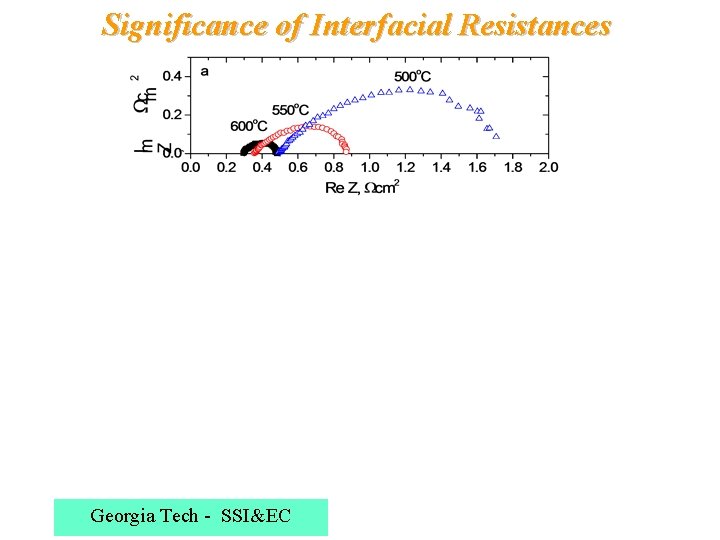
Significance of Interfacial Resistances Georgia Tech - SSI&EC
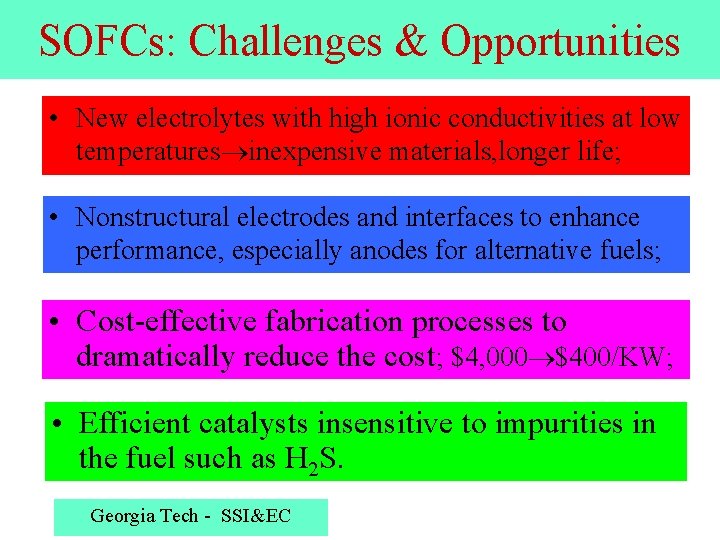
SOFCs: Challenges & Opportunities • New electrolytes with high ionic conductivities at low temperatures inexpensive materials, longer life; • Nonstructural electrodes and interfaces to enhance performance, especially anodes for alternative fuels; • Cost-effective fabrication processes to dramatically reduce the cost; $4, 000 $400/KW; • Efficient catalysts insensitive to impurities in the fuel such as H 2 S. Georgia Tech - SSI&EC
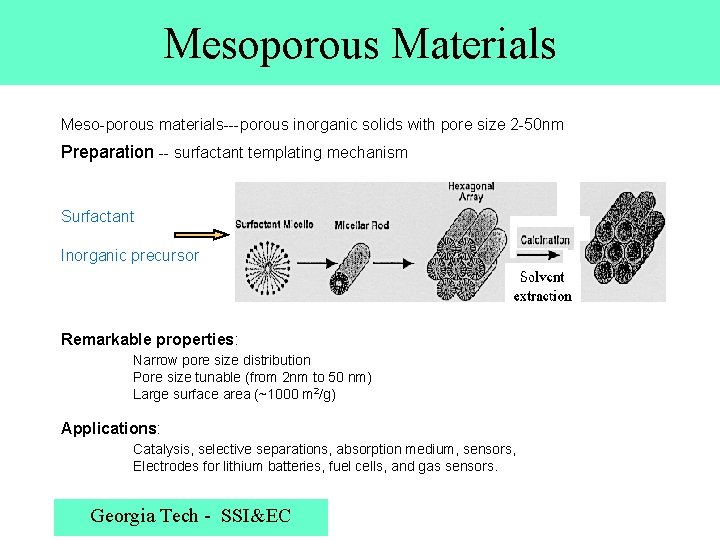
Mesoporous Materials Meso-porous materials---porous inorganic solids with pore size 2 -50 nm Preparation -- surfactant templating mechanism Surfactant Inorganic precursor Remarkable properties: Narrow pore size distribution Pore size tunable (from 2 nm to 50 nm) Large surface area (~1000 m 2/g) Applications: Catalysis, selective separations, absorption medium, sensors, Electrodes for lithium batteries, fuel cells, and gas sensors. Georgia Tech - SSI&EC
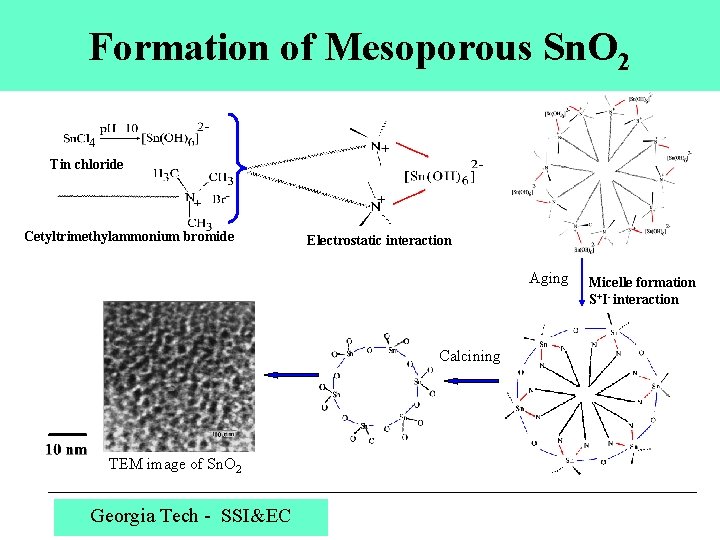
Formation of Mesoporous Sn. O 2 Tin chloride Cetyltrimethylammonium bromide Electrostatic interaction Aging Calcining TEM image of Sn. O 2 Georgia Tech - SSI&EC Micelle formation S+I- interaction
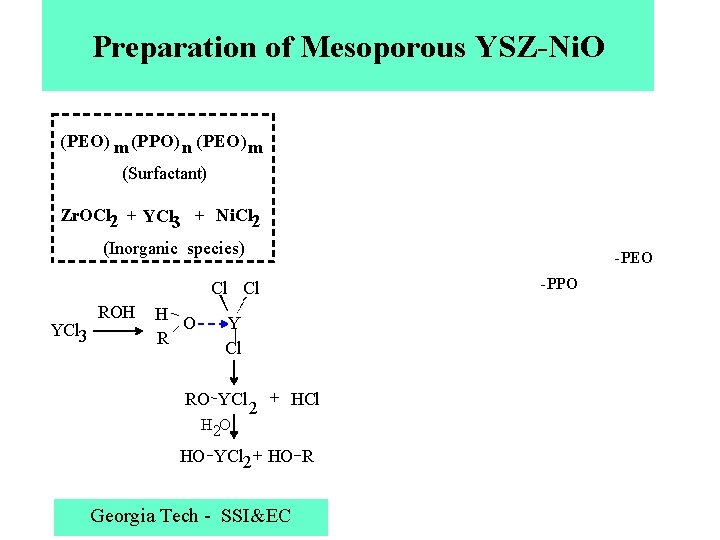
Preparation of Mesoporous YSZ-Ni. O (PEO) m (PPO) n (PEO) m (Surfactant) Zr. OCl 2 + YCl 3 + Ni. Cl 2 (Inorganic species) Cl Cl YCl 3 ROH H O R Y Cl RO YCl 2 + HCl H 2 O HO YCl 2 + HO R Georgia Tech - SSI&EC -PEO -PPO
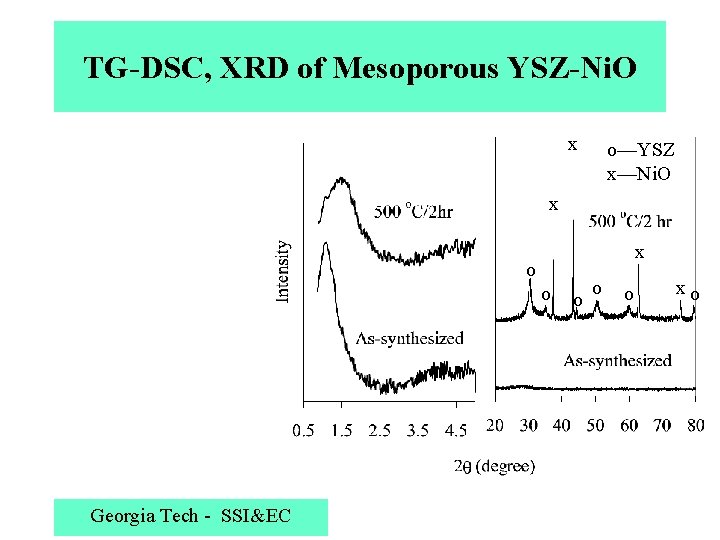
TG-DSC, XRD of Mesoporous YSZ-Ni. O x o—YSZ x—Ni. O x x o o Georgia Tech - SSI&EC o o o xo
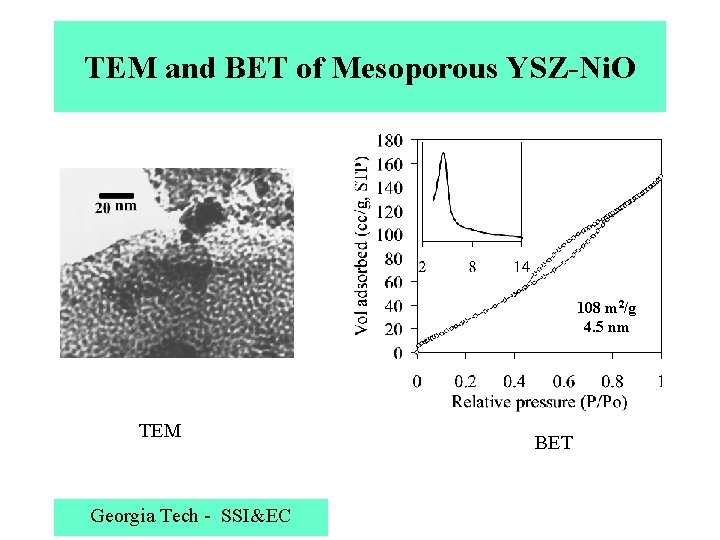
TEM and BET of Mesoporous YSZ-Ni. O 108 m 2/g 4. 5 nm TEM Georgia Tech - SSI&EC BET
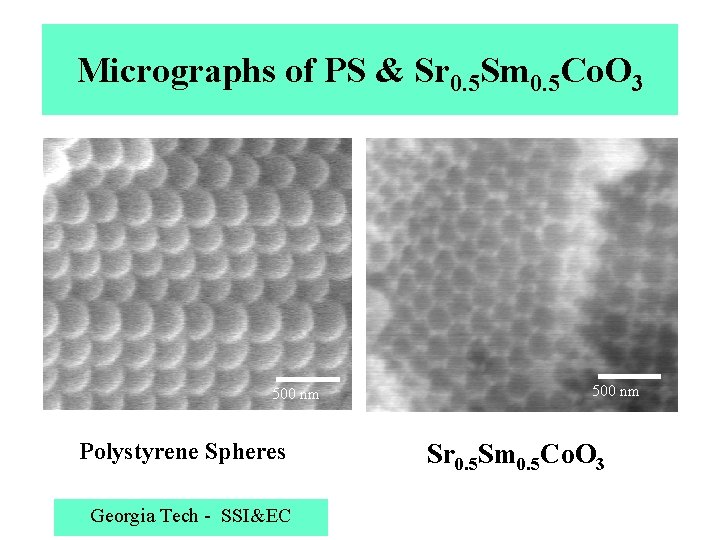
Micrographs of PS & Sr 0. 5 Sm 0. 5 Co. O 3 500 nm Polystyrene Spheres Georgia Tech - SSI&EC 500 nm Sr 0. 5 Sm 0. 5 Co. O 3
Concluding Remarks Ø Fuel Cells are the most efficient/cleanest technology for conversion of chemical to electrical energy; Ø PEMFC and SOFC are the most versatile system for various applications; Ø Cost reduction is the key to successful commercialization of fuel cells; Ø Fuel cells will significantly influence our everyday life in the years to come. Georgia Tech - SSI&EC