
Fuel Cell Systems Engineering Lecture 7 Quantitative Decision







- Slides: 19
Fuel Cell Systems Engineering Lecture 7 Quantitative Decision Methods Fuel Cell Systems Engineering, F 06
Topics • • Discussion of individual assignment Review questions on OTC solicitation. Review Paladin LOA Discuss quantitative decision making process, Multi-Attribute Utility Theory, (MAUT) • Group activities. Fuel Cell Systems Engineering, F 06
Questions on OTC Solicitation • Is methanol as a fuel a design constraint? • Is 250 W or 300 W the specified output? Fuel Cell Systems Engineering, F 06
How Do You Decide on a Course of Action? • • Let the Boss make the decision Take a vote Roll the dice Consult the Ouija board OR • Use a quantitative decision making method to determine the “Best Technical Approach” Fuel Cell Systems Engineering, F 06
The Challenge • Because the decision variables are many and varied, we need a method to “normalize” the ratings to some common basis. • Examples: power in watts, mission duration in hours, efficiency in %, weight in pounds, etc. • The concept of evaluating the Utility of various alternatives allows us to do that. Fuel Cell Systems Engineering, F 06
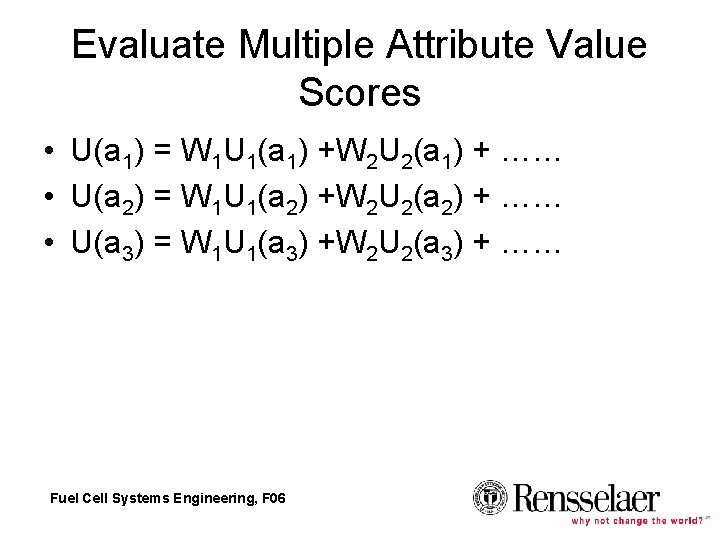
Utility of Alternative ai • The utility of an alternative equals the weighted sum of the utilities of individual attributes. U(ai)=w 1 U 1(ai)+w 2 U 2(ai)+…+ wn. Un(ai) OR n U(ai)=Σwj. Uj(ai) j=1 Fuel Cell Systems Engineering, F 06
Multi-Attribute Utility Theory Identify Performance Attributes Identify Hierarchy of Attributes Establish Utility vs. Performance Curves for Attributes Establish Relative Importance Among Attributes Identify Alternatives and Related Performance for Each Attribute Evaluate Multiple Attribute Value Scores Conduct Sensitivity Analysis Fuel Cell Systems Engineering, F 06
Identify Performance Attributes • Select attributes with the highest degree of importance • Include ALL attributes with high importance • Insure attributes are independent (you can trade off one for the other) and mutually exclusive (one attribute does not include another) Fuel Cell Systems Engineering, F 06
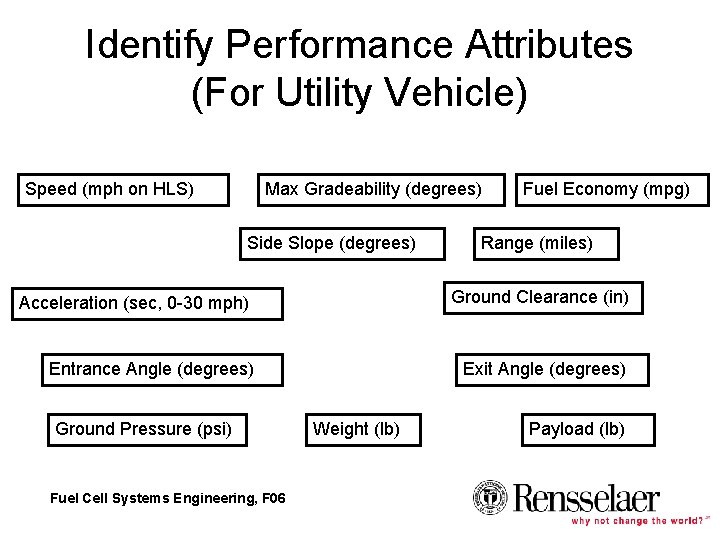
Identify Performance Attributes (For Utility Vehicle) Speed (mph on HLS) Max Gradeability (degrees) Side Slope (degrees) Fuel Economy (mpg) Range (miles) Acceleration (sec, 0 -30 mph) Ground Clearance (in) Entrance Angle (degrees) Exit Angle (degrees) Ground Pressure (psi) Fuel Cell Systems Engineering, F 06 Weight (lb) Payload (lb)
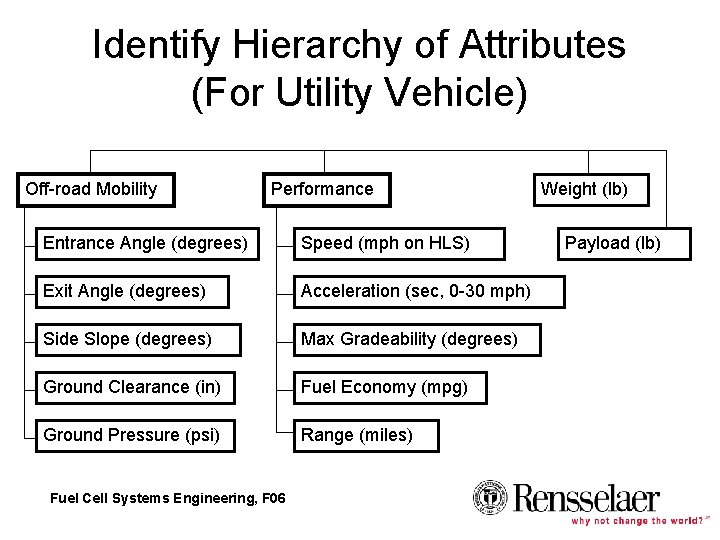
Identify Hierarchy of Attributes • Are there logical groupings of related attributes? • Create a tree of attributes to facilitate easier identification of relative importance Fuel Cell Systems Engineering, F 06
Identify Hierarchy of Attributes (For Utility Vehicle) Off-road Mobility Performance Entrance Angle (degrees) Speed (mph on HLS) Exit Angle (degrees) Acceleration (sec, 0 -30 mph) Side Slope (degrees) Max Gradeability (degrees) Ground Clearance (in) Fuel Economy (mpg) Ground Pressure (psi) Range (miles) Fuel Cell Systems Engineering, F 06 Weight (lb) Payload (lb)
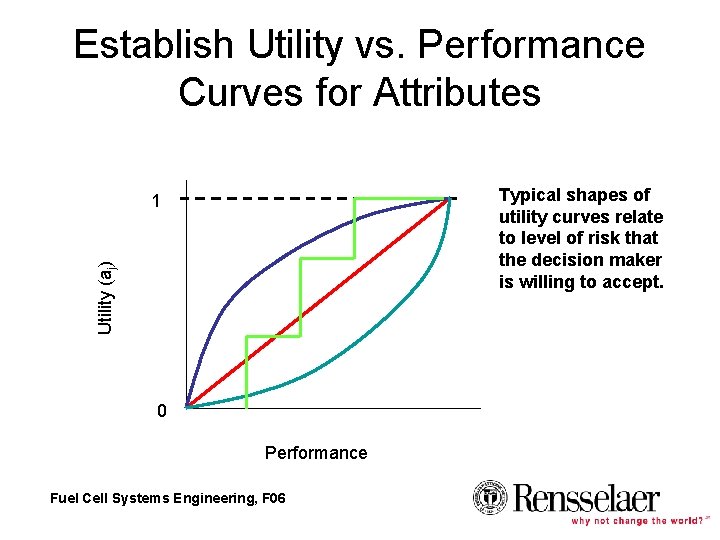
Establish Utility vs. Performance Curves for Attributes Typical shapes of utility curves relate to level of risk that the decision maker is willing to accept. Utility (aj) 1 0 Performance Fuel Cell Systems Engineering, F 06
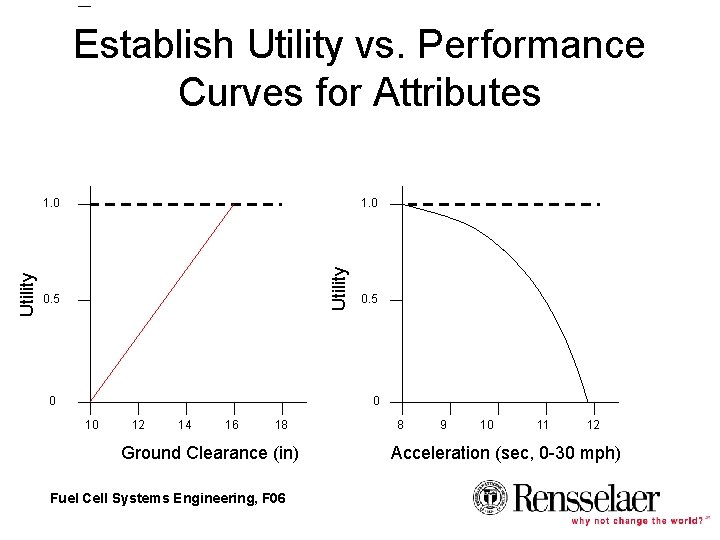
Establish Utility vs. Performance Curves for Attributes 1. 0 Utility 1. 0 0. 5 0 10 12 14 16 18 Ground Clearance (in) Fuel Cell Systems Engineering, F 06 8 9 10 11 12 Acceleration (sec, 0 -30 mph)
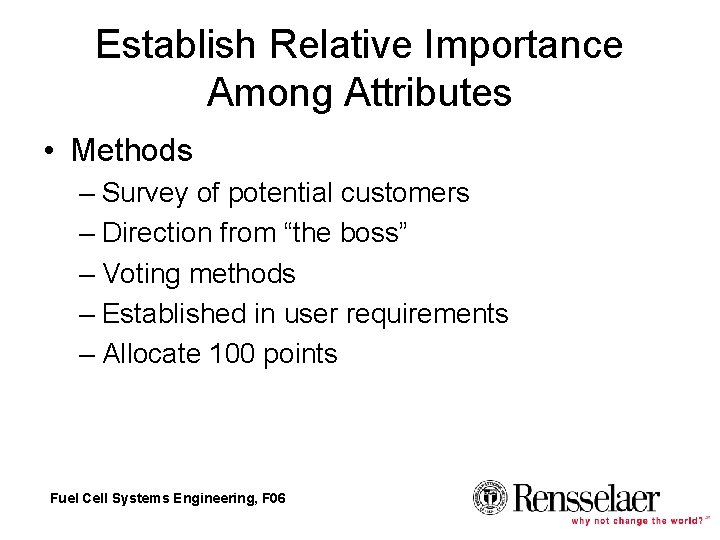
Establish Relative Importance Among Attributes • Methods – Survey of potential customers – Direction from “the boss” – Voting methods – Established in user requirements – Allocate 100 points Fuel Cell Systems Engineering, F 06
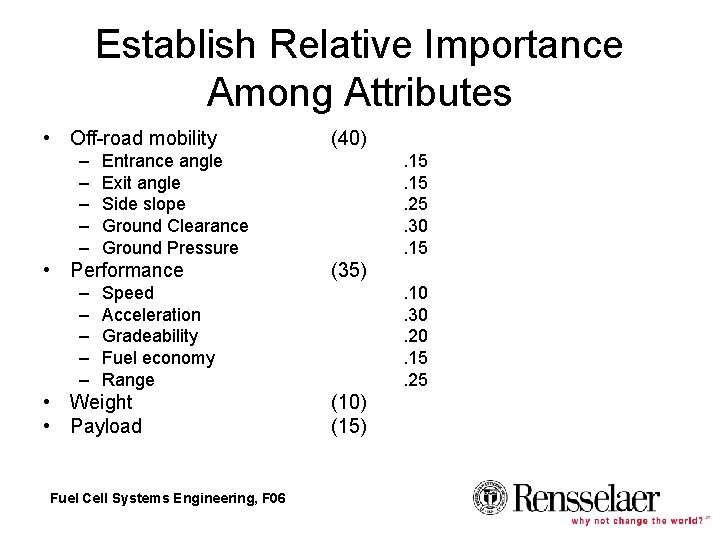
Establish Relative Importance Among Attributes • Off-road mobility – – – Entrance angle Exit angle Side slope Ground Clearance Ground Pressure • Performance – – – (40). 15. 25. 30. 15 (35) Speed Acceleration Gradeability Fuel economy Range • Weight • Payload Fuel Cell Systems Engineering, F 06 . 10. 30. 20. 15. 25 (10) (15)
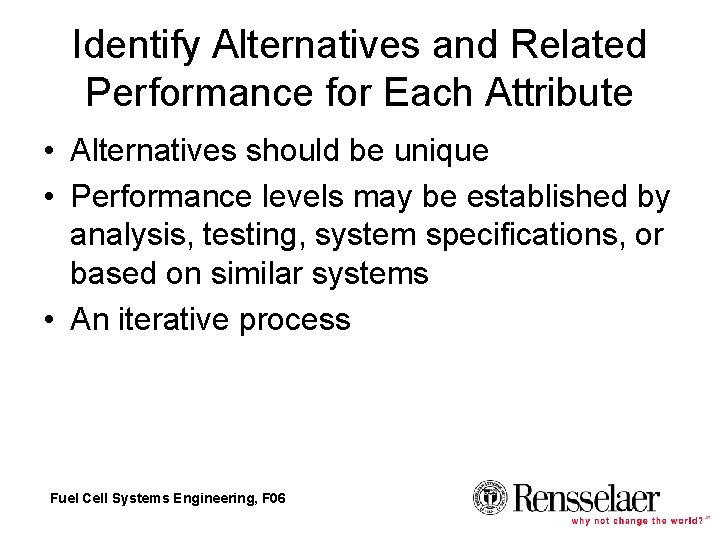
Identify Alternatives and Related Performance for Each Attribute • Alternatives should be unique • Performance levels may be established by analysis, testing, system specifications, or based on similar systems • An iterative process Fuel Cell Systems Engineering, F 06
Evaluate Multiple Attribute Value Scores • U(a 1) = W 1 U 1(a 1) +W 2 U 2(a 1) + …… • U(a 2) = W 1 U 1(a 2) +W 2 U 2(a 2) + …… • U(a 3) = W 1 U 1(a 3) +W 2 U 2(a 3) + …… Fuel Cell Systems Engineering, F 06
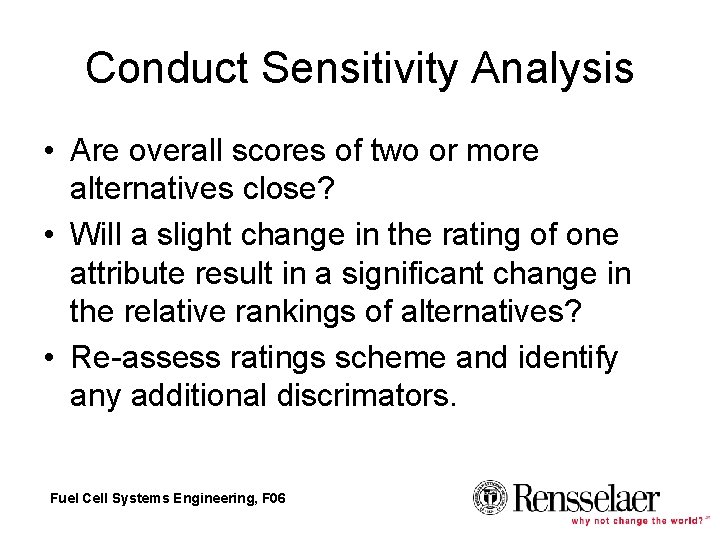
Conduct Sensitivity Analysis • Are overall scores of two or more alternatives close? • Will a slight change in the rating of one attribute result in a significant change in the relative rankings of alternatives? • Re-assess ratings scheme and identify any additional discrimators. Fuel Cell Systems Engineering, F 06
Additional Sources • Sage & Armstrong, Introduction to Systems Engineering, Wiley, 2000 Fuel Cell Systems Engineering, F 06