
FTPC calibration status Joern Putschke for the STAR
FTPC calibration status Joern Putschke for the STAR FTPC group STAR Analysis Meeting 2002 October 22 -24, 2002 July 2002 STAR Collaboration Meeting
Overview • The Forward-TPC layout • Laser Calibration – Residuals and momentum resolution – Deflection angle • Vertex reconstruction • “Time. Step problem” • DCA distribution • Multiplicity (raw) – FTPC vs. TPC/CTB – FTPC min. Bias and Hijing • Azimuthal angle distribution • Plans for Y 03 October 2002 STAR Analysis Meeting 2
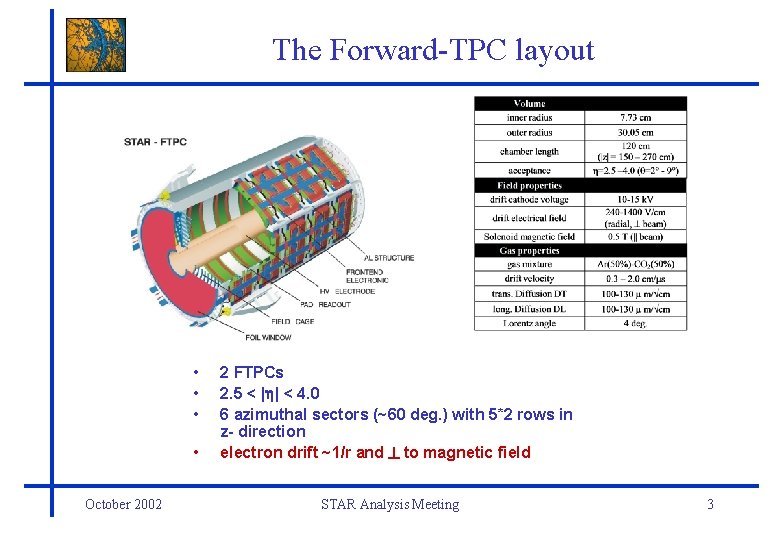
The Forward-TPC layout • • October 2002 2 FTPCs 2. 5 < | | < 4. 0 6 azimuthal sectors (~60 deg. ) with 5*2 rows in z- direction electron drift ~1/r and to magnetic field STAR Analysis Meeting 3
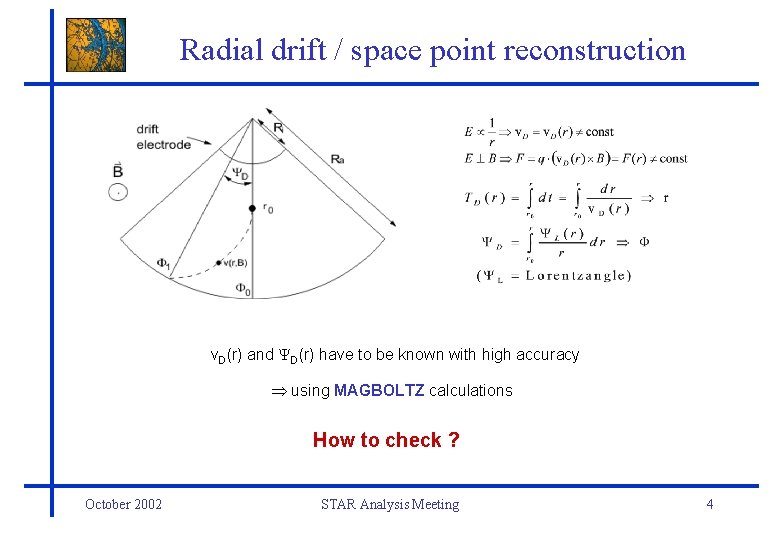
Radial drift / space point reconstruction v. D(r) and D(r) have to be known with high accuracy using MAGBOLTZ calculations How to check ? October 2002 STAR Analysis Meeting 4
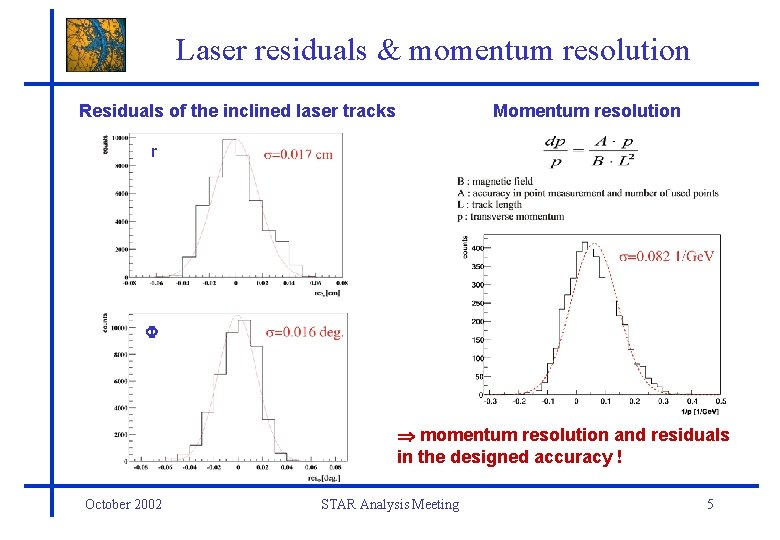
Laser residuals & momentum resolution Residuals of the inclined laser tracks Momentum resolution r momentum resolution and residuals in the designed accuracy ! October 2002 STAR Analysis Meeting 5
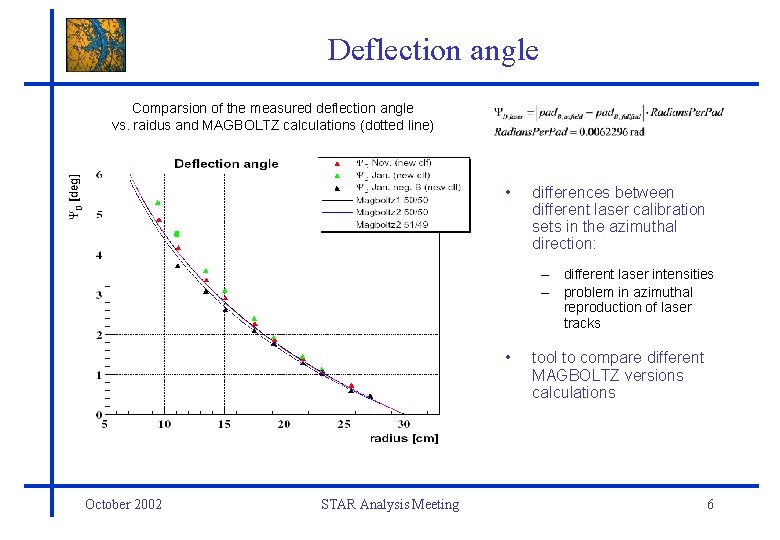
Deflection angle Comparsion of the measured deflection angle vs. raidus and MAGBOLTZ calculations (dotted line) • differences between different laser calibration sets in the azimuthal direction: – different laser intensities – problem in azimuthal reproduction of laser tracks • October 2002 STAR Analysis Meeting tool to compare different MAGBOLTZ versions calculations 6
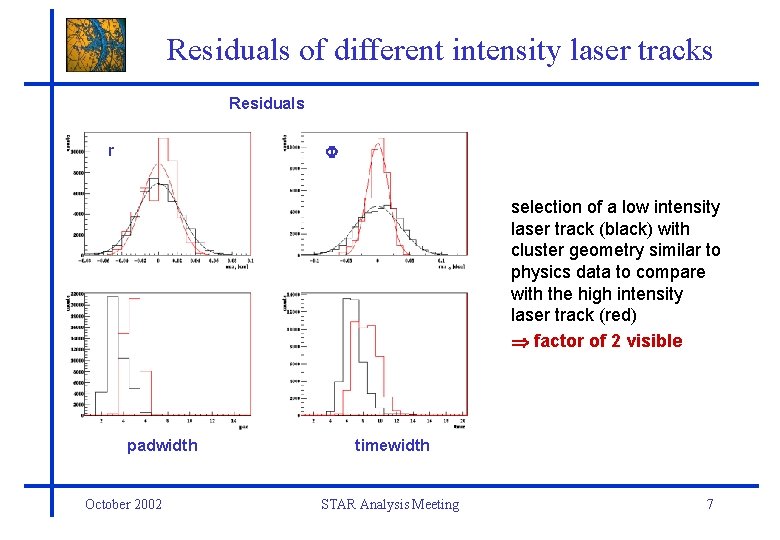
Residuals of different intensity laser tracks Residuals r selection of a low intensity laser track (black) with cluster geometry similar to physics data to compare with the high intensity laser track (red) factor of 2 visible padwidth October 2002 timewidth STAR Analysis Meeting 7
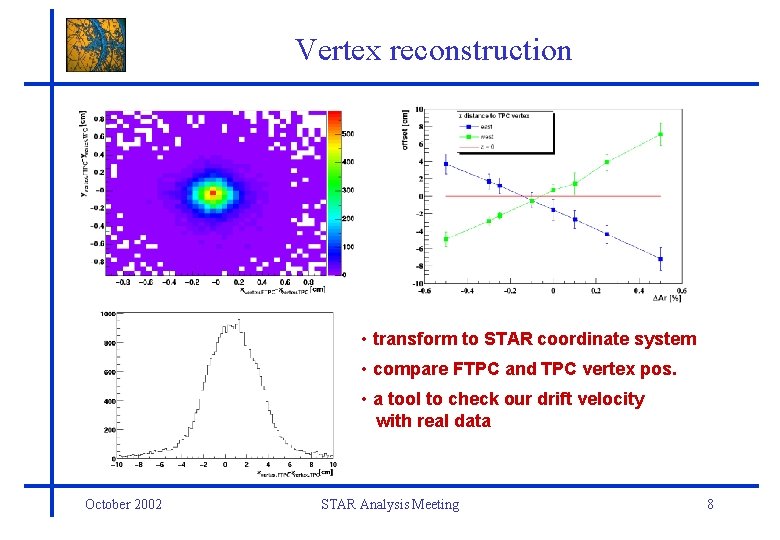
Vertex reconstruction • transform to STAR coordinate system • compare FTPC and TPC vertex pos. • a tool to check our drift velocity with real data October 2002 STAR Analysis Meeting 8
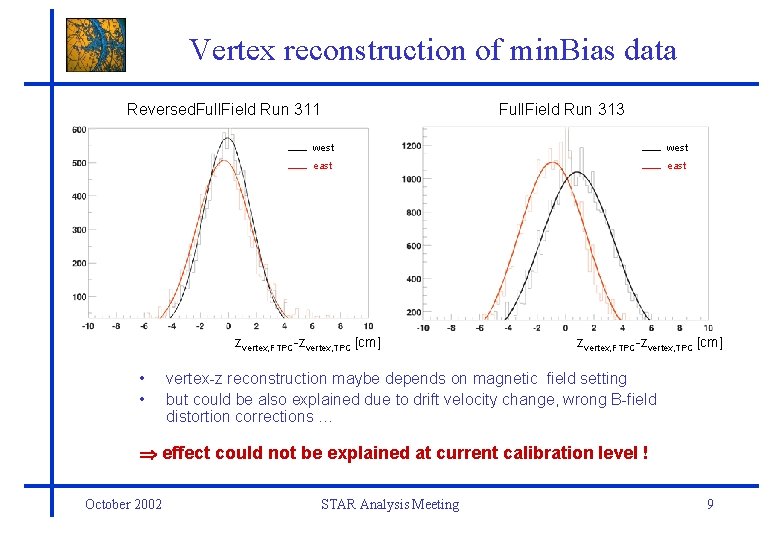
Vertex reconstruction of min. Bias data Reversed. Full. Field Run 311 west east zvertex, FTPC-zvertex, TPC [cm] • • Full. Field Run 313 zvertex, FTPC-zvertex, TPC [cm] vertex-z reconstruction maybe depends on magnetic field setting but could be also explained due to drift velocity change, wrong B-field distortion corrections … effect could not be explained at current calibration level ! October 2002 STAR Analysis Meeting 9
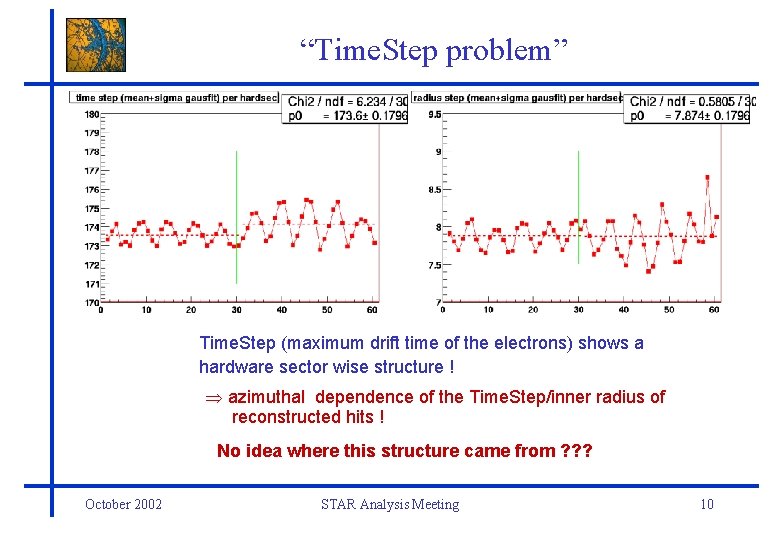
“Time. Step problem” Time. Step (maximum drift time of the electrons) shows a hardware sector wise structure ! azimuthal dependence of the Time. Step/inner radius of reconstructed hits ! No idea where this structure came from ? ? ? October 2002 STAR Analysis Meeting 10
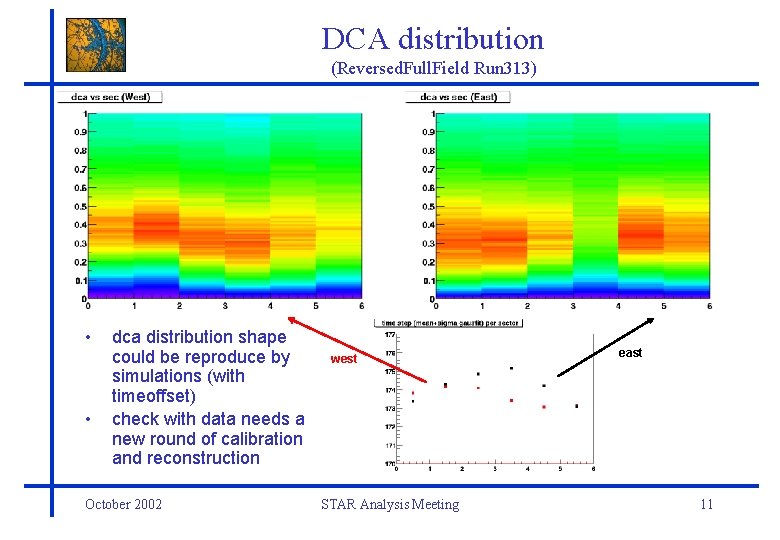
DCA distribution (Reversed. Full. Field Run 313) • • dca distribution shape could be reproduce by simulations (with timeoffset) check with data needs a new round of calibration and reconstruction October 2002 west STAR Analysis Meeting east 11
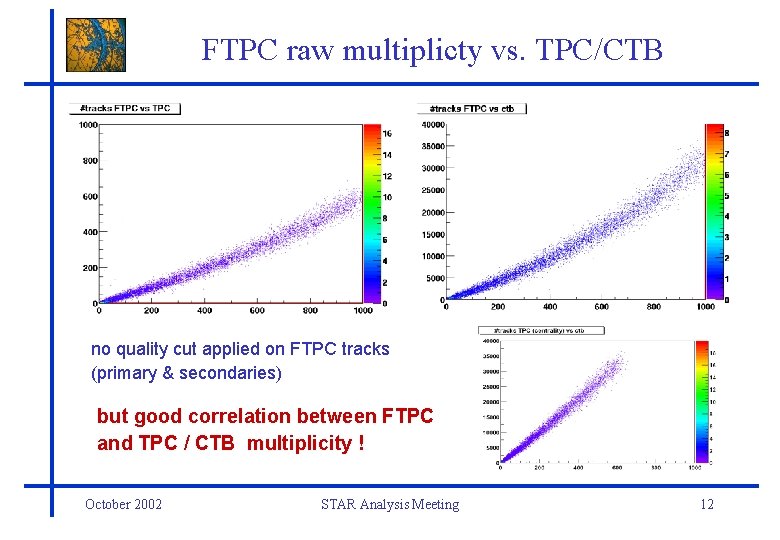
FTPC raw multiplicty vs. TPC/CTB no quality cut applied on FTPC tracks (primary & secondaries) but good correlation between FTPC and TPC / CTB multiplicity ! October 2002 STAR Analysis Meeting 12
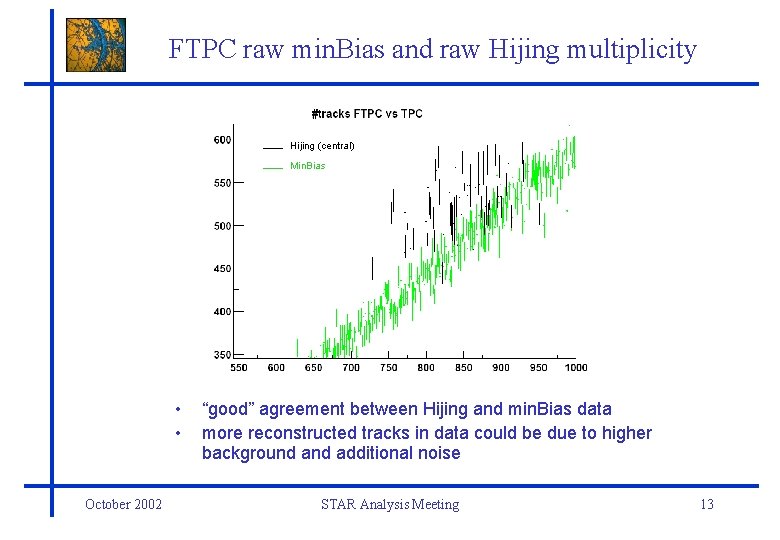
FTPC raw min. Bias and raw Hijing multiplicity Hijing (central) Min. Bias • • October 2002 “good” agreement between Hijing and min. Bias data more reconstructed tracks in data could be due to higher background additional noise STAR Analysis Meeting 13
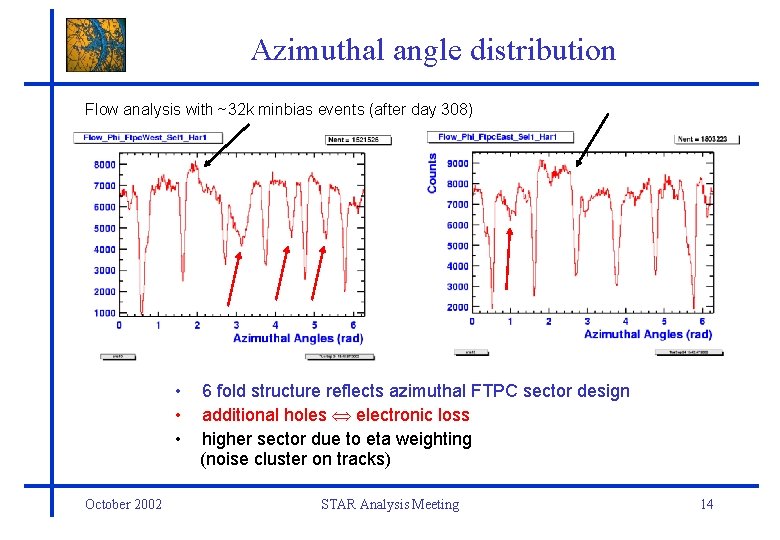
Azimuthal angle distribution Flow analysis with ~32 k minbias events (after day 308) • • • October 2002 6 fold structure reflects azimuthal FTPC sector design additional holes electronic loss higher sector due to eta weighting (noise cluster on tracks) STAR Analysis Meeting 14
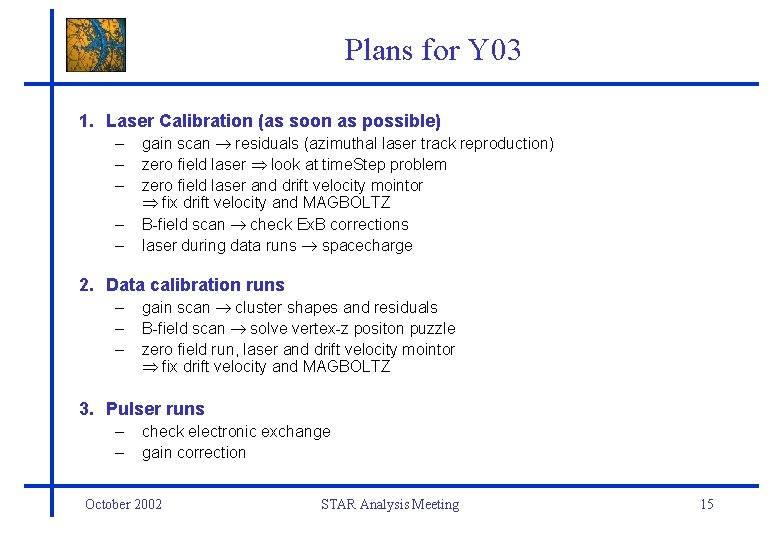
Plans for Y 03 1. Laser Calibration (as soon as possible) – – – gain scan residuals (azimuthal laser track reproduction) zero field laser look at time. Step problem zero field laser and drift velocity mointor fix drift velocity and MAGBOLTZ B-field scan check Ex. B corrections laser during data runs spacecharge 2. Data calibration runs – – – gain scan cluster shapes and residuals B-field scan solve vertex-z positon puzzle zero field run, laser and drift velocity mointor fix drift velocity and MAGBOLTZ 3. Pulser runs – – check electronic exchange gain correction October 2002 STAR Analysis Meeting 15
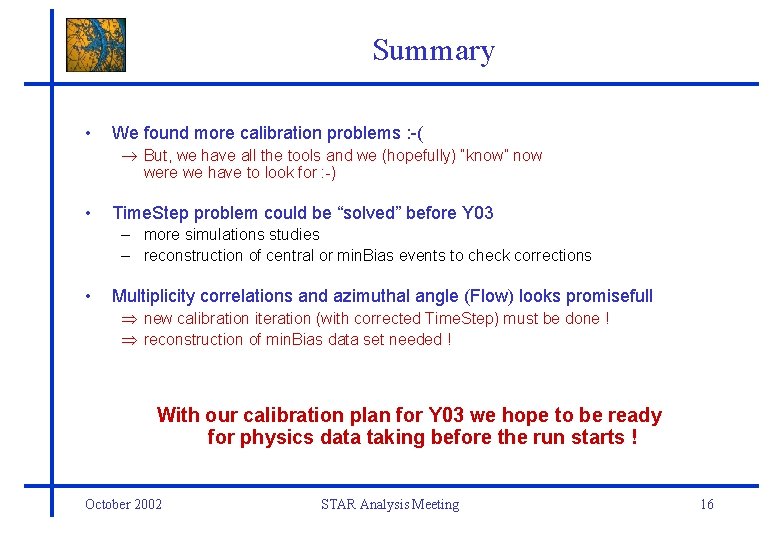
Summary • We found more calibration problems : -( But, we have all the tools and we (hopefully) “know” now were we have to look for : -) • Time. Step problem could be “solved” before Y 03 – more simulations studies – reconstruction of central or min. Bias events to check corrections • Multiplicity correlations and azimuthal angle (Flow) looks promisefull new calibration iteration (with corrected Time. Step) must be done ! reconstruction of min. Bias data set needed ! With our calibration plan for Y 03 we hope to be ready for physics data taking before the run starts ! October 2002 STAR Analysis Meeting 16
The STAR FTPC group • • Volker Eckhardt Maria Mora Corral Markus Oldenburg Joern Putschke Janet Seyboth Peter Seyboth Frank Simon October 2002 STAR Analysis Meeting 17
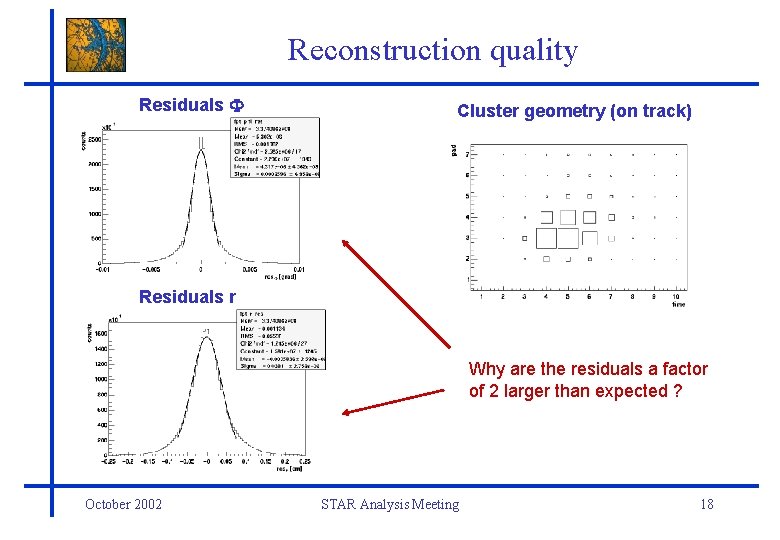
Reconstruction quality Residuals Cluster geometry (on track) Residuals r Why are the residuals a factor of 2 larger than expected ? October 2002 STAR Analysis Meeting 18
![1/Nevent*d. N/d 1/Nevent*d. N/dpt Raw charged particle spectra pt [Ge. V] Efficency and acceptance](http://slidetodoc.com/presentation_image_h2/035c422e218d7dae9a87856a72349f95/image-19.jpg "1/Nevent*d. N/d 1/Nevent*d. N/dpt Raw charged particle spectra pt [Ge. V] Efficency and acceptance")
1/Nevent*d. N/d 1/Nevent*d. N/dpt Raw charged particle spectra pt [Ge. V] Efficency and acceptance calculations have started to extract corrected charged particle spectra ! October 2002 STAR Analysis Meeting 19
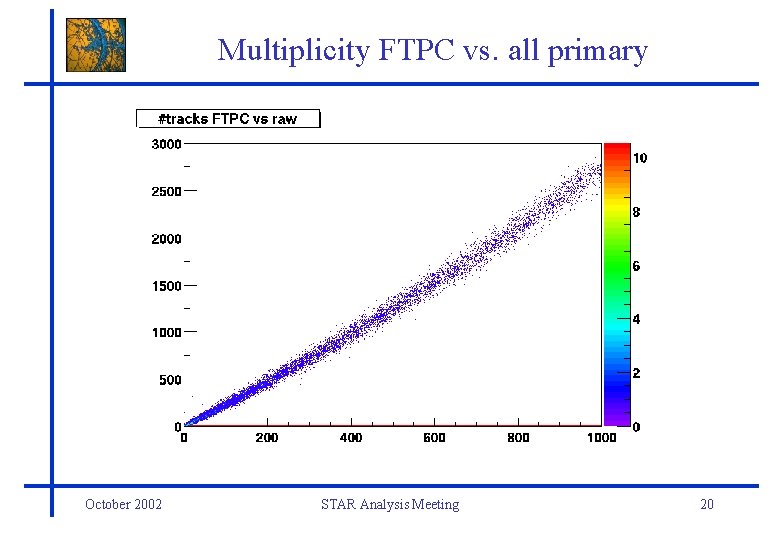
Multiplicity FTPC vs. all primary October 2002 STAR Analysis Meeting 20
- Slides: 20