
FTK WORKSHOP ALEXANDROUPOLI 10032014 FTKIM PIXEL CLUSTERING INTEGRATION



- Slides: 45
FTK WORKSHOP, ALEXANDROUPOLI: 10/03/2014 FTK_IM: PIXEL CLUSTERING, INTEGRATION AND TESTS Calliope-Louisa Sotiropoulou Aristotle University of Thessaloniki
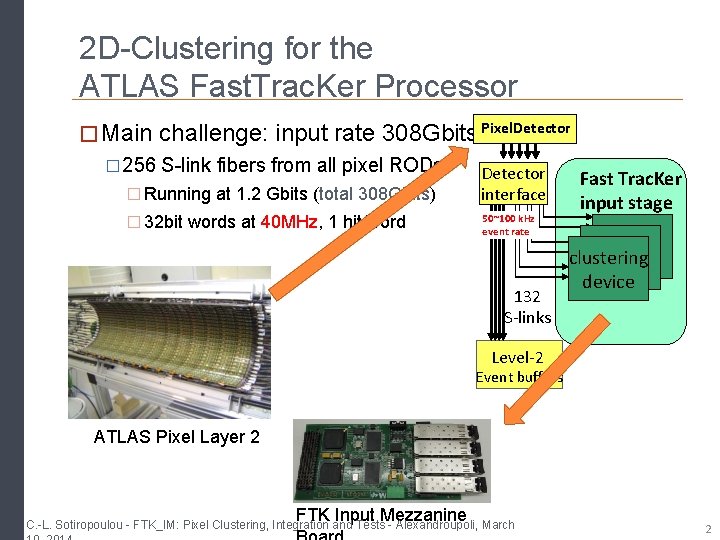
2 D-Clustering for the ATLAS Fast. Trac. Ker Processor � Main challenge: input rate 308 Gbits Pixel. Detector � 256 S-link fibers from all pixel RODs Detector � Running at 1. 2 Gbits (total 308 Gbits) interface � 32 bit words at 40 MHz, 1 hit/word 50~100 k. Hz event rate 132 S-links Fast Trac. Ker input stage clustering device Level-2 Event buffers ATLAS Pixel Layer 2 FTK Input Mezzanine C. -L. Sotiropoulou - FTK_IM: Pixel Clustering, Integration and Tests - Alexandroupoli, March 2
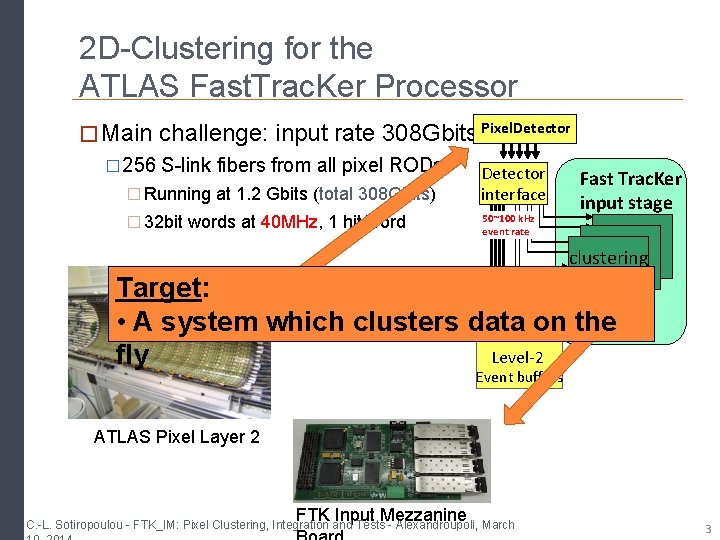
2 D-Clustering for the ATLAS Fast. Trac. Ker Processor � Main challenge: input rate 308 Gbits Pixel. Detector � 256 S-link fibers from all pixel RODs Detector � Running at 1. 2 Gbits (total 308 Gbits) interface � 32 bit words at 40 MHz, 1 hit/word 50~100 k. Hz event rate Fast Trac. Ker input stage clustering device Target: 132 S-links • A system which clusters data on the Level-2 fly Event buffers ATLAS Pixel Layer 2 FTK Input Mezzanine C. -L. Sotiropoulou - FTK_IM: Pixel Clustering, Integration and Tests - Alexandroupoli, March 3
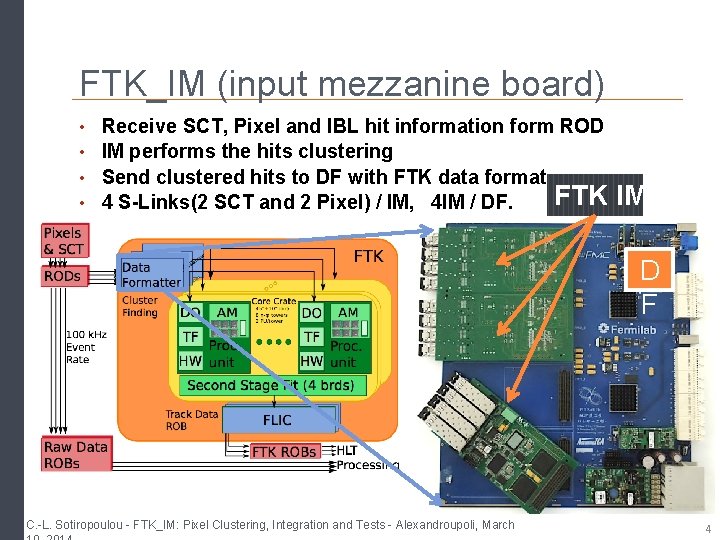
FTK_IM (input mezzanine board) • • Receive SCT, Pixel and IBL hit information form ROD IM performs the hits clustering Send clustered hits to DF with FTK data format. FTK 4 S-Links(2 SCT and 2 Pixel) / IM, 4 IM / DF. IM D F C. -L. Sotiropoulou - FTK_IM: Pixel Clustering, Integration and Tests - Alexandroupoli, March 4
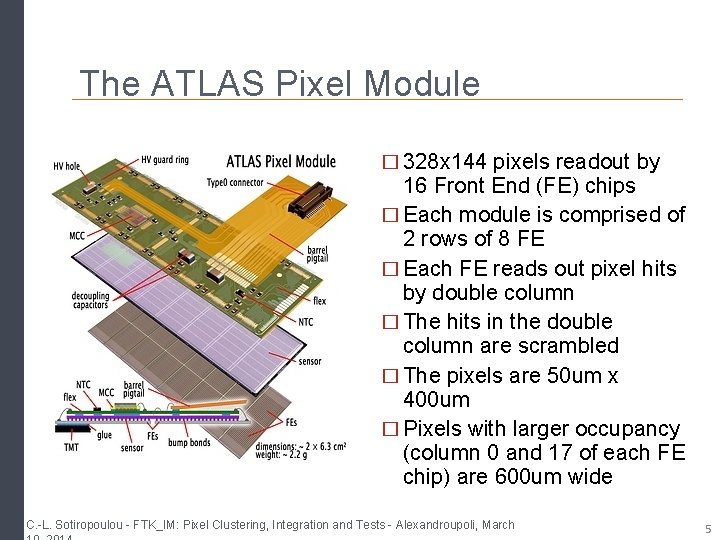
The ATLAS Pixel Module � 328 x 144 pixels readout by 16 Front End (FE) chips � Each module is comprised of 2 rows of 8 FE � Each FE reads out pixel hits by double column � The hits in the double column are scrambled � The pixels are 50 um x 400 um � Pixels with larger occupancy (column 0 and 17 of each FE chip) are 600 um wide C. -L. Sotiropoulou - FTK_IM: Pixel Clustering, Integration and Tests - Alexandroupoli, March 5
The Clustering Problem 3 9 � The work on Pixel 7 1 Clustering started last April 13 15 4 8 6 11 � Associate hits from same cluster 12 2 5 10 � Loop over hit list � Time increases with 14 occupancy & instantaneous luminosity � Non linear execution time The Cluster Hits arrive scrambled Loop over the list of hits � Goal: 1 2 3 4 5 6 7 8 9 10 Keep up with 40 Mhz hit input rate C. -L. Sotiropoulou - FTK_IM: Pixel Clustering, Integration and Tests - Alexandroupoli, March 6
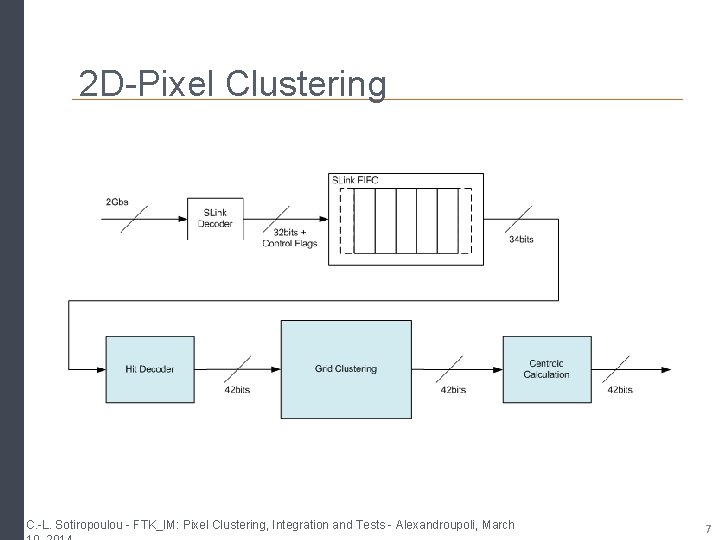
2 D-Pixel Clustering C. -L. Sotiropoulou - FTK_IM: Pixel Clustering, Integration and Tests - Alexandroupoli, March 7
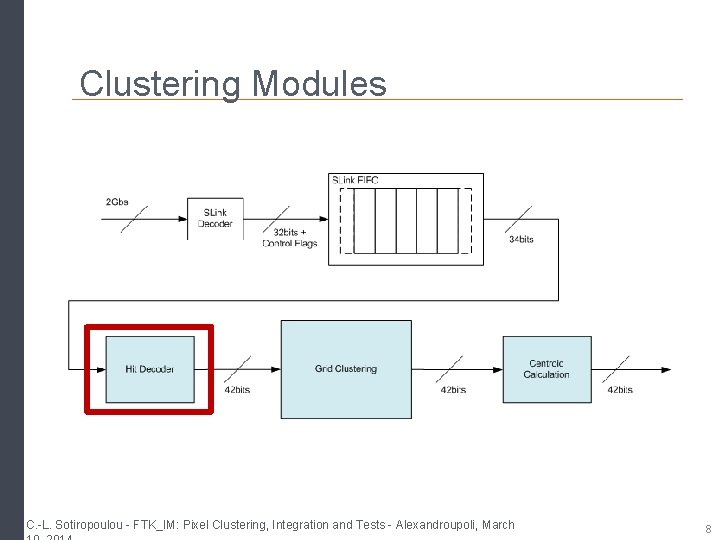
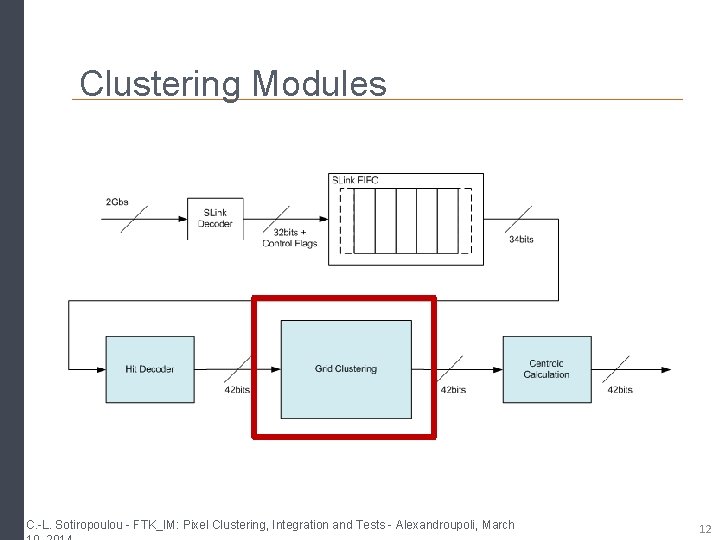
Clustering Modules C. -L. Sotiropoulou - FTK_IM: Pixel Clustering, Integration and Tests - Alexandroupoli, March 8
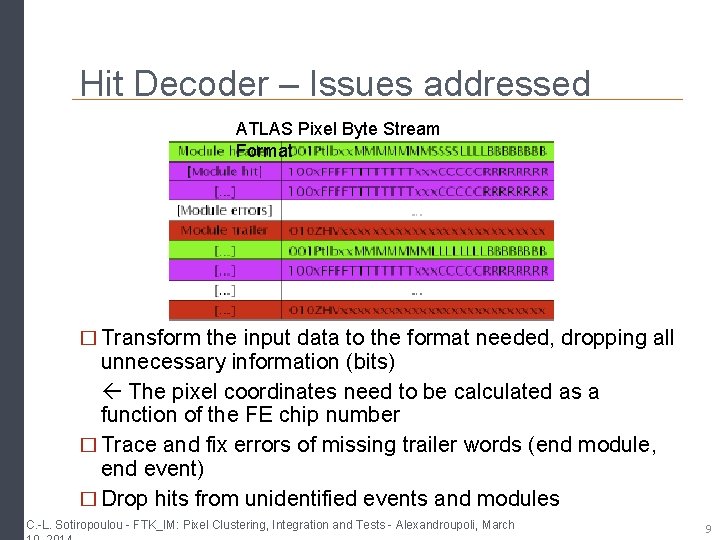
Hit Decoder – Issues addressed ATLAS Pixel Byte Stream Format � Transform the input data to the format needed, dropping all unnecessary information (bits) The pixel coordinates need to be calculated as a function of the FE chip number � Trace and fix errors of missing trailer words (end module, end event) � Drop hits from unidentified events and modules C. -L. Sotiropoulou - FTK_IM: Pixel Clustering, Integration and Tests - Alexandroupoli, March 9
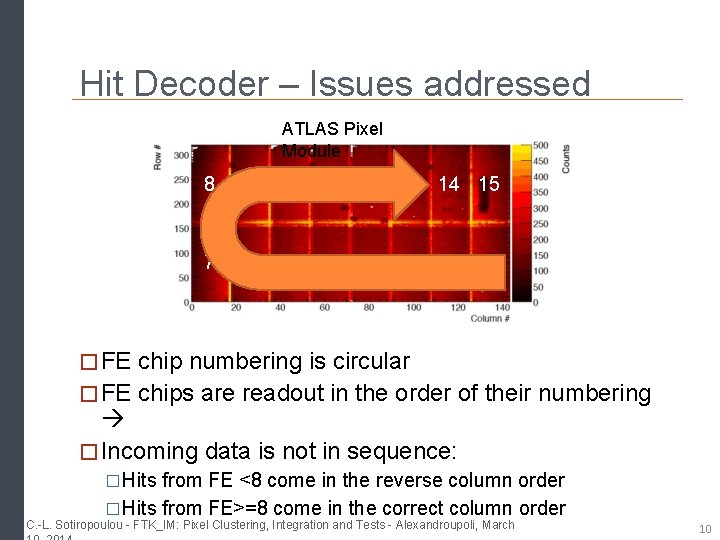
Hit Decoder – Issues addressed ATLAS Pixel Module 8 9 10 11 12 13 14 15 7 6 5 4 3 2 1 0 � FE chip numbering is circular � FE chips are readout in the order of their numbering � Incoming data is not in sequence: �Hits from FE <8 come in the reverse column order �Hits from FE>=8 come in the correct column order C. -L. Sotiropoulou - FTK_IM: Pixel Clustering, Integration and Tests - Alexandroupoli, March 10
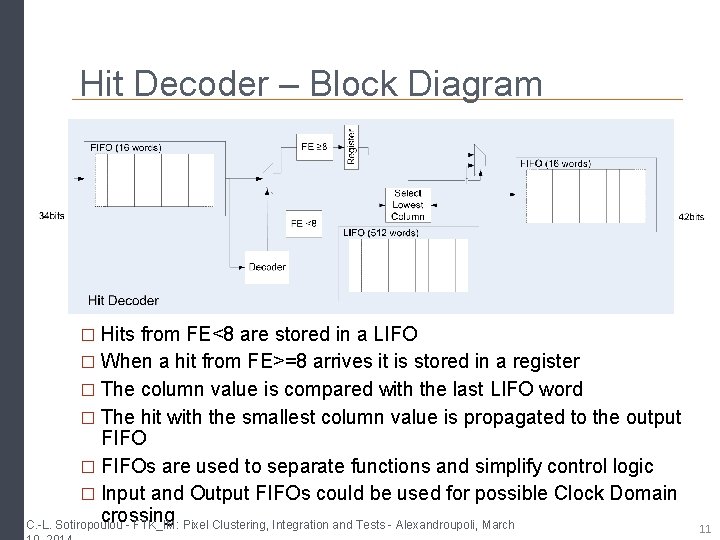
Hit Decoder – Block Diagram � Hits from FE<8 are stored in a LIFO � When a hit from FE>=8 arrives it is stored in a register � The column value is compared with the last LIFO word � The hit with the smallest column value is propagated to the output FIFO � FIFOs are used to separate functions and simplify control logic � Input and Output FIFOs could be used for possible Clock Domain crossing C. -L. Sotiropoulou - FTK_IM: Pixel Clustering, Integration and Tests - Alexandroupoli, March 11
Clustering Modules C. -L. Sotiropoulou - FTK_IM: Pixel Clustering, Integration and Tests - Alexandroupoli, March 12
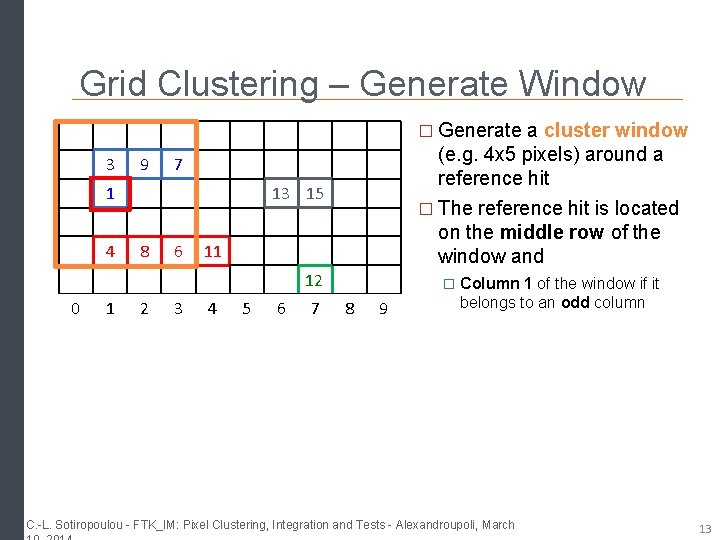
Grid Clustering – Generate Window � Generate a cluster window 3 9 1 4 (e. g. 4 x 5 pixels) around a reference hit � The reference hit is located on the middle row of the window and 7 13 15 8 6 11 12 0 1 2 3 4 5 6 7 � Column 1 of the window if it 8 9 belongs to an odd column C. -L. Sotiropoulou - FTK_IM: Pixel Clustering, Integration and Tests - Alexandroupoli, March 13
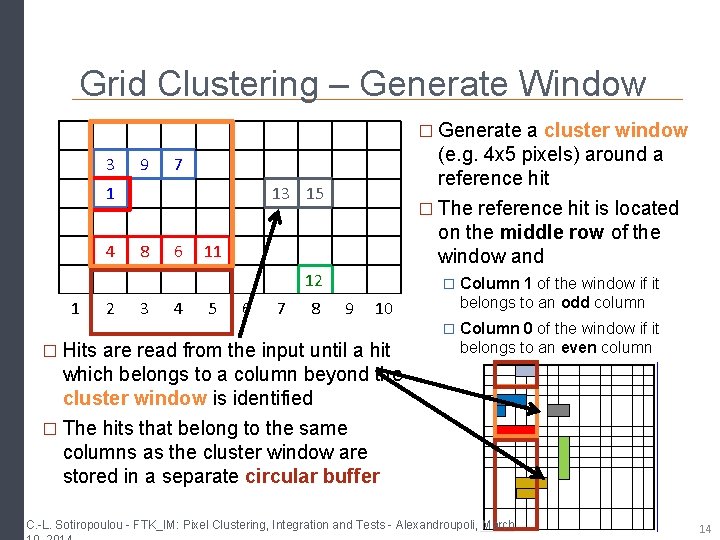
Grid Clustering – Generate Window � Generate a cluster window 3 9 1 4 (e. g. 4 x 5 pixels) around a reference hit � The reference hit is located on the middle row of the window and 7 13 15 8 6 11 12 1 2 3 4 5 6 7 8 � Column 1 of the window if it 9 10 � Hits are read from the input until a hit belongs to an odd column � Column 0 of the window if it belongs to an even column which belongs to a column beyond the cluster window is identified � The hits that belong to the same columns as the cluster window are stored in a separate circular buffer C. -L. Sotiropoulou - FTK_IM: Pixel Clustering, Integration and Tests - Alexandroupoli, March 14
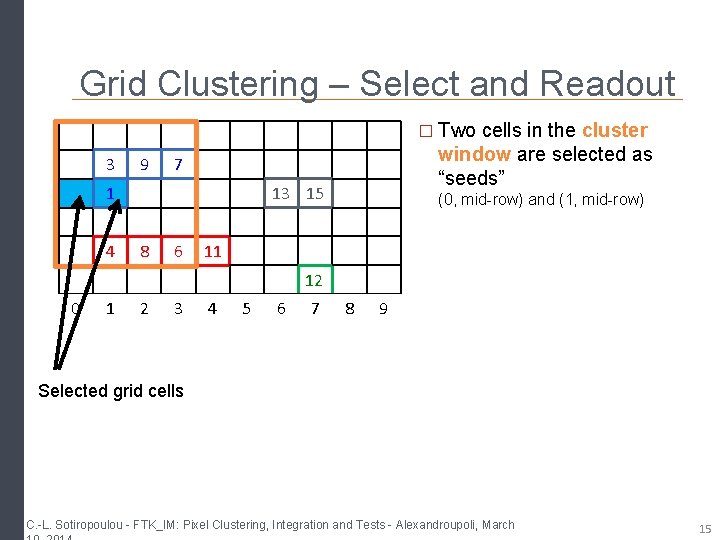
Grid Clustering – Select and Readout � Two cells in the cluster 3 9 1 4 window are selected as “seeds” 7 13 15 8 6 (0, mid-row) and (1, mid-row) 11 12 0 1 2 3 4 5 6 7 8 9 Selected grid cells C. -L. Sotiropoulou - FTK_IM: Pixel Clustering, Integration and Tests - Alexandroupoli, March 15
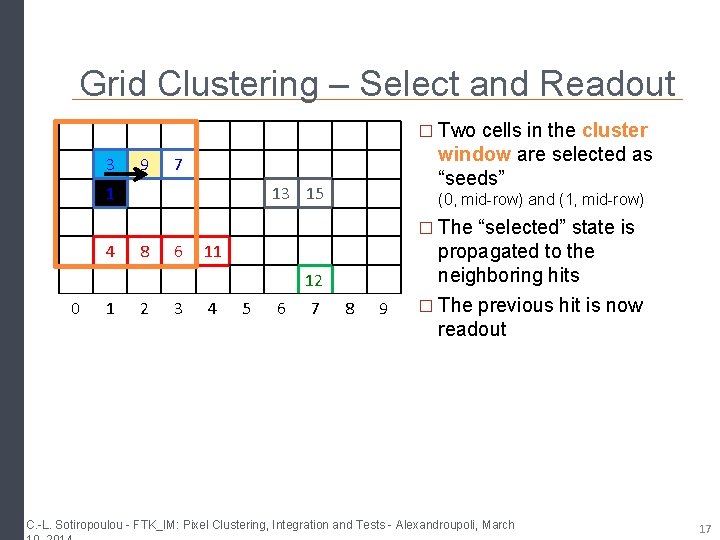
Grid Clustering – Select and Readout � Two cells in the cluster 3 9 window are selected as “seeds” 7 1 13 15 (0, mid-row) and (1, mid-row) � The “selected” state is 4 8 6 11 propagated to the neighboring hits 12 0 1 2 3 4 5 6 7 8 9 C. -L. Sotiropoulou - FTK_IM: Pixel Clustering, Integration and Tests - Alexandroupoli, March 16
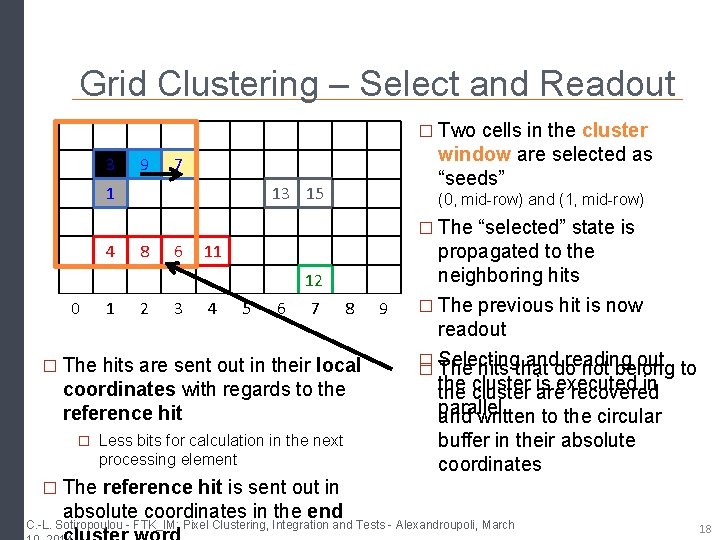
Grid Clustering – Select and Readout � Two cells in the cluster 3 9 window are selected as “seeds” 7 1 13 15 (0, mid-row) and (1, mid-row) � The “selected” state is 4 8 6 11 12 0 1 2 3 4 5 6 7 8 9 propagated to the neighboring hits � The previous hit is now readout C. -L. Sotiropoulou - FTK_IM: Pixel Clustering, Integration and Tests - Alexandroupoli, March 17
Grid Clustering – Select and Readout � Two cells in the cluster 3 9 window are selected as “seeds” 7 1 13 15 (0, mid-row) and (1, mid-row) � The “selected” state is 4 8 6 11 12 0 1 2 3 4 5 6 7 8 � The hits are sent out in their local coordinates with regards to the reference hit � Less bits for calculation in the next processing element 9 propagated to the neighboring hits � The previous hit is now readout � anddo reading out to � Selecting The hits that not belong the in the cluster is areexecuted recovered parallel and written to the circular buffer in their absolute coordinates � The reference hit is sent out in absolute coordinates in the end C. -L. Sotiropoulou - FTK_IM: Pixel Clustering, Integration and Tests - Alexandroupoli, March 18
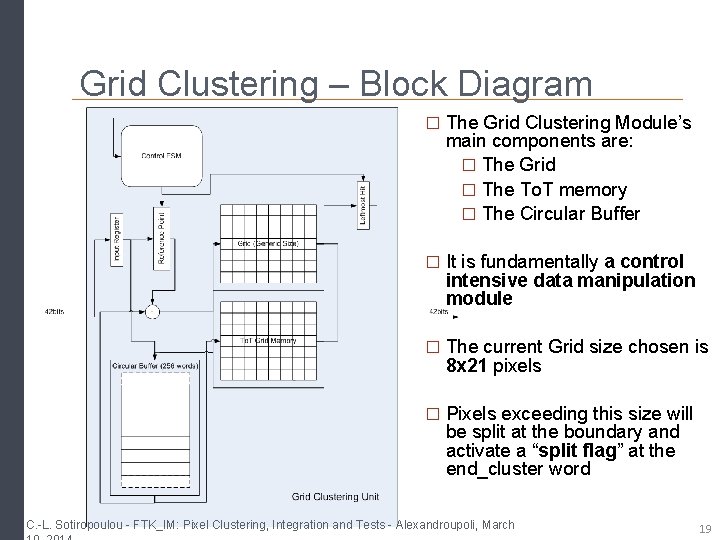
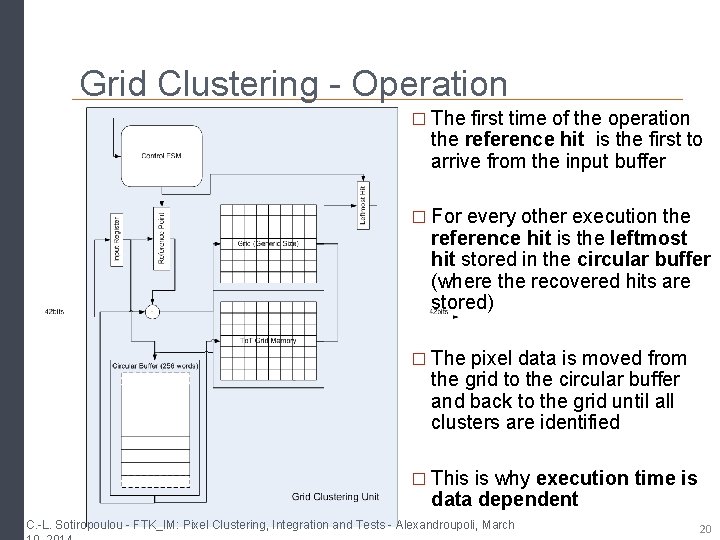
Grid Clustering – Block Diagram � The Grid Clustering Module’s main components are: � The Grid � The To. T memory � The Circular Buffer � It is fundamentally a control intensive data manipulation module � The current Grid size chosen is 8 x 21 pixels � Pixels exceeding this size will be split at the boundary and activate a “split flag” at the end_cluster word C. -L. Sotiropoulou - FTK_IM: Pixel Clustering, Integration and Tests - Alexandroupoli, March 19
Grid Clustering - Operation � The first time of the operation the reference hit is the first to arrive from the input buffer � For every other execution the reference hit is the leftmost hit stored in the circular buffer (where the recovered hits are stored) � The pixel data is moved from the grid to the circular buffer and back to the grid until all clusters are identified � This is why execution time is data dependent C. -L. Sotiropoulou - FTK_IM: Pixel Clustering, Integration and Tests - Alexandroupoli, March 20
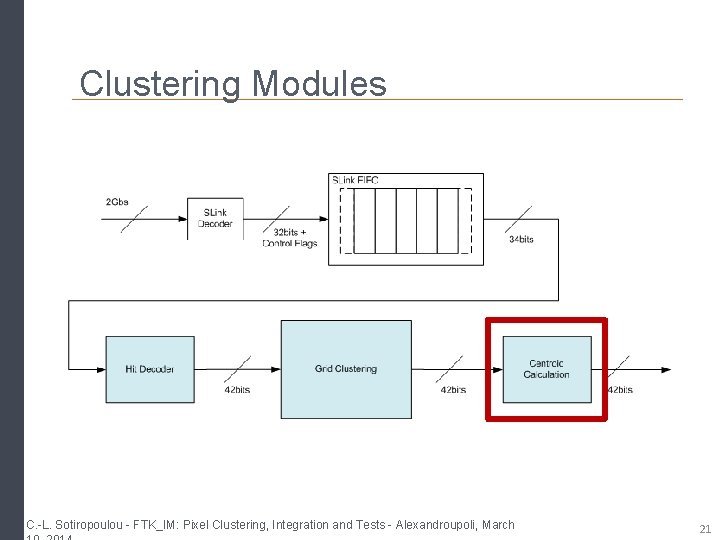
Clustering Modules C. -L. Sotiropoulou - FTK_IM: Pixel Clustering, Integration and Tests - Alexandroupoli, March 21
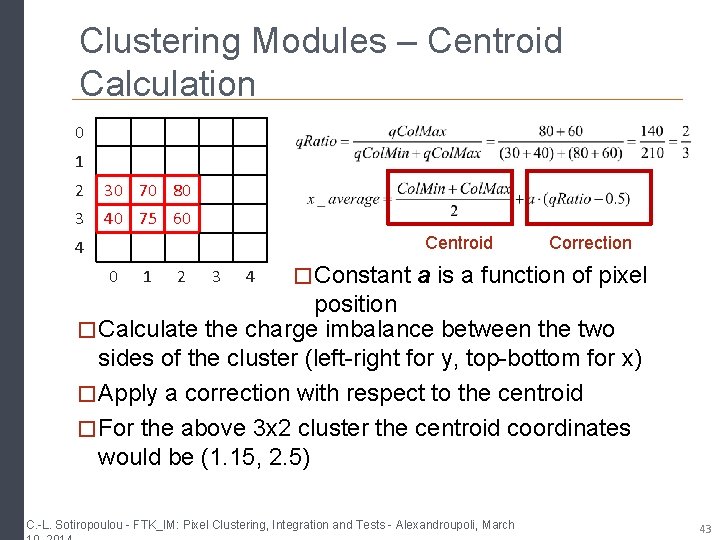
Clustering Modules – Centroid Calculation � A calculation of the average coordinate without using To. T was the baseline for the FTK TDR � A correction based on To. T (linear interpolation) and pixel absolute position will be implemented �This is beyond baseline FTK �FW to be planned and written � The Centroid Calculation step will output the cluster centroid and also the cluster size in two coordinates C. -L. Sotiropoulou - FTK_IM: Pixel Clustering, Integration and Tests - Alexandroupoli, March 22
Clustering – Parallel Version � The fundamental characteristic of the 2 D-Pixel Clustering implementation is that different clustering engines can work independently on different data Increase performance with greater FPGA resource usage � A parallelization strategy was chosen: �Instantiate multiple clustering engines (grid clustering modules) that work independently on data from separate pixel modules �To achieve this data parallelizing (demultiplexing) and data serializing (multiplexing) modules are necessary C. -L. Sotiropoulou - FTK_IM: Pixel Clustering, Integration and Tests - Alexandroupoli, March 23
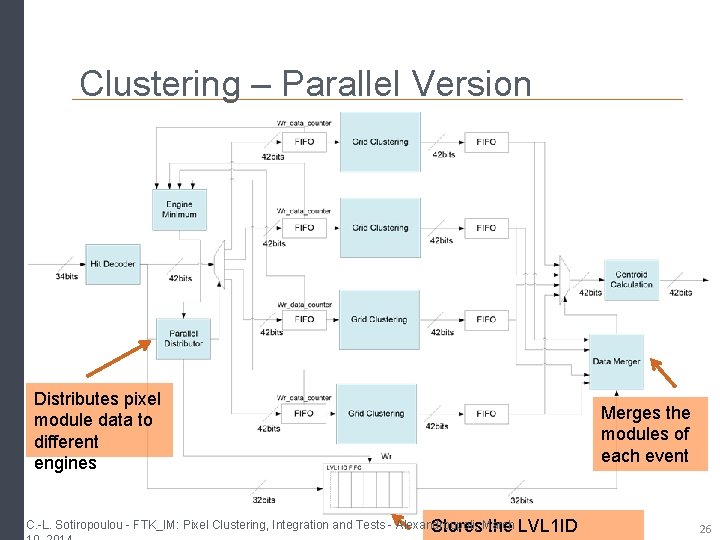
Clustering – Parallel Version � Parallel Distributor (Data Demultiplexing) �It distributes the data to the different pixel modules to different clustering engines by choosing always the “less busy engine” �The less busy engine is decided by the number of data words each engine has queued at its input � There is a LVL 1 ID FIFO which stores the LVL 1 IDs of the processed events in the arrived sequence so that they are recovered in the same sequence from the Data Multiplexing module C. -L. Sotiropoulou - FTK_IM: Pixel Clustering, Integration and Tests - Alexandroupoli, March 24
Clustering – Parallel Version � Data Merger (Data Multiplexing) �It begins operation as soon as the LVL 1 ID FIFO and a parallel engine have valid output �It identifies the parallel engines that have the same event and propagates data out from the engine with the smallest index number �The other engines continue working and storing data at their output FIFOs until they are almost full. Then backpressure is applied at the clustering modules. � The parallel engines are buffered with FIFOs at input and output to avoid backpressure as much as possible C. -L. Sotiropoulou - FTK_IM: Pixel Clustering, Integration and Tests - Alexandroupoli, March 25
Clustering – Parallel Version Distributes pixel module data to different engines C. -L. Sotiropoulou - FTK_IM: Pixel Clustering, Integration and Tests - Alexandroupoli, Stores. March the LVL 1 ID Merges the modules of each event 26
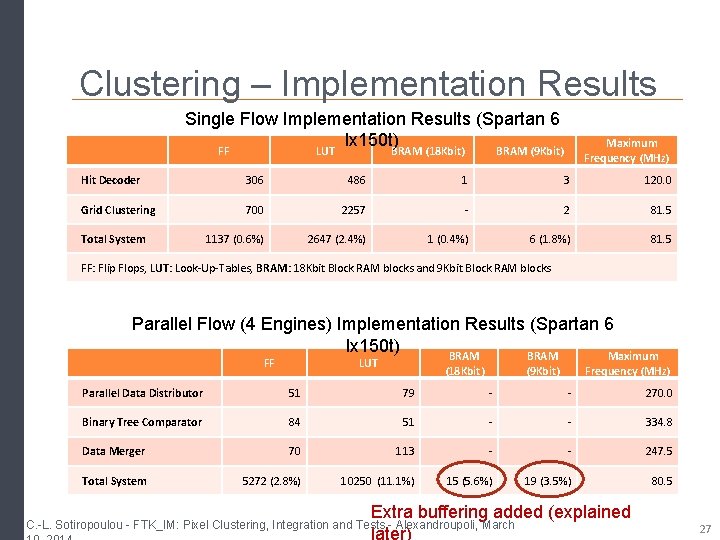
Clustering – Implementation Results Single Flow Implementation Results (Spartan 6 lx 150 t)BRAM (18 Kbit) FF LUT BRAM (9 Kbit) Maximum Frequency (MHz) Hit Decoder 306 486 1 3 120. 0 Grid Clustering 700 2257 - 2 81. 5 1137 (0. 6%) 2647 (2. 4%) 1 (0. 4%) 6 (1. 8%) 81. 5 Total System FF: Flip Flops, LUT: Look-Up-Tables, BRAM: 18 Kbit Block RAM blocks and 9 Kbit Block RAM blocks Parallel Flow (4 Engines) Implementation Results (Spartan 6 lx 150 t) BRAM Maximum FF LUT (18 Kbit) (9 Kbit) Frequency (MHz) Parallel Data Distributor 51 79 - - 270. 0 Binary Tree Comparator 84 51 - - 334. 8 Data Merger 70 113 - - 247. 5 Total System 5272 (2. 8%) 10250 (11. 1%) 15 (5. 6%) 19 (3. 5%) 80. 5 Extra buffering added (explained later) C. -L. Sotiropoulou - FTK_IM: Pixel Clustering, Integration and Tests - Alexandroupoli, March 27
Clustering – Testing Results Single Flow � Successful integration with the rest of the FTK_IM firmware � Testing with ZH nunubb files (80 pu) � Small event files (3 events: 2 modules per event) multiple times � Big event files (50 events: 7 modules per event) multiple times – this is what each pixel clustering module will receive from the RODs � Output was compared with the bit-accurate simulation (prepared by Akis – more details in his presentation) � Some very small differences exist (less than ~0. 4%) which are due to the backpressure applied by the DF and the slower than anticipated Currently being C. -L. Sotiropoulou - FTK_IM: Pixel Clustering, Integration input and Testsrate - Alexandroupoli, March 28
Clustering – Testing Results Parallel Flow � Successful integration with the rest of the FTK_IM firmware of a 4 Engine Parallel Flow � Tests with the same input files � Output same quality as the single input flow Currently debugged C. -L. Sotiropoulou - FTK_IM: Pixel Clustering, Integration and Tests - Alexandroupoli, March 29
Clustering - Performance Results (Single Flow) � For the Single Flow we have a processing time per word of 84. 15 ns � At worst case one word is read every 25 ns (40 MHz) � 84. 15/25 = 3. 36 clock cycles of 40 MHz are required for one data word processing � Therefore it was anticipated that 4 engines would be sufficient for Pixel (B Layer) worst case � The latency presented at the plot is not realistic because it the end_event words at the input are delayed due to the backpressure applied by both grid clustering and hit decoder modules C. -L. Sotiropoulou - FTK_IM: Pixel Clustering, Integration and Tests - Alexandroupoli, March 30
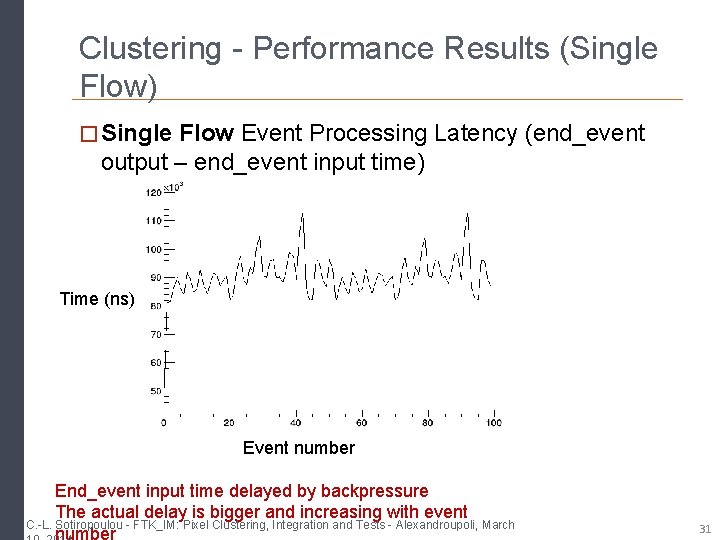
Clustering - Performance Results (Single Flow) � Single Flow Event Processing Latency (end_event output – end_event input time) Time (ns) Event number End_event input time delayed by backpressure The actual delay is bigger and increasing with event C. -L. Sotiropoulou - FTK_IM: Pixel Clustering, Integration and Tests - Alexandroupoli, March number 31
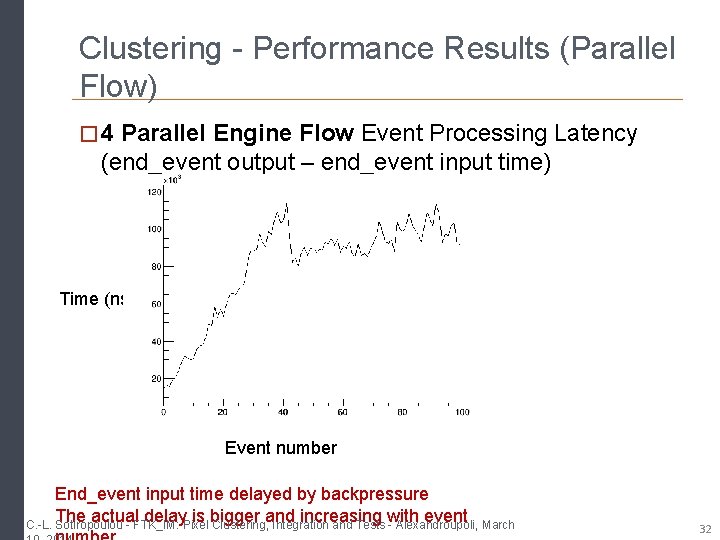
Clustering - Performance Results (Parallel Flow) � 4 Parallel Engine Flow Event Processing Latency (end_event output – end_event input time) Time (ns) Event number End_event input time delayed by backpressure The actual delay is bigger and increasing with event C. -L. Sotiropoulou - FTK_IM: Pixel Clustering, Integration and Tests - Alexandroupoli, March 32
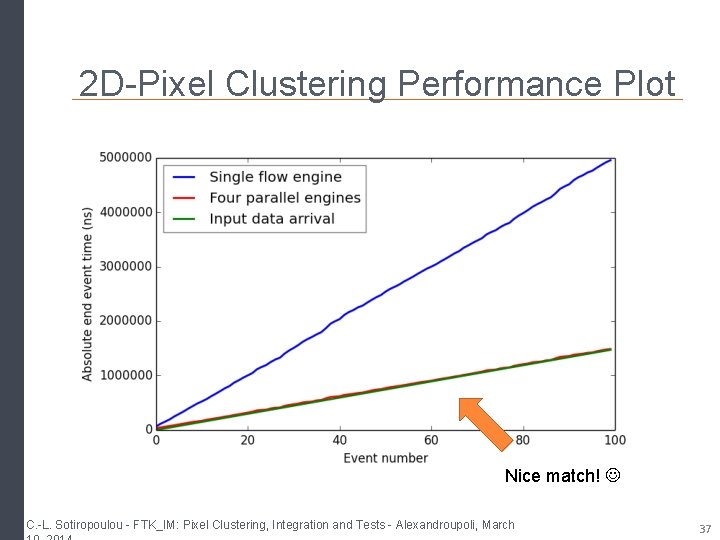
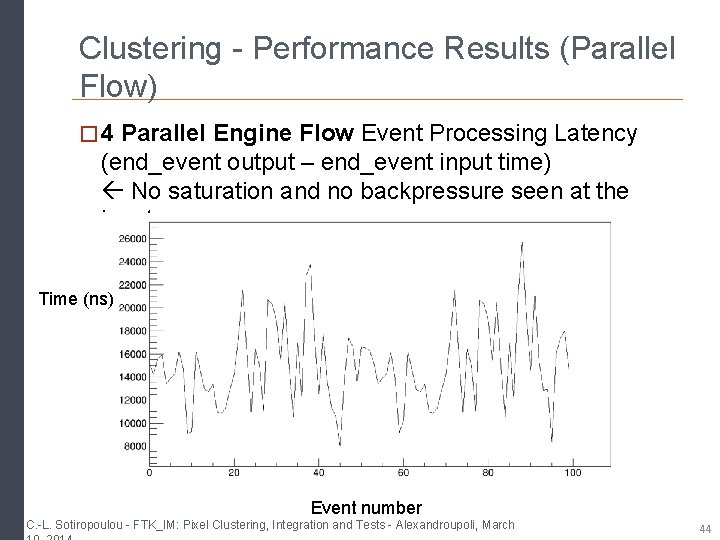
Clustering - Performance Results (Parallel Flow) � The 4 Parallel Engine Flow saturates after 30 events � This is because of the back pressure applied by the Data Merger � We increased the buffering before the Data Merger to reduce this effect � Bigger buffering processing time per word reduced to 25. 24 ns which is the 8 Parallel Engine Flow performance without the extra buffering (next slides) (0. 24 ns is due to simulation time artifacts) C. -L. Sotiropoulou - FTK_IM: Pixel Clustering, Integration and Tests - Alexandroupoli, March 33
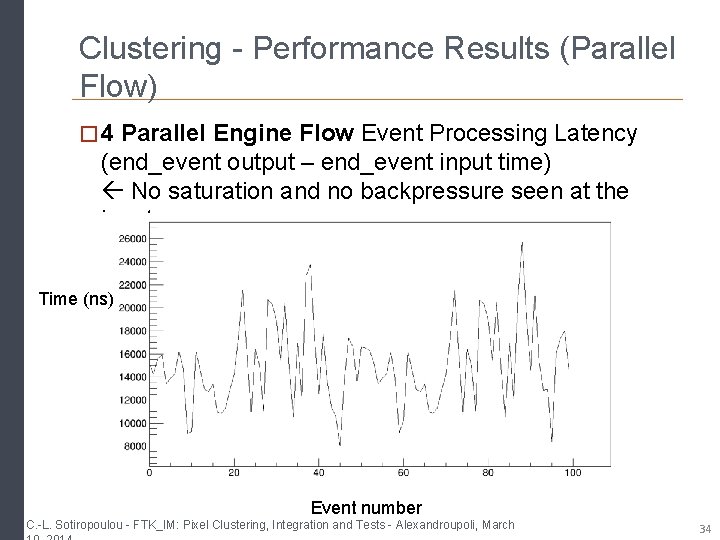
Clustering - Performance Results (Parallel Flow) � 4 Parallel Engine Flow Event Processing Latency (end_event output – end_event input time) No saturation and no backpressure seen at the input Time (ns) Event number C. -L. Sotiropoulou - FTK_IM: Pixel Clustering, Integration and Tests - Alexandroupoli, March 34
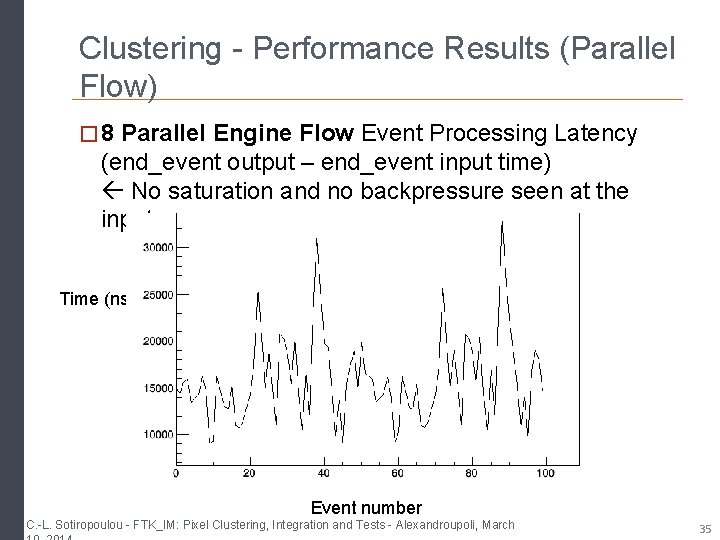
Clustering - Performance Results (Parallel Flow) � 8 Parallel Engine Flow Event Processing Latency (end_event output – end_event input time) No saturation and no backpressure seen at the input Time (ns) Event number C. -L. Sotiropoulou - FTK_IM: Pixel Clustering, Integration and Tests - Alexandroupoli, March 35
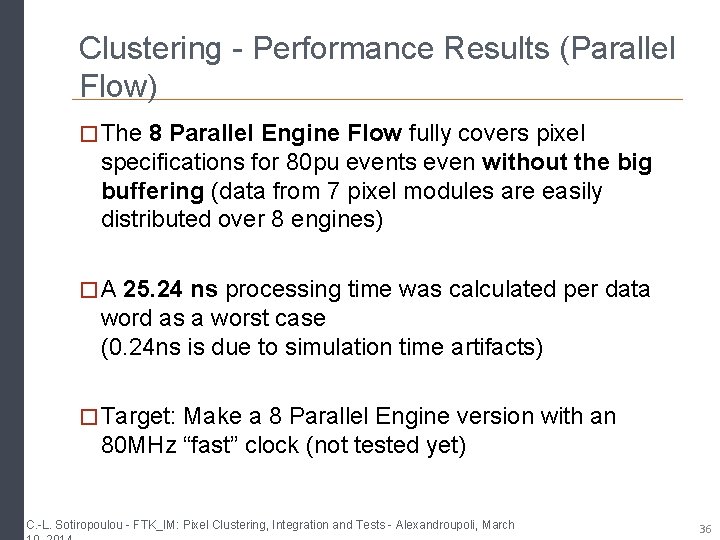
Clustering - Performance Results (Parallel Flow) � The 8 Parallel Engine Flow fully covers pixel specifications for 80 pu events even without the big buffering (data from 7 pixel modules are easily distributed over 8 engines) � A 25. 24 ns processing time was calculated per data word as a worst case (0. 24 ns is due to simulation time artifacts) � Target: Make a 8 Parallel Engine version with an 80 MHz “fast” clock (not tested yet) C. -L. Sotiropoulou - FTK_IM: Pixel Clustering, Integration and Tests - Alexandroupoli, March 36
2 D-Pixel Clustering Performance Plot Nice match! C. -L. Sotiropoulou - FTK_IM: Pixel Clustering, Integration and Tests - Alexandroupoli, March 37
2 D-Pixel Clustering Dissemination � Presented in: �ICATPP 2013 �IEEE NSS 2013 �In the merged presentation of TWEPP 2013 � A paper for IEEE TNS currently written (first draft finished, under review by the authors) � Three (3) more abstracts submitted C. -L. Sotiropoulou - FTK_IM: Pixel Clustering, Integration and Tests - Alexandroupoli, March 38
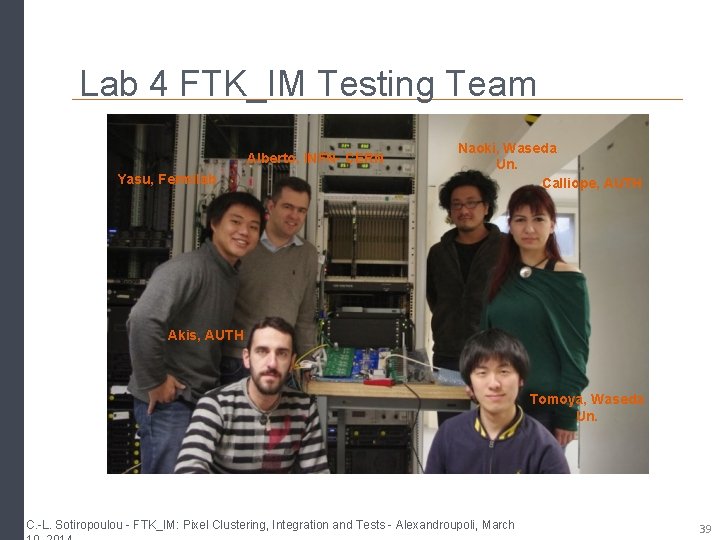
Lab 4 FTK_IM Testing Team Alberto, INFN- CERN Yasu, Fermilab Naoki, Waseda Un. Calliope, AUTH Akis, AUTH Tomoya, Waseda Un. C. -L. Sotiropoulou - FTK_IM: Pixel Clustering, Integration and Tests - Alexandroupoli, March 39
Clustering – Next Steps � Finalize parallel FW (debugging etc. ) � Finalize integrated version (issues with the wrapper, error words, monitoring etc. ) � Prepare simplified centroid calculator �Implement final output format �Then ready for tests with AUX card � Study IBL data flow (and implement IBL FW) � Maximum input hit rate from IBL : 100 MHz � Higher occupancy � IBL data flow not trivial & not solved yet A lot happened with pixel clustering in the last year… C. -L. Sotiropoulou - FTK_IM: Pixel Clustering, Integration and Tests - Alexandroupoli, March 40
Back. Up C. -L. Sotiropoulou - FTK_IM: Pixel Clustering, Integration and Tests - Alexandroupoli, March 41
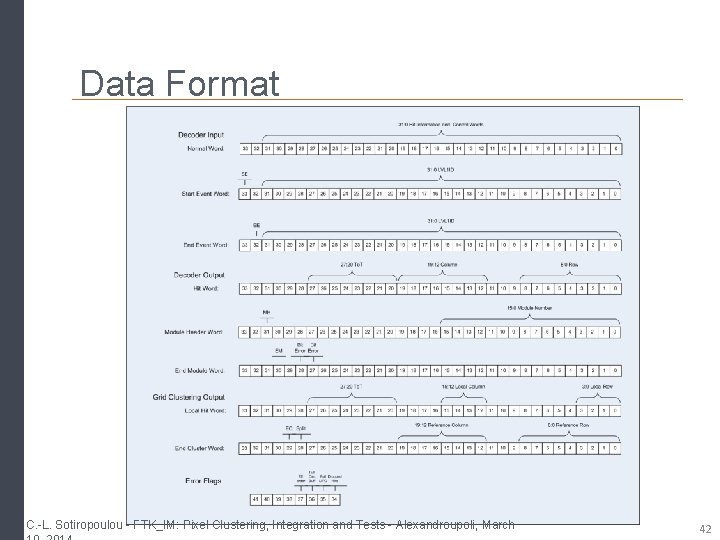
Data Format C. -L. Sotiropoulou - FTK_IM: Pixel Clustering, Integration and Tests - Alexandroupoli, March 42
Clustering Modules – Centroid Calculation 0 1 2 30 70 80 3 40 75 60 Centroid 4 0 1 2 3 4 Correction � Constant a is a function of pixel position � Calculate the charge imbalance between the two sides of the cluster (left-right for y, top-bottom for x) � Apply a correction with respect to the centroid � For the above 3 x 2 cluster the centroid coordinates would be (1. 15, 2. 5) C. -L. Sotiropoulou - FTK_IM: Pixel Clustering, Integration and Tests - Alexandroupoli, March 43
Clustering - Performance Results (Parallel Flow) � 4 Parallel Engine Flow Event Processing Latency (end_event output – end_event input time) No saturation and no backpressure seen at the input Time (ns) Event number C. -L. Sotiropoulou - FTK_IM: Pixel Clustering, Integration and Tests - Alexandroupoli, March 44
Clustering - Performance Results (Parallel Flow) � 4 Parallel Engine Flow Event Processing Latency (end_event output – end_event input time) No saturation and no backpressure seen at the input � 25000 ns delay 1000 words from Slink � This also means 1000 words being distributed/processed by different engines � The parallel distributor and data merger work on one module at a time � Enough buffering before/after each engine is needed to ensure that all engines can work at full speed without waiting for data from parallel distributor and without backpressure from data merger C. -L. Sotiropoulou - FTK_IM: Pixel Clustering, Integration and Tests - Alexandroupoli, March 45