
FTIR microspectroscopy a powerful tool for spatially resolved

- Slides: 20
FT-IR microspectroscopy: a powerful tool for spatially resolved studies on supports for solid phase organic synthesis Lisa Vaccari
Outline Source for Imaging and Spectroscopic Studies in the Infrared Solid phase organic synthesis Beamline layout Mid. IR experimental station FT-IR Microspectroscopy Introduction Reaction Kinetic Diffusion Process Acknowledgements
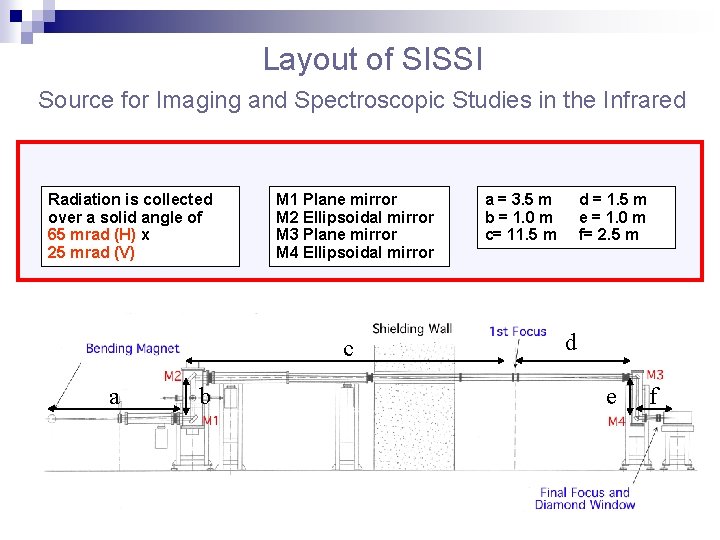
Layout of SISSI Source for Imaging and Spectroscopic Studies in the Infrared Radiation is collected over a solid angle of 65 mrad (H) x 25 mrad (V) M 1 Plane mirror M 2 Ellipsoidal mirror M 3 Plane mirror M 4 Ellipsoidal mirror c a b a = 3. 5 m b = 1. 0 m c= 11. 5 m d = 1. 5 m e = 1. 0 m f= 2. 5 m d e M 1 Plane mirror M 2 Ellipsoidal mirror M 3 Plane mirror M 4 Ellipsoidal mirror f
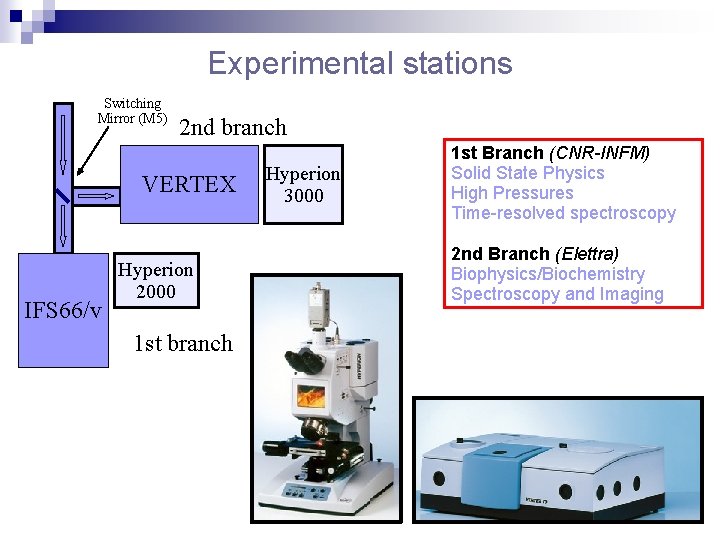
Experimental stations Switching Mirror (M 5) 2 nd branch VERTEX IFS 66/v Hyperion 2000 1 st branch Hyperion 3000 1 st Branch (CNR-INFM) Solid State Physics High Pressures Time-resolved spectroscopy 2 nd Branch (Elettra) Biophysics/Biochemistry Spectroscopy and Imaging
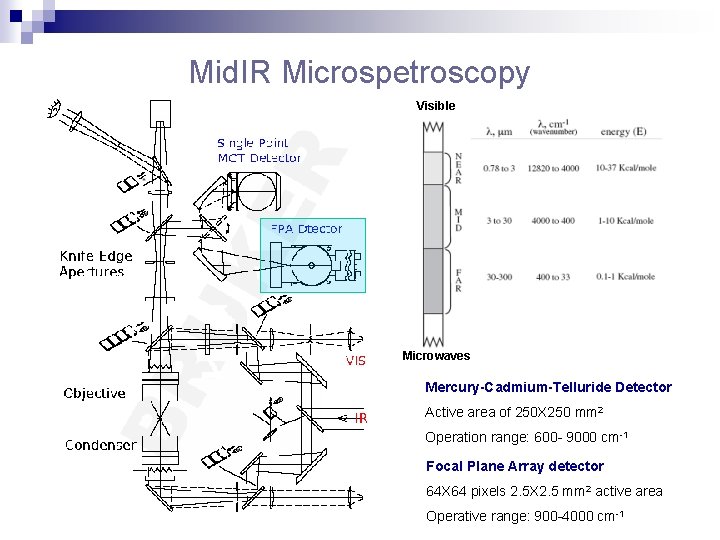
Mid. IR Microspetroscopy Visible Microwaves Mercury-Cadmium-Telluride Detector Active area of 250 X 250 mm 2 Operation range: 600 - 9000 cm-1 Focal Plane Array detector 64 X 64 pixels 2. 5 X 2. 5 mm 2 active area Operative range: 900 -4000 cm-1
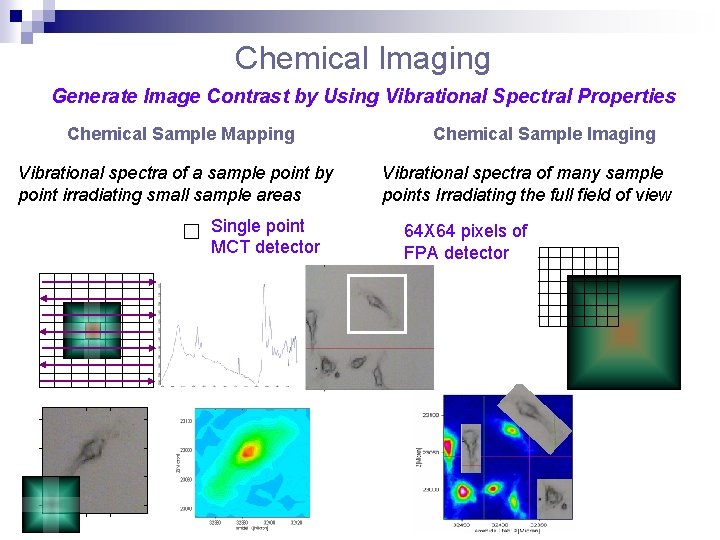
Chemical Imaging Generate Image Contrast by Using Vibrational Spectral Properties Chemical Sample Mapping Vibrational spectra of a sample point by point irradiating small sample areas Single point MCT detector Chemical Sample Imaging Vibrational spectra of many sample points Irradiating the full field of view 64 X 64 pixels of FPA detector
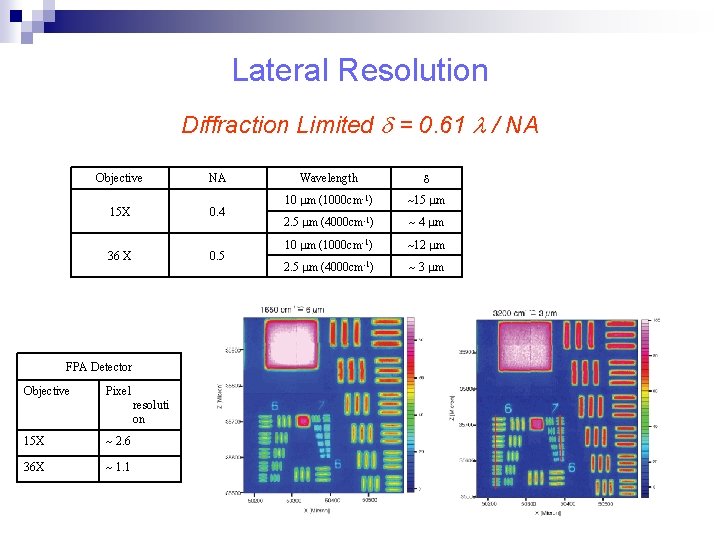
Lateral Resolution Diffraction Limited d = 0. 61 l / NA Objective NA 15 X 0. 4 36 X 0. 5 FPA Detector Objective Pixel resoluti on 15 X 2. 6 36 X 1. 1 Wavelength d 10 mm (1000 cm-1) 15 mm 2. 5 mm (4000 cm-1) 4 mm 10 mm (1000 cm-1) 12 mm 2. 5 mm (4000 cm-1) 3 mm
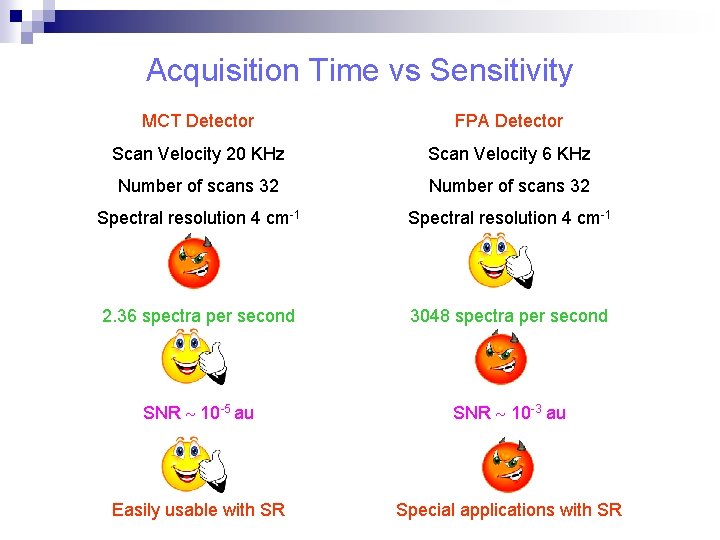
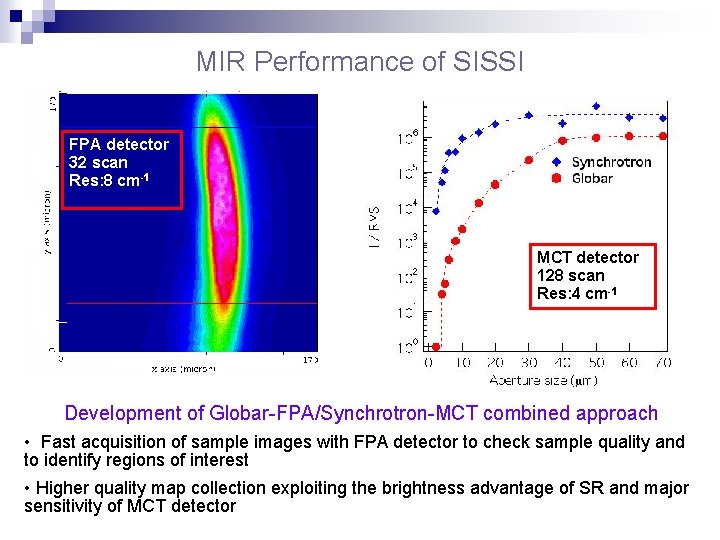
Acquisition Time vs Sensitivity MCT Detector FPA Detector Scan Velocity 20 KHz Scan Velocity 6 KHz Number of scans 32 Spectral resolution 4 cm-1 2. 36 spectra per second 3048 spectra per second SNR 10 -5 au SNR 10 -3 au Easily usable with SR Special applications with SR
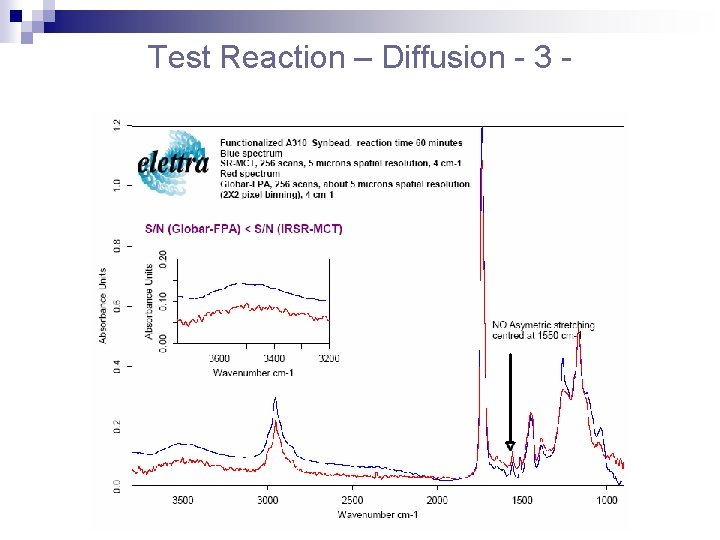
MIR Performance of SISSI FPA detector 32 scan Res: 8 cm-1 MCT detector 128 scan Res: 4 cm-1 Development of Globar-FPA/Synchrotron-MCT combined approach • Fast acquisition of sample images with FPA detector to check sample quality and to identify regions of interest • Higher quality map collection exploiting the brightness advantage of SR and major sensitivity of MCT detector
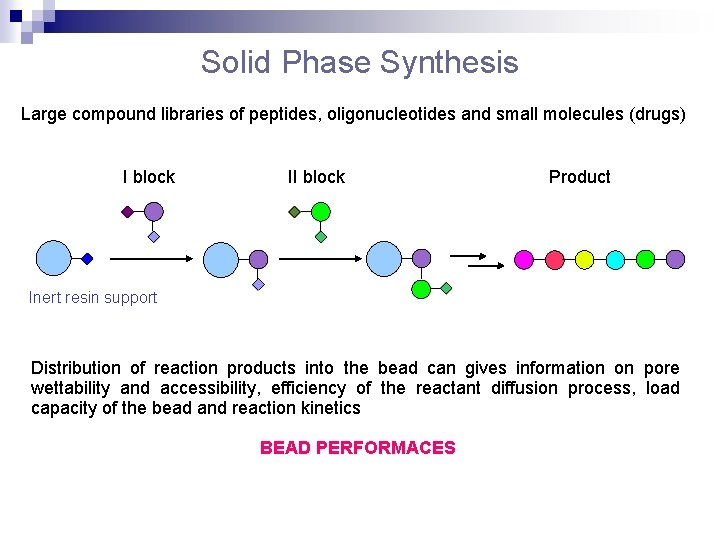
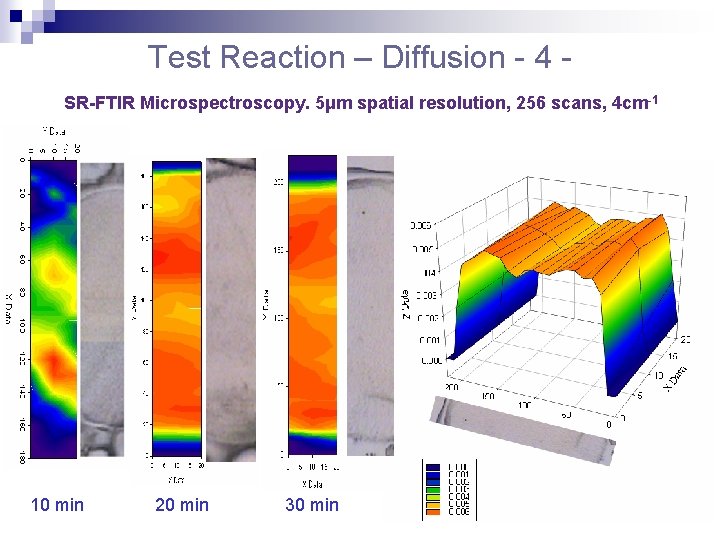
Solid Phase Synthesis Large compound libraries of peptides, oligonucleotides and small molecules (drugs) I block II block Product Inert resin support Distribution of reaction products into the bead can gives information on pore wettability and accessibility, efficiency of the reactant diffusion process, load capacity of the bead and reaction kinetics BEAD PERFORMACES
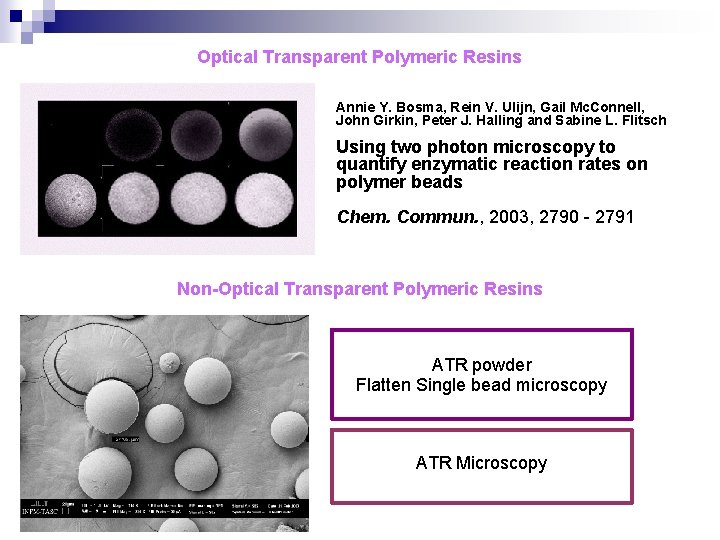
Optical Transparent Polymeric Resins Annie Y. Bosma, Rein V. Ulijn, Gail Mc. Connell, John Girkin, Peter J. Halling and Sabine L. Flitsch Using two photon microscopy to quantify enzymatic reaction rates on polymer beads Chem. Commun. , 2003, 2790 - 2791 Non-Optical Transparent Polymeric Resins ATR powder Flatten Single bead microscopy ATR Microscopy
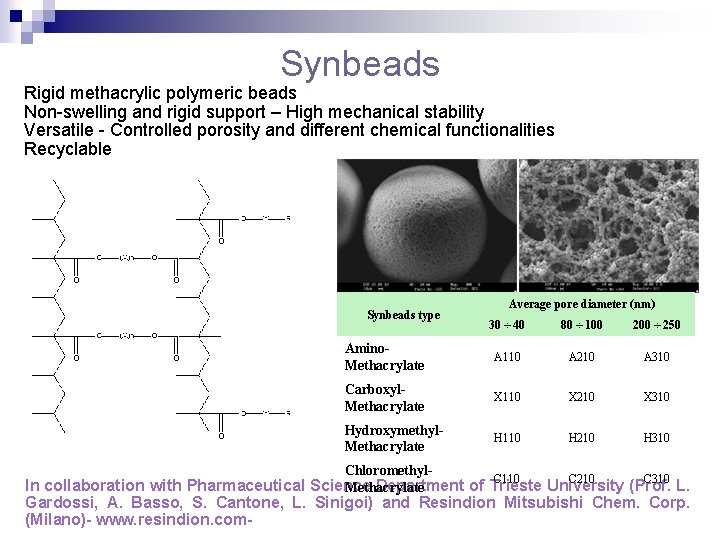
Synbeads Rigid methacrylic polymeric beads Non-swelling and rigid support – High mechanical stability Versatile - Controlled porosity and different chemical functionalities Recyclable Synbeads type Average pore diameter (nm) 30 ÷ 40 80 ÷ 100 200 ÷ 250 Amino. Methacrylate A 110 A 210 A 310 Carboxyl. Methacrylate X 110 X 210 X 310 Hydroxymethyl. Methacrylate H 110 H 210 H 310 Chloromethyl. C 110 C 210 C 310 In collaboration with Pharmaceutical Science Department of Trieste University (Prof. L. Methacrylate Gardossi, A. Basso, S. Cantone, L. Sinigoi) and Resindion Mitsubishi Chem. Corp. (Milano)- www. resindion. com-
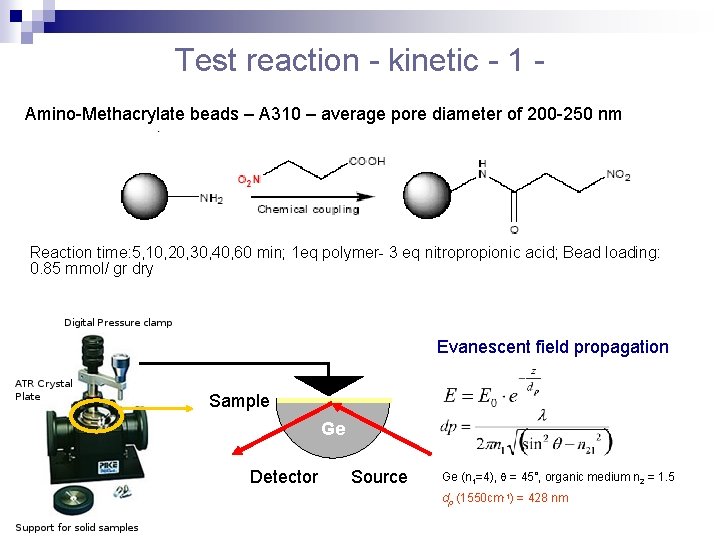
Test reaction - kinetic - 1 Amino-Methacrylate beads – A 310 – average pore diameter of 200 -250 nm Reaction time: 5, 10, 20, 30, 40, 60 min; 1 eq polymer- 3 eq nitropropionic acid; Bead loading: 0. 85 mmol/ gr dry Evanescent field propagation Sample Ge Detector Source Ge (n 1=4), = 45˚, organic medium n 2 = 1. 5 dp (1550 cm-1) = 428 nm
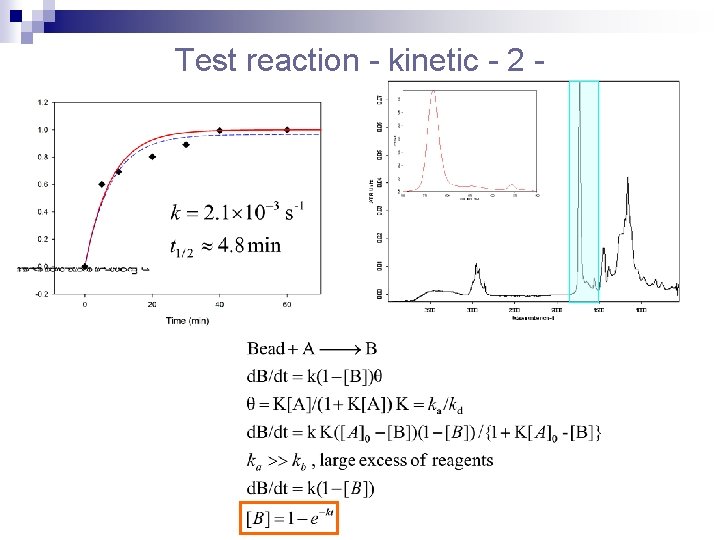
Test reaction - kinetic - 2 -
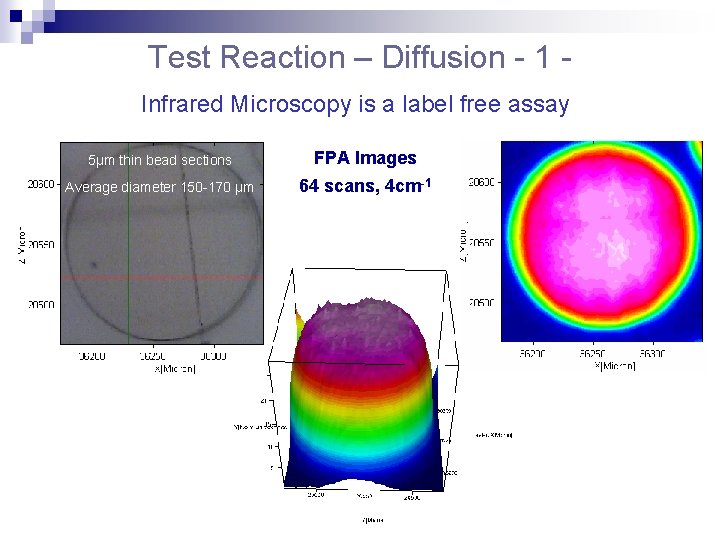
Test Reaction – Diffusion - 1 Infrared Microscopy is a label free assay 5μm thin bead sections FPA Images Average diameter 150 -170 μm 64 scans, 4 cm-1
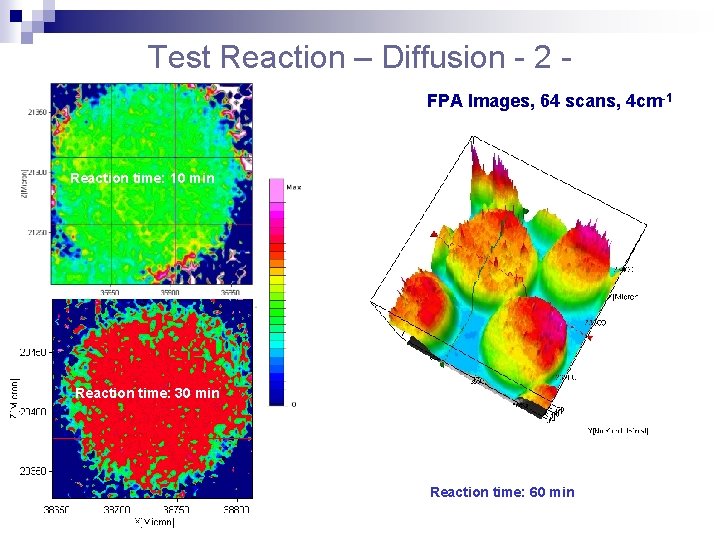
Test Reaction – Diffusion - 2 FPA Images, 64 scans, 4 cm-1 Reaction time: 10 min Reaction time: 30 min Reaction time: 60 min
Test Reaction – Diffusion - 3 -
Test Reaction – Diffusion - 4 SR-FTIR Microspectroscopy. 5μm spatial resolution, 256 scans, 4 cm-1 10 min 20 min 30 min
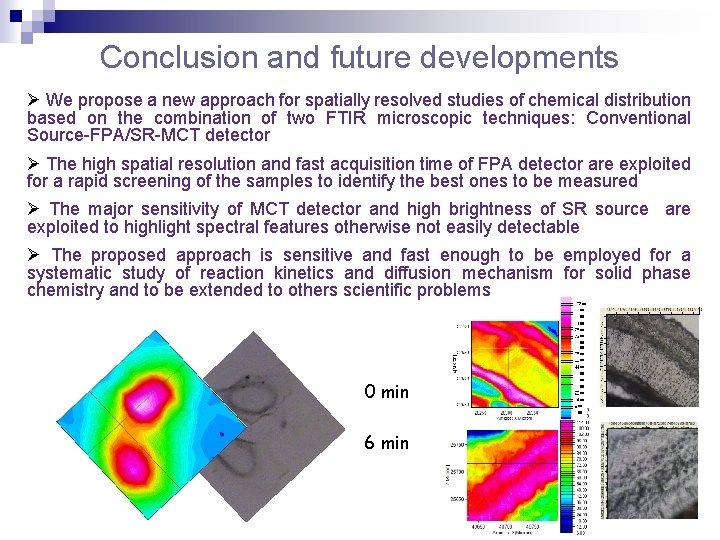
Conclusion and future developments Ø We propose a new approach for spatially resolved studies of chemical distribution based on the combination of two FTIR microscopic techniques: Conventional Source-FPA/SR-MCT detector Ø The high spatial resolution and fast acquisition time of FPA detector are exploited for a rapid screening of the samples to identify the best ones to be measured Ø The major sensitivity of MCT detector and high brightness of SR source are exploited to highlight spectral features otherwise not easily detectable Ø The proposed approach is sensitive and fast enough to be employed for a systematic study of reaction kinetics and diffusion mechanism for solid phase chemistry and to be extended to others scientific problems 0 min 6 min
Acknowledgements Trieste University – Pharmaceutical Science Department Prof. Lucia Gradossi, Alessandra Basso, Sara Cantone and Loris Sinigoi SISSI group M. Kiskinova, D. Eichert, F. Morgera G. Birarda and D. Bedolla S. Lupi, A. Perucchi, R. Sopracase, Thanks for your attention