
FSSC 22000 Nonconformities TQCSI Training Agenda FSSC 22000

- Slides: 16
FSSC 22000 Nonconformities TQCSI Training
Agenda • FSSC 22000 auditors • Version 5 documentation • grading of nonconformities • escalation for system issues • Version 5 Audit Report • new nonconformities format • Harmonisation training.
References • FSSC 22000 Scheme Version 4. 1 • FSSC 22000 Scheme Version 5 • WI 54 – FSSC 22000 • WI 81 – FSSC Auditors • WI 90 – F Codes • TQCSIF-06 – TQCSI Rules of Certification for FSSC 22000 (V 5) • TQCSIF-20 EA/B/C – Audit Report – FSSC 22000 • TQCSIF-30 A – FSSC 22000 Nonconformity Report (Draft) • TQCSIF-142 – FSSC 22000 (ISO 22000 + Additional Requirements) Checklist • TQCSIF-142 A – ISO 22002 -1 (Manufacturing PRP) Checklist • TQCSIF-142 B – ISO 22002 -4 (Food Packaging Manufacturing PRP) Checklist.
Website • use TQCSI website for marketing FSSC 22000 • www. tqcsi. com, Our Services, Certification Standards, FSSC 22000.
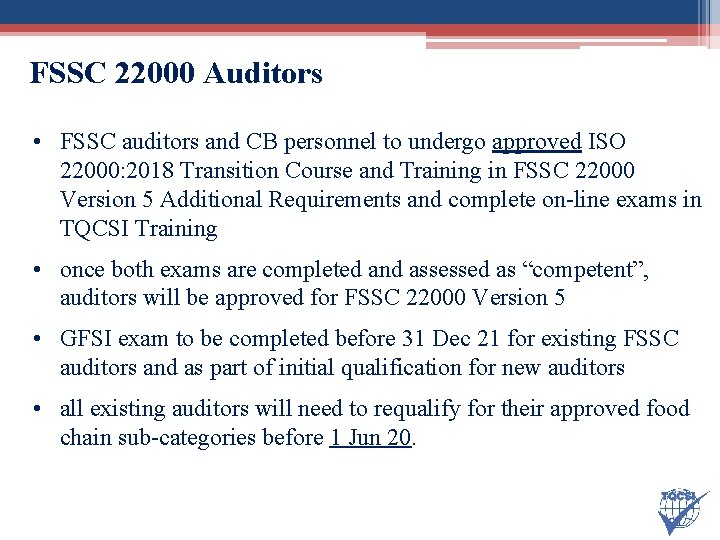
FSSC 22000 Auditors • FSSC auditors and CB personnel to undergo approved ISO 22000: 2018 Transition Course and Training in FSSC 22000 Version 5 Additional Requirements and complete on-line exams in TQCSI Training • once both exams are completed and assessed as “competent”, auditors will be approved for FSSC 22000 Version 5 • GFSI exam to be completed before 31 Dec 21 for existing FSSC auditors and as part of initial qualification for new auditors • all existing auditors will need to requalify for their approved food chain sub-categories before 1 Jun 20.
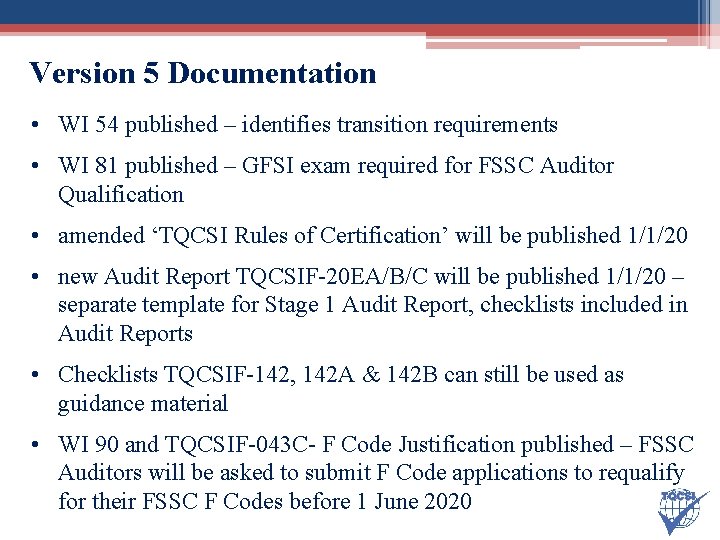
Version 5 Documentation • WI 54 published – identifies transition requirements • WI 81 published – GFSI exam required for FSSC Auditor Qualification • amended ‘TQCSI Rules of Certification’ will be published 1/1/20 • new Audit Report TQCSIF-20 EA/B/C will be published 1/1/20 – separate template for Stage 1 Audit Report, checklists included in Audit Reports • Checklists TQCSIF-142, 142 A & 142 B can still be used as guidance material • WI 90 and TQCSIF-043 C- F Code Justification published – FSSC Auditors will be asked to submit F Code applications to requalify for their FSSC F Codes before 1 June 2020
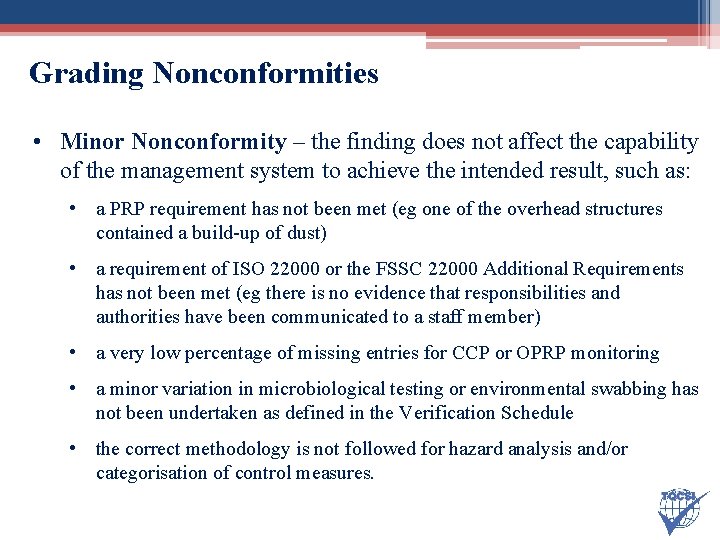
Grading Nonconformities • Minor Nonconformity – the finding does not affect the capability of the management system to achieve the intended result, such as: • a PRP requirement has not been met (eg one of the overhead structures contained a build-up of dust) • a requirement of ISO 22000 or the FSSC 22000 Additional Requirements has not been met (eg there is no evidence that responsibilities and authorities have been communicated to a staff member) • a very low percentage of missing entries for CCP or OPRP monitoring • a minor variation in microbiological testing or environmental swabbing has not been undertaken as defined in the Verification Schedule • the correct methodology is not followed for hazard analysis and/or categorisation of control measures.
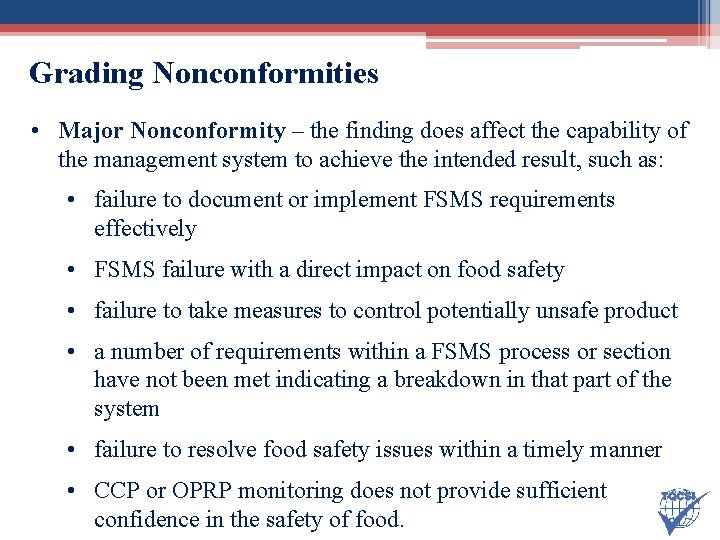
Grading Nonconformities • Major Nonconformity – the finding does affect the capability of the management system to achieve the intended result, such as: • failure to document or implement FSMS requirements effectively • FSMS failure with a direct impact on food safety • failure to take measures to control potentially unsafe product • a number of requirements within a FSMS process or section have not been met indicating a breakdown in that part of the system • failure to resolve food safety issues within a timely manner • CCP or OPRP monitoring does not provide sufficient confidence in the safety of food.
Grading Nonconformities • Critical Nonconformity – to be raised where food safety is directly impacted or when the integrity of certification or relevant legislation is at stake, such as: • significant breach of legislation or a regulatory requirement • proven falsification of records • observed product contamination.
Escalation of Nonconformities • a number of nonconformities raised for the same process or clause indicate a systemic issue and need to be escalated to a major nonconformity • Example: during an audit of a production facility the following minor nonconformities were raised: • NC#1 build-up of dust identified in different areas of production • NC#2 cleaning tools not maintained in a clean condition • NC#3 evidence of product spills on the floor. These indicate a systemic issue with the organisation’s cleaning program. A major nonconformity is expected to be raised for the relevant PRP (Cleaning).
Version 5 Audit Report • TQCSIF-20 EA – FSSC Audit Report Stage 1: • reduced audit report content, • FSSC 22000 and PRP checklist are not required to be completed • TQCSIF-20 EB – FSSC Audit Report Food Manufacturing: • checklists are embedded in audit report, including PRP for food manufacturing/production of bio-chemicals • TQCSIF-20 EC – FSSC Audit Report Food Packaging Manufacturing: • checklists are embedded in audit report, including PRP for food packaging manufacturing.
New Nonconformities Format • new TQCSIF-30 A (Nonconformity Report) • separate from Audit Report • different format for minor/major/critical nonconformities • audit team leader to sign off review of evidence for correction/corrective action. • includes documentation of the outcome of Follow-Up Audits for major nonconformities • includes documentation of the date of suspension and planned date for the Follow-Up Audit for critical nonconformities.
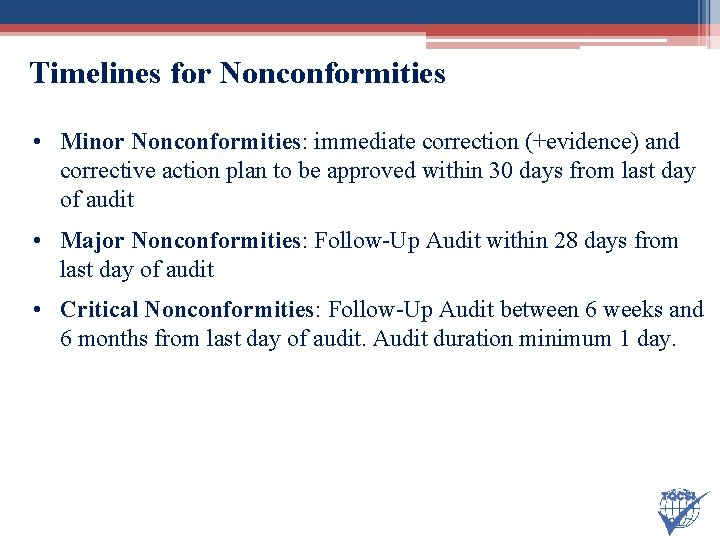
Timelines for Nonconformities • Minor Nonconformities: immediate correction (+evidence) and corrective action plan to be approved within 30 days from last day of audit • Major Nonconformities: Follow-Up Audit within 28 days from last day of audit • Critical Nonconformities: Follow-Up Audit between 6 weeks and 6 months from last day of audit. Audit duration minimum 1 day.
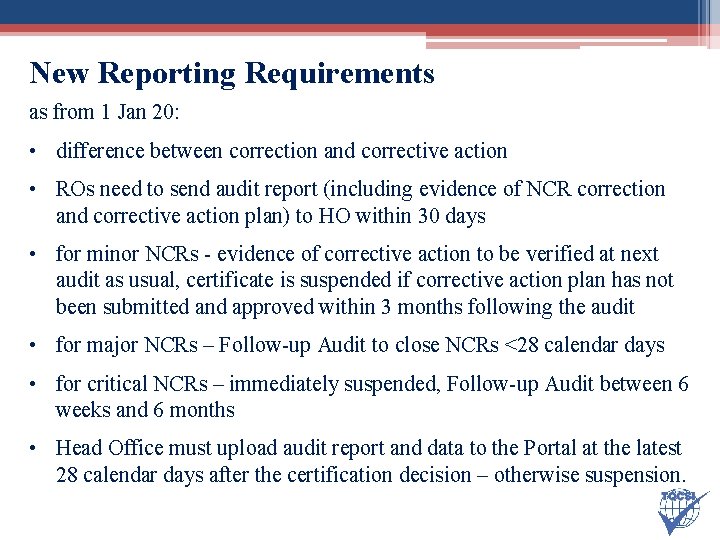
New Reporting Requirements as from 1 Jan 20: • difference between correction and corrective action • ROs need to send audit report (including evidence of NCR correction and corrective action plan) to HO within 30 days • for minor NCRs - evidence of corrective action to be verified at next audit as usual, certificate is suspended if corrective action plan has not been submitted and approved within 3 months following the audit • for major NCRs – Follow-up Audit to close NCRs <28 calendar days • for critical NCRs – immediately suspended, Follow-up Audit between 6 weeks and 6 months • Head Office must upload audit report and data to the Portal at the latest 28 calendar days after the certification decision – otherwise suspension.
Harmonisation Training • President attending FSSC 22000 Harmonisation Conference in Amsterdam 30 -31 October • Harmonisation Training will then be available through TQCSI Training for completion before 31 December.
Any Questions? www. tqcsi. com