
FSM continued Four Steps to Build a Finite
FSM continued

Four Steps to Build a Finite State Machine • Step 1 – State diagram and state table – There are no set procedures and diagrams. Application dependent – Choose a state to be the starting state when power is turned on the first time – A state diagram can be represented by a graph or by a table 11/15/2007 2: 38: 32 PM week 12 -5. ppt 2

Four Steps to Build a Finite State Machine • Step 2 – State assignment – Assign a unique binary number to each state – Rewrite the state table using the assigned number for each state • Step 3 – Combinational logic for next state function and output function • Step 4 - Implementation 11/15/2007 2: 38: 32 PM week 12 -5. ppt 3

FSM • The state is updated at the edge of the clock cycle • The next state is computed once every clock.
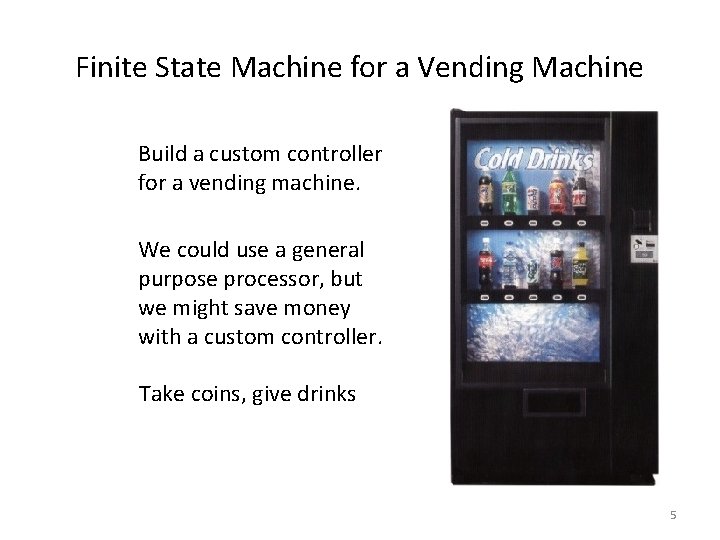
Finite State Machine for a Vending Machine Build a custom controller for a vending machine. We could use a general purpose processor, but we might save money with a custom controller. Take coins, give drinks 5
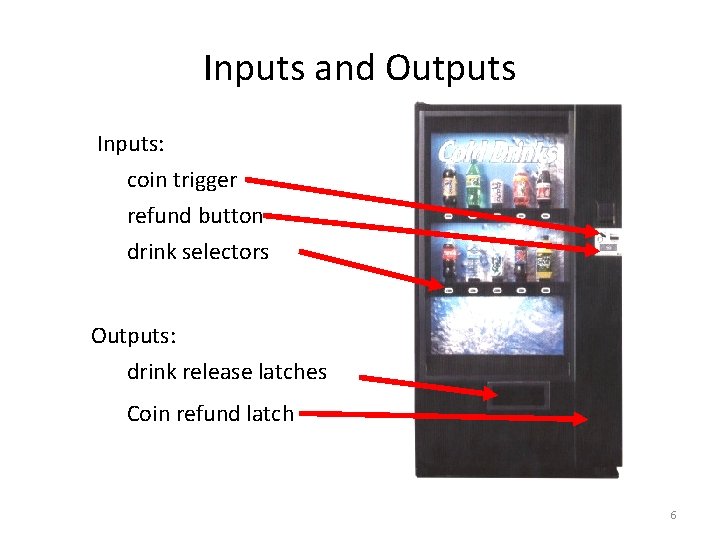
Inputs and Outputs Inputs: coin trigger refund button drink selectors Outputs: drink release latches Coin refund latch 6
Specifications • Sells only two kinds of drinks, A, B. (For now, assume all drinks are available in the machine. ) • All drinks are $0. 50. • Accepts quarters only. If you put in more than $0. 50, consider it as $0. 50. • Will respond to refund button. If pressed, release all quarters. • If the current amount of money is less than $0. 50 – Will not respond to select buttons. • If the current amount of money is $0. 50 – Will respond to select buttons. If SA is pressed, release drink A, if SB is pressed, release drink B. Then, take in all the money.
Controller Outputs • • Suppose the latch to be used to build the vending machine is controlled by one bit. It will be closed if the control signal is 0. If the control signal is 1 for a duration of one clock cycle, it will open for a period of time sufficient to allow things stored to fall through. After that, if the control signal is 0, it will be closed. If it is 1, it will stay open until the control signal returns to 1. Controller outputs are: L_A, L_B, L_RF, L_TK. These are signals to control the latches. – L_A=1, the latch for drink A opens, and drink A will fall out. – L_B=1, the latch for drink B opens, and drink B will fall out. – L_RF=1, the latch for coin refund opens, and coins will fall out. – L_TK = 1, the latch for coin take opens, and coins will fall from the temporarily storing place to the inside of the machine. – Based on the specification of the latches, we need to set the control signals to be 1 for one clock.
Inputs • Inputs include some buttons: SA, SB, RF. – SA = 1 when the user is pressing the select A button, else it is 0 – SB = 1 when the user is pressing the select B button, else it is 0 – RF = 1 when the user is pressing the refund button, else it is 0 • Inputs also include CIS (coin insert). When a coin is falling in, CIS is 1 for one clock cycle (from one falling edge to the next falling edge). It is 0 all other time.
Design • How to design this controller, given the specifications and the inputs and the outputs? • Is this a stateless controller, or a controller with states?
State • To tell if a controller has states or not, the simplest way is to check if the controller’s output is relevant to what happened in the past. If it is relevant, it has state; otherwise it does not. • The vending machine controller has state, because the controller’s response to the same input (e. g. , SA) is different depending on the number of quarters inserted.
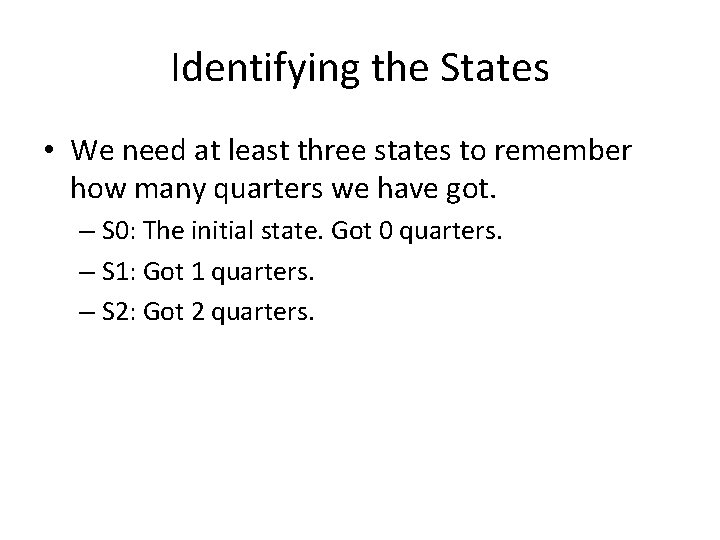
Identifying the States • We need at least three states to remember how many quarters we have got. – S 0: The initial state. Got 0 quarters. – S 1: Got 1 quarters. – S 2: Got 2 quarters.
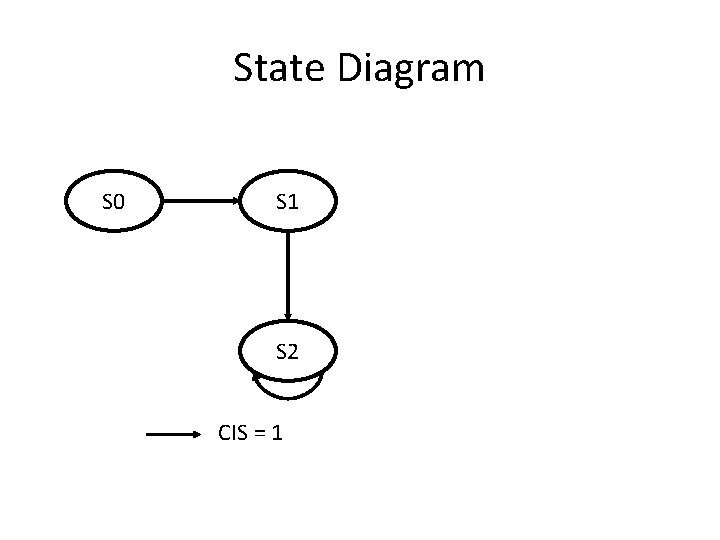
State Diagram S 0 S 1 S 2 CIS = 1
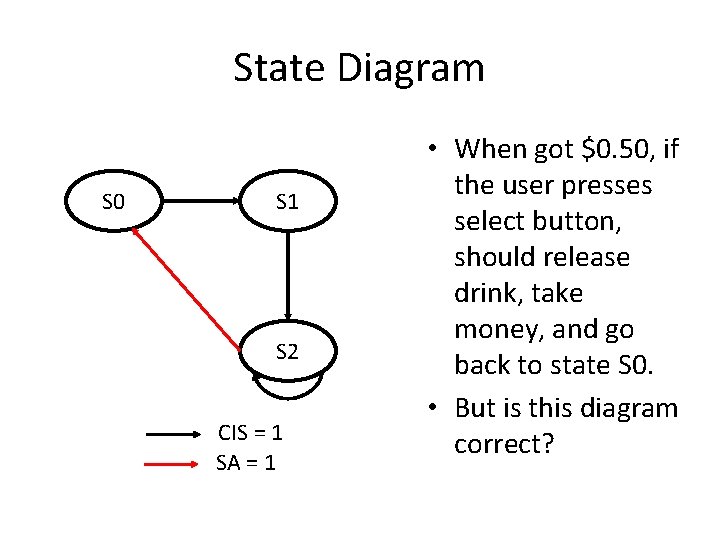
State Diagram S 0 S 1 S 2 CIS = 1 SA = 1 • When got $0. 50, if the user presses select button, should release drink, take money, and go back to state S 0. • But is this diagram correct?
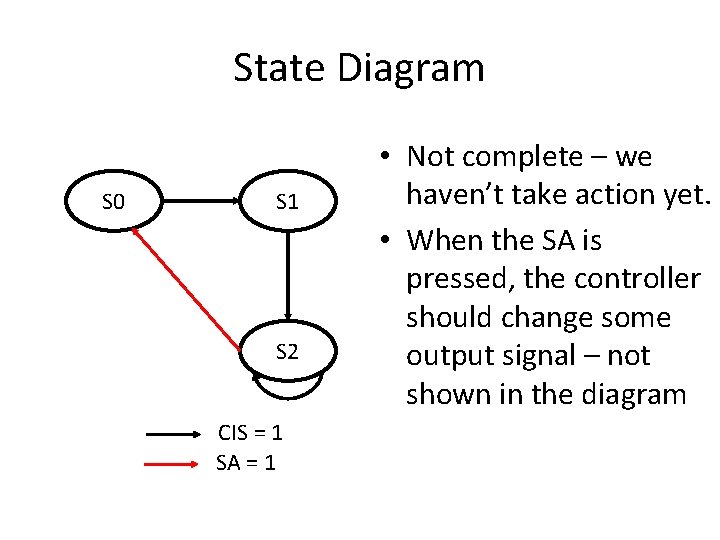
State Diagram S 0 S 1 S 2 CIS = 1 SA = 1 • Not complete – we haven’t take action yet. • When the SA is pressed, the controller should change some output signal – not shown in the diagram
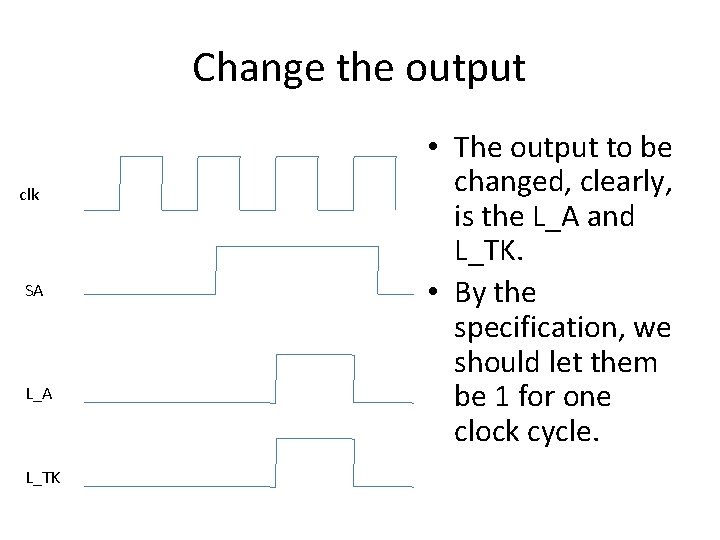
Change the output clk SA L_TK • The output to be changed, clearly, is the L_A and L_TK. • By the specification, we should let them be 1 for one clock cycle.
Other options • Can we just let the latch be controlled by the SA button, meaning that the latch is open when SA is pressed? • If we do this, I will just get free drinks. • So the latch has to be determined by the states somehow. • Can we just say that the latch is open if in state S 2 and when SA is pressed? • When in state S 2, if SA is pressed, the next state is not S 2 – the overlapping time may not be enough because SA can become 1 at arbitrary time.
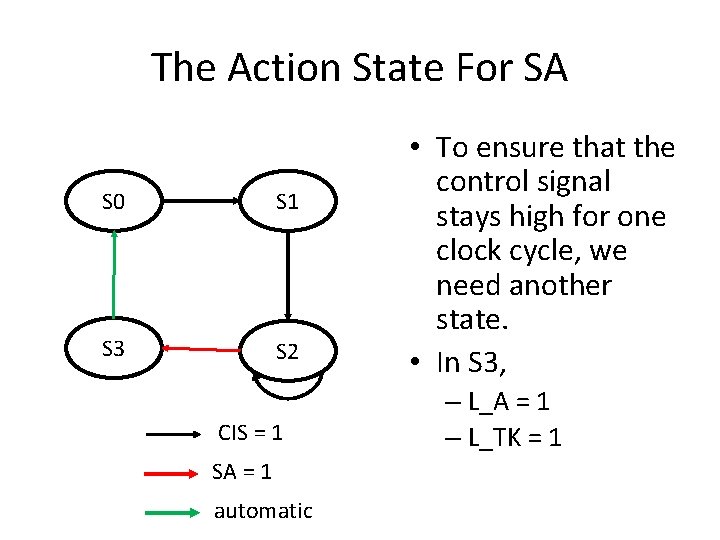
The Action State For SA S 0 S 1 S 3 S 2 CIS = 1 SA = 1 automatic • To ensure that the control signal stays high for one clock cycle, we need another state. • In S 3, – L_A = 1 – L_TK = 1
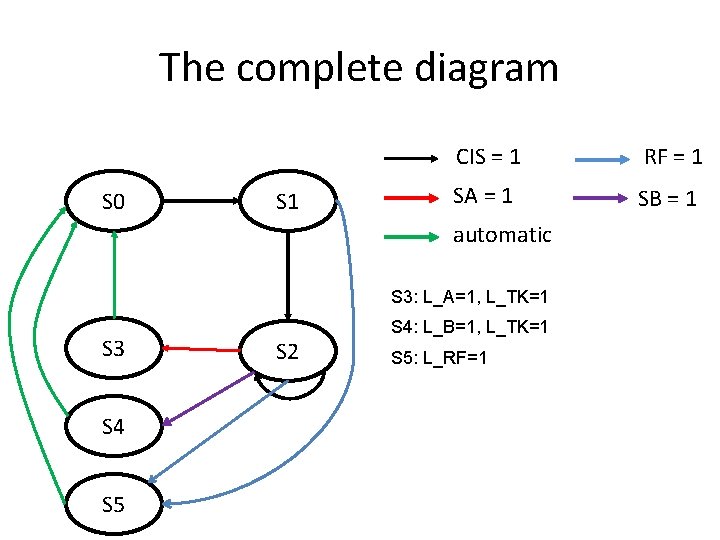
The complete diagram S 0 S 1 CIS = 1 RF = 1 SA = 1 SB = 1 automatic S 3: L_A=1, L_TK=1 S 3 S 4 S 5 S 2 S 4: L_B=1, L_TK=1 S 5: L_RF=1
- Slides: 19