
FSA READINGWRITING January 2015 FSA WRITING TEST FORMAT



- Slides: 32
FSA READING/WRITING January 2015
FSA - WRITING
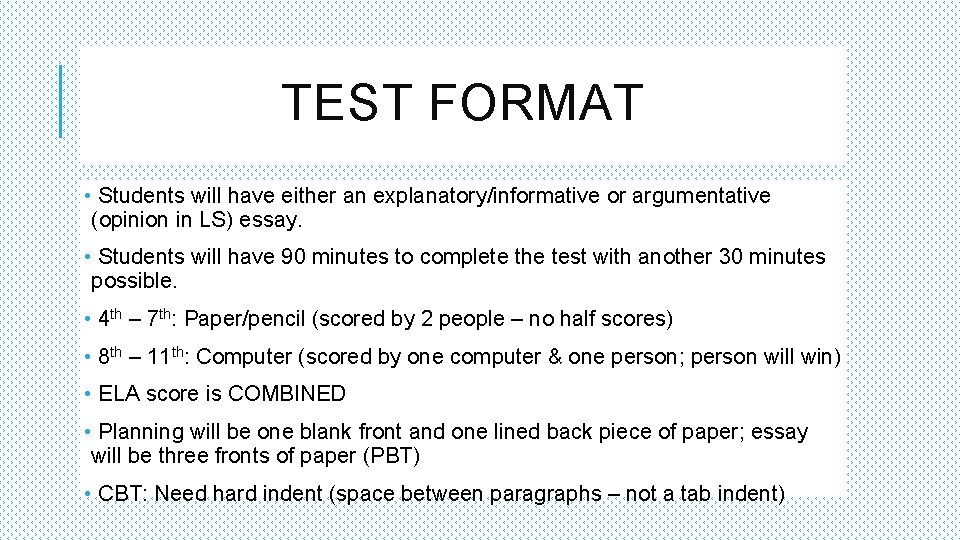
TEST FORMAT • Students will have either an explanatory/informative or argumentative (opinion in LS) essay. • Students will have 90 minutes to complete the test with another 30 minutes possible. • 4 th – 7 th: Paper/pencil (scored by 2 people – no half scores) • 8 th – 11 th: Computer (scored by one computer & one person; person will win) • ELA score is COMBINED • Planning will be one blank front and one lined back piece of paper; essay will be three fronts of paper (PBT) • CBT: Need hard indent (space between paragraphs – not a tab indent)
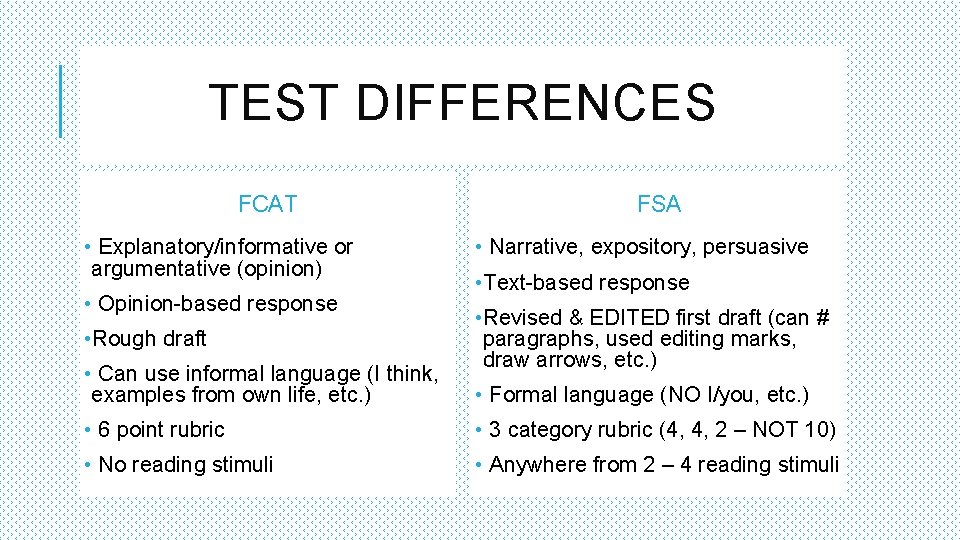
TEST DIFFERENCES FCAT • Explanatory/informative or argumentative (opinion) • Opinion-based response • Rough draft • Can use informal language (I think, examples from own life, etc. ) FSA • Narrative, expository, persuasive • Text-based response • Revised & EDITED first draft (can # paragraphs, used editing marks, draw arrows, etc. ) • Formal language (NO I/you, etc. ) • 6 point rubric • 3 category rubric (4, 4, 2 – NOT 10) • No reading stimuli • Anywhere from 2 – 4 reading stimuli
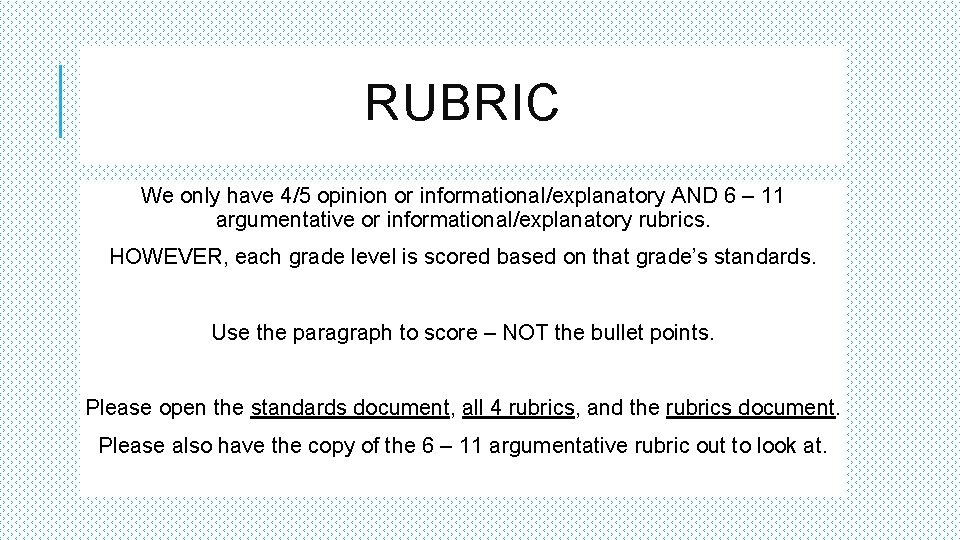
RUBRIC We only have 4/5 opinion or informational/explanatory AND 6 – 11 argumentative or informational/explanatory rubrics. HOWEVER, each grade level is scored based on that grade’s standards. Use the paragraph to score – NOT the bullet points. Please open the standards document, all 4 rubrics, and the rubrics document. Please also have the copy of the 6 – 11 argumentative rubric out to look at.
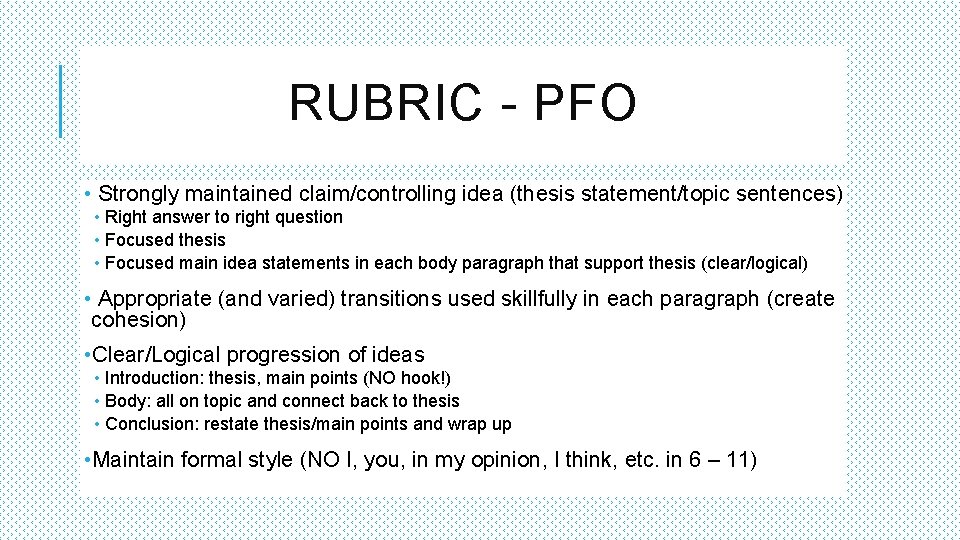
RUBRIC - PFO • Strongly maintained claim/controlling idea (thesis statement/topic sentences) • Right answer to right question • Focused thesis • Focused main idea statements in each body paragraph that support thesis (clear/logical) • Appropriate (and varied) transitions used skillfully in each paragraph (create cohesion) • Clear/Logical progression of ideas • Introduction: thesis, main points (NO hook!) • Body: all on topic and connect back to thesis • Conclusion: restate thesis/main points and wrap up • Maintain formal style (NO I, you, in my opinion, I think, etc. in 6 – 11)
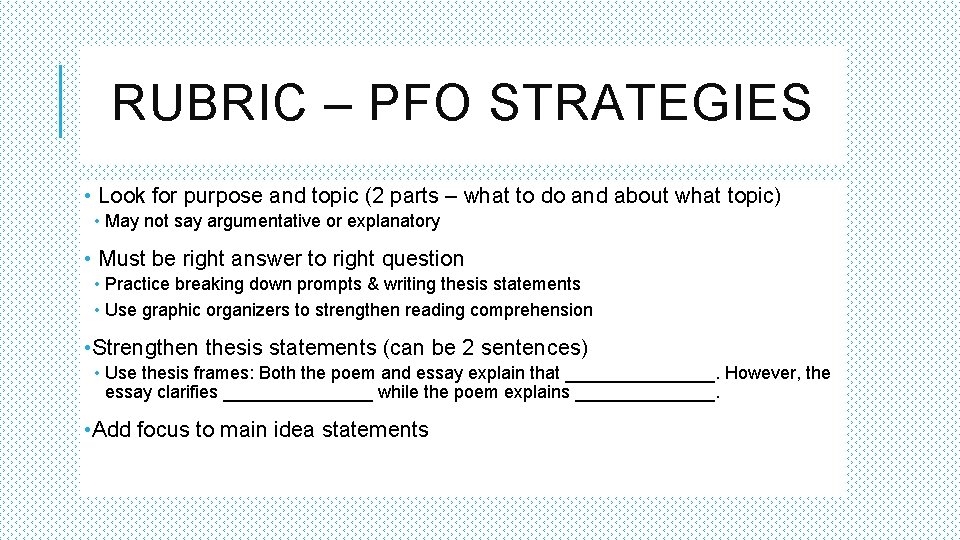
RUBRIC – PFO STRATEGIES • Look for purpose and topic (2 parts – what to do and about what topic) • May not say argumentative or explanatory • Must be right answer to right question • Practice breaking down prompts & writing thesis statements • Use graphic organizers to strengthen reading comprehension • Strengthen thesis statements (can be 2 sentences) • Use thesis frames: Both the poem and essay explain that ________. However, the essay clarifies ________ while the poem explains _______. • Add focus to main idea statements
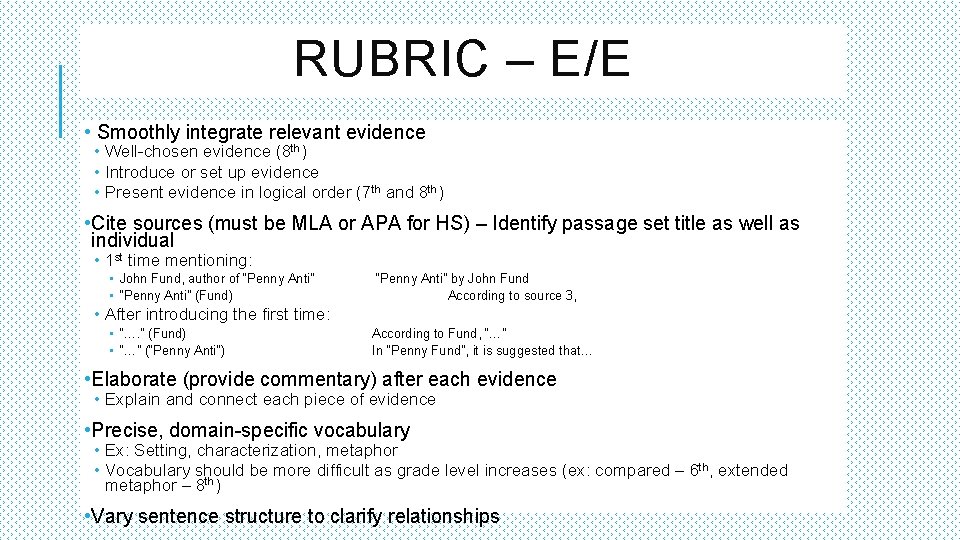
RUBRIC – E/E • Smoothly integrate relevant evidence • Well-chosen evidence (8 th) • Introduce or set up evidence • Present evidence in logical order (7 th and 8 th) • Cite sources (must be MLA or APA for HS) – Identify passage set title as well as individual • 1 st time mentioning: • John Fund, author of “Penny Anti” • “Penny Anti” (Fund) “Penny Anti” by John Fund According to source 3, • After introducing the first time: • “…. ” (Fund) • “…” (“Penny Anti”) According to Fund, “…” In “Penny Fund”, it is suggested that… • Elaborate (provide commentary) after each evidence • Explain and connect each piece of evidence • Precise, domain-specific vocabulary • Ex: Setting, characterization, metaphor • Vocabulary should be more difficult as grade level increases (ex: compared – 6 th, extended metaphor – 8 th) • Vary sentence structure to clarify relationships
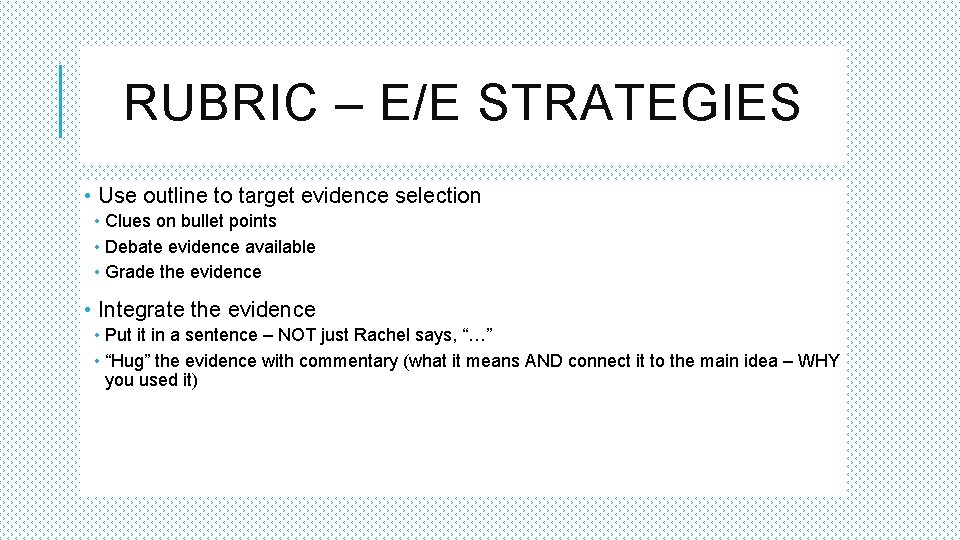
RUBRIC – E/E STRATEGIES • Use outline to target evidence selection • Clues on bullet points • Debate evidence available • Grade the evidence • Integrate the evidence • Put it in a sentence – NOT just Rachel says, “…” • “Hug” the evidence with commentary (what it means AND connect it to the main idea – WHY you used it)
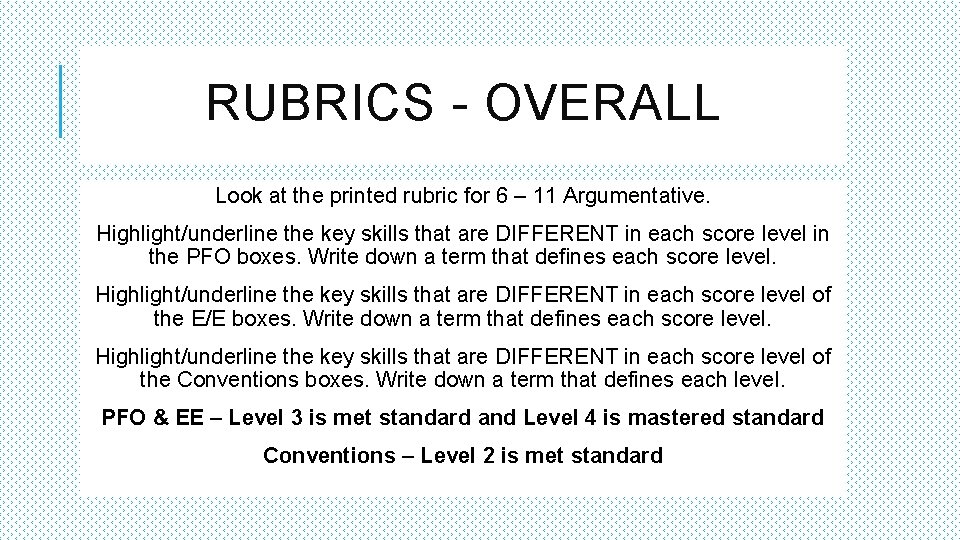
RUBRICS - OVERALL Look at the printed rubric for 6 – 11 Argumentative. Highlight/underline the key skills that are DIFFERENT in each score level in the PFO boxes. Write down a term that defines each score level. Highlight/underline the key skills that are DIFFERENT in each score level of the E/E boxes. Write down a term that defines each score level. Highlight/underline the key skills that are DIFFERENT in each score level of the Conventions boxes. Write down a term that defines each level. PFO & EE – Level 3 is met standard and Level 4 is mastered standard Conventions – Level 2 is met standard
RUBRICS – LS VS. US Look at the informative/explanatory rubrics for both levels. What are key terms that are different for US than for LS? Look at the argumentative/opinion rubrics for both levels. What are key terms that are different for US than for LS?
RUBRICS – GRADE LEVEL SPECIFIC Look at the printed standard comparison chart. With your group, go through your assigned benchmark and look at grades 4 – 11. Copy in key differences to each grade level in the chart. 4 th grade should have the basic requirements (this may happen again in 6 th grade for some parts). Share with other group so you have both filled in. HOW DO WE WANT TO COMMUNICATE THE RUBRIC TO OTHER SUBJECT AREAS AND TO STUDENTS?
WRITING – INTRODUCTION Needs to have: • Thesis statement • Titles and authors IF literary analysis (emphasis on text vs. idea) • Main points • Provide background (1 sentence summary) Restate prompt, short summary • It doesn’t ever say it needs a HOOK! If they can, great. If they can’t, don’t! • Assume the reader is intelligent but hasn’t read the text (scorers should have read the text though)
WRITING – CONCLUSION Needs to have: • Concluding statement – restate thesis • Review/summarize main points • Synthesize (wrap up) – especially important in 7 th grade and up – should be 1 sentence
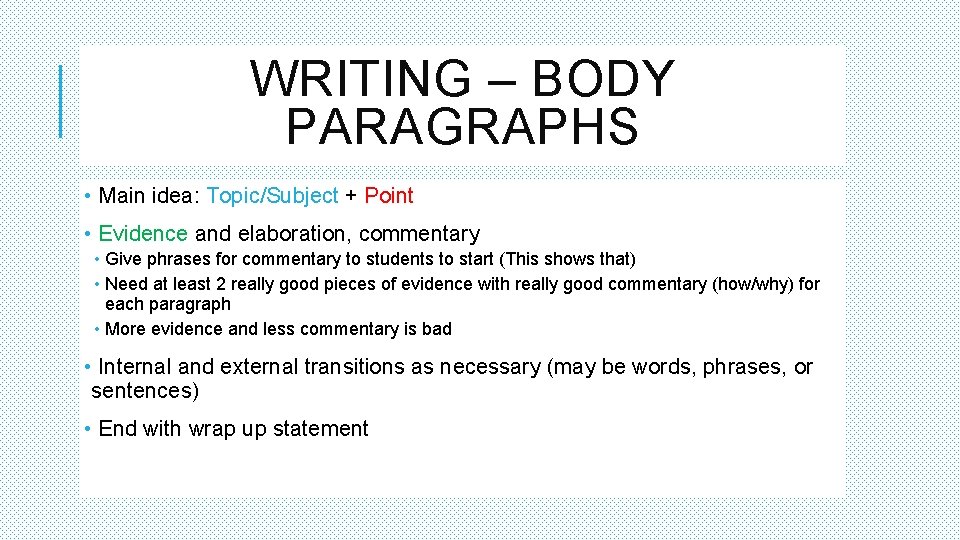
WRITING – BODY PARAGRAPHS • Main idea: Topic/Subject + Point • Evidence and elaboration, commentary • Give phrases for commentary to students to start (This shows that) • Need at least 2 really good pieces of evidence with really good commentary (how/why) for each paragraph • More evidence and less commentary is bad • Internal and external transitions as necessary (may be words, phrases, or sentences) • End with wrap up statement
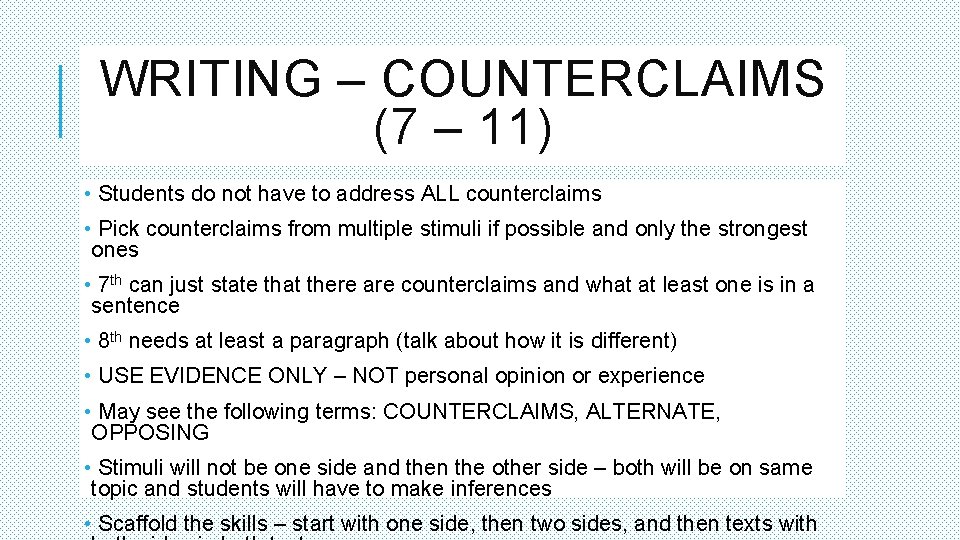
WRITING – COUNTERCLAIMS (7 – 11) • Students do not have to address ALL counterclaims • Pick counterclaims from multiple stimuli if possible and only the strongest ones • 7 th can just state that there are counterclaims and what at least one is in a sentence • 8 th needs at least a paragraph (talk about how it is different) • USE EVIDENCE ONLY – NOT personal opinion or experience • May see the following terms: COUNTERCLAIMS, ALTERNATE, OPPOSING • Stimuli will not be one side and then the other side – both will be on same topic and students will have to make inferences • Scaffold the skills – start with one side, then two sides, and then texts with
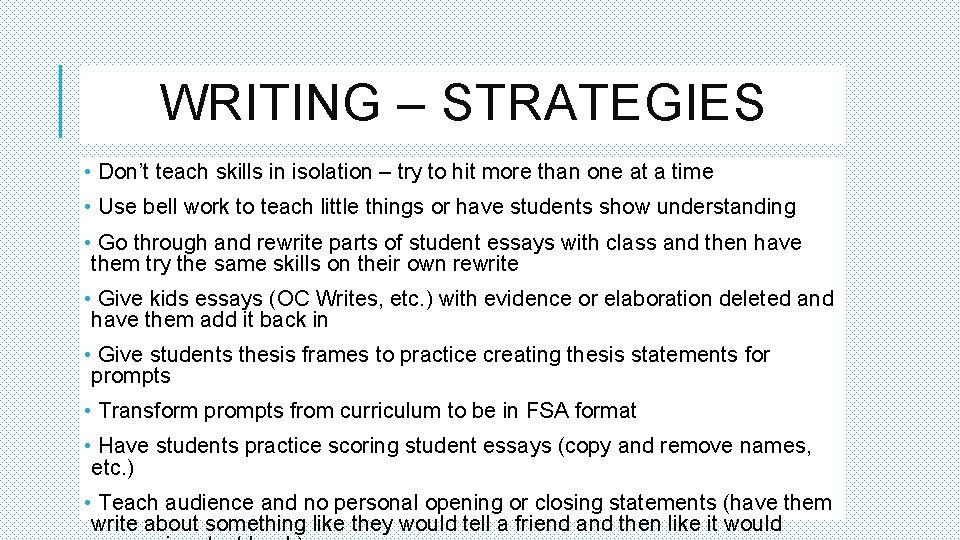
WRITING – STRATEGIES • Don’t teach skills in isolation – try to hit more than one at a time • Use bell work to teach little things or have students show understanding • Go through and rewrite parts of student essays with class and then have them try the same skills on their own rewrite • Give kids essays (OC Writes, etc. ) with evidence or elaboration deleted and have them add it back in • Give students thesis frames to practice creating thesis statements for prompts • Transform prompts from curriculum to be in FSA format • Have students practice scoring student essays (copy and remove names, etc. ) • Teach audience and no personal opening or closing statements (have them write about something like they would tell a friend and then like it would
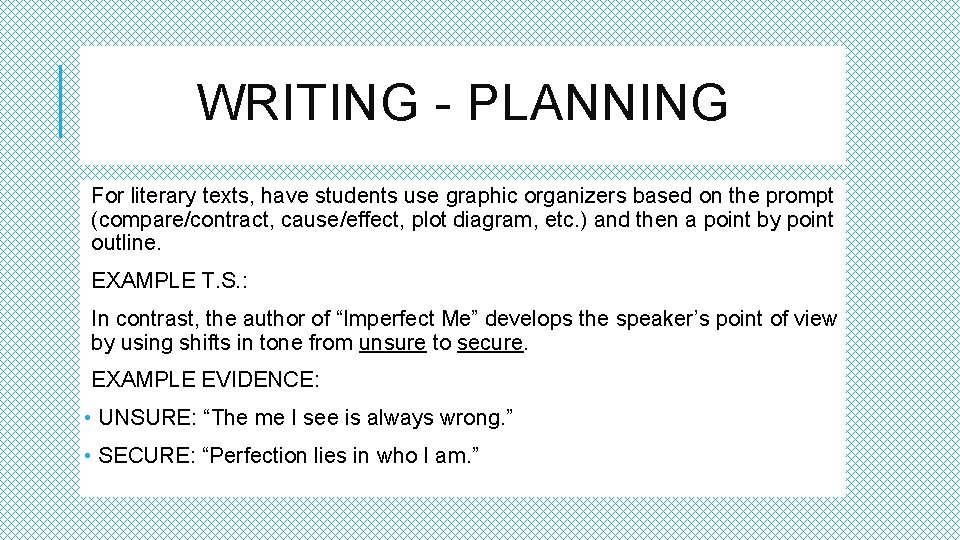
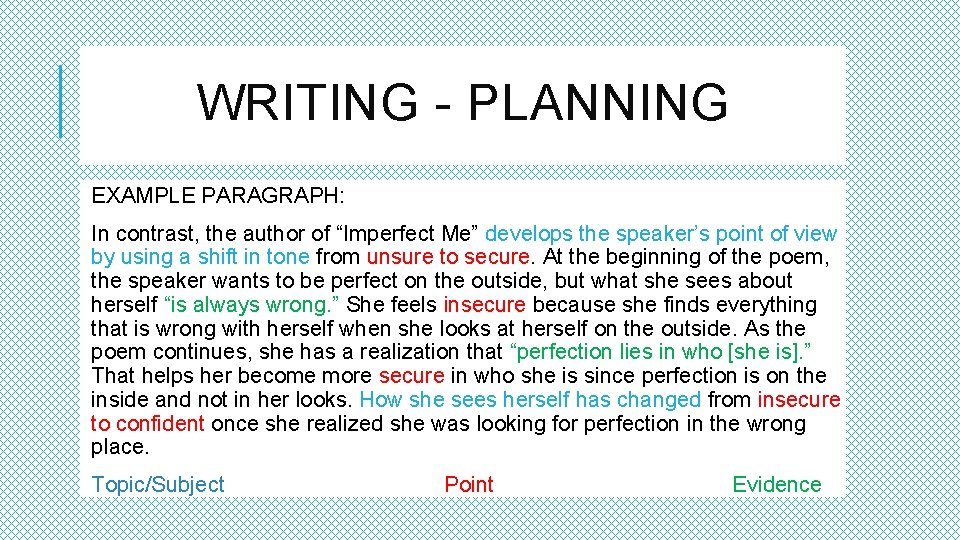
WRITING - PLANNING For literary texts, have students use graphic organizers based on the prompt (compare/contract, cause/effect, plot diagram, etc. ) and then a point by point outline. EXAMPLE T. S. : In contrast, the author of “Imperfect Me” develops the speaker’s point of view by using shifts in tone from unsure to secure. EXAMPLE EVIDENCE: • UNSURE: “The me I see is always wrong. ” • SECURE: “Perfection lies in who I am. ”
WRITING - PLANNING EXAMPLE PARAGRAPH: In contrast, the author of “Imperfect Me” develops the speaker’s point of view by using a shift in tone from unsure to secure. At the beginning of the poem, the speaker wants to be perfect on the outside, but what she sees about herself “is always wrong. ” She feels insecure because she finds everything that is wrong with herself when she looks at herself on the outside. As the poem continues, she has a realization that “perfection lies in who [she is]. ” That helps her become more secure in who she is since perfection is on the inside and not in her looks. How she sees herself has changed from insecure to confident once she realized she was looking for perfection in the wrong place. Topic/Subject Point Evidence
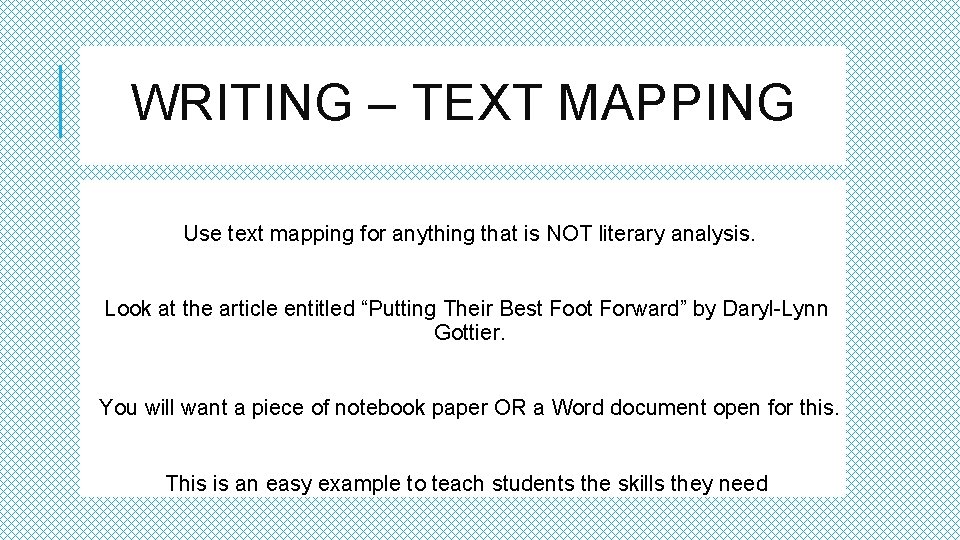
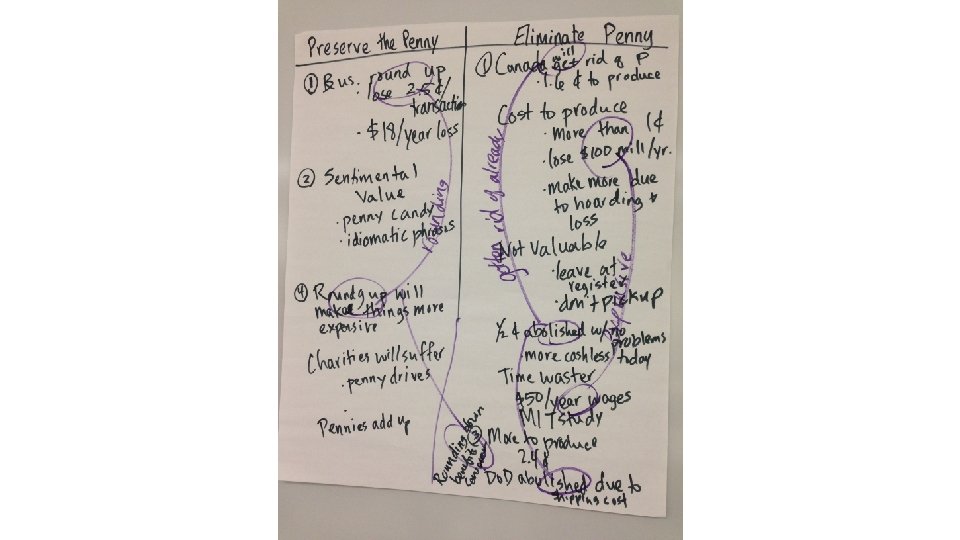
WRITING – TEXT MAPPING Use text mapping for anything that is NOT literary analysis. Look at the article entitled “Putting Their Best Foot Forward” by Daryl-Lynn Gottier. You will want a piece of notebook paper OR a Word document open for this. This is an easy example to teach students the skills they need
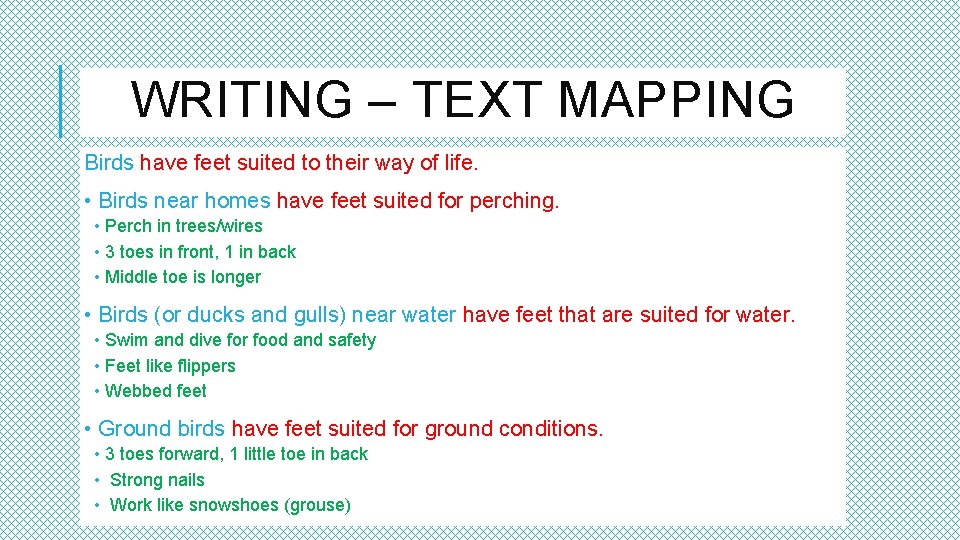
WRITING – TEXT MAPPING Birds have feet suited to their way of life. • Birds near homes have feet suited for perching. • Perch in trees/wires • 3 toes in front, 1 in back • Middle toe is longer • Birds (or ducks and gulls) near water have feet that are suited for water. • Swim and dive for food and safety • Feet like flippers • Webbed feet • Ground birds have feet suited for ground conditions. • 3 toes forward, 1 little toe in back • Strong nails • Work like snowshoes (grouse)
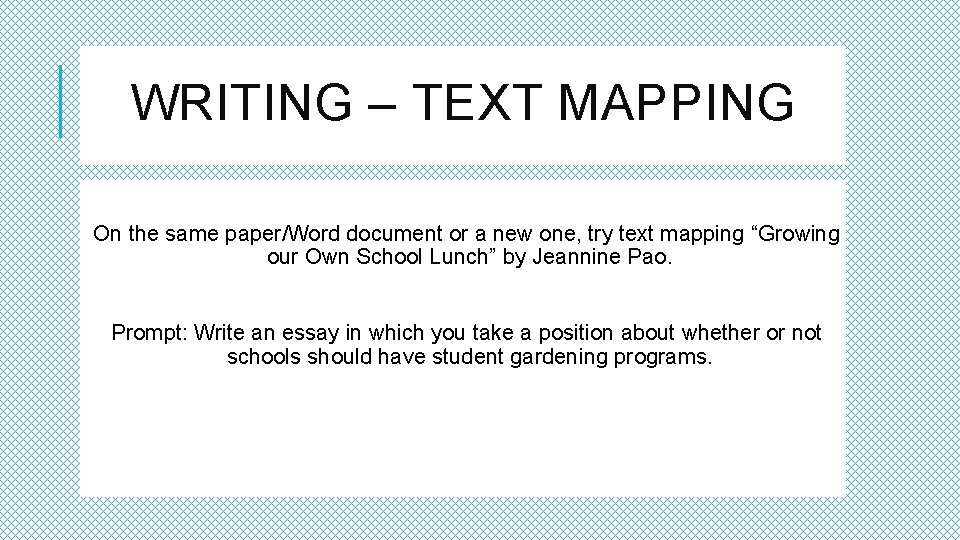
WRITING – TEXT MAPPING On the same paper/Word document or a new one, try text mapping “Growing our Own School Lunch” by Jeannine Pao. Prompt: Write an essay in which you take a position about whether or not schools should have student gardening programs.
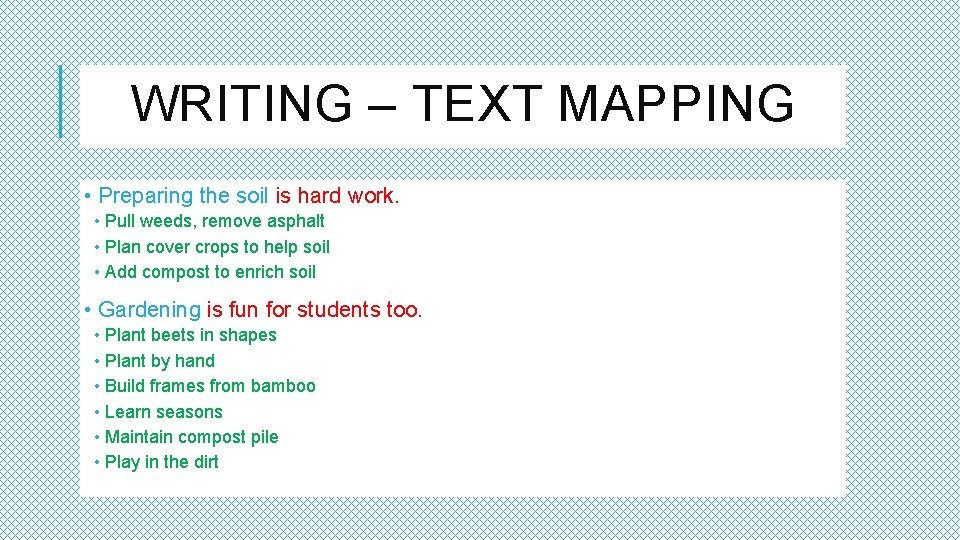
WRITING – TEXT MAPPING • Preparing the soil is hard work. • Pull weeds, remove asphalt • Plan cover crops to help soil • Add compost to enrich soil • Gardening is fun for students too. • Plant beets in shapes • Plant by hand • Build frames from bamboo • Learn seasons • Maintain compost pile • Play in the dirt
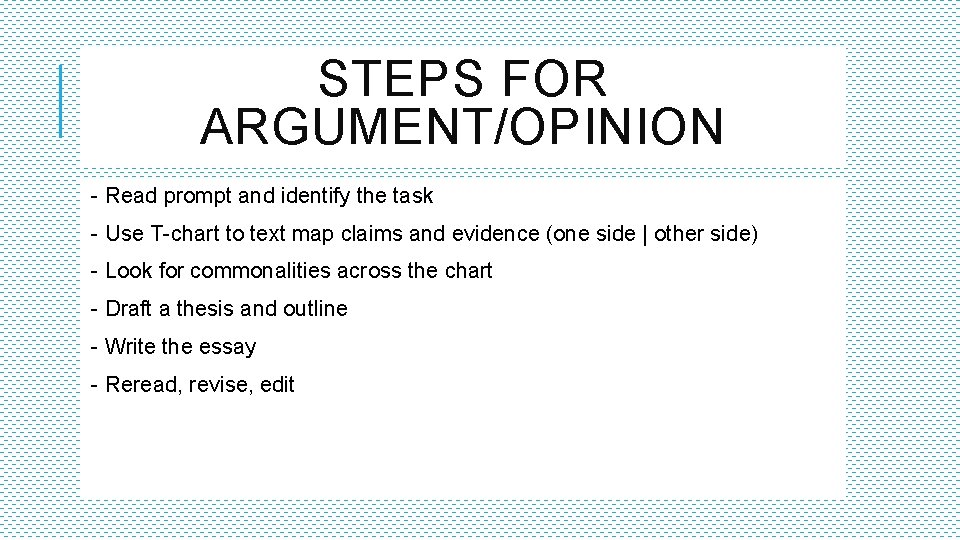
STEPS FOR ARGUMENT/OPINION - Read prompt and identify the task - Use T-chart to text map claims and evidence (one side | other side) - Look for commonalities across the chart - Draft a thesis and outline - Write the essay - Reread, revise, edit
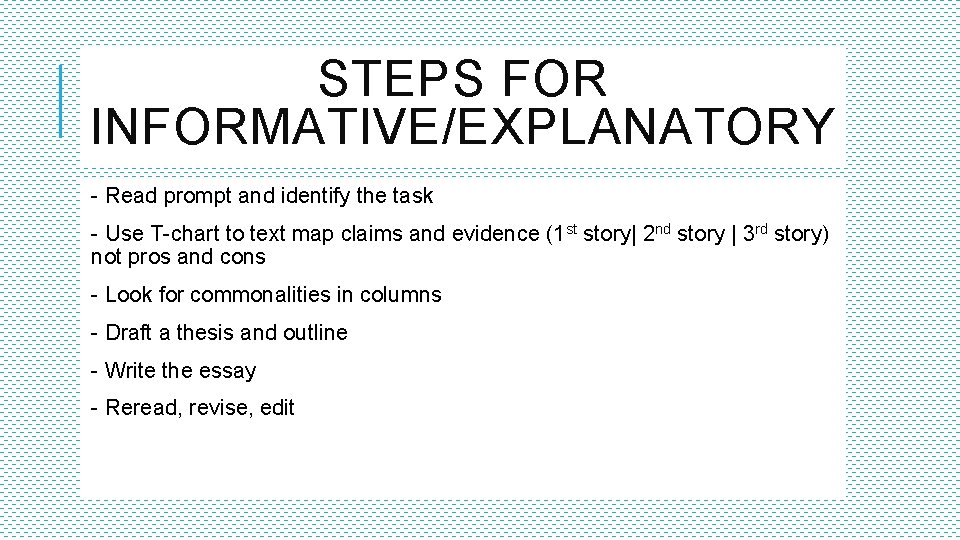
STEPS FOR INFORMATIVE/EXPLANATORY - Read prompt and identify the task - Use T-chart to text map claims and evidence (1 st story| 2 nd story | 3 rd story) not pros and cons - Look for commonalities in columns - Draft a thesis and outline - Write the essay - Reread, revise, edit
QUESTIONS? ? ? How can we take this back to our classrooms and teach it this year by March? How can we apply this to other subject areas? (See list of ideas, how can we use their help, who is teaching what tomorrow, etc. ) What common vocabulary should we be using vertically and horizontally?
FSA - READING
READING Look at ELA Test Design Summary document. • Percentages and standards tested by grade level • Depth of questions • Test length • Session lengths • Types of responses
READING Look at 6 th grade Test Item Specifications document. THIS IS YOUR BEST RESOURCE FOR THE TEST! Get familiar with your grade level(s).
QUESTIONS? ? ? How can we take this back to our classrooms and teach it this year by April? How can we apply this to other subject areas?
READING/WRITING CALENDARS Create instructional calendars to teach these things by test day and give to other subject areas so they can help us out.