
FRQ PAGE 21 In 2014 a deadly strain
- Slides: 6
FRQ PAGE 21 In 2014, a deadly strain of the Ebola virus killed a large number in West Africa, mainly in the countries of Sierra Leone, Liberia, and Guinea. Many American doctors and nurses traveled to those countries to assist the victims of that virus. Shortly afterwards, some governors in the US issued orders that anyone who visited those three countries must be quarantined in their homes for 21 days on returning to the US. Then-governor of Maine, Paul Le. Page, justified his quarantine order by saying, “While we certainly respect the rights of the individual, we must be vigilant in protecting 1. 3 million Mainers, as well as anyone who visits our great state. ” In response, American nurse Kaci Hickox refused to follow that quarantine order saying, “So many states have started enacting these policies that I think are just completely not evidence-based. They don’t do a good job of balancing the risks and benefits when thinking about taking away an individual’s rights. ”
FRQ PAGE 21 A. Describe natural rights philosophy • Natural rights are the rights to life, liberty, and property and that people form government for the limited purpose of protecting those natural rights. B. Describe one way in which the scenario relates to the concept of natural rights. • The quarantine order limits the nurse’s natural right to liberty • Allowing the nurse to leave home would harm other citizen’s health, which if fatal would result in loss of natural right to life. • Inability to work if the person fell ill which would have an effect on their natural right to property. C. Explain one way in which the quarantine illustrates the government’s role of balancing individual liberty with social order. • The government must protect not merely the nurse’s individual righ to liberty, but those other individuals’ natural rights in life, liberty, and property.
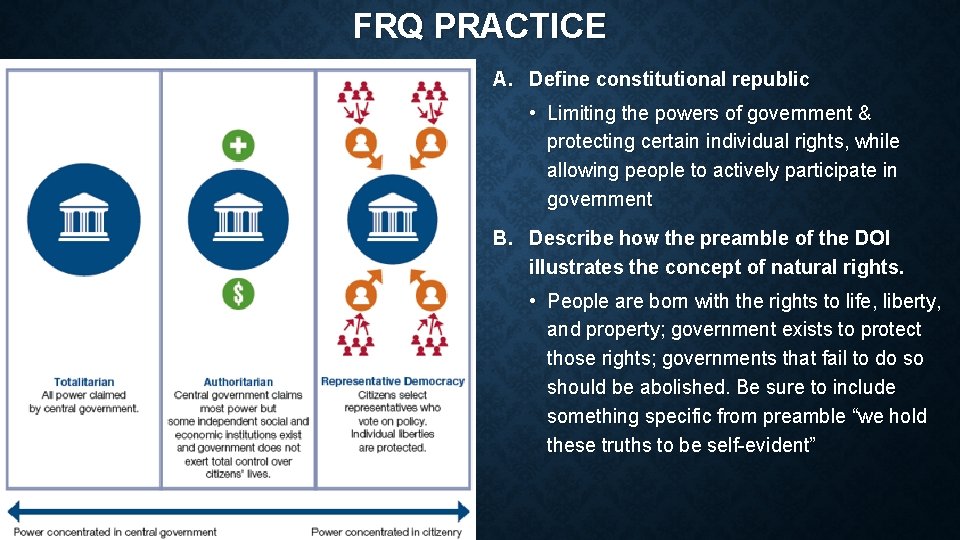
FRQ PRACTICE A. Define constitutional republic • Limiting the powers of government & protecting certain individual rights, while allowing people to actively participate in government B. Describe how the preamble of the DOI illustrates the concept of natural rights. • People are born with the rights to life, liberty, and property; government exists to protect those rights; governments that fail to do so should be abolished. Be sure to include something specific from preamble “we hold these truths to be self-evident”
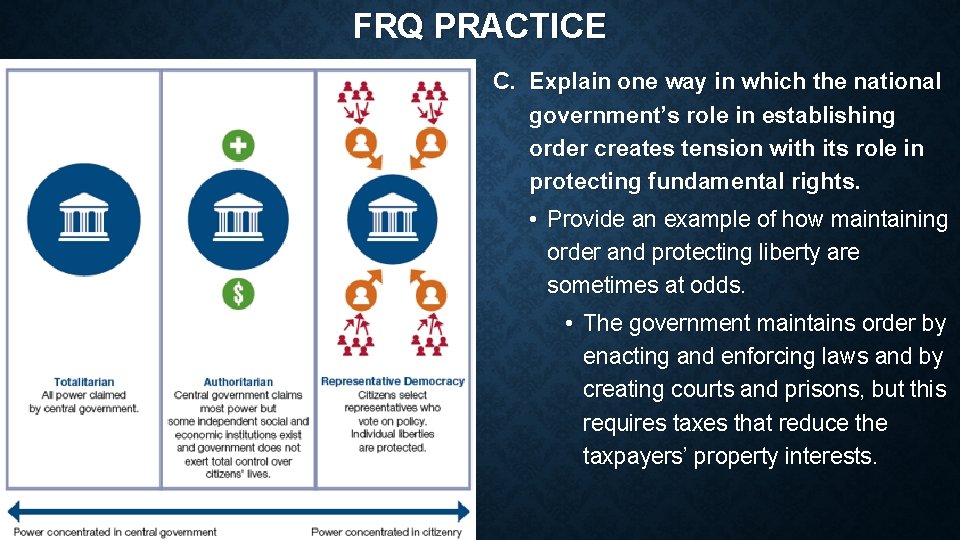
FRQ PRACTICE C. Explain one way in which the national government’s role in establishing order creates tension with its role in protecting fundamental rights. • Provide an example of how maintaining order and protecting liberty are sometimes at odds. • The government maintains order by enacting and enforcing laws and by creating courts and prisons, but this requires taxes that reduce the taxpayers’ property interests.
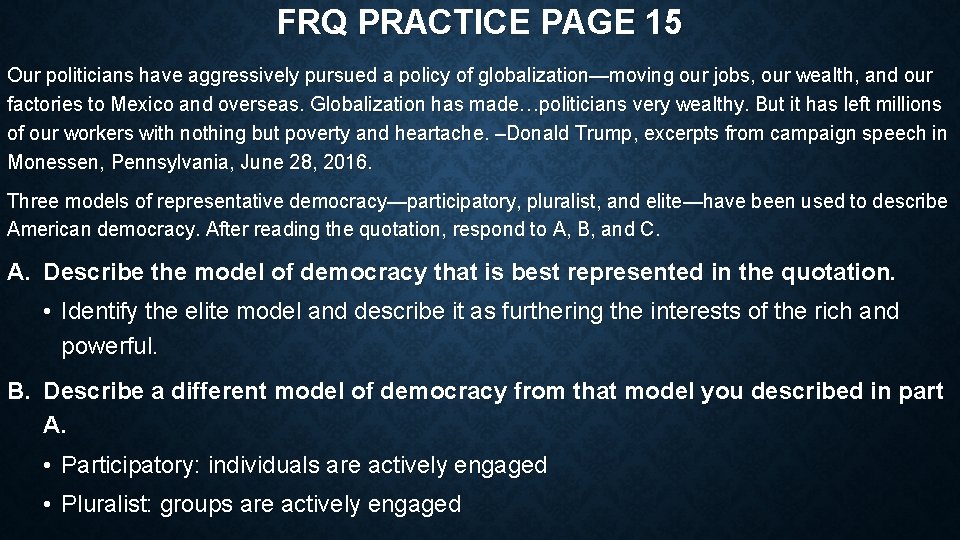
FRQ PRACTICE PAGE 15 Our politicians have aggressively pursued a policy of globalization—moving our jobs, our wealth, and our factories to Mexico and overseas. Globalization has made…politicians very wealthy. But it has left millions of our workers with nothing but poverty and heartache. –Donald Trump, excerpts from campaign speech in Monessen, Pennsylvania, June 28, 2016. Three models of representative democracy—participatory, pluralist, and elite—have been used to describe American democracy. After reading the quotation, respond to A, B, and C. A. Describe the model of democracy that is best represented in the quotation. • Identify the elite model and describe it as furthering the interests of the rich and powerful. B. Describe a different model of democracy from that model you described in part A. • Participatory: individuals are actively engaged • Pluralist: groups are actively engaged
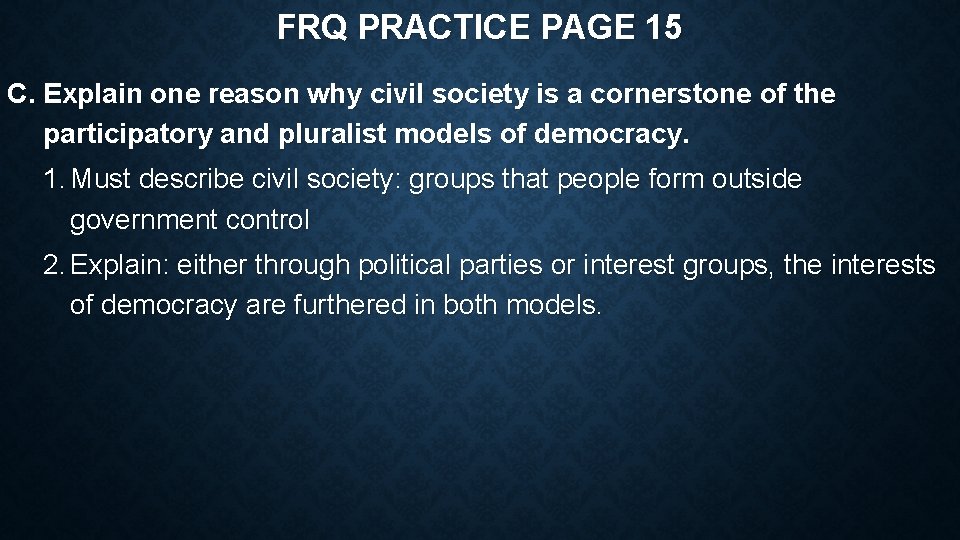
FRQ PRACTICE PAGE 15 C. Explain one reason why civil society is a cornerstone of the participatory and pluralist models of democracy. 1. Must describe civil society: groups that people form outside government control 2. Explain: either through political parties or interest groups, the interests of democracy are furthered in both models.