
FRONT DESKBUSINESS OFFICE OPERATIONS ROLE IN STUDENT HEALTH
FRONT DESK/BUSINESS OFFICE OPERATIONS’ ROLE IN STUDENT HEALTH CENTERS ACHA May 2018 Joseph Campos II, Ph. D. University of Hawaii at Manoa

GOO. GL/ITGQQI
This presentation will discuss the many ways in which the front desk and business office staff are integral parts of any clinical environment.
LET US START – WHAT IS THE ROLE OF FRONT/BUSINESS OFFICE Administration plays a vital barrier-removal role as the principal way to add value to the healthcare operation. Administration have critical roles that are grounded in efficient operations and management that are required to ensure the healthcare operation's survival: 1) building relationships 2) exchanging information 3) decision making 4) Influencing developments
SOME BASICS OF THE FRONT DESK OPERATIONS Well designed physical space Continuity & coordination of clinical care Accessible for questions & scheduling Courteous & efficient staff Efficient use of technology Effective administration & billing
THE MAIN COMPONENT OF THE FRONT DESK IS THE STAFF Clear Communicator • Must be able to speak clearly, and interface with a variety of patients • Must be able to explain financial policies and the expectation of the patient • Must be able to ask the right questions and resolve issues Positive Attitude • Good disposition, not easily rattled • Can diffuse angry patients • Ability to develop and maintain positive working relationships
THE MAIN COMPONENT OF THE FRONT DESK IS THE STAFF Computer • Literate EHR system require computer competence Language • • Proficiency Good writing Skills If the population speaks another language there should be proficiency in that language or know how to access translation services
BASIC DESIGN OF THE FRONT DESK OPERATIONS Create line of site with waiting and clinic space Reduce travel distance Plan adjacencies (communication & interaction needs) Remove redundancies Sufficient signage Need for privacy
RETHINK THE FRONT DESK OPERATIONS Efficiency – avoid overloading the front desk staff with non-related tasks Patient flow, billing, educating begin at the front desk Cross train staff
FRONT DESK OPERATIONS IN THE QI PROCESS Plan Do Study Act Repeat
FRONT DESK OPERATIONS IN THE QI PROCESS Setting Aims Establishing Selecting Testing Measures Changes

SOME BASICS OF THE FRONT DESK OPERATIONS Scheduling Registration Clinical Visit Medical Records and Documentation Billing Collections
SCHEDULING Uses and verifies information Changes May and updates provider schedules as needed take scheduling calls at front desk as back up Schedules walk-in and same day appointments
REGISTRATION Provide patient preliminary information regarding the visit Verifies information at time of appointment Efficient front desk will enable smooth patient flow
CLINICAL VISIT Prepares patients for clinical visit Interfaces with nursing staff on continual basis Reviews chart and verifies that all chart necessary forms are in chart updates chart as needed

MEDICAL RECORDS AND DOCUMENTATION Inputs initial information into patient EHR Updates Information Explains information and charges
BILLING Billing staff relies on front desk for accurate demographic information Review account balances with patients and post payments Verifies insurance at every visit Establish a billing process that involves front desk Examines and verifies coding
BILLING – EXAMPLE 5/5/17 Providers, I just wanted to share two observations that I have made since actively fling claims. The following items would help us tremendously in not having to duplicate work already completed: 1) If possible, please check that if the behavioral health assessment is done that the code, 96127, is in the charge ticket and note. I am not sure if this is done on your side or the intake/triage side. 2) It would help us if the systolic and diastolic lines are linked to the BMI diagnosis only. There are occasions when they are linked to all diagnoses and we need to go in and readjust. That is it for now, I will share more as I discover items. Thank you for all the work you do.
BILLING – EXAMPLE 5/17/17 Providers, I wanted to send a follow-up to the e-mail I sent two weeks ago. I thank those of you who have attempted to help minimize the work of billing by being cognizant of this observation I shared and I truly appreciate the extra effort on your part. I was told that "96127 is not done by doctors, and linking systolic and diastolic should be done by staff and not doctors also. " However, although linking of SBP/DBP to BMI is done by the nursing/PMA staff, all the diagnoses that follow seem to get linked to that as well. This is where providers could check to make sure it is only linked to the BMI. I am sure this is an additional step in your already busy schedules, but if you could help to make sure they linked correctly we will then have multiple levels of checks on this issue before claims are filed.
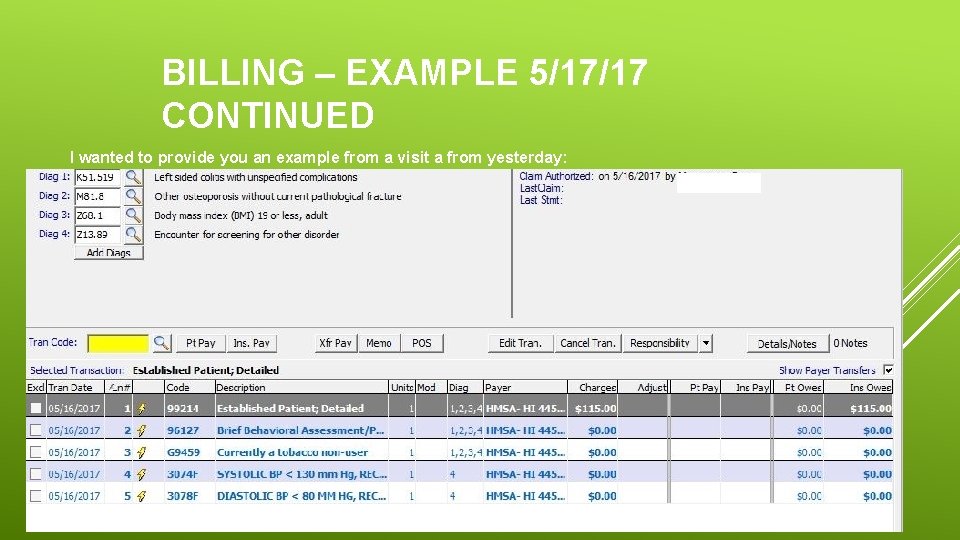
BILLING – EXAMPLE 5/17/17 CONTINUED I wanted to provide you an example from a visit a from yesterday:
BILLING – EXAMPLE 5/17/17 CONTINUED In this visit 96127 is linked to all diagnoses when it should be linked to diagnosis 4 (Z 13. 89). In addition, 3074 F and 3078 F are linked to diagnosis 4 when it should be linked to diagnosis 3 (Z 68. 1). This visit will be billed to HMSA where we have to put the non-billable/zero-balance items so it is important that they be linked correctly. I will work with IT to see if there is anything that can be done via Pn. C to ensure that this is not a Pn. C issue. In the meantime, I do appreciate all your efforts in helping with this issue.

COLLECTIONS Collects co-pays up front Reviews patient balance at every visit Accepts payments Reviews financial policy at every visit
MEASURING PERFORMANCE: WHY? Provide data that can be used to create an effective programs Provides a process to identify and creatively address operating problems Measure individual performance to identify internal best practices Show efficiently the staff operates
CREATING BENCHMARKS/MEASURES Determine what is critical for success Define the matrices to measure Determine Internal or External Benchmark Measure/Compare performance Determine the actions needed Adapt a best process QI / Implement, reassess, evaluate and measure
WORK IN STRATEGIC PLANNING – FRONT DESK/BUSINESS OFFICE HAS INSIGHT Elements of Strategic Planning: Identify/Describe the group of customers/target group to be served. Identify mandates: Consider statutory regulations, institutional requirements, and accreditation standards. Develop a mission statement and organizational philosophy.
WORK IN STRATEGIC PLANNING – CONT. Assess the environment: Who are the constituents. Measure internal strengths and weaknesses and external opportunities and threats. Formulate and define goals and objectives. Identify strategies: Promote the accomplishment of objectives. Implement programs: Apply the strategies. Evaluate programs: Analyze the accomplishment of objectives.
BUDGET MANAGEMENT Front office and Business Office staff can provide information on how to deal with budgetary constraints. They have insight into a variety of aspects of day-to-day operations.
HUMAN RESOURCE MANAGEMENT Front office and Business Office staff can help providers in dealing with issues of Human Resource Management. Help set a constructive and productive tone in dealing with people. Maintain adherence to peronnel policies.
INFORMATION SYSTEMS MANAGEMENT Front office and Business Office staff deal with the EHR system in different ways and can help utilize it the system to its fullest. Information Technology is a key to EHR and falls within administrative functions.
INFORMATION SYSTEMS MANAGEMENT – CONT. Blockchain Technology – Digital ledger that allows for dtata to be stored in chronological order. This information can be interconnected, but not changed, once entered. Information can be stored without identifying factors that can be a security risk. Benefits healthcare with less paperwork and capturing permission across health institutions. Intelligent Interoperability – Breaks down silos and makes information more accountable. Make sense of large data generated by EHR systems. Artificial Intelligence – In the future could be used to design treatment plans, manage medications, and administrative tasks. Automation – Increase patient experience.
RISK MANAGEMENT Administration is responsible for risk management: OSHA Laws: facilities and management issues (emergency drills, safety and security issues), bloodborne pathogens, hazardous communication, employee training, hepatitis B vaccination, and TB testing. Accrediting agencies requirements as a part of a quality management and improvement program. Fiscal integrity. Providing a safe and secure place of employment, particularly through new employee orientation and training.
ASSESSMENT, EVALUATION, AND COMPARISON Evaluation of a student health service: How many students are utilizing the services? Are students satisfied with the services received? Are the program objectives being accomplished? Are the objectives being accomplished? Are activities being done in the most cost-efficient manner?
ANNUAL REPORTS AND AUDITS Documenting the effectiveness of the services provided Keeping upper management informed Relating functions to the institutional mission Presenting data information that can be used in making decisions/policy Highlighting important trends or unusual activities, situations, or occurrences

GOO. GL/ITGQQI
- Slides: 34