
From Xrays to Cordless Phones Radiation Causes Brain
From X-rays to Cordless Phones: Radiation Causes Brain Tumors Lloyd Morgan Revised 14 March 2006 Lloyd Morgan email: bilovsky@aol. com
Ionizing Radiation Exposures are from X-rays, A-bombs, radioactivity Only “known” environmental cause of brain tumors (since 1974 or earlier) Energy sufficient to break molecular bonds For example, DNA • Broken DNA creates free radicals – Free radicals cause further DNA damage thought to cause cancer Revised 14 March 2006 Lloyd Morgan email: bilovsky@aol. com 2
Ionizing Radiation Increased risk of brain tumors Age: Children at greater risk than adults Dose measured in Gray (Gy): Risk increases linearly with dose • Dose=(Radiation power)/(weight of exposed tissue) x (time) – Risk increases with power (Watts) – Risk increases with time Excess risk, 30 or more years (all ages) [1] Brain Cancer: 200+% Meningioma: 70+% Revised 14 March 2006 Lloyd Morgan email: bilovsky@aol. com 3
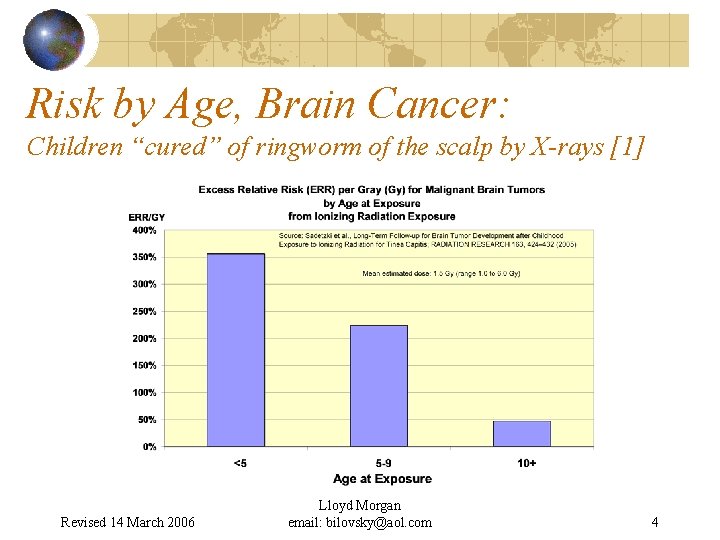
Risk by Age, Brain Cancer: Children “cured” of ringworm of the scalp by X-rays [1] Revised 14 March 2006 Lloyd Morgan email: bilovsky@aol. com 4
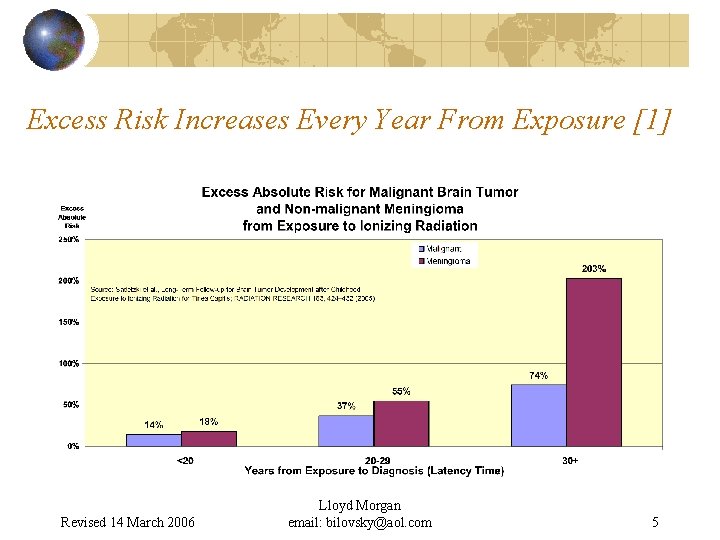
Excess Risk Increases Every Year From Exposure [1] Revised 14 March 2006 Lloyd Morgan email: bilovsky@aol. com 5
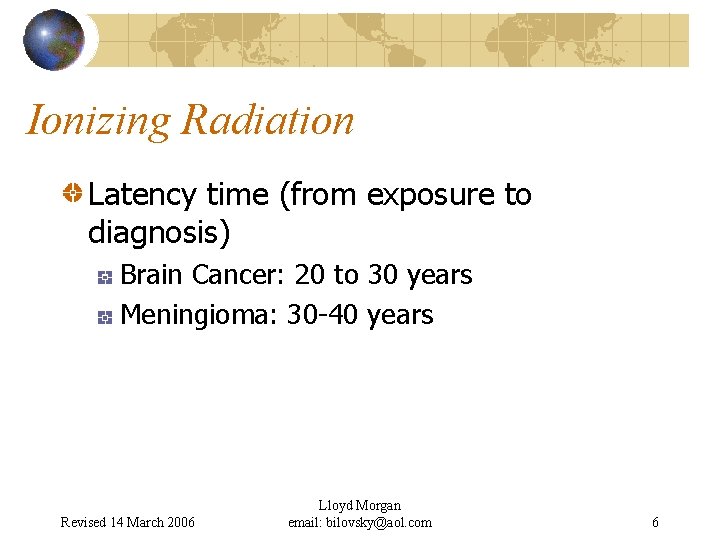
Ionizing Radiation Latency time (from exposure to diagnosis) Brain Cancer: 20 to 30 years Meningioma: 30 -40 years Revised 14 March 2006 Lloyd Morgan email: bilovsky@aol. com 6
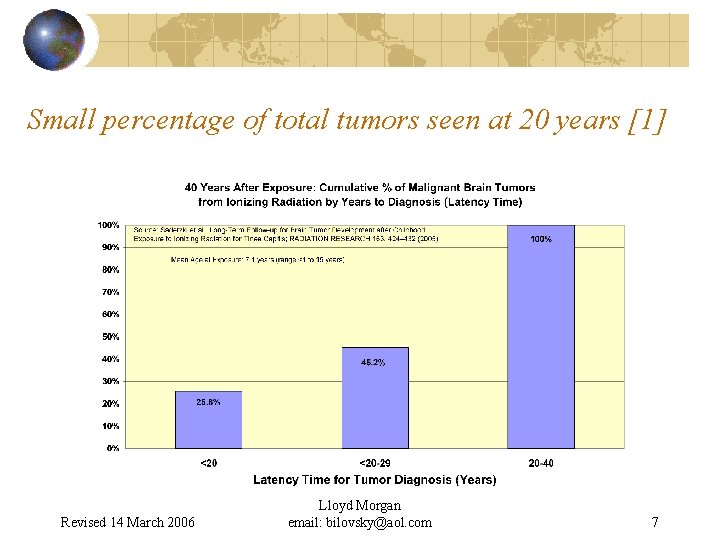
Small percentage of total tumors seen at 20 years [1] Revised 14 March 2006 Lloyd Morgan email: bilovsky@aol. com 7
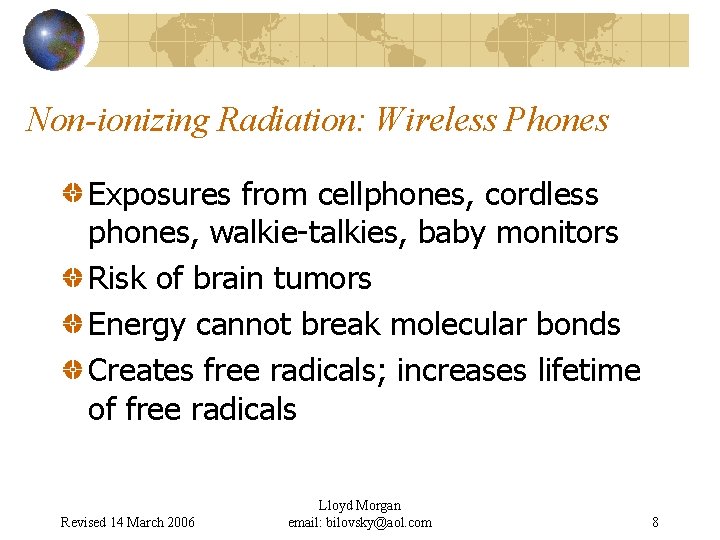
Non-ionizing Radiation: Wireless Phones Exposures from cellphones, cordless phones, walkie-talkies, baby monitors Risk of brain tumors Energy cannot break molecular bonds Creates free radicals; increases lifetime of free radicals Revised 14 March 2006 Lloyd Morgan email: bilovsky@aol. com 8
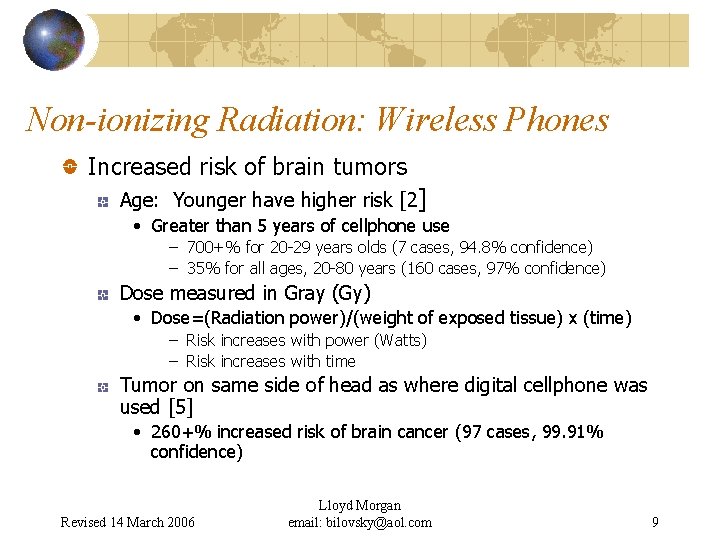
Non-ionizing Radiation: Wireless Phones Increased risk of brain tumors Age: Younger have higher risk [2] • Greater than 5 years of cellphone use – 700+% for 20 -29 years olds (7 cases, 94. 8% confidence) – 35% for all ages, 20 -80 years (160 cases, 97% confidence) Dose measured in Gray (Gy) • Dose=(Radiation power)/(weight of exposed tissue) x (time) – Risk increases with power (Watts) – Risk increases with time Tumor on same side of head as where digital cellphone was used [5] • 260+% increased risk of brain cancer (97 cases, 99. 91% confidence) Revised 14 March 2006 Lloyd Morgan email: bilovsky@aol. com 9

Wireless Phones: Risk by Age [2] Revised 14 March 2006 Lloyd Morgan email: bilovsky@aol. com 10
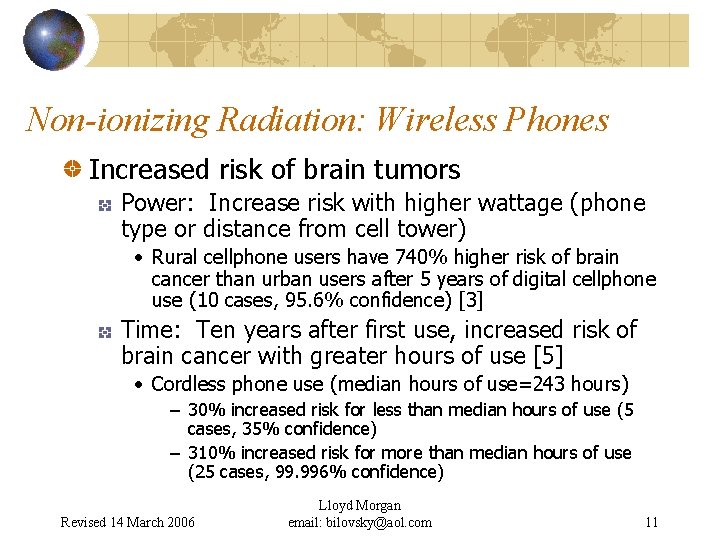
Non-ionizing Radiation: Wireless Phones Increased risk of brain tumors Power: Increase risk with higher wattage (phone type or distance from cell tower) • Rural cellphone users have 740% higher risk of brain cancer than urban users after 5 years of digital cellphone use (10 cases, 95. 6% confidence) [3] Time: Ten years after first use, increased risk of brain cancer with greater hours of use [5] • Cordless phone use (median hours of use=243 hours) – 30% increased risk for less than median hours of use (5 cases, 35% confidence) – 310% increased risk for more than median hours of use (25 cases, 99. 996% confidence) Revised 14 March 2006 Lloyd Morgan email: bilovsky@aol. com 11
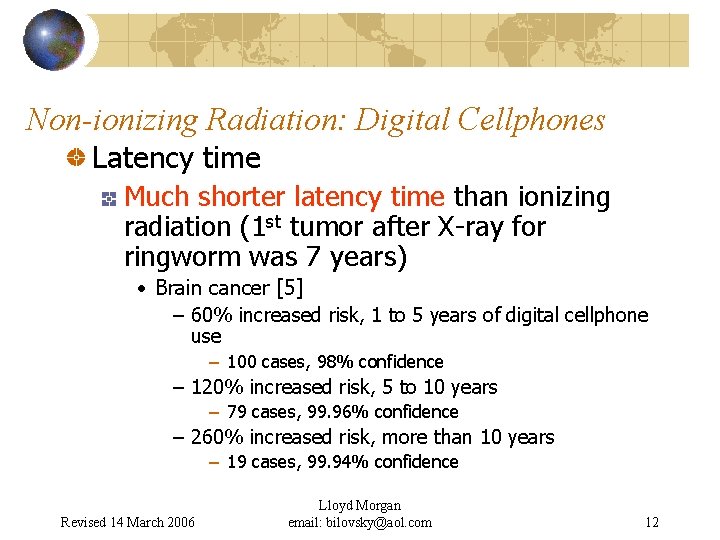
Non-ionizing Radiation: Digital Cellphones Latency time Much shorter latency time than ionizing radiation (1 st tumor after X-ray for ringworm was 7 years) • Brain cancer [5] – 60% increased risk, 1 to 5 years of digital cellphone use – 100 cases, 98% confidence – 120% increased risk, 5 to 10 years – 79 cases, 99. 96% confidence – 260% increased risk, more than 10 years – 19 cases, 99. 94% confidence Revised 14 March 2006 Lloyd Morgan email: bilovsky@aol. com 12
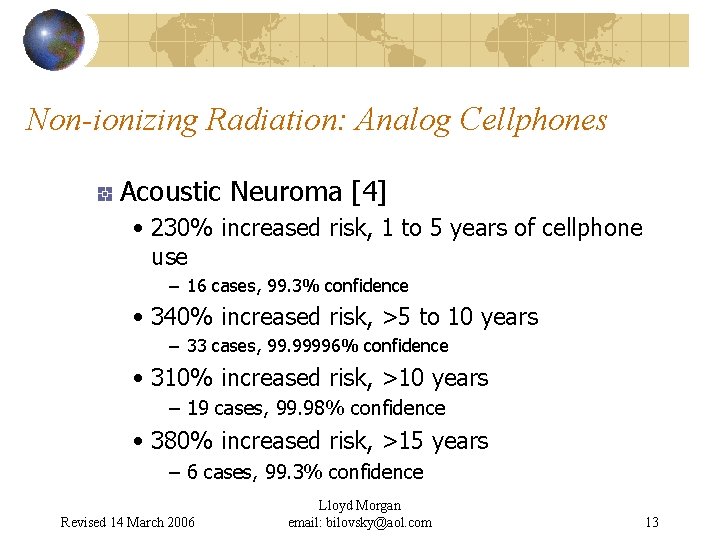
Non-ionizing Radiation: Analog Cellphones Acoustic Neuroma [4] • 230% increased risk, 1 to 5 years of cellphone use – 16 cases, 99. 3% confidence • 340% increased risk, >5 to 10 years – 33 cases, 99. 99996% confidence • 310% increased risk, >10 years – 19 cases, 99. 98% confidence • 380% increased risk, >15 years – 6 cases, 99. 3% confidence Revised 14 March 2006 Lloyd Morgan email: bilovsky@aol. com 13
Non-ionizing Radiation: Analog Cellphones Meningioma [4] • 20% increased risk, 1 -5 years of cellphone use – 32 cases, 63% confidence • 20% increased risk, 5 to 10 years – 47 cases, 63% confidence • 60% increased risk, more than 10 years – 34 cases, 96% confidence Revised 14 March 2006 Lloyd Morgan email: bilovsky@aol. com 14
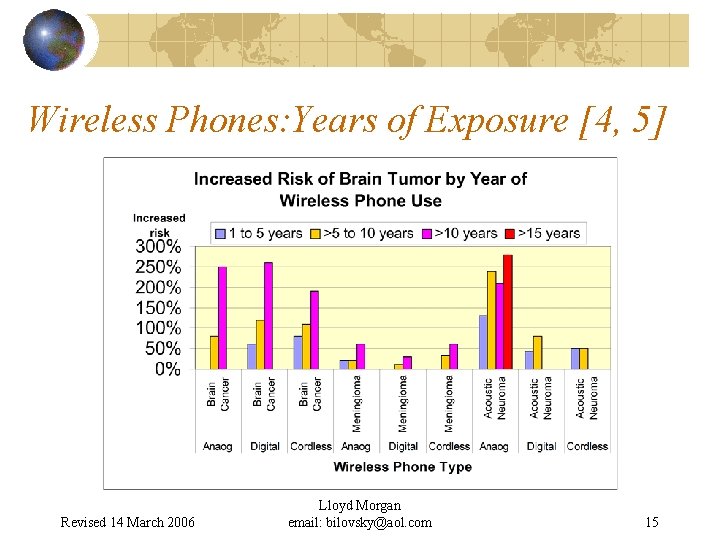
Wireless Phones: Years of Exposure [4, 5] Revised 14 March 2006 Lloyd Morgan email: bilovsky@aol. com 15
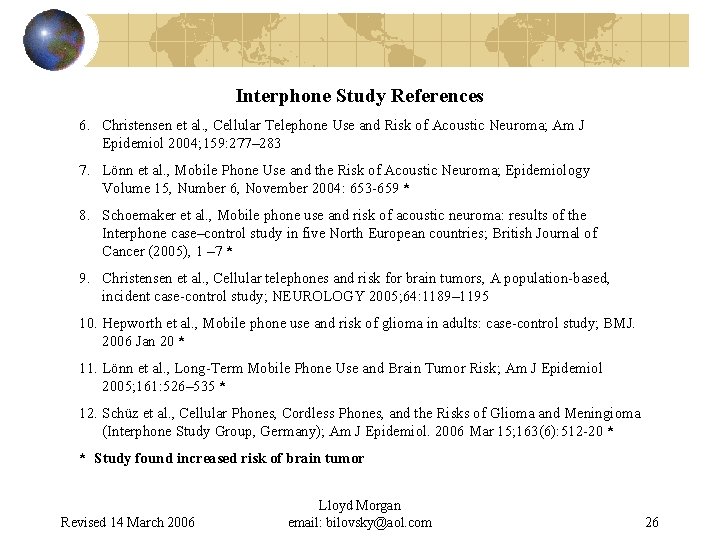
Cellphone Industry’s Studies of the Risk of Brain Tumor from Cellphone Use “Interphone” studies rarely find a risk of brain tumors from cellphone use 13 participating countries • Increased risk has been found – 5 of 7 studies found increased risk for more than 10 years of use [7, 8, 10, 11, 12] Major funding received from cellphone industry • Funding “was governed by agreements that guaranteed complete scientific independence” – The researchers knew where the funding had come from – “Don’t bite the hand that feeds you, ” is the psychological reality – Doesn’t mean that the researchers are dishonest Revised 14 March 2006 Lloyd Morgan email: bilovsky@aol. com 16
Scatter Plots (following slides) Vertical axis is percentage confidence of a finding Horizontal axis is excess (or decrease) risk of a brain tumor of a finding Risk overview If no risk • About half of all findings will show increased risk and • About half of all findings will show decreased risk Revised 14 March 2006 Lloyd Morgan email: bilovsky@aol. com 17
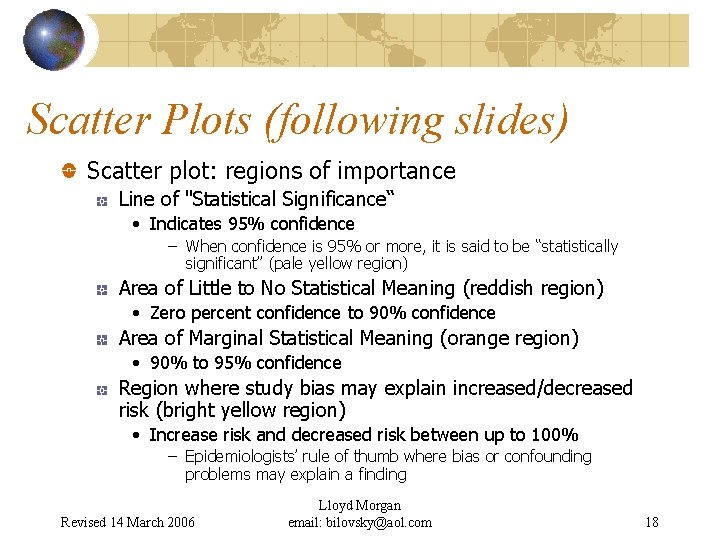
Scatter Plots (following slides) Scatter plot: regions of importance Line of "Statistical Significance“ • Indicates 95% confidence – When confidence is 95% or more, it is said to be “statistically significant” (pale yellow region) Area of Little to No Statistical Meaning (reddish region) • Zero percent confidence to 90% confidence Area of Marginal Statistical Meaning (orange region) • 90% to 95% confidence Region where study bias may explain increased/decreased risk (bright yellow region) • Increase risk and decreased risk between up to 100% – Epidemiologists’ rule of thumb where bias or confounding problems may explain a finding Revised 14 March 2006 Lloyd Morgan email: bilovsky@aol. com 18
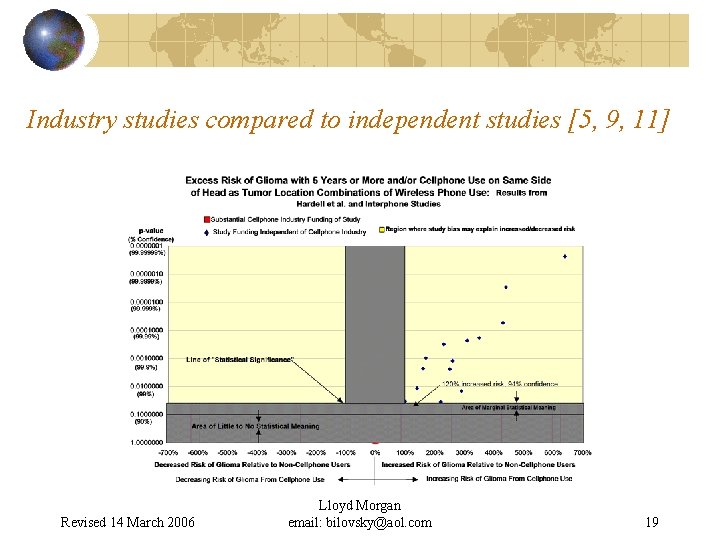
Industry studies compared to independent studies [5, 9, 11] Revised 14 March 2006 Lloyd Morgan email: bilovsky@aol. com 19
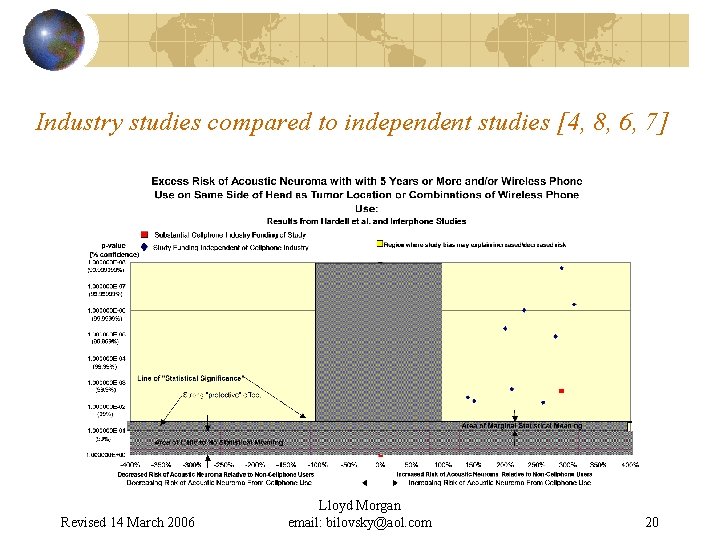
Industry studies compared to independent studies [4, 8, 6, 7] Revised 14 March 2006 Lloyd Morgan email: bilovsky@aol. com 20
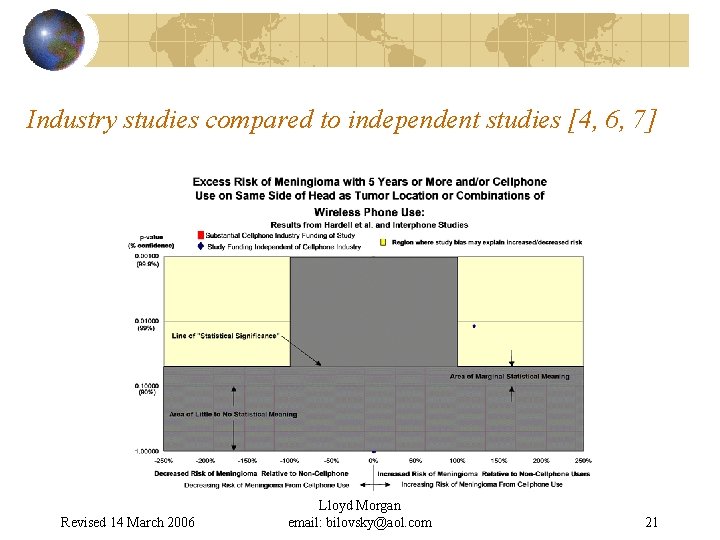
Industry studies compared to independent studies [4, 6, 7] Revised 14 March 2006 Lloyd Morgan email: bilovsky@aol. com 21
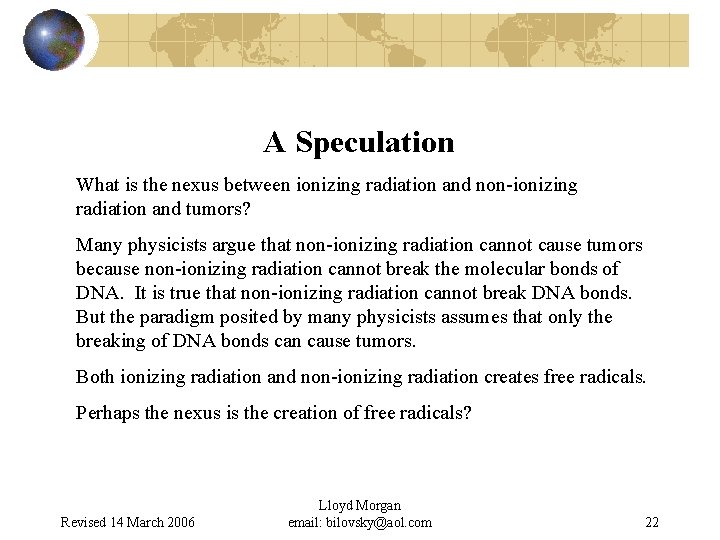
A Speculation What is the nexus between ionizing radiation and non-ionizing radiation and tumors? Many physicists argue that non-ionizing radiation cannot cause tumors because non-ionizing radiation cannot break the molecular bonds of DNA. It is true that non-ionizing radiation cannot break DNA bonds. But the paradigm posited by many physicists assumes that only the breaking of DNA bonds can cause tumors. Both ionizing radiation and non-ionizing radiation creates free radicals. Perhaps the nexus is the creation of free radicals? Revised 14 March 2006 Lloyd Morgan email: bilovsky@aol. com 22
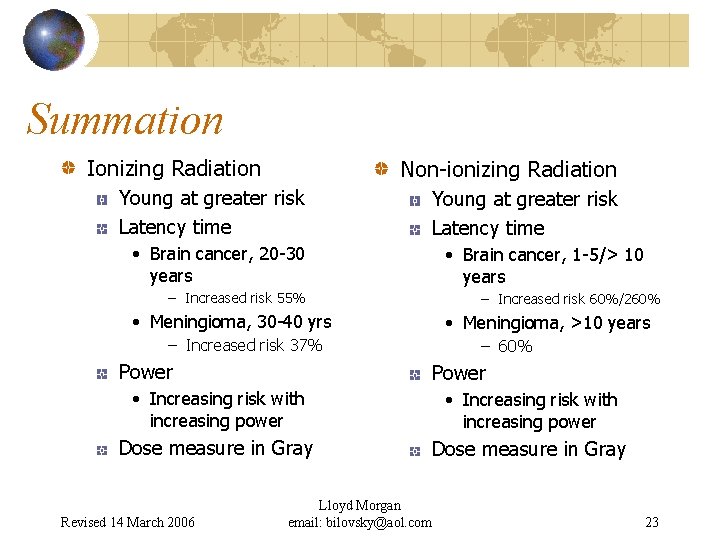
Summation Ionizing Radiation Non-ionizing Radiation Young at greater risk Latency time • Brain cancer, 20 -30 years • Brain cancer, 1 -5/> 10 years – Increased risk 55% – Increased risk 60%/260% • Meningioma, 30 -40 yrs • Meningioma, >10 years – Increased risk 37% Power – 60% Power • Increasing risk with increasing power Dose measure in Gray Revised 14 March 2006 Lloyd Morgan email: bilovsky@aol. com 23
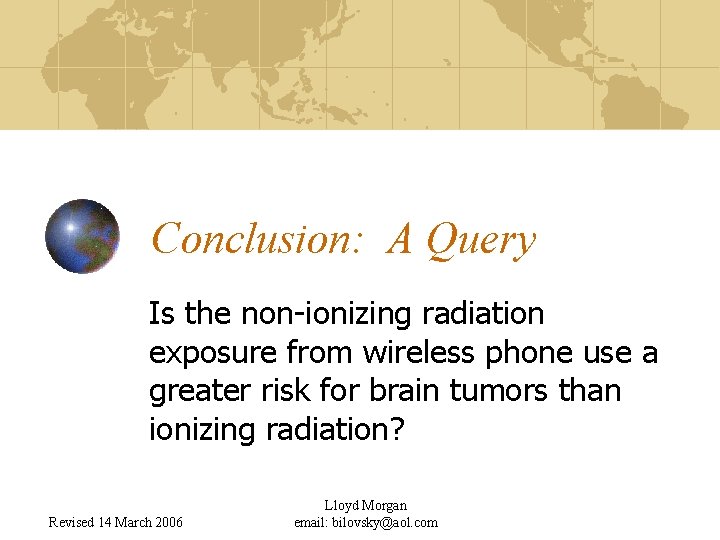
Conclusion: A Query Is the non-ionizing radiation exposure from wireless phone use a greater risk for brain tumors than ionizing radiation? Revised 14 March 2006 Lloyd Morgan email: bilovsky@aol. com
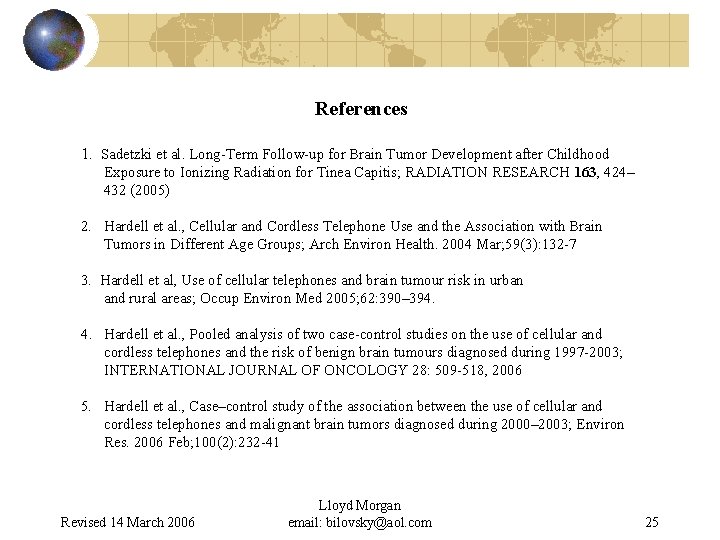
References 1. Sadetzki et al. Long-Term Follow-up for Brain Tumor Development after Childhood Exposure to Ionizing Radiation for Tinea Capitis; RADIATION RESEARCH 163, 424– 432 (2005) 2. Hardell et al. , Cellular and Cordless Telephone Use and the Association with Brain Tumors in Different Age Groups; Arch Environ Health. 2004 Mar; 59(3): 132 -7 3. Hardell et al, Use of cellular telephones and brain tumour risk in urban and rural areas; Occup Environ Med 2005; 62: 390– 394. 4. Hardell et al. , Pooled analysis of two case-control studies on the use of cellular and cordless telephones and the risk of benign brain tumours diagnosed during 1997 -2003; INTERNATIONAL JOURNAL OF ONCOLOGY 28: 509 -518, 2006 5. Hardell et al. , Case–control study of the association between the use of cellular and cordless telephones and malignant brain tumors diagnosed during 2000– 2003; Environ Res. 2006 Feb; 100(2): 232 -41 Revised 14 March 2006 Lloyd Morgan email: bilovsky@aol. com 25
Interphone Study References 6. Christensen et al. , Cellular Telephone Use and Risk of Acoustic Neuroma; Am J Epidemiol 2004; 159: 277– 283 7. Lönn et al. , Mobile Phone Use and the Risk of Acoustic Neuroma; Epidemiology Volume 15, Number 6, November 2004: 653 -659 * 8. Schoemaker et al. , Mobile phone use and risk of acoustic neuroma: results of the Interphone case–control study in five North European countries; British Journal of Cancer (2005), 1 – 7 * 9. Christensen et al. , Cellular telephones and risk for brain tumors, A population-based, incident case-control study; NEUROLOGY 2005; 64: 1189– 1195 10. Hepworth et al. , Mobile phone use and risk of glioma in adults: case-control study; BMJ. 2006 Jan 20 * 11. Lönn et al. , Long-Term Mobile Phone Use and Brain Tumor Risk; Am J Epidemiol 2005; 161: 526– 535 * 12. Schüz et al. , Cellular Phones, Cordless Phones, and the Risks of Glioma and Meningioma (Interphone Study Group, Germany); Am J Epidemiol. 2006 Mar 15; 163(6): 512 -20 * * Study found increased risk of brain tumor Revised 14 March 2006 Lloyd Morgan email: bilovsky@aol. com 26
- Slides: 26