
From Wisc Key to Bourbon A Learned Index

From Wisc. Key to Bourbon: A Learned Index for Log-Structured Merge Trees Yifan Dai, Yien Xu, Aishwarya Ganesan, Ramnatthan Alagappan, Brian Kroth, Andrea Arpaci-Dusseau and Remzi Arpaci-Dusseau
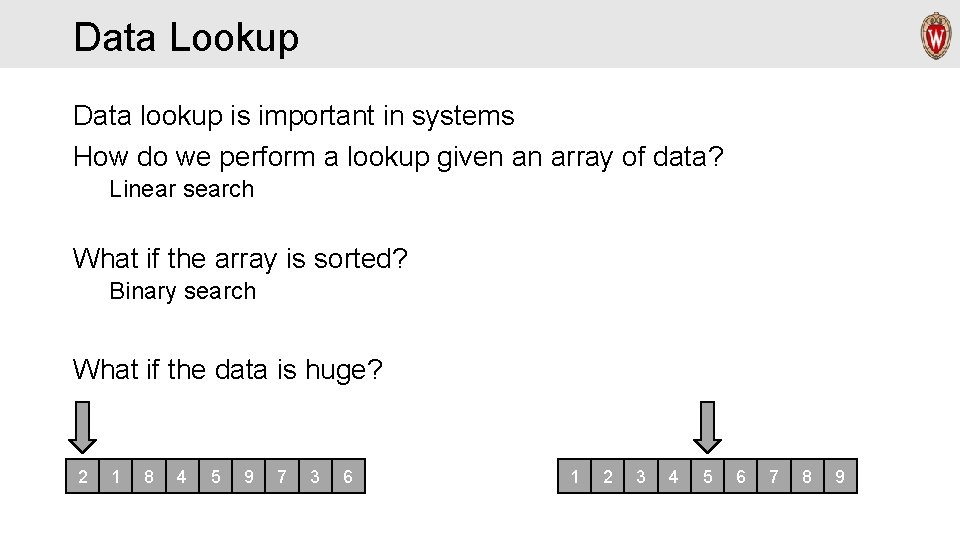
Data Lookup Data lookup is important in systems How do we perform a lookup given an array of data? Linear search What if the array is sorted? Binary search What if the data is huge? 2 1 8 4 5 9 7 3 6 1 2 3 4 5 6 7 8 9
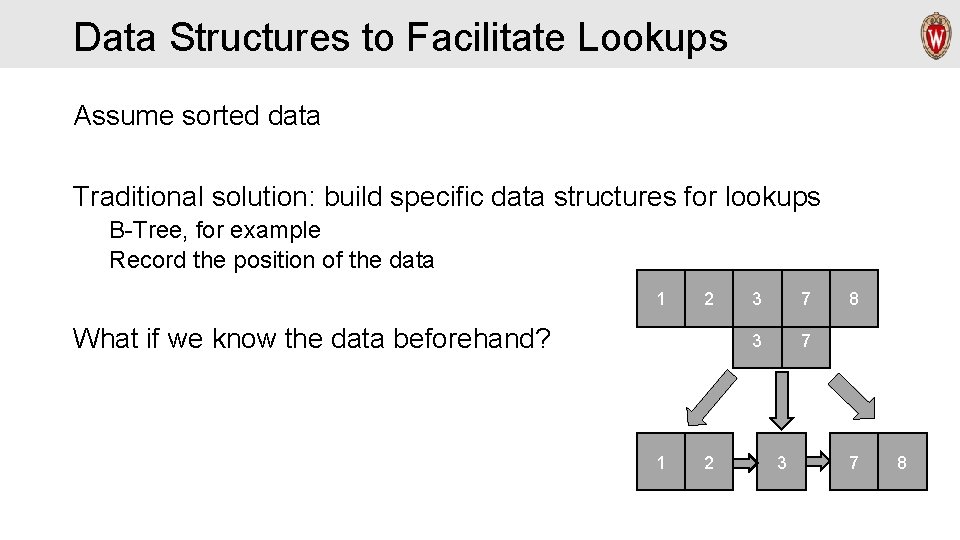
Data Structures to Facilitate Lookups Assume sorted data Traditional solution: build specific data structures for lookups B-Tree, for example Record the position of the data 1 2 What if we know the data beforehand? 1 2 3 7 3 8 7 8
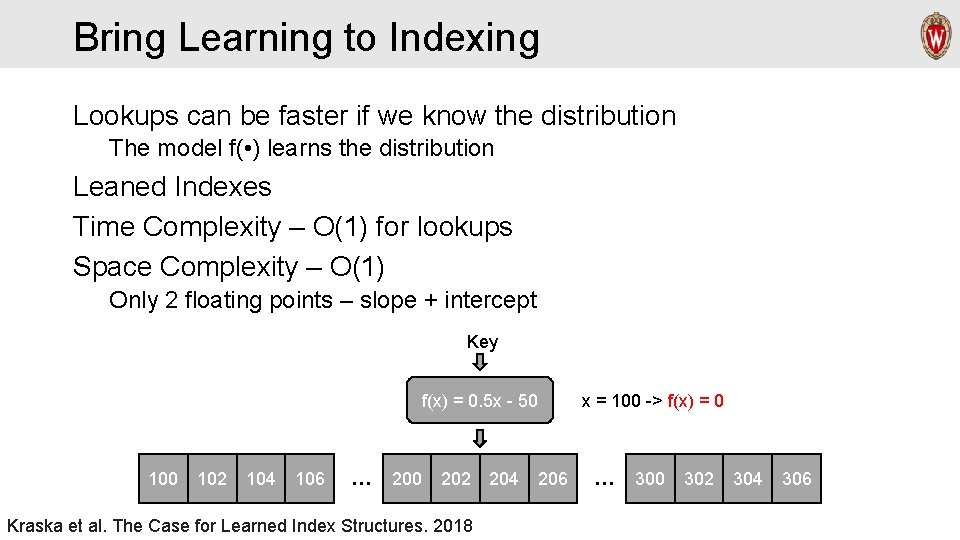
Bring Learning to Indexing Lookups can be faster if we know the distribution The model f( • ) learns the distribution Leaned Indexes Time Complexity – O(1) for lookups Space Complexity – O(1) Only 2 floating points – slope + intercept Key f(x) = 0. 5 x - 50 102 104 106 … 200 202 Kraska et al. The Case for Learned Index Structures. 2018 204 206 x = 100 -> f(x) = 0 … 300 302 304 306
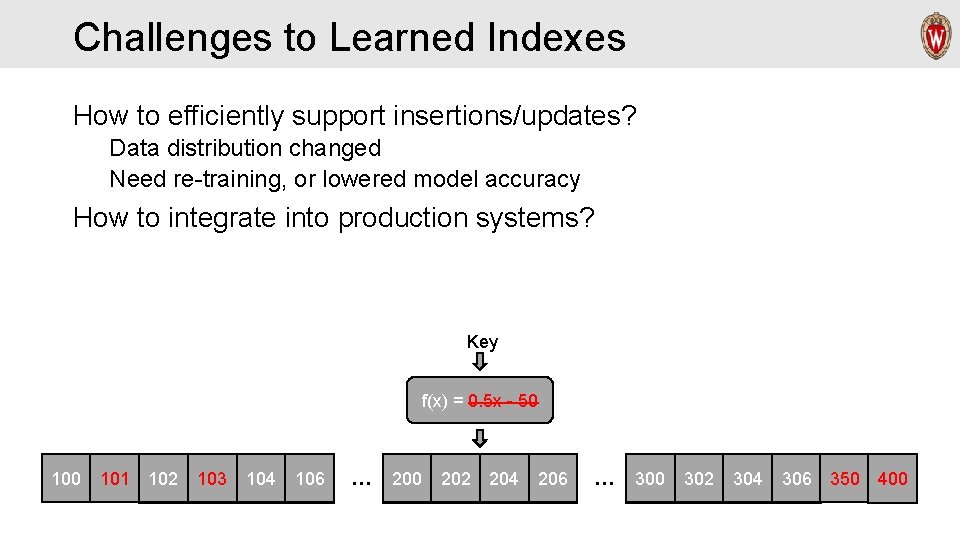
Challenges to Learned Indexes How to efficiently support insertions/updates? Data distribution changed Need re-training, or lowered model accuracy How to integrate into production systems? Key f(x) = 0. 5 x - 50 101 102 100 103 102 104 106 … 200 202 204 206 … 300 302 304 306 350 400
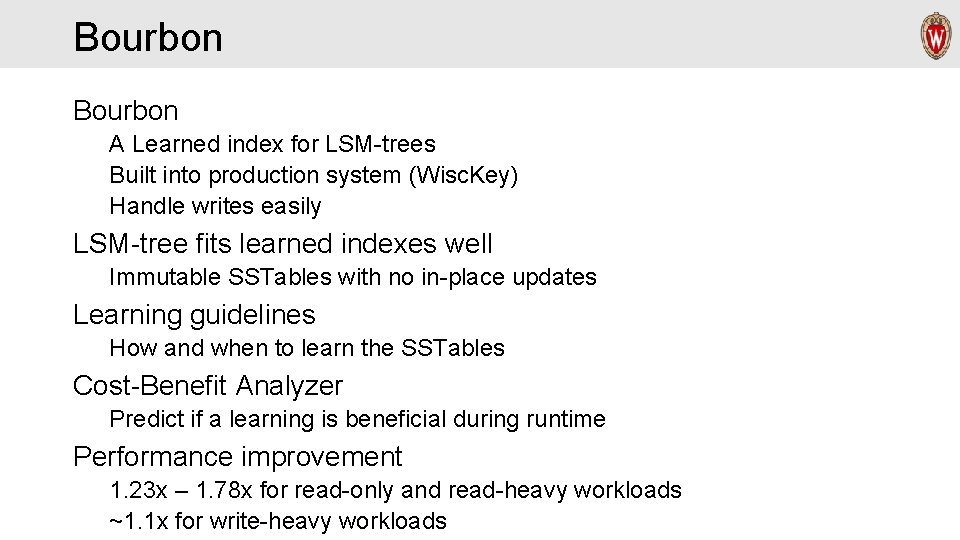
Bourbon A Learned index for LSM-trees Built into production system (Wisc. Key) Handle writes easily LSM-tree fits learned indexes well Immutable SSTables with no in-place updates Learning guidelines How and when to learn the SSTables Cost-Benefit Analyzer Predict if a learning is beneficial during runtime Performance improvement 1. 23 x – 1. 78 x for read-only and read-heavy workloads ~1. 1 x for write-heavy workloads

Level. DB Mem. Table Key-value store based on LSM SSTable 2 in-memory tables Memory 7 levels of on-disk SSTables (files) Update/Insertion procedure Buffered in Mem. Tables Merging compaction From upper to lower levels No in-place updates to SSTables Lookup procedure From upper to lower levels Positive/Negative internal lookups L 0 (8 M) L 1 (10 M) Kmin Kmax L 2 (100 M) … L 3 (1 G) … … …… L 6 (1 T) …
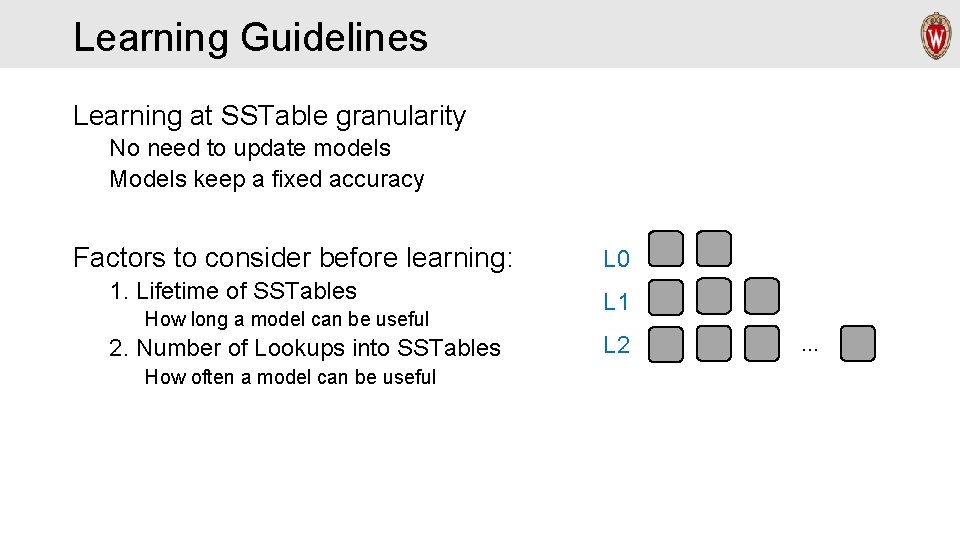
Learning Guidelines Learning at SSTable granularity No need to update models Models keep a fixed accuracy Factors to consider before learning: 1. Lifetime of SSTables How long a model can be useful 2. Number of Lookups into SSTables How often a model can be useful L 0 L 1 L 2 …
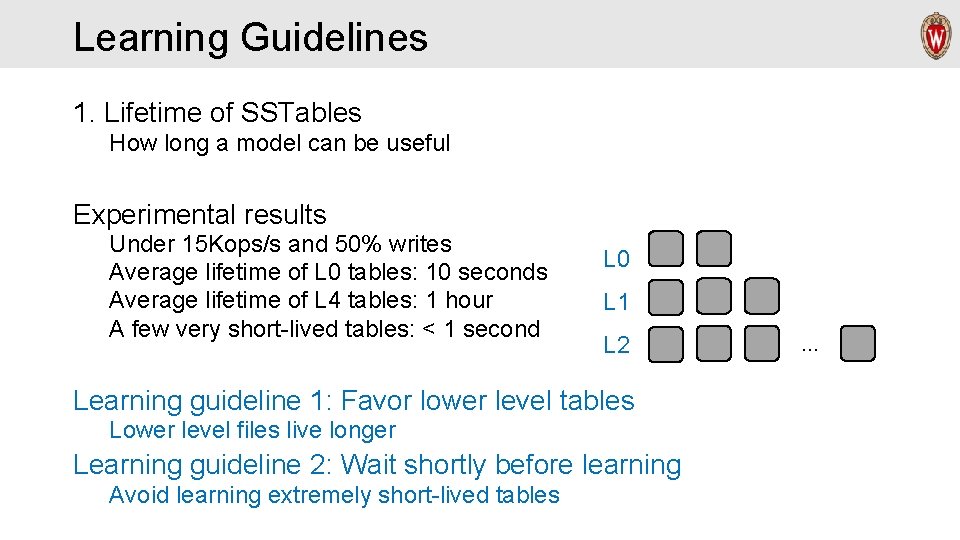
Learning Guidelines 1. Lifetime of SSTables How long a model can be useful Experimental results Under 15 Kops/s and 50% writes Average lifetime of L 0 tables: 10 seconds Average lifetime of L 4 tables: 1 hour A few very short-lived tables: < 1 second L 0 L 1 L 2 Learning guideline 1: Favor lower level tables Lower level files live longer Learning guideline 2: Wait shortly before learning Avoid learning extremely short-lived tables …
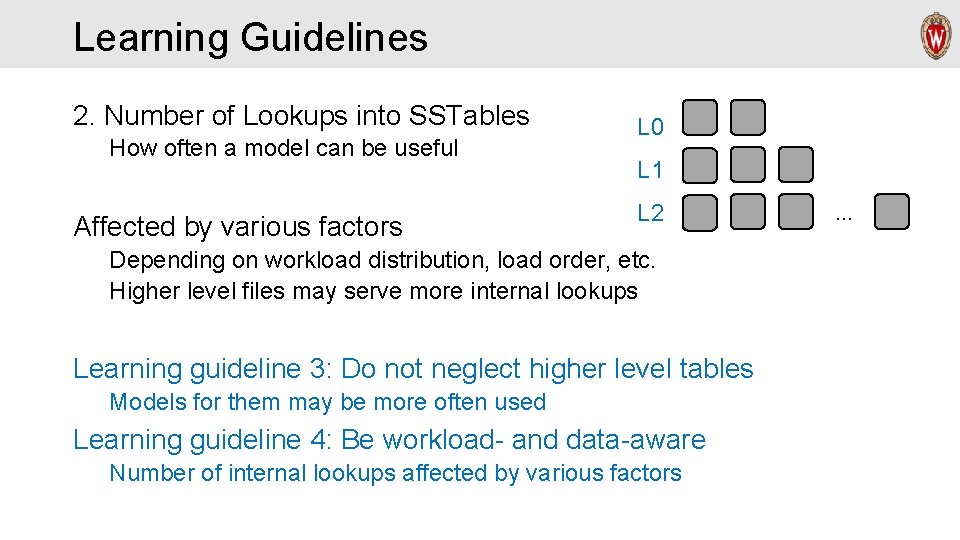
Learning Guidelines 2. Number of Lookups into SSTables How often a model can be useful Affected by various factors L 0 L 1 L 2 Depending on workload distribution, load order, etc. Higher level files may serve more internal lookups Learning guideline 3: Do not neglect higher level tables Models for them may be more often used Learning guideline 4: Be workload- and data-aware Number of internal lookups affected by various factors …
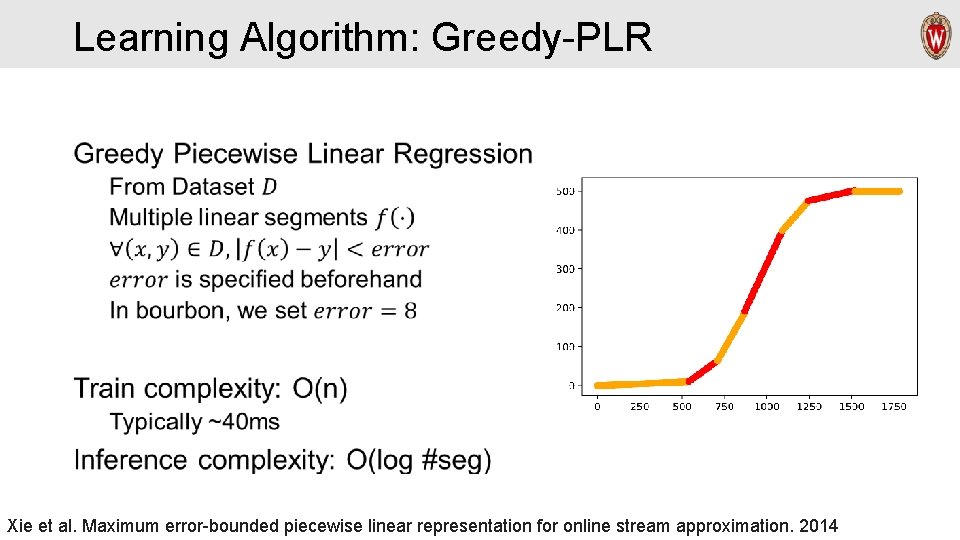
Learning Algorithm: Greedy-PLR Xie et al. Maximum error-bounded piecewise linear representation for online stream approximation. 2014
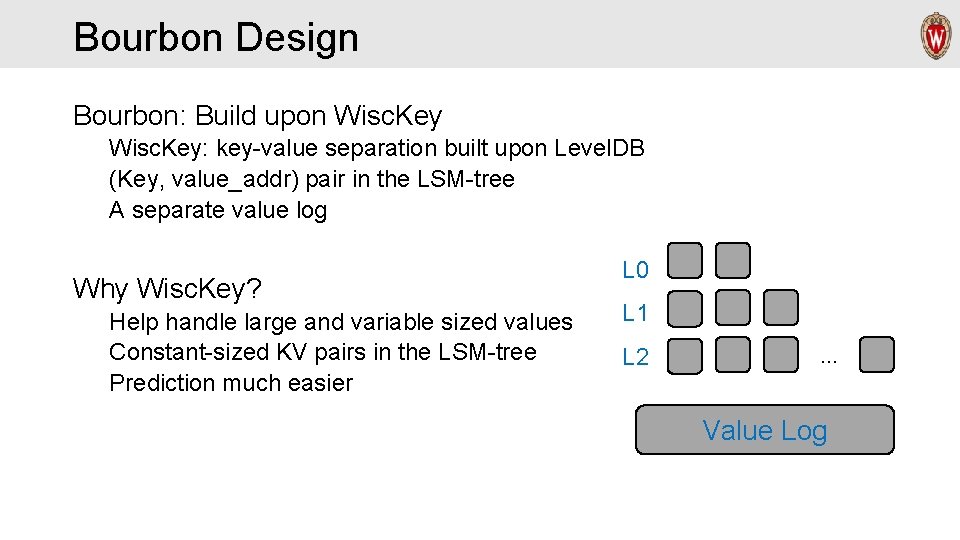
Bourbon Design Bourbon: Build upon Wisc. Key: key-value separation built upon Level. DB (Key, value_addr) pair in the LSM-tree A separate value log Why Wisc. Key? Help handle large and variable sized values Constant-sized KV pairs in the LSM-tree Prediction much easier L 0 L 1 L 2 … Value Log
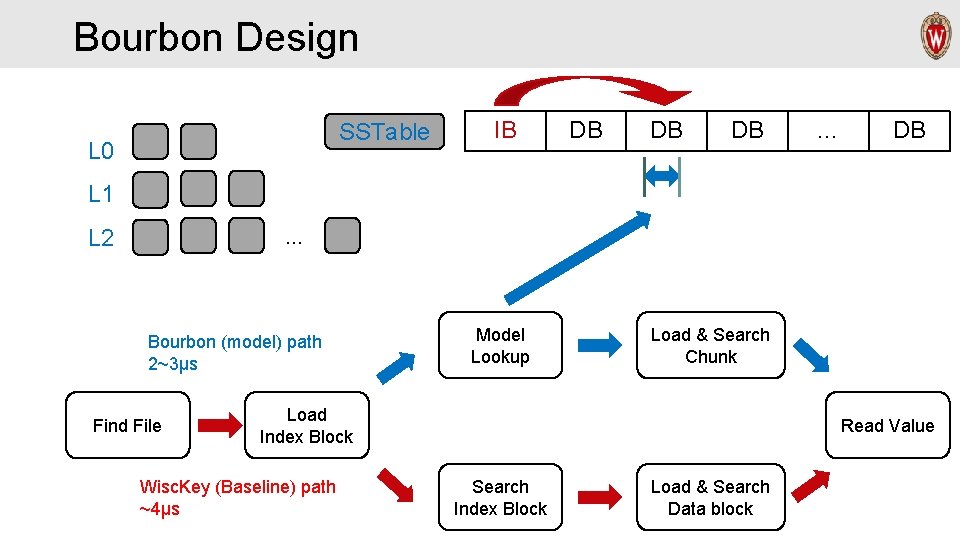
Bourbon Design SSTable L 0 IB DB DB DB … DB L 1 L 2 … Bourbon (model) path 2~3μs Find File Model Lookup Load & Search Chunk Load Index Block Wisc. Key (Baseline) path ~4μs Read Value Search Index Block Load & Search Data block
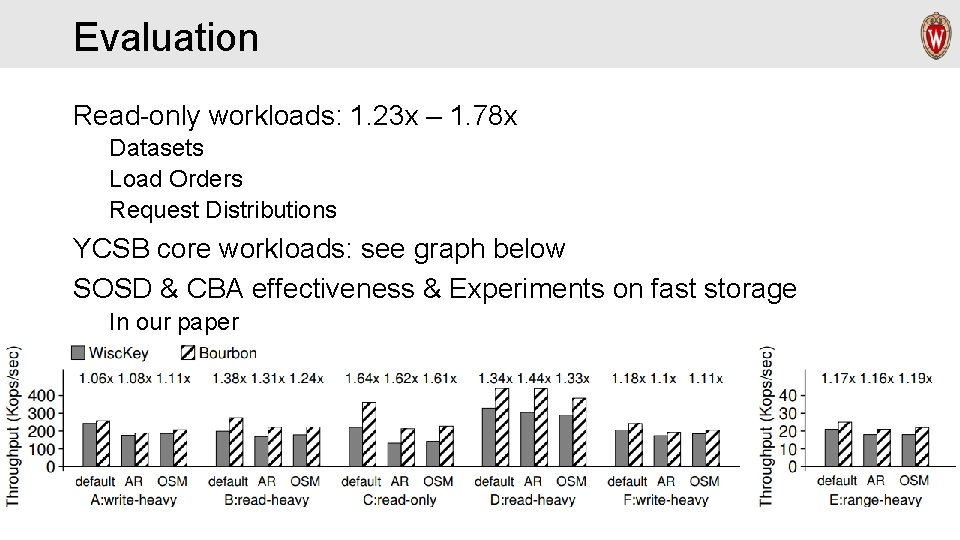
Evaluation Read-only workloads: 1. 23 x – 1. 78 x Datasets Load Orders Request Distributions YCSB core workloads: see graph below SOSD & CBA effectiveness & Experiments on fast storage In our paper
Conclusion Bourbon Integrates learned indexes into a production LSM system Beneficial on various workloads Learning guidelines on how and when to learn Cost-Benefit Analyzer on whether a learning is worthwhile How will ML change computer system mechanisms? Not just policies Bourbon improves the lookup process with learned indexes What other mechanisms can ML replace or improve? Careful study and deep understanding are required
Thank You for Watching! The ADvanced Systems Laboratory (ADSL) https: //research. cs. wisc. edu/wind/ Microsoft Gray Systems Laboratory https: //azuredata. microsoft. com/
- Slides: 16