
From theory to practice Lessons from projects integrating
- Slides: 1
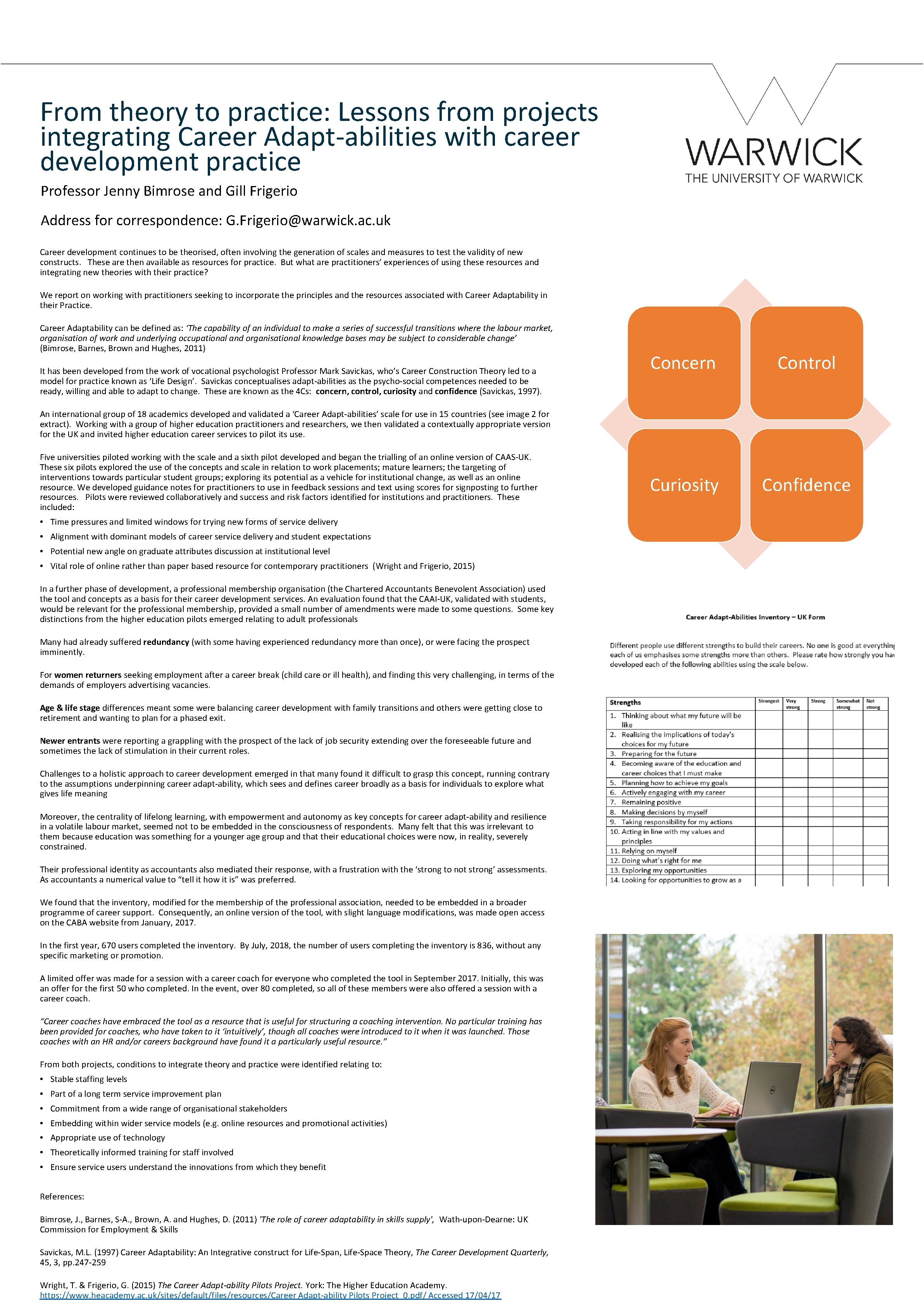
From theory to practice: Lessons from projects integrating Career Adapt-abilities with career development practice Professor Jenny Bimrose and Gill Frigerio Address for correspondence: G. Frigerio@warwick. ac. uk Career development continues to be theorised, often involving the generation of scales and measures to test the validity of new constructs. These are then available as resources for practice. But what are practitioners’ experiences of using these resources and integrating new theories with their practice? We report on working with practitioners seeking to incorporate the principles and the resources associated with Career Adaptability in their Practice. Career Adaptability can be defined as: ‘The capability of an individual to make a series of successful transitions where the labour market, organisation of work and underlying occupational and organisational knowledge bases may be subject to considerable change’ (Bimrose, Barnes, Brown and Hughes, 2011) It has been developed from the work of vocational psychologist Professor Mark Savickas, who’s Career Construction Theory led to a model for practice known as ‘Life Design’. Savickas conceptualises adapt-abilities as the psycho-social competences needed to be ready, willing and able to adapt to change. These are known as the 4 Cs: concern, control, curiosity and confidence (Savickas, 1997). Concern Control Curiosity Confidence An international group of 18 academics developed and validated a ‘Career Adapt-abilities’ scale for use in 15 countries (see image 2 for extract). Working with a group of higher education practitioners and researchers, we then validated a contextually appropriate version for the UK and invited higher education career services to pilot its use. Five universities piloted working with the scale and a sixth pilot developed and began the trialling of an online version of CAAS-UK. These six pilots explored the use of the concepts and scale in relation to work placements; mature learners; the targeting of interventions towards particular student groups; exploring its potential as a vehicle for institutional change, as well as an online resource. We developed guidance notes for practitioners to use in feedback sessions and text using scores for signposting to further resources. Pilots were reviewed collaboratively and success and risk factors identified for institutions and practitioners. These included: • Time pressures and limited windows for trying new forms of service delivery • Alignment with dominant models of career service delivery and student expectations • Potential new angle on graduate attributes discussion at institutional level • Vital role of online rather than paper based resource for contemporary practitioners (Wright and Frigerio, 2015) In a further phase of development, a professional membership organisation (the Chartered Accountants Benevolent Association) used the tool and concepts as a basis for their career development services. An evaluation found that the CAAI-UK, validated with students, would be relevant for the professional membership, provided a small number of amendments were made to some questions. Some key distinctions from the higher education pilots emerged relating to adult professionals Many had already suffered redundancy (with some having experienced redundancy more than once), or were facing the prospect imminently. For women returners seeking employment after a career break (child care or ill health), and finding this very challenging, in terms of the demands of employers advertising vacancies. Age & life stage differences meant some were balancing career development with family transitions and others were getting close to retirement and wanting to plan for a phased exit. Newer entrants were reporting a grappling with the prospect of the lack of job security extending over the foreseeable future and sometimes the lack of stimulation in their current roles. Challenges to a holistic approach to career development emerged in that many found it difficult to grasp this concept, running contrary to the assumptions underpinning career adapt-ability, which sees and defines career broadly as a basis for individuals to explore what gives life meaning Moreover, the centrality of lifelong learning, with empowerment and autonomy as key concepts for career adapt-ability and resilience in a volatile labour market, seemed not to be embedded in the consciousness of respondents. Many felt that this was irrelevant to them because education was something for a younger age group and that their educational choices were now, in reality, severely constrained. Their professional identity as accountants also mediated their response, with a frustration with the ‘strong to not strong’ assessments. As accountants a numerical value to “tell it how it is” was preferred. We found that the inventory, modified for the membership of the professional association, needed to be embedded in a broader programme of career support. Consequently, an online version of the tool, with slight language modifications, was made open access on the CABA website from January, 2017. In the first year, 670 users completed the inventory. By July, 2018, the number of users completing the inventory is 836, without any specific marketing or promotion. A limited offer was made for a session with a career coach for everyone who completed the tool in September 2017. Initially, this was an offer for the first 50 who completed. In the event, over 80 completed, so all of these members were also offered a session with a career coach. “Career coaches have embraced the tool as a resource that is useful for structuring a coaching intervention. No particular training has been provided for coaches, who have taken to it ‘intuitively’, though all coaches were introduced to it when it was launched. Those coaches with an HR and/or careers background have found it a particularly useful resource. ” From both projects, conditions to integrate theory and practice were identified relating to: • Stable staffing levels • Part of a long term service improvement plan • Commitment from a wide range of organisational stakeholders • Embedding within wider service models (e. g. online resources and promotional activities) • Appropriate use of technology • Theoretically informed training for staff involved • Ensure service users understand the innovations from which they benefit References: Bimrose, J. , Barnes, S-A. , Brown, A. and Hughes, D. (2011) 'The role of career adaptability in skills supply', Wath-upon-Dearne: UK Commission for Employment & Skills Savickas, M. L. (1997) Career Adaptability: An Integrative construct for Life-Span, Life-Space Theory, The Career Development Quarterly, 45, 3, pp. 247 -259 Wright, T. & Frigerio, G. (2015) The Career Adapt-ability Pilots Project. York: The Higher Education Academy. https: //www. heacademy. ac. uk/sites/default/files/resources/Career Adapt-ability Pilots Project_0. pdf/ Accessed 17/04/17