
From the Pioneerflyby anomalies to an alternative cosmology
From the Pioneer-flyby anomalies to an alternative cosmology. Mike Mc. Culloch. Honorary Fellow, University of Exeter, U. K. M. E. Mc. Culloch@exeter. ac. uk Talk for Cosmo-08 at the University of Wisconsin, Madison, 26 th August 2008 Outline: Reasons, and a method, for modifying inertia (Mi. Hs. C) Mi. Hs. C predicts a minimum acceleration: c 2/R (dark energy? ) Mi. Hs. C predicts the Pioneer anomaly (when unbound)… and the flyby anomalies (using mutual accelerations) First attempts at a cosmology. Conclusions
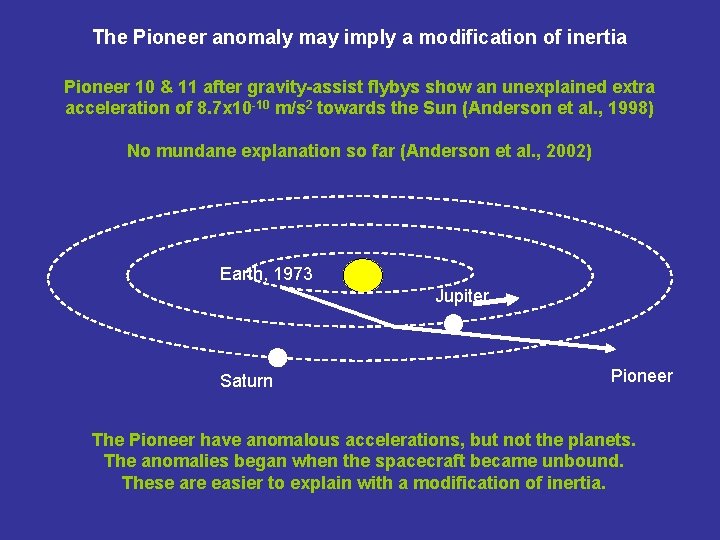
The Pioneer anomaly may imply a modification of inertia Pioneer 10 & 11 after gravity-assist flybys show an unexplained extra acceleration of 8. 7 x 10 -10 m/s 2 towards the Sun (Anderson et al. , 1998) No mundane explanation so far (Anderson et al. , 2002) Earth, 1973 Jupiter Saturn Pioneer The Pioneer have anomalous accelerations, but not the planets. The anomalies began when the spacecraft became unbound. These are easier to explain with a modification of inertia.
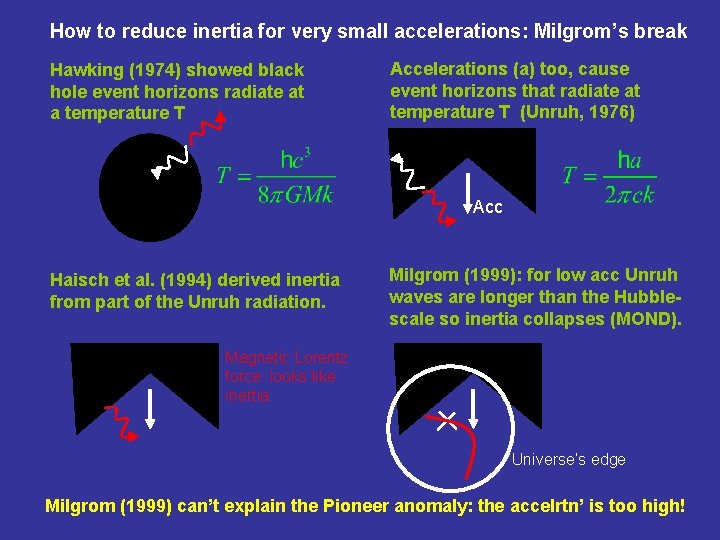
How to reduce inertia for very small accelerations: Milgrom’s break Hawking (1974) showed black hole event horizons radiate at a temperature T Accelerations (a) too, cause event horizons that radiate at temperature T (Unruh, 1976) Acc Haisch et al. (1994) derived inertia from part of the Unruh radiation. Milgrom (1999): for low acc Unruh waves are longer than the Hubblescale so inertia collapses (MOND). Magnetic Lorentz force: looks like inertia. Universe’s edge Milgrom (1999) can’t explain the Pioneer anomaly: the accelrtn’ is too high!
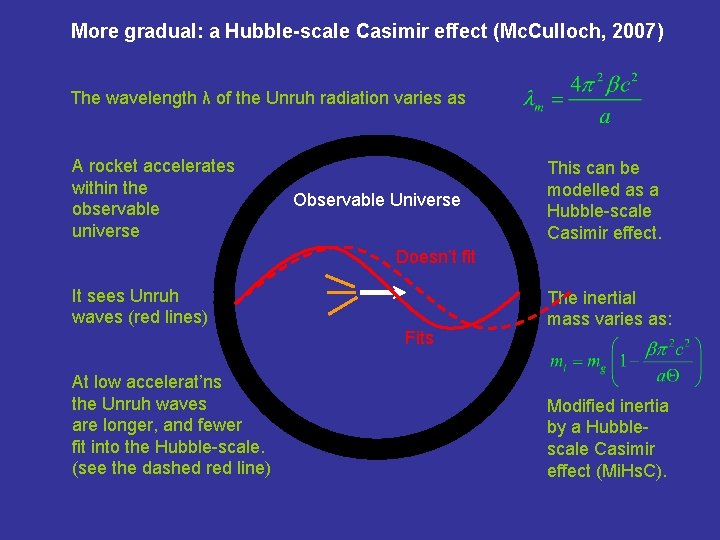
More gradual: a Hubble-scale Casimir effect (Mc. Culloch, 2007) The wavelength λ of the Unruh radiation varies as A rocket accelerates within the observable universe Observable Universe This can be modelled as a Hubble-scale Casimir effect. Doesn’t fit It sees Unruh waves (red lines) Fits At low accelerat’ns the Unruh waves are longer, and fewer fit into the Hubble-scale. (see the dashed red line) The inertial mass varies as: Modified inertia by a Hubblescale Casimir effect (Mi. Hs. C).
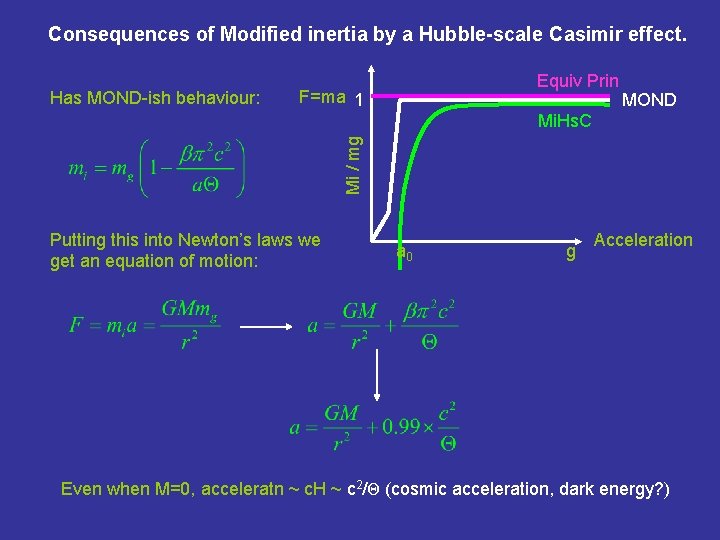
Consequences of Modified inertia by a Hubble-scale Casimir effect. Has MOND-ish behaviour: Equiv Prin F=ma 1 MOND Mi / mg Mi. Hs. C Putting this into Newton’s laws we get an equation of motion: a 0 g Acceleration Even when M=0, acceleratn ~ c. H ~ c 2/Θ (cosmic acceleration, dark energy? )
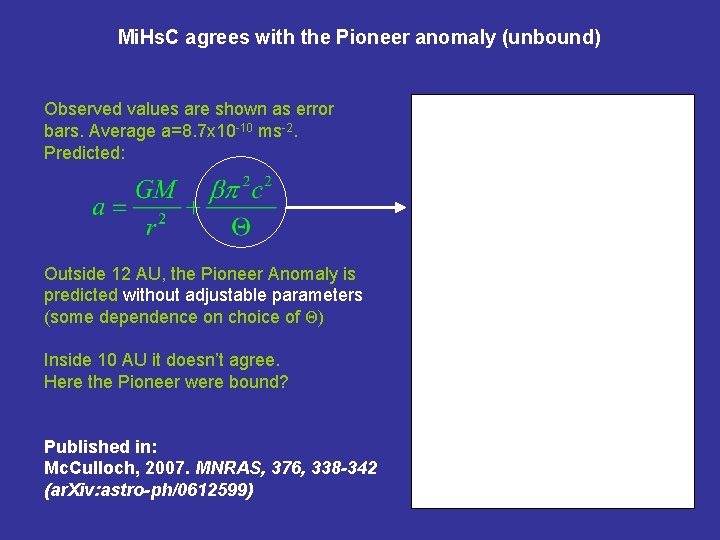
Mi. Hs. C agrees with the Pioneer anomaly (unbound) Observed values are shown as error bars. Average a=8. 7 x 10 -10 ms-2. Predicted: Outside 12 AU, the Pioneer Anomaly is predicted without adjustable parameters (some dependence on choice of Θ) Inside 10 AU it doesn’t agree. Here the Pioneer were bound? Published in: Mc. Culloch, 2007. MNRAS, 376, 338 -342 (ar. Xiv: astro-ph/0612599)

The flyby anomalies, Anderson et al. (2008) dv dv Anderson et al. (2008) found the following empirical formula: and said the cause may be ‘something to do with rotation’… Unexpected speed-up of Earth flyby craft by a few mm/s (dv) seen by: Antreasian & Guinn (1998) Anderson et al. (2008). Not: relativistic frame dragging computer error, engine firing, tides, Solar wind, geoid error. Lammerzahl et al. (2006). .
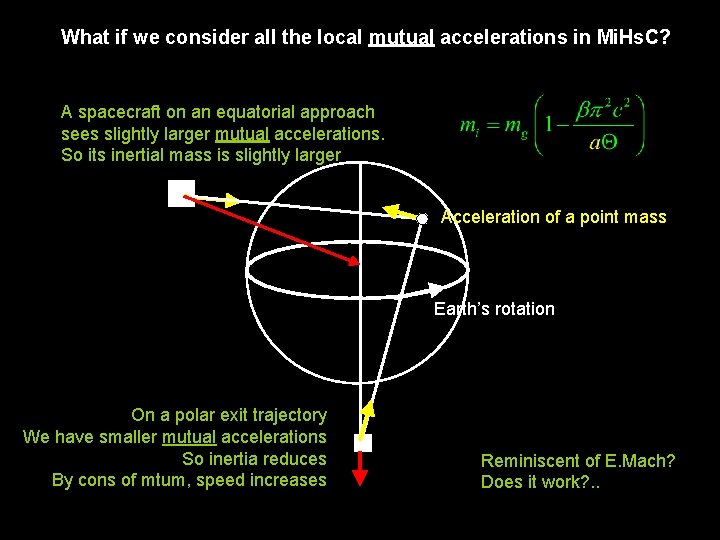
What if we consider all the local mutual accelerations in Mi. Hs. C? A spacecraft on an equatorial approach sees slightly larger mutual accelerations. So its inertial mass is slightly larger Acceleration of a point mass Earth’s rotation On a polar exit trajectory We have smaller mutual accelerations So inertia reduces By cons of mtum, speed increases Reminiscent of E. Mach? Does it work? . .

Using mutual accelerations, Mi. Hs. C predicts the flyby anomalies Conservation of momentum for craft & Earth before (1) and after (2) flyby a is the average mutual acceleration, including the Earth’s rotation: Where Φ = latitude Derived Observed
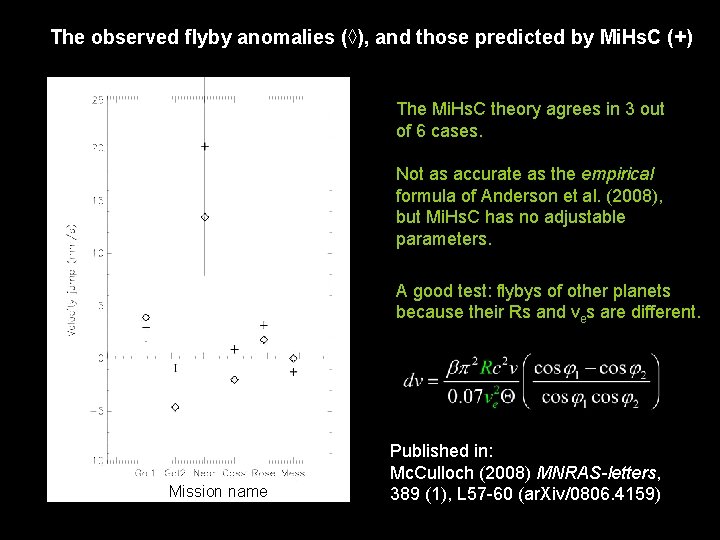
The observed flyby anomalies (◊), and those predicted by Mi. Hs. C (+) The Mi. Hs. C theory agrees in 3 out of 6 cases. Not as accurate as the empirical formula of Anderson et al. (2008), but Mi. Hs. C has no adjustable parameters. A good test: flybys of other planets because their Rs and ves are different. Mission name Published in: Mc. Culloch (2008) MNRAS-letters, 389 (1), L 57 -60 (ar. Xiv/0806. 4159)
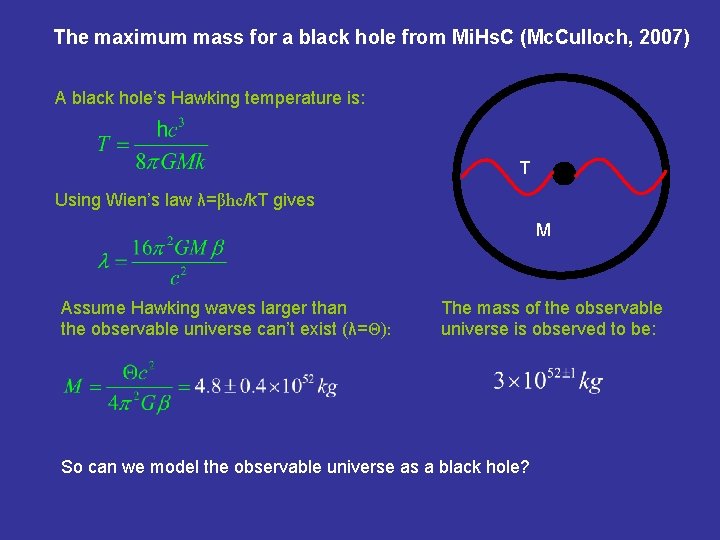
The maximum mass for a black hole from Mi. Hs. C (Mc. Culloch, 2007) A black hole’s Hawking temperature is: T Using Wien’s law λ=βhc/k. T gives M Assume Hawking waves larger than the observable universe can’t exist (λ=Θ): The mass of the observable universe is observed to be: So can we model the observable universe as a black hole?
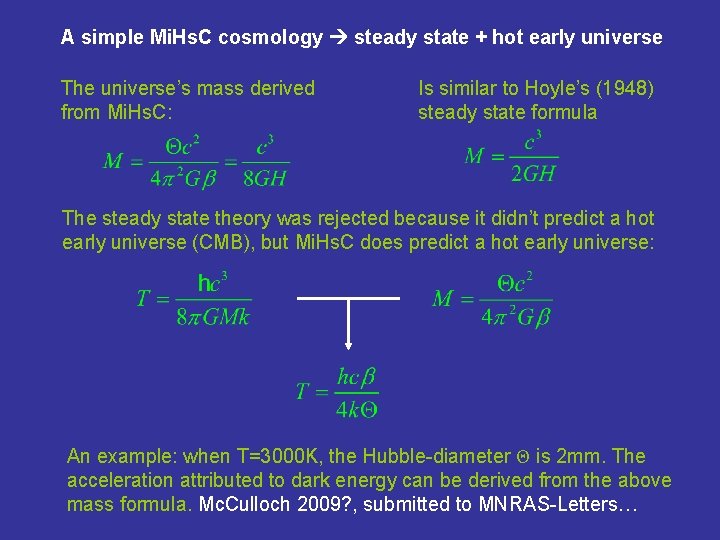
A simple Mi. Hs. C cosmology steady state + hot early universe The universe’s mass derived from Mi. Hs. C: Is similar to Hoyle’s (1948) steady state formula The steady state theory was rejected because it didn’t predict a hot early universe (CMB), but Mi. Hs. C does predict a hot early universe: An example: when T=3000 K, the Hubble-diameter Θ is 2 mm. The acceleration attributed to dark energy can be derived from the above mass formula. Mc. Culloch 2009? , submitted to MNRAS-Letters…
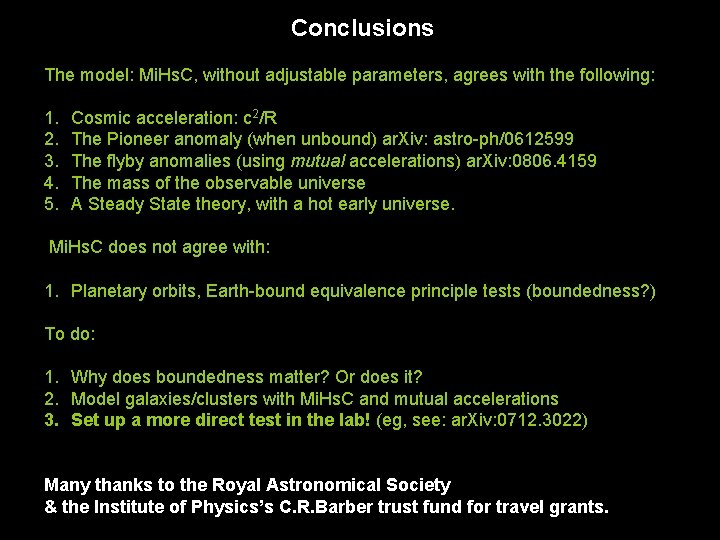
Conclusions The model: Mi. Hs. C, without adjustable parameters, agrees with the following: 1. 2. 3. 4. 5. Cosmic acceleration: c 2/R The Pioneer anomaly (when unbound) ar. Xiv: astro-ph/0612599 The flyby anomalies (using mutual accelerations) ar. Xiv: 0806. 4159 The mass of the observable universe A Steady State theory, with a hot early universe. Mi. Hs. C does not agree with: 1. Planetary orbits, Earth-bound equivalence principle tests (boundedness? ) To do: 1. Why does boundedness matter? Or does it? 2. Model galaxies/clusters with Mi. Hs. C and mutual accelerations 3. Set up a more direct test in the lab! (eg, see: ar. Xiv: 0712. 3022) Many thanks to the Royal Astronomical Society & the Institute of Physics’s C. R. Barber trust fund for travel grants.
- Slides: 13