
From the Economics of Education to Education Economicsand
- Slides: 31
From the “Economics of Education” to “Education & Economics”…and back! A pluralist perspective Fabio R. Aricò @Fabio. Arico Ecuator Seminar Series June 2016
YOUR PRESENTER Fabio Aricò Senior Lecturer in Macroeconomics School of Economics – UEA Convenor of UEA Higher Education Research Group Research fields • Higher Education policy and practice (access, satisfaction) • Self-Assessment and Academic Self-Efficacy • Technology Enhanced Learning • Learning Gain in HE 2
OUTLINE 1. Autobiographical note (only what strictly needed) 2. The divide between researchers in Education and Economics 3. An example based on the attack to Human Capital Theory 4. The notion of Capital in Education and Economics 5. An example of how Economics of Education can do more than HCT 6. Re-defining myself as a social scientist 7. A pluralist epilogue 3
AUTOBIOGRAPHICAL NOTE • I was initially trained in a traditionally heterodox department in Italy. I was suggested to embrace the mainstream. I moved to the UK. • I worked on my Ph. D using mainstream tools, I enjoyed it. But it did not last long… • I have come back to appreciate heterodoxy and I embraced a pluralist view in terms of how we develop teaching and research in Economics. • I have done something a bit more radical…I started to do research in Education, but using my own background and toolbox. 4
AUTOBIOGRAPHICAL NOTE 5
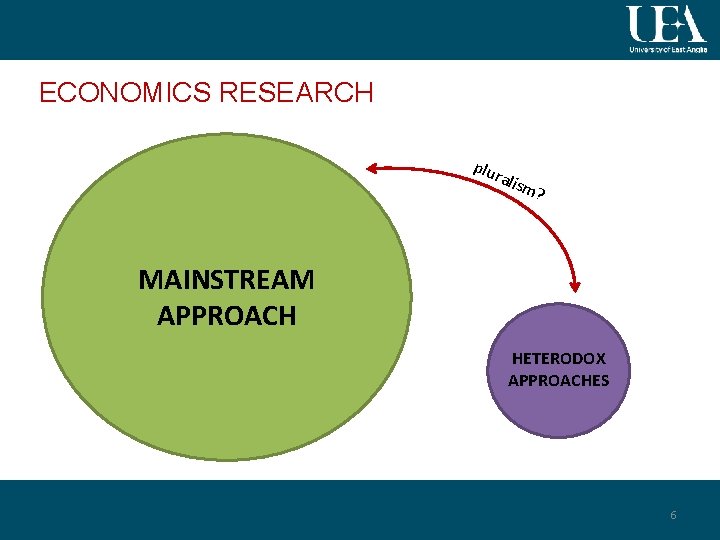
ECONOMICS RESEARCH plu rali sm? MAINSTREAM APPROACH HETERODOX APPROACHES 6
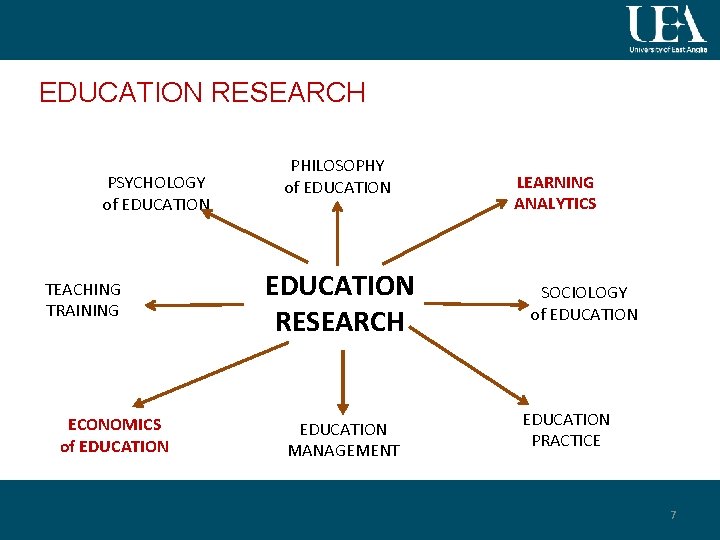
EDUCATION RESEARCH PSYCHOLOGY of EDUCATION TEACHING TRAINING ECONOMICS of EDUCATION PHILOSOPHY of EDUCATION RESEARCH EDUCATION MANAGEMENT LEARNING ANALYTICS SOCIOLOGY of EDUCATION PRACTICE 7
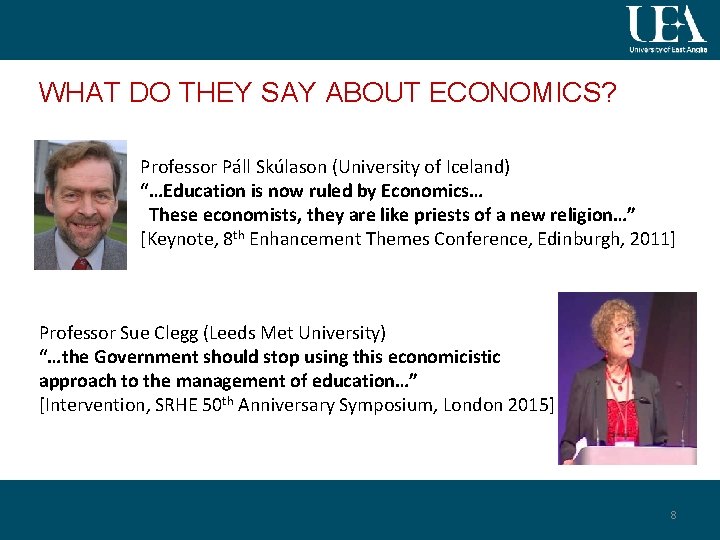
WHAT DO THEY SAY ABOUT ECONOMICS? Professor Páll Skúlason (University of Iceland) “…Education is now ruled by Economics… These economists, they are like priests of a new religion…” [Keynote, 8 th Enhancement Themes Conference, Edinburgh, 2011] Professor Sue Clegg (Leeds Met University) “…the Government should stop using this economicistic approach to the management of education…” [Intervention, SRHE 50 th Anniversary Symposium, London 2015] 8
WHY DO THEY DISLIKE ECONOMISTS? EDUCATION RESEARCH in the UK • Predominantly based on qualitative methodology • Cuts to Education by the current Government • Metrics-driven approach to funding associated to the ‘economicistic’ approach to Education management. ECONOMICS RESEARCH and TEACHING • Predominantly based on quantitative methodology • Traditional tendency to isolate from other Social Sciences • Crisis in the aftermath of financial crisis and Great Recession criticism raised to the way Economics it thought and taught. 9
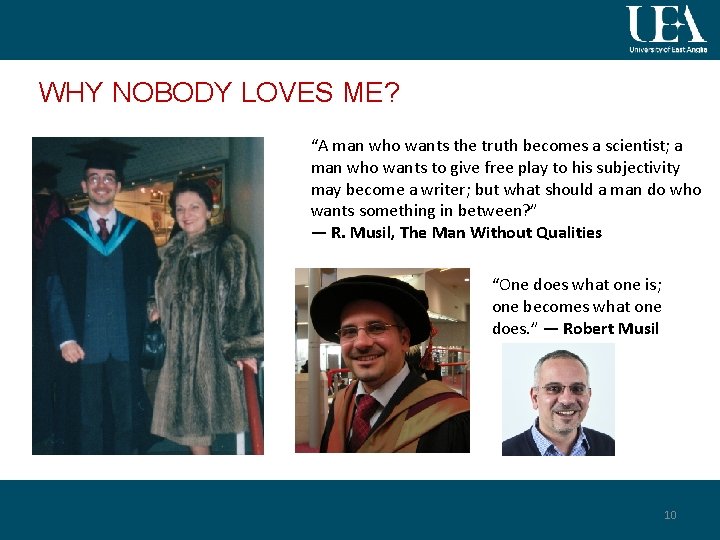
WHY NOBODY LOVES ME? “A man who wants the truth becomes a scientist; a man who wants to give free play to his subjectivity may become a writer; but what should a man do who wants something in between? ” ― R. Musil, The Man Without Qualities “One does what one is; one becomes what one does. ” ― Robert Musil 10
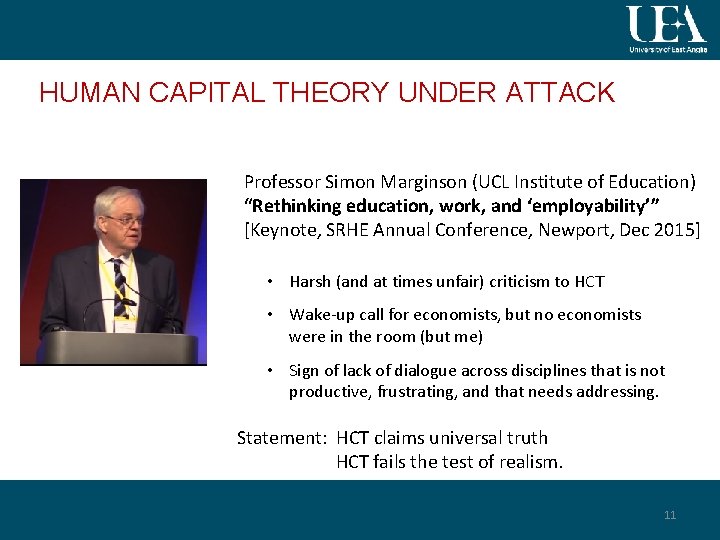
HUMAN CAPITAL THEORY UNDER ATTACK Professor Simon Marginson (UCL Institute of Education) “Rethinking education, work, and ‘employability’” [Keynote, SRHE Annual Conference, Newport, Dec 2015] • Harsh (and at times unfair) criticism to HCT • Wake-up call for economists, but no economists were in the room (but me) • Sign of lack of dialogue across disciplines that is not productive, frustrating, and that needs addressing. Statement: HCT claims universal truth HCT fails the test of realism. 11
HUMAN CAPITAL THEORY UNDER ATTACK 1 st Attack: HCT is only focussed on individual’s earning rate of return on education as only thing that matters. but education process is contextual to each individual. 1 st Response: HCT evolved and extended since the 1960 s Developments in Growth Theory in 1990 s Romer (1986), Lucas (1988), Mankiw Romer Weil (1992) positive externalities from education Development in Economics of Education (past 25 years) disentangling the effect of ability myopic discount rates in HC investment 12
HUMAN CAPITAL THEORY UNDER ATTACK 2 nd Attack: HCT is just one-lens approach through which we see phenomena Social Science seen as a closed-system Mathematical model correct only if assumptions are. 2 nd Response: Recall pledge to Economics being isolated (mea culpa) Theoretically: isn’t this criticism applicable to every model? Pragmatically: we need to decide how much to invest in education animal spirits: urge to action rather than inaction (Keynes) 13
HUMAN CAPITAL THEORY UNDER ATTACK 3 rd Attack: Empirical multivariate analysis relies on independence of explanatory variables, which does not exist in reality. The world is complex, but statistics claims it can isolate causal relationships between factors. 3 rd Response: Statistics is mainly about association, not causation. Statistical inference is based on probability. We attempt to control for the mistakes we can make in our predictions. Pragmatically: there is a debate in the way we use statistics/econometrics we need economists do defend ourselves by other economists thankfully, economists love to disagree. Celebrate that! 14
HUMAN CAPITAL THEORY UNDER ATTACK 4 th Attack: Agents do not behave according to rational motives Research in sociology shows status-seeking behaviour matters, as well as a range of other non-rational determinants. 4 th Response: Economics is taking care of that too, but very few people know. Think about the development in Behavioural Economics. Our (economists) fault is that we talk to each other, but do not engage with a much wider debate in the social sciences. Both theoretically and empirically, Economics of Education addresses these issues. (Example to follow) 15
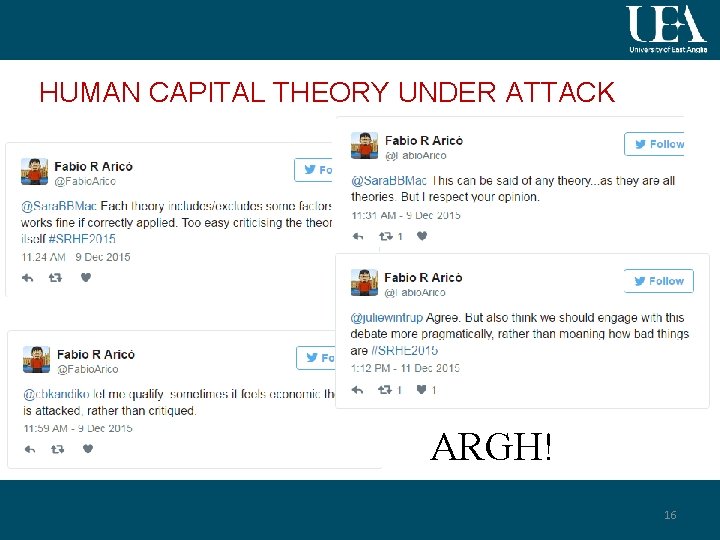
HUMAN CAPITAL THEORY UNDER ATTACK ARGH! 16
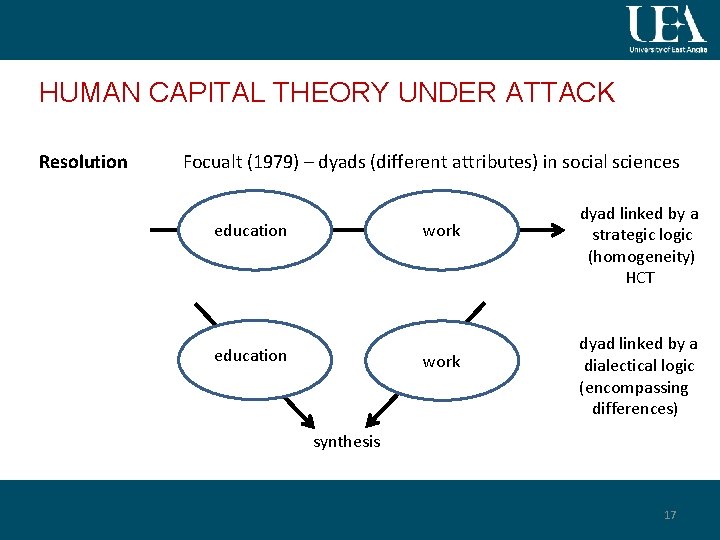
HUMAN CAPITAL THEORY UNDER ATTACK Resolution Focualt (1979) – dyads (different attributes) in social sciences education work dyad linked by a strategic logic (homogeneity) HCT dyad linked by a dialectical logic (encompassing differences) synthesis 17
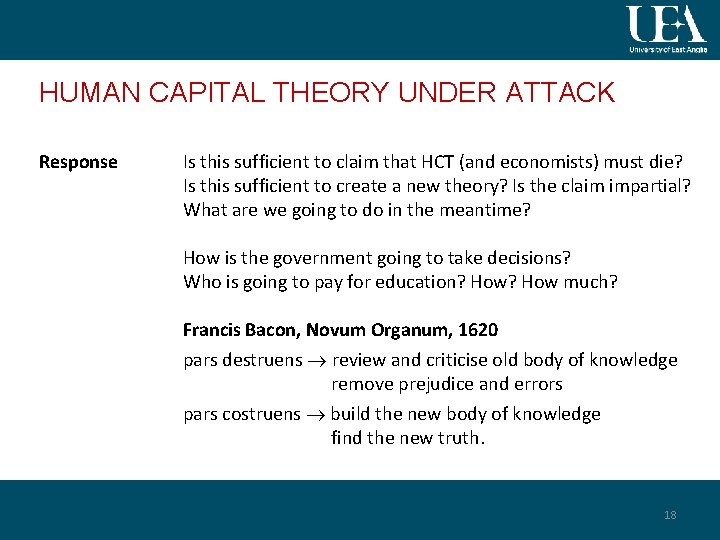
HUMAN CAPITAL THEORY UNDER ATTACK Response Is this sufficient to claim that HCT (and economists) must die? Is this sufficient to create a new theory? Is the claim impartial? What are we going to do in the meantime? How is the government going to take decisions? Who is going to pay for education? How much? Francis Bacon, Novum Organum, 1620 pars destruens review and criticise old body of knowledge remove prejudice and errors pars costruens build the new body of knowledge find the new truth. 18
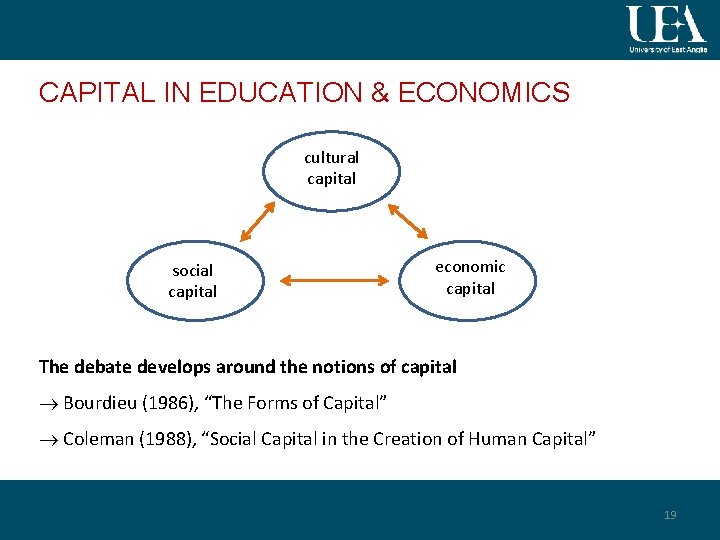
CAPITAL IN EDUCATION & ECONOMICS cultural capital social capital economic capital The debate develops around the notions of capital Bourdieu (1986), “The Forms of Capital” Coleman (1988), “Social Capital in the Creation of Human Capital” 19
ECONOMICS of EDUCATION CAN DO IT! Jack Whybrow, UEA Ph. D Candidate in Economics “An investigation into the Cultural and Social Capital influences on rates of UK HE participation. An analysis using two cohorts born in 1958 and 1970” engages with the different notions of capital engages with the sociological literature enriches previous models of participation in HE a great example of how Economics of Education can up its game! 20
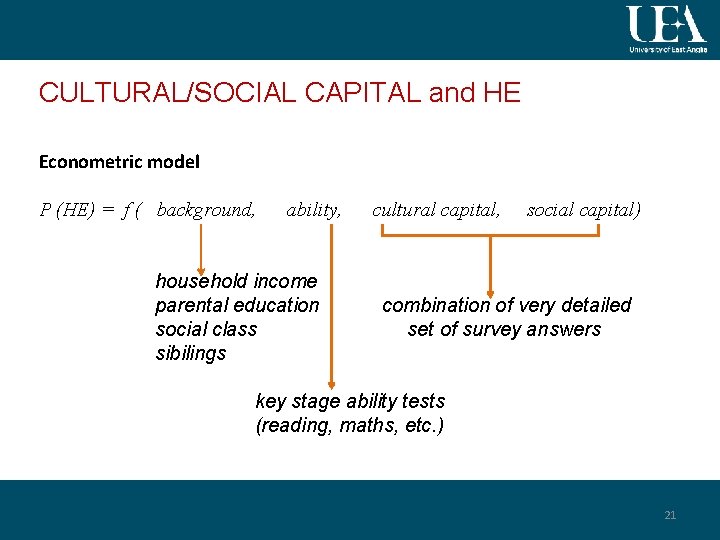
CULTURAL/SOCIAL CAPITAL and HE Econometric model P (HE) = f ( background, ability, household income parental education social class sibilings cultural capital, social capital) combination of very detailed set of survey answers key stage ability tests (reading, maths, etc. ) 21
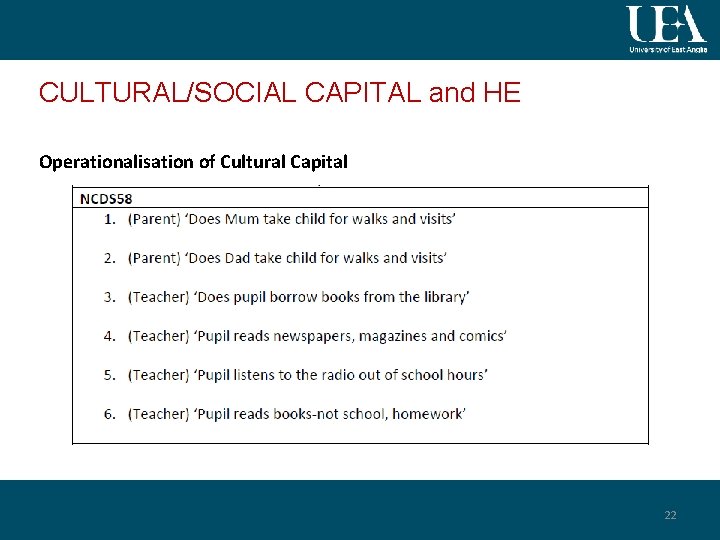
CULTURAL/SOCIAL CAPITAL and HE Operationalisation of Cultural Capital 22
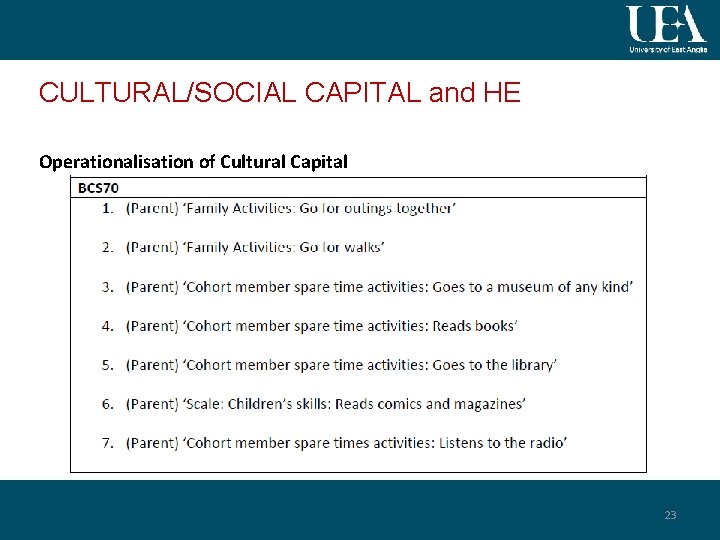
CULTURAL/SOCIAL CAPITAL and HE Operationalisation of Cultural Capital 23
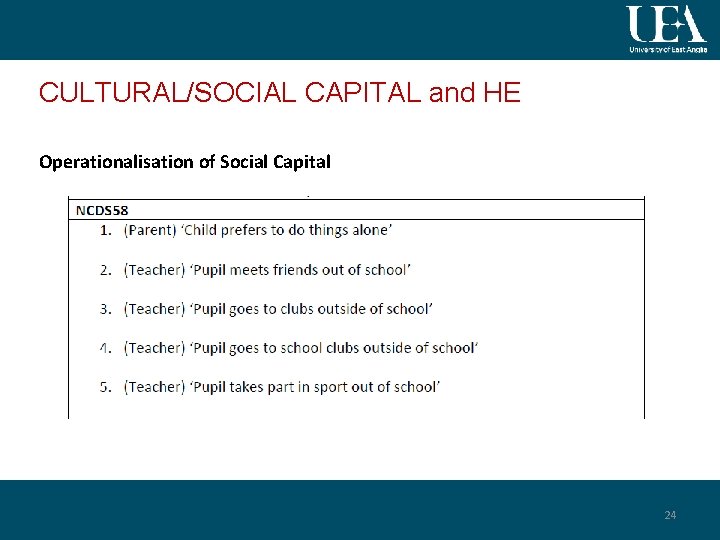
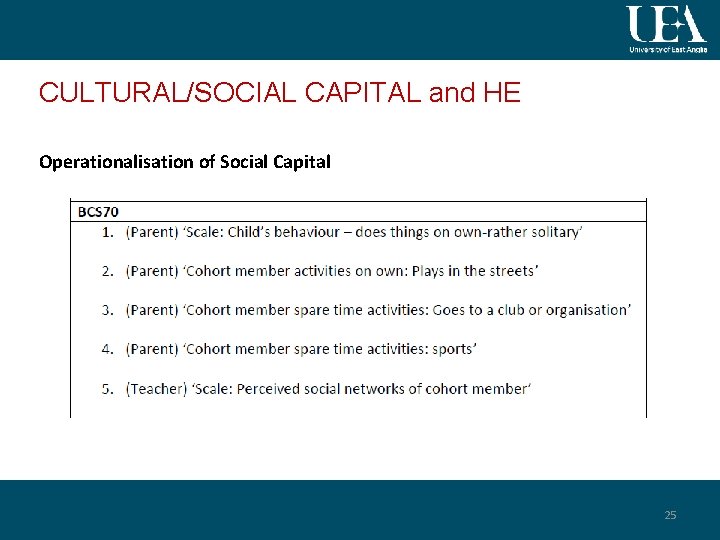
CULTURAL/SOCIAL CAPITAL and HE Operationalisation of Social Capital 24
CULTURAL/SOCIAL CAPITAL and HE Operationalisation of Social Capital 25
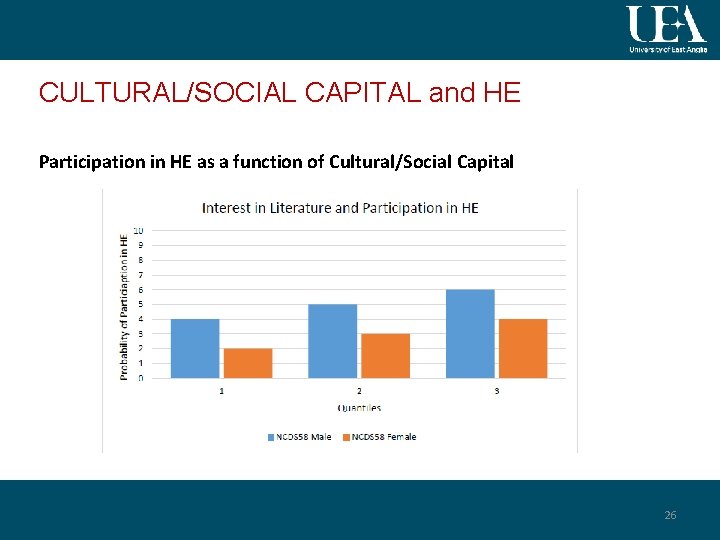
CULTURAL/SOCIAL CAPITAL and HE Participation in HE as a function of Cultural/Social Capital 26
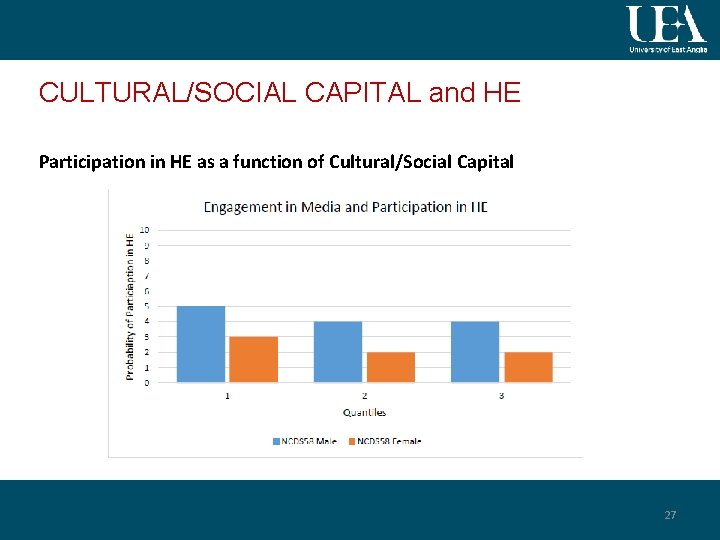
CULTURAL/SOCIAL CAPITAL and HE Participation in HE as a function of Cultural/Social Capital 27
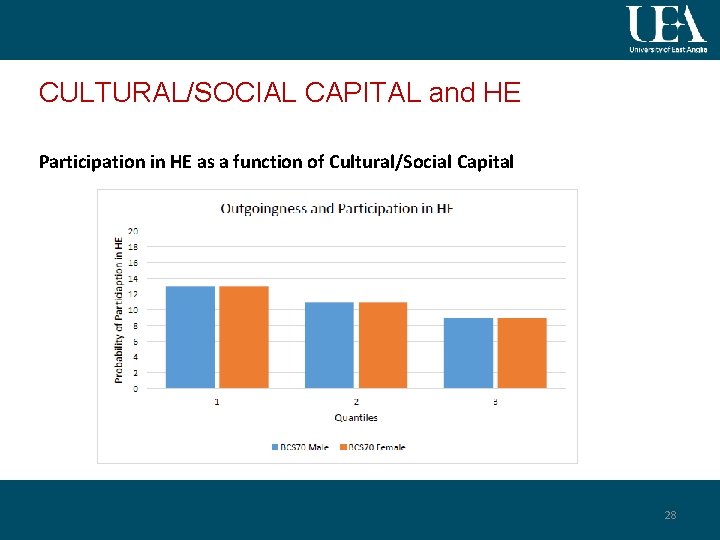
CULTURAL/SOCIAL CAPITAL and HE Participation in HE as a function of Cultural/Social Capital 28
CULTURAL/SOCIAL CAPITAL and HE In summary - A beautiful example of how econometric modelling is simultaneously informed by sociological and economic theories - A better understanding of the factors that are associated to participation in HE, and that could determine variation of earnings (not this paper) - A wider range of options for the policy-maker, who can engage with the socio-cultural dimensions of education-choice, and aim to use education as a vector for social mobility. 29
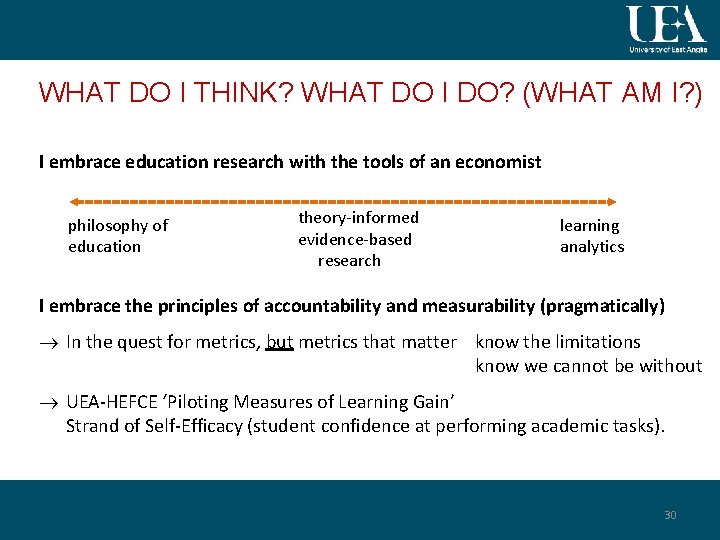
WHAT DO I THINK? WHAT DO I DO? (WHAT AM I? ) I embrace education research with the tools of an economist philosophy of education theory-informed evidence-based research learning analytics I embrace the principles of accountability and measurability (pragmatically) In the quest for metrics, but metrics that matter know the limitations know we cannot be without UEA-HEFCE ‘Piloting Measures of Learning Gain’ Strand of Self-Efficacy (student confidence at performing academic tasks). 30
A PLURALIST EPILOGUE There is a crisis of confidence in Economics and in the Social Sciences we have models but we continuously challenge their validity without confidence no model can ever be fit to purpose (Keynes) in a complex world confidence can only be restored by open dialogue. Economists - should come out from their own discipline and bring the debate out in the open - be ethical, resist the temptation of the hegemony of policy-making (vested int. ) Education Researchers - should invite economists to their table, as equal partners - should engage more with the political debate, in a constructive way, acknowledge a pragmatic urge to change and co-operate towards it. 31