
From the DSM5 To the DMID 2 Robert
From the DSM-5 To the DM-ID 2 Robert J. Fletcher, DSW, ACSW, NADD-CC Founder & CEO, NADD Chief Editor, DM-ID 2 NADD State Ohio Conference Columbus, Ohio September 26, 2017
DM-ID-2 Improves Lives Accurate Diagnosis Effective Treatment Improved Outcomes Better Quality Better Of Life
Outline of Presentation • • • Limitations of the DSM System Prevalence of MI in IDD Description of DM-ID-2 Structure of the DM-ID-2 Six Applications of criteria subsets Diagnostic specific examples of criteria modification
Limitations of the DSM System • Psychiatric disorders in persons with IDD are often under or misdiagnosed. (Gustafsona Sonmader, 2004) • The DSM and ICD are systems designed for use for the general population and are dependent on the individual’s ability to participate verbally during the evaluation (DSM 5) (DM-ID-2, 2016)
Limitations of the DSM System • Individuals with IDD may be non verbal or have significant challenges in receptive and expressive language • Individuals with IDD may not be able to fully participate in the evaluation process through the self -report method (DM-ID-2, 2016)
Limitations of the DSM System • Symptoms of psychopathology may not be expressed in the same way in persons with IDD as compared to the general population (Moss, et al, 1998) • Difficulty with using traditional diagnostic criteria lies in the fact that individuals with IDD may not always be reliable self reporters (DM-ID-2, 2016)
Limitations of the DSM System • Diagnostic Overshadowing (Reiss, et al, 1982) • Applicability of established diagnostic systems is increasingly suspect as the severity of IDD increases (Rush & Frances, 2000) • DSM System relies on self report of signs and symptoms (DSM-5) (DM-ID-2, 2016)
Prevalence of Mental Illness in IDD • People with IDD can experience the same psychiatric disorders as the general population • Studies have indicated that psychiatric disorders in people with IDD are at a higher rate than in the general population • The research data indicates a wide variance of psychiatric disorders in people with IDD from 30% to 70%. (DM-ID-2, 2016)
Variance of Prevalent Rates The Variance of data reflects a number of variables including: 1) Nature of study sample 2) Definitions 3) Classification systems 4) The inclusion or exclusion of “challenging behaviors” (DM-ID-2, 2016)
Variance of Prevalent Rates 5) The inclusion or exclusion of ASD under the general mantle of psychiatric disorders 6) The training and experience of the clinician 7) Methodological quality of the study (DM-ID-2, 2016)
Examples of Three Studies 1) Cooper, Smiley, Morrison, Williamson and Allen (2007) • Used multiple measures • N= 1, 023 • Comprehensive individualized assessment • Point prevalence of mental illness of 40. 9% (Clinical diagnosis) § 35. 2% (DC-LD) § 16. 6% (ICD-10) § 15% (DSM-5) (DM-ID-2, 2016)
Examples of Three Studies 2) Bailey (2007) • Random sample • N= 240 • 57% (DC-ID) • 24. 8% (ICD-10) • 13. 2% (DSM-5) (DM-ID-2, 2016)
Examples of Three Studies 3) National Core Indicators (2016) • Study based on client chart data • N= 16, 631 • 49. 5% mental illness in IDD (DM-ID-2, 2016)
The Publication of the DSM-5 Necessitates Revision of the DM-ID THE DM-ID-2 (DM-ID-2, 2016)
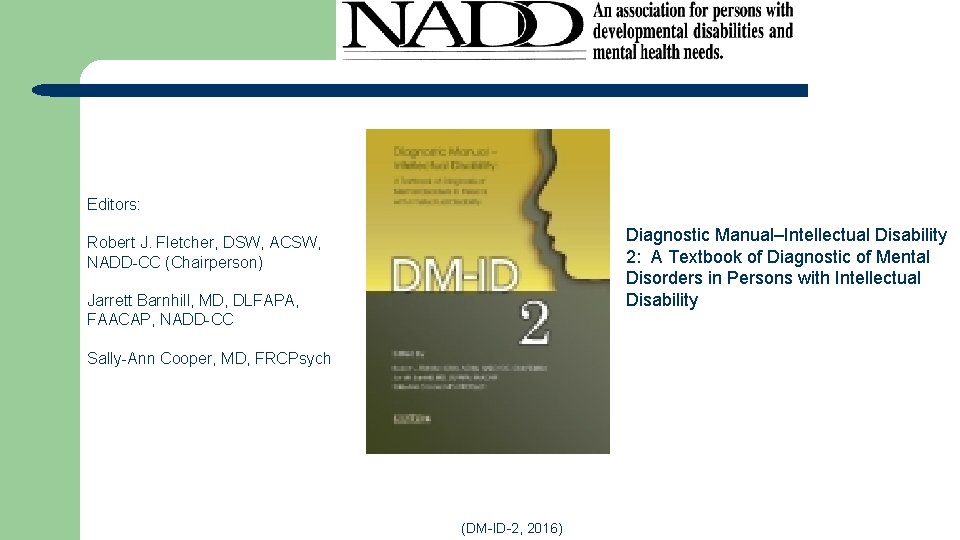
Editors: Diagnostic Manual–Intellectual Disability 2: A Textbook of Diagnostic of Mental Disorders in Persons with Intellectual Disability Robert J. Fletcher, DSW, ACSW, NADD-CC (Chairperson) Jarrett Barnhill, MD, DLFAPA, FAACAP, NADD-CC Sally-Ann Cooper, MD, FRCPsych (DM-ID-2, 2016)
Description of DM-ID-2 • Designed to provide state-of-the-art knowledge of mental disorders in persons with IDD • Corresponds closely to the DSM-5 classification system • Developed to improve understanding of mental disorders and unique expressions in persons with IDD (DM-ID-2, 2016)
Description of DM-ID-2 • Designed to facilitate a more accurate psychiatric diagnosis • Based on Expert Consensus Model • Covers all major diagnostic categories as defined in DSM-5 (DM-ID-2, 2016)
Description of DM-ID-2 • Provides information to help with diagnostic process • Addresses pathoplastic effect of IDD on psychopathology (how the disorder is manifested in people with IDD) • Designed with a developmental perspective to help clinicians to recognize symptom profiles in adults and children with IDD (DM-ID-2, 2016)
Description of DM-ID-2 • Empirically-based approach to identify specific psychiatric disorders in persons with IDD • Provides clear examples of how symptom presentations can be interpreted for people with IDD • Each diagnosis incorporates diagnostic considerations that highlight specific bio-psycho-social factors • Provides adaptations of criteria, where appropriate (DM-ID-2, 2016)
DM-ID-2 Two Special Added-Value Chapters • Assessment and Diagnostic Procedures • Behavioral Phenotype of Genetic Disorders (DM-ID-2, 2016)
Assessment and Diagnostic Procedures Chapter • Psychiatric diagnosis is a challenge • Need to rely on multiple sources for information • Need to understand the person and their challenges • Obtain medical information (DM-ID-2, 2016)
Assessment and Diagnostic Procedures Chapter Special Considerations • Use language that can be understood • Confirm understanding Establishing Chief Complaint and History • Ask client • Ask other individuals • Obtain historical information (DM-ID-2, 2016)
Historical Information l Pregnancy, birth l Early development l Behavioral adjustment in early school years l Educational interventions throughout childhood l Early family relationships, family members l Behavioral adjustment in adolescence l Level of education intervention in high school years l Most recent individual Educational Plan and full assessment l Friends and community contacts in adolescence-adulthood (DM-ID-2, 2016)
Historical Information l Living situations in adulthood l Occupational history l Substance abuse history l Current social connections l Social history, hobbies, community activities l History of partners, marriage, or children l Psychological evaluations l Intelligence testing (IQ) (DM-ID-2, 2016)
Historical Information l Adaptive behavior testing l Medical history (including current and past medications) l Illnesses in childhood l Disabilities, visual, hearing, physical l Seizure disorder (and associated medications) l Surgical procedures l Current conditions l Accidents, especially head trauma (DM-ID-2, 2016)
Behavioral Phenotypes of Neurodevelopmental Disorders Chapter • The physical phenotype of a genetic syndrome is: • A set of biological characteristics • Produced by a genetic abnormality (genotype) • Example: • Recognized face of a person with Down Syndrome (ie small mouth, upward slant eyes) • Diagnosis of genetic syndromes based on physical finding and confirmed by laboratory evaluation (DM-ID-2, 2016)
Behavioral Phenotypes of Neurodevelopmental Disorders Chapter A behavioral phenotype is: • The specific characteristic behavioral repertoire exhibited by people with a genetic disorder (Flint and Yule, 1994) • A characteristic pattern of motor, cognitive, linguistic and/or social abnormalities which is consistently associated with a biological disorder (Society of Behavioral Phenotype) (DM-ID-2, 2016)
Behavioral Phenotypes of 12 ID Syndromes Angelman Syndrome Prader-Willi Syndrome Chromosome 15 q 112 -131 Duplication Syndrome Rubenstein-Taybi Syndrome Smith-Magenis Syndrome Down Syndrome Tuberous Sclerosis Complex Fetal Alcohol Syndrome Velocardiofacial Syndrome Fragile-X Syndrome Williams Syndrome Phenylketonuria (DM-ID-2, 2016)
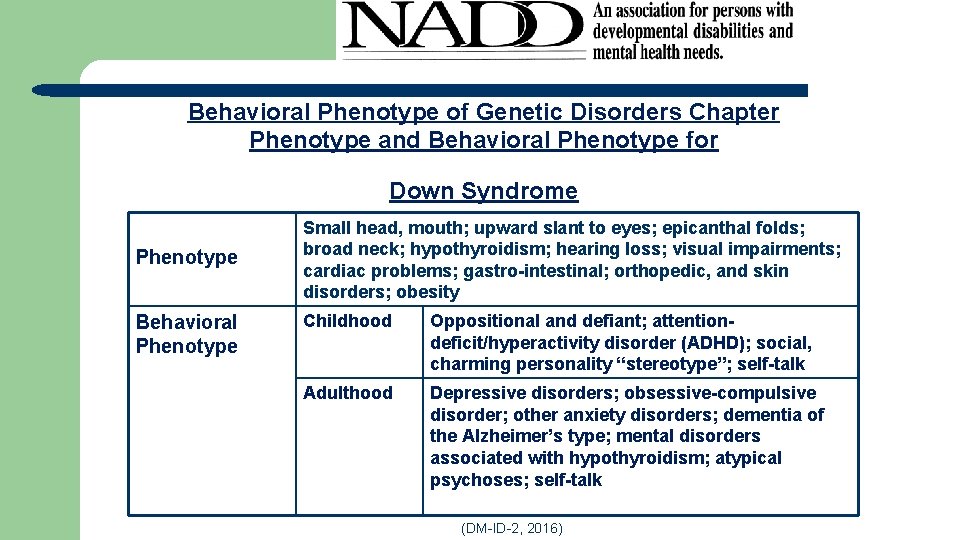
Behavioral Phenotype of Genetic Disorders Chapter Phenotype and Behavioral Phenotype for Down Syndrome Phenotype Behavioral Phenotype Small head, mouth; upward slant to eyes; epicanthal folds; broad neck; hypothyroidism; hearing loss; visual impairments; cardiac problems; gastro-intestinal; orthopedic, and skin disorders; obesity Childhood Oppositional and defiant; attentiondeficit/hyperactivity disorder (ADHD); social, charming personality “stereotype”; self-talk Adulthood Depressive disorders; obsessive-compulsive disorder; other anxiety disorders; dementia of the Alzheimer’s type; mental disorders associated with hypothyroidism; atypical psychoses; self-talk (DM-ID-2, 2016)
A Guide to Structure of the DM-ID-2 A guideline was developed to structure the diagnostic chapters • allowing for clarity and uniformity. • The diagnostic chapters in the DM-ID-2 generally follow this guideline. • The primary elements of the guideline are listed on the following slides (DM-ID-2, 2016)
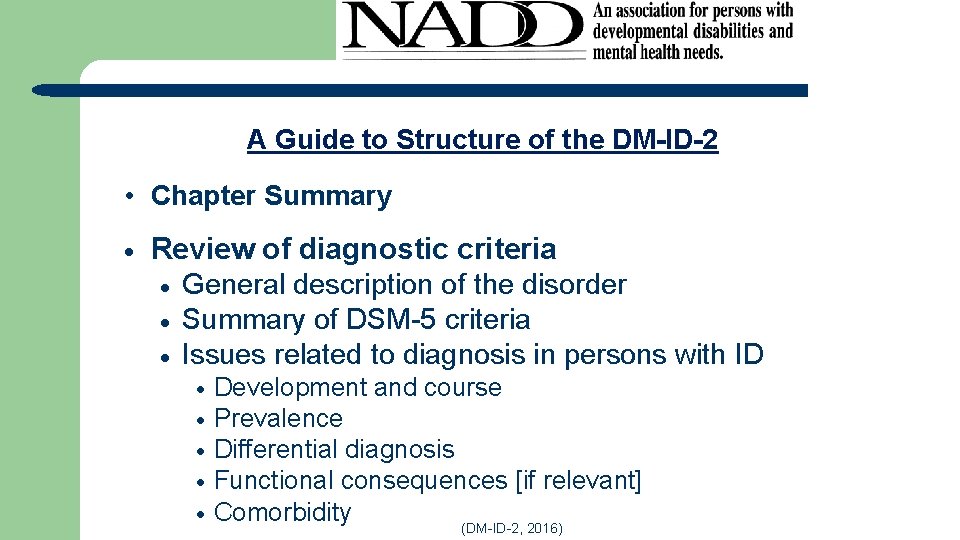
A Guide to Structure of the DM-ID-2 • Chapter Summary Review of diagnostic criteria General description of the disorder Summary of DSM-5 criteria Issues related to diagnosis in persons with ID Development and course Prevalence Differential diagnosis Functional consequences [if relevant] Comorbidity (DM-ID-2, 2016)
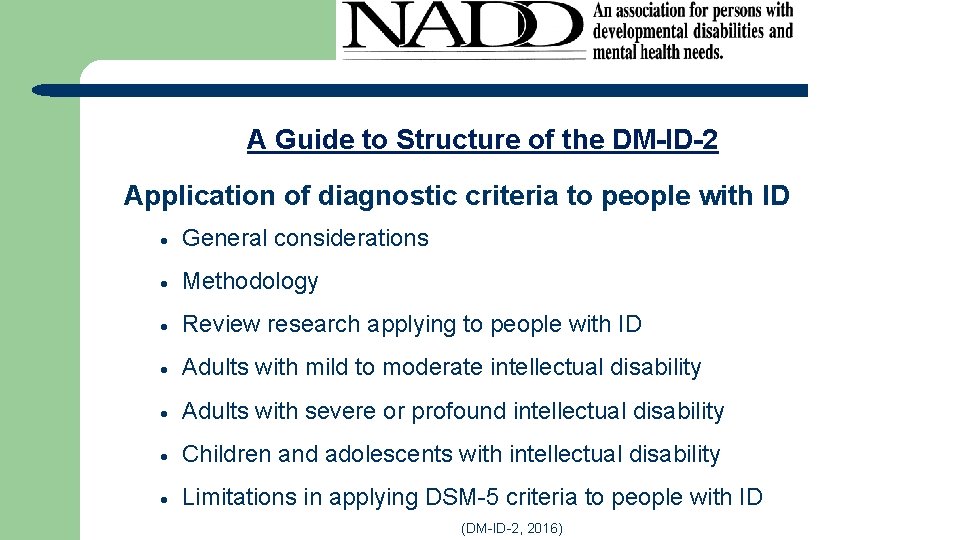
A Guide to Structure of the DM-ID-2 Application of diagnostic criteria to people with ID General considerations Methodology Review research applying to people with ID Adults with mild to moderate intellectual disability Adults with severe or profound intellectual disability Children and adolescents with intellectual disability Limitations in applying DSM-5 criteria to people with ID (DM-ID-2, 2016)
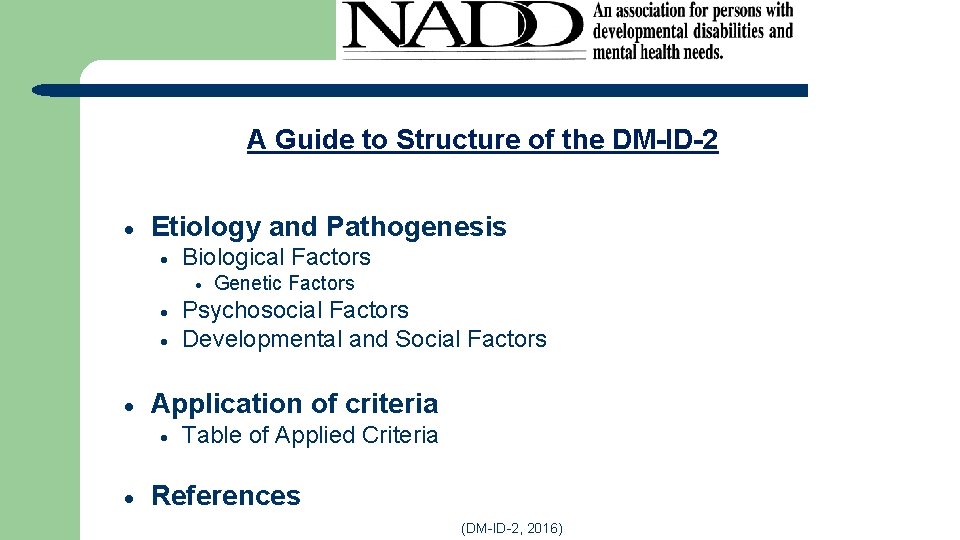
A Guide to Structure of the DM-ID-2 Etiology and Pathogenesis Biological Factors Psychosocial Factors Developmental and Social Factors Application of criteria Genetic Factors Table of Applied Criteria References (DM-ID-2, 2016)
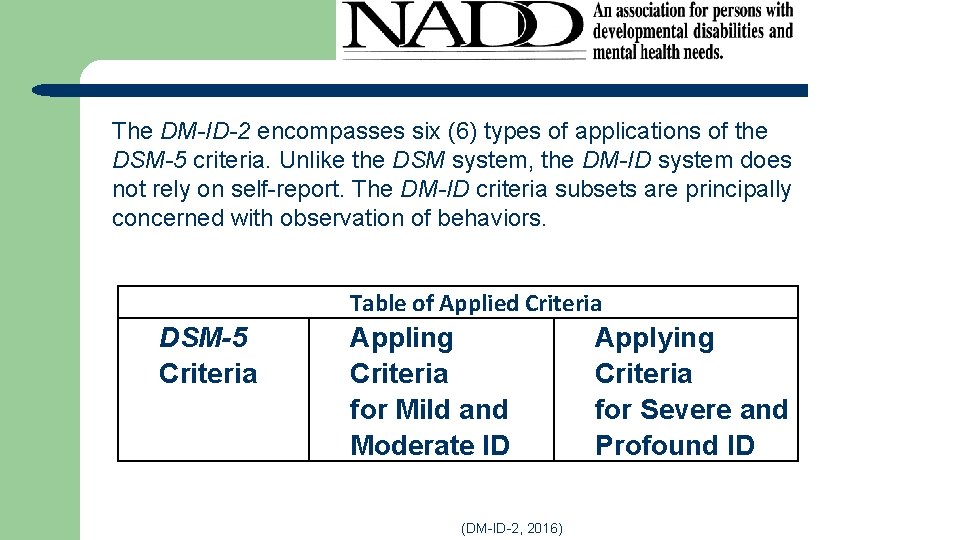
The DM-ID-2 encompasses six (6) types of applications of the DSM-5 criteria. Unlike the DSM system, the DM-ID system does not rely on self-report. The DM-ID criteria subsets are principally concerned with observation of behaviors. Table of Applied Criteria DSM-5 Criteria Appling Criteria for Mild and Moderate ID (DM-ID-2, 2016) Applying Criteria for Severe and Profound ID
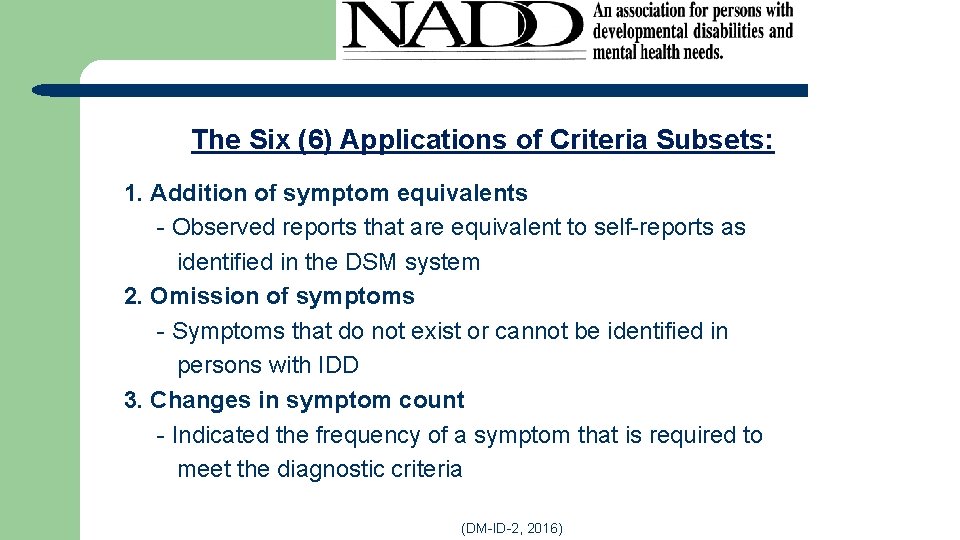
The Six (6) Applications of Criteria Subsets: 1. Addition of symptom equivalents - Observed reports that are equivalent to self-reports as identified in the DSM system 2. Omission of symptoms - Symptoms that do not exist or cannot be identified in persons with IDD 3. Changes in symptom count - Indicated the frequency of a symptom that is required to meet the diagnostic criteria (DM-ID-2, 2016)
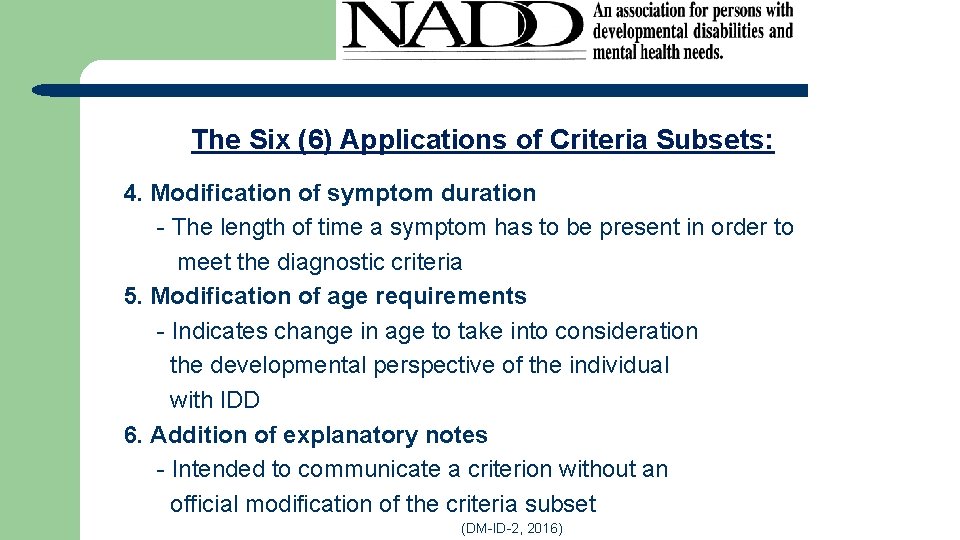
The Six (6) Applications of Criteria Subsets: 4. Modification of symptom duration - The length of time a symptom has to be present in order to meet the diagnostic criteria 5. Modification of age requirements - Indicates change in age to take into consideration the developmental perspective of the individual with IDD 6. Addition of explanatory notes - Intended to communicate a criterion without an official modification of the criteria subset (DM-ID-2, 2016)
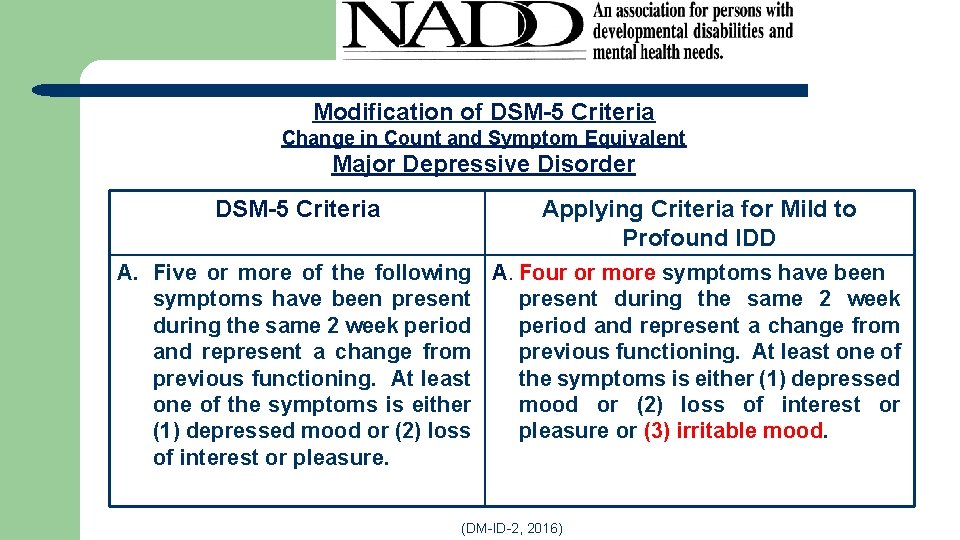
Modification of DSM-5 Criteria Change in Count and Symptom Equivalent Major Depressive Disorder DSM-5 Criteria Applying Criteria for Mild to Profound IDD A. Five or more of the following A. Four or more symptoms have been present during the same 2 week period and represent a change from previous functioning. At least one of previous functioning. At least the symptoms is either (1) depressed one of the symptoms is either mood or (2) loss of interest or (1) depressed mood or (2) loss pleasure or (3) irritable mood. of interest or pleasure. (DM-ID-2, 2016)
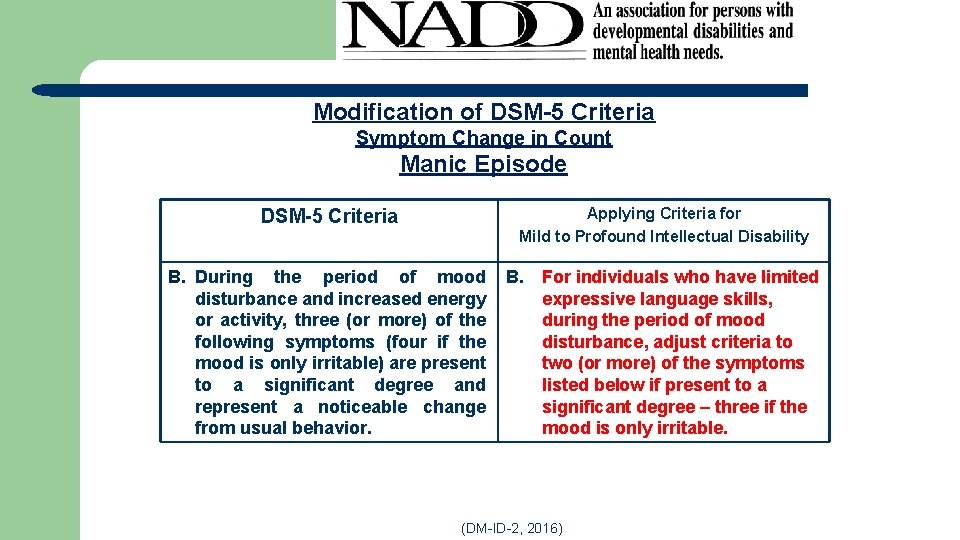
Modification of DSM-5 Criteria Symptom Change in Count Manic Episode DSM-5 Criteria Applying Criteria for Mild to Profound Intellectual Disability B. During the period of mood disturbance and increased energy or activity, three (or more) of the following symptoms (four if the mood is only irritable) are present to a significant degree and represent a noticeable change from usual behavior. B. For individuals who have limited expressive language skills, during the period of mood disturbance, adjust criteria to two (or more) of the symptoms listed below if present to a significant degree – three if the mood is only irritable. (DM-ID-2, 2016)
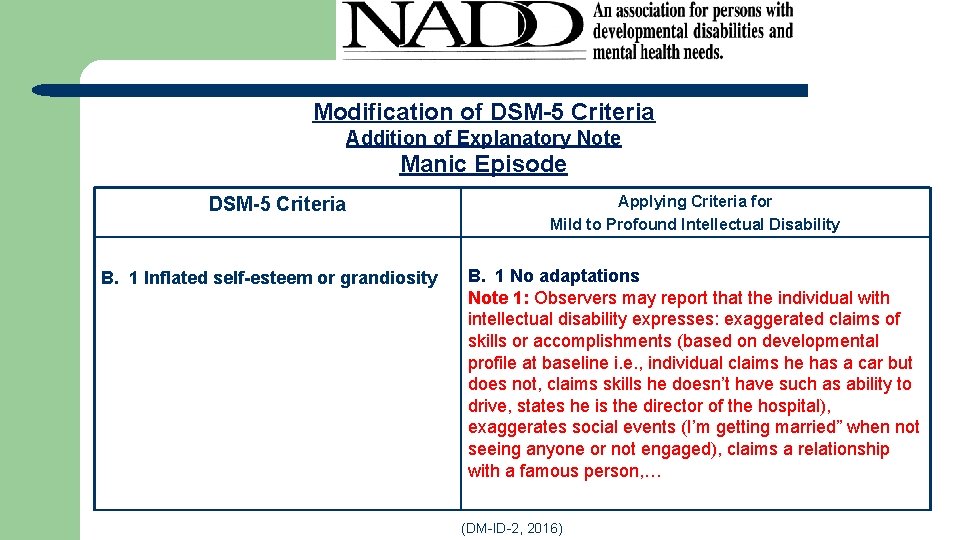
Modification of DSM-5 Criteria Addition of Explanatory Note Manic Episode DSM-5 Criteria B. 1 Inflated self-esteem or grandiosity Applying Criteria for Mild to Profound Intellectual Disability B. 1 No adaptations Note 1: Observers may report that the individual with intellectual disability expresses: exaggerated claims of skills or accomplishments (based on developmental profile at baseline i. e. , individual claims he has a car but does not, claims skills he doesn’t have such as ability to drive, states he is the director of the hospital), exaggerates social events (I’m getting married” when not seeing anyone or not engaged), claims a relationship with a famous person, … (DM-ID-2, 2016)
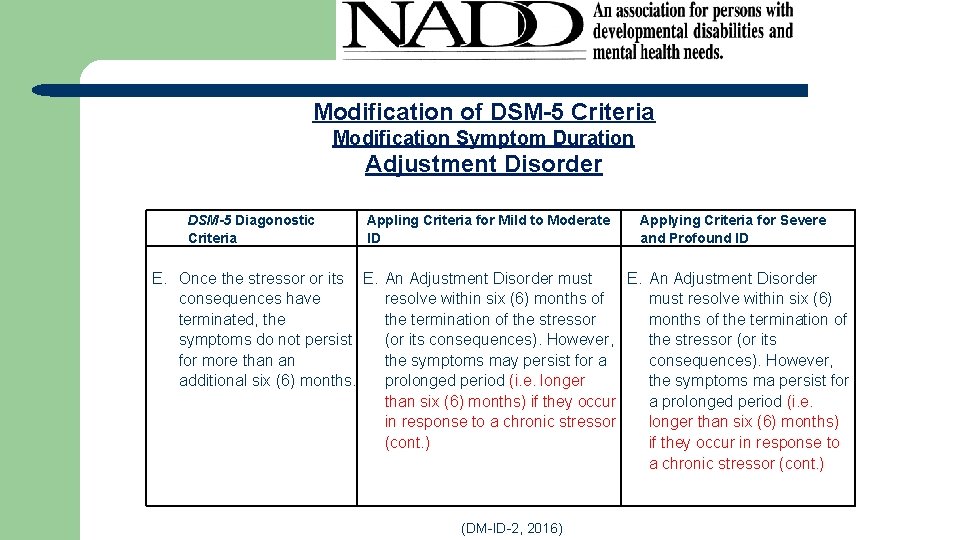
Modification of DSM-5 Criteria Modification Symptom Duration Adjustment Disorder DSM-5 Diagonostic Criteria Appling Criteria for Mild to Moderate ID Applying Criteria for Severe and Profound ID E. Once the stressor or its E. An Adjustment Disorder must E. An Adjustment Disorder consequences have resolve within six (6) months of must resolve within six (6) terminated, the termination of the stressor months of the termination of symptoms do not persist (or its consequences). However, the stressor (or its for more than an the symptoms may persist for a consequences). However, additional six (6) months. prolonged period (i. e. longer the symptoms ma persist for than six (6) months) if they occur a prolonged period (i. e. in response to a chronic stressor longer than six (6) months) (cont. ) if they occur in response to a chronic stressor (cont. ) (DM-ID-2, 2016)
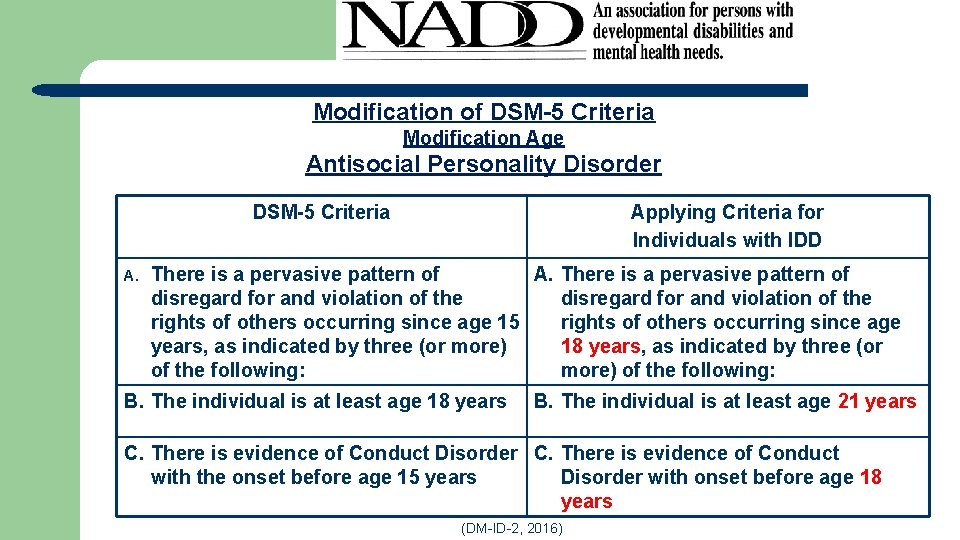
Modification of DSM-5 Criteria Modification Age Antisocial Personality Disorder DSM-5 Criteria A. Applying Criteria for Individuals with IDD There is a pervasive pattern of A. There is a pervasive pattern of disregard for and violation of the rights of others occurring since age 15 rights of others occurring since age years, as indicated by three (or more) 18 years, as indicated by three (or of the following: more) of the following: B. The individual is at least age 18 years B. The individual is at least age 21 years C. There is evidence of Conduct Disorder C. There is evidence of Conduct with the onset before age 15 years Disorder with onset before age 18 years (DM-ID-2, 2016)
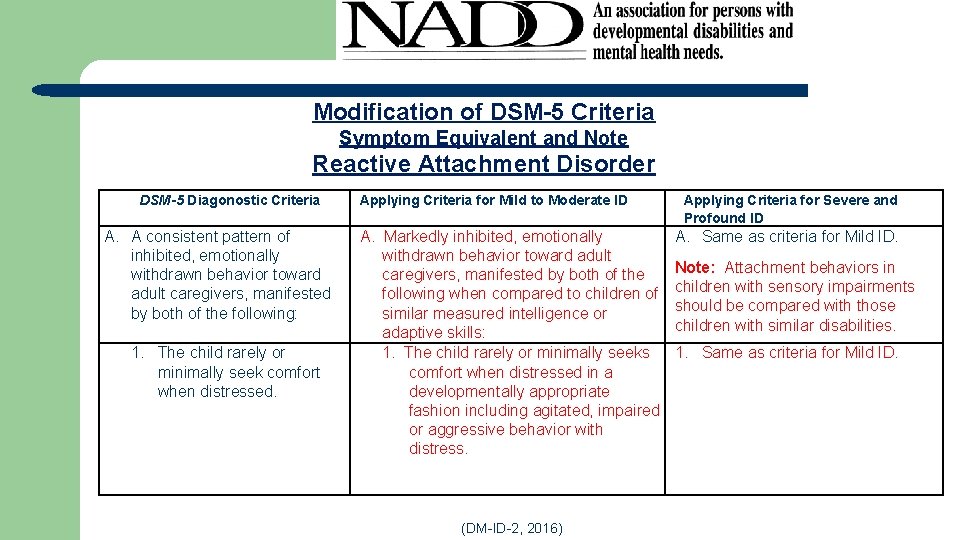
Modification of DSM-5 Criteria Symptom Equivalent and Note Reactive Attachment Disorder DSM-5 Diagonostic Criteria A. A consistent pattern of inhibited, emotionally withdrawn behavior toward adult caregivers, manifested by both of the following: 1. The child rarely or minimally seek comfort when distressed. Applying Criteria for Mild to Moderate ID A. Markedly inhibited, emotionally withdrawn behavior toward adult caregivers, manifested by both of the following when compared to children of similar measured intelligence or adaptive skills: 1. The child rarely or minimally seeks comfort when distressed in a developmentally appropriate fashion including agitated, impaired or aggressive behavior with distress. (DM-ID-2, 2016) Applying Criteria for Severe and Profound ID A. Same as criteria for Mild ID. Note: Attachment behaviors in children with sensory impairments should be compared with those children with similar disabilities. 1. Same as criteria for Mild ID.
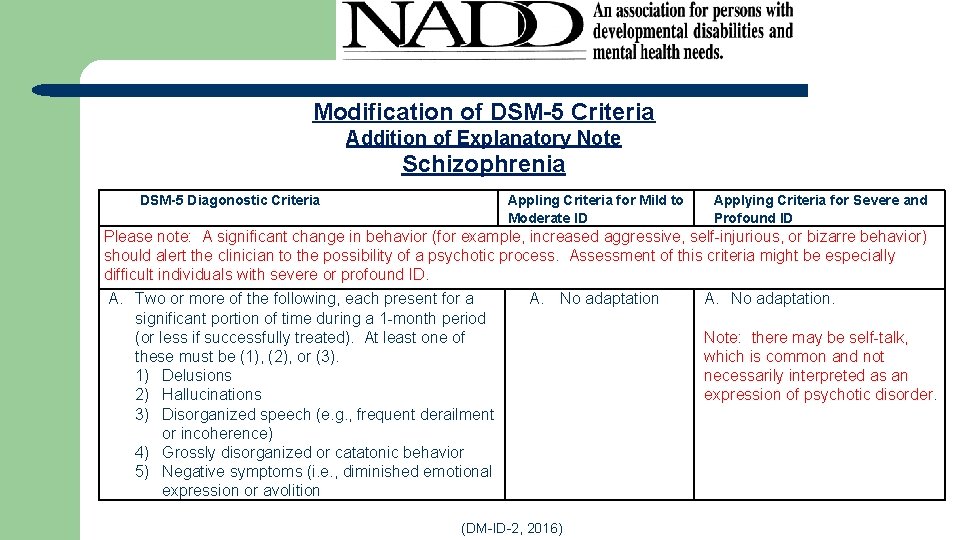
Modification of DSM-5 Criteria Addition of Explanatory Note Schizophrenia DSM-5 Diagonostic Criteria Appling Criteria for Mild to Moderate ID Applying Criteria for Severe and Profound ID Please note: A significant change in behavior (for example, increased aggressive, self-injurious, or bizarre behavior) should alert the clinician to the possibility of a psychotic process. Assessment of this criteria might be especially difficult individuals with severe or profound ID. A. Two or more of the following, each present for a significant portion of time during a 1 -month period (or less if successfully treated). At least one of these must be (1), (2), or (3). 1) Delusions 2) Hallucinations 3) Disorganized speech (e. g. , frequent derailment or incoherence) 4) Grossly disorganized or catatonic behavior 5) Negative symptoms (i. e. , diminished emotional expression or avolition A. No adaptation (DM-ID-2, 2016) A. No adaptation. Note: there may be self-talk, which is common and not necessarily interpreted as an expression of psychotic disorder.
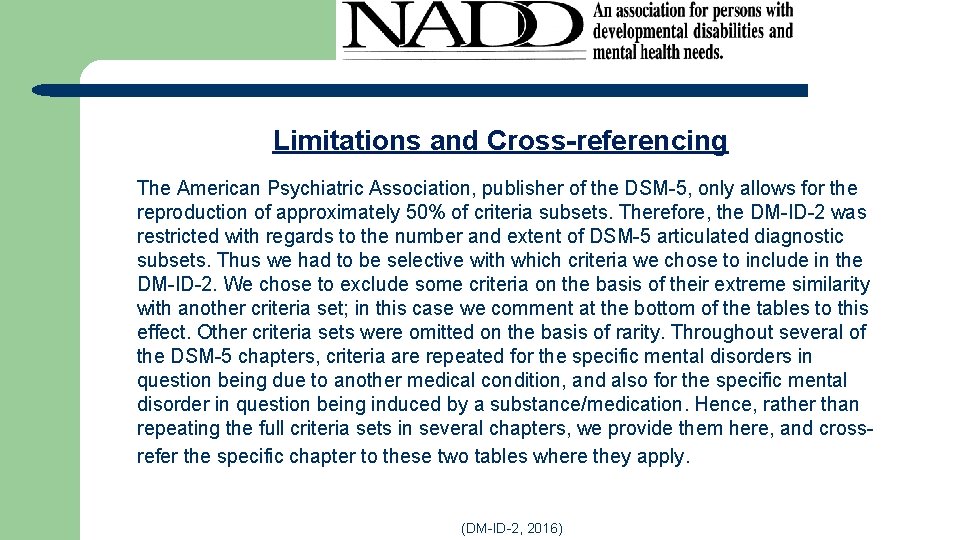
Limitations and Cross-referencing The American Psychiatric Association, publisher of the DSM-5, only allows for the reproduction of approximately 50% of criteria subsets. Therefore, the DM-ID-2 was restricted with regards to the number and extent of DSM-5 articulated diagnostic subsets. Thus we had to be selective with which criteria we chose to include in the DM-ID-2. We chose to exclude some criteria on the basis of their extreme similarity with another criteria set; in this case we comment at the bottom of the tables to this effect. Other criteria sets were omitted on the basis of rarity. Throughout several of the DSM-5 chapters, criteria are repeated for the specific mental disorders in question being due to another medical condition, and also for the specific mental disorder in question being induced by a substance/medication. Hence, rather than repeating the full criteria sets in several chapters, we provide them here, and crossrefer the specific chapter to these two tables where they apply. (DM-ID-2, 2016)
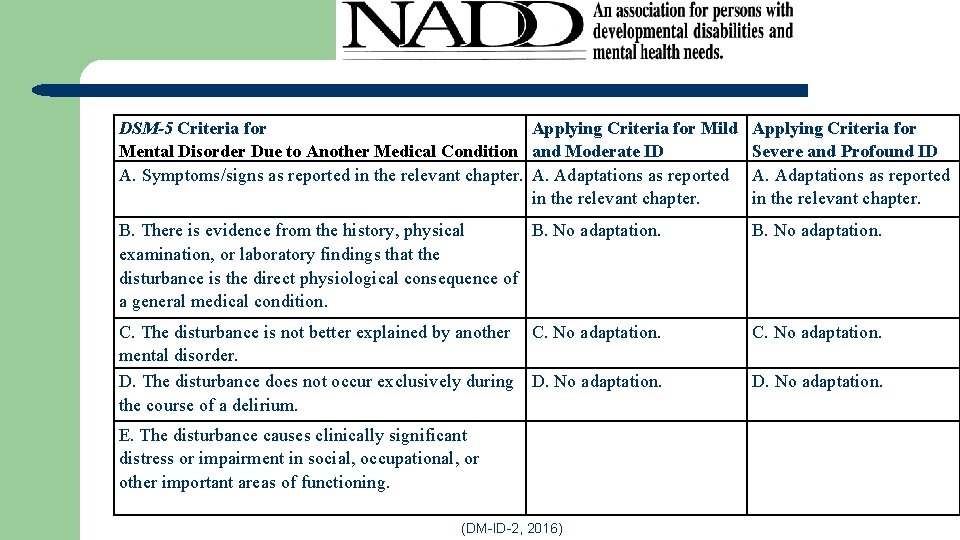
DSM-5 Criteria for Applying Criteria for Mild Mental Disorder Due to Another Medical Condition and Moderate ID A. Symptoms/signs as reported in the relevant chapter. A. Adaptations as reported in the relevant chapter. Applying Criteria for Severe and Profound ID A. Adaptations as reported in the relevant chapter. B. There is evidence from the history, physical B. No adaptation. examination, or laboratory findings that the disturbance is the direct physiological consequence of a general medical condition. B. No adaptation. C. The disturbance is not better explained by another C. No adaptation. mental disorder. D. The disturbance does not occur exclusively during D. No adaptation. the course of a delirium. C. No adaptation. E. The disturbance causes clinically significant distress or impairment in social, occupational, or other important areas of functioning. (DM-ID-2, 2016) D. No adaptation.
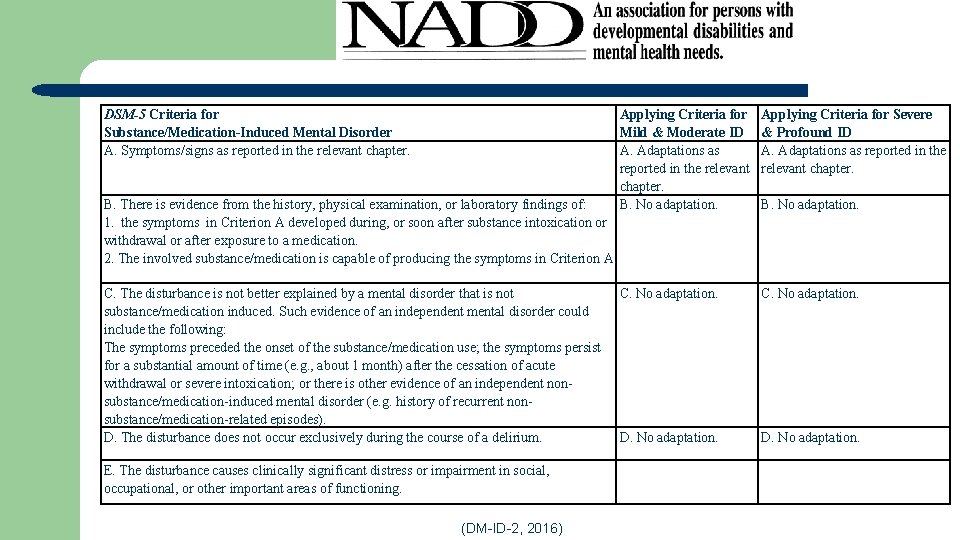
DSM-5 Criteria for Substance/Medication-Induced Mental Disorder A. Symptoms/signs as reported in the relevant chapter. Applying Criteria for Mild & Moderate ID A. Adaptations as reported in the relevant chapter. B. No adaptation. Applying Criteria for Severe & Profound ID A. Adaptations as reported in the relevant chapter. C. The disturbance is not better explained by a mental disorder that is not substance/medication induced. Such evidence of an independent mental disorder could include the following: The symptoms preceded the onset of the substance/medication use; the symptoms persist for a substantial amount of time (e. g. , about 1 month) after the cessation of acute withdrawal or severe intoxication; or there is other evidence of an independent nonsubstance/medication-induced mental disorder (e. g. history of recurrent nonsubstance/medication-related episodes). D. The disturbance does not occur exclusively during the course of a delirium. C. No adaptation. D. No adaptation. E. The disturbance causes clinically significant distress or impairment in social, occupational, or other important areas of functioning. B. There is evidence from the history, physical examination, or laboratory findings of: 1. the symptoms in Criterion A developed during, or soon after substance intoxication or withdrawal or after exposure to a medication. 2. The involved substance/medication is capable of producing the symptoms in Criterion A. (DM-ID-2, 2016) B. No adaptation.
Summary • Review of the limitations of existing diagnostic systems • Assessment practices • Relevance of behavioral phenotypes • The structure of the DM-ID-2 • Six (6) modifications to the DSM-5 and how they apply to the DM-ID-2 (DM-ID-2, 2016)
THANK YOU! For information Dr. Robert Fletcher NADD rfletcher@thenadd. org www. thenadd. org 845 -331 -4336
- Slides: 48