
From Synergy to Knowledge Integrating multiple language resources
- Slides: 76
From Synergy to Knowledge: Integrating multiple language resources Part I: Language Resources and Tools Chu-Ren Huang Academia Sinica http: //cwn. ling. sinica. edu. tw/huang. htm 4 th National NLP Research Symposium, De La Salle Univ. , Manila, June 14 -16 2007
Outline: Language Resources and Tools o Introduction: 10 Years in Chinese Language Processing-A mirror for other Asian Languages o The Starting Point: Resources and Resources Sharing o n OLAC: The Open Language Archives Community n Asian Language Resources Committee of AFNLP n Standards: ISO TC 37 Language Resources Mangagement n Language Archives Project of Taiwan Tools: Getting Started in NLP with NLTK C. R. Huang, 4 th National NLP Research Symposium, De La Salle Univ. , Manila, June 14 -16 2007 p. 2
Why Resources and Tools Language Resources o Foundation and empirical basis of scientific studies of natural languages n The only reliable source for language specific features o Infrastructure for knowledge representation and knowledge engineering o Essential to preserve linguistic and cultural diversity Tools o Needed to ‘process’ o General enough for multilingual processing and cross-lingual comparison o Robust enough to deal with language specific issues C. R. Huang, 4 th National NLP Research Symposium, De La Salle Univ. , Manila, June 14 -16 2007 p. 3
Chinese Language Processing as a Mirror For the development of Asian Language Processing o Unlike Japanese, which has enjoying being one of the leaders in technological innovation o The development of Chinese language processing coincides with the developing economies of Taiwan and China o Especially the availability of Chinese language PC’s o Similar to the situation of many Asian languages now C. R. Huang, 4 th National NLP Research Symposium, De La Salle Univ. , Manila, June 14 -16 2007 p. 4
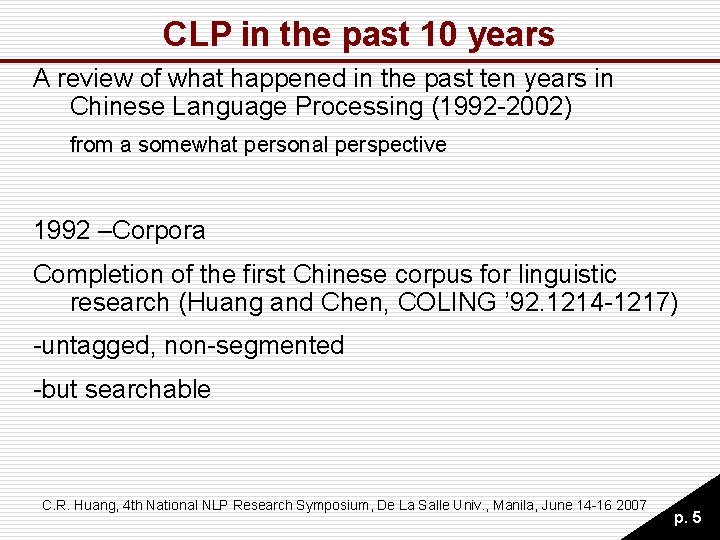
CLP in the past 10 years A review of what happened in the past ten years in Chinese Language Processing (1992 -2002) from a somewhat personal perspective 1992 –Corpora Completion of the first Chinese corpus for linguistic research (Huang and Chen, COLING ’ 92. 1214 -1217) -untagged, non-segmented -but searchable C. R. Huang, 4 th National NLP Research Symposium, De La Salle Univ. , Manila, June 14 -16 2007 p. 5
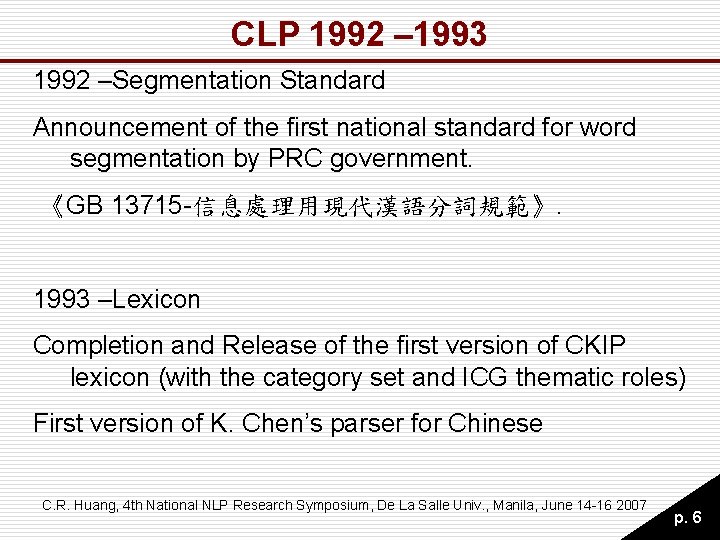
CLP 1992 – 1993 1992 –Segmentation Standard Announcement of the first national standard for word segmentation by PRC government. 《GB 13715 -信息處理用現代漢語分詞規範》. 1993 –Lexicon Completion and Release of the first version of CKIP lexicon (with the category set and ICG thematic roles) First version of K. Chen’s parser for Chinese C. R. Huang, 4 th National NLP Research Symposium, De La Salle Univ. , Manila, June 14 -16 2007 p. 6
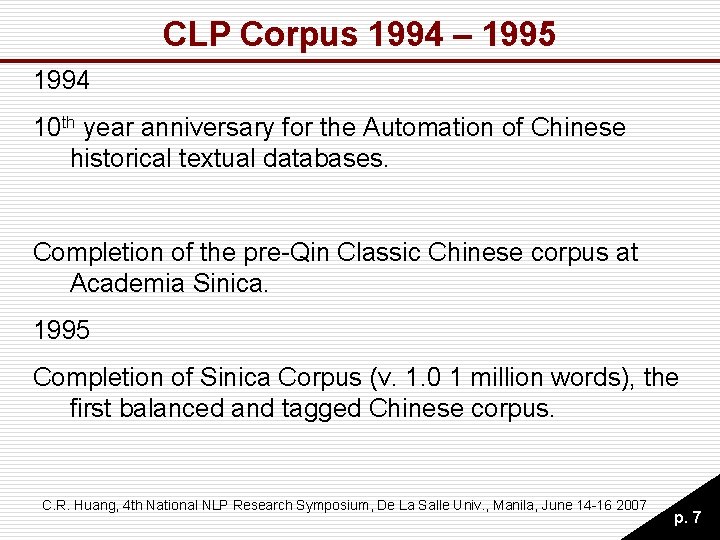
CLP Corpus 1994 – 1995 1994 10 th year anniversary for the Automation of Chinese historical textual databases. Completion of the pre-Qin Classic Chinese corpus at Academia Sinica. 1995 Completion of Sinica Corpus (v. 1. 0 1 million words), the first balanced and tagged Chinese corpus. C. R. Huang, 4 th National NLP Research Symposium, De La Salle Univ. , Manila, June 14 -16 2007 p. 7
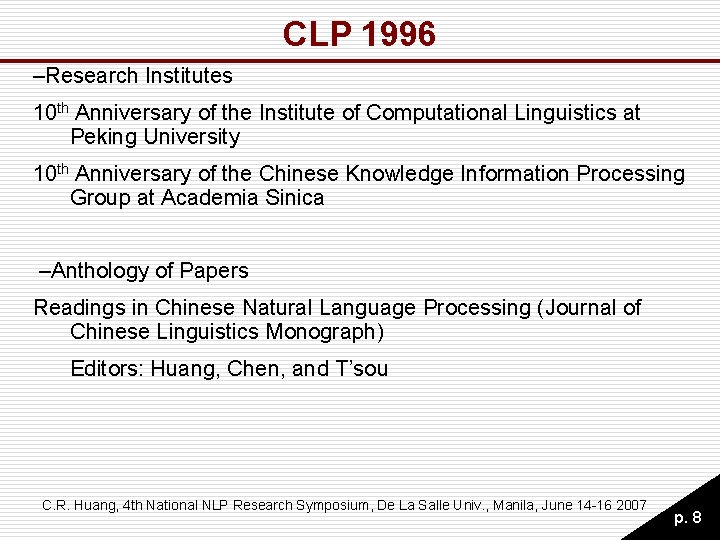
CLP 1996 –Research Institutes 10 th Anniversary of the Institute of Computational Linguistics at Peking University 10 th Anniversary of the Chinese Knowledge Information Processing Group at Academia Sinica –Anthology of Papers Readings in Chinese Natural Language Processing (Journal of Chinese Linguistics Monograph) Editors: Huang, Chen, and T’sou C. R. Huang, 4 th National NLP Research Symposium, De La Salle Univ. , Manila, June 14 -16 2007 p. 8
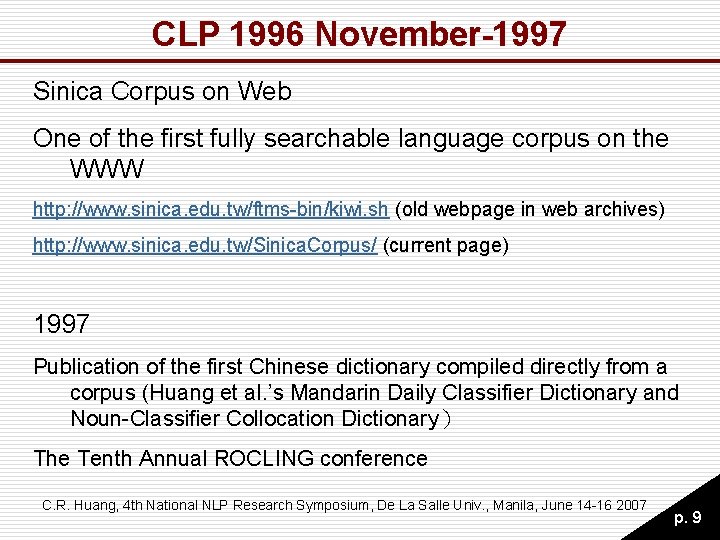
CLP 1996 November-1997 Sinica Corpus on Web One of the first fully searchable language corpus on the WWW http: //www. sinica. edu. tw/ftms-bin/kiwi. sh (old webpage in web archives) http: //www. sinica. edu. tw/Sinica. Corpus/ (current page) 1997 Publication of the first Chinese dictionary compiled directly from a corpus (Huang et al. ’s Mandarin Daily Classifier Dictionary and Noun-Classifier Collocation Dictionary) The Tenth Annual ROCLING conference C. R. Huang, 4 th National NLP Research Symposium, De La Salle Univ. , Manila, June 14 -16 2007 p. 9
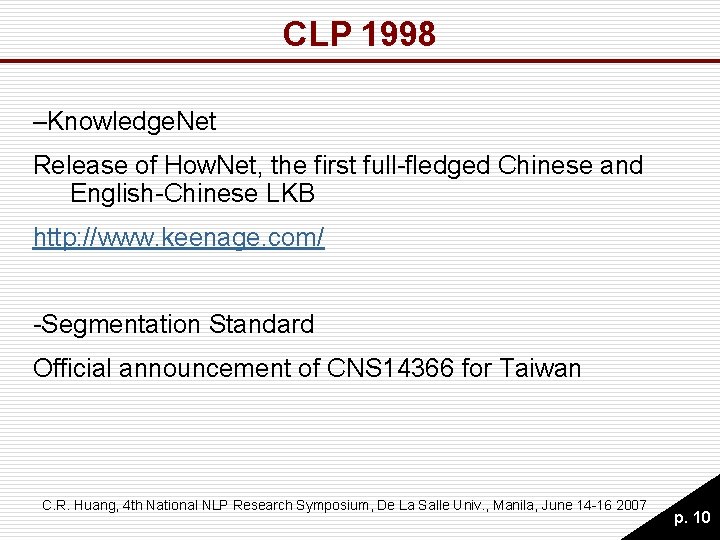
CLP 1998 –Knowledge. Net Release of How. Net, the first full-fledged Chinese and English-Chinese LKB http: //www. keenage. com/ -Segmentation Standard Official announcement of CNS 14366 for Taiwan C. R. Huang, 4 th National NLP Research Symposium, De La Salle Univ. , Manila, June 14 -16 2007 p. 10
CLP 2000 –Treebanks Simultaneous completion and announcement of two Chinese Treebanks: *Penn Chinese Treebank *Sinica Treebank ACL Workshop on Chinese Language Processing C. R. Huang, 4 th National NLP Research Symposium, De La Salle Univ. , Manila, June 14 -16 2007 p. 11
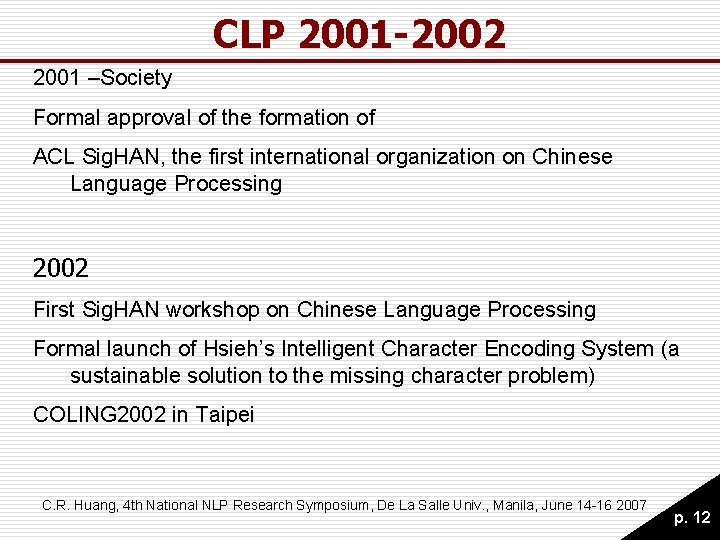
CLP 2001 -2002 2001 –Society Formal approval of the formation of ACL Sig. HAN, the first international organization on Chinese Language Processing 2002 First Sig. HAN workshop on Chinese Language Processing Formal launch of Hsieh’s Intelligent Character Encoding System (a sustainable solution to the missing character problem) COLING 2002 in Taipei C. R. Huang, 4 th National NLP Research Symposium, De La Salle Univ. , Manila, June 14 -16 2007 p. 12
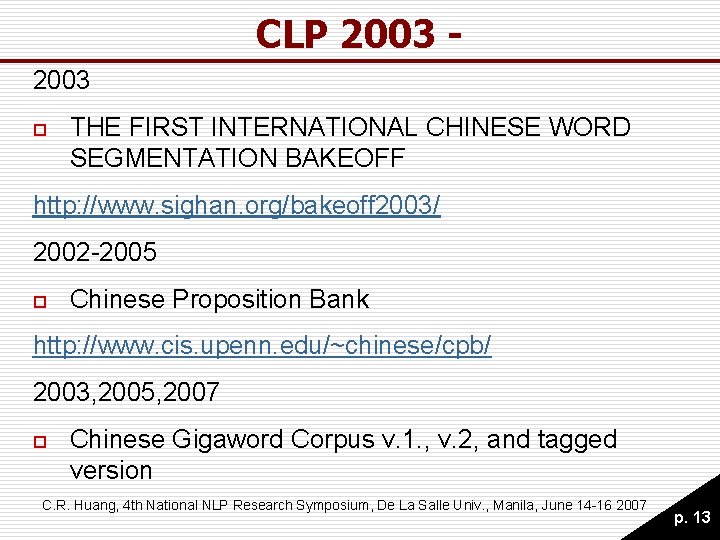
CLP 2003 o THE FIRST INTERNATIONAL CHINESE WORD SEGMENTATION BAKEOFF http: //www. sighan. org/bakeoff 2003/ 2002 -2005 o Chinese Proposition Bank http: //www. cis. upenn. edu/~chinese/cpb/ 2003, 2005, 2007 o Chinese Gigaword Corpus v. 1. , v. 2, and tagged version C. R. Huang, 4 th National NLP Research Symposium, De La Salle Univ. , Manila, June 14 -16 2007 p. 13
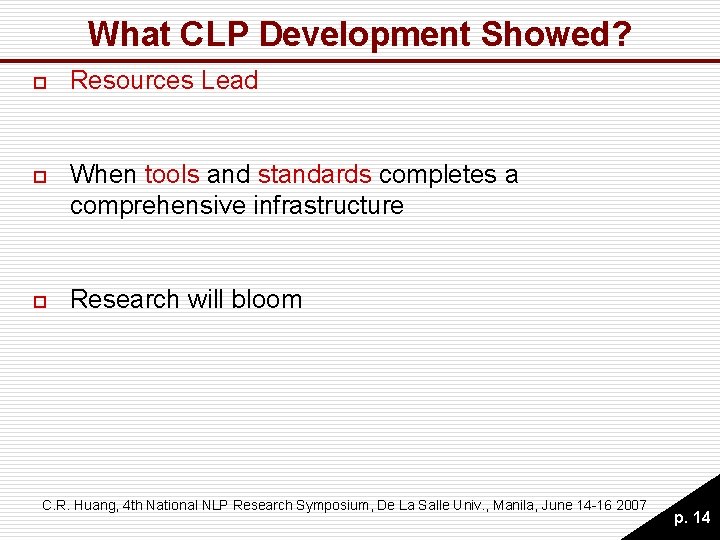
What CLP Development Showed? o Resources Lead o When tools and standards completes a comprehensive infrastructure o Research will bloom C. R. Huang, 4 th National NLP Research Symposium, De La Salle Univ. , Manila, June 14 -16 2007 p. 14
Resources Development o Towards a Sharable and Sustainable Model of Resources Development OLAC Open Language Archives Community http: //www. language-archives. org C. R. Huang, 4 th National NLP Research Symposium, De La Salle Univ. , Manila, June 14 -16 2007 p. 15
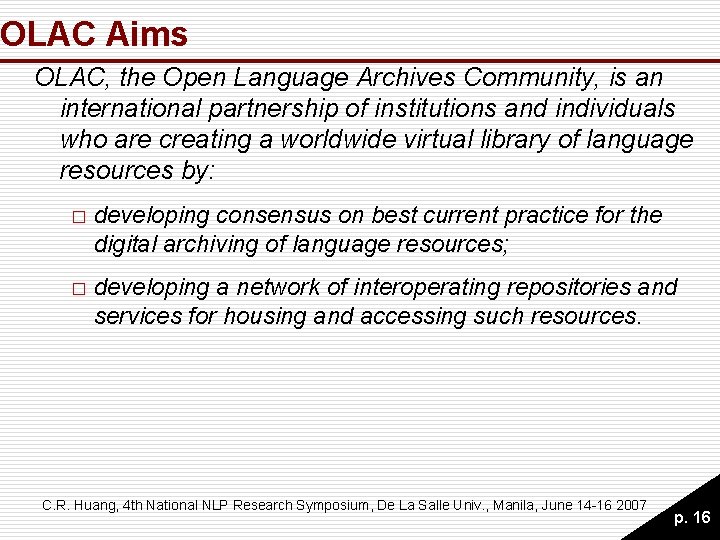
OLAC Aims OLAC, the Open Language Archives Community, is an international partnership of institutions and individuals who are creating a worldwide virtual library of language resources by: � developing consensus on best current practice for the digital archiving of language resources; � developing a network of interoperating repositories and services for housing and accessing such resources. C. R. Huang, 4 th National NLP Research Symposium, De La Salle Univ. , Manila, June 14 -16 2007 p. 16
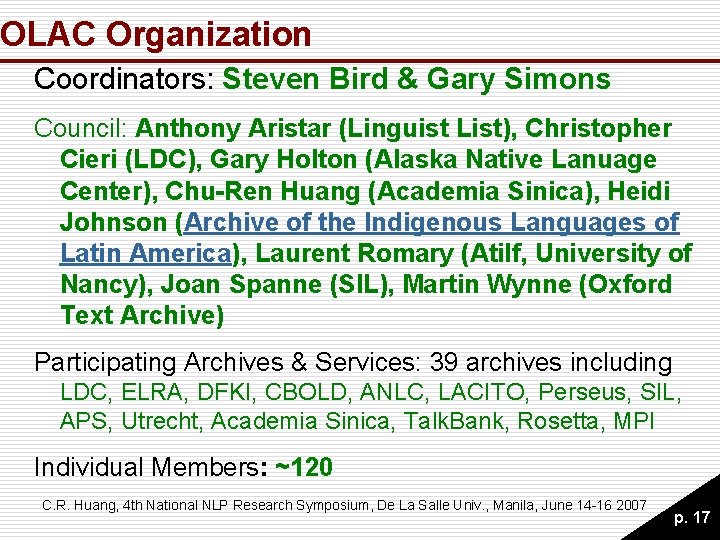
OLAC Organization Coordinators: Steven Bird & Gary Simons Council: Anthony Aristar (Linguist List), Christopher Cieri (LDC), Gary Holton (Alaska Native Lanuage Center), Chu-Ren Huang (Academia Sinica), Heidi Johnson (Archive of the Indigenous Languages of Latin America), Laurent Romary (Atilf, University of Nancy), Joan Spanne (SIL), Martin Wynne (Oxford Text Archive) Participating Archives & Services: 39 archives including LDC, ELRA, DFKI, CBOLD, ANLC, LACITO, Perseus, SIL, APS, Utrecht, Academia Sinica, Talk. Bank, Rosetta, MPI Individual Members: ~120 C. R. Huang, 4 th National NLP Research Symposium, De La Salle Univ. , Manila, June 14 -16 2007 p. 17
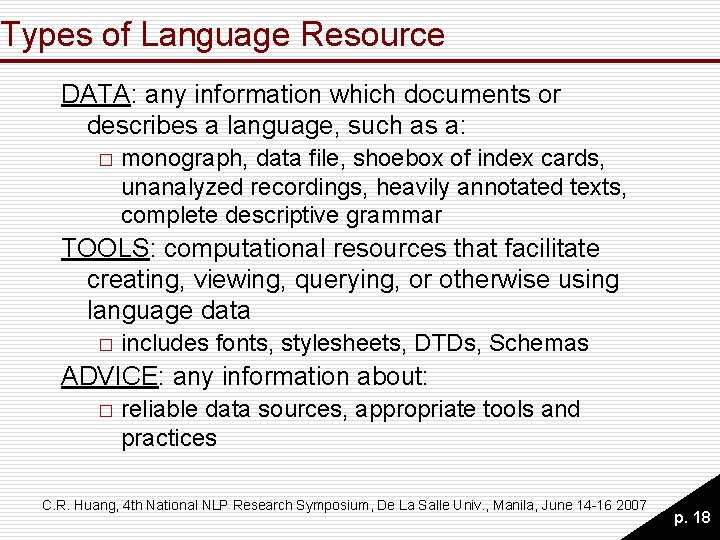
Types of Language Resource DATA: any information which documents or describes a language, such as a: � monograph, data file, shoebox of index cards, unanalyzed recordings, heavily annotated texts, complete descriptive grammar TOOLS: computational resources that facilitate creating, viewing, querying, or otherwise using language data � includes fonts, stylesheets, DTDs, Schemas ADVICE: any information about: � reliable data sources, appropriate tools and practices C. R. Huang, 4 th National NLP Research Symposium, De La Salle Univ. , Manila, June 14 -16 2007 p. 18
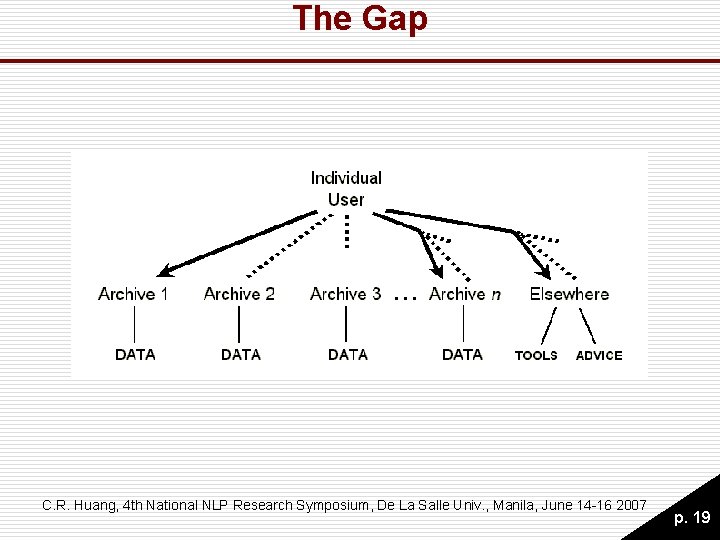
The Gap C. R. Huang, 4 th National NLP Research Symposium, De La Salle Univ. , Manila, June 14 -16 2007 p. 19
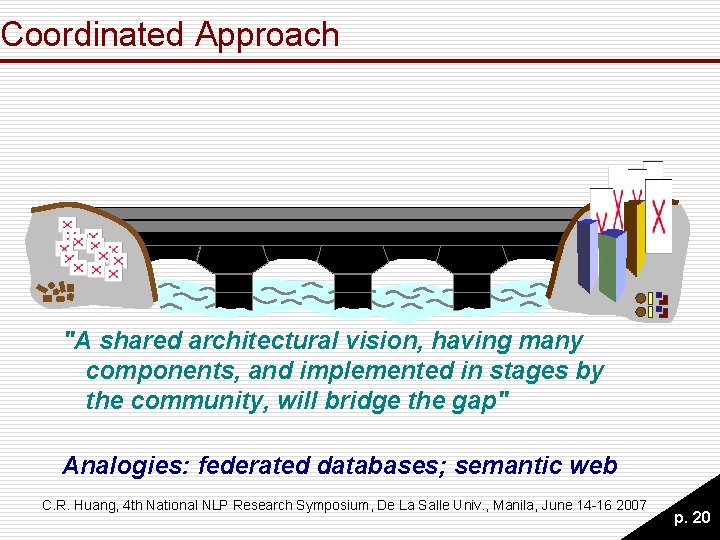
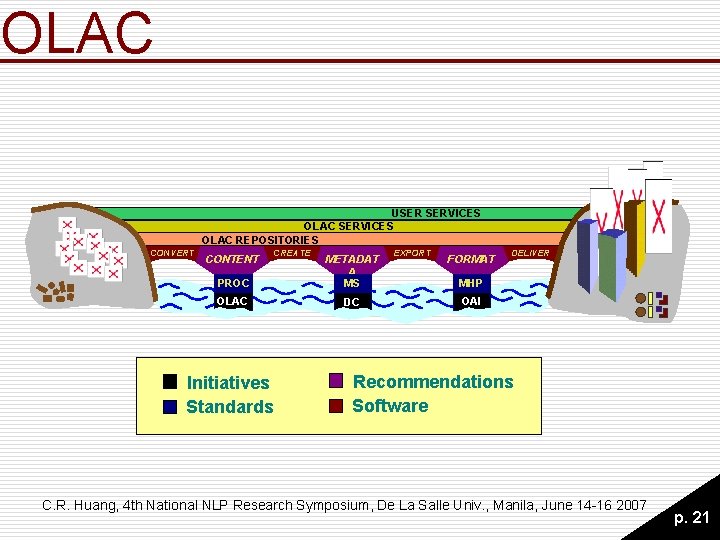
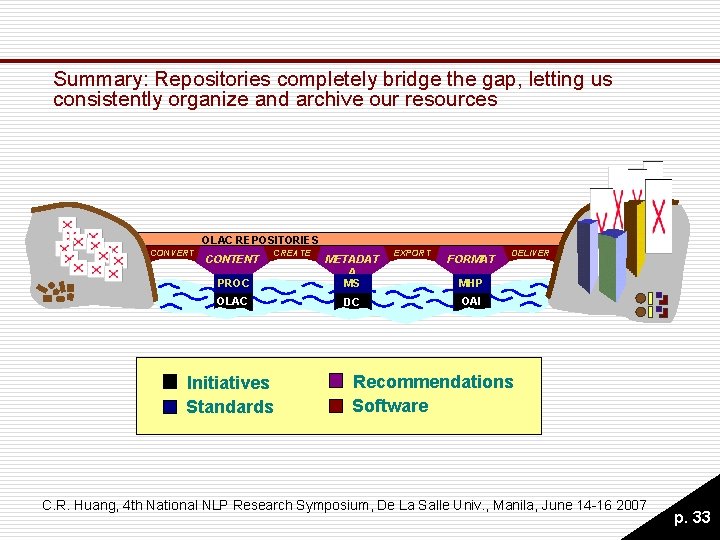
Coordinated Approach OLAC OAI "A shared architectural vision, having many components, and implemented in stages by the community, will bridge the gap" Analogies: federated databases; semantic web C. R. Huang, 4 th National NLP Research Symposium, De La Salle Univ. , Manila, June 14 -16 2007 p. 20
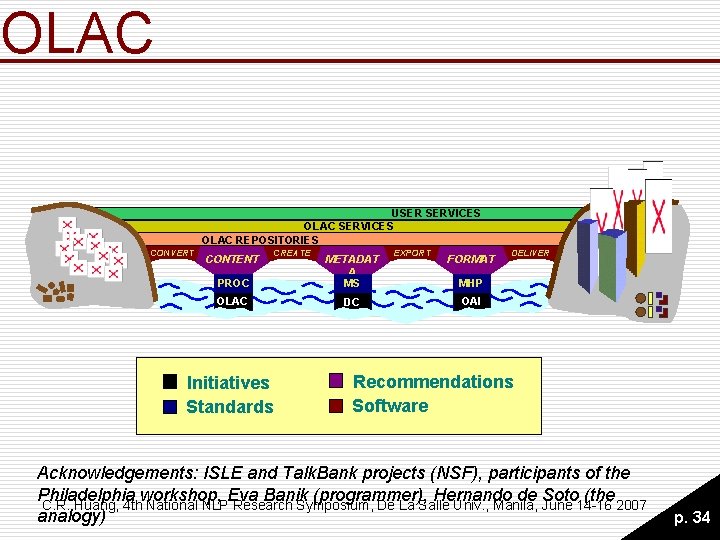
OLAC USER SERVICES OLAC REPOSITORIES CONVERT CONTENT CREATE PROC METADAT A MS OLAC DC OAI Initiatives Standards EXPORT FORMAT DELIVER MHP OAI Recommendations Software C. R. Huang, 4 th National NLP Research Symposium, De La Salle Univ. , Manila, June 14 -16 2007 p. 21
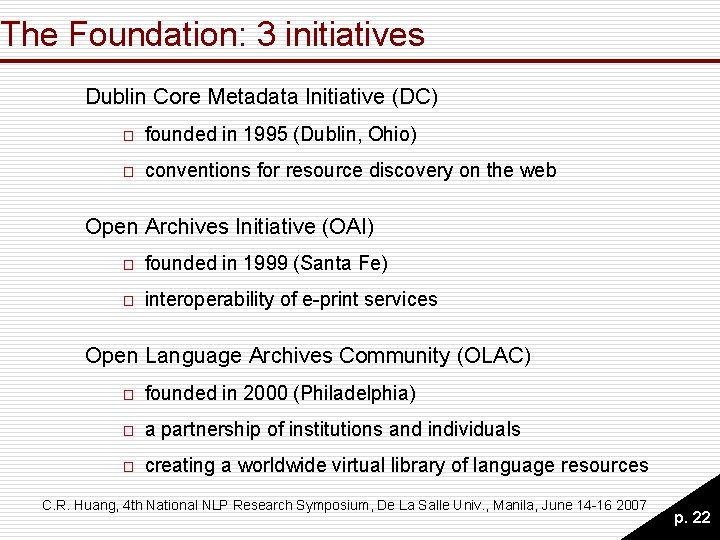
The Foundation: 3 initiatives Dublin Core Metadata Initiative (DC) � founded in 1995 (Dublin, Ohio) � conventions for resource discovery on the web Open Archives Initiative (OAI) � founded in 1999 (Santa Fe) � interoperability of e-print services Open Language Archives Community (OLAC) � founded in 2000 (Philadelphia) � a partnership of institutions and individuals � creating a worldwide virtual library of language resources C. R. Huang, 4 th National NLP Research Symposium, De La Salle Univ. , Manila, June 14 -16 2007 p. 22
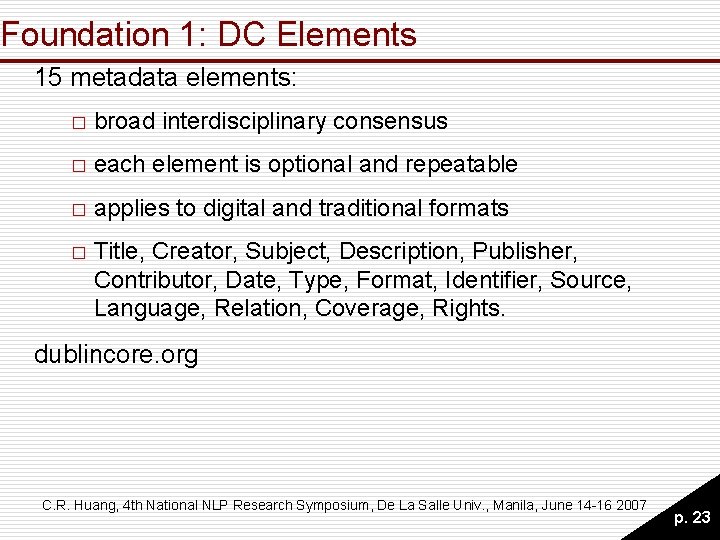
Foundation 1: DC Elements 15 metadata elements: � broad interdisciplinary consensus � each element is optional and repeatable � applies to digital and traditional formats � Title, Creator, Subject, Description, Publisher, Contributor, Date, Type, Format, Identifier, Source, Language, Relation, Coverage, Rights. dublincore. org C. R. Huang, 4 th National NLP Research Symposium, De La Salle Univ. , Manila, June 14 -16 2007 p. 23
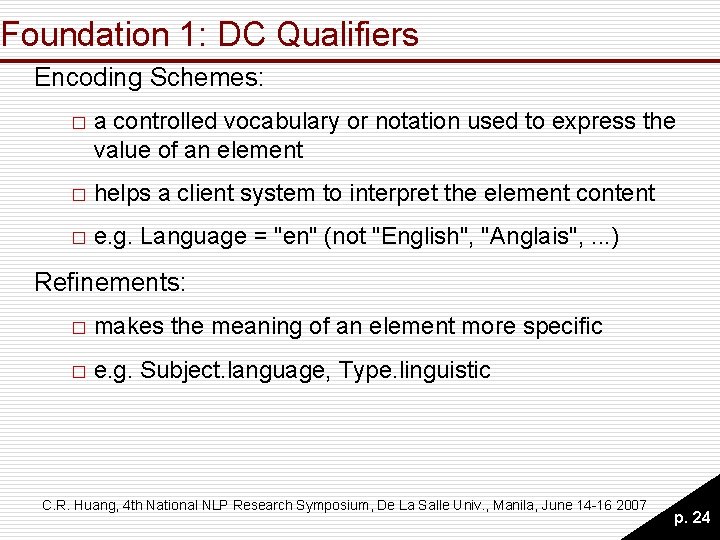
Foundation 1: DC Qualifiers Encoding Schemes: � a controlled vocabulary or notation used to express the value of an element � helps a client system to interpret the element content � e. g. Language = "en" (not "English", "Anglais", . . . ) Refinements: � makes the meaning of an element more specific � e. g. Subject. language, Type. linguistic C. R. Huang, 4 th National NLP Research Symposium, De La Salle Univ. , Manila, June 14 -16 2007 p. 24
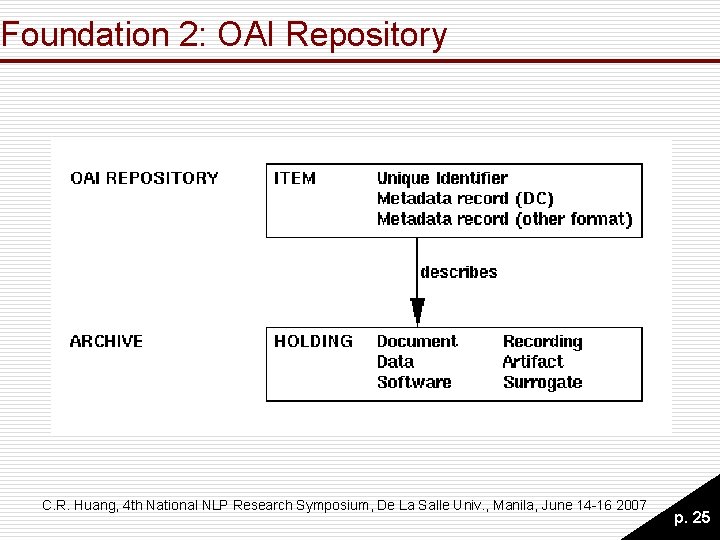
Foundation 2: OAI Repository C. R. Huang, 4 th National NLP Research Symposium, De La Salle Univ. , Manila, June 14 -16 2007 p. 25
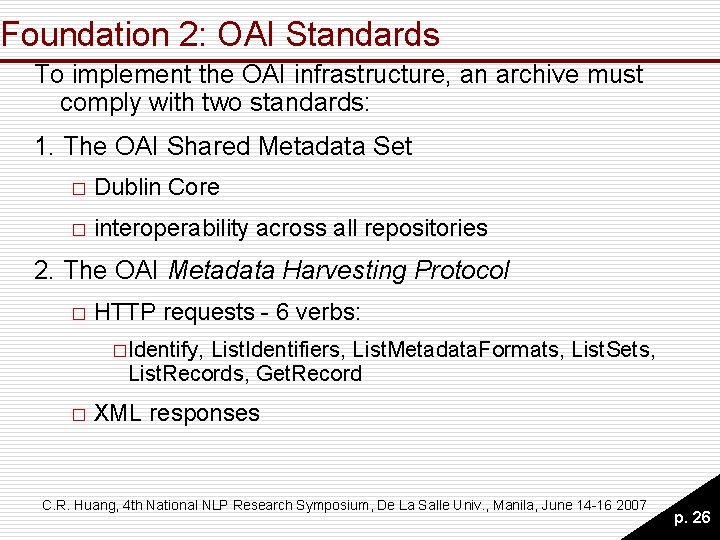
Foundation 2: OAI Standards To implement the OAI infrastructure, an archive must comply with two standards: 1. The OAI Shared Metadata Set � Dublin Core � interoperability across all repositories 2. The OAI Metadata Harvesting Protocol � HTTP requests - 6 verbs: �Identify, List. Identifiers, List. Metadata. Formats, List. Sets, List. Records, Get. Record � XML responses C. R. Huang, 4 th National NLP Research Symposium, De La Salle Univ. , Manila, June 14 -16 2007 p. 26
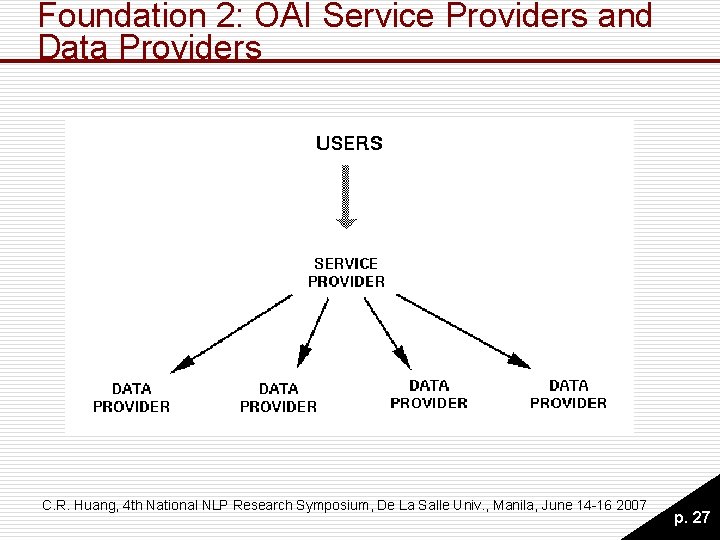
Foundation 2: OAI Service Providers and Data Providers C. R. Huang, 4 th National NLP Research Symposium, De La Salle Univ. , Manila, June 14 -16 2007 p. 27
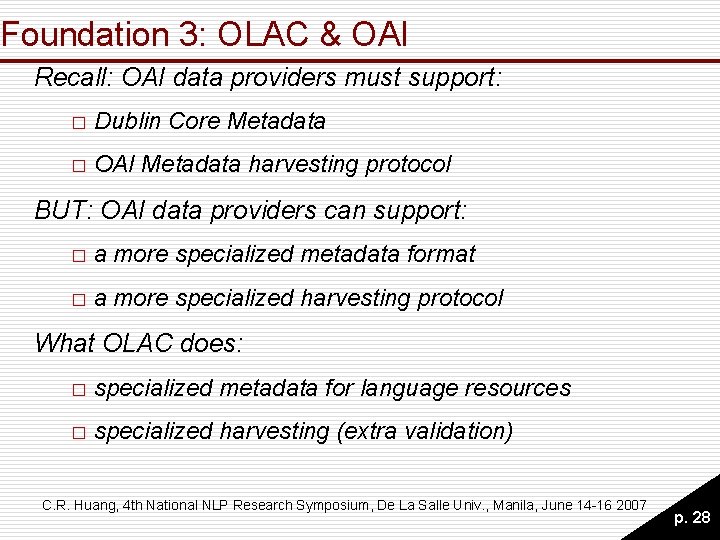
Foundation 3: OLAC & OAI Recall: OAI data providers must support: � Dublin Core Metadata � OAI Metadata harvesting protocol BUT: OAI data providers can support: � a more specialized metadata format � a more specialized harvesting protocol What OLAC does: � specialized metadata for language resources � specialized harvesting (extra validation) C. R. Huang, 4 th National NLP Research Symposium, De La Salle Univ. , Manila, June 14 -16 2007 p. 28
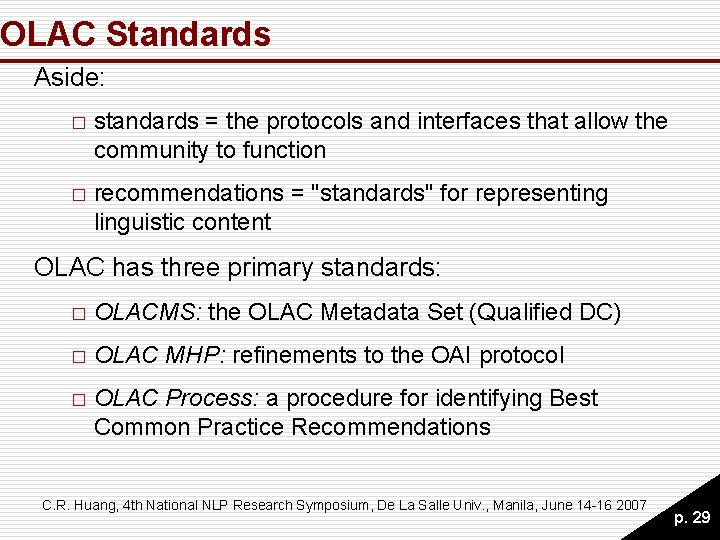
OLAC Standards Aside: � standards = the protocols and interfaces that allow the community to function � recommendations = "standards" for representing linguistic content OLAC has three primary standards: � OLACMS: the OLAC Metadata Set (Qualified DC) � OLAC MHP: refinements to the OAI protocol � OLAC Process: a procedure for identifying Best Common Practice Recommendations C. R. Huang, 4 th National NLP Research Symposium, De La Salle Univ. , Manila, June 14 -16 2007 p. 29
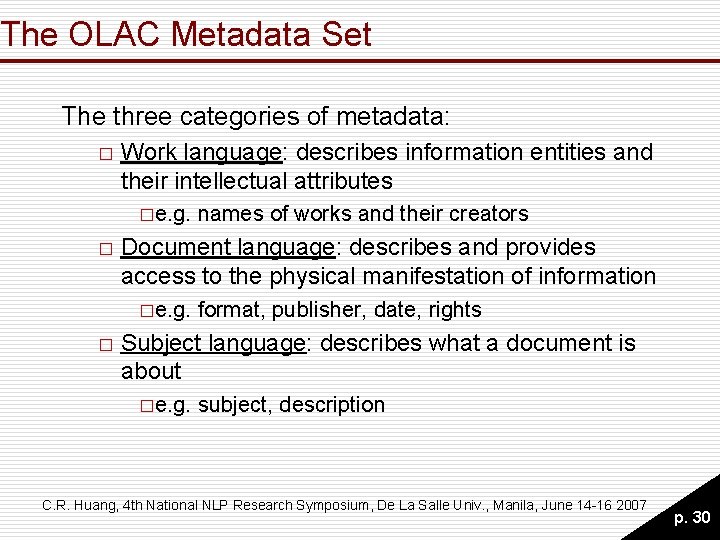
The OLAC Metadata Set The three categories of metadata: � Work language: describes information entities and their intellectual attributes �e. g. � Document language: describes and provides access to the physical manifestation of information �e. g. � names of works and their creators format, publisher, date, rights Subject language: describes what a document is about �e. g. subject, description C. R. Huang, 4 th National NLP Research Symposium, De La Salle Univ. , Manila, June 14 -16 2007 p. 30
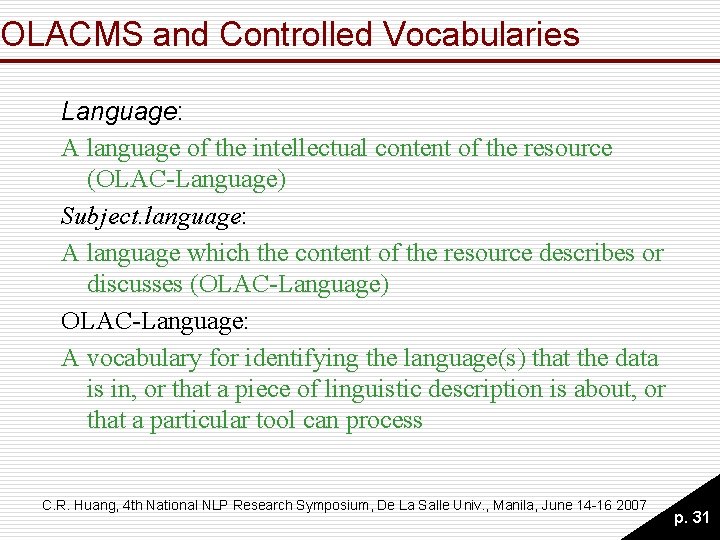
OLACMS and Controlled Vocabularies Language: A language of the intellectual content of the resource (OLAC-Language) Subject. language: A language which the content of the resource describes or discusses (OLAC-Language) OLAC-Language: A vocabulary for identifying the language(s) that the data is in, or that a piece of linguistic description is about, or that a particular tool can process C. R. Huang, 4 th National NLP Research Symposium, De La Salle Univ. , Manila, June 14 -16 2007 p. 31
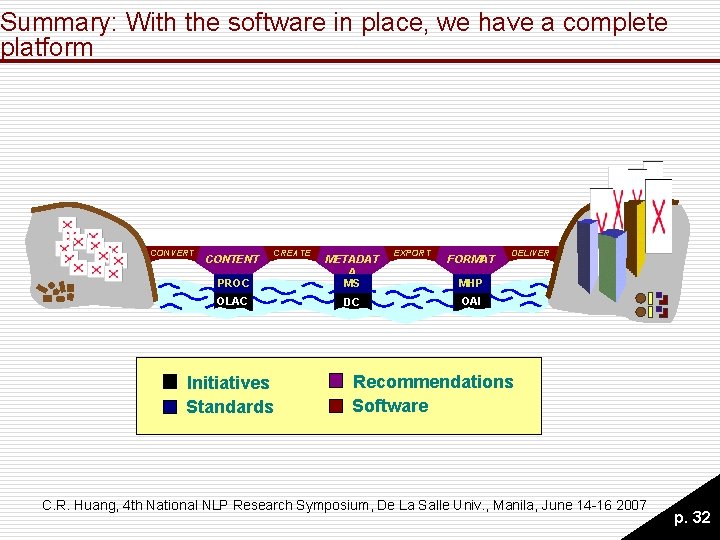
Summary: With the software in place, we have a complete platform CONVERT CONTENT CREATE PROC METADAT A MS OLAC DC OAI Initiatives Standards EXPORT FORMAT DELIVER MHP OAI Recommendations Software C. R. Huang, 4 th National NLP Research Symposium, De La Salle Univ. , Manila, June 14 -16 2007 p. 32
Summary: Repositories completely bridge the gap, letting us consistently organize and archive our resources OLAC REPOSITORIES CONVERT CONTENT CREATE PROC METADAT A MS OLAC DC OAI Initiatives Standards EXPORT FORMAT DELIVER MHP OAI Recommendations Software C. R. Huang, 4 th National NLP Research Symposium, De La Salle Univ. , Manila, June 14 -16 2007 p. 33
OLAC USER SERVICES OLAC REPOSITORIES CONVERT CONTENT CREATE PROC METADAT A MS OLAC DC OAI Initiatives Standards EXPORT FORMAT DELIVER MHP OAI Recommendations Software Acknowledgements: ISLE and Talk. Bank projects (NSF), participants of the Philadelphia workshop, Eva Banik (programmer), Hernando de Soto (the C. R. Huang, 4 th National NLP Research Symposium, De La Salle Univ. , Manila, June 14 -16 2007 analogy) p. 34
OLACMS helps archive versatility Given Shared Metadata Standard o New language archives can be created on the fly by harvesting existing archives o Rich information can be inferred by establishing temporal and geographic anchors for each document. C. R. Huang, 4 th National NLP Research Symposium, De La Salle Univ. , Manila, June 14 -16 2007 p. 35
OLAC Infrastructure Helps to Solve Language Archive Problems such as o Language Identification and o Metadata Set for Multi-lingual Language Archives C. R. Huang, 4 th National NLP Research Symposium, De La Salle Univ. , Manila, June 14 -16 2007 p. 36
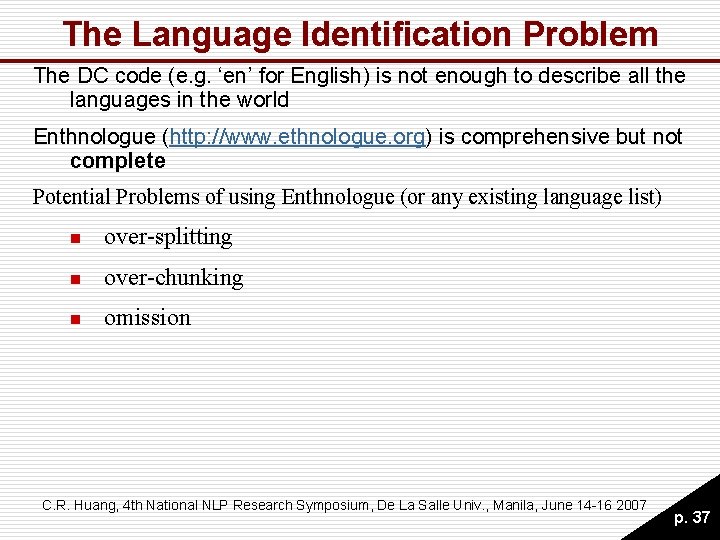
The Language Identification Problem The DC code (e. g. ‘en’ for English) is not enough to describe all the languages in the world Enthnologue (http: //www. ethnologue. org) is comprehensive but not complete Potential Problems of using Enthnologue (or any existing language list) n over-splitting n over-chunking n omission C. R. Huang, 4 th National NLP Research Symposium, De La Salle Univ. , Manila, June 14 -16 2007 p. 37
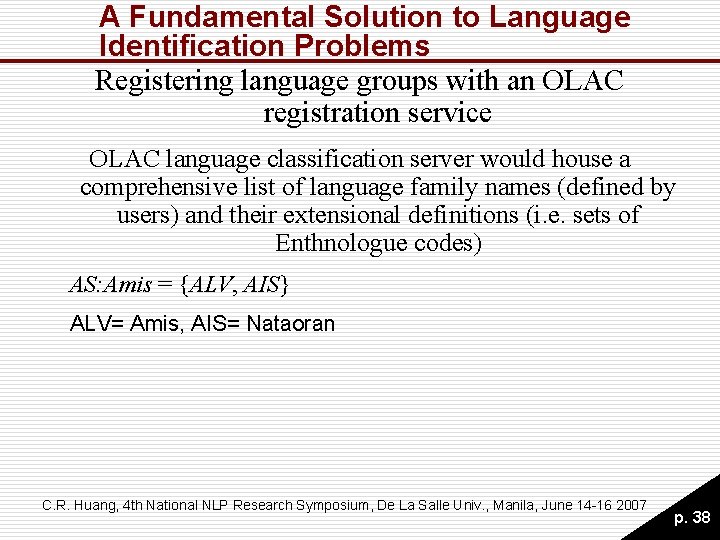
A Fundamental Solution to Language Identification Problems Registering language groups with an OLAC registration service OLAC language classification server would house a comprehensive list of language family names (defined by users) and their extensional definitions (i. e. sets of Enthnologue codes) AS: Amis = {ALV, AIS} ALV= Amis, AIS= Nataoran C. R. Huang, 4 th National NLP Research Symposium, De La Salle Univ. , Manila, June 14 -16 2007 p. 38
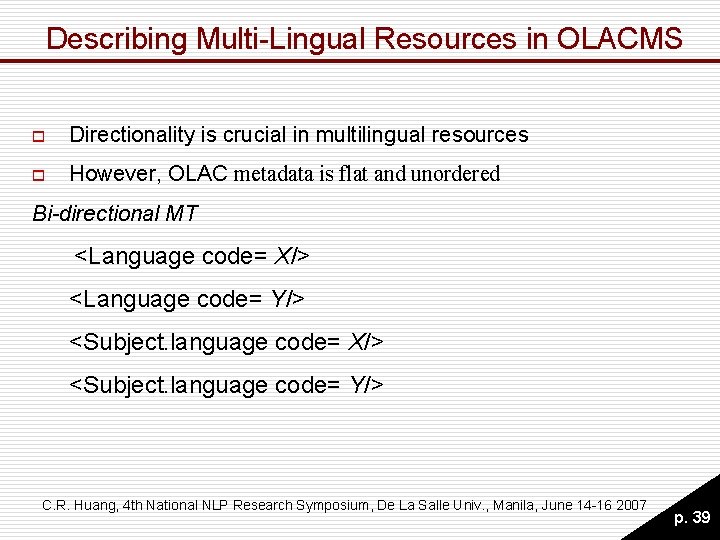
Describing Multi-Lingual Resources in OLACMS o Directionality is crucial in multilingual resources o However, OLAC metadata is flat and unordered Bi-directional MT <Language code= X/> <Language code= Y/> <Subject. language code= X/> <Subject. language code= Y/> C. R. Huang, 4 th National NLP Research Symposium, De La Salle Univ. , Manila, June 14 -16 2007 p. 39
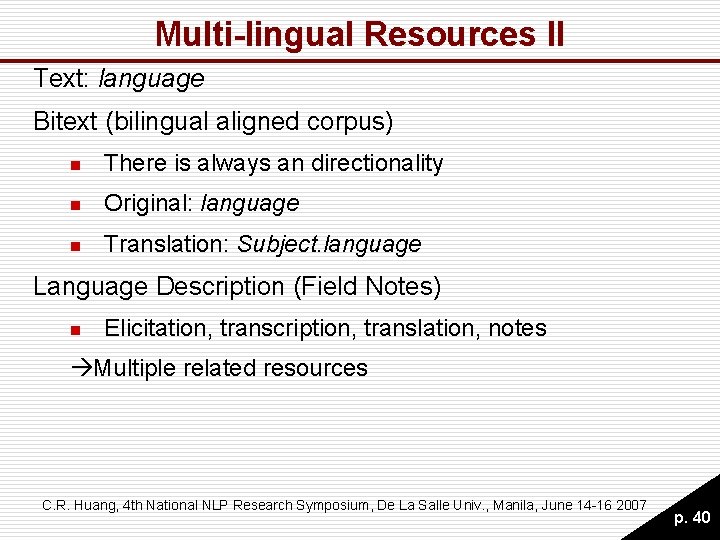
Multi-lingual Resources II Text: language Bitext (bilingual aligned corpus) n There is always an directionality n Original: language n Translation: Subject. language Language Description (Field Notes) n Elicitation, transcription, translation, notes Multiple related resources C. R. Huang, 4 th National NLP Research Symposium, De La Salle Univ. , Manila, June 14 -16 2007 p. 40
Language Archives Project of Taiwan o Part of the National Digital Archives Project (NDAP) o Pilot Stage 2000 -2001 o First Phase: 2002 -2006 o Both Language Archives o And Linguistic Anchor C. R. Huang, 4 th National NLP Research Symposium, De La Salle Univ. , Manila, June 14 -16 2007 p. 41
Language and Digital Archives C. R. Huang, 4 th National NLP Research Symposium, De La Salle Univ. , Manila, June 14 -16 2007 p. 42
Digital Archives are Linguistically Anchored • Archives are anchored with Lexical Knowledge. Base (LKB) -because LKB as collection of lexical types instantiated in archives uniquely defines each archive -And each lexical item is the conceptual atom projecting knowledge from archive to archive C. R. Huang, 4 th National NLP Research Symposium, De La Salle Univ. , Manila, June 14 -16 2007 p. 43
Multi-anchor Knowledge Linking o Geographical anchor based on GIS (geography information system) -Ecology (Fauna, Weather, Geology etc. ) -Socio-Anthropological classification o Linguistic anchor based on LKB -etymology, language grouping, loan words, C. R. Huang, 4 th National NLP Research Symposium, De La Salle Univ. , Manila, June 14 -16 2007 p. 44
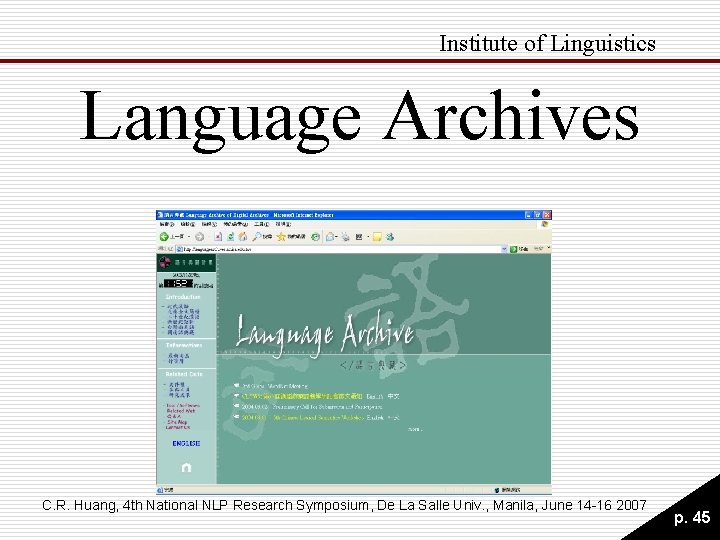
Institute of Linguistics Language Archives C. R. Huang, 4 th National NLP Research Symposium, De La Salle Univ. , Manila, June 14 -16 2007 p. 45
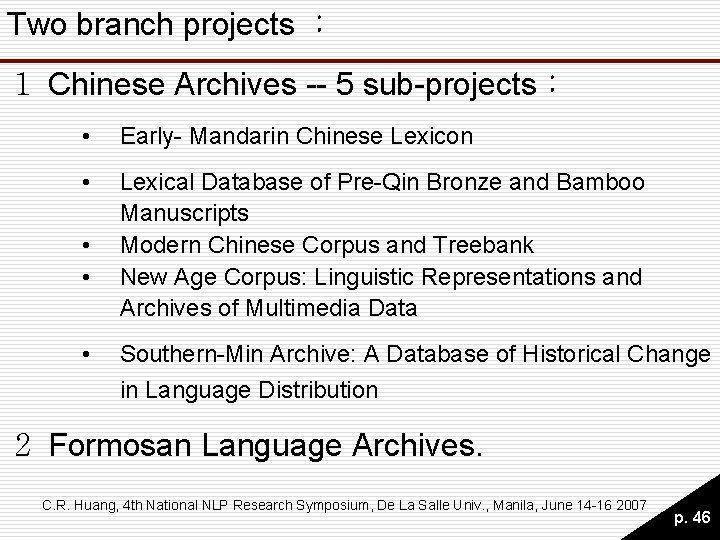
Two branch projects : 1 Chinese Archives -- 5 sub-projects: • Early- Mandarin Chinese Lexicon • Lexical Database of Pre-Qin Bronze and Bamboo Manuscripts Modern Chinese Corpus and Treebank New Age Corpus: Linguistic Representations and Archives of Multimedia Data • • • Southern-Min Archive: A Database of Historical Change in Language Distribution 2 Formosan Language Archives. C. R. Huang, 4 th National NLP Research Symposium, De La Salle Univ. , Manila, June 14 -16 2007 p. 46
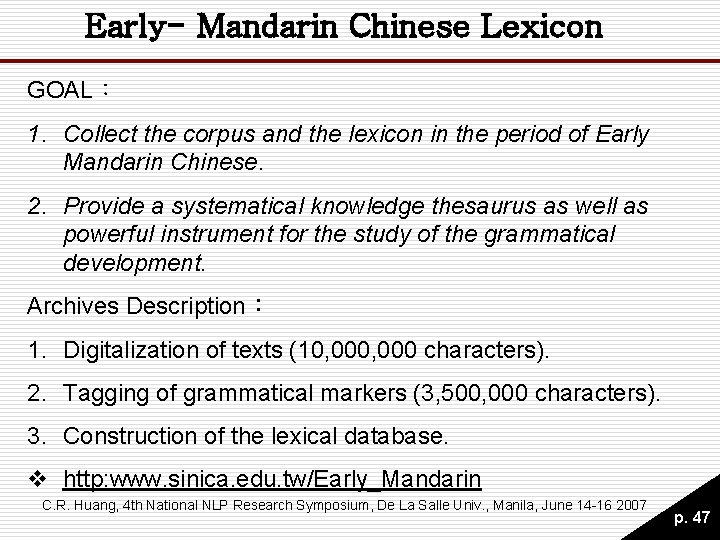
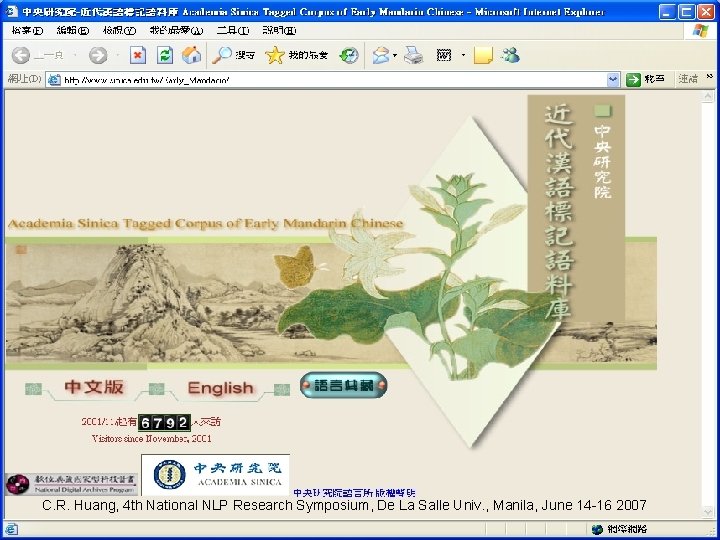
Early- Mandarin Chinese Lexicon GOAL: 1. Collect the corpus and the lexicon in the period of Early Mandarin Chinese. 2. Provide a systematical knowledge thesaurus as well as powerful instrument for the study of the grammatical development. Archives Description: 1. Digitalization of texts (10, 000 characters). 2. Tagging of grammatical markers (3, 500, 000 characters). 3. Construction of the lexical database. v http: www. sinica. edu. tw/Early_Mandarin C. R. Huang, 4 th National NLP Research Symposium, De La Salle Univ. , Manila, June 14 -16 2007 p. 47
C. R. Huang, 4 th National NLP Research Symposium, De La Salle Univ. , Manila, June 14 -16 2007 p. 48
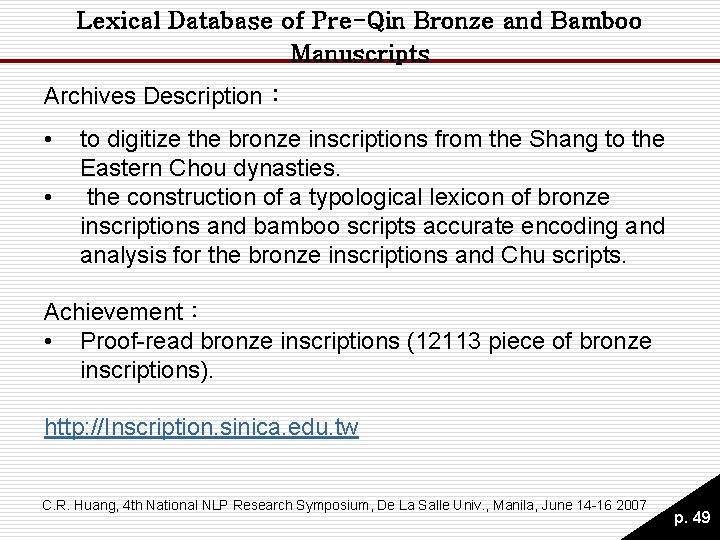
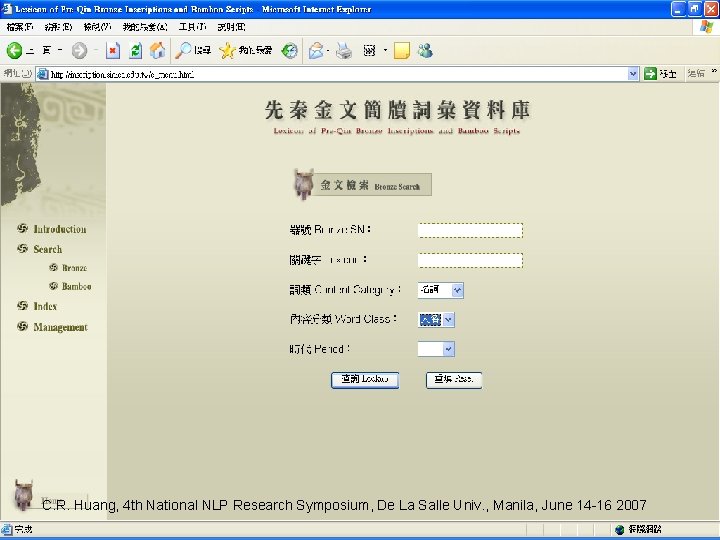
Lexical Database of Pre-Qin Bronze and Bamboo Manuscripts Archives Description: • • to digitize the bronze inscriptions from the Shang to the Eastern Chou dynasties. the construction of a typological lexicon of bronze inscriptions and bamboo scripts accurate encoding and analysis for the bronze inscriptions and Chu scripts. Achievement: • Proof-read bronze inscriptions (12113 piece of bronze inscriptions). http: //Inscription. sinica. edu. tw C. R. Huang, 4 th National NLP Research Symposium, De La Salle Univ. , Manila, June 14 -16 2007 p. 49
C. R. Huang, 4 th National NLP Research Symposium, De La Salle Univ. , Manila, June 14 -16 2007 p. 50
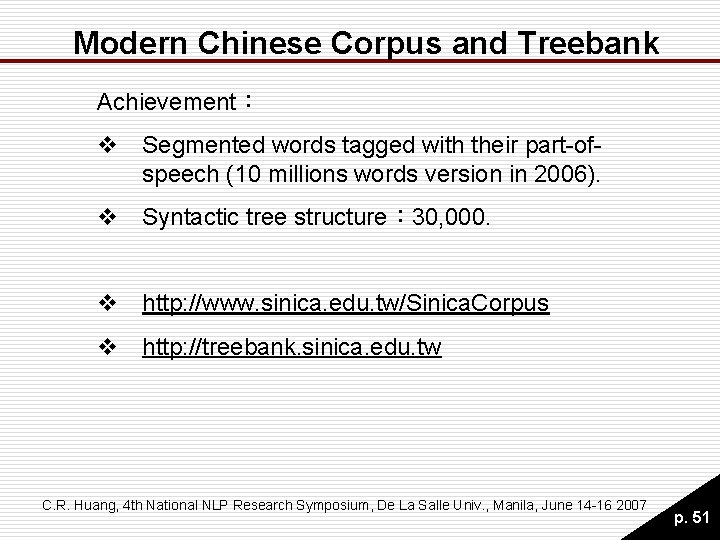
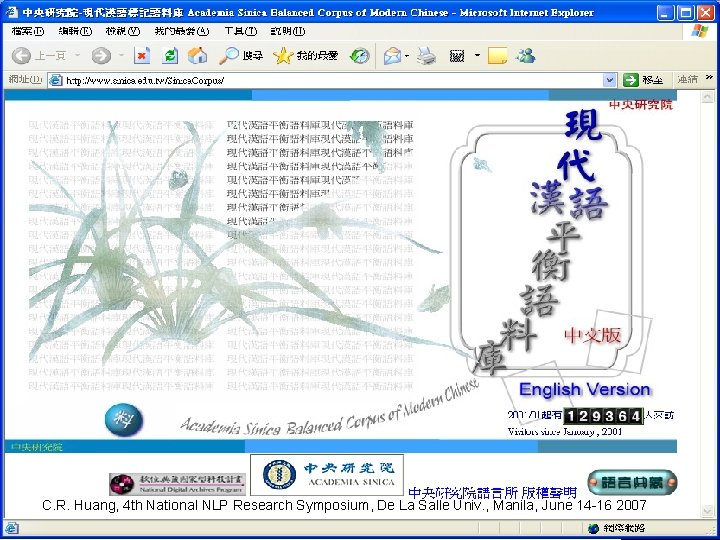
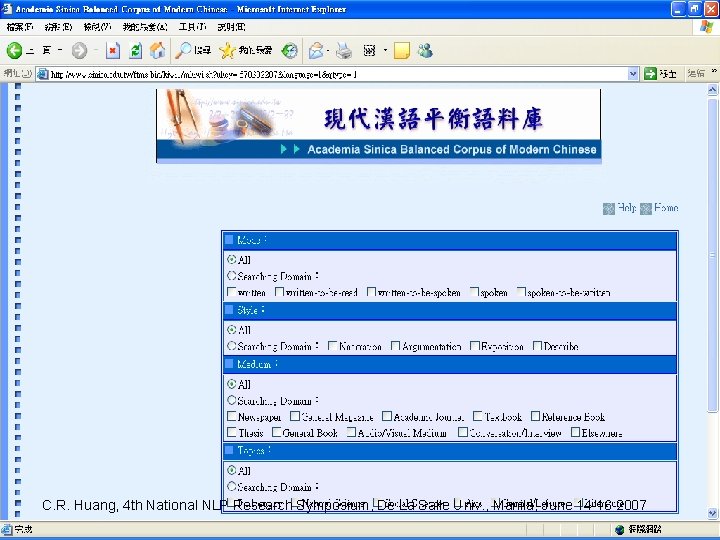
Modern Chinese Corpus and Treebank Achievement: v Segmented words tagged with their part-ofspeech (10 millions words version in 2006). v Syntactic tree structure: 30, 000. v http: //www. sinica. edu. tw/Sinica. Corpus v http: //treebank. sinica. edu. tw C. R. Huang, 4 th National NLP Research Symposium, De La Salle Univ. , Manila, June 14 -16 2007 p. 51
C. R. Huang, 4 th National NLP Research Symposium, De La Salle Univ. , Manila, June 14 -16 2007 p. 52
C. R. Huang, 4 th National NLP Research Symposium, De La Salle Univ. , Manila, June 14 -16 2007 p. 53
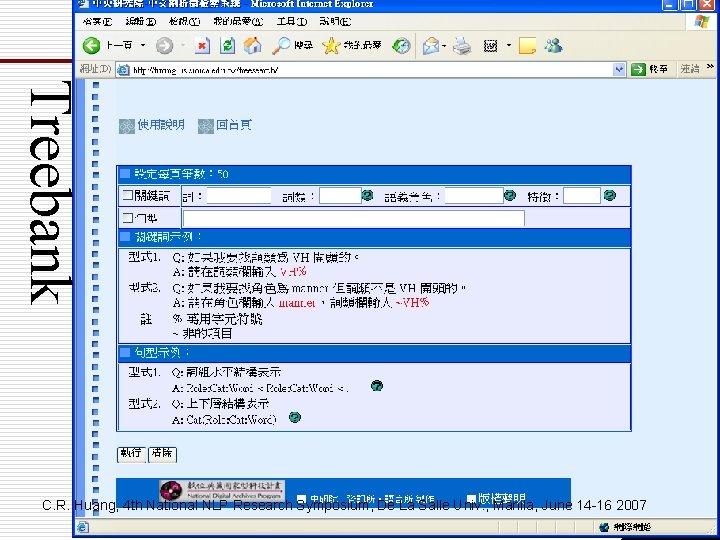
Treebank C. R. Huang, 4 th National NLP Research Symposium, De La Salle Univ. , Manila, June 14 -16 2007 p. 54
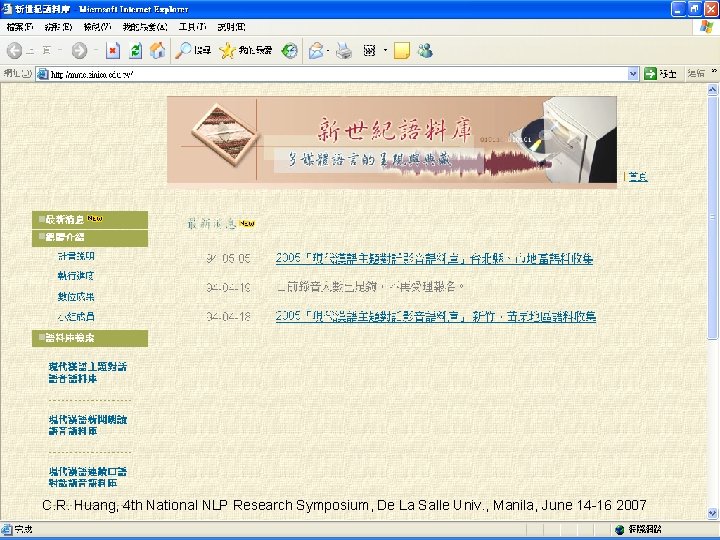
New Age Corpus: Linguistic Representations and Archives of Multimedia Data Archives Description: 1. A multimodal corpus of spoken Mandarin in Taiwan. 2. By means of different designs of tasks and scenarios. 3. Combining data format of written transcripts with digital technology of video and audio processing. C. R. Huang, 4 th National NLP Research Symposium, De La Salle Univ. , Manila, June 14 -16 2007 p. 55
New Age Corpus: Linguistic Representations and Archives of Multimedia Data Achievement: v Transcribed and transformed the 11 hour-digital data. v Tagged the 5 -hour speech data. v http: //mmc. sinica. edu. tw C. R. Huang, 4 th National NLP Research Symposium, De La Salle Univ. , Manila, June 14 -16 2007 p. 56
C. R. Huang, 4 th National NLP Research Symposium, De La Salle Univ. , Manila, June 14 -16 2007 p. 57
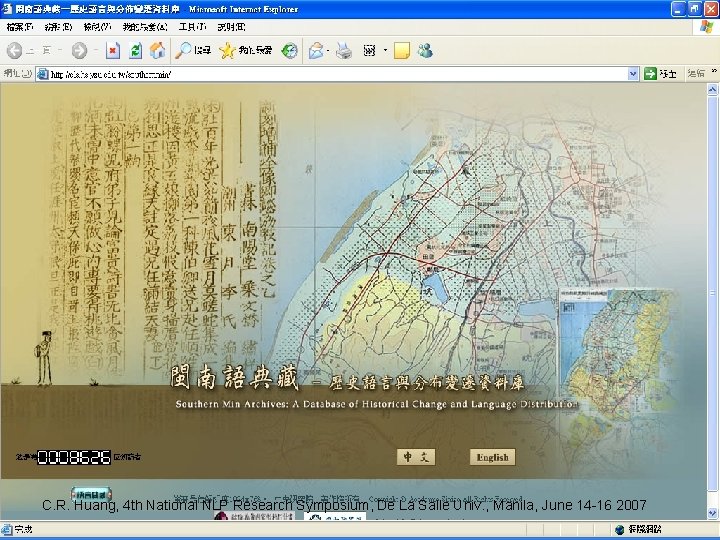
Southern-Min Archive: A Database of Historical Change in Language Distribution Archives Description: 1. From the perspectives of historical change and geographical distribution. 2. A tagged corpus of Southern Min written documents from 16 th century to 20 th century. 3. A linguistic Geographical Informational System displaying distributions of languages in Hsinfeng. C. R. Huang, 4 th National NLP Research Symposium, De La Salle Univ. , Manila, June 14 -16 2007 p. 58
C. R. Huang, 4 th National NLP Research Symposium, De La Salle Univ. , Manila, June 14 -16 2007 p. 59
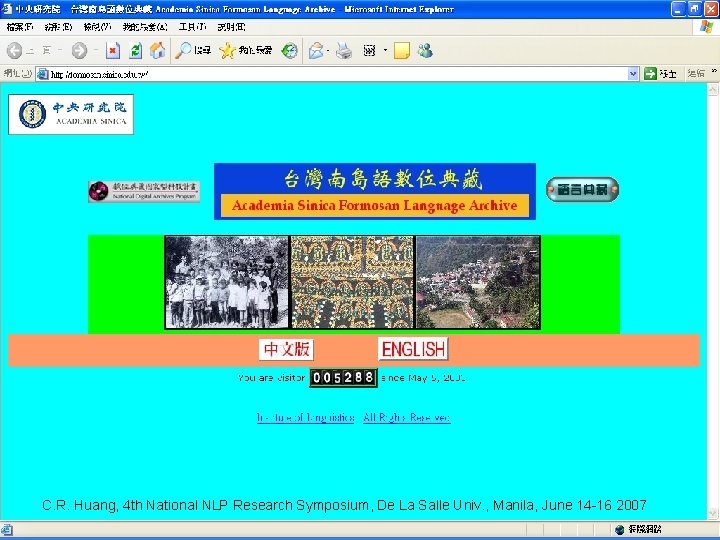
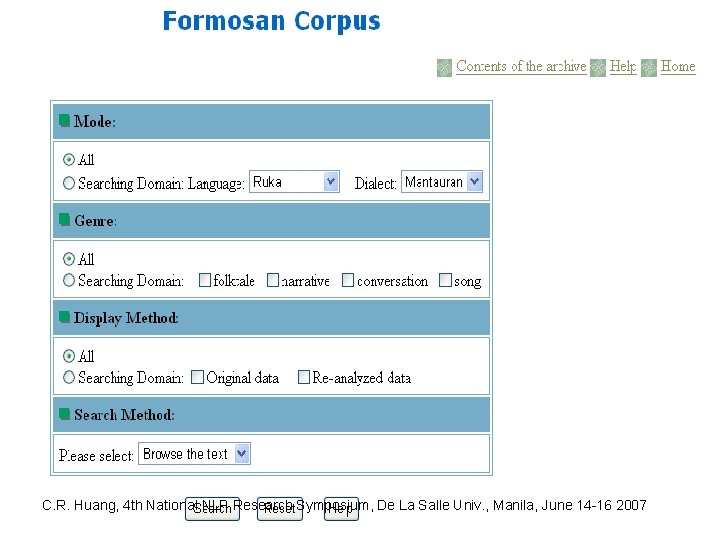
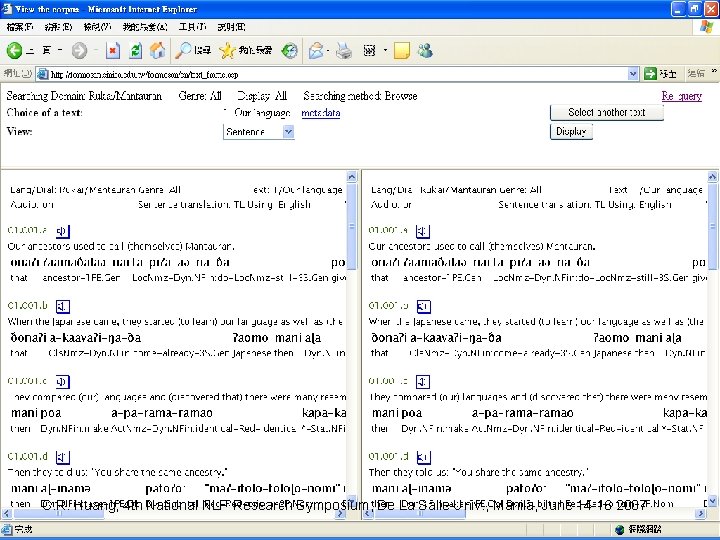
Formosan Language archives Archives Description: 1. Preserve the endangered Formosan Austronesian languages 1. 1 corpora, lexicons and grammars 2. 1. 2 integration of linguistic information with GIS. 2. fifteen extant Formosan languages 2. 1 Rukai, Yami, Saisiyat, Tsou, Atayal, Bunun, Paiwan, Amis and Puyuma v http: //formosan. sinica. edu. tw/ C. R. Huang, 4 th National NLP Research Symposium, De La Salle Univ. , Manila, June 14 -16 2007 p. 60
C. R. Huang, 4 th National NLP Research Symposium, De La Salle Univ. , Manila, June 14 -16 2007 p. 61
C. R. Huang, 4 th National NLP Research Symposium, De La Salle Univ. , Manila, June 14 -16 2007 p. 62
C. R. Huang, 4 th National NLP Research Symposium, De La Salle Univ. , Manila, June 14 -16 2007 p. 63
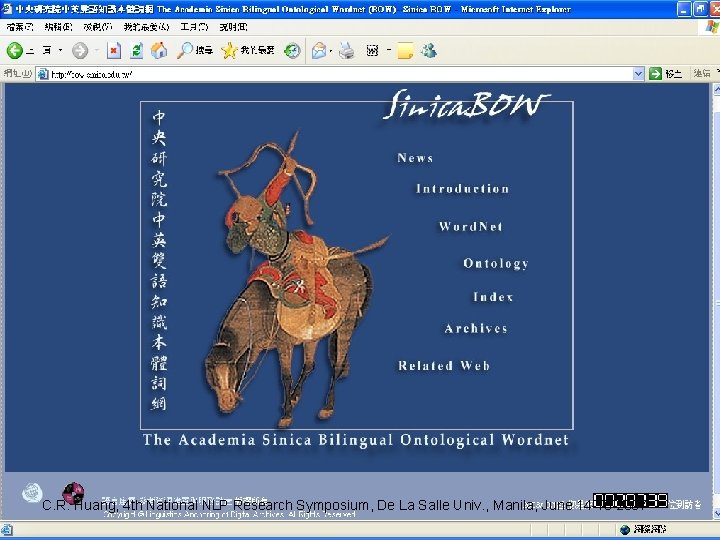
Sinica BOW: Bilingual Ontological Wordnet o To construct a Chinese Word. Net as the linguistic ontology for knowledge representation; o To provide linguistic anchoring grounded with temporal information by building a synchronic lexicon for all historical periods; and o To provide linguistic anchoring reference and implementation services. C. R. Huang, 4 th National NLP Research Symposium, De La Salle Univ. , Manila, June 14 -16 2007 p. 64
C. R. Huang, 4 th National NLP Research Symposium, De La Salle Univ. , Manila, June 14 -16 2007 p. 65
Asian Language Resources Committee Mail List: alr@cl. cs. titech. ac. jp o Affiliated with AFNLP o Cataloguing Asian Language Resources n Will adopt OLACMS and search engine o Hosting ALR Workshops (5 so far) o Asian Language Processing Special Issues in Language Resources and Evaluation o Co-Chairs: Togunaga take@cl. cs. titech. ac. jp Huang churen@sinica. edu. tw http: //www. cl. cs. titech. ac. jp/alr/ C. R. Huang, 4 th National NLP Research Symposium, De La Salle Univ. , Manila, June 14 -16 2007 p. 66
An overview of the Natural Language Toolkit http: //nltk. sourceforge. net Project Leaders: Steven Bird, Edward Loper, Ewan Klein Acknowledgement: I would like to thank Steven Bird for agreeing to let me use these slides on NLTK 4 th National NLP Research Symposium, De La Salle Univ. , Manila, June 14 -16 2007
Summary o NLTK is a suite of open source Python modules, data sets and tutorials o supporting research and development in natural language processing o Download NLTK from nltk. sourceforge. net o A Truly Multilingual Toolkit accessible to beginning researchers in NLP n o A good way to attract international scholars to research on your language Also a good stepping stone for a developing HLT language to test a full range of NLP applications C. R. Huang, 4 th National NLP Research Symposium, De La Salle Univ. , Manila, June 14 -16 2007 p. 68
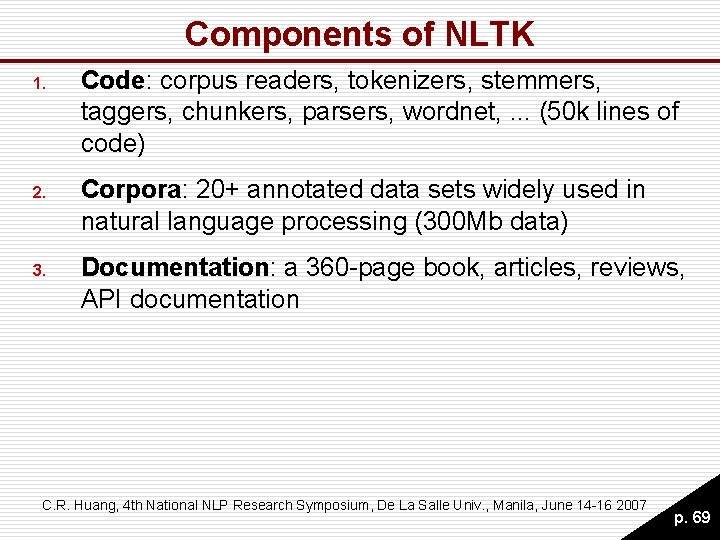
Components of NLTK 1. Code: corpus readers, tokenizers, stemmers, taggers, chunkers, parsers, wordnet, . . . (50 k lines of code) 2. Corpora: 20+ annotated data sets widely used in natural language processing (300 Mb data) 3. Documentation: a 360 -page book, articles, reviews, API documentation C. R. Huang, 4 th National NLP Research Symposium, De La Salle Univ. , Manila, June 14 -16 2007 p. 69
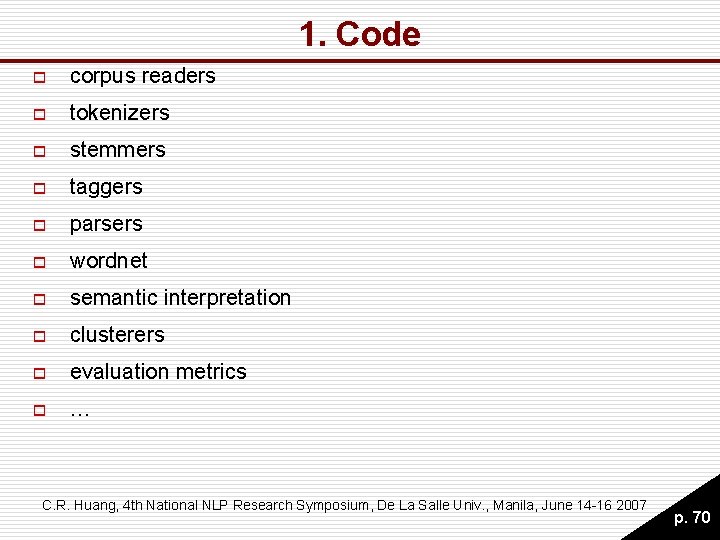
1. Code o corpus readers o tokenizers o stemmers o taggers o parsers o wordnet o semantic interpretation o clusterers o evaluation metrics o … C. R. Huang, 4 th National NLP Research Symposium, De La Salle Univ. , Manila, June 14 -16 2007 p. 70
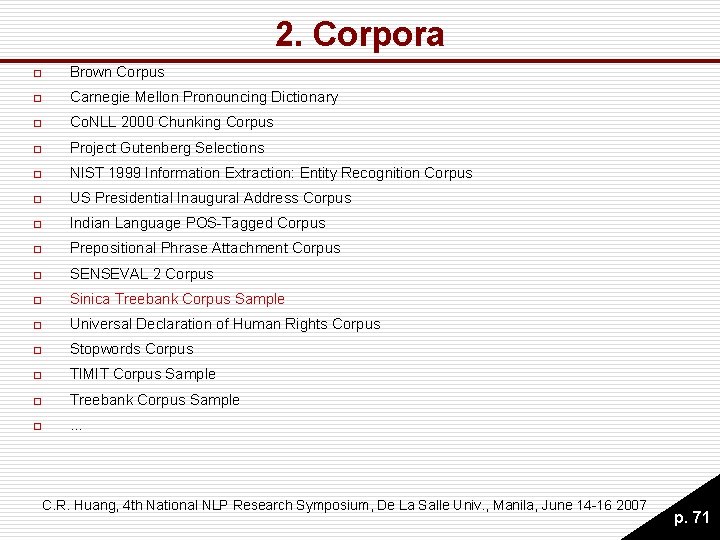
2. Corpora o Brown Corpus o Carnegie Mellon Pronouncing Dictionary o Co. NLL 2000 Chunking Corpus o Project Gutenberg Selections o NIST 1999 Information Extraction: Entity Recognition Corpus o US Presidential Inaugural Address Corpus o Indian Language POS-Tagged Corpus o Prepositional Phrase Attachment Corpus o SENSEVAL 2 Corpus o Sinica Treebank Corpus Sample o Universal Declaration of Human Rights Corpus o Stopwords Corpus o TIMIT Corpus Sample o Treebank Corpus Sample o … C. R. Huang, 4 th National NLP Research Symposium, De La Salle Univ. , Manila, June 14 -16 2007 p. 71
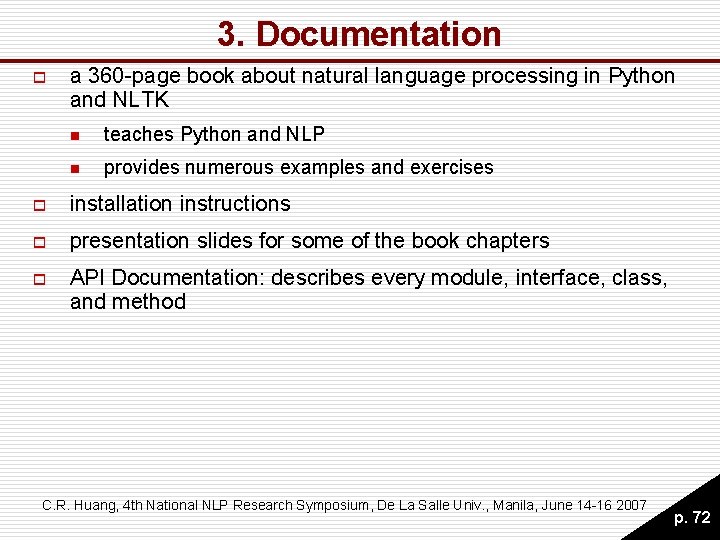
3. Documentation o a 360 -page book about natural language processing in Python and NLTK n teaches Python and NLP n provides numerous examples and exercises o installation instructions o presentation slides for some of the book chapters o API Documentation: describes every module, interface, class, and method C. R. Huang, 4 th National NLP Research Symposium, De La Salle Univ. , Manila, June 14 -16 2007 p. 72
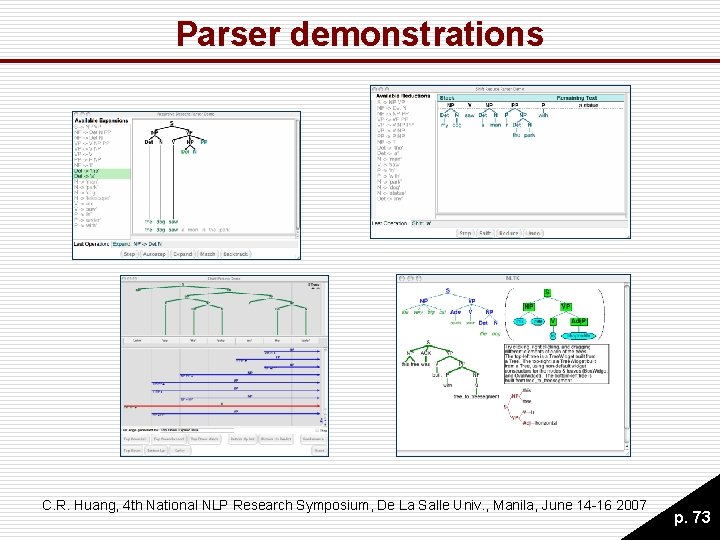
Parser demonstrations C. R. Huang, 4 th National NLP Research Symposium, De La Salle Univ. , Manila, June 14 -16 2007 p. 73
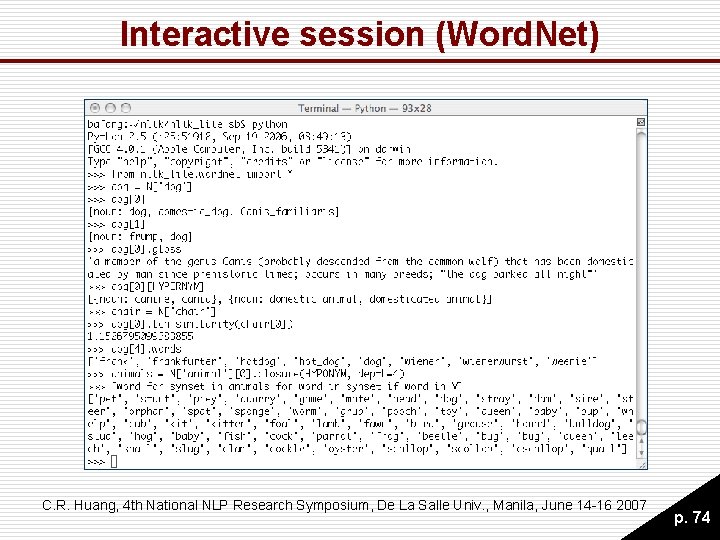
Interactive session (Word. Net) C. R. Huang, 4 th National NLP Research Symposium, De La Salle Univ. , Manila, June 14 -16 2007 p. 74
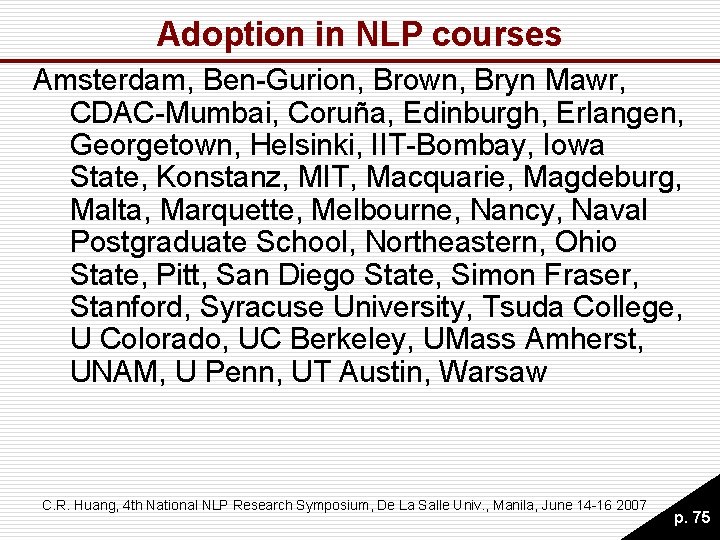
Adoption in NLP courses Amsterdam, Ben-Gurion, Brown, Bryn Mawr, CDAC-Mumbai, Coruña, Edinburgh, Erlangen, Georgetown, Helsinki, IIT-Bombay, Iowa State, Konstanz, MIT, Macquarie, Magdeburg, Malta, Marquette, Melbourne, Nancy, Naval Postgraduate School, Northeastern, Ohio State, Pitt, San Diego State, Simon Fraser, Stanford, Syracuse University, Tsuda College, U Colorado, UC Berkeley, UMass Amherst, UNAM, U Penn, UT Austin, Warsaw C. R. Huang, 4 th National NLP Research Symposium, De La Salle Univ. , Manila, June 14 -16 2007 p. 75
Contribute… o NLTK is an open source project o all code, data, documentation is free o dozens of people have contributed over the past 6 years o please visit the website for project ideas o sign up on the NLTK-Announce mailing list to hear about new releases C. R. Huang, 4 th National NLP Research Symposium, De La Salle Univ. , Manila, June 14 -16 2007 p. 76