
From simple to complex Thermodynamic Models A model
- Slides: 51
From « simple » to « complex » Thermodynamic Models A model: a conceptual view of the real world to understand anticipate
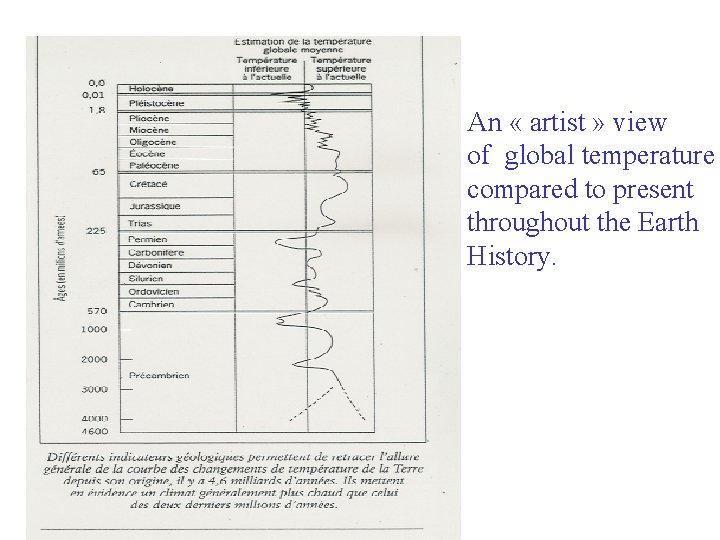
An « artist » view of global temperature compared to present throughout the Earth History.
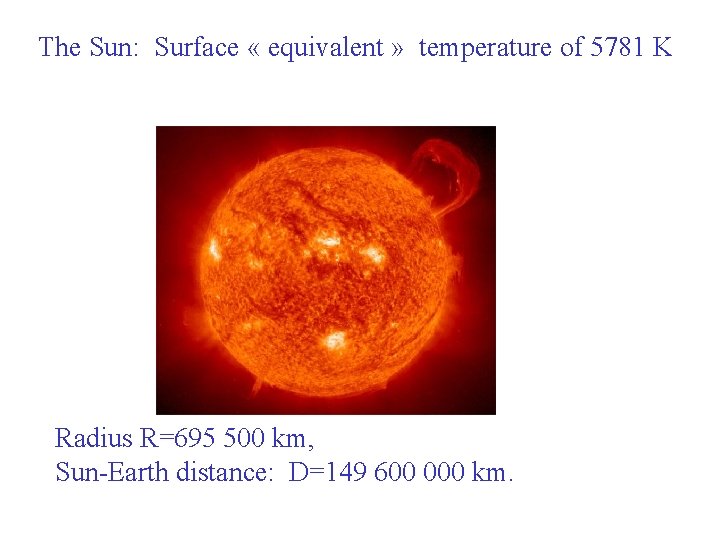
The Sun: Surface « equivalent » temperature of 5781 K Radius R=695 500 km, Sun-Earth distance: D=149 600 000 km.
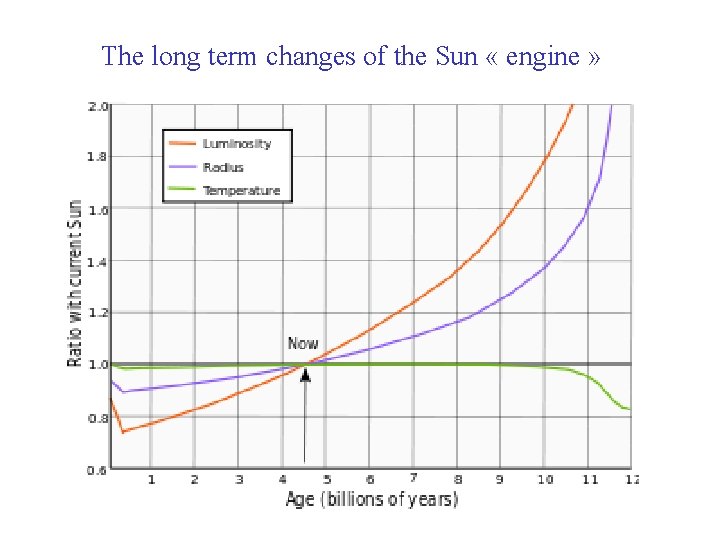
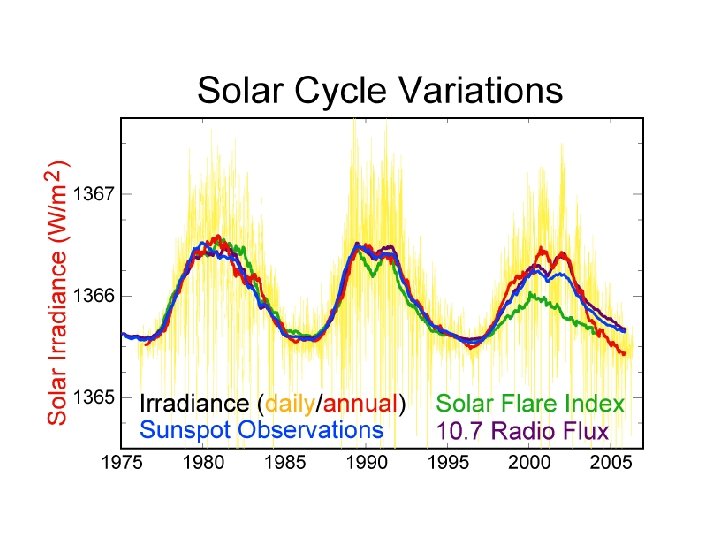
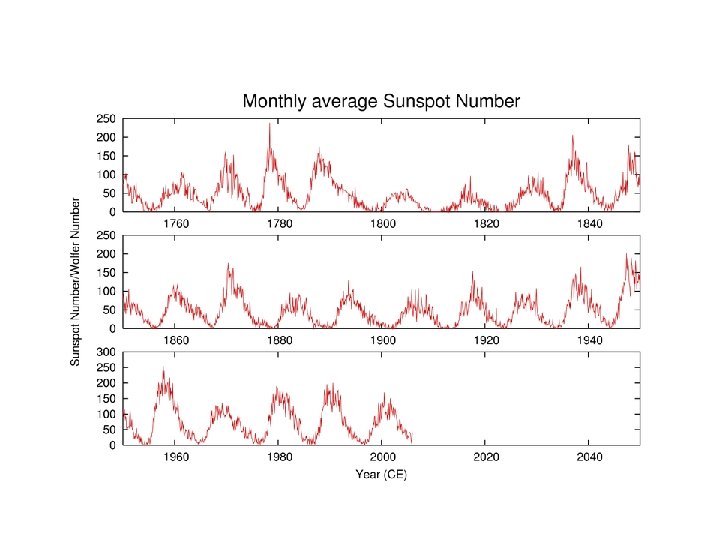
The long term changes of the Sun « engine »
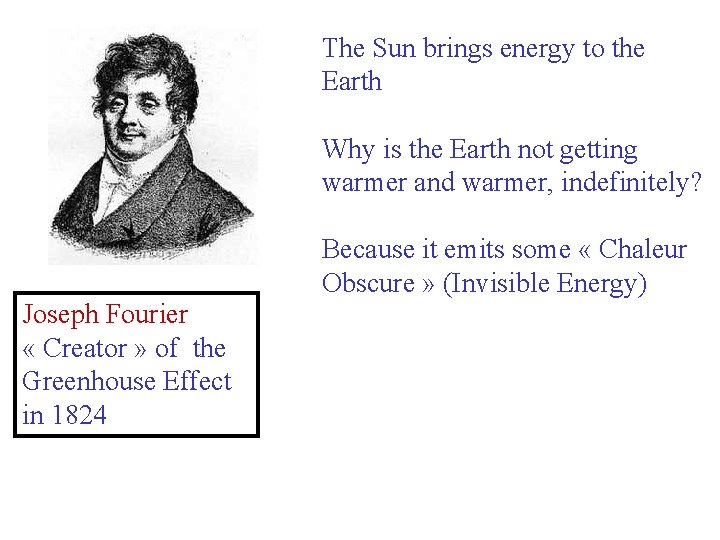
The Sun brings energy to the Earth Why is the Earth not getting warmer and warmer, indefinitely? Because it emits some « Chaleur Obscure » (Invisible Energy) Joseph Fourier « Creator » of the Greenhouse Effect in 1824
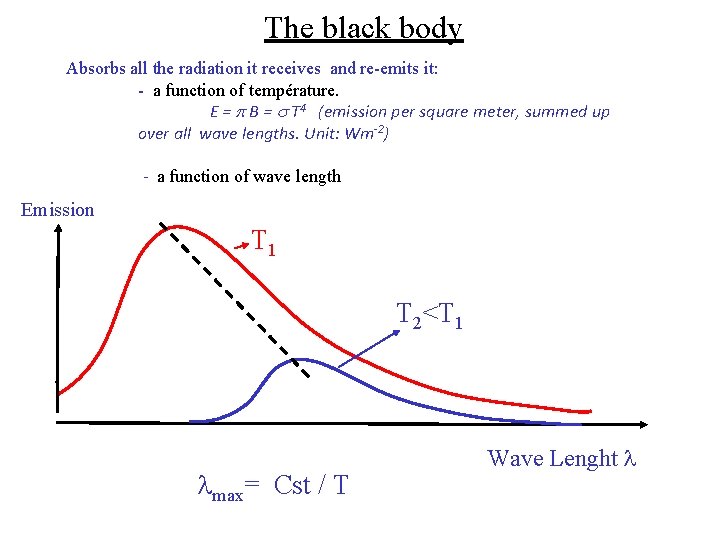
The black body Absorbs all the radiation it receives and re-emits it: - a function of température. E = p B = s T 4 (emission per square meter, summed up over all wave lengths. Unit: Wm-2) - a function of wave length Emission T 1 T 2<T 1 lmax= Cst / T Wave Lenght l
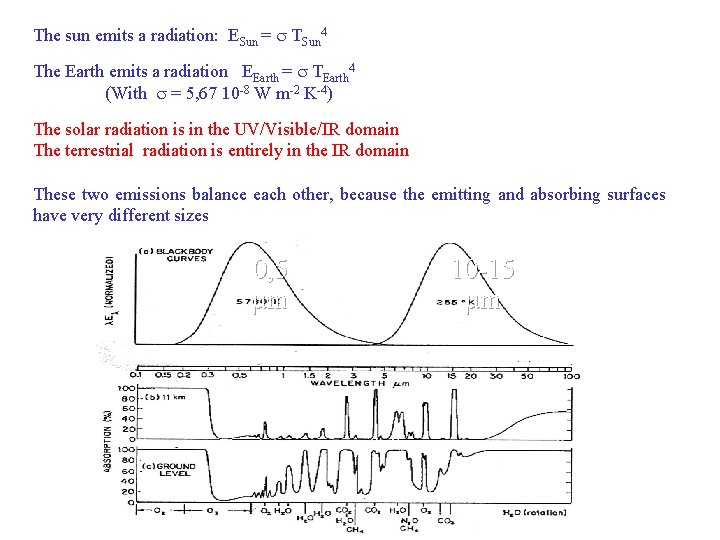
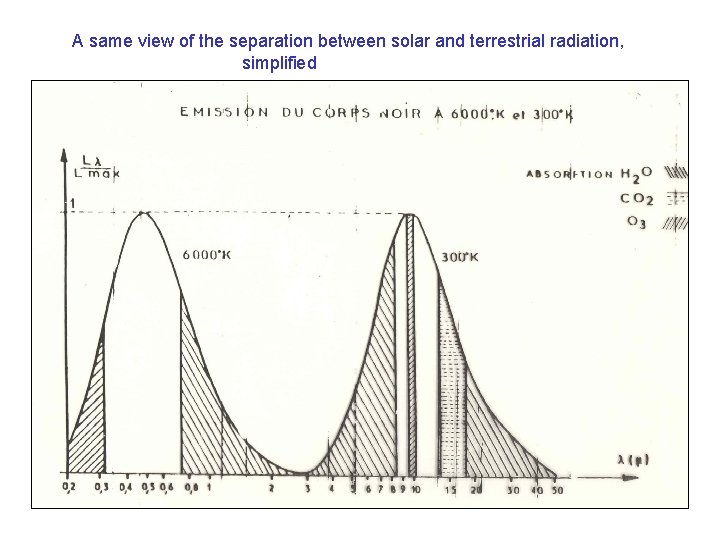
The sun emits a radiation: ESun = s TSun 4 The Earth emits a radiation EEarth = s TEarth 4 (With s = 5, 67 10 -8 W m-2 K-4) The solar radiation is in the UV/Visible/IR domain The terrestrial radiation is entirely in the IR domain These two emissions balance each other, because the emitting and absorbing surfaces have very different sizes 0, 5 µm 10 -15 µm
A same view of the separation between solar and terrestrial radiation, simplified
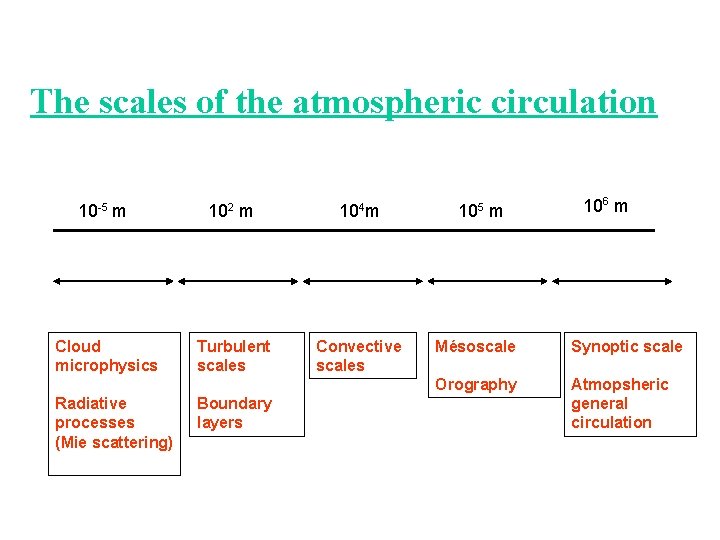
The scales of the atmospheric circulation 10 -5 m 102 m 104 m Cloud microphysics Turbulent scales Convective scales Radiative processes (Mie scattering) Boundary layers 105 m 106 m Mésoscale Synoptic scale Orography Atmopsheric general circulation
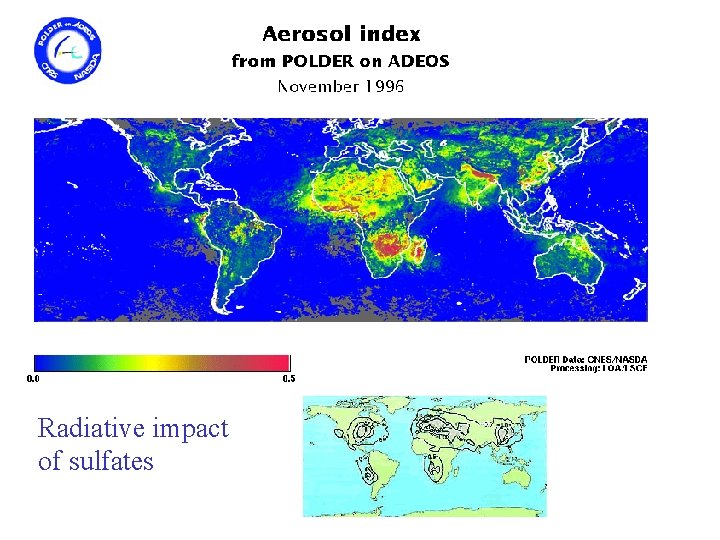
Radiative impact of sulfates
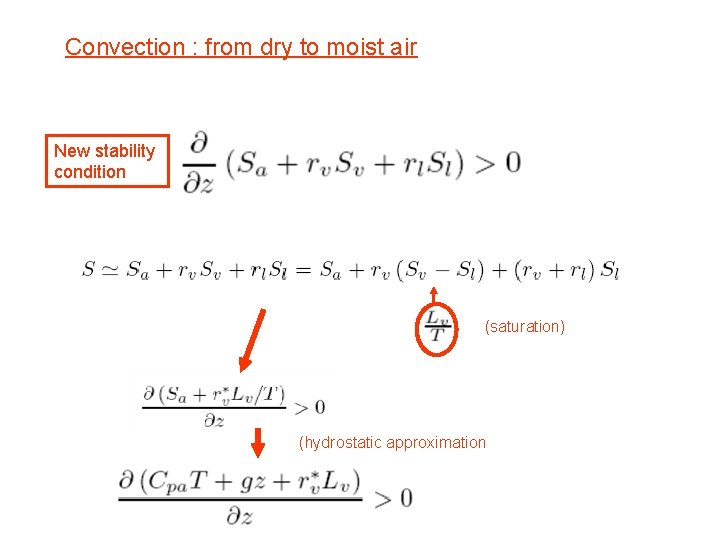
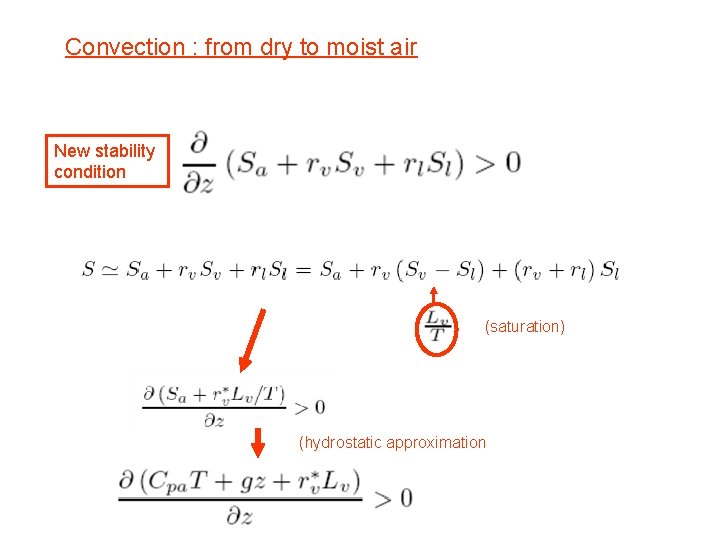
Convection : from dry to moist air New stability condition (saturation) (hydrostatic approximation
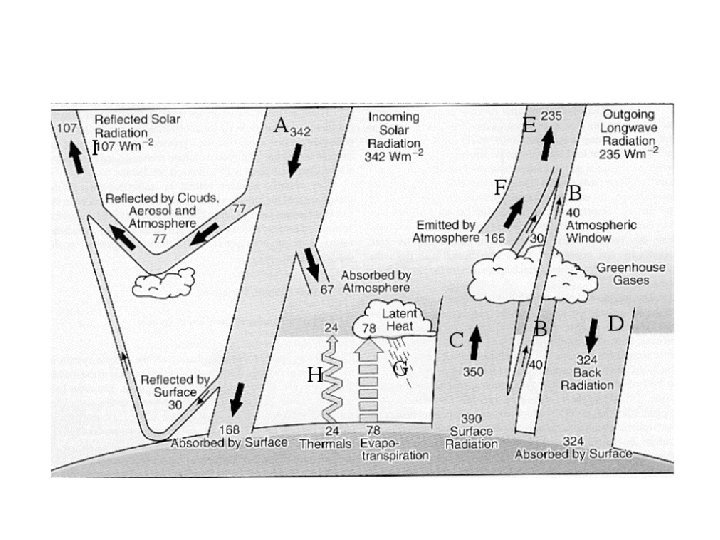
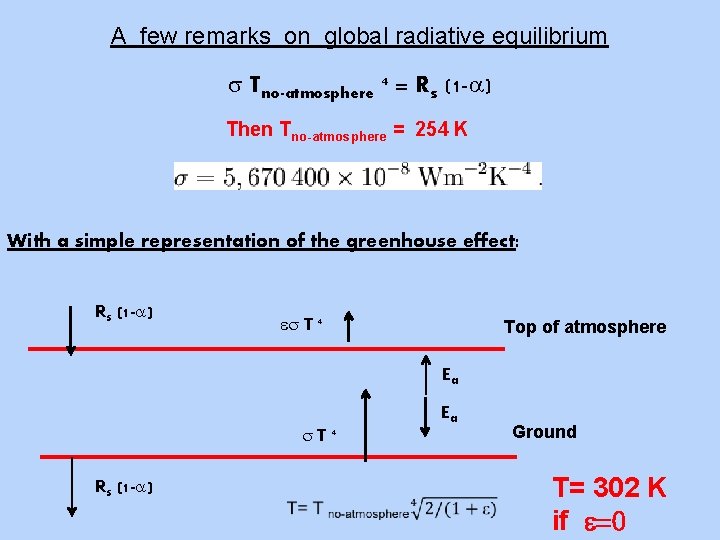
A few remarks on global radiative equilibrium s Tno-atmosphere 4 = Rs (1 -a) Then Tno-atmosphere = 254 K With a simple representation of the greenhouse effect: Rs (1 -a) es T 4 Top of atmosphere Ea s. T 4 Rs (1 -a) Ea Ground T= 302 K if e=0
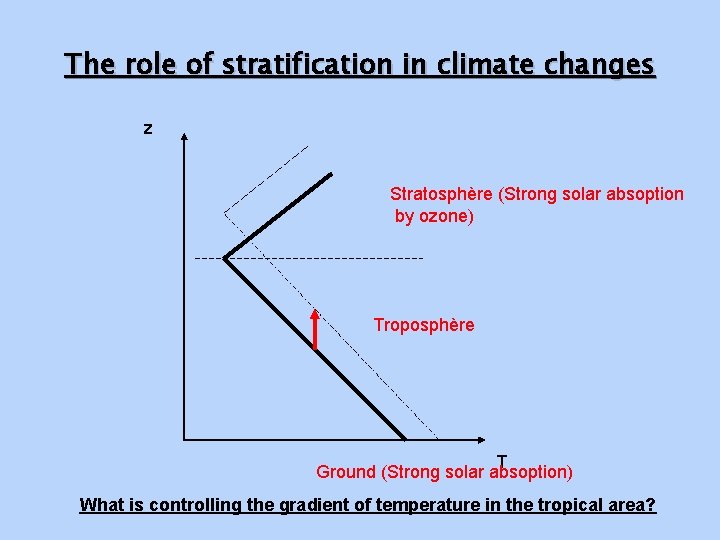
The role of stratification in climate changes z Stratosphère (Strong solar absoption by ozone) Troposphère T Ground (Strong solar absoption) What is controlling the gradient of temperature in the tropical area?
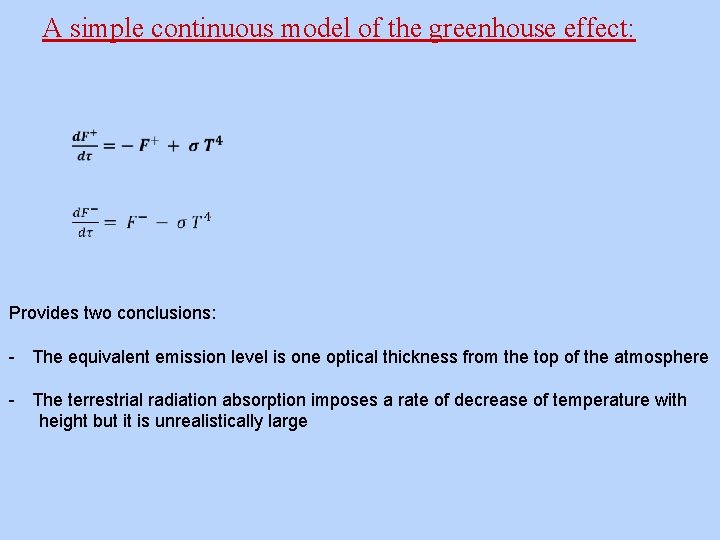
A simple continuous model of the greenhouse effect: Provides two conclusions: - The equivalent emission level is one optical thickness from the top of the atmosphere - The terrestrial radiation absorption imposes a rate of decrease of temperature with height but it is unrealistically large
A simple continuous model of the greenhouse effect: Provides two conclusions: - The equivalent emission level is one optical thickness from th - The terrestrial radiation absorption imposes a rate of decrease height but it is unrealistically large
Convection : from dry to moist air New stability condition (saturation) (hydrostatic approximation
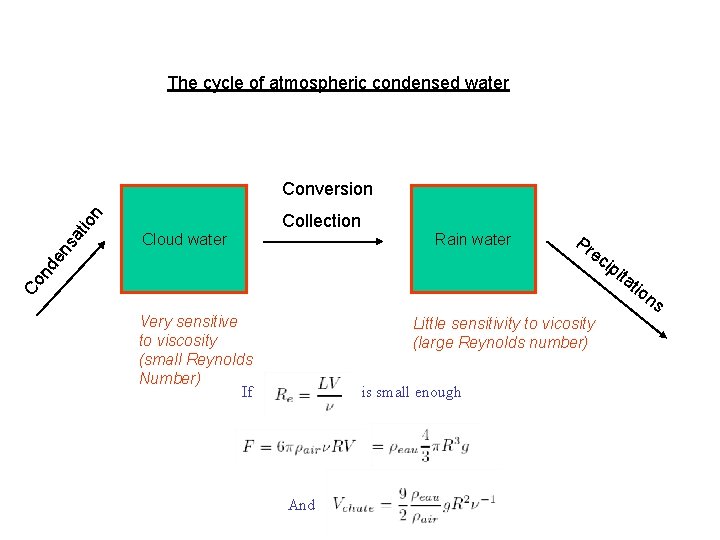
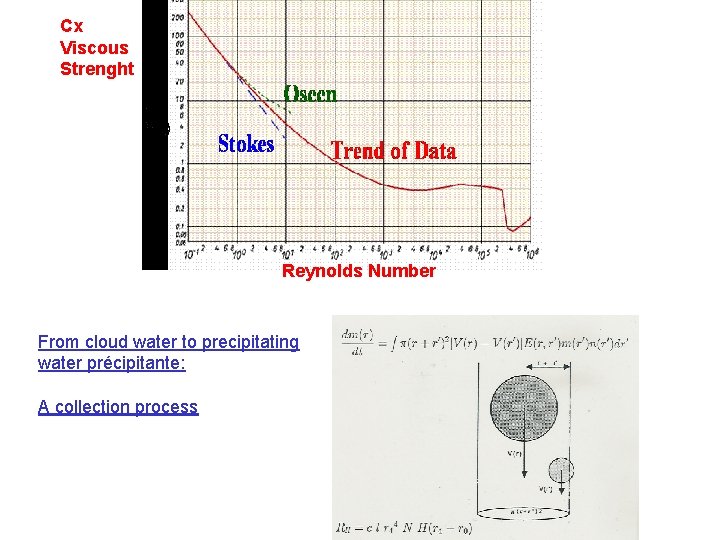
The cycle of atmospheric condensed water Cloud water Collection Rain water Pr e Co nd en sa t io n Conversion Very sensitive to viscosity (small Reynolds Number) If Little sensitivity to vicosity (large Reynolds number) is small enough And cip ita tio ns
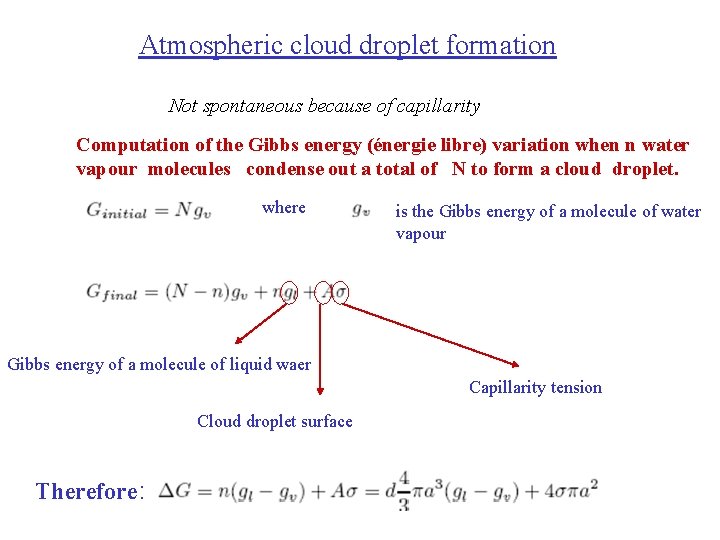
Atmospheric cloud droplet formation Not spontaneous because of capillarity Computation of the Gibbs energy (énergie libre) variation when n water vapour molecules condense out a total of N to form a cloud droplet. where is the Gibbs energy of a molecule of water vapour Gibbs energy of a molecule of liquid waer Capillarity tension Cloud droplet surface Therefore:
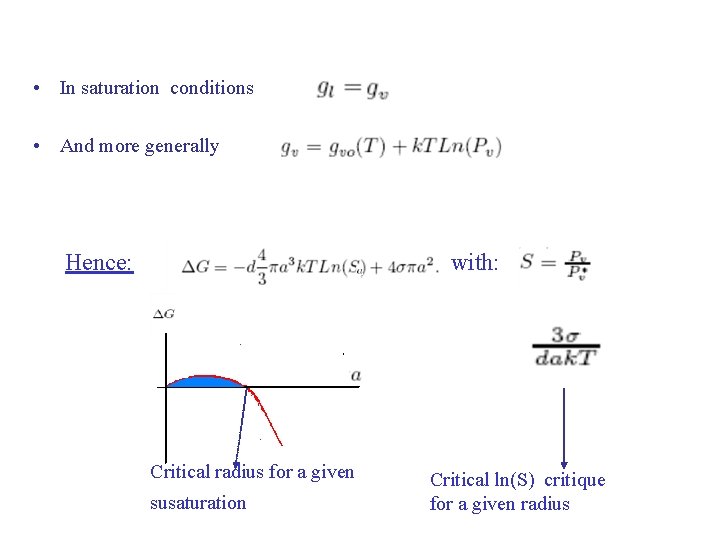
• In saturation conditions • And more generally Hence: with: Critical radius for a given susaturation Critical ln(S) critique for a given radius
Cx Viscous Strenght Reynolds Number From cloud water to precipitating water précipitante: A collection process
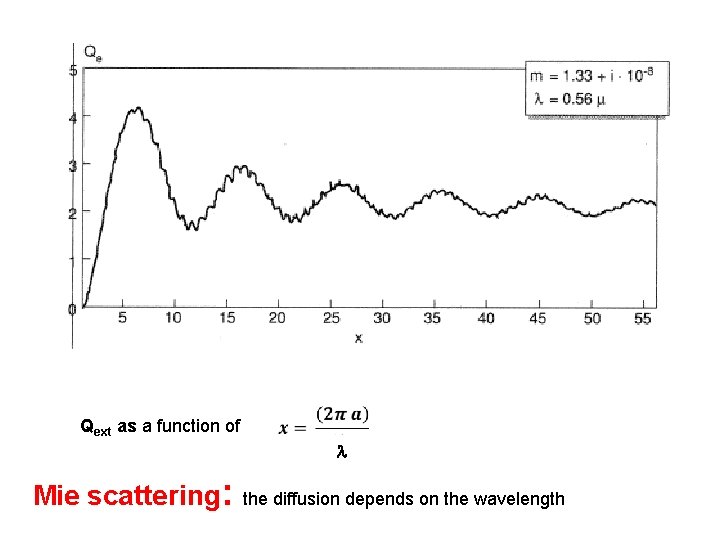
Qext as a function of l Mie scattering: the diffusion depends on the wavelength
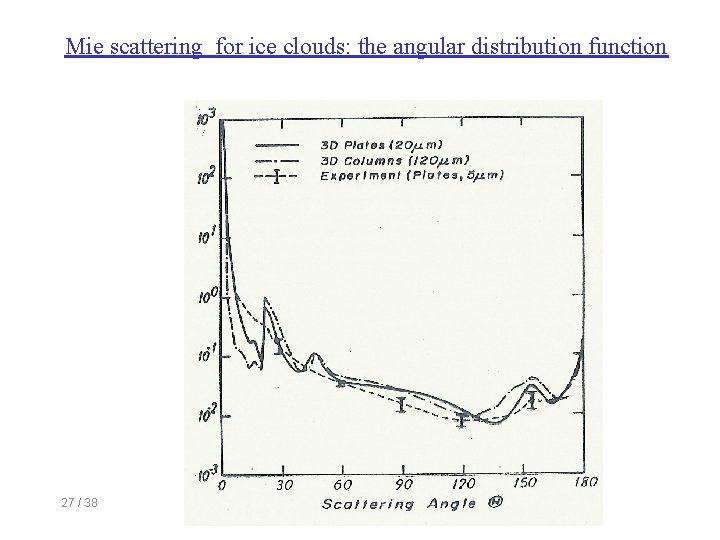
Mie scattering for ice clouds: the angular distribution function 27 / 38
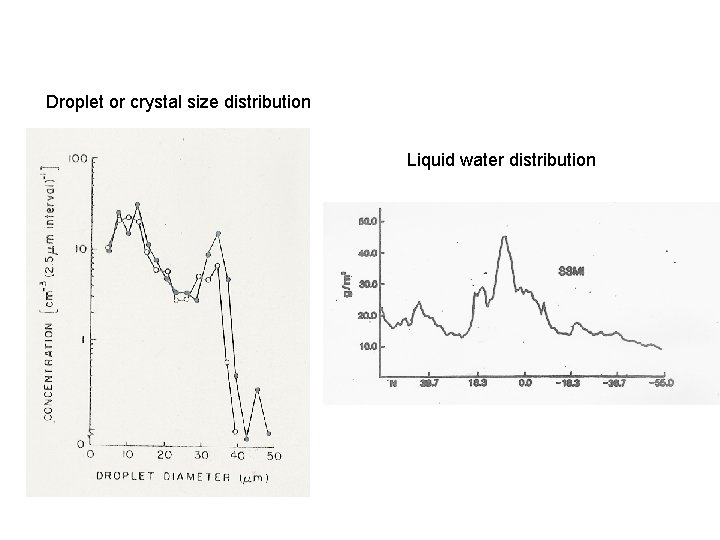
L’eau nuageuse Droplet or crystal size distribution Liquid water distribution
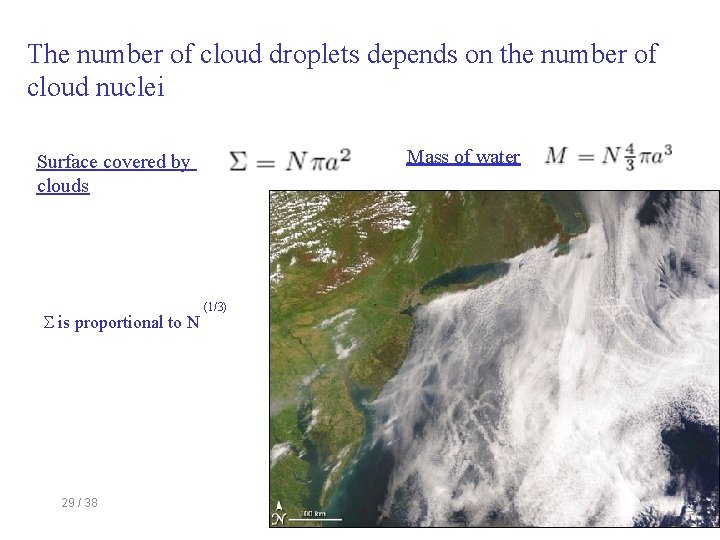
The number of cloud droplets depends on the number of cloud nuclei Mass of water Surface covered by clouds S is proportional to N 29 / 38 (1/3)
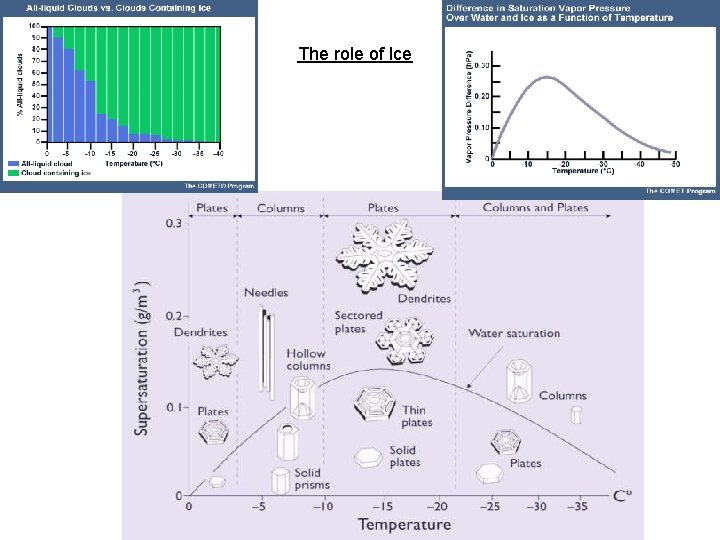
The role of Ice
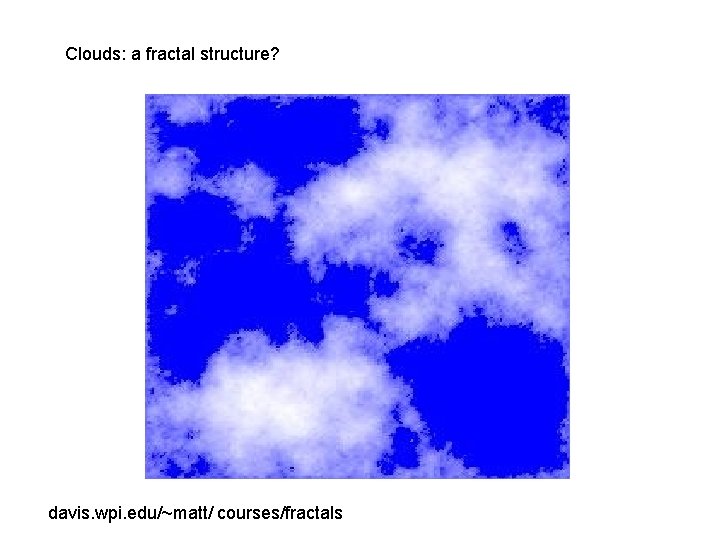
Clouds: a fractal structure? davis. wpi. edu/~matt/ courses/fractals
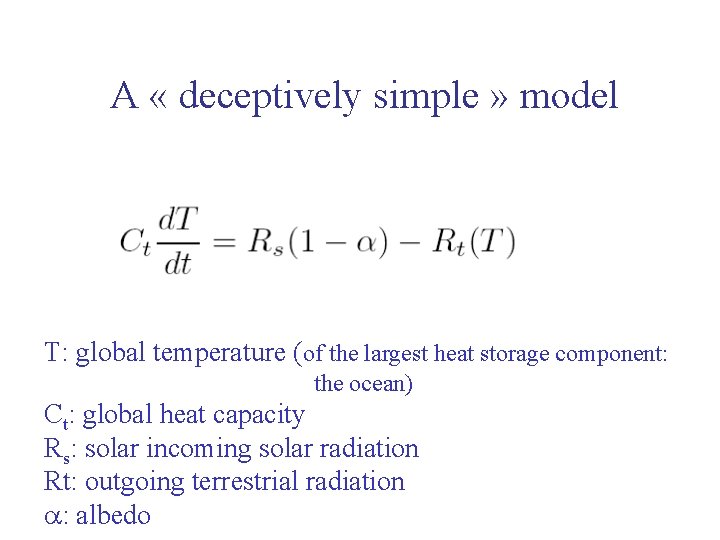
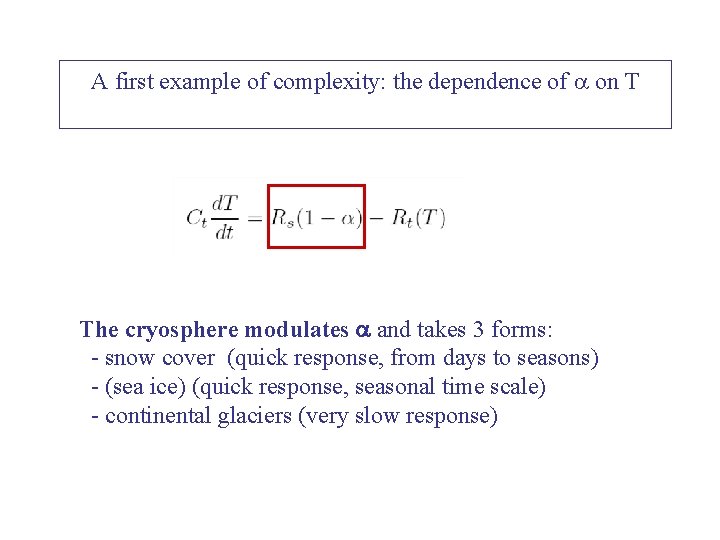
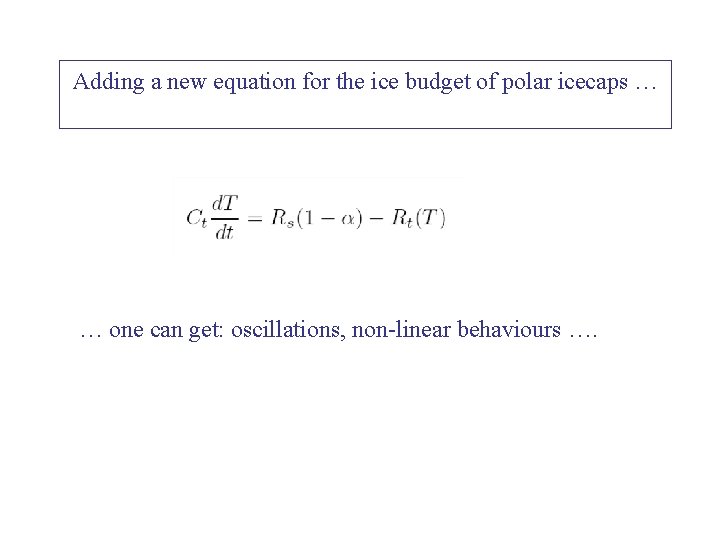
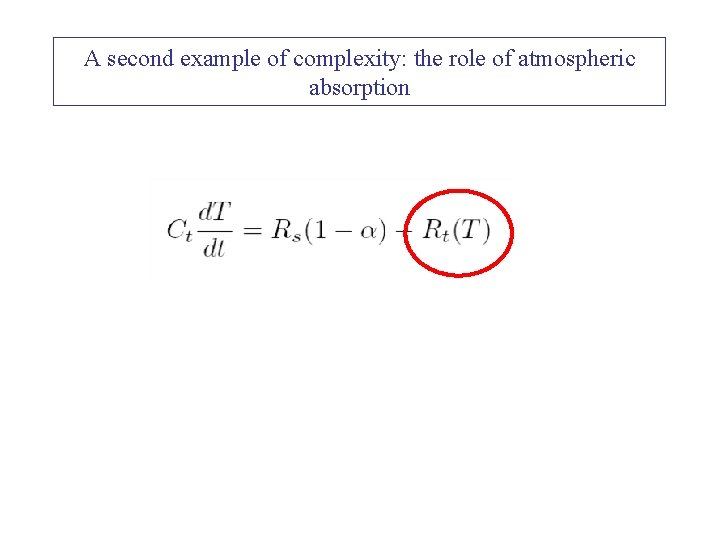
A « deceptively simple » model T: global temperature (of the largest heat storage component: the ocean) Ct: global heat capacity Rs: solar incoming solar radiation Rt: outgoing terrestrial radiation a: albedo
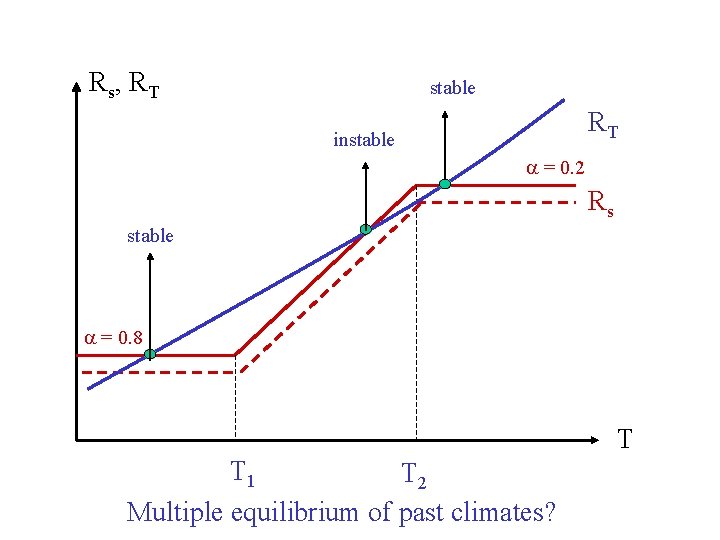
A first example of complexity: the dependence of a on T The cryosphere modulates a and takes 3 forms: - snow cover (quick response, from days to seasons) - (sea ice) (quick response, seasonal time scale) - continental glaciers (very slow response)
Rs, RT stable RT instable a = 0. 2 Rs stable a = 0. 8 T T 1 T 2 Multiple equilibrium of past climates?
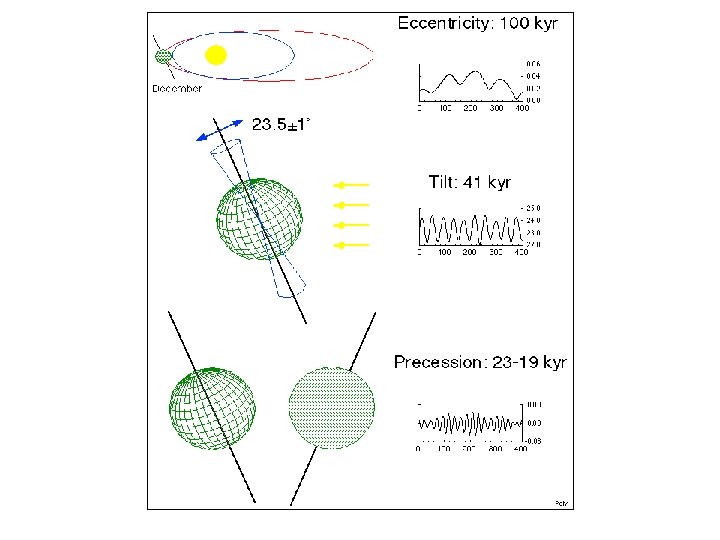
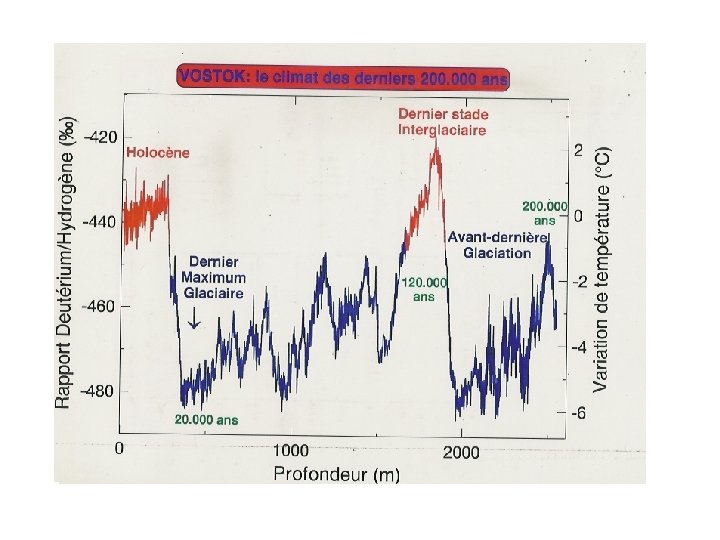
What we may want to explain: - Why is there a long term « stability » of the Earth climate compared to other planets? - What is the risk of big disruption? - What is the cause of the Quaternary variations?
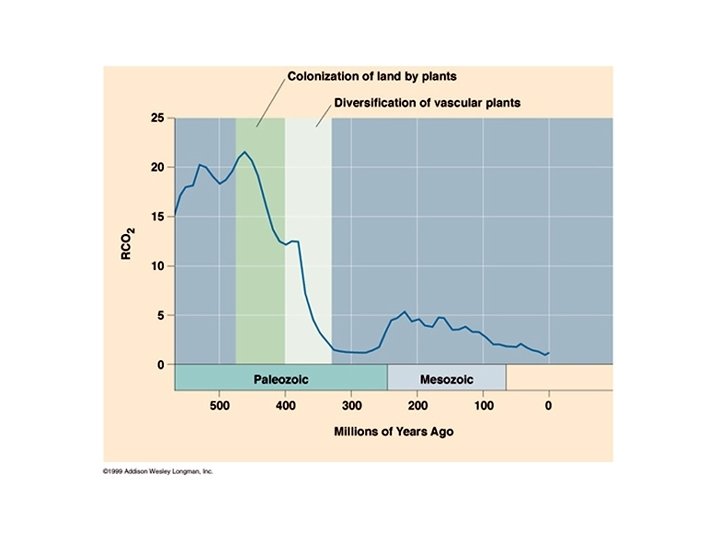
The Gaia Theory (J. Lovelock): The climate of the Earth is regulated by life, which ensures an equilibrium between the increasing solar emissions, and the decreasing greenhouse effect A theory valid at the scale of (hundreds of) million years
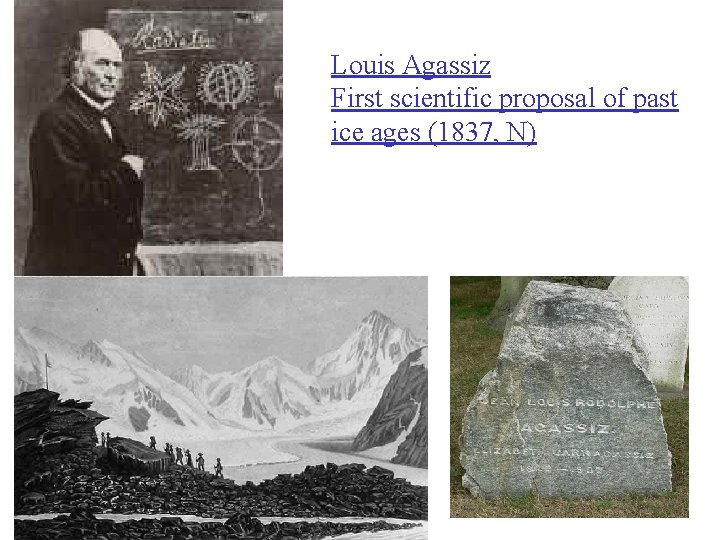
Louis Agassiz First scientific proposal of past ice ages (1837, N)
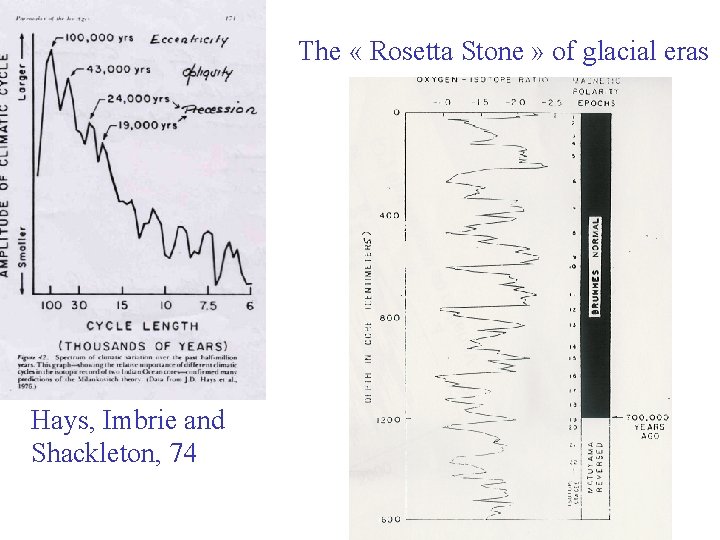
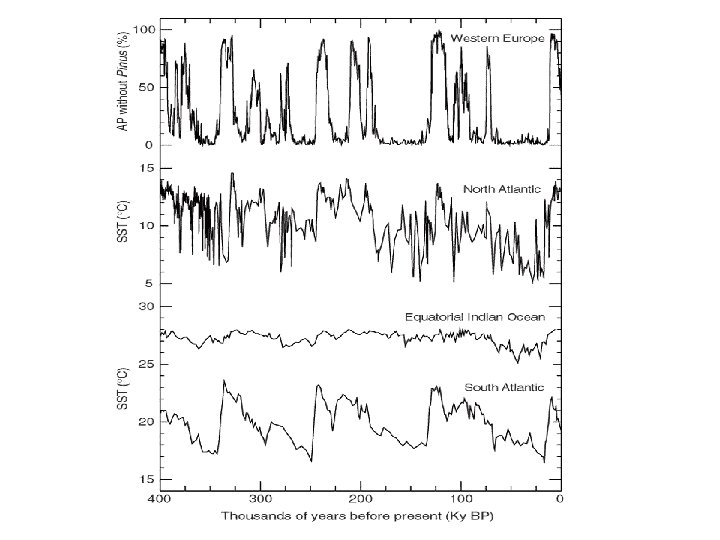
The « Rosetta Stone » of glacial eras Hays, Imbrie and Shackleton, 74
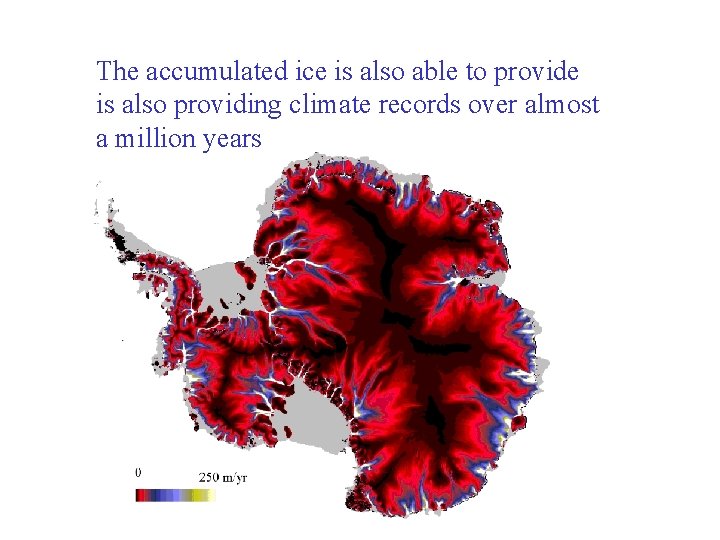
The accumulated ice is also able to provide is also providing climate records over almost a million years
Adding a new equation for the ice budget of polar icecaps … … one can get: oscillations, non-linear behaviours ….
A second example of complexity: the role of atmospheric absorption
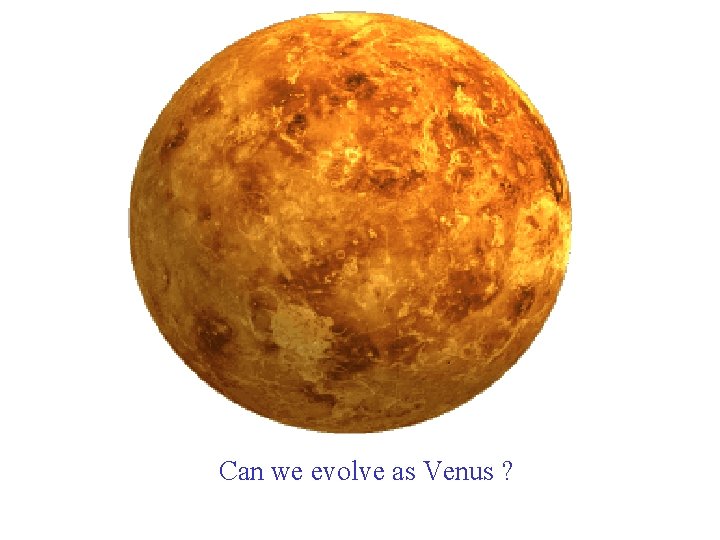
Can we evolve as Venus ?
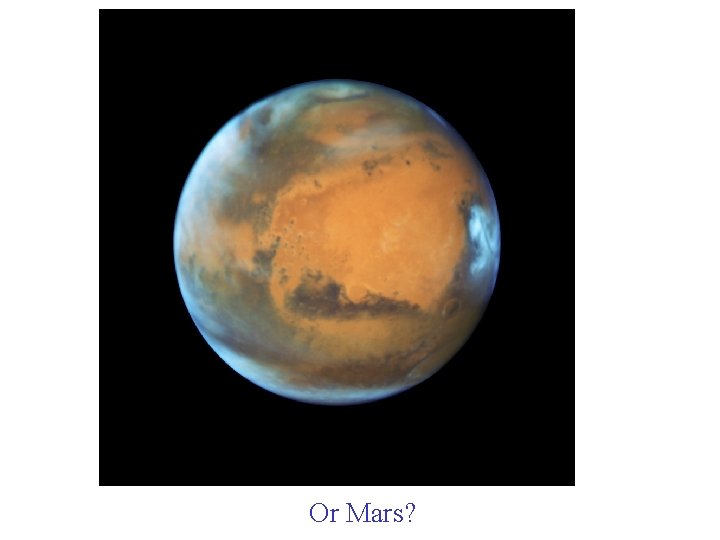
Or Mars?
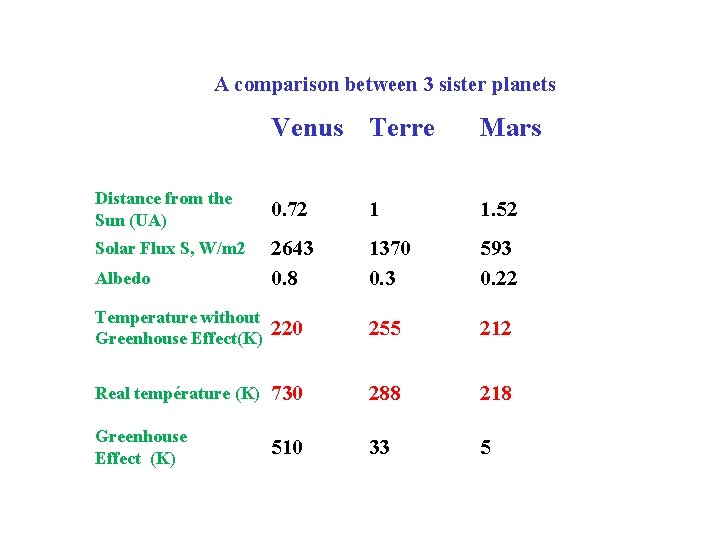
A comparison between 3 sister planets Venus Terre Mars 0. 72 1 1. 52 2643 0. 8 1370 0. 3 593 0. 22 Temperature without 220 Greenhouse Effect(K) 255 212 Real température (K) 730 288 218 Greenhouse Effect (K) 33 5 Distance from the Sun (UA) Solar Flux S, W/m 2 Albedo 510
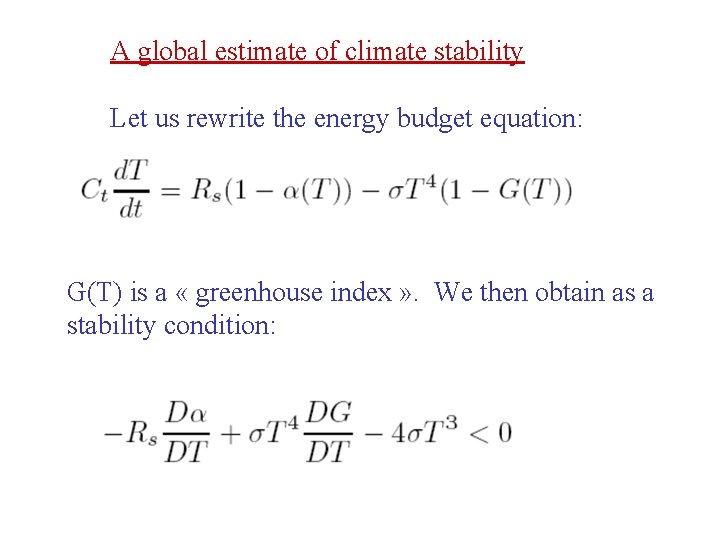
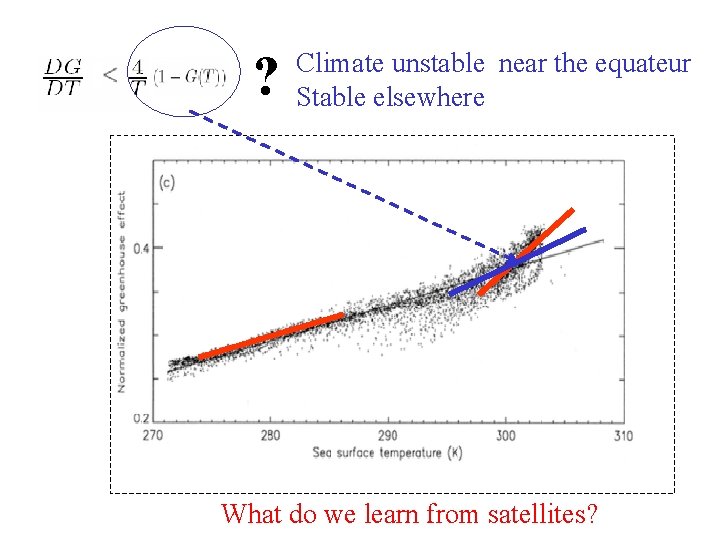
A global estimate of climate stability Let us rewrite the energy budget equation: G(T) is a « greenhouse index » . We then obtain as a stability condition:
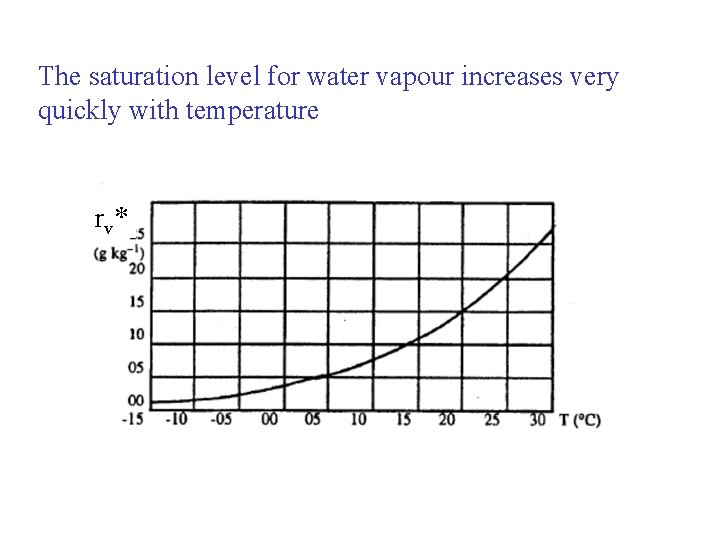
The saturation level for water vapour increases very quickly with temperature rv*
? Climate unstable near the equateur Stable elsewhere What do we learn from satellites?
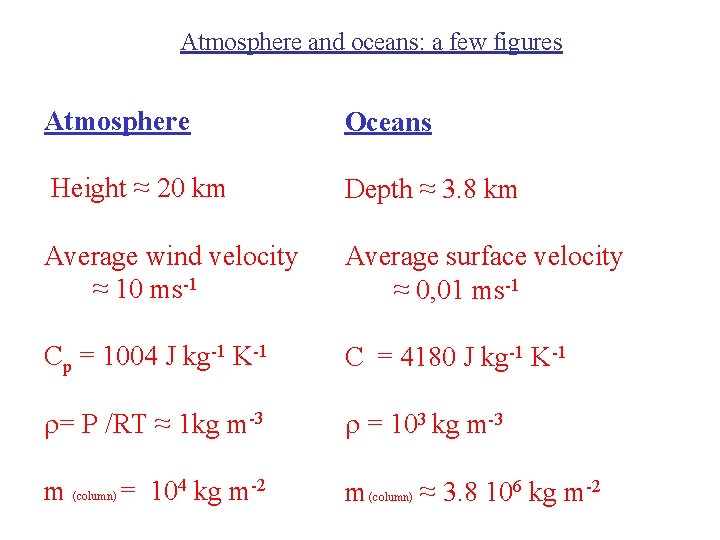
Atmosphere and oceans: a few figures Atmosphere Oceans Height ≈ 20 km Depth ≈ 3. 8 km Average wind velocity ≈ 10 ms-1 Average surface velocity ≈ 0, 01 ms-1 Cp = 1004 J kg-1 K-1 C = 4180 J kg-1 K-1 r= P /RT ≈ 1 kg m-3 r = 103 kg m-3 m (column) = 104 kg m-2 m (column) ≈ 3. 8 106 kg m-2