
From Raw Data to Physics Reconstruction and Analysis














- Slides: 42
From Raw Data to Physics: Reconstruction and Analysis Reconstruction: Tracking; Particle ID How we try to tell particles apart Analysis: Measuring a. S in QCD What to do when theory doesn’t make clear predictions Alignment We know what we designed; is it what we built? Summary From Raw Data to Physics Bob Jacobsen July 23, 2003
From Raw Data to Physics: Reconstruction and Analysis Reconstruction: Particle ID How we try to tell particles apart Analyzing simulated data: Measuring a. S in QCD What to do when theory doesn’t make clear predictions Alignment: We know what we designed; is it what we built? Computing: From Raw Data to Physics Bob Jacobsen July 23, 2003
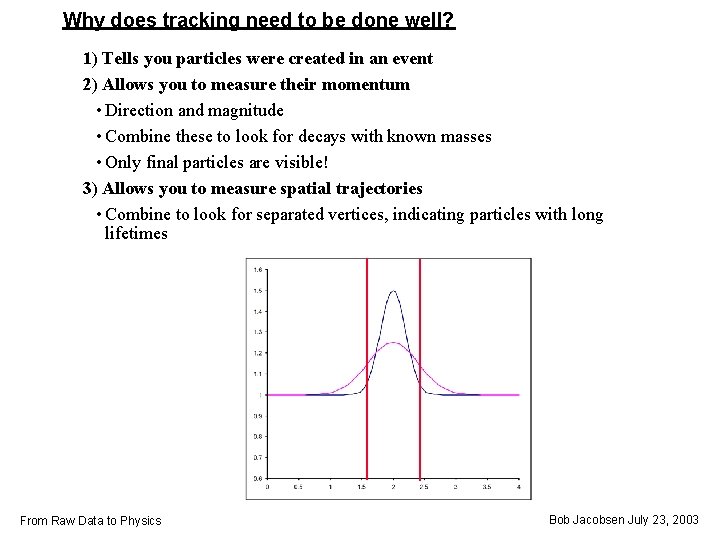
Why does tracking need to be done well? 1) Tells you particles were created in an event 2) Allows you to measure their momentum • Direction and magnitude • Combine these to look for decays with known masses • Only final particles are visible! 3) Allows you to measure spatial trajectories • Combine to look for separated vertices, indicating particles with long lifetimes From Raw Data to Physics Bob Jacobsen July 23, 2003
From Raw Data to Physics Bob Jacobsen July 23, 2003
Track Fitting 1 D straight line as simple case Two perfect measurements • Away from interaction point • With no measurement uncertainty • Just draw a line through them and extrapolate Y X Imperfect measurements give less precise results • The farther you go, the less you know Smaller errors, more points help constrain the possibilities How to find the best track from a large set of points? From Raw Data to Physics Bob Jacobsen July 23, 2003
How to fit quantitatively? Parameterize track: • Two measurements, two parameters => OK Position of ith hit Predicted track position at ith hit Best track? • Consistency with measurements represented by Sum of normalized errors squared • This is directly a function of our parameters: Accuracy of measurement • The best track has the smallest normalized error • So minimize in the usual way: From Raw Data to Physics Bob Jacobsen July 23, 2003
Two equations in two unknowns • Terms in () are constants calculated from measurement, detector geometry Generalizes nicely to 3 D, helical tracks with 5 parameters • Five equations in five unknowns From Raw Data to Physics Bob Jacobsen July 23, 2003
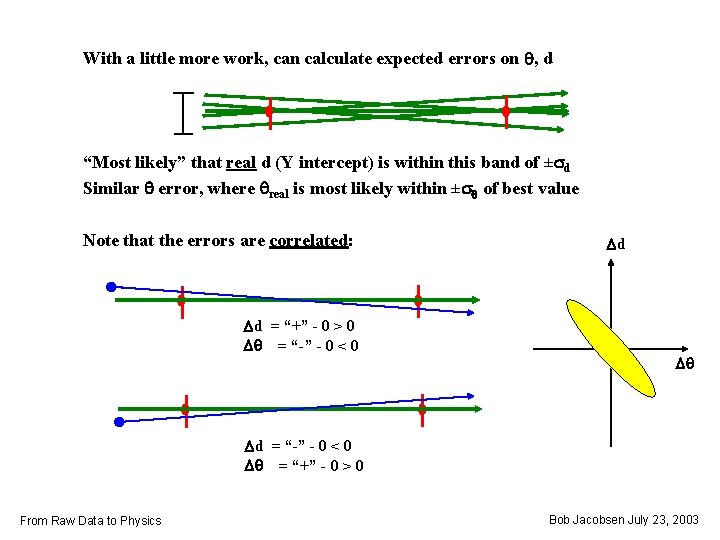
With a little more work, can calculate expected errors on q, d “Most likely” that real d (Y intercept) is within this band of ±sd Similar q error, where qreal is most likely within ±sq of best value Note that the errors are correlated: Dd = “+” - 0 > 0 Dq = “-” - 0 < 0 Dd Dq Dd = “-” - 0 < 0 Dq = “+” - 0 > 0 From Raw Data to Physics Bob Jacobsen July 23, 2003
Typical size of errors 10 cm ± 10 microns Error on position is about ± 10 microns By similar triangles Error on angle is about ± 0. 1 milliradians (± 0. 002 degrees) Satisfyingly small errors! Allows separation of tracks that come from different particle decays But how to we “see” particles? • Charged particles pass through matter, • ionize some atoms, leaving energy • which we can sense electronically. More ionization => more signal => more precision => more energy loss From Raw Data to Physics Bob Jacobsen July 23, 2003
Multiple Scattering qms Charged particles passing through matter “scatter” by a random angle 300 m Si RMS = 0. 9 milliradians / bp 1 mm Be RMS = 0. 8 milliradians / bp qms Also leads to position errors From Raw Data to Physics Bob Jacobsen July 23, 2003
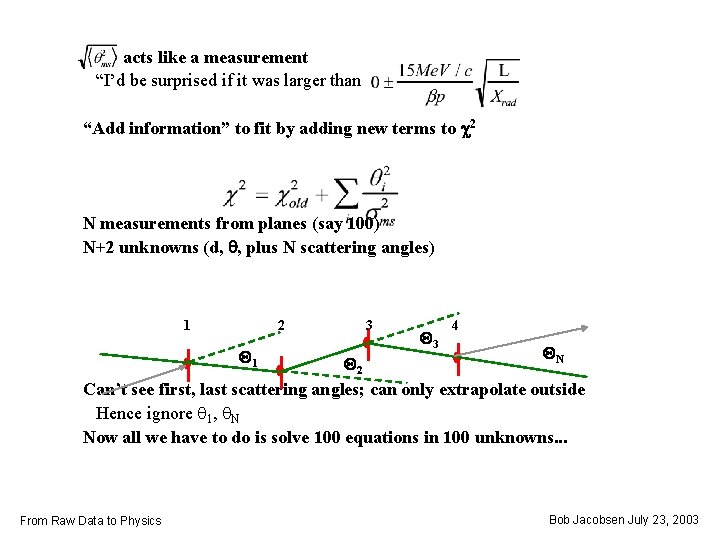
So? 1 2 3 q 3 4 q 2 Fitting points 3 & 4 no longer measures angle at IP Track already scattered by random angles q 1, q 2, q 3 Track has more parameters 1 if x-x 3 > 0, otherwise 0 If we knew q 1, q 2, … we’d know entire trajectory Can we measure those angles? q 2 roughly given by y 1, y 2, y 3 Just a more complex c 2 equation? From Raw Data to Physics Bob Jacobsen July 23, 2003
acts like a measurement “I’d be surprised if it was larger than “Add information” to fit by adding new terms to c 2 N measurements from planes (say 100) N+2 unknowns (d, q, plus N scattering angles) 1 2 Q 1 3 Q 2 Q 3 4 QN Can’t see first, last scattering angles; can only extrapolate outside Hence ignore q 1, q. N Now all we have to do is solve 100 equations in 100 unknowns. . . From Raw Data to Physics Bob Jacobsen July 23, 2003
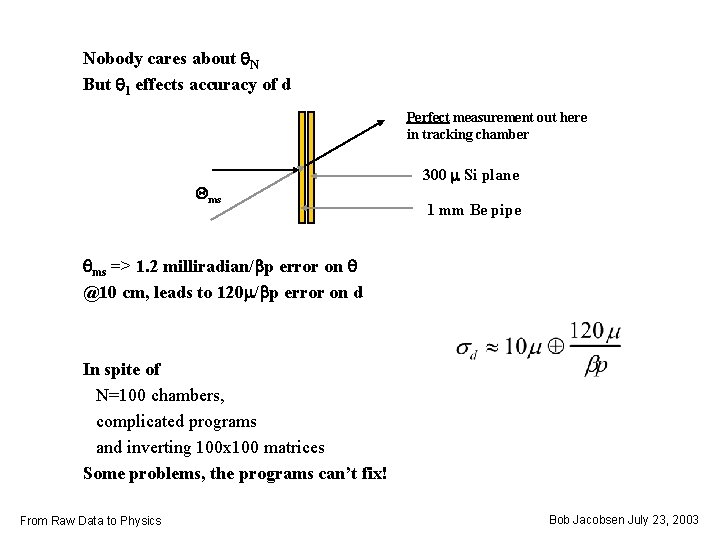
Nobody cares about q. N But q 1 effects accuracy of d Perfect measurement out here in tracking chamber Qms 300 m Si plane 1 mm Be pipe qms => 1. 2 milliradian/bp error on q @10 cm, leads to 120 m/bp error on d In spite of N=100 chambers, complicated programs and inverting 100 x 100 matrices Some problems, the programs can’t fix! From Raw Data to Physics Bob Jacobsen July 23, 2003
“Kalman fit”? (ref: Brillion) Computational expensive to calculate solutions with 100 angles Computer time grows like O(N 3), with N large And we’re not really interested in all those angles anyway Instead, approximate, working inward N times: 1 From Raw Data to Physics 2 3 4 Bob Jacobsen July 23, 2003
“Kalman fit”? (ref: Brillion) Computational expensive to calculate solutions with 100 angles Computer time grows like O(N 3), with N large And we’re not really interested in all those angles anyway Instead, approximate, working inward N times: 1 From Raw Data to Physics 2 3 4 Bob Jacobsen July 23, 2003
“Kalman fit”? (ref: Brillion) Computational expensive to calculate solutions with 100 angles Computer time grows like O(N 3), with N large And we’re not really interested in all those angles anyway Instead, approximate, working inward N times: 1 2 3 4 This is O(N) computations May need to repeat once or twice to use good starting estimate Each one a little more complex But still results in a large net savings of CPU time Moral: Consider what you really want to know From Raw Data to Physics Bob Jacobsen July 23, 2003
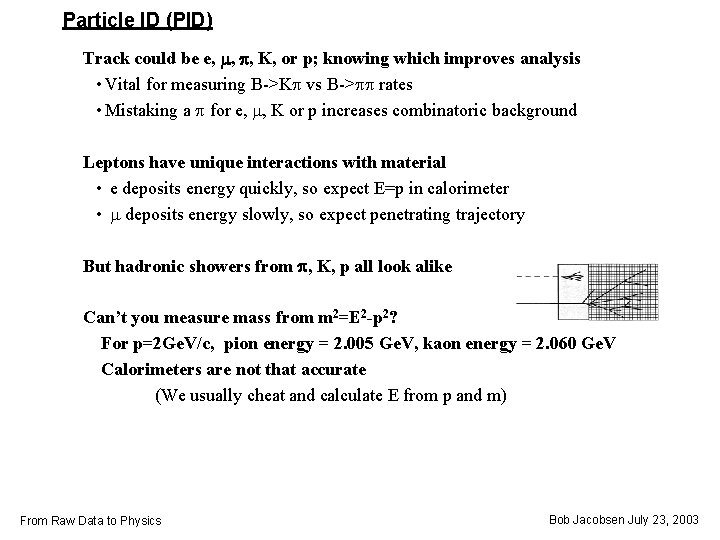
Particle ID (PID) Track could be e, m, p, K, or p; knowing which improves analysis • Vital for measuring B->Kp vs B->pp rates • Mistaking a p for e, m, K or p increases combinatoric background Leptons have unique interactions with material • e deposits energy quickly, so expect E=p in calorimeter • m deposits energy slowly, so expect penetrating trajectory But hadronic showers from p, K, p all look alike Can’t you measure mass from m 2=E 2 -p 2? For p=2 Ge. V/c, pion energy = 2. 005 Ge. V, kaon energy = 2. 060 Ge. V Calorimeters are not that accurate (We usually cheat and calculate E from p and m) From Raw Data to Physics Bob Jacobsen July 23, 2003
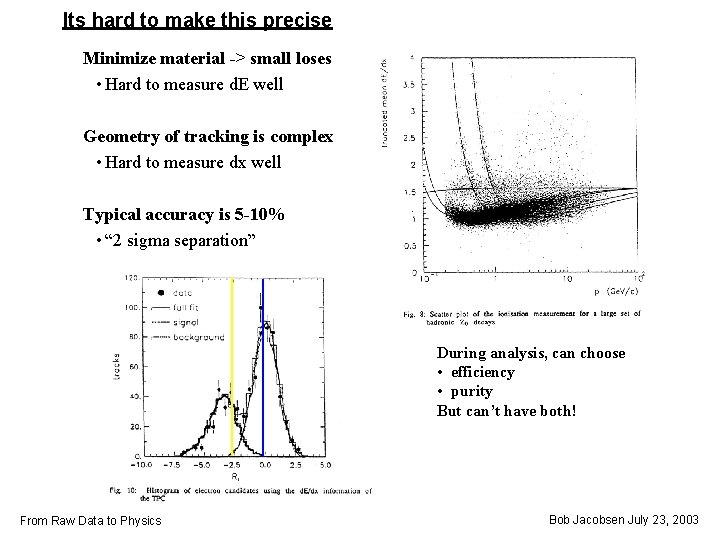
d. E/dx Charged particles moving through matter lose energy to ionization Loss is a function of the speed, so a function of mass and momentum Alternately, measuring With certain ambiguities! From Raw Data to Physics lets us identify the particle type Bob Jacobsen July 23, 2003
Its hard to make this precise Minimize material -> small loses • Hard to measure d. E well Geometry of tracking is complex • Hard to measure dx well Typical accuracy is 5 -10% • “ 2 sigma separation” During analysis, can choose • efficiency • purity But can’t have both! From Raw Data to Physics Bob Jacobsen July 23, 2003
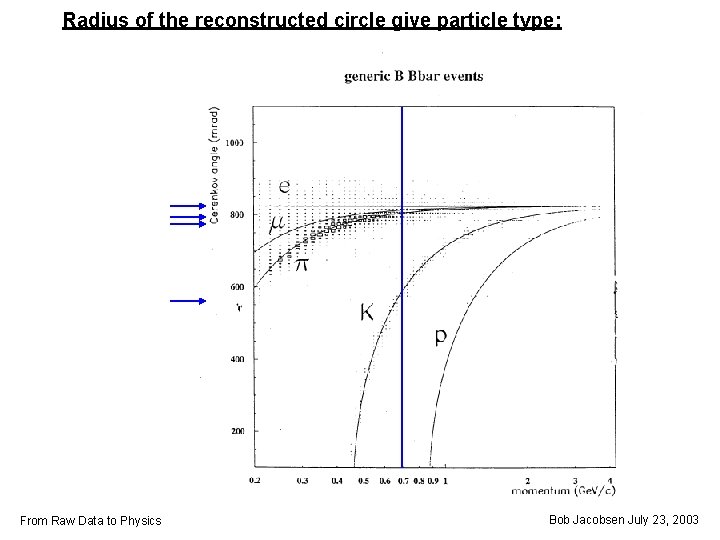
Another velocity-dependent process: Cherenkov light Particles moving faster than light in a medium (glass, water) emit light • Angle is related to velocity • Light forms a cone Focus it onto a plane, and you get a circle: From Raw Data to Physics Bob Jacobsen July 23, 2003
Radius of the reconstructed circle give particle type: From Raw Data to Physics Bob Jacobsen July 23, 2003
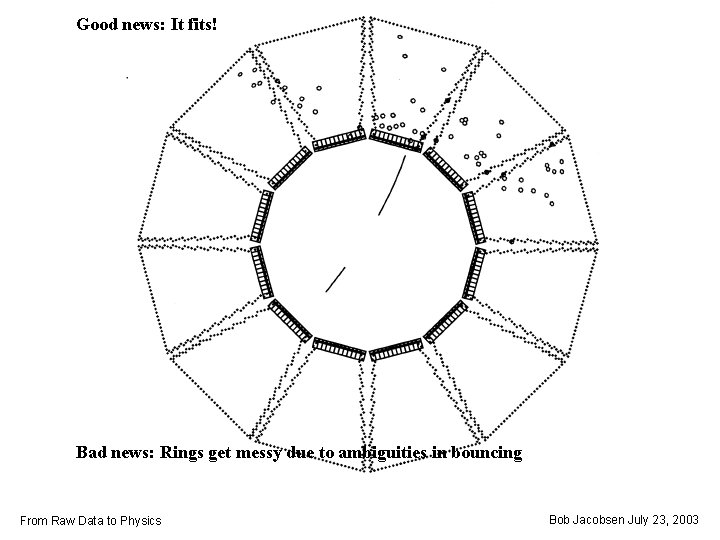
How to make this fit? Space inside a detector is very tight, and the ring needs space to form Ba. Bar uses novel “DIRC” geometry: From Raw Data to Physics Bob Jacobsen July 23, 2003
Good news: It fits! Bad news: Rings get messy due to ambiguities in bouncing From Raw Data to Physics Bob Jacobsen July 23, 2003
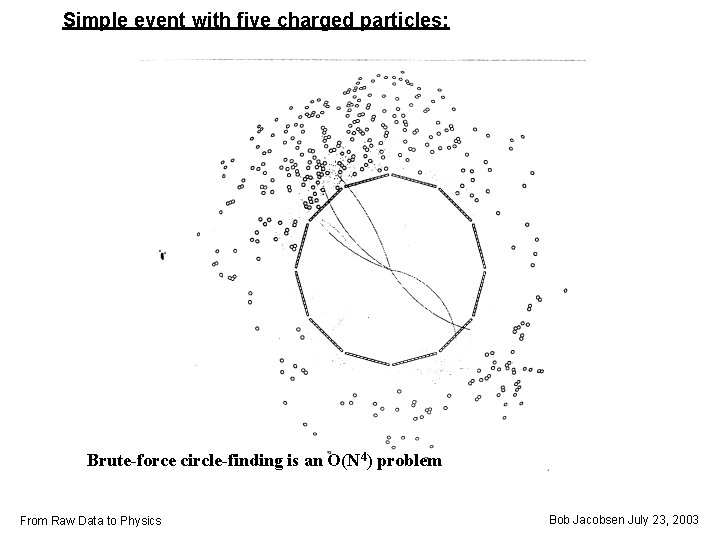
Simple event with five charged particles: Brute-force circle-finding is an O(N 4) problem From Raw Data to Physics Bob Jacobsen July 23, 2003
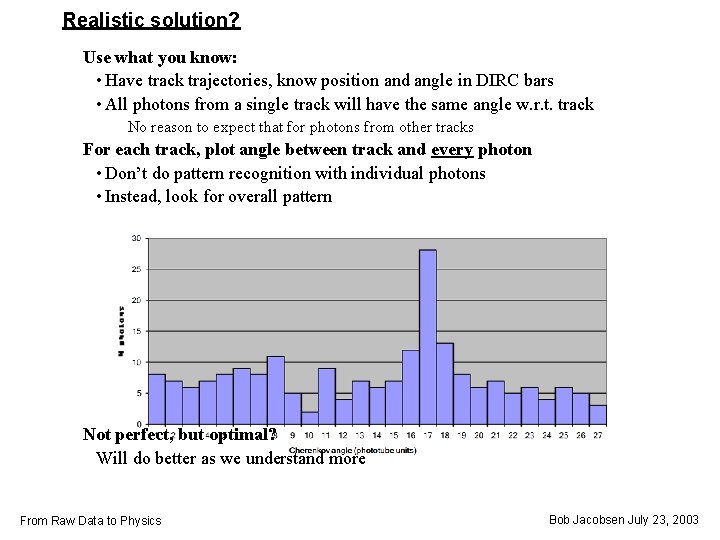
Realistic solution? Use what you know: • Have track trajectories, know position and angle in DIRC bars • All photons from a single track will have the same angle w. r. t. track No reason to expect that for photons from other tracks For each track, plot angle between track and every photon • Don’t do pattern recognition with individual photons • Instead, look for overall pattern Not perfect, but optimal? Will do better as we understand more From Raw Data to Physics Bob Jacobsen July 23, 2003
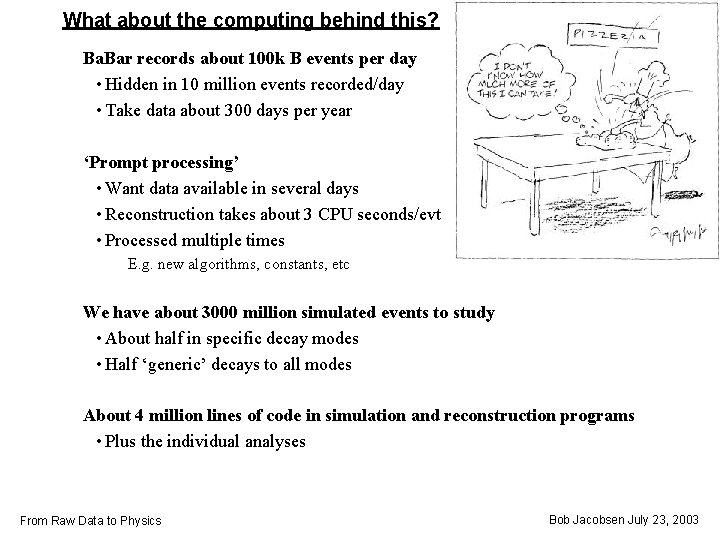
What about the computing behind this? Ba. Bar records about 100 k B events per day • Hidden in 10 million events recorded/day • Take data about 300 days per year ‘Prompt processing’ • Want data available in several days • Reconstruction takes about 3 CPU seconds/evt • Processed multiple times E. g. new algorithms, constants, etc We have about 3000 million simulated events to study • About half in specific decay modes • Half ‘generic’ decays to all modes About 4 million lines of code in simulation and reconstruction programs • Plus the individual analyses From Raw Data to Physics Bob Jacobsen July 23, 2003
Traditional flow of data - real and simulated Generators Specific reaction Geometry Simulation Particle paths Response Simulation Recorded signals Reconstruction Separate components • Often made by different experts Product is realistic data for analysis • And lots of it! DAQ system Observed tracks, etc Physics Tools Interpreted events Individual Analyses From Raw Data to Physics Bob Jacobsen July 23, 2003
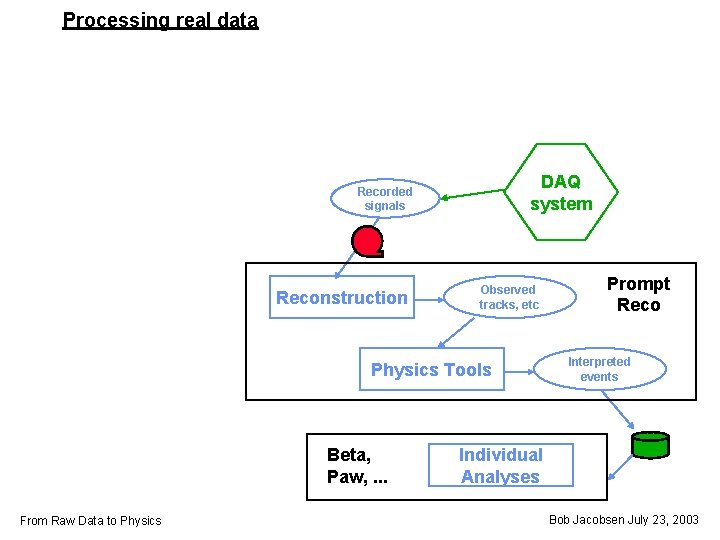
Processing real data DAQ system Recorded signals Reconstruction Observed tracks, etc Physics Tools Beta, Paw, . . . From Raw Data to Physics Prompt Reco Interpreted events Individual Analyses Bob Jacobsen July 23, 2003
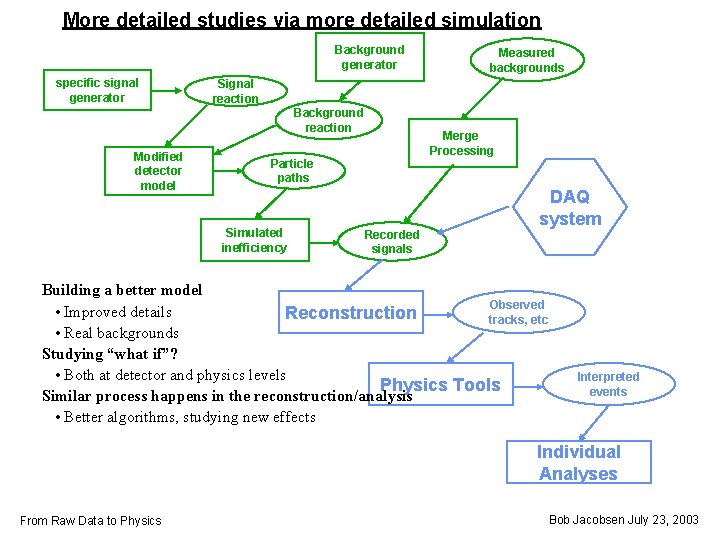
More detailed studies via more detailed simulation Background generator specific signal generator Signal reaction Background reaction Modified detector model Measured backgrounds Merge Processing Particle paths Simulated inefficiency Recorded signals DAQ system Building a better model Observed • Improved details Reconstruction tracks, etc • Real backgrounds Studying “what if”? • Both at detector and physics levels Physics Tools Similar process happens in the reconstruction/analysis • Better algorithms, studying new effects Interpreted events Individual Analyses From Raw Data to Physics Bob Jacobsen July 23, 2003
Partitioning production system into programs Generators bbsim Specific reaction Geometry Simulation Particle paths Response Simulation Event store data Background real data Sim. App Recorded signals Reconstruction Physics Tools ROOT, Paw, . . From Raw Data to Physics Bear Observed tracks, etc Interpreted events Individual Analyses Bob Jacobsen July 23, 2003
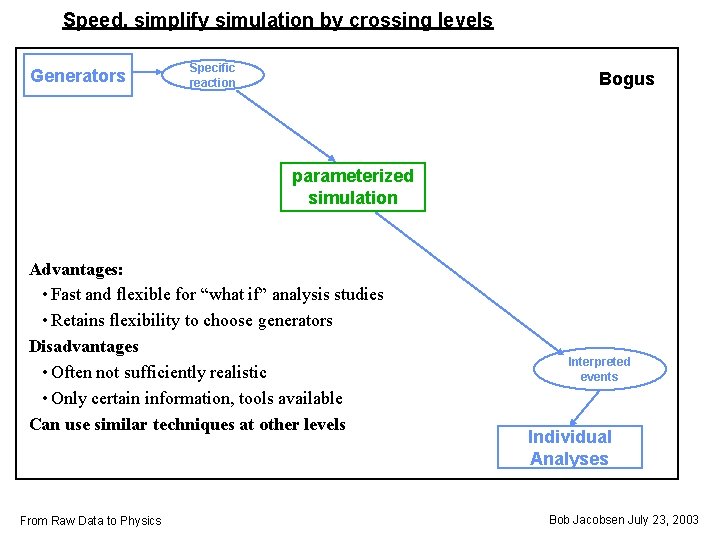
Speed, simplify simulation by crossing levels Generators Specific reaction Bogus parameterized simulation Advantages: • Fast and flexible for “what if” analysis studies • Retains flexibility to choose generators Disadvantages • Often not sufficiently realistic • Only certain information, tools available Can use similar techniques at other levels From Raw Data to Physics Interpreted events Individual Analyses Bob Jacobsen July 23, 2003
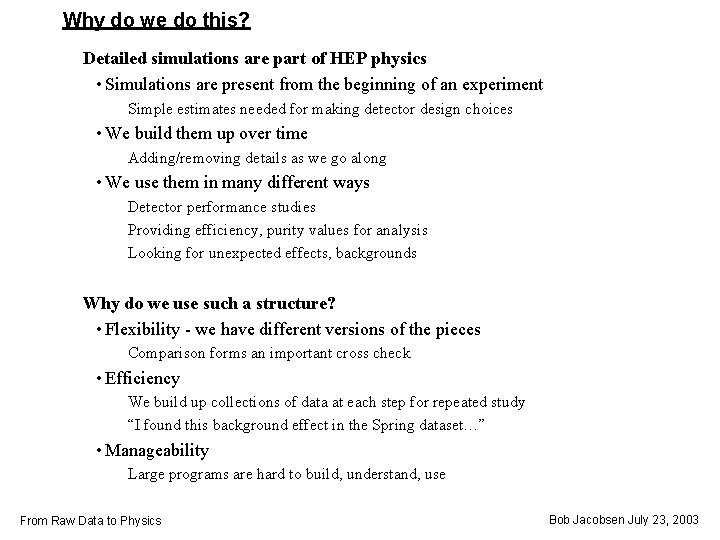
Why do we do this? Detailed simulations are part of HEP physics • Simulations are present from the beginning of an experiment Simple estimates needed for making detector design choices • We build them up over time Adding/removing details as we go along • We use them in many different ways Detector performance studies Providing efficiency, purity values for analysis Looking for unexpected effects, backgrounds Why do we use such a structure? • Flexibility - we have different versions of the pieces Comparison forms an important cross check • Efficiency We build up collections of data at each step for repeated study “I found this background effect in the Spring dataset…” • Manageability Large programs are hard to build, understand, use From Raw Data to Physics Bob Jacobsen July 23, 2003
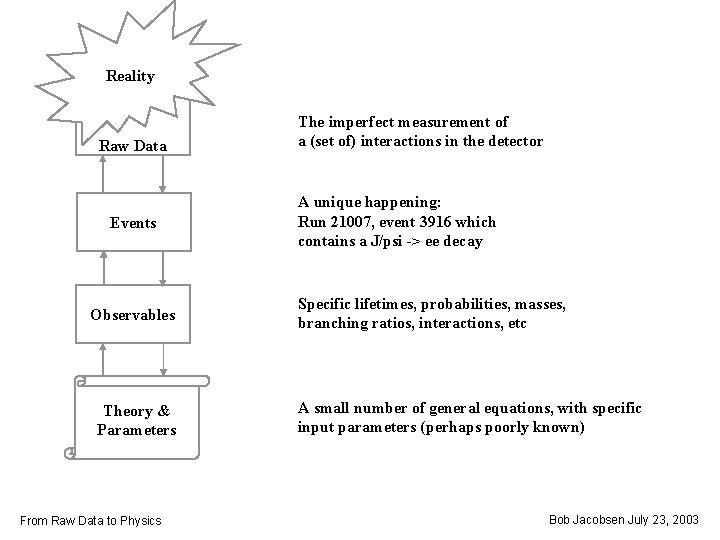
Reality Raw Data Events Observables Theory & Parameters From Raw Data to Physics The imperfect measurement of a (set of) interactions in the detector A unique happening: Run 21007, event 3916 which contains a J/psi -> ee decay Specific lifetimes, probabilities, masses, branching ratios, interactions, etc A small number of general equations, with specific input parameters (perhaps poorly known) Bob Jacobsen July 23, 2003
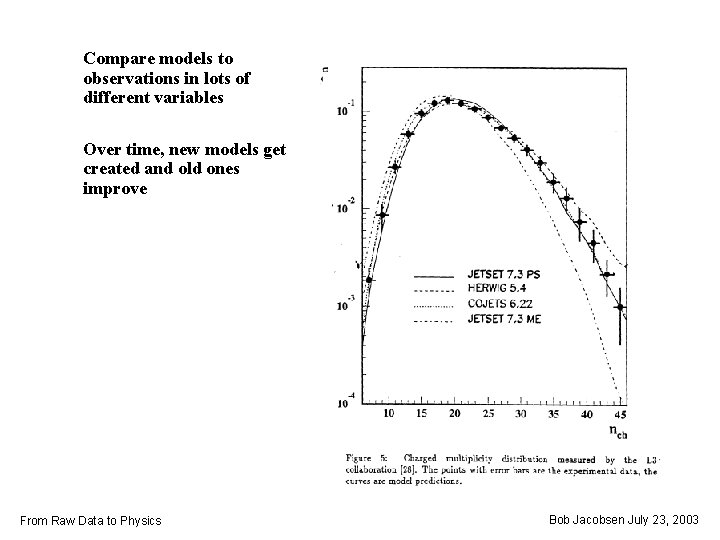
Analysis: Measuring a. S in QCD predicts a set of basic interactions: • You can measure the strong coupling constant by the relative rates Unfortunately, QCD only makes exact predictions at high energy • Low energy QCD, e. g. making hadrons, must be “modeled” From Raw Data to Physics Bob Jacobsen July 23, 2003
Compare models to observations in lots of different variables Over time, new models get created and old ones improve From Raw Data to Physics Bob Jacobsen July 23, 2003
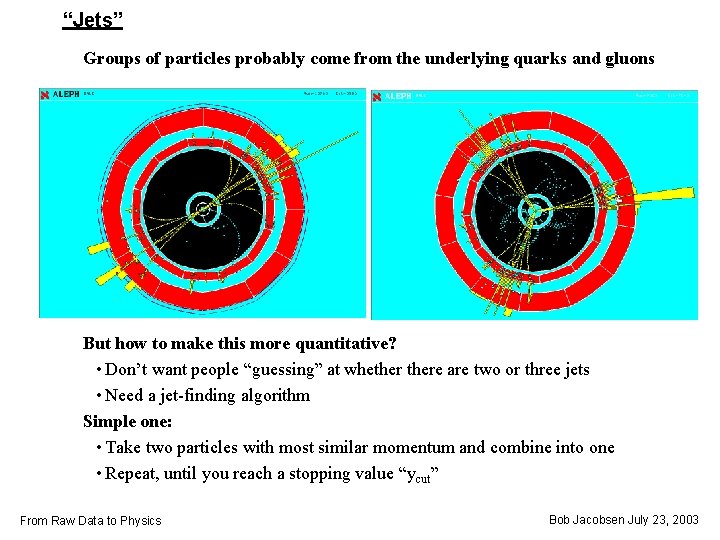
“Jets” Groups of particles probably come from the underlying quarks and gluons But how to make this more quantitative? • Don’t want people “guessing” at whethere are two or three jets • Need a jet-finding algorithm Simple one: • Take two particles with most similar momentum and combine into one • Repeat, until you reach a stopping value “ycut” From Raw Data to Physics Bob Jacobsen July 23, 2003
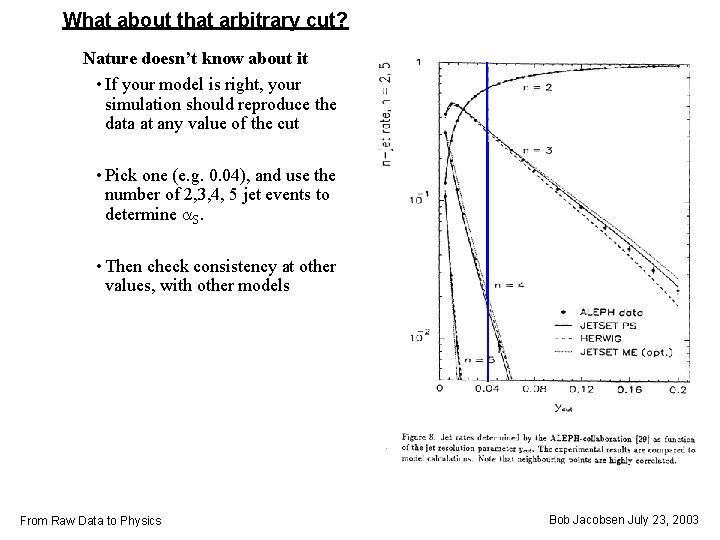
What about that arbitrary cut? Nature doesn’t know about it • If your model is right, your simulation should reproduce the data at any value of the cut • Pick one (e. g. 0. 04), and use the number of 2, 3, 4, 5 jet events to determine a. S. • Then check consistency at other values, with other models From Raw Data to Physics Bob Jacobsen July 23, 2003
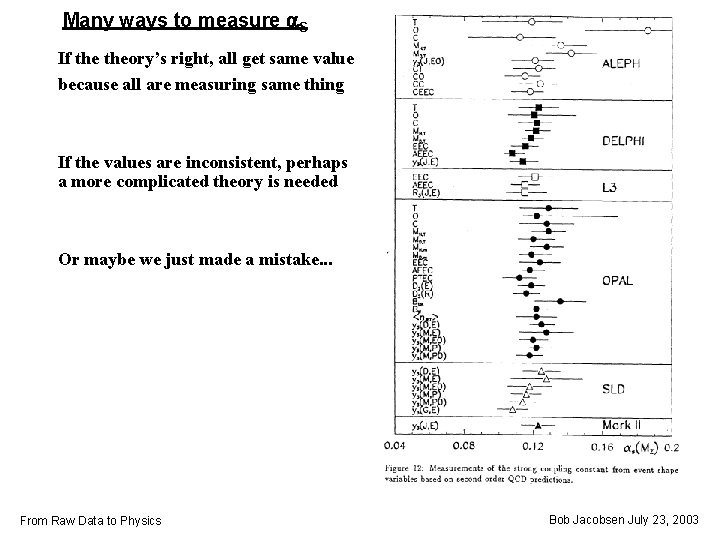
Many ways to measure a. S If theory’s right, all get same value because all are measuring same thing If the values are inconsistent, perhaps a more complicated theory is needed Or maybe we just made a mistake. . . From Raw Data to Physics Bob Jacobsen July 23, 2003
Alignment & Calibration How do you know the gain of each calorimeter cell? • What’s the relationship between ADC counts and energy? • You designed it to have a specific value; does it? How do you know where the tracking hits are in space? • Need to know Si plane positions to about 5 microns Start with • Test beam information • Surveys during construction • Simulations and tests But it always comes down to calibrating/aligning with real data From Raw Data to Physics Bob Jacobsen July 23, 2003
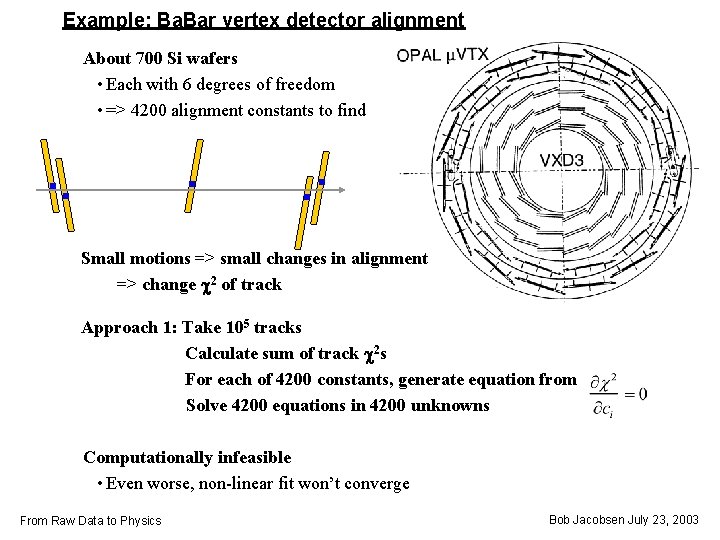
Example: Ba. Bar vertex detector alignment About 700 Si wafers • Each with 6 degrees of freedom • => 4200 alignment constants to find Small motions => small changes in alignment => change c 2 of track Approach 1: Take 105 tracks Calculate sum of track c 2 s For each of 4200 constants, generate equation from Solve 4200 equations in 4200 unknowns Computationally infeasible • Even worse, non-linear fit won’t converge From Raw Data to Physics Bob Jacobsen July 23, 2003
Instead, break problem into pieces: • Two mechanical halves => 2 x 6 “global alignment constants” • “local” constants within the halves Do local alignment iteratively • Look at pairs of adjacent wafers, and try to position them • Then use tracks to position entire layers • And iterate as needed Iterative, sensitive process • Manually guided from initial knowledge to final approximation • Requires judgement on when to stop, how often to redo From Raw Data to Physics Bob Jacobsen July 23, 2003
Summary Reconstruction and analysis is how we get from raw data to physics papers Throughout, you deal with: • Too little information • Too much detail • Little prior knowledge You have to count on • Lots of cross checks • Prior art • Tuning and evolutionary improvement But you can generate wonderful results from these instruments! From Raw Data to Physics Bob Jacobsen July 23, 2003