
From Principles to Capabilities the Birth and Evolution
From Principles to Capabilities the Birth and Evolution of High Throughput Computing Miron Livny Wisconsin Institutes for Discovery Madison-Wisconsin
The lessons of the past and the illusions of predictions
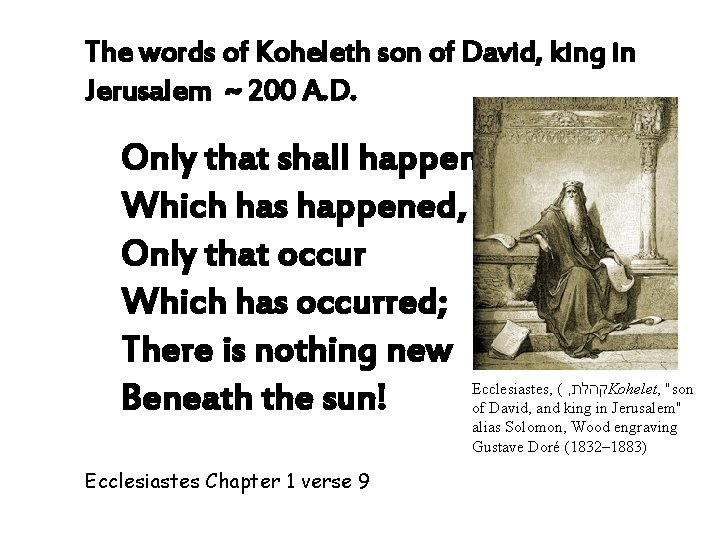
The words of Koheleth son of David, king in Jerusalem ~ 200 A. D. Only that shall happen Which has happened, Only that occur Which has occurred; There is nothing new Beneath the sun! Ecclesiastes, ( , קהלת Kohelet, "son of David, and king in Jerusalem" alias Solomon, Wood engraving Gustave Doré (1832– 1883) Ecclesiastes Chapter 1 verse 9

The Talmud says in the name of Rabbi Yochanan, “Since the destruction of the Temple, prophecy has been taken from prophets and given to fools and children. ” (Baba Batra 12 b)
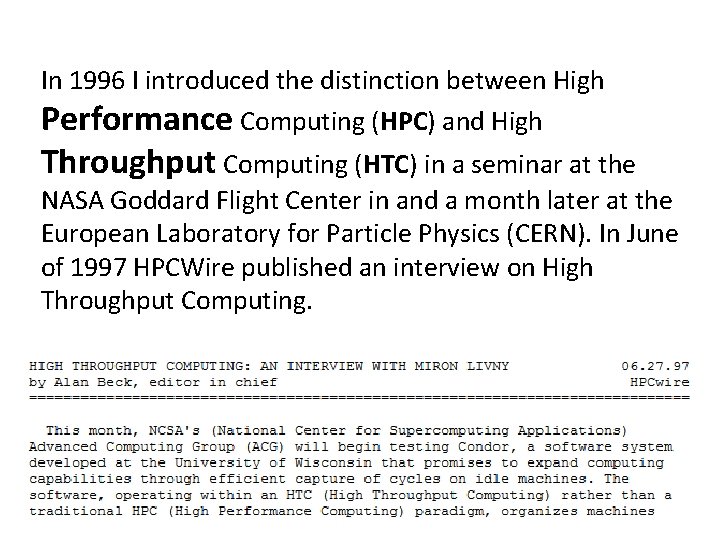
In 1996 I introduced the distinction between High Performance Computing (HPC) and High Throughput Computing (HTC) in a seminar at the NASA Goddard Flight Center in and a month later at the European Laboratory for Particle Physics (CERN). In June of 1997 HPCWire published an interview on High Throughput Computing.
High Throughput Computing is a 24 -7 -365 activity and therefore requires automation FLOPY (60*60*24*7*52)*FLOPS

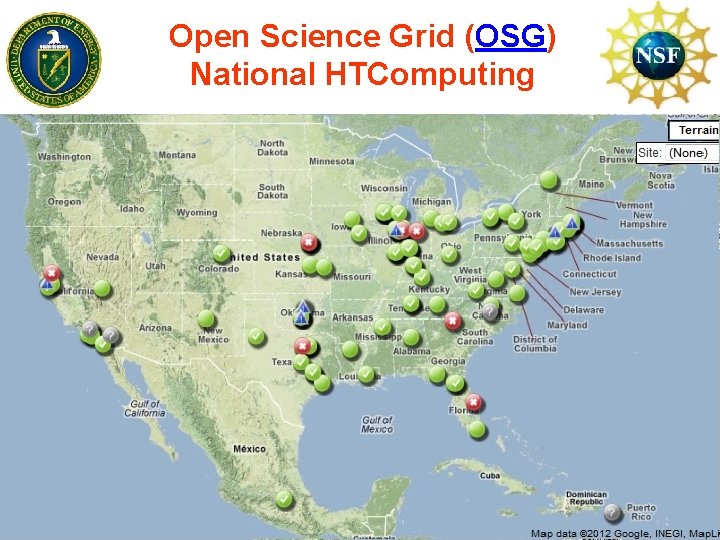
“The members of the Open Science Grid (OSG) are united by a commitment to promote the adoption and to advance the state of the art of distributed high throughput computing (DHTC) – shared utilization of autonomous resources where all the elements are optimized for maximizing computational throughput. ”
Open Science Grid (OSG) National HTComputing
Scientific Computing for the 21 st Century Workshop on HPC and Super-computing for Future Science Applications June 6, 2013 Richard Carlson Richard. Carlson@science. doe. gov

Traditional Scientific Computing Issues • Tussle between High Performance Computing and High Throughput Computing – Capability vs Capacity • Tussle between Grid / Cloud / Distributed computing – What are the differences between grid and cloud • Tussle between hardware ownership and software services – Who owns and manages the hardware vs the deployed services • Tussle between basic research and sustained deployment activities – How to balance research with sustainability
In 1978 I fell in love with the problem of load balancing in distributed systems
Claims for “benefits” provided by Distributed Processing Systems P. H. Enslow, “What is a Distributed Data Processing System? ” Computer, January 1978 – – – High Availability and Reliability High System Performance Ease of Modular and Incremental Growth Automatic Load and Resource Sharing Good Response to Temporary Overloads Easy Expansion in Capacity and/or Function
Definitional Criteria for a Distributed Processing System P. H. Enslow and T. G. Saponas “”Distributed and Decentralized Control in Fully Distributed Processing Systems” Technical Report, 1981 – Multiplicity of resources – Component interconnection – Unity of control – System transparency – Component autonomy
Unity of Control All the component of the system should be unified in their desire to achieve a common goal. This goal will determine the rules according to which each of these elements will be controlled.
Component autonomy The components of the system, both the logical and physical, should be autonomous and are thus afforded the ability to refuse a request of service made by another element. However, in order to achieve the system’s goals they have to interact in a cooperative manner and thus adhere to a common set of policies. These policies should be carried out by the control schemes of each element.

It is always a tradeoff that forces us to strike a balance
In 1983 I wrote a Ph. D. thesis – “Study of Load Balancing Algorithms for Decentralized Distributed Processing Systems” http: //www. cs. wisc. edu/condor/doc/livny-dissertation. pdf

BASICS OF TWO M/M/1 SYSTEMS l m When utilization is 80%, you wait on the average 4 units for every unit of service When utilization is 80%, 25% of the time a customer is waiting for service while a server is idle

Should I stay or should I move?
In 1985 I extended the scope of the distributed load balancing problem to include “ownership” of resources

Should I share my resources and if I do with whom, when (and at what price)?
AWS Spot Instances and Google Exa. Cycle are recent examples from the private sector
Now you have customers who are resource consumers, resource providers or both

Submit Locally and run Globally (Here is the work I need to get done and here are the resources I bring to the table)
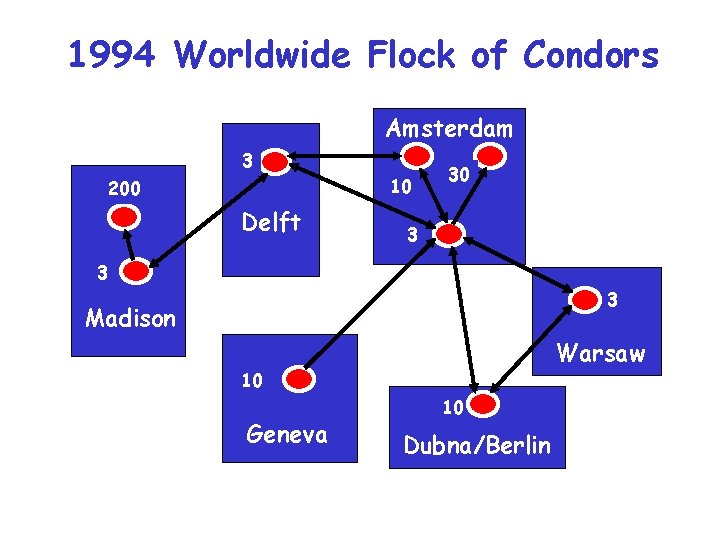
1994 Worldwide Flock of Condors Amsterdam 3 10 200 Delft 30 3 3 3 Madison Warsaw 10 Geneva 10 Dubna/Berlin
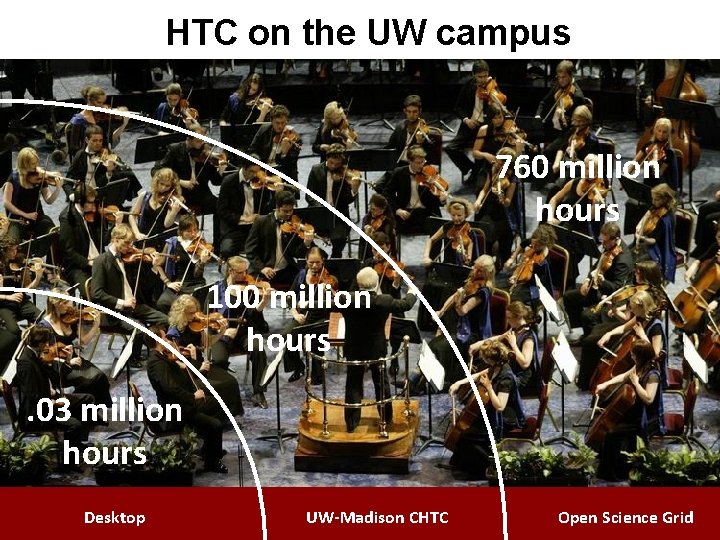
HTC on the UW campus 760 million hours 100 million hours. 03 million hours Desktop UW-Madison CHTC Open Science Grid
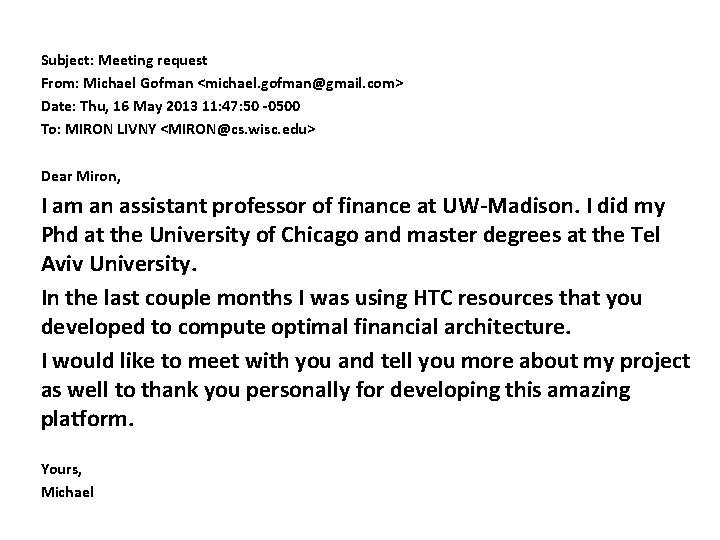
Subject: Meeting request From: Michael Gofman <michael. gofman@gmail. com> Date: Thu, 16 May 2013 11: 47: 50 -0500 To: MIRON LIVNY <MIRON@cs. wisc. edu> Dear Miron, I am an assistant professor of finance at UW-Madison. I did my Phd at the University of Chicago and master degrees at the Tel Aviv University. In the last couple months I was using HTC resources that you developed to compute optimal financial architecture. I would like to meet with you and tell you more about my project as well to thank you personally for developing this amazing platform. Yours, Michael
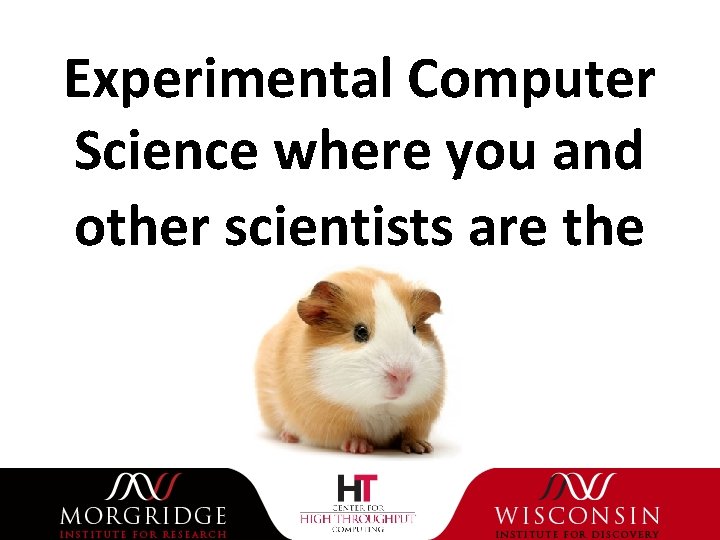
Experimental Computer Science where you and other scientists are the
30
Dear Professor Livny, I'm writing to you as I wish to invite you to a panel we're organizing at the next ECCS 2012 on "Experiments in Computer Science: Are Traditional Experimental Principles Enough? ” I was present during your ECSS presentation last year in Milan on "Experimental Computer Science and Computing Infrastructures" and, actually, was the person who asked you about a more scientifically oriented notion of experiment. I must confess that your talk, and the discussion I had with some colleagues after, was ones of the driving forces behind the organization of this panel and a pre-summit workshop (also on experiments in computer science So it would be really fantastic if you would be interested in participating in the panel.
Edsger Dijkstra once stated: "Computer science is no more about computers than astronomy is about telescopes. " Research Methods for Science By Michael P. Marder page 14. Published by Cambridge University Press
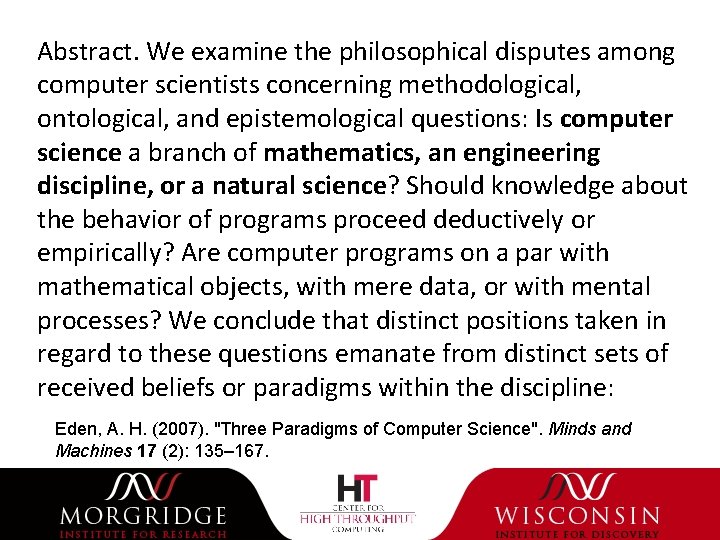
Abstract. We examine the philosophical disputes among computer scientists concerning methodological, ontological, and epistemological questions: Is computer science a branch of mathematics, an engineering discipline, or a natural science? Should knowledge about the behavior of programs proceed deductively or empirically? Are computer programs on a par with mathematical objects, with mere data, or with mental processes? We conclude that distinct positions taken in regard to these questions emanate from distinct sets of received beliefs or paradigms within the discipline: Eden, A. H. (2007). "Three Paradigms of Computer Science". Minds and Machines 17 (2): 135– 167.
Real and hard Computer Science problems are exposed when you do it for “real”
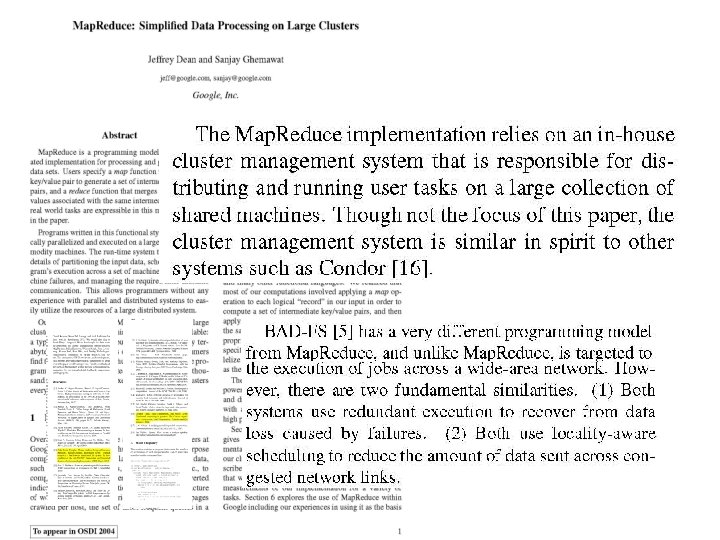

You have Impact!

“Why are you leaving academia and taking a job in industry? ” “I want to have impact!” 37
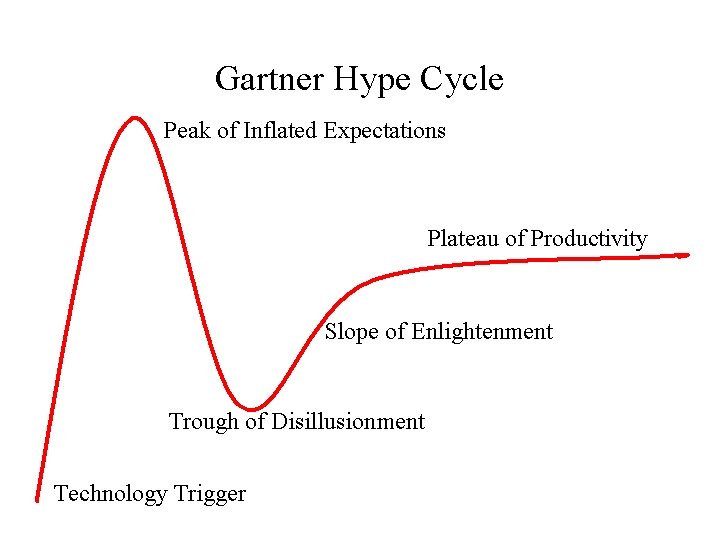
Solving “real-life” end-to-end problems makes you hype resistance
Perspectives on Grid Computing Uwe Schwiegelshohn Rosa M. Badia Marian Bubak Marco Danelutto Schahram Dustdar Fabrizio Gagliardi Alfred Geiger Ladislav Hluchy Dieter Kranzlmüller Erwin Laure Thierry Priol Alexander Reinefeld Michael Resch Andreas Reuter Otto Rienhoff Thomas Rüter Peter Sloot Domenico Talia Klaus Ullmann Ramin Yahyapour Gabriele von Voigt We should not waste our time in redefining terms or key technologies: clusters, Grids, Clouds. . . What is in a name? Ian Foster recently quoted Miron Livny saying: "I was doing Cloud computing way before people called it Grid computing", referring to the ground breaking Condor technology. It is the Grid scientific paradigm that counts!
How do we prepare for the HTC needs of 2020?
Scientific Collaborations at Extreme-Scales: d. V/dt - Accelerating the Rate of Progress towards Extreme Scale Collaborative Science Collaboration of five institutions – ANL, ISI, UCSD, UND and UW Funded by the Advanced Scientific Computing Research (ASCR) program of the DOE Office of Science
“Using planning as the unifying concept for this project, we will develop and evaluate by means of atscale experimentation novel algorithms and software architectures that will make it less labor intensive for a scientist to find the appropriate computing resources, acquire those resources, deploy the desired applications and data on these resources, and then manage them as the applications run. The proposed research will advance the understanding of resource management within a collaboration in the areas of: trust, planning for resource provisioning, and workload, computer, data, and network resource management. ”
“Over the last 15 years, Condor has evolved from a concept to an essential component of U. S. and international cyberinfrastructure supporting a wide range of research, education, and outreach communities. The Condor team is among the top two or three cyberinfrastructure development teams in the country. In spite of their success, this proposal shows them to be committed to rapid development of new capabilities to assure that Condor remains a competitive offering. Within the NSF portfolio of computational and dataintensive cyberinfrastructure offerings, the High Throughput Computing Condor software system ranks with the NSF High Performance Computing centers in importance for supporting NSF researchers. ” A recent anonymous NSF review
“… a mix of continuous changes in technologies, user and application requirements, and the business model of computing capacity acquisition will continue to pose new challenges and opportunities to the effectiveness of scientific HTC. … we have identified six key challenge areas that we believe will drive HTC technologies innovation in the next five years. ” • • • Evolving resource acquisition models Hardware complexity Widely disparate use cases Data intensive computing Black-box applications Scalability
The value of sustained experimental Computer Science
- Slides: 46