
From Net Art to PostInternet Art The Cyclical
- Slides: 41
From Net Art to Post-Internet Art: The Cyclical Nature of Art Movements Raivo Kelomees, Ph. D Estonian Academy of Arts Senior researcher offline@online. ee
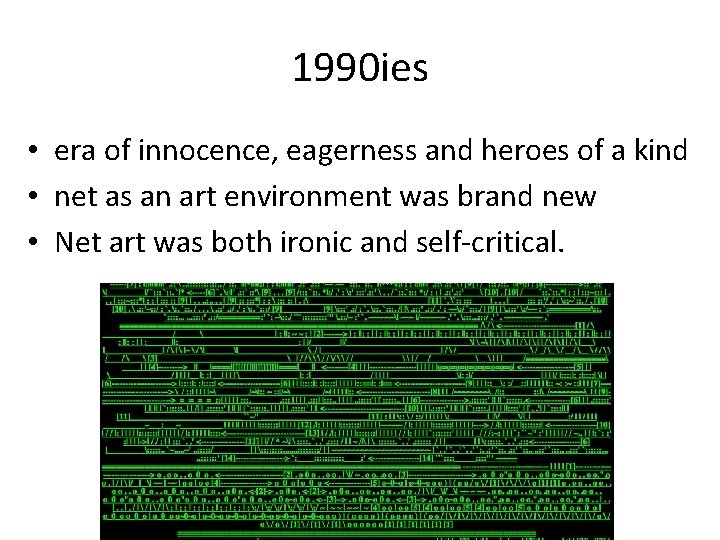
1990 ies • era of innocence, eagerness and heroes of a kind • net as an art environment was brand new • Net art was both ironic and self-critical.
Then and now… • Then: In the 1990 s, culture and art had to be brought to the internet • Now: the current post-digital and postinternet era, the internet environment is like nature: it surrounds us • Now: Net as an environment where people live their everyday lives
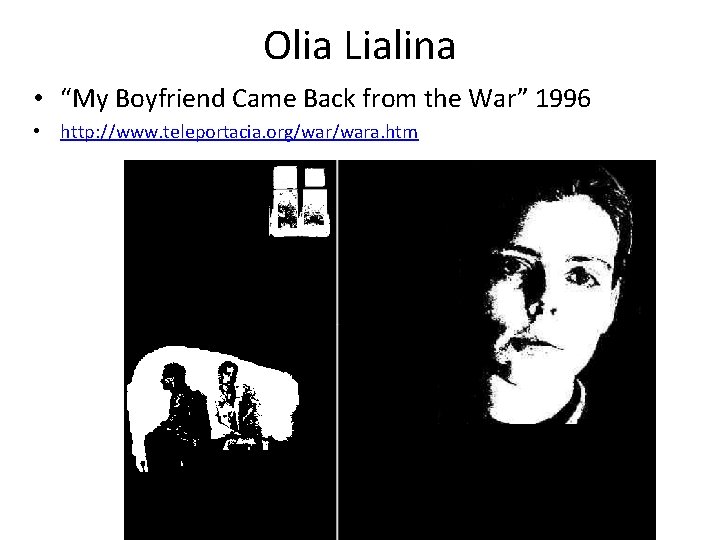
net. art • The term ‘net art’ was coined around 1996 • 1995: Ćosić got an e-mail (Shulgin) • “[. . . ] J 8~g#|; Net. Art{-^s 1 [. . . ]” • most significant names were Alexei Shulgin, Olia Lialina, Jodi. org (Joan Heemskerk and Dirk Paesmans), Vuc Ćosić, Graham Harwood and Heath Bunting, and theoreticians Tilman Baumgärtel, Josephine Bosma, Geert Lovink and Pit Schultz
Olia Lialina • “My Boyfriend Came Back from the War” 1996 • http: //www. teleportacia. org/wara. htm
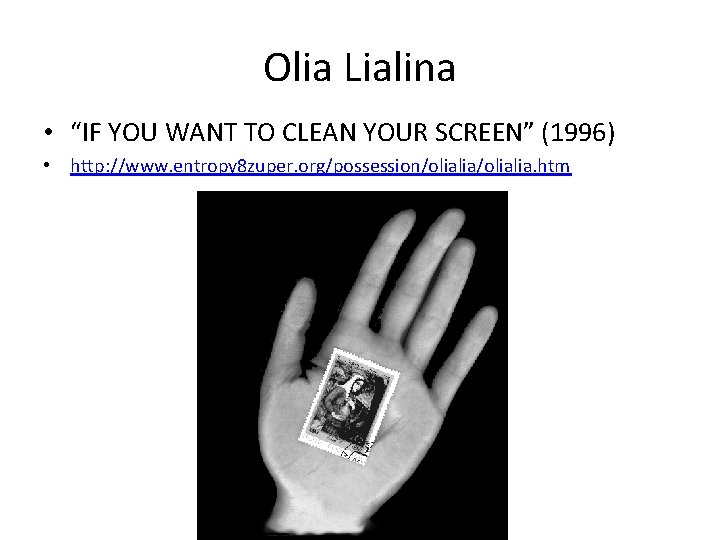
Olia Lialina • “IF YOU WANT TO CLEAN YOUR SCREEN” (1996) • http: //www. entropy 8 zuper. org/possession/olialia. htm
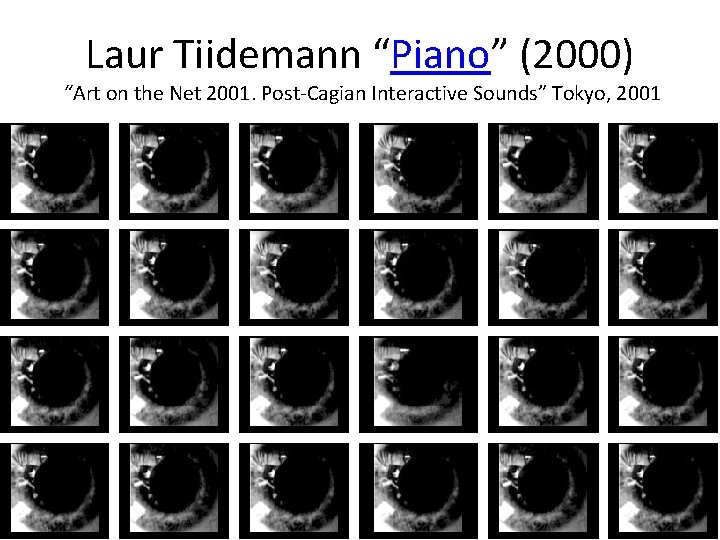
Laur Tiidemann “Piano” (2000) “Art on the Net 2001. Post-Cagian Interactive Sounds” Tokyo, 2001
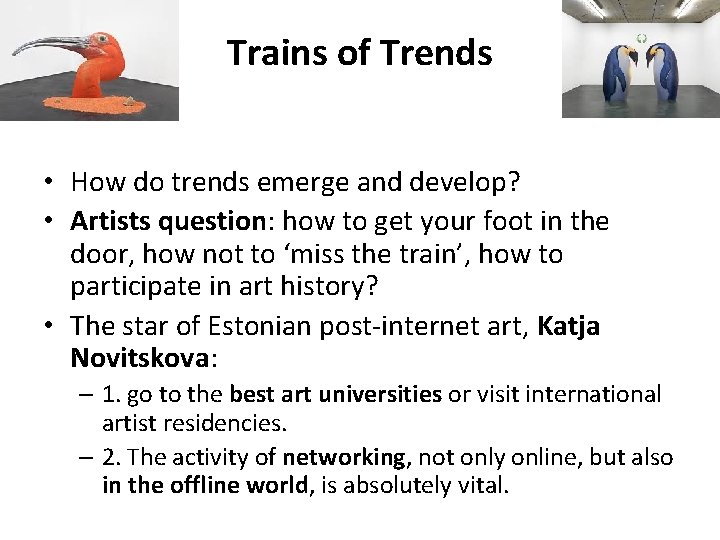
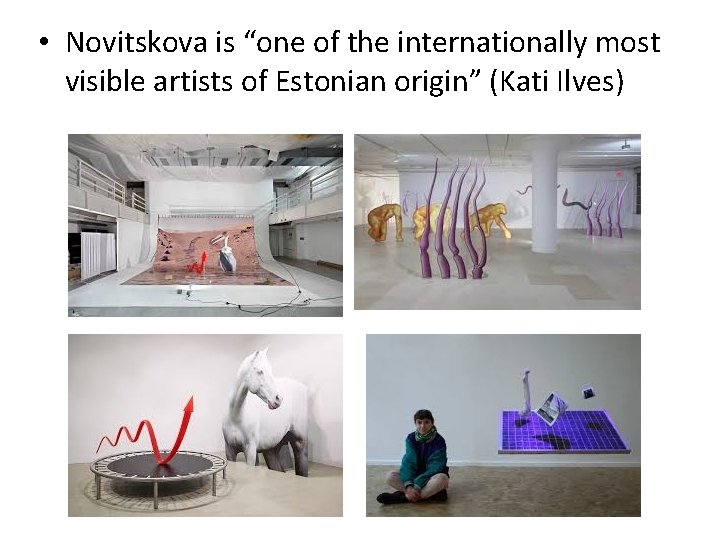
Trains of Trends • How do trends emerge and develop? • Artists question: how to get your foot in the door, how not to ‘miss the train’, how to participate in art history? • The star of Estonian post-internet art, Katja Novitskova: – 1. go to the best art universities or visit international artist residencies. – 2. The activity of networking, not only online, but also in the offline world, is absolutely vital.
• Novitskova is “one of the internationally most visible artists of Estonian origin” (Kati Ilves)
Now: net-based art become physical • net-based, non-material telecommunication art practice become more spatial, objectbased and physical, • it has left the internet, • the immaterial has become material, and • the non-objectified has become objectified and commercialised.
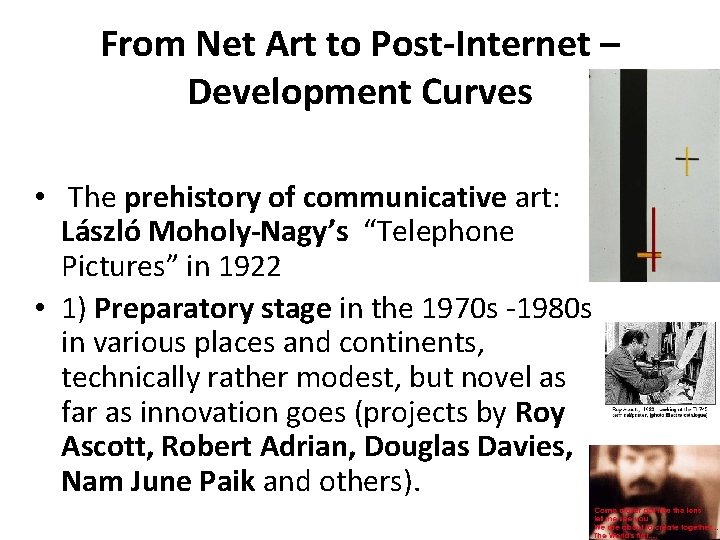
From Net Art to Post-Internet – Development Curves • The prehistory of communicative art: László Moholy-Nagy’s “Telephone Pictures” in 1922 • 1) Preparatory stage in the 1970 s -1980 s in various places and continents, technically rather modest, but novel as far as innovation goes (projects by Roy Ascott, Robert Adrian, Douglas Davies, Nam June Paik and others).
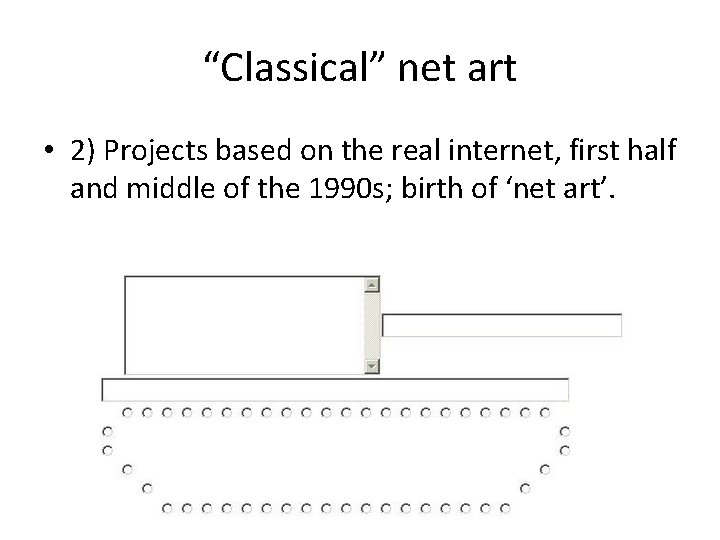
“Classical” net art • 2) Projects based on the real internet, first half and middle of the 1990 s; birth of ‘net art’.
• 3) Software art and the generative art trend, partially coinciding with net art (Alexei Shulgin, Olga Goriunova and Amy Alexander).
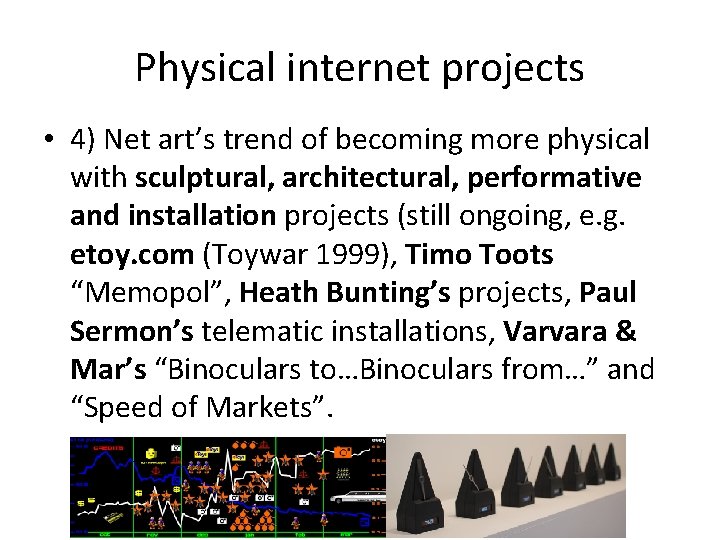
Physical internet projects • 4) Net art’s trend of becoming more physical with sculptural, architectural, performative and installation projects (still ongoing, e. g. etoy. com (Toywar 1999), Timo Toots “Memopol”, Heath Bunting’s projects, Paul Sermon’s telematic installations, Varvara & Mar’s “Binoculars to…Binoculars from…” and “Speed of Markets”.
• 5) The post-internet art trend, which emerged from the internet environment, but its contacts with net-based practice were indirect; the net experience and content became more physical: the second half of the 2000 s to the present (Marisa Olson, Gene Mc. Hugh, Artie Vierkant and others).
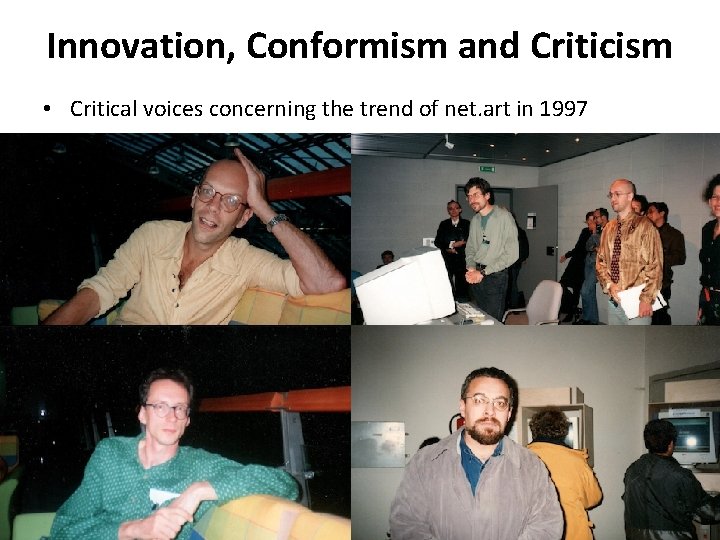
Innovation, Conformism and Criticism • Critical voices concerning the trend of net. art in 1997
Geert Lovink: • “So net-art is situated by nature, because its use this technical media, its situated within this history. Although its has those turbulent forces, it tries to escape, but in fact it can´t. But it would be fatal if it can´t also, you know, just escape art history and all art system. The conformism is that it just accept history as it is and accept the rules of representation. ” • “Question of demand in market terms for net-art is obvious. So there is market opportunity for someone. “ – R. Kelomees. Interview with Geert Lovink in September 1997 during Ars Electronica in Linz. Unpublished.
Andreas Broeckmann: • “It is phenomenon, people are following the ideas, following the stiles of others, which is common, which we know all the way through art history. So, why it shouldn't happen here, it could be that its more stronger and observable at the moment because language of expression in internet art is maybe more limited as in other art forms, at least at the moment. ” • R. Kelomees. Interview with Andreas Broeckmann in September 1997 during Ars Electronica in Linz. Unpublished.
Alexei Shulgin: • “As the best epoch was the age of innocence, when the artists created for the joy of it and did not get paid, they only spent. Nor did they know whether they would actually produce anything worthwhile. The situation has changed. The era of competition is coming. An upheaval. ” • R. Kelomees. Interview with Alexei Shulgin in September 1997 during Ars Electronica in Linz. Unpublished.
Lev Manovich: • “What is interesting and strange about this phenomena that obviously artists are trying to gain power and it is not accidental that this movement has strong connection to Eastern. Europe, because artists of Eastern Europe are pretty much excluded from western art market. … Internet is new territory, which doesn't have its hierarchy jet, doesn't have its art institutions. It became a place where young, smart, aggressive Easter European artists are fighting for recognition. ” – R. Kelomees. Interview with Lev Manovich in November 1997 during Ostranenie festivali in Dessau, Germany. Unpublished.
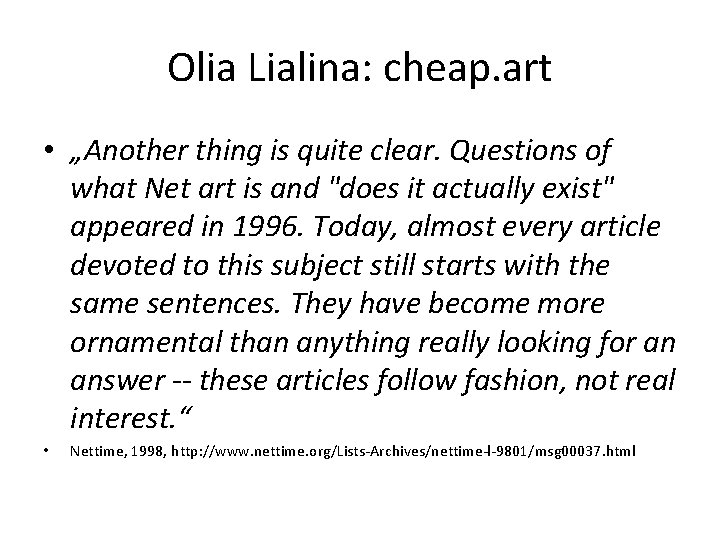
Olia Lialina: cheap. art • „Another thing is quite clear. Questions of what Net art is and "does it actually exist" appeared in 1996. Today, almost every article devoted to this subject still starts with the same sentences. They have become more ornamental than anything really looking for an answer -- these articles follow fashion, not real interest. “ • Nettime, 1998, http: //www. nettime. org/Lists-Archives/nettime-l-9801/msg 00037. html
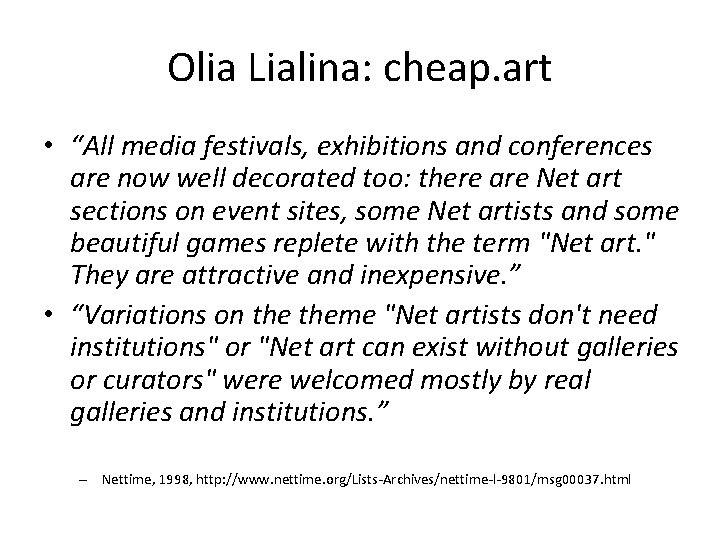
Olia Lialina: cheap. art • “All media festivals, exhibitions and conferences are now well decorated too: there are Net art sections on event sites, some Net artists and some beautiful games replete with the term "Net art. " They are attractive and inexpensive. ” • “Variations on theme "Net artists don't need institutions" or "Net art can exist without galleries or curators" were welcomed mostly by real galleries and institutions. ” – Nettime, 1998, http: //www. nettime. org/Lists-Archives/nettime-l-9801/msg 00037. html
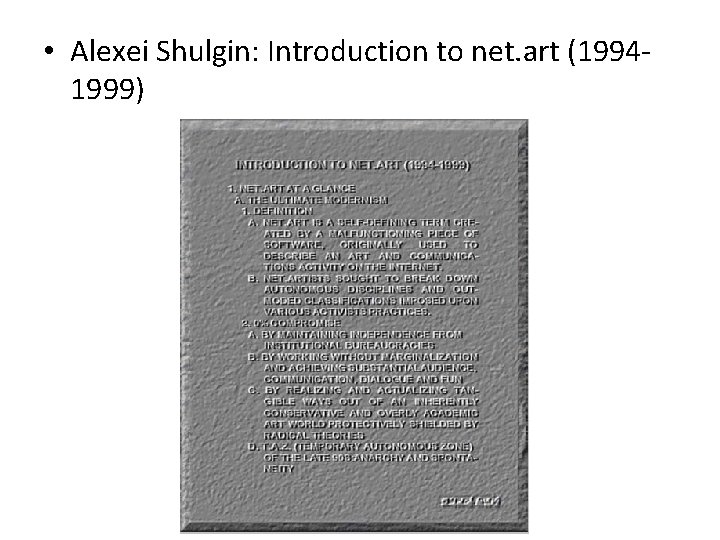
• Alexei Shulgin: Introduction to net. art (19941999)
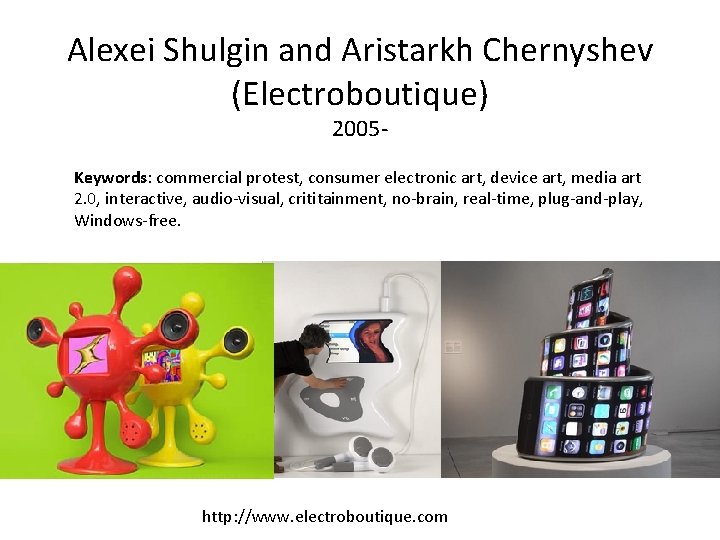
Alexei Shulgin and Aristarkh Chernyshev (Electroboutique) 2005 - Keywords: commercial protest, consumer electronic art, device art, media art 2. 0, interactive, audio-visual, crititainment, no-brain, real-time, plug-and-play, Windows-free. http: //www. electroboutique. com
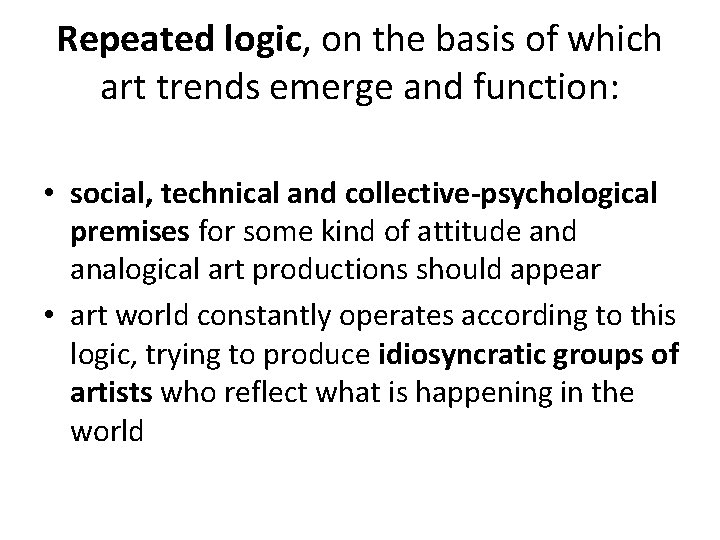
Repeated logic, on the basis of which art trends emerge and function: • social, technical and collective-psychological premises for some kind of attitude and analogical art productions should appear • art world constantly operates according to this logic, trying to produce idiosyncratic groups of artists who reflect what is happening in the world
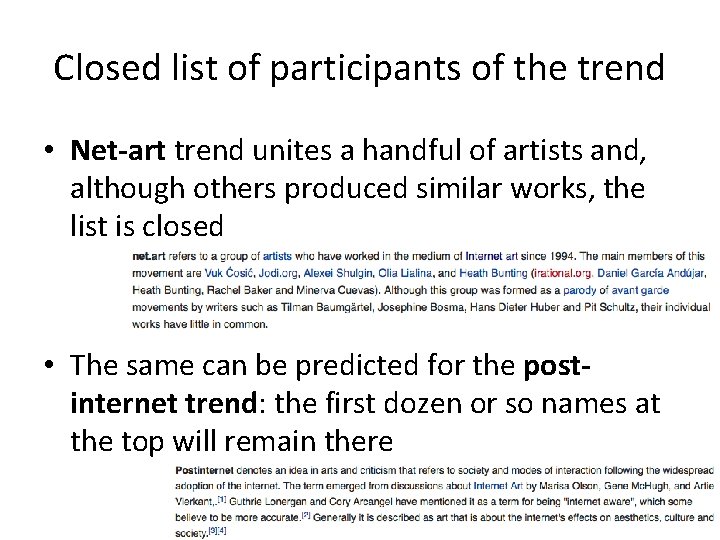
Closed list of participants of the trend • Net-art trend unites a handful of artists and, although others produced similar works, the list is closed • The same can be predicted for the postinternet trend: the first dozen or so names at the top will remain there
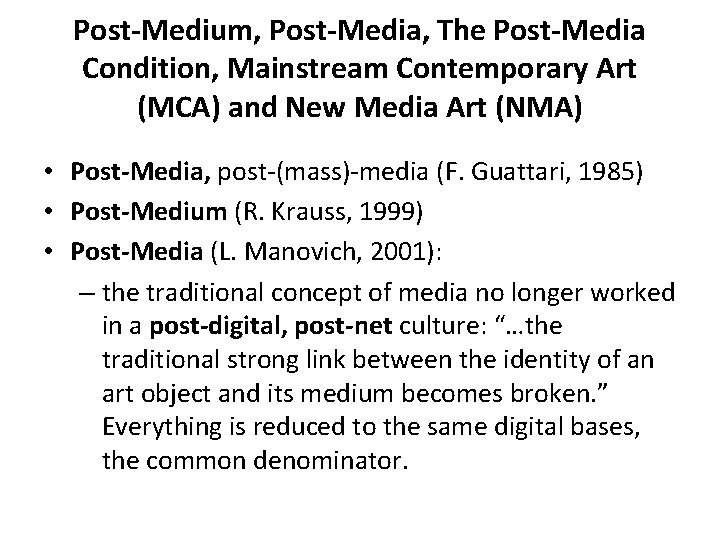
Post-Medium, Post-Media, The Post-Media Condition, Mainstream Contemporary Art (MCA) and New Media Art (NMA) • Post-Media, post-(mass)-media (F. Guattari, 1985) • Post-Medium (R. Krauss, 1999) • Post-Media (L. Manovich, 2001): – the traditional concept of media no longer worked in a post-digital, post-net culture: “…the traditional strong link between the identity of an art object and its medium becomes broken. ” Everything is reduced to the same digital bases, the common denominator.
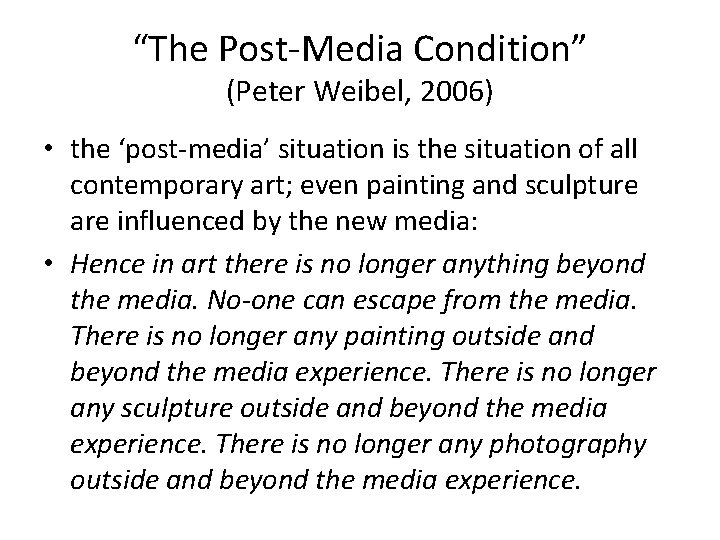
“The Post-Media Condition” (Peter Weibel, 2006) • the ‘post-media’ situation is the situation of all contemporary art; even painting and sculpture are influenced by the new media: • Hence in art there is no longer anything beyond the media. No-one can escape from the media. There is no longer any painting outside and beyond the media experience. There is no longer any sculpture outside and beyond the media experience. There is no longer any photography outside and beyond the media experience.
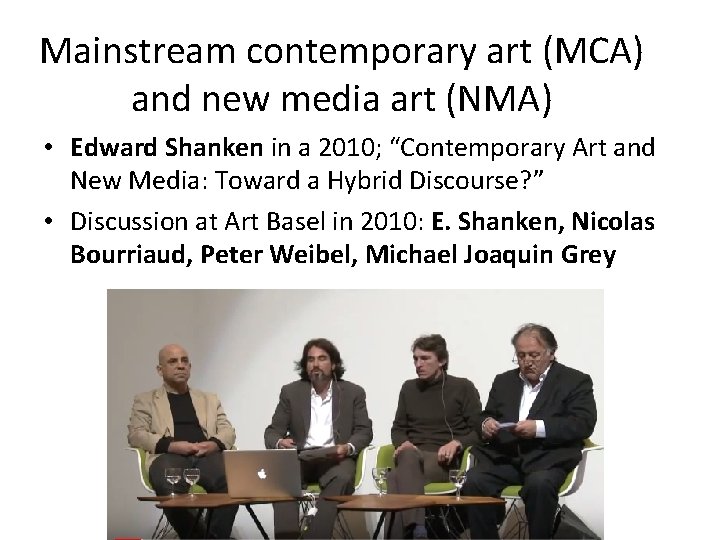
Mainstream contemporary art (MCA) and new media art (NMA) • Edward Shanken in a 2010; “Contemporary Art and New Media: Toward a Hybrid Discourse? ” • Discussion at Art Basel in 2010: E. Shanken, Nicolas Bourriaud, Peter Weibel, Michael Joaquin Grey
Hybrid discourse? • Bourriaud: technological impacts on contemporary art is indirect, in the same way as photography influenced impressionism • Weibel: the new media has had an impact on the entire new art situation, including traditional arts • The term ‘modern art’ has been replaced by ‘contemporary art’, primarily because of the influences of new technology.
“Digital” as a different environment • The digital environment is not just the transfer medium, the mediator medium, the re-mediator. • The art forms emerging on these platform (interactive art, net art, software art, telecommunicative art, bioart and other hybrid formats) also possess their own set of rules. • A different kind of playing field where the previous conventions of physical art and reality are no longer valid
The backlash known as ‘post-internet’ • Requirements for technical skills in the 1990 ies and now • the cognitive abilities of creative people are not sufficient for complex technical solutions • “art market” as a engine for object-based art trends • “art market” need constant refreshment, why not through the physical internet-influenced art
Hypothesis: • the whole the post-internet art movement can be viewed as a reaction against the specially skilled, cognitive demands of technical art and at the same time accommodate the system of contemporary art: producing physical artefacts.
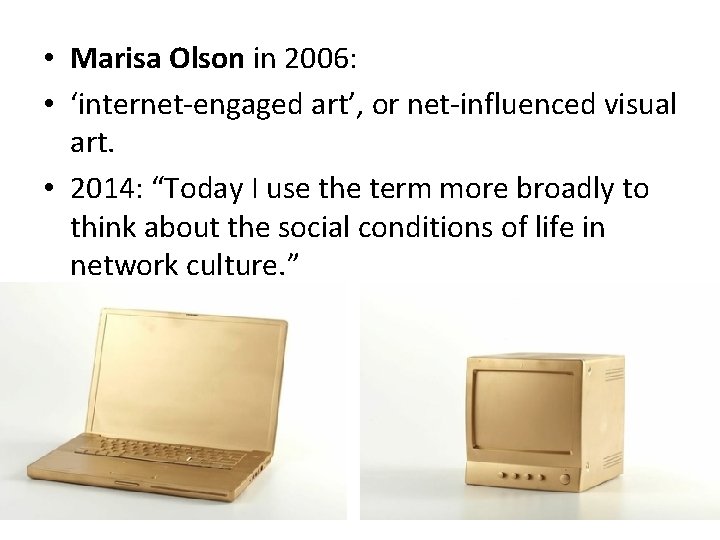
• Marisa Olson in 2006: • ‘internet-engaged art’, or net-influenced visual art. • 2014: “Today I use the term more broadly to think about the social conditions of life in network culture. ”
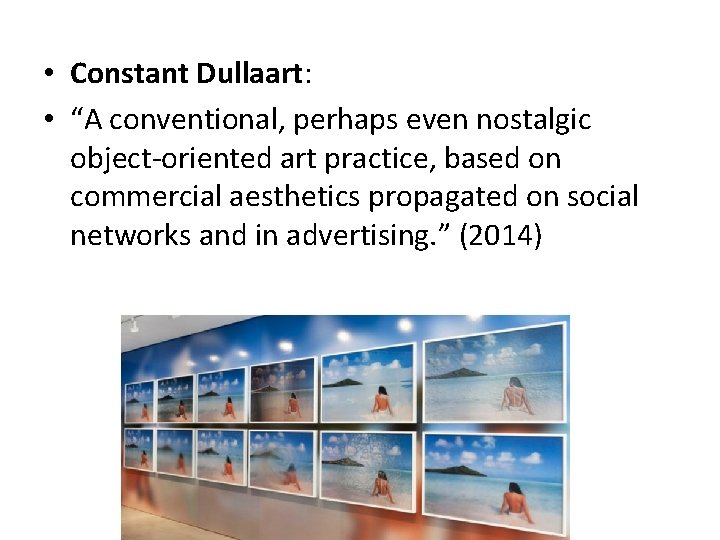
• Constant Dullaart: • “A conventional, perhaps even nostalgic object-oriented art practice, based on commercial aesthetics propagated on social networks and in advertising. ” (2014)
• Brian Droitcour: • …post-internet art does to art what porn does to sex … (2014)
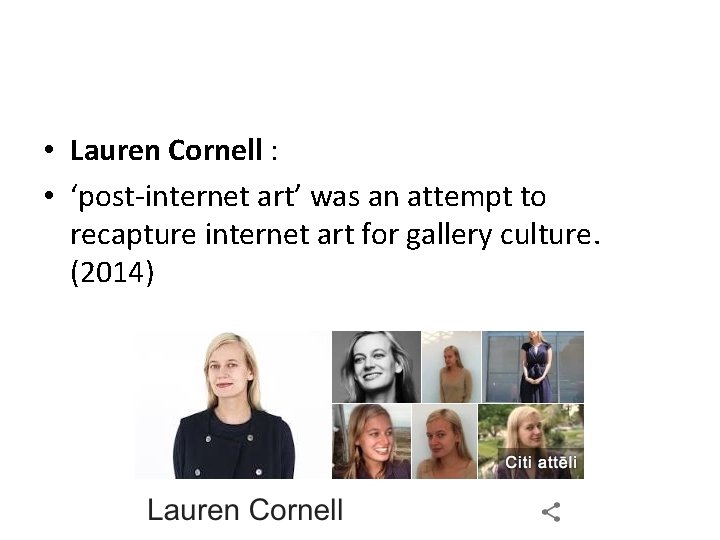
• Lauren Cornell : • ‘post-internet art’ was an attempt to recapture internet art for gallery culture. (2014)
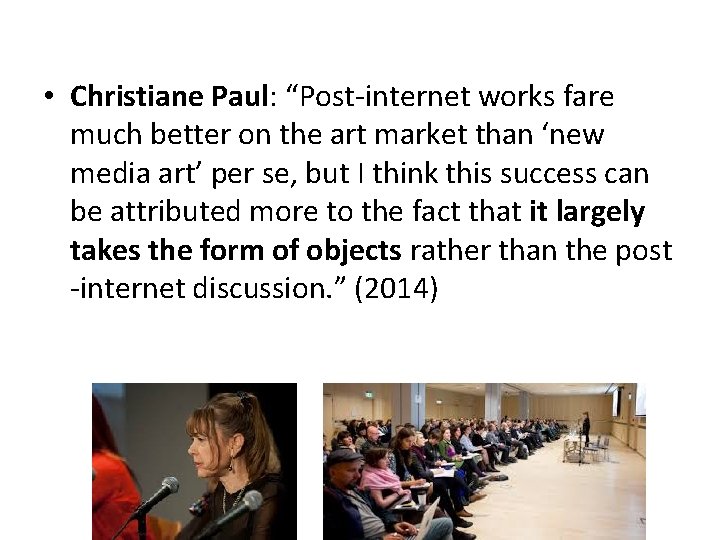
• Christiane Paul: “Post-internet works fare much better on the art market than ‘new media art’ per se, but I think this success can be attributed more to the fact that it largely takes the form of objects rather than the post -internet discussion. ” (2014)
• Christiane Paul: “I think it would be highly problematic to claim that there is a progression from Internet art to post-internet art. ”(2014) • Lance Wakeling: “I think post-internet is the morning after the honeymoon of the marriage between the digital and the real. It is a fleeting, temporal marker for the beauty and horror that will follow. ”(2014) – All quotes from: Art Post-Internet. Catalogue. Edited by Karen Archey and Robin Peckham. Ullens Center for Contemporary Art in Beijing, 2014, 95, available online at http: //post-inter. net/
Conclusion • it is positive that post-internet has introduced media-awareness into the discussions of contemporary art • After E. Shanken proposal for “hybrid discourse” hopefully something will follow. • Net. art, 1994 -2006 (? ) • Post-internet, 2006 - (? )
Thank you! Raivo Kelomees Estonian Academy of Arts offline@online. ee From Net Art to Post-Internet Art: The Cyclical Nature of Art Movements First version of the article: From Net Art to Post-Internet Art, Estonian Art, 2017 http: //www. estonianart. ee/art/from-net-art-to-post-internet-art/