
From MATLAB and Simulink to Real Time with
From MATLAB® and Simulink® to Real Time with TI DSPs Echo and Reverberation Content developed in partnership with Tel-Aviv University © 2007 Texas Instruments Inc, 0 -
Objectives • To explain echo and reverberation. • To build Simulink® models. • To test the models using the Texas Instruments C 6713 DSK with a microphone and headphones/computer loudspeakers. © 2007 Texas Instruments Inc, Slide 2

Echo • Echo is audible because the speed of sound is relatively slow, about 400 meters per second. • Click on icon to listen to echo. © 2007 Texas Instruments Inc, Slide 3
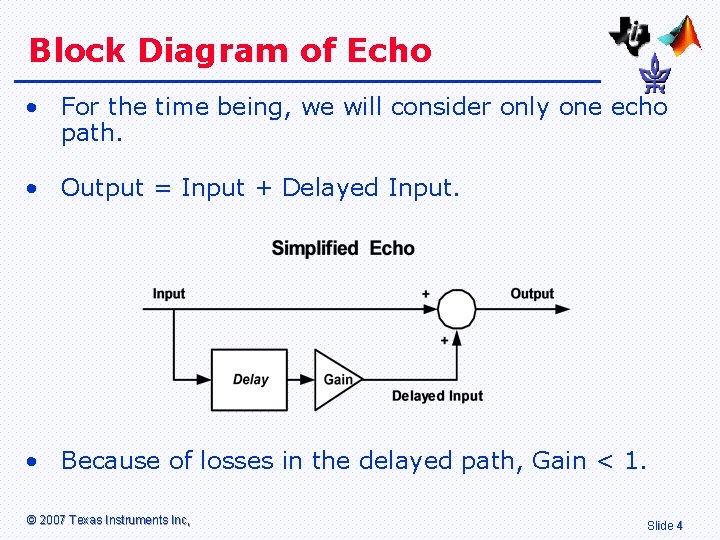
Block Diagram of Echo • For the time being, we will consider only one echo path. • Output = Input + Delayed Input. • Because of losses in the delayed path, Gain < 1. © 2007 Texas Instruments Inc, Slide 4

Equation for Simplified Echo © 2007 Texas Instruments Inc, Slide 5
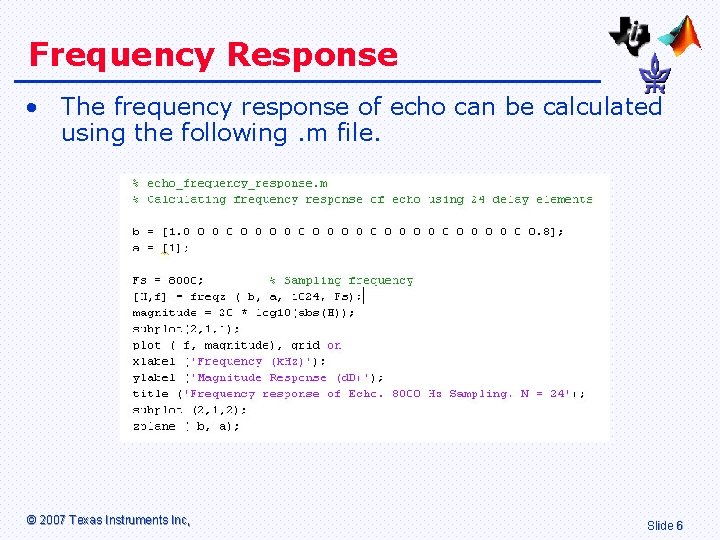
Frequency Response • The frequency response of echo can be calculated using the following. m file. © 2007 Texas Instruments Inc, Slide 6
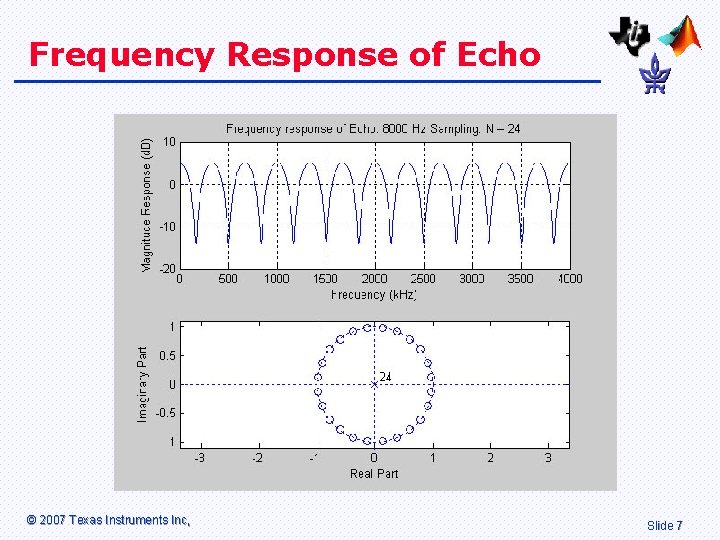
Frequency Response of Echo © 2007 Texas Instruments Inc, Slide 7
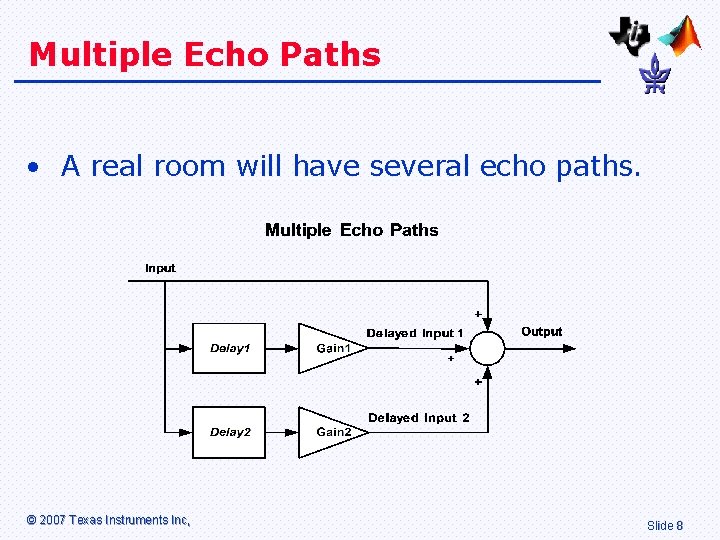
Multiple Echo Paths • A real room will have several echo paths. © 2007 Texas Instruments Inc, Slide 8
Summary of Echo • The Echo output is derived solely from the input. • Certain frequencies are attenuated. • Because the poles lie inside the unit circle, echo is stable. © 2007 Texas Instruments Inc, Slide 9
Reverberation • Reverberation is similar to echo, but uses a slightly different configuration. • Click on the icon to hear reverberation. © 2007 Texas Instruments Inc, Slide 10
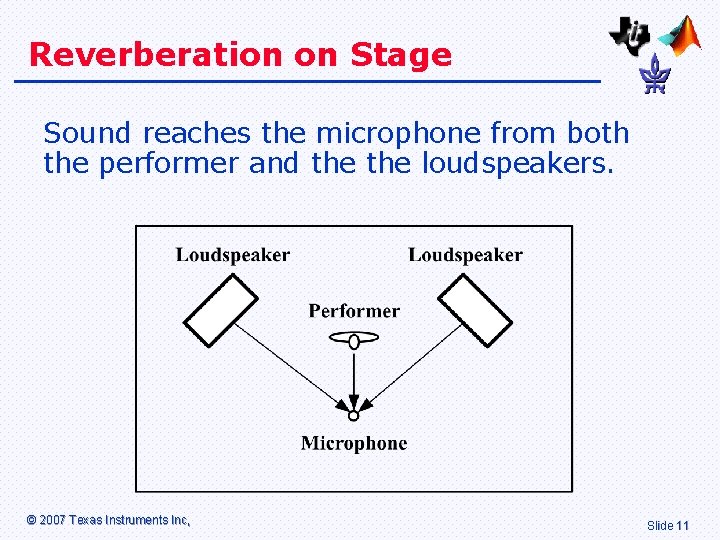
Reverberation on Stage Sound reaches the microphone from both the performer and the loudspeakers. © 2007 Texas Instruments Inc, Slide 11
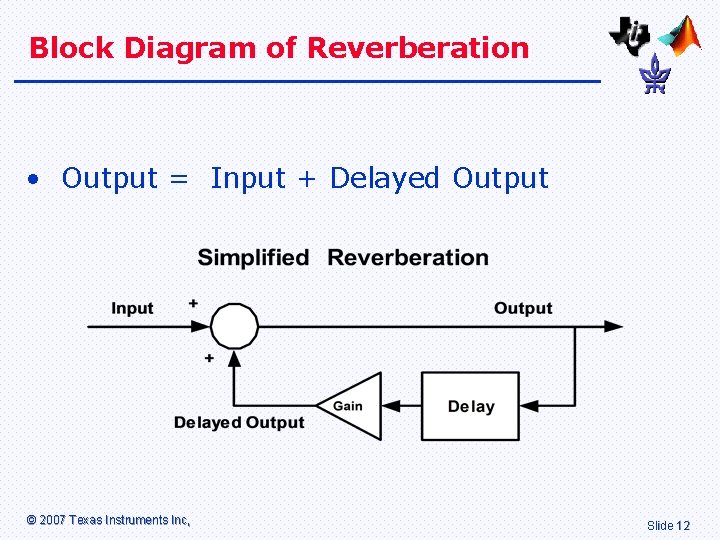
Block Diagram of Reverberation • Output = Input + Delayed Output © 2007 Texas Instruments Inc, Slide 12
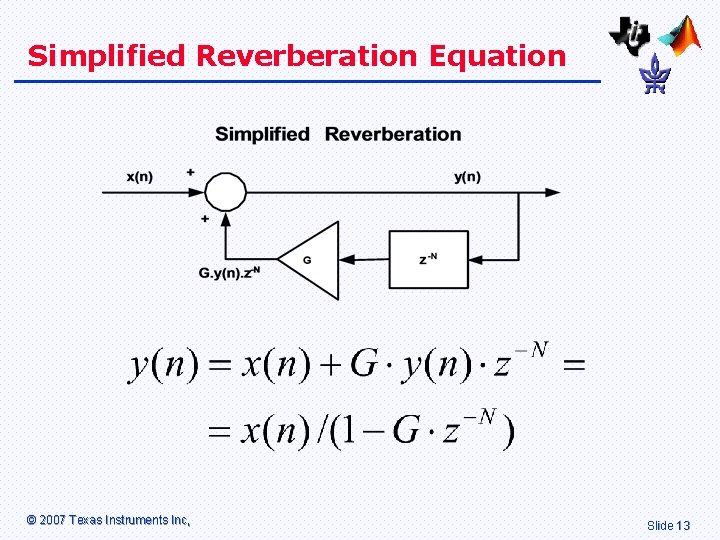
Simplified Reverberation Equation © 2007 Texas Instruments Inc, Slide 13
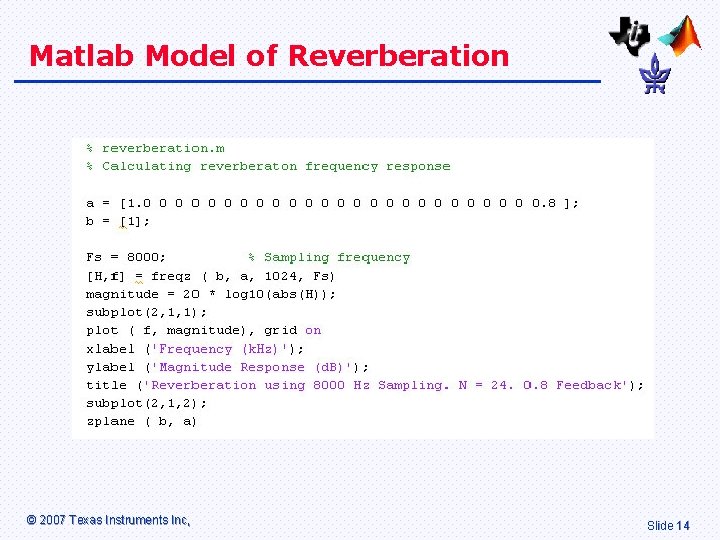
Matlab Model of Reverberation © 2007 Texas Instruments Inc, Slide 14
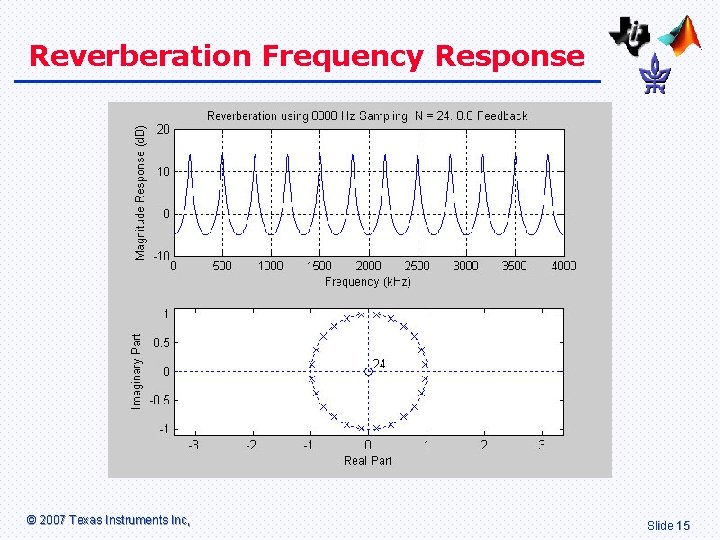
Reverberation Frequency Response © 2007 Texas Instruments Inc, Slide 15
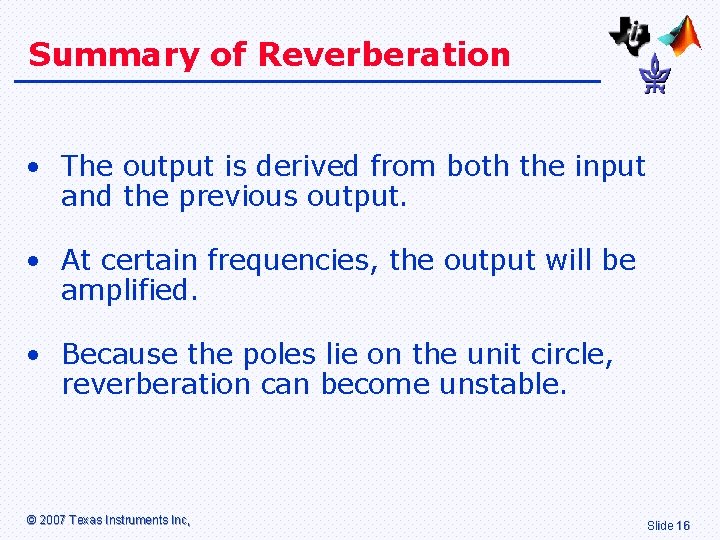
Summary of Reverberation • The output is derived from both the input and the previous output. • At certain frequencies, the output will be amplified. • Because the poles lie on the unit circle, reverberation can become unstable. © 2007 Texas Instruments Inc, Slide 16
Real World Echo and Reverberation • A real room will have several echo paths. • When sound is reflected off a surface there will be “coloration”. Certain frequencies will be absorbed and there will be phase changes. • Therefore, a commercial echo / reverberation unit will contain many different delay paths. © 2007 Texas Instruments Inc, Slide 17
Simulink Models © 2007 Texas Instruments Inc, Slide 18
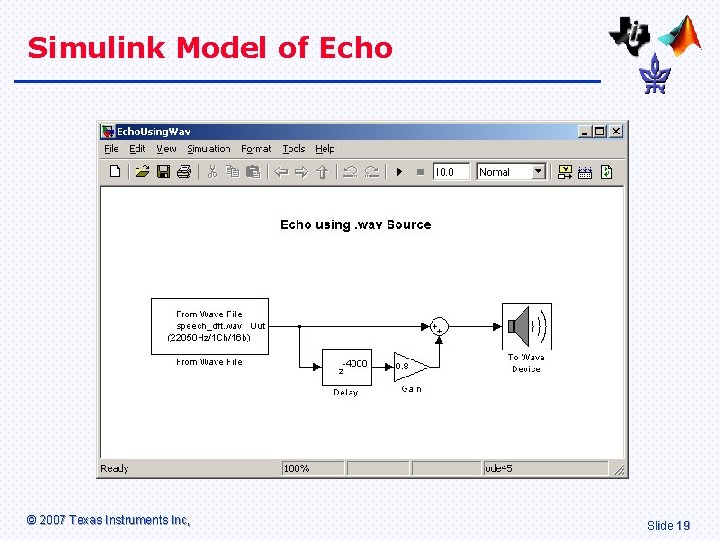
Simulink Model of Echo © 2007 Texas Instruments Inc, Slide 19
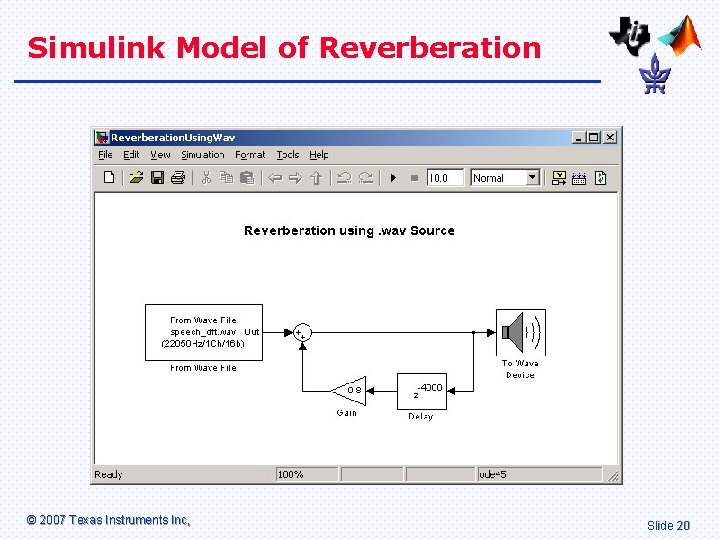
Simulink Model of Reverberation © 2007 Texas Instruments Inc, Slide 20
Modifications for TI C 6713 © 2007 Texas Instruments Inc, Slide 21
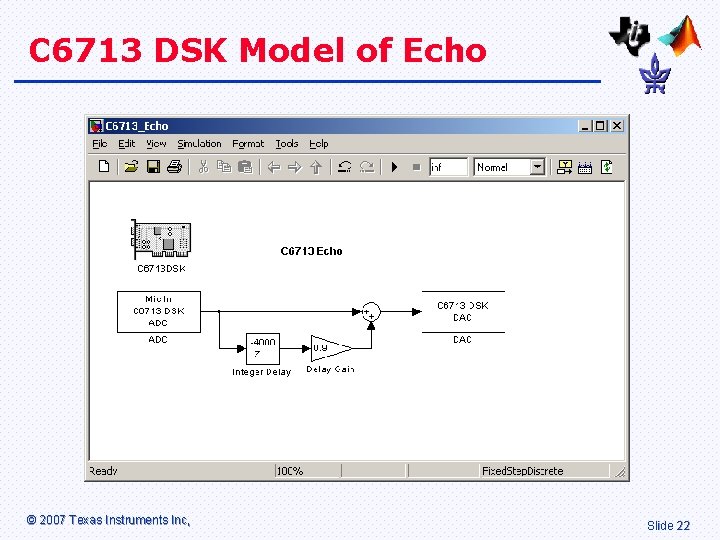
C 6713 DSK Model of Echo © 2007 Texas Instruments Inc, Slide 22
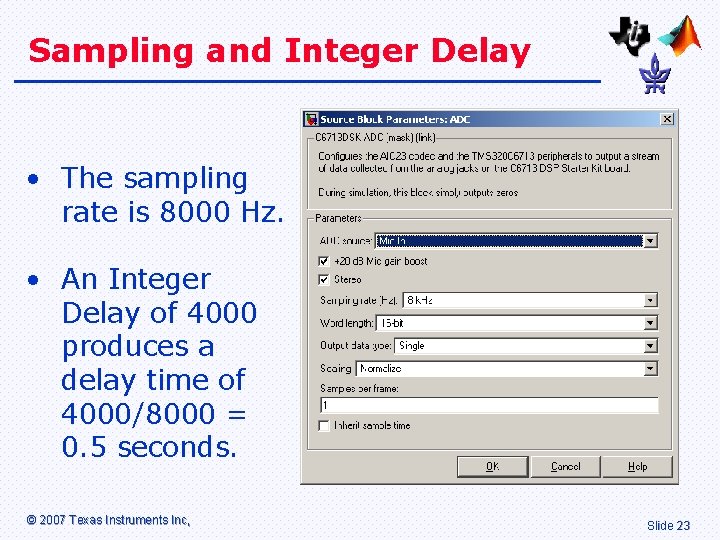
Sampling and Integer Delay • The sampling rate is 8000 Hz. • An Integer Delay of 4000 produces a delay time of 4000/8000 = 0. 5 seconds. © 2007 Texas Instruments Inc, Slide 23
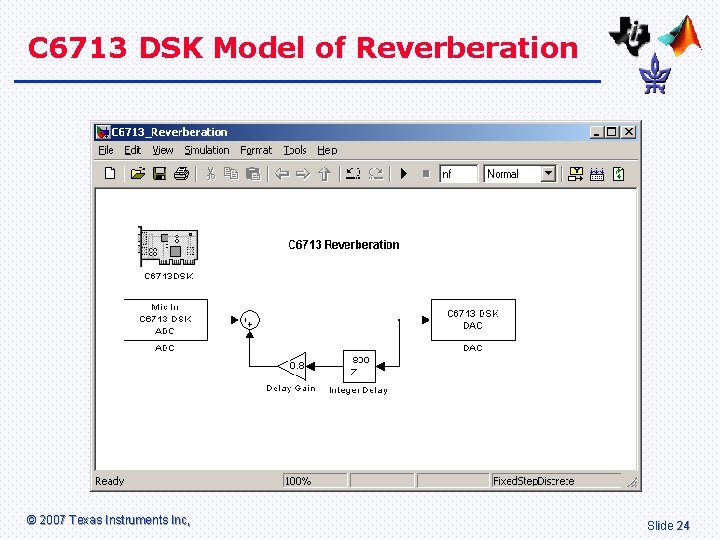
C 6713 DSK Model of Reverberation © 2007 Texas Instruments Inc, Slide 24
Simulink Model of Reverberation • Using 8000 samples per second, a delay of 800 samples will take 800/8000 = 0. 1 seconds (100 ms). • A Delay Gain of 0. 8 has been used. This means 80% of the output is fed back into the input. – Increase this value for more reverberation, but less stability. – Decrease this value for less reverberation, but more stability. © 2007 Texas Instruments Inc, Slide 25
Introduction to Laboratory © 2007 Texas Instruments Inc, Slide 26
The Complete Simulink Model • In the Laboratory you will build a Simulink Model for echo and reverberation. • You will be able to run different echo and reverberation effects on the C 6713 DSK. © 2007 Texas Instruments Inc, Slide 27
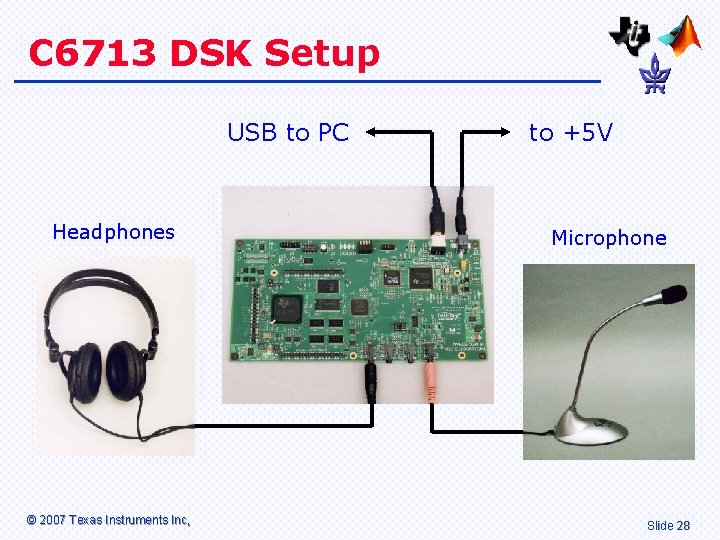
C 6713 DSK Setup USB to PC Headphones © 2007 Texas Instruments Inc, to +5 V Microphone Slide 28
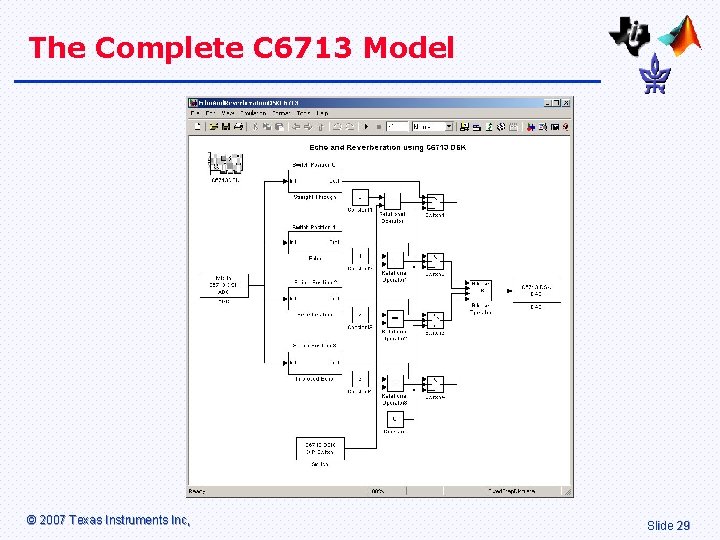
The Complete C 6713 Model © 2007 Texas Instruments Inc, Slide 29
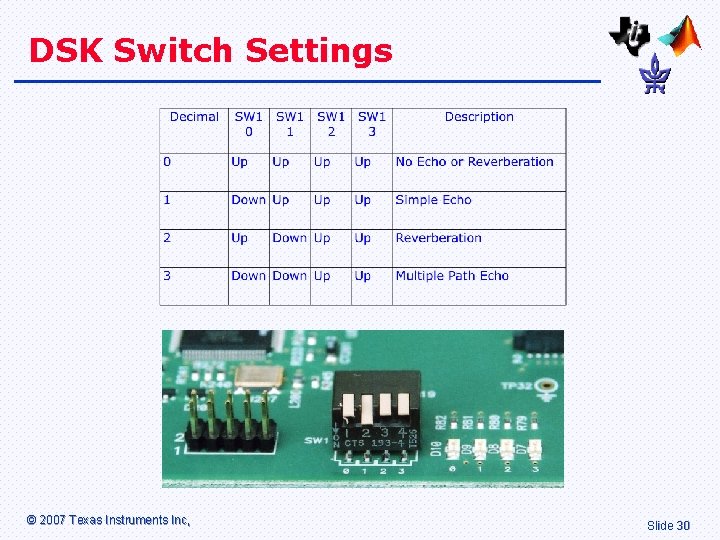
DSK Switch Settings © 2007 Texas Instruments Inc, Slide 30
References • A Digital Signal Processing Primer by Ken Steiglitz. ISBN 0 -8053 -1684 -1. © 2007 Texas Instruments Inc, Slide 31
- Slides: 31