
From linguistic relativity to sociolinguistic relativity 1 Introduction
- Slides: 22
From linguistic relativity to sociolinguistic relativity 1 - Introduction Without a doubt, Hymes’ theory of language and his approach to the study of language use have made significant contributions to our understanding of the pragmatically based, mutually constitutive nature of language and culture. A less visible but equally significant contribution of his work is the advancement of our understanding of the concept of linguistic relativity
Like Whorf, Hymes sees language and culture as inextricably linked However, by giving primacy to language use and function rather than linguistic code and form, form Hymes transforms Whorf ’s notion of linguistic relativity in a subtle but in significant ways. More to the point, in asserting the primacy of language as human action, the source of relativity becomes located in language use, not in language structure.
The priority of sociolinguistic relativity relative to the notion of linguistic relativity With particular regard to the Sapir–Whorf hypothesis, it is essential to notice that Whorf’s sort of linguistic relativity is secondary, and dependent upon a primary sociolinguistic relativity, that of differential engagement of languages in social life.
For example, description of a language may show that it expresses certain cognitive style, perhaps implicit metaphysical assumptions. But what chances the language has to make an impress upon individuals and behaviour will depend upon the degree and pattern of its admission into communicative events. .
Peoples do not all everywhere use language to the same degree, in the same situations, or for the same things; some peoples focus upon language more than others. Such differences in the place of a language in the communicative system of a people cannot be assumed to be without influence on the depth of a language’s influence on such things as world view. Hymes (1974)
Recent cross-linguistic research in cognitive linguistics (e. g. Levinson, 2003; Slobin, 1997, 2003) provides compelling empirical support for the notion of sociolinguistic relativity by revealing substantive links between thought and language use. For example, differences across languages in terms of how spatial relationships are described have been linked to different cognitive styles among speakers of these languages.
Encapsulating these findings is cognitive linguist Slobin’s concept, which asserts that languages afford users with preferred perspectives for encoding their lived experiences. That is, the language one uses helps shapes one’s conceptual understandings about the world.
Quote 1 Thinking-for-speaking The language or languages that we learn in childhood are not neutral coding systems of an objective reality. Rather, each one is a subjective orientation to the world of human experience, and this orientation affects the ways in which we think while we are speaking. Slobin (1996)
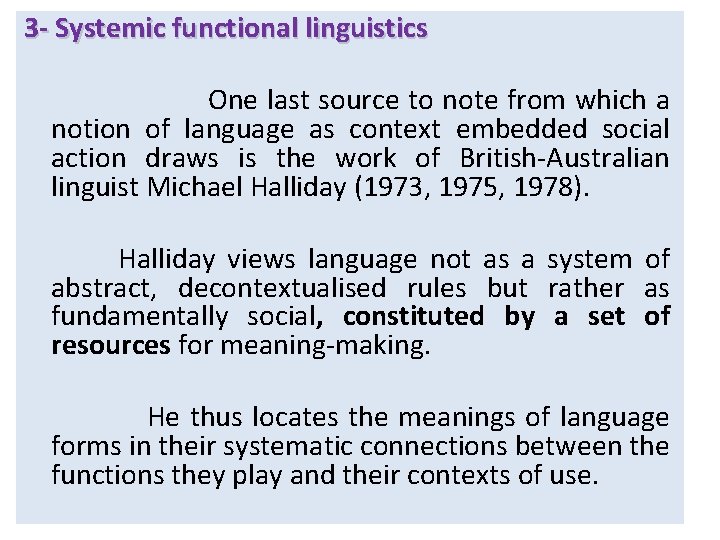
3 - Systemic functional linguistics One last source to note from which a notion of language as context embedded social action draws is the work of British-Australian linguist Michael Halliday (1973, 1975, 1978). Halliday views language not as a system of abstract, decontextualised rules but rather as fundamentally social, constituted by a set of resources for meaning-making. He thus locates the meanings of language forms in their systematic connections between the functions they play and their contexts of use.
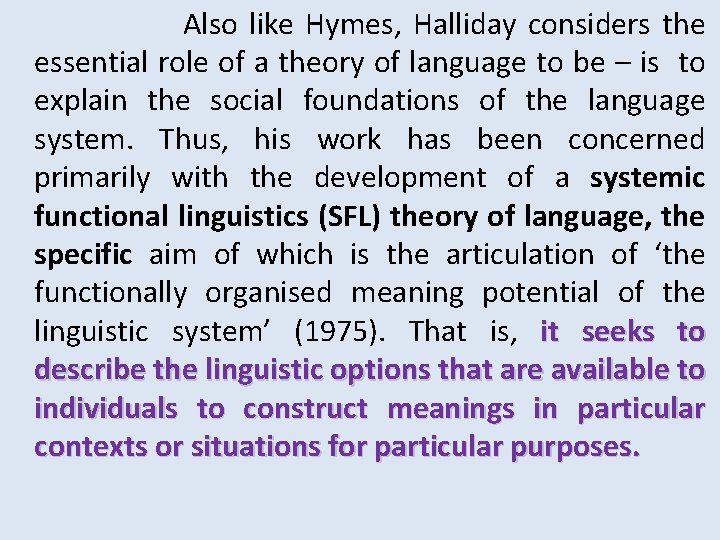
Also like Hymes, Halliday considers the essential role of a theory of language to be – is to explain the social foundations of the language system. Thus, his work has been concerned primarily with the development of a systemic functional linguistics (SFL) theory of language, the specific aim of which is the articulation of ‘the functionally organised meaning potential of the linguistic system’ (1975). That is, it seeks to describe the linguistic options that are available to individuals to construct meanings in particular contexts or situations for particular purposes.
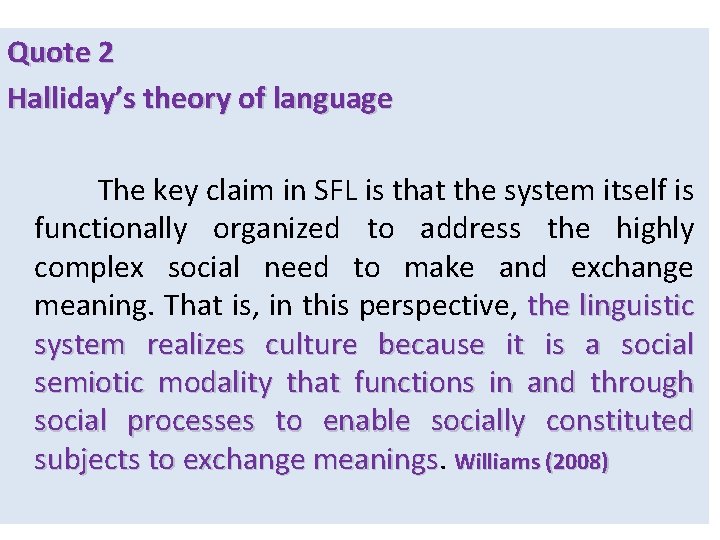
Quote 2 Halliday’s theory of language The key claim in SFL is that the system itself is functionally organized to address the highly complex social need to make and exchange meaning. That is, in this perspective, the linguistic system realizes culture because it is a social semiotic modality that functions in and through social processes to enable socially constituted subjects to exchange meanings Williams (2008)
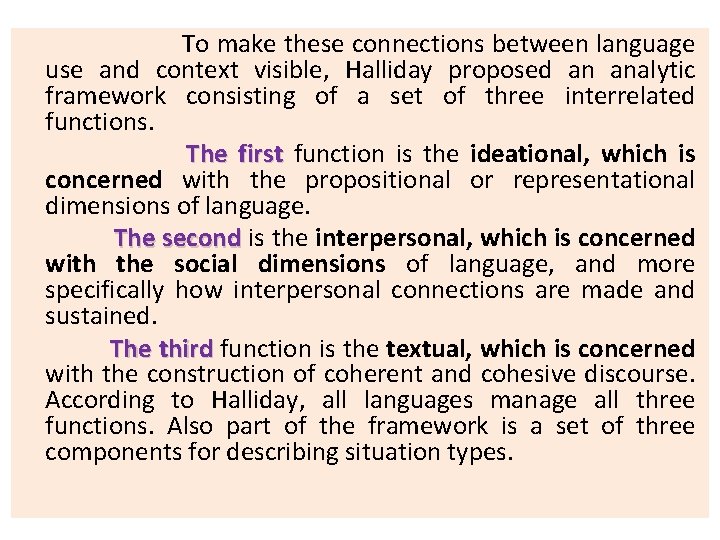
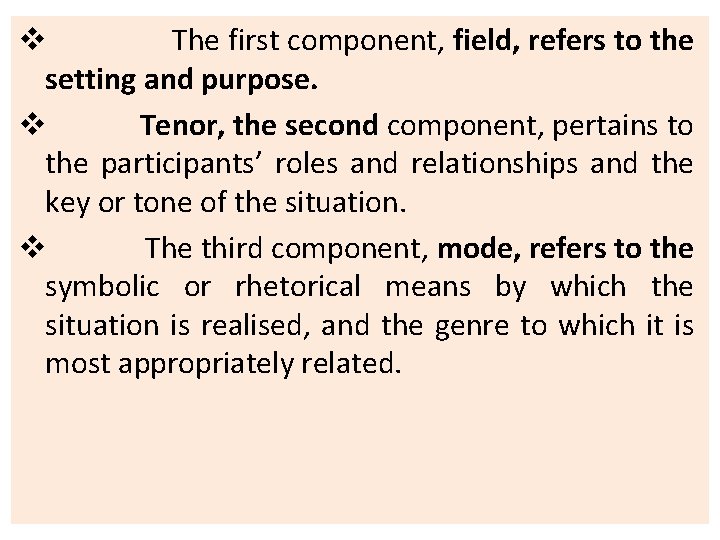
To make these connections between language use and context visible, Halliday proposed an analytic framework consisting of a set of three interrelated functions. The first function is the ideational, which is concerned with the propositional or representational dimensions of language. The second is the interpersonal, which is concerned with the social dimensions of language, and more specifically how interpersonal connections are made and sustained. The third function is the textual, which is concerned with the construction of coherent and cohesive discourse. According to Halliday, all languages manage all three functions. Also part of the framework is a set of three components for describing situation types.
v The first component, field, refers to the setting and purpose. v Tenor, the second component, pertains to the participants’ roles and relationships and the key or tone of the situation. v The third component, mode, refers to the symbolic or rhetorical means by which the situation is realised, and the genre to which it is most appropriately related.
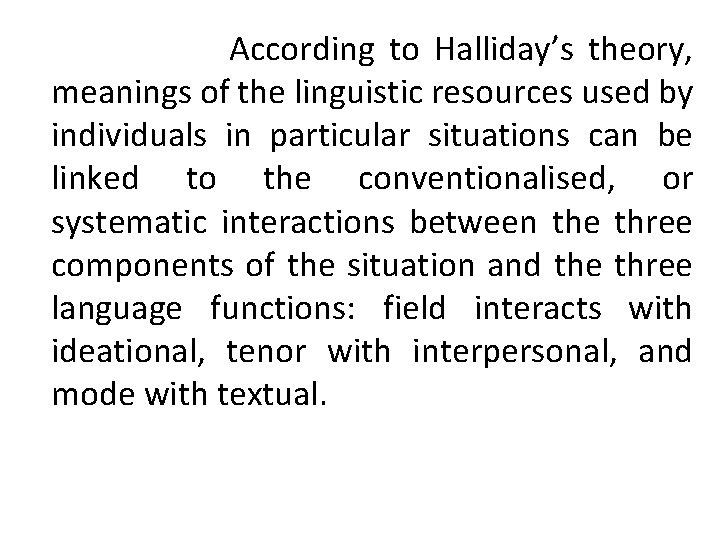
According to Halliday’s theory, meanings of the linguistic resources used by individuals in particular situations can be linked to the conventionalised, or systematic interactions between the three components of the situation and the three language functions: field interacts with ideational, tenor with interpersonal, and mode with textual.
This knowledge comprises the communicative plans with which individuals approach their communicative activities, and they use their shared understandings of a situation in terms of field, tenor and mode to anticipate the language forms and meanings likely to be used.
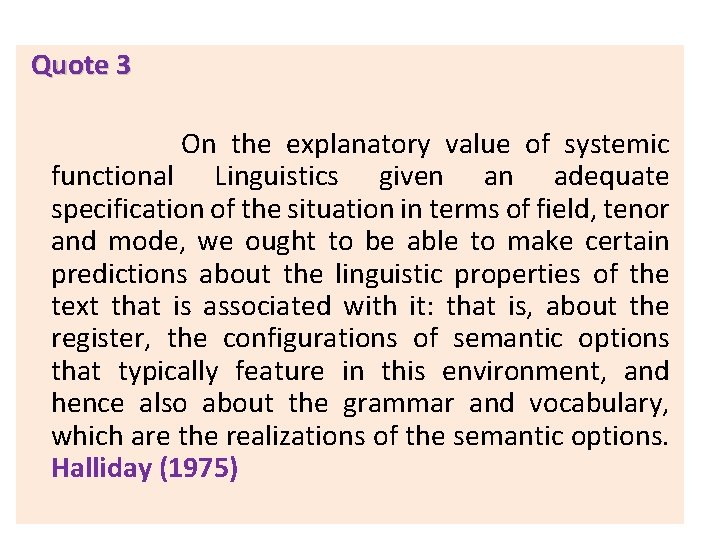
Quote 3 On the explanatory value of systemic functional Linguistics given an adequate specification of the situation in terms of field, tenor and mode, we ought to be able to make certain predictions about the linguistic properties of the text that is associated with it: that is, about the register, the configurations of semantic options that typically feature in this environment, and hence also about the grammar and vocabulary, which are the realizations of the semantic options. Halliday (1975)
Like Hymes’s approach to the study of language, SFL has engendered much empirical research. The directions taken, however, differ somewhat in that the focus of studies from the perspective of SFL is on describing functions of particular linguistic features as they are realised in a variety of texts.
A last point to make is that a sociocultural perspective of language and culture does not draw the same distinction between competence and performance as the traditional Chomskyan perspective does (Crowley, 1996). In the latter perspective, competence and performance are considered to be two distinct systems: systems the formal and the functional A sociocultural perspective makes no such distinction. Rather it takes as fundamental the existence of one system, a system of action, in which form and meaning – knowledge and use – are two mutually constituted components
Differences between traditional ‘a historical’ and, sociocultural approaches to the study of language. . . it is clear that the decontextualised, a historical approach to language must be called into question by a method which does not seek for an abstract structure but looks instead for the uses, and their significance, to which language is put at the micro- and macro-social levels.
And this is not just a question of turning away from langue to parole, or from competence to performance, since that would be to accept the misleading alternatives on offer in the established models.
The new approach would seek and analyse precisely neither abstract linguistic structure nor individual use but the institutional, political and ideological relationships between language and history. .
In short, it would consider the modes in which language becomes important for its users not as a faculty which they all share at an abstract level, but as a practice in which they all participate in very different ways, to very different effects, under very different pressures, in their everyday lives. Crowley (1996)