
From last time This is Andersens algorithm 94





![ESC/Java [Leino et al PLDI 2002] Clean. L TSys DSL DFA WP/SP MC ATP](https://slidetodoc.com/presentation_image_h2/4fa335d68bc65bcd63dda591094816b2/image-26.jpg "ESC/Java [Leino et al PLDI 2002] Clean. L TSys DSL DFA WP/SP MC ATP")

![Rhodium [Lerner et al POPL 2005] Clean. L TSys DSL DFA WP/SP MC ATP](https://slidetodoc.com/presentation_image_h2/4fa335d68bc65bcd63dda591094816b2/image-28.jpg "Rhodium [Lerner et al POPL 2005] Clean. L TSys DSL DFA WP/SP MC ATP")
![Rhodium [Lerner et al POPL 2005] Clean. L TSys DSL DFA WP/SP MC ATP](https://slidetodoc.com/presentation_image_h2/4fa335d68bc65bcd63dda591094816b2/image-29.jpg "Rhodium [Lerner et al POPL 2005] Clean. L TSys DSL DFA WP/SP MC ATP")
![Rhodium [Lerner et al POPL 2005] Rdm Opt VCGen Optdependent Clean. L TSys DSL](https://slidetodoc.com/presentation_image_h2/4fa335d68bc65bcd63dda591094816b2/image-30.jpg "Rhodium [Lerner et al POPL 2005] Rdm Opt VCGen Optdependent Clean. L TSys DSL")

- Slides: 31
From last time This is Andersen’s algorithm ’ 94 Final result S 1: l : = new Cons Iter 1 Iter 2 p : = l l p S 1 p l S 2: t : = new Cons l p p : = t S 1 t S 2 l S 2 S 1 l t S 2 S 1 L 2 S 1 l l S 2 L 1 t L 2 p l t S 2 S 1 t p l p t p l t p *p : = t l p S 1 Iter 3 S 1 t S 2 p l S 1 t S 2
Flow insensitive loss of precision • Flow insensitive analysis leads to loss of precision! main() { x : = &y; . . . Flow insensitive analysis tells us that x may point to z here! x : = &z; } • However: – uses less memory (memory can be a big bottleneck to running on large programs) – runs faster
Worst case complexity of Andersen x a b y c d e x *x = y f a b y c d e Worst case: N 2 per statement, so at least N 3 for the whole program. Andersen is in fact O(N 3) f
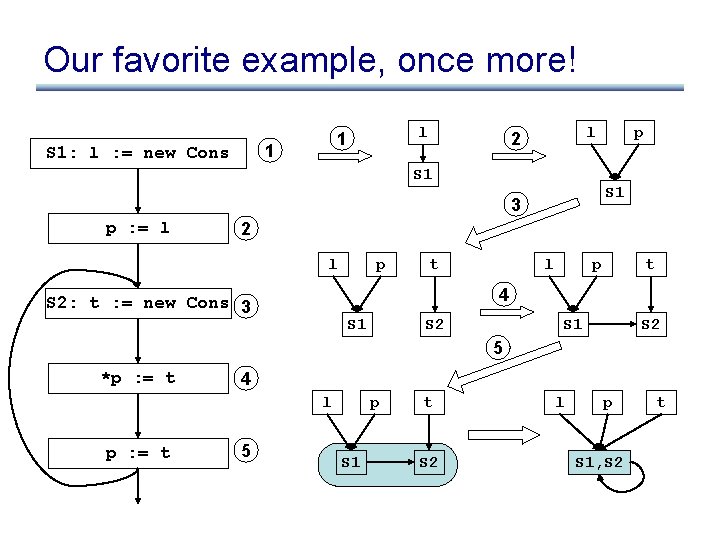
New idea: one successor per node • Make each node have only one successor. • This is an invariant that we want to maintain. x y a, b, c d, e, f *x = y x y a, b, c d, e, f
More general case for *x = y x y *x = y
More general case for *x = y x *x = y y x y
Handling: x = *y
Handling: x = *y x x = *y y x y
Handling: x = y (what about y = x? ) x y x = y Handling: x = &y
Handling: x = y (what about y = x? ) x y x y x = y get the same for y = x Handling: x = &y x y x x = &y y, …
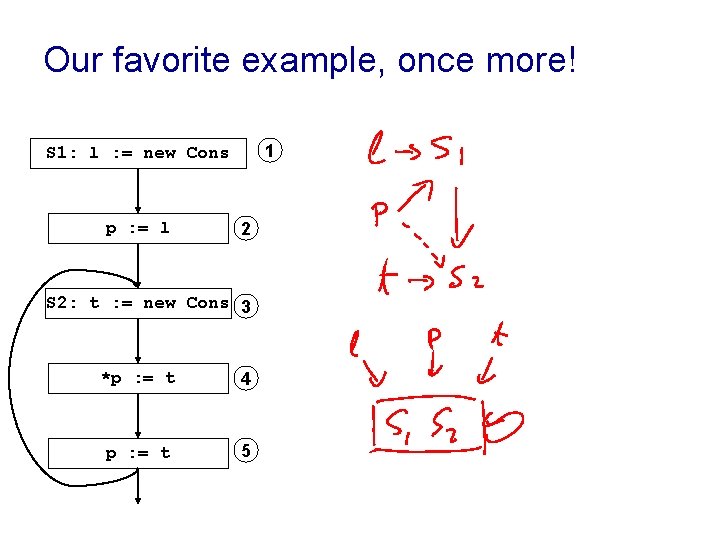
Our favorite example, once more! 1 S 1: l : = new Cons p : = l 2 S 2: t : = new Cons 3 *p : = t 4 p : = t 5
Our favorite example, once more! 1 S 1: l : = new Cons l 1 l 2 S 1 3 p : = l p 2 l p t 4 S 2: t : = new Cons 3 S 1 S 2 5 *p : = t 4 l p : = t 5 p S 1 t S 2 l p S 1, S 2 t
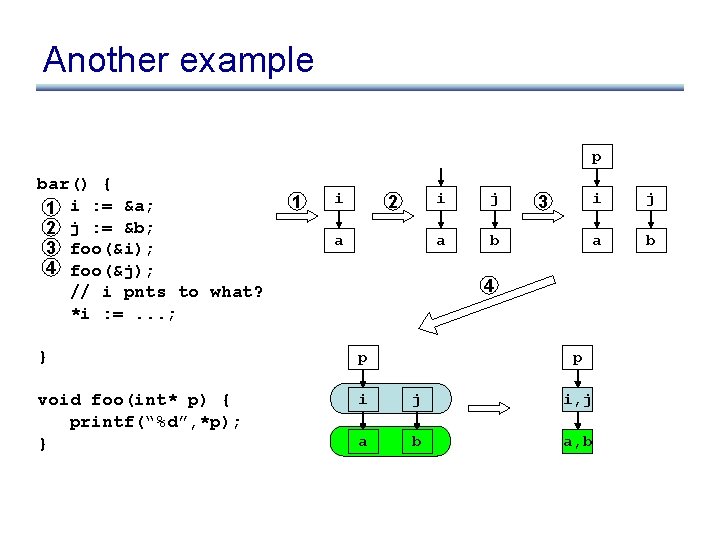
Another example bar() { 1 i : = &a; 2 j : = &b; 3 foo(&i); 4 foo(&j); // i pnts to what? *i : =. . . ; } void foo(int* p) { printf(“%d”, *p); }
Another example p bar() { 1 i : = &a; 2 j : = &b; 3 foo(&i); 4 foo(&j); // i pnts to what? *i : =. . . ; 1 i 2 a i j a b 3 i j a b 4 } p void foo(int* p) { printf(“%d”, *p); } i j i, j a b a, b p
Steensgaard & beyond • A well engineered implementation of Steensgaard ran on Word 97 (2. 1 MLOC) in 1 minute. • One Level Flow (Das PLDI 00) is an extension to Steensgaard that gets more precision and runs in 2 minutes on Word 97.
Program analysis and Software Reliability
Software reliability: issues • What are the issues?
Software reliability: issues • What is software reliability? How to measure it? – Bug counts ? Will we ever have bug-free software? – How many 9’s ? – Service Level Agreements ? • What is a bug? – – Adherence to specifications But what is a specification… User unhappy: is that a bug? Different levels of severity
Software reliability: issues • Cost of the methods for achieving reliability – Independently develop 5 versions of the software, run them all in parallel ) less likely that they fail at the same time in the same way. But… cost… is… high – For tools, cost of development of the tools • Burden on the programmer – fully automated vs. semi-automated methods – allow progressive adoption • Scalability vs. precision – start with scalability and get precision later? – Or the other way around?
Software reliability: issues • Level of guarantee provided by the method – Hard guarantees, statistical guarantees, no formal guarantee – What if tool is broken: trusted computing base • When is the method used? – compile-time, link-time, load-time, run-time • What does the tool see? – source code, assembly, the whole program or part of the program
One way of dividing the spectrum if (…) { x : = …; } else { y : = …; } …; Compiler 0100101 1010010 1011011
One way of dividing the spectrum Static techniques if (…) { x : = …; } else { y : = …; } …; Testing techniques Compiler 0100101 1010010 1011011 Run-time techniques
One way of dividing the spectrum Static techniques if (…) { x : = …; } else { y : = …; } …; Testing techniques Compiler 0100101 1010010 1011011 Run-time techniques
Static Techniques if (…) { x : = …; } else { y : = …; } …; Code satisfies spec? Spec « ¬ $ r t l • Spec: says what code should and should not do • Complete spec: specifies all behaviors (hard to formalize) • Incomplete spec: only defines some behaviors – e. g. “no null derefs”, “requests received are eventually processed” • Many formalisms exist for specs (Pre/Post conditions, FSMs, Temporal Logic, Abstract State Machines etc. )
Clean. L TSys DSL Static Techniques if (…) { x : = …; } else { y : = …; } …; Code satisfies spec? Spec « ¬ $ r t l • Language Design – Clean language design – Type Systems – Domain-specific languages – … DFA WP/SP MC ATP • Program Analysis Interaction between the two – – Dataflow analysis WP/SP Model checking Automated Theorem Proving – …
ESC/Java [Leino et al PLDI 2002] Clean. L TSys DSL DFA WP/SP MC ATP • Programmer annotates code with pre- and postconditions, tool verifies that these hold Automated Theorem Prover object Foo { //@ PRE (FORMULA) method bar(. . . ) { ) WP(POST, bar) = weakest condition Q such that Q at entry to bar establishes POST at exist . . . Compute Weakest Precondition } //@ POST (FORMULA) }
How does Program Analysis fit in? • First, WP computation is a kind of program analysis – – in fact, can be seen as a dataflow analysis predicates as sets of states WP operator acts as flow function WP-based concrete semantics • Second, can use global points-to analysis to help WP computation – do better job with pointer stores *x : =. . . – or with field assignments o. f : =. . .
Rhodium [Lerner et al POPL 2005] Clean. L TSys DSL DFA WP/SP MC ATP Compiler Parser DSL Opt Checker Code Gen
Rhodium [Lerner et al POPL 2005] Clean. L TSys DSL DFA WP/SP MC ATP Compiler Parser DSL Opt Checker Code Gen
Rhodium [Lerner et al POPL 2005] Rdm Opt VCGen Optdependent Clean. L TSys DSL DFA WP/SP MC ATP Opt-independent Lemma For any Rhodium opt: If Local VC is true Then opt is OK Local VC Checker f oo ¬ Pr « $ r l t Automatic Theorem Prover
How does Program Analysis fit in? • First, Rhodium is a system for expressing and checking the correctness of DFAs • Second, the Rhodium system is an example of program analysis of a domain-specific language