
From last time Theories are tested by observations
From last time… • Theories are tested by observations. • Different theories can predict equivalent behavior within experimental accuracy. • Simplicity or symmetry of a theory may be hints of its ‘truth’. • In some cases, a new theory forced by observations can require acceptance of radical, non-intuitive ideas. Physics 107, Fall 2006 1

Aristotle’s views on motion • Aristotle’s observations VERTICAL MOTION – The element earth moves down toward its natural resting place. – Water’s natural place is just above earth. – Air rises to its natural place in the atmosphere. – Fire leaps upwards to its natural place above the atmosphere. HORIZONTAL MOTION – Qualitatively different. – Bodies seem to need push or pull to maintain horizontal motion (contrary to their ‘natural’ motion). Physics 107, Fall 2006 2
More Aristotle • Heavier objects should fall vertically faster than lighter ones. • Why? – Theoretically: • Heavier ones contain more of the ‘earth’ element. – Experimentally: • Light objects often observed to fall slowly • Harder to lift heavier objects • How much faster? – Aristotle says proportional to their weight. – Unclear why, but is simplest relation. • Clearly doesn’t work in some cases. – e. g. Flat paper vs crumpled paper. Physics 107, Fall 2006 3
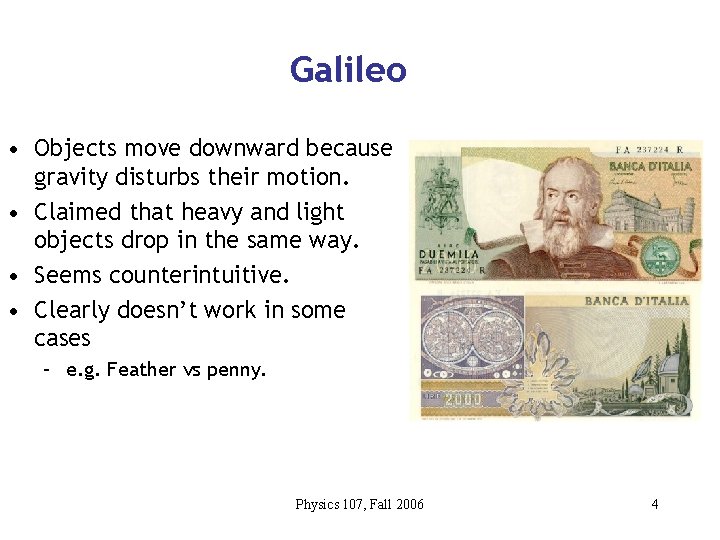
Galileo • Objects move downward because gravity disturbs their motion. • Claimed that heavy and light objects drop in the same way. • Seems counterintuitive. • Clearly doesn’t work in some cases – e. g. Feather vs penny. Physics 107, Fall 2006 4
Which falls faster? A. Heavier mass hits first B. Lighter mass hits first C. Both masses hit at the same time Physics 107, Fall 2006 5
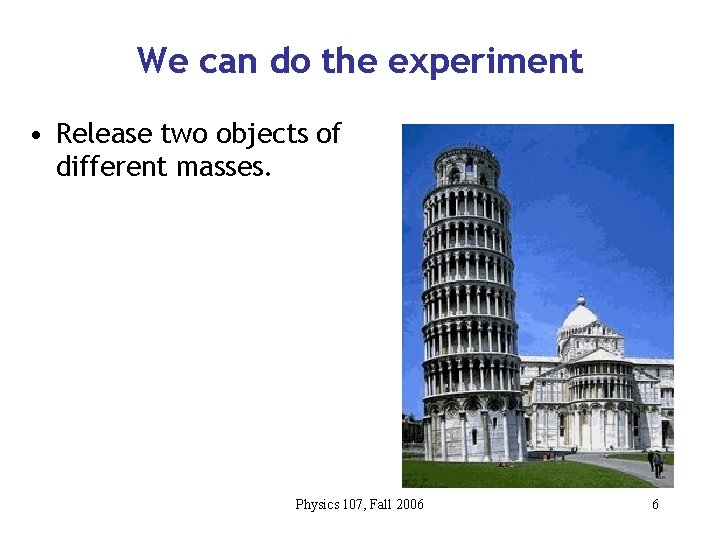
We can do the experiment • Release two objects of different masses. Physics 107, Fall 2006 6
Why doesn’t it seem exactly right? • Confused by air resistance. Air exerts a force on the falling body. • Would be clearer if we could do it in vacuum. • May allow us to tell which theory is correct. Physics 107, Fall 2006 7
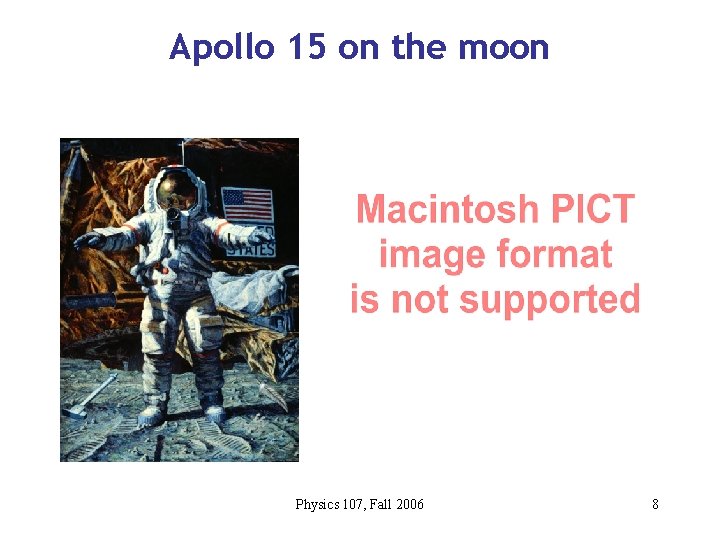
Apollo 15 on the moon Physics 107, Fall 2006 8
Just how does the object fall? Galileo showed that the falling motion is independent of mass, but… • How long does it take to fall? • How fast is it going? • Does the speed change during the fall? Or… What makes something move? Physics 107, Fall 2006 9
Galileo’s ideas about motion Principle of Inertia Object moving on level surface moves in unchanging direction at constant speed unless disturbed. Principle of superposition An object subject to two separate influences (disturbances) responds to each without modifying its response to the other. Physics 107, Fall 2006 10
Inertia • No continued pushing/pulling required to maintain horizontal motion. – Object retains constant speed (possibly zero) unless pushed or pulled. • Direct contradiction to previous views. Inertia: describes degree to which an object will maintain its state of motion, whether moving or at rest. Large inertia -> difficult to change state of motion of object Physics 107, Fall 2006 11
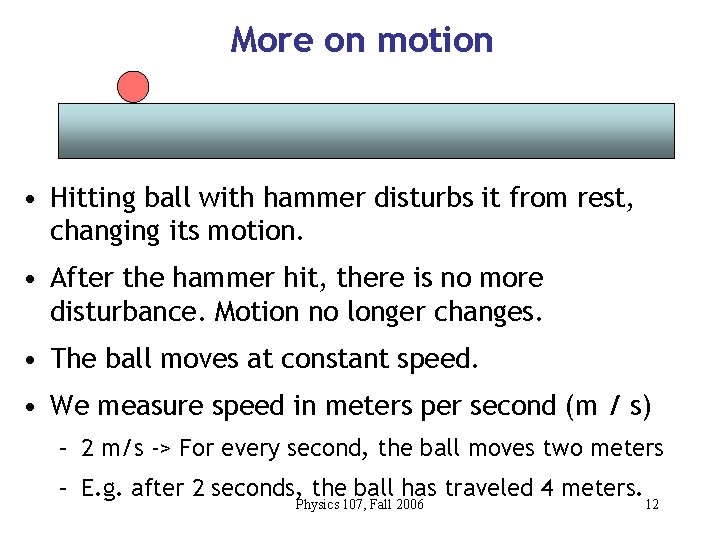
More on motion • Hitting ball with hammer disturbs it from rest, changing its motion. • After the hammer hit, there is no more disturbance. Motion no longer changes. • The ball moves at constant speed. • We measure speed in meters per second (m / s) – 2 m/s -> For every second, the ball moves two meters – E. g. after 2 seconds, the ball has traveled 4 meters. Physics 107, Fall 2006 12
Superposition • Hit the ball with two hammers • Both these disturbances act on the ball, causing it to change it’s motion. • Net effect on the ball is the superposition, or adding up, of the two disturbances (hammer hits) Physics 107, Fall 2006 13
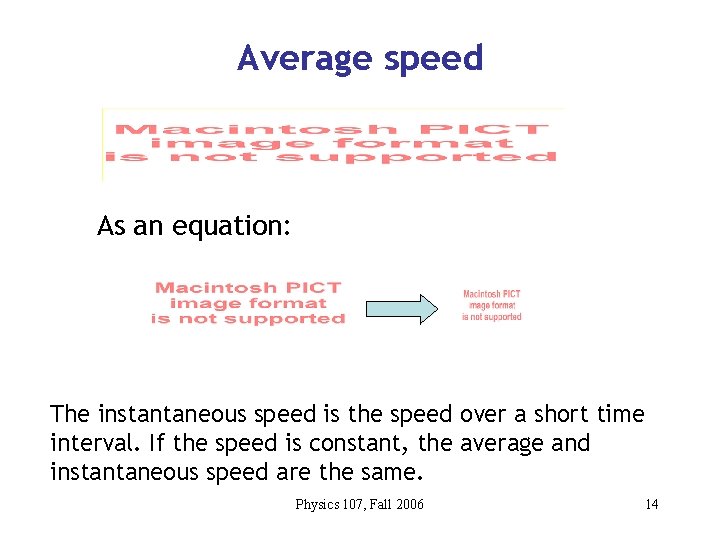
Average speed As an equation: The instantaneous speed is the speed over a short time interval. If the speed is constant, the average and instantaneous speed are the same. Physics 107, Fall 2006 14
Instantaneous speed • Instantaneous speed is the average velocity over an infinitesimal (very short) time interval. • This is what your speedometer reads. • Instantaneous speed gives you a better understanding of the motion. Physics 107, Fall 2006 15
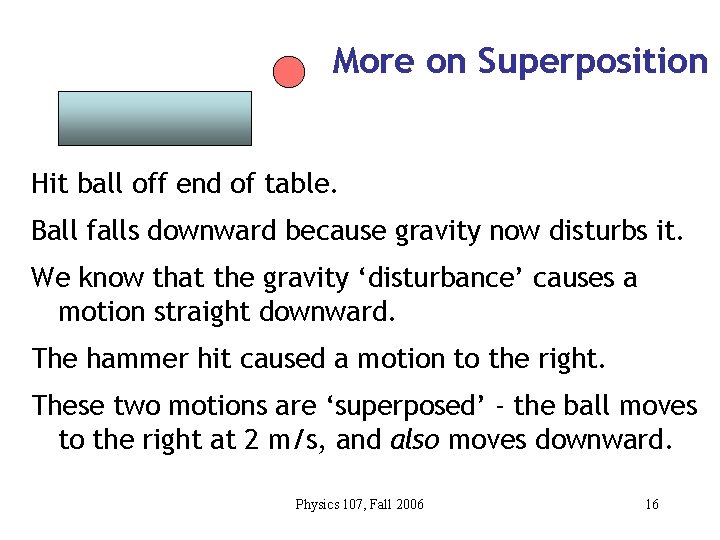
More on Superposition Hit ball off end of table. Ball falls downward because gravity now disturbs it. We know that the gravity ‘disturbance’ causes a motion straight downward. The hammer hit caused a motion to the right. These two motions are ‘superposed’ - the ball moves to the right at 2 m/s, and also moves downward. Physics 107, Fall 2006 16
Back to falling objects I drop two balls, one from twice the height of the other. The time it takes the higher ball to fall is how much longer than the lower ball? A. B. C. D. Twice Three time Four times None of the above Physics 107, Fall 2006 17
Details of a falling object • Just how does the object fall? • Apparently independent of mass, but how fast? • Starts at rest (zero speed), ends moving fast §Hence speed is not constant. • Final speed increases with height. • Falling time increases with height. Physics 107, Fall 2006 18
Galileo measured this • But falling motion too fast for accurate measurement. • Galileo was able to measure a different aspect, that let him determine the time. • In this way he made extremely accurate measurements. Physics 107, Fall 2006 19
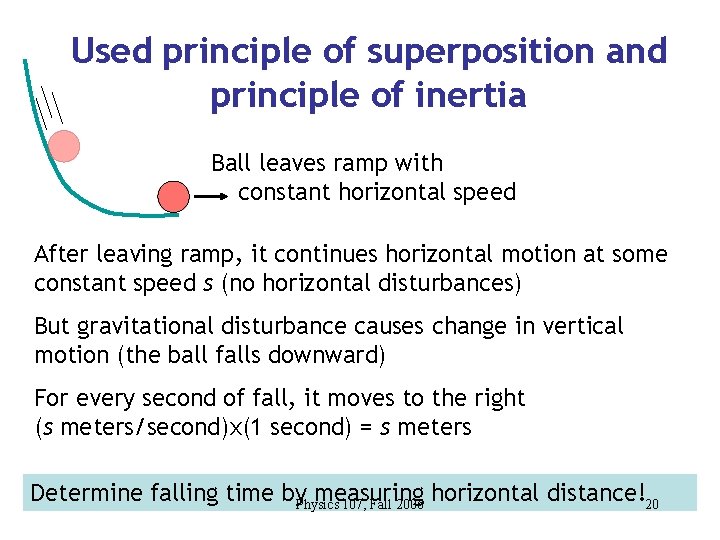
Used principle of superposition and principle of inertia Ball leaves ramp with constant horizontal speed After leaving ramp, it continues horizontal motion at some constant speed s (no horizontal disturbances) But gravitational disturbance causes change in vertical motion (the ball falls downward) For every second of fall, it moves to the right (s meters/second)x(1 second) = s meters Determine falling time by. Physics measuring horizontal distance!20 107, Fall 2006

An equation From this, Galileo determined that the falling time varied proportional to the square root of the falling distance. Falling time = t Falling distance = d Physics 107, Fall 2006 21

How much longer does it take? I drop two balls, one from twice the height of the other. The time it takes the higher ball to fall is how much longer than the lower ball? A. B. C. D. Two times longer Three times longer Four times longer Square root of 2 longer Physics 107, Fall 2006 22
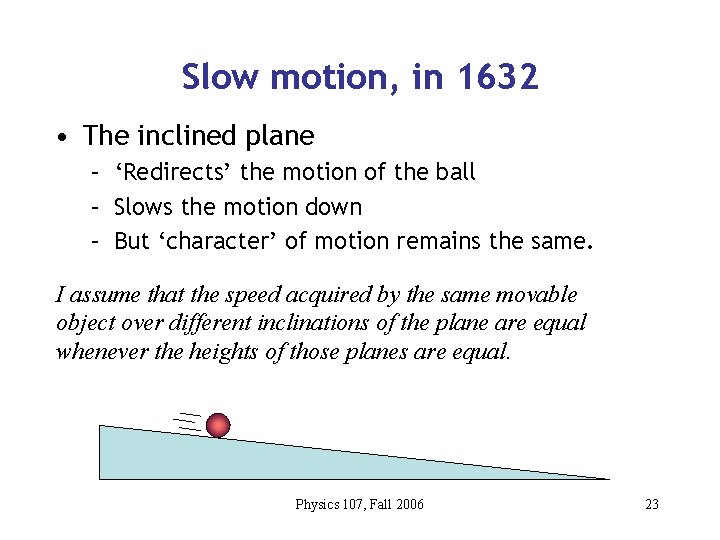
Slow motion, in 1632 • The inclined plane – ‘Redirects’ the motion of the ball – Slows the motion down – But ‘character’ of motion remains the same. I assume that the speed acquired by the same movable object over different inclinations of the plane are equal whenever the heights of those planes are equal. Physics 107, Fall 2006 23
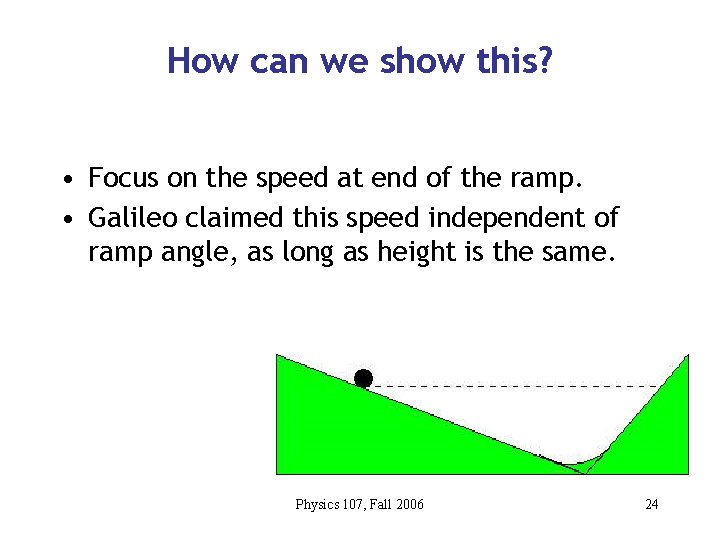
How can we show this? • Focus on the speed at end of the ramp. • Galileo claimed this speed independent of ramp angle, as long as height is the same. Physics 107, Fall 2006 24
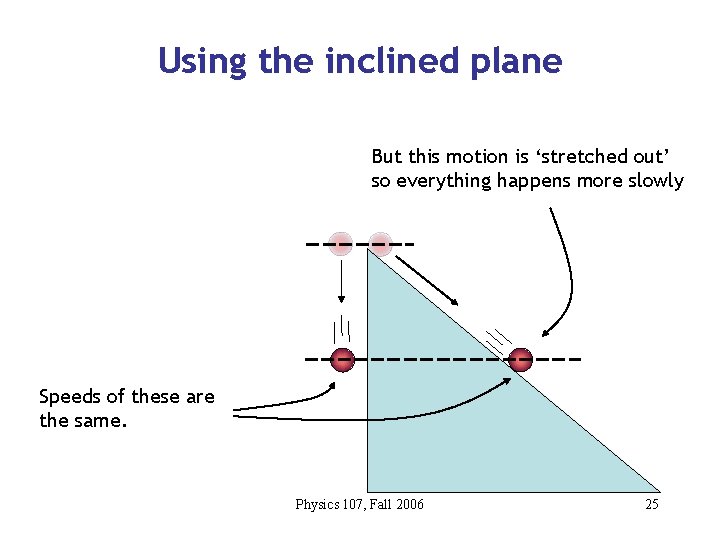
Using the inclined plane But this motion is ‘stretched out’ so everything happens more slowly Speeds of these are the same. Physics 107, Fall 2006 25
Measure gravitational dropping motion with inclined plane • Have argued motion is the same. • Difficult to measure velocity… • …but can now measure distance and time from marks on the inclined plane. Physics 107, Fall 2006 26
Falling speed As an object falls, it’s speed is A. Constant B. Increasing proportional to time C. Increasing proportional to time squared Physics 107, Fall 2006 27
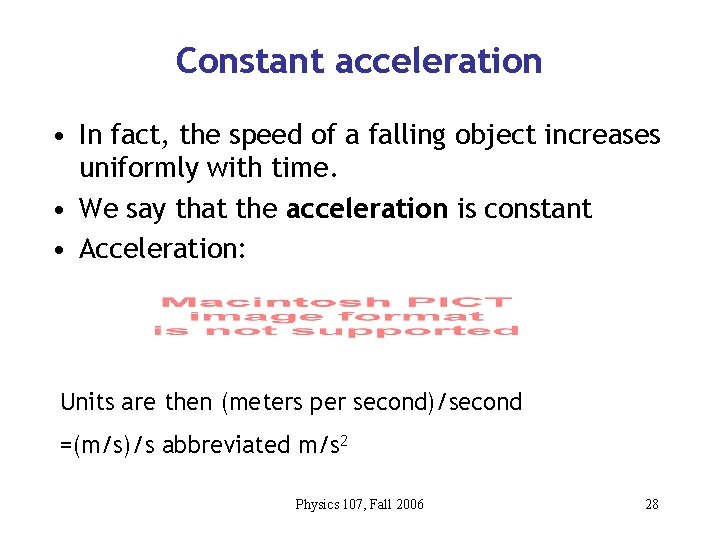
Constant acceleration • In fact, the speed of a falling object increases uniformly with time. • We say that the acceleration is constant • Acceleration: Units are then (meters per second)/second =(m/s)/s abbreviated m/s 2 Physics 107, Fall 2006 28
Galileo’s experiment A piece of wooden moulding or scantling, about 12 cubits [about 7 m] long, half a cubit [about 30 cm] wide and three finger-breadths [about 5 cm] thick, was taken; on its edge was cut a channel a little more than one finger in breadth; having made this groove very straight, smooth, and polished, and having lined it with parchment, also as smooth and polished as possible, we rolled along it a hard, smooth, and very round bronze ball. For the measurement of time, we employed a large vessel of water placed in an elevated position; to the bottom of this vessel was soldered a pipe of small diameter giving a thin jet of water, which we collected in a small glass during the time of each descent. . . the water thus collected was weighed, after each descent, on a very accurate balance; the difference and ratios of these weights gave us the differences and ratios of the times. . . Using this method, Galileo very precisely determined a law that explained the. Physics motion 107, Fall 2006 29
Next time… • Have uncovered some quantitative relations regarding motions of bodies. • But need to clearly define the concepts to describe this motion • Next time we will investigate position, velocity, acceleration, momentum Physics 107, Fall 2006 30
- Slides: 30