
FROM INSIGHT TO DELIVERY Social Return on Investment
- Slides: 23
FROM INSIGHT TO DELIVERY Social Return on Investment Value for Money in Health and Wellbeing: for the People of Greenwich Graham Lister Visiting Professor London South Bank University
Some Questions? ¢ What is value for money? l ¢ What do we mean by wellbeing? l ¢ Why do LAs and NHS need a common language? How do we predict long term behaviour outcomes? l ¢ How do we measure social value? What is Social Return on Investment? l ¢ Whose values are we talking about? When we can only measure short term change? How do we allow for uncertainty? l And discount long term impacts?
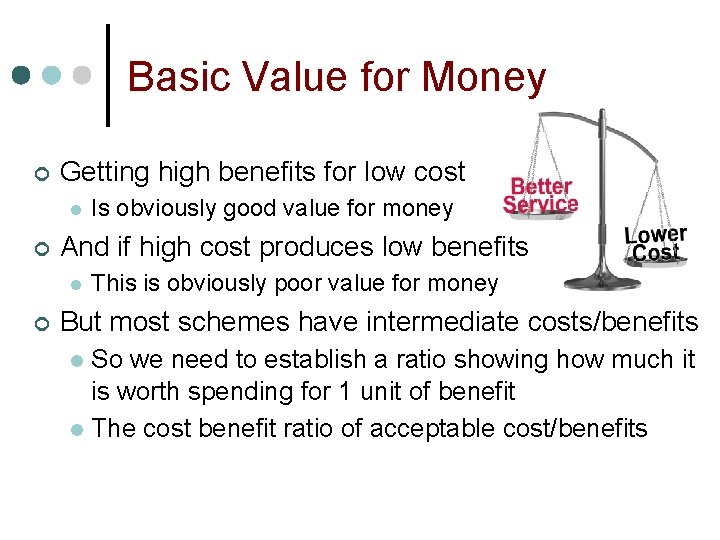
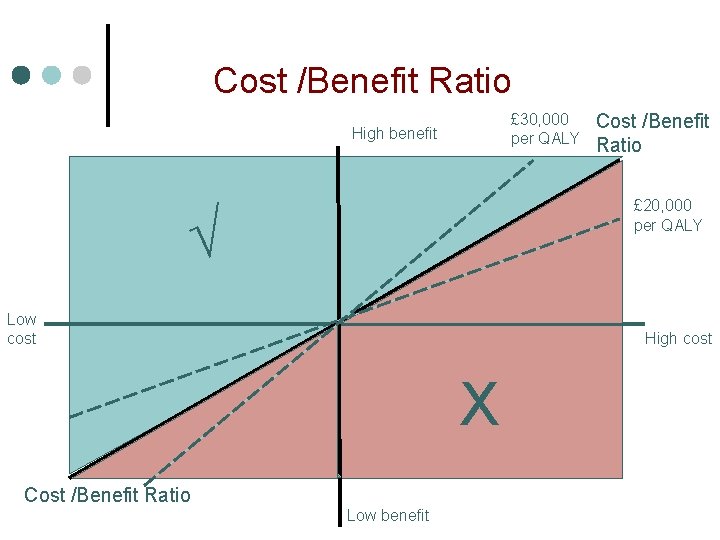
Basic Value for Money ¢ Getting high benefits for low cost l ¢ And if high cost produces low benefits l ¢ Is obviously good value for money This is obviously poor value for money But most schemes have intermediate costs/benefits So we need to establish a ratio showing how much it is worth spending for 1 unit of benefit l The cost benefit ratio of acceptable cost/benefits l
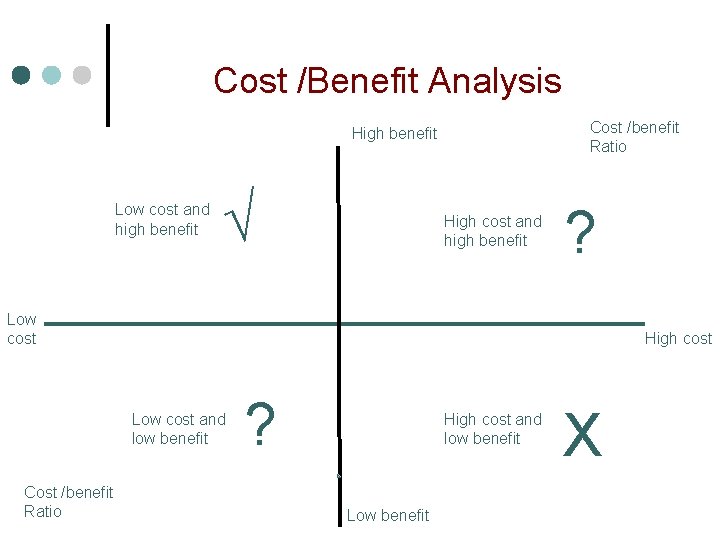
Cost /Benefit Analysis Cost /benefit Ratio High benefit Low cost and high benefit √ High cost and high benefit ? Low cost High cost Low cost and low benefit Cost /benefit Ratio ? High cost and low benefit Low benefit X
Cost /Benefit Ratio £ 30, 000 per QALY High benefit Cost /Benefit Ratio £ 20, 000 per QALY √ Low cost High cost X Cost /Benefit Ratio Low benefit
Cost Benefit/ Value for money ¢ Value for Money may mean: l Cost Offset ~ cost per £ saved l Cost effectiveness ~ cost/ outcome l Cost consequences ~ cost/ multiple outcome l Cost-utility ~ cost/weighted outcomes l Cost benefit ~ cost/ £ economic value l Social Return on Investment ~ total social cost per value to society (wellbeing) improved.
How was Social Return on Investment developed? ¢ ¢ Developed in USA in late 1990 s l To evaluate social enterprises with non profit aims A European Network formed in 2004 l To develop consistent approach and methodology New Economic Foundation UK 2004/5 l SROI Primer and Methodology published 2004 Cabinet Office supports guide and network 2009 l ¢ Guide to SROI for Wellbeing Programmes 2013/2015 Legislative Framework l l l Health and Social Care Act 2012 Public Services (Social Value Act) 2012 Care Act 2014
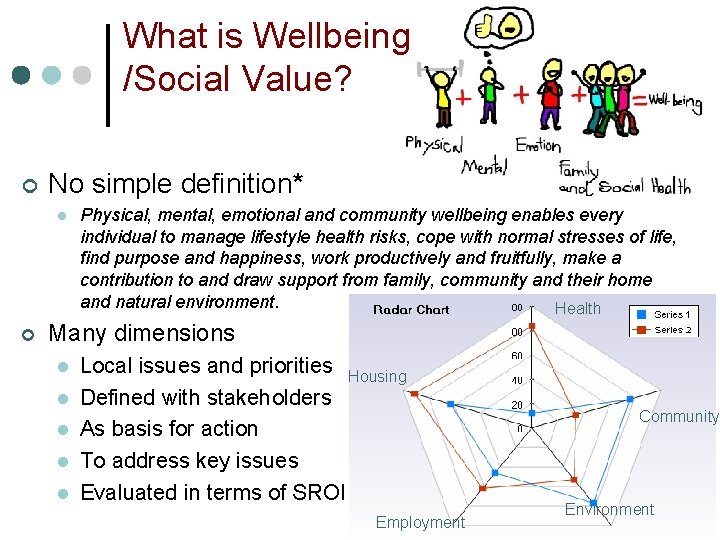
What is Wellbeing /Social Value? ¢ No simple definition* l ¢ Physical, mental, emotional and community wellbeing enables every individual to manage lifestyle health risks, cope with normal stresses of life, find purpose and happiness, work productively and fruitfully, make a contribution to and draw support from family, community and their home and natural environment. Health Many dimensions l l l Local issues and priorities Housing Defined with stakeholders As basis for action To address key issues Evaluated in terms of SROI Employment Community Environment
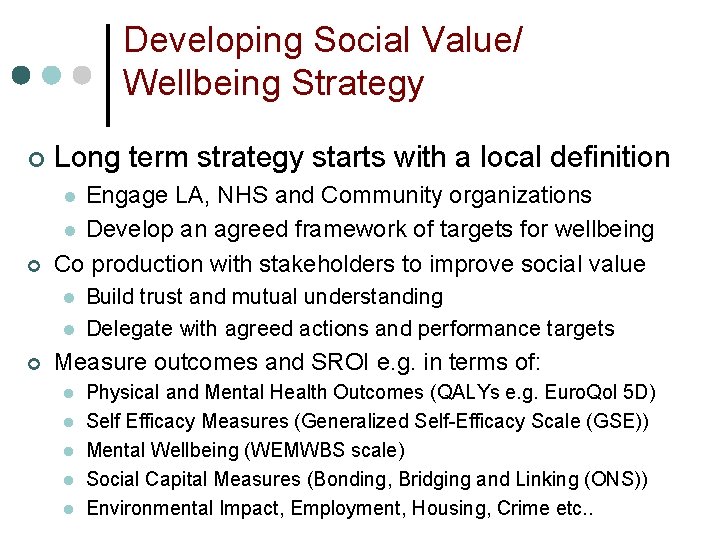
Developing Social Value/ Wellbeing Strategy ¢ Long term strategy starts with a local definition ¢ Engage LA, NHS and Community organizations l Develop an agreed framework of targets for wellbeing Co production with stakeholders to improve social value l l l ¢ Build trust and mutual understanding Delegate with agreed actions and performance targets Measure outcomes and SROI e. g. in terms of: l l l Physical and Mental Health Outcomes (QALYs e. g. Euro. Qol 5 D) Self Efficacy Measures (Generalized Self-Efficacy Scale (GSE)) Mental Wellbeing (WEMWBS scale) Social Capital Measures (Bonding, Bridging and Linking (ONS)) Environmental Impact, Employment, Housing, Crime etc. .
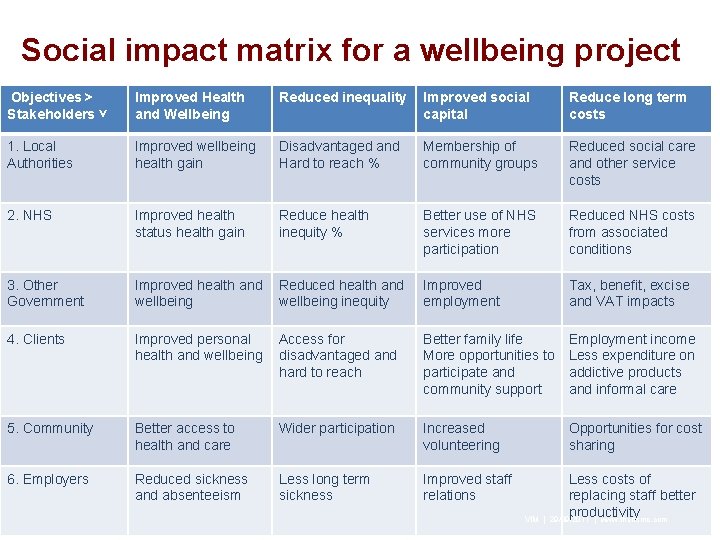
Social impact matrix for a wellbeing project Objectives > Stakeholders ˅ Improved Health and Wellbeing Reduced inequality Improved social capital Reduce long term costs 1. Local Authorities Improved wellbeing health gain Disadvantaged and Hard to reach % Membership of community groups Reduced social care and other service costs 2. NHS Improved health status health gain Reduce health inequity % Better use of NHS services more participation Reduced NHS costs from associated conditions 3. Other Government Improved health and wellbeing Reduced health and wellbeing inequity Improved employment Tax, benefit, excise and VAT impacts 4. Clients Improved personal health and wellbeing Access for disadvantaged and hard to reach Better family life More opportunities to participate and community support Employment income Less expenditure on addictive products and informal care 5. Community Better access to health and care Wider participation Increased volunteering Opportunities for cost sharing 6. Employers Reduced sickness and absenteeism Less long term sickness Improved staff relations Vf. M | Less costs of replacing staff better productivity 29/09/2011 | www. thensmc. com
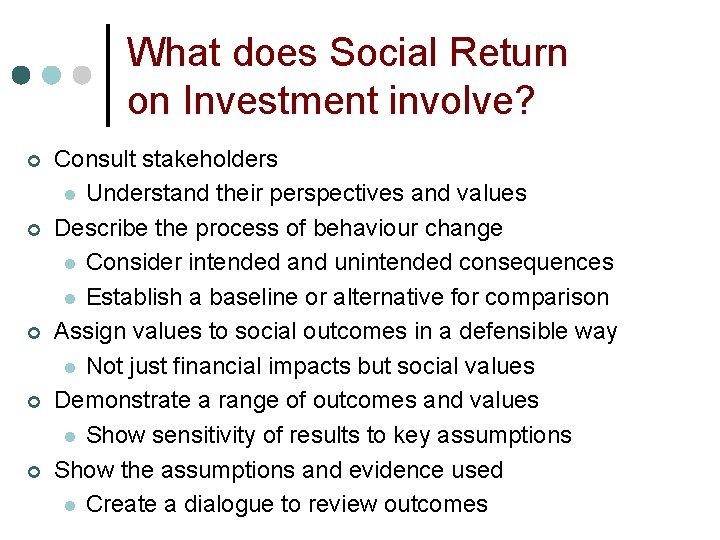
What does Social Return on Investment involve? ¢ ¢ ¢ Consult stakeholders l Understand their perspectives and values Describe the process of behaviour change l Consider intended and unintended consequences l Establish a baseline or alternative for comparison Assign values to social outcomes in a defensible way l Not just financial impacts but social values Demonstrate a range of outcomes and values l Show sensitivity of results to key assumptions Show the assumptions and evidence used l Create a dialogue to review outcomes
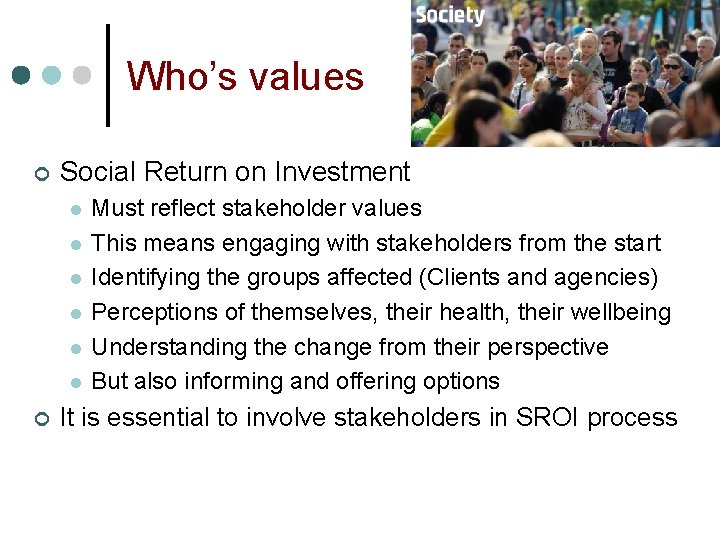
Who’s values ¢ Social Return on Investment l l l ¢ Must reflect stakeholder values This means engaging with stakeholders from the start Identifying the groups affected (Clients and agencies) Perceptions of themselves, their health, their wellbeing Understanding the change from their perspective But also informing and offering options It is essential to involve stakeholders in SROI process
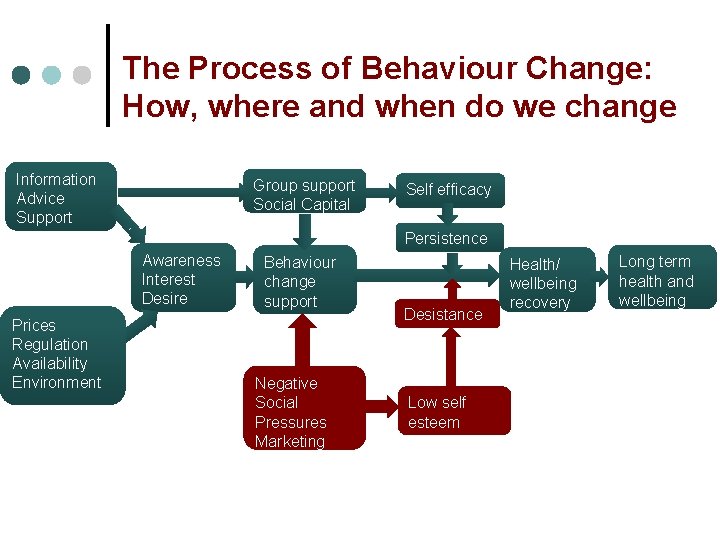
The Process of Behaviour Change: How, where and when do we change Information Advice Support Group support Social Capital Self efficacy Persistence Awareness Interest Desire Prices Regulation Availability Environment Behaviour change support Negative Social Pressures Marketing Desistance Low self esteem Health/ wellbeing recovery Long term health and wellbeing
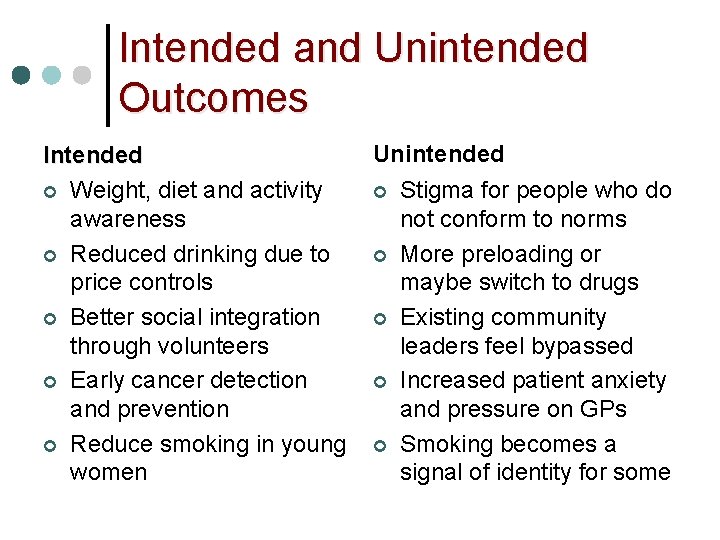
Intended and Unintended Outcomes Intended ¢ Weight, diet and activity awareness ¢ Reduced drinking due to price controls ¢ Better social integration through volunteers ¢ Early cancer detection and prevention ¢ Reduce smoking in young women Unintended ¢ ¢ ¢ Stigma for people who do not conform to norms More preloading or maybe switch to drugs Existing community leaders feel bypassed Increased patient anxiety and pressure on GPs Smoking becomes a signal of identity for some
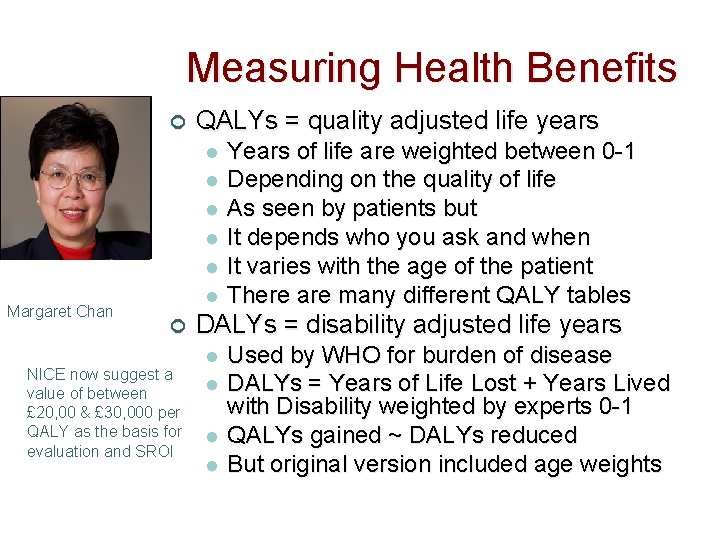
Measuring Health Benefits ¢ QALYs = quality adjusted life years l l l Margaret Chan l ¢ NICE now suggest a value of between £ 20, 00 & £ 30, 000 per QALY as the basis for evaluation and SROI Years of life are weighted between 0 -1 Depending on the quality of life As seen by patients but It depends who you ask and when It varies with the age of the patient There are many different QALY tables DALYs = disability adjusted life years l l Used by WHO for burden of disease DALYs = Years of Life Lost + Years Lived with Disability weighted by experts 0 -1 QALYs gained ~ DALYs reduced But original version included age weights
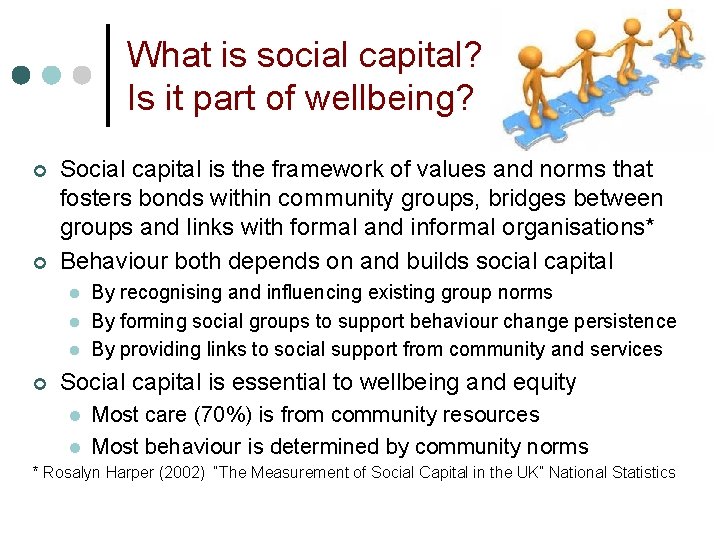
What is social capital? Is it part of wellbeing? ¢ ¢ Social capital is the framework of values and norms that fosters bonds within community groups, bridges between groups and links with formal and informal organisations* Behaviour both depends on and builds social capital l ¢ By recognising and influencing existing group norms By forming social groups to support behaviour change persistence By providing links to social support from community and services Social capital is essential to wellbeing and equity l l Most care (70%) is from community resources Most behaviour is determined by community norms * Rosalyn Harper (2002) “The Measurement of Social Capital in the UK” National Statistics
Why is improving equity important for wellbeing? ¢ ¢ ¢ It is morally wrong to allow disadvantage to determine outcomes - so equity is an objective of health and wellbeing People in the most deprived areas, have a life expectancy 34 years less than those in the least deprived areas, about 2 years less than the average they also score lower wellbeing Reducing inequality in health and wellbeing is also a social value and a target for Local Authorities and NHS.
Is Integrated Health and Social Care Important for Wellbeing? ¢ Integrated care creates social value and wellbeing l See LGA resources http: //www. local. gov. uk/health-wellbeing-and-adultsocial-care/-/journal_content/56/10180/4060433/ARTICLE ¢ This goes further than LA/NHS cooperation l It requires community engagement in co-production of advice, support and neighbourhood schemes l Thoughtful redesign of: housing, advice and support services, community spaces, transport, access to the high street and shops. l Community, communication and contact
SROI Describes, Measures and Values Outcomes and Costs ¢ SROI requires clarity of goals, outcomes and measures l Describe, measure and value costs and impacts l Relate interim impacts to long term wellbeing measures l Consider uncertainties and risks l Relate costs to current value of social gains • By applying a social time preference rate (discount rate) ¢ To produce a cost per unit value of social wellbeing
Recognising Uncertainty ¢ ¢ ¢ ¢ Most health data is uncertain Behaviour change is particularly difficult to predict, and Long term future projections even more so With many causes and consequences Often based on assumptions, so Recognise uncertainty and estimate ranges of values Establish confidence interval (probability of outcome) Perform sensitivity analysis l l Test outcomes when assumptions change Don’t pretend precise knowledge
Value for Money in Health and Wellbeing ¢ Is not an exact science Long term impacts are mostly expert consensus l Outcomes always depend upon assumptions l ¢ It l ¢ requires both descriptions and measures Qualitative and quantitative methods But most importantly a shared understanding Of what health and wellbeing means for people l So engagement must be part of the process l ¢ Value for money provides a common language
Further reading l For definitions of wellbeing visit National Wellbeing Institute Australia • See http: //nwia. idwellness. org/2011/02/28/definitions-of-wellbeing-quality-of-life-and-wellness/ l Investigate the New Economic Foundation resources and network for SROI • See http: //www. neweconomics. org/publications/entry/a-guide-to-social-return-on-investment • And http: //www. neweconomics. org/publications/by/well-being l Review National Wellbeing Measures for the UK at ONS web site • http: //www. ons. gov. uk/ons/dcp 171766_377786. pdf l Scottish Government Guide to Measuring Wellbeing for Young Persons • See http: //www. scotland. gov. uk/Topics/People/Young. People/gettingitright/background/wellbeing l Look at the National Social Marketing Centre Value for Money resources at • See http: //thensmc. com/resources/vfm l My web site provides learning sessions and tools for Vf. M • See http: //www. building-leadership-for-health. org. uk • See page “Evaluating Behaviour Change” for downloadable resources
FURTHER READING Croydon Councils guidelines on creating social value: https: //www. croydon. gov. uk/sites/default/files/articles/downloads/socialvalue. pdf Liverpool Clinical Commissioning Group Social Value Strategy and Action Plan http: //www. liverpoolccg. nhs. uk/Library/About_us/Publications/Social_Value_Strategy_LCCG_2014. pdf The NICE evaluation tools for tobacco, activity and alcohol http: //www. nice. org. uk/About/Whatwe-do/Into-practice/Return-on-investment-tools/Tobacco-return-on-investment-tool http: //www. nice. org. uk/About/What-we-do/Into-practice/Return-on-investment-tools/Physical-activityreturn-on-investment-tool http: //www. nice. org. uk/About/Whatwe-do/Into-practice/Return-on-investment-tools/Alcohol-return-on-investment-tool The NAVCA report on Measuring social value can be downloaded from http: //www. navca. org. uk/localvs/lcp/research The ASH toolkit for measuring the cost of tobacco to the local economy http: //www. ash. org. uk/localtoolkit/ NHS Guides and Tools at http: //www. institute. nhs. uk/quality_and_service_improvement_tools/quality_and_service_improvement_ tools/Return_on_Investment_%28 ROI%29_calculator. html https: //www. gov. uk/government/uploads/system/uploads/attachment_data/file/215895/dh_122354. pdf http: //www. thesroinetwork. org/publications/doc_details/224 -guide-to-commissioning-for-maximum-value http: //www. nhsconfed. org/~/media/Confederation/Files/Publications/Documents/building-socialvalue. pdf The HACT (Housing Associations Charitable Trust) Guides and Measures of social value http: //www. hact. org. uk/social-value-publications