
From Gene to Protein Transcription Translation AN OVERVIEW
- Slides: 23
From Gene to Protein Transcription & Translation
AN OVERVIEW
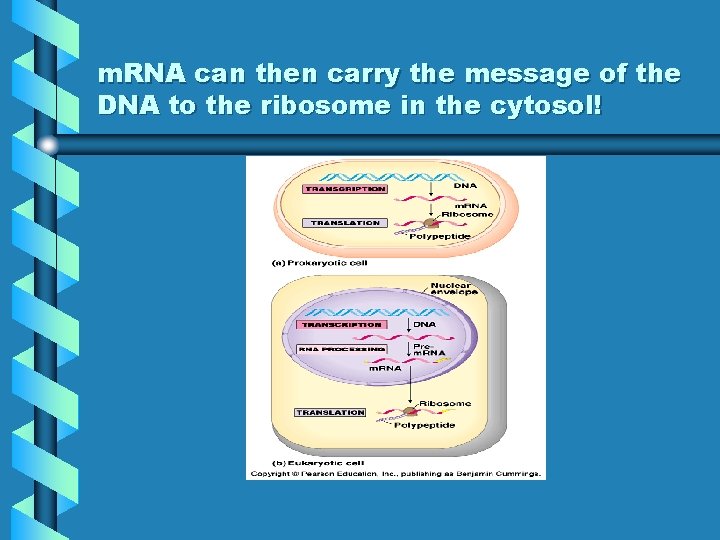
Mobility Problem • DNA cannot leave the nucleus. • Proteins are made in the cytosol • How to connect the 2?
Transcription • RNA can leave the nucleus. • Similar structure to DNA, except – Only one-stranded – Does not have Thymine (T). Has Uracil (U) instead. – Ribose for its sugar instead of deoxyribose.
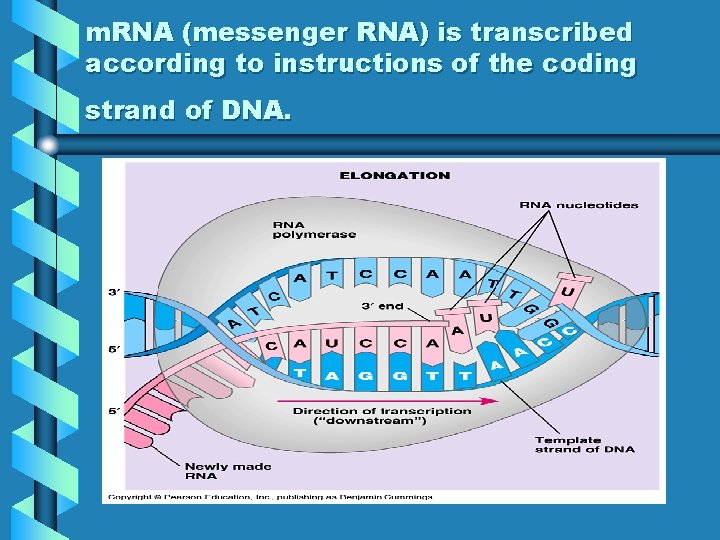
m. RNA (messenger RNA) is transcribed according to instructions of the coding strand of DNA.
m. RNA can then carry the message of the DNA to the ribosome in the cytosol!
Language Problem • Language of DNA- 4 bases, A, T, G, & C • Language of Proteins- 20 amino acids. • How to translate?
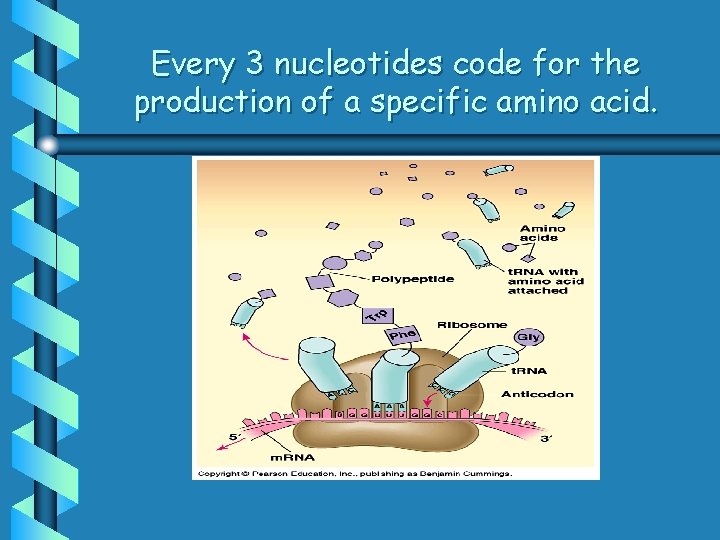
Translation • Synthesis of a polypeptide, under the direction of the translator RNA • Occurs in cytosol, at the ribosome.
Every 3 nucleotides code for the production of a specific amino acid.
Transcription A Closer Look
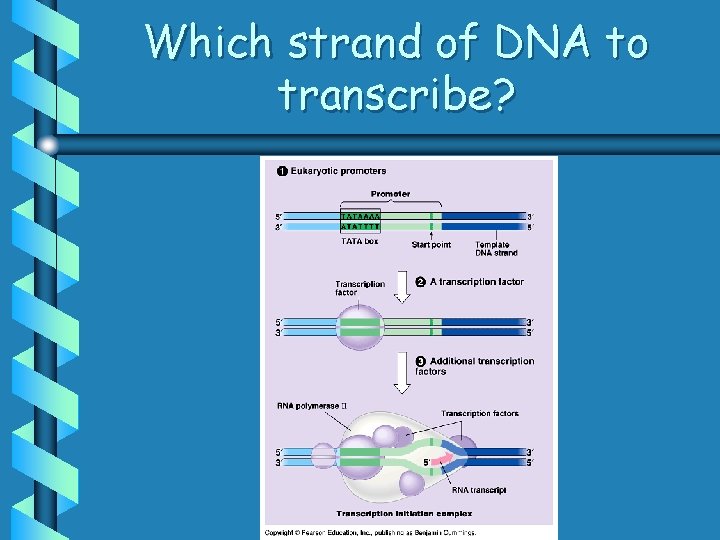
1. RNA polymerase separates 2 strands of DNA a) It then hooks RNA nucleotides together as they match to DNA template. b) 5’ 3’
2. Polymerase attaches to sequence of DNA called promoter. 3. Sequence that signals end of transcription is called terminator.
Which strand of DNA to transcribe?
Modifying RNA • Both ends of the RNA sequence are altered. – 5’ end is capped with a modified Guanine – 3’ end is capped with a poly-A tail.
More Modification • RNA splicing – Initial RNA sequence is approximately 8, 000 nucleotides – Generally, only approx. 1, 200 are needed, though. – Noncoding areas are found in between coding areas
Introns - Noncoding region Exons - Coding region of nucleic acid
How are introns found & cut out? • sn. RNPs (“snurps”) recognize the end of an intron • They then form a spliceosome with other proteins and cut out that intron
Translation A closer look
What’s a triplet code? • Flow of information from gene (DNA) to protein is a triplet code • Every 3 nucleotides will code for the production of a specific amino acid. • m. RNA base triplets are called codons.
The purpose of t. RNA. • Interpreter of the m. RNA codons is t. RNA (transfer RNA) • Each t. RNA molecule has a section called the anticodon. • t. RNA grabs a specific amino acid & brings it to the ribosome
How do m. RNA & t. RNA work together to get the correct amino acid? • Anticodon of t. RNA meets with the codon of m. RNA at the ribosome. – Ex- m. RNA codon UUU - t. RNA anticodon- AAA - t. RNA will have phenylalanine to add to the polypeptide
• First • Second • Study ribosomes, • Study Building a p. 316. Polypeptide, p. 317 -318