
From Gene to Protein SLIDE SHOW BY KIM

From Gene to Protein SLIDE SHOW BY KIM FOGLIA (modified) All Blue edged slides are Kim’s (hyperlinks may have been added) How Genes Work AP Biology 2007 -2008
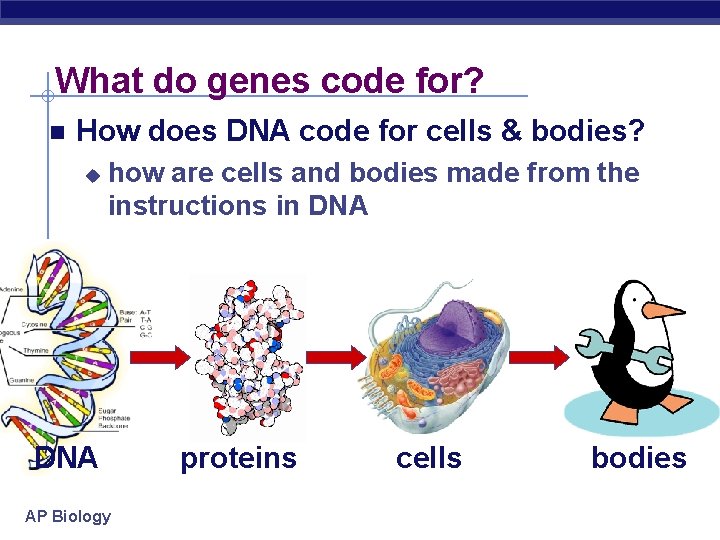
What do genes code for? How does DNA code for cells & bodies? u how are cells and bodies made from the instructions in DNA AP Biology proteins cells bodies
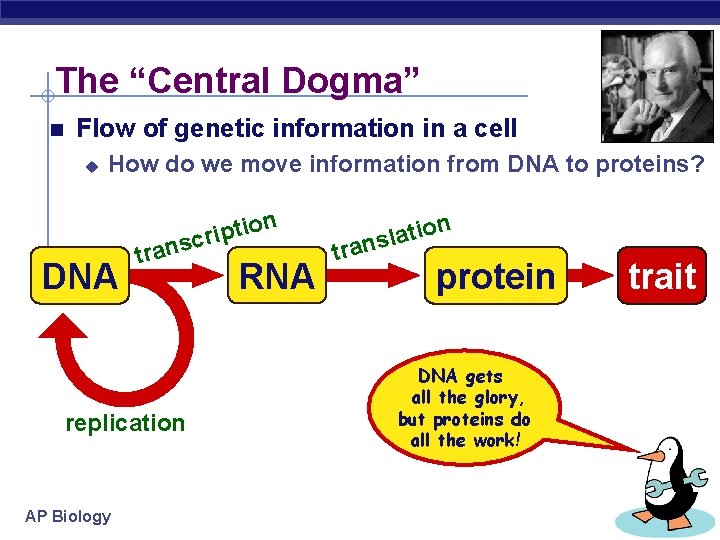
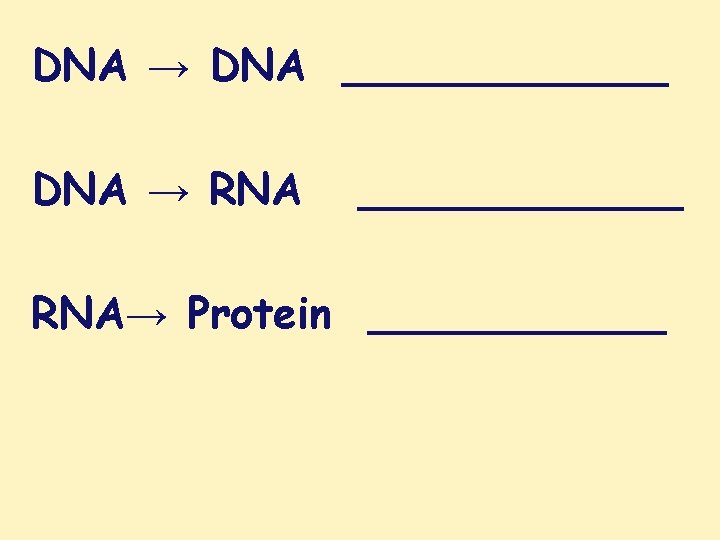
The “Central Dogma” Flow of genetic information in a cell u How do we move information from DNA to proteins? DNA tran replication AP Biology n io t p i r sc RNA tr n tio a l s an protein DNA gets all the glory, but proteins do all the work! trait
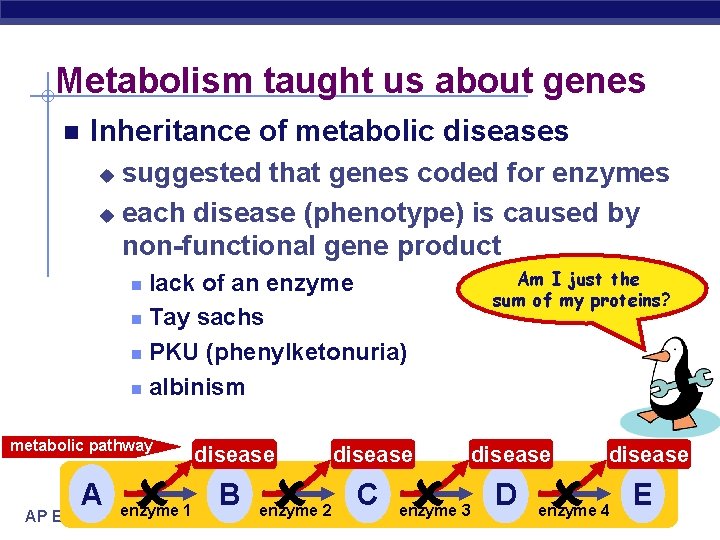
Metabolism taught us about genes Inheritance of metabolic diseases suggested that genes coded for enzymes u each disease (phenotype) is caused by non-functional gene product u lack of an enzyme Tay sachs PKU (phenylketonuria) albinism metabolic pathway A AP Biology enzyme 1 Am I just the sum of my proteins? disease B C D E enzyme 2 enzyme 3 enzyme 4
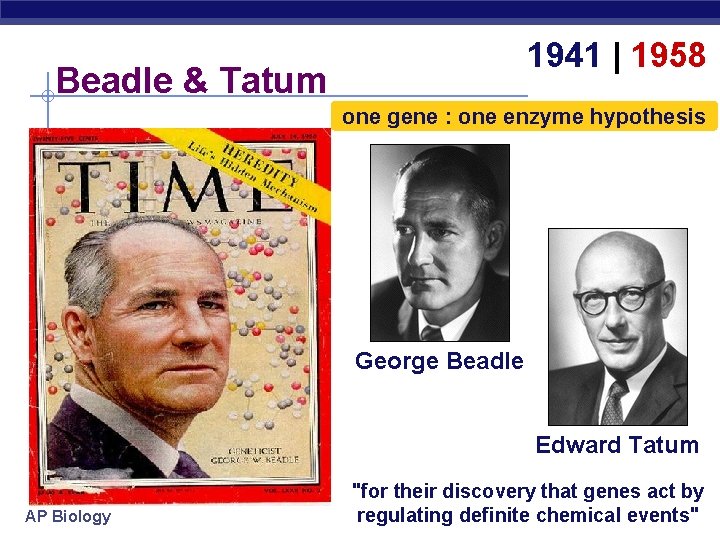
1941 | 1958 Beadle & Tatum one gene : one enzyme hypothesis George Beadle Edward Tatum AP Biology "for their discovery that genes act by regulating definite chemical events"
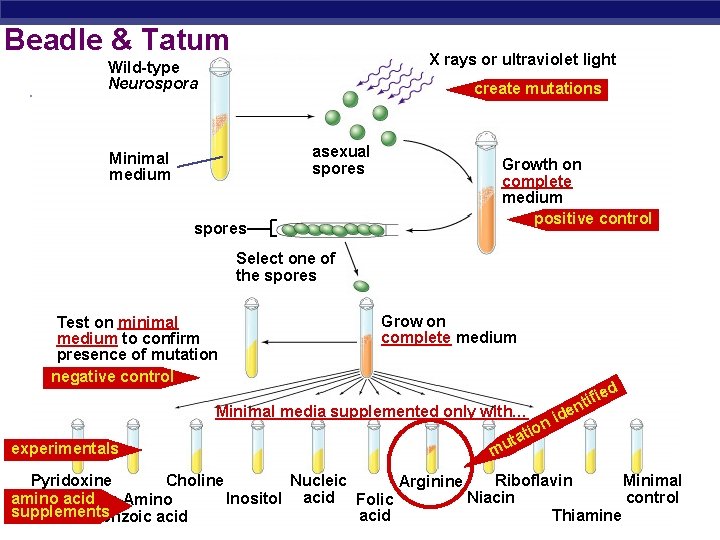
Beadle & Tatum X rays or ultraviolet light Wild-type Neurospora create mutations asexual spores Minimal medium spores Growth on complete medium positive control Select one of the spores Test on minimal medium to confirm presence of mutation negative control experimentals Grow on complete medium d fie i t n Minimal media supplemented only with… ide n tio a t mu Choline Minimal Pyridoxine Riboflavin Nucleic Arginine control Niacin amino acid p-Amino Inositol acid Folic supplements acid Thiamine benzoic acid AP Biology
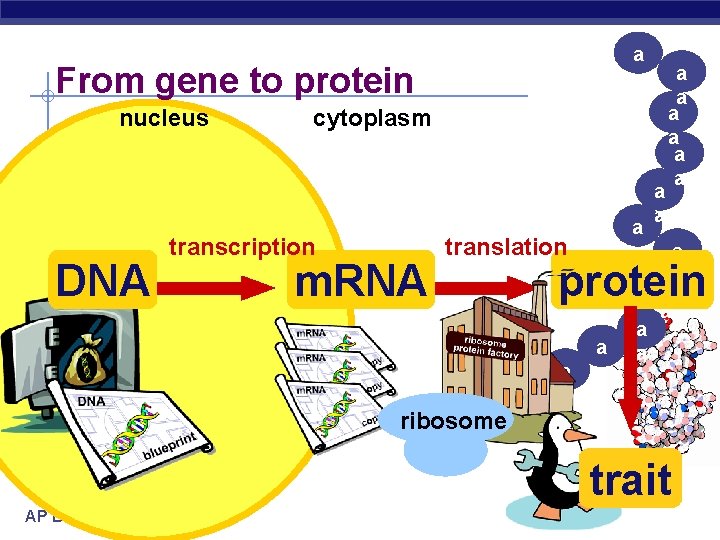
a a From gene to protein nucleus DNA cytoplasm transcription m. RNA a a translation a a a protein a a a a ribosome trait AP Biology
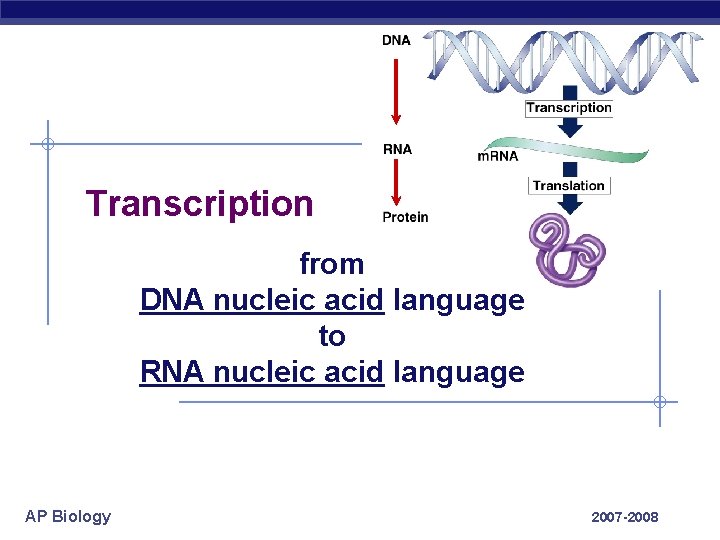
Transcription from DNA nucleic acid language to RNA nucleic acid language AP Biology 2007 -2008
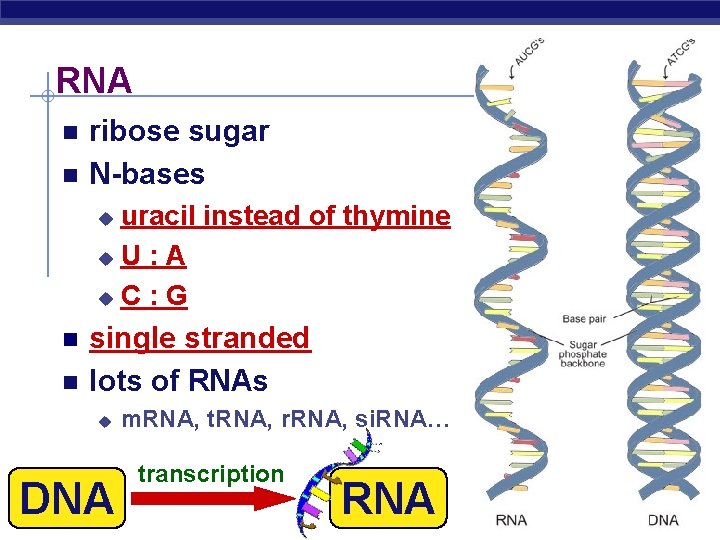
RNA ribose sugar N-bases uracil instead of thymine u. U : A u. C : G u single stranded lots of RNAs u DNA AP Biology m. RNA, t. RNA, r. RNA, si. RNA… transcription RNA
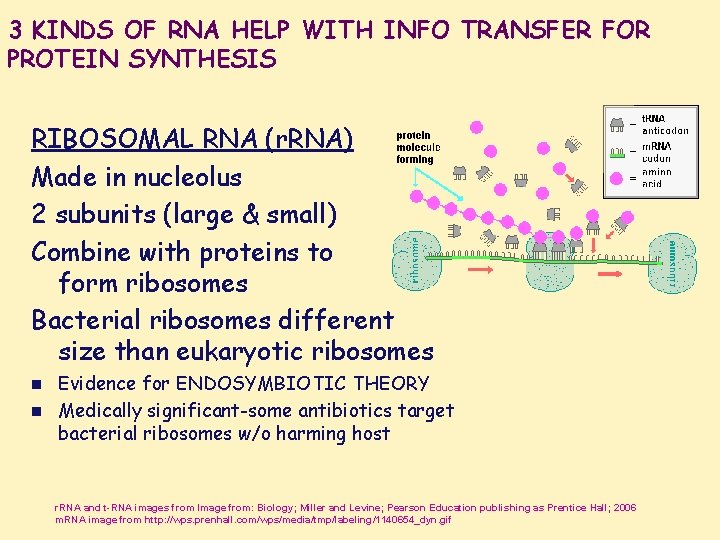
3 KINDS OF RNA HELP WITH INFO TRANSFER FOR PROTEIN SYNTHESIS RIBOSOMAL RNA (r. RNA) Made in nucleolus 2 subunits (large & small) Combine with proteins to form ribosomes Bacterial ribosomes different size than eukaryotic ribosomes Evidence for ENDOSYMBIOTIC THEORY Medically significant-some antibiotics target bacterial ribosomes w/o harming host r. RNA and t-RNA images from Image from: Biology; Miller and Levine; Pearson Education publishing as Prentice Hall; 2006 m. RNA image from http: //wps. prenhall. com/wps/media/tmp/labeling/1140654_dyn. gif
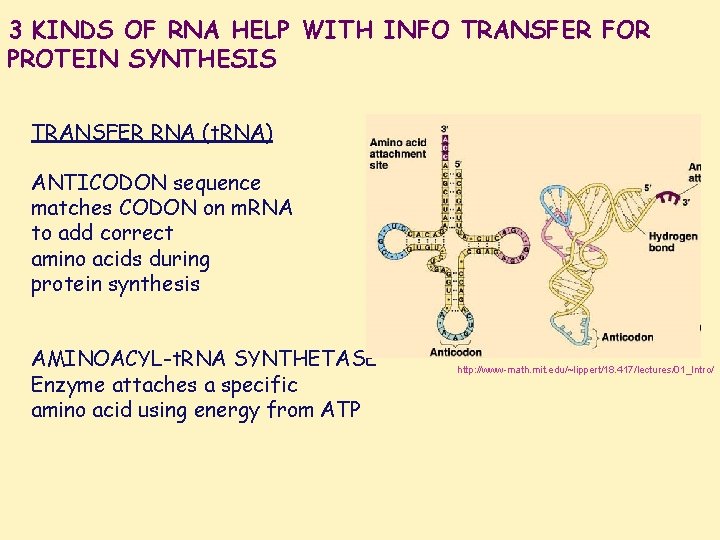
3 KINDS OF RNA HELP WITH INFO TRANSFER FOR PROTEIN SYNTHESIS TRANSFER RNA (t. RNA) ANTICODON sequence matches CODON on m. RNA to add correct amino acids during protein synthesis AMINOACYL-t. RNA SYNTHETASE Enzyme attaches a specific amino acid using energy from ATP http: //www-math. mit. edu/~lippert/18. 417/lectures/01_Intro/
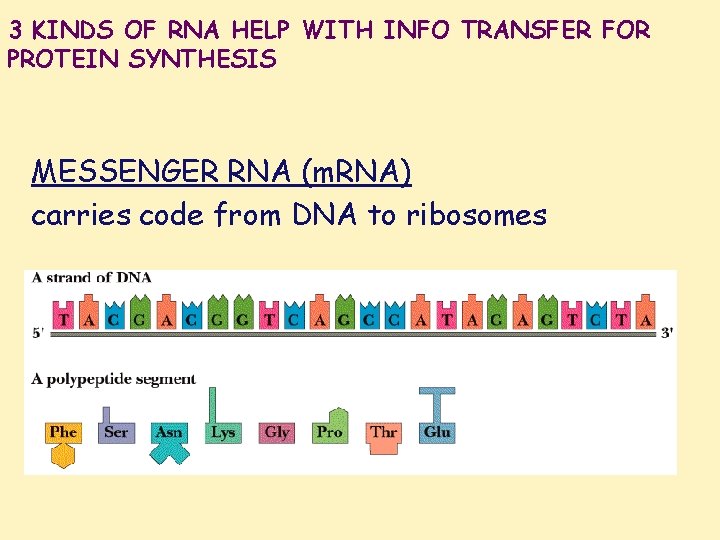
3 KINDS OF RNA HELP WITH INFO TRANSFER FOR PROTEIN SYNTHESIS MESSENGER RNA (m. RNA) carries code from DNA to ribosomes
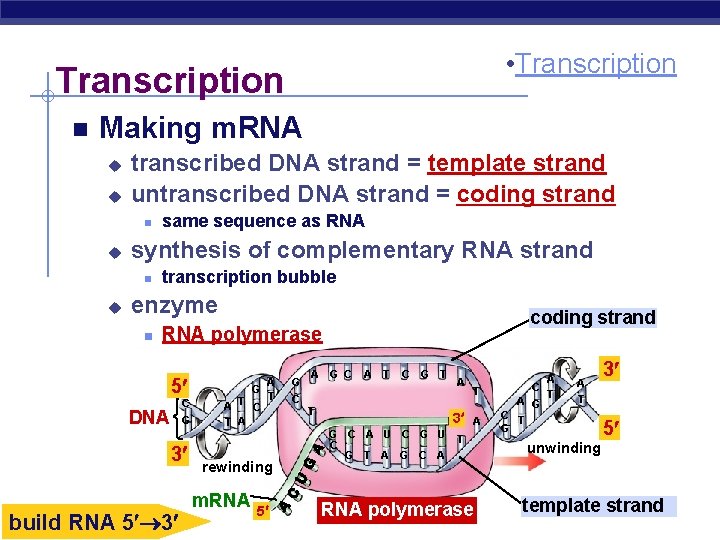
• Transcription Making m. RNA u u transcribed DNA strand = template strand untranscribed DNA strand = coding strand u synthesis of complementary RNA strand u same sequence as RNA transcription bubble enzyme RNA polymerase 5 C DNA G 3 AP Biology build RNA coding strand 5 3 A G T A T C T A rewinding m. RNA 5 G C A T C G T T A 3 G C A U C G T A G C A T RNA polymerase C A G C T G A T unwinding 3 5 template strand
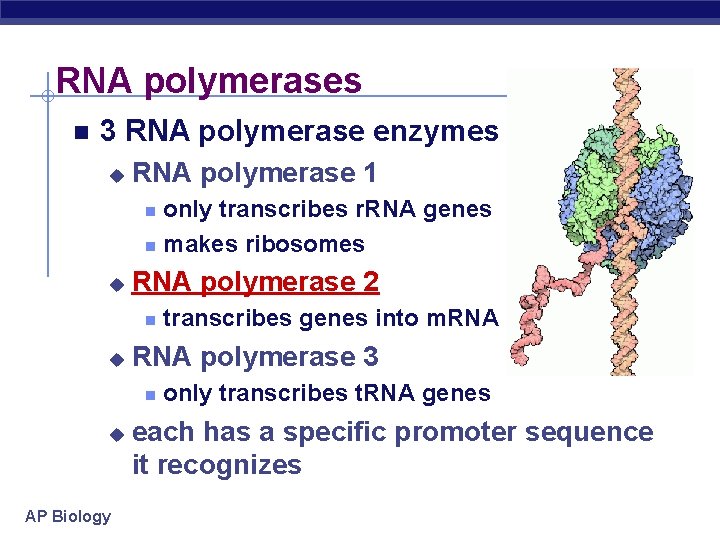
RNA polymerases 3 RNA polymerase enzymes u RNA polymerase 1 only transcribes r. RNA genes makes ribosomes u RNA polymerase 2 u RNA polymerase 3 u AP Biology transcribes genes into m. RNA only transcribes t. RNA genes each has a specific promoter sequence it recognizes
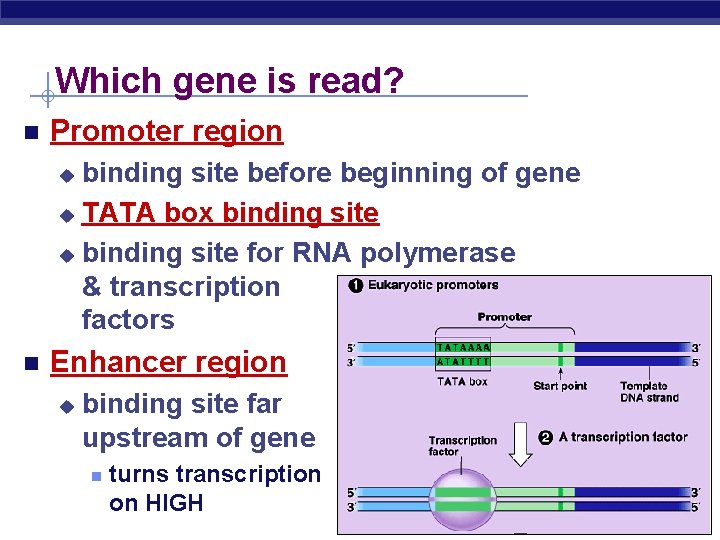
Which gene is read? Promoter region binding site before beginning of gene u TATA box binding site u binding site for RNA polymerase & transcription factors u Enhancer region u binding site far upstream of gene turns transcription on HIGH AP Biology
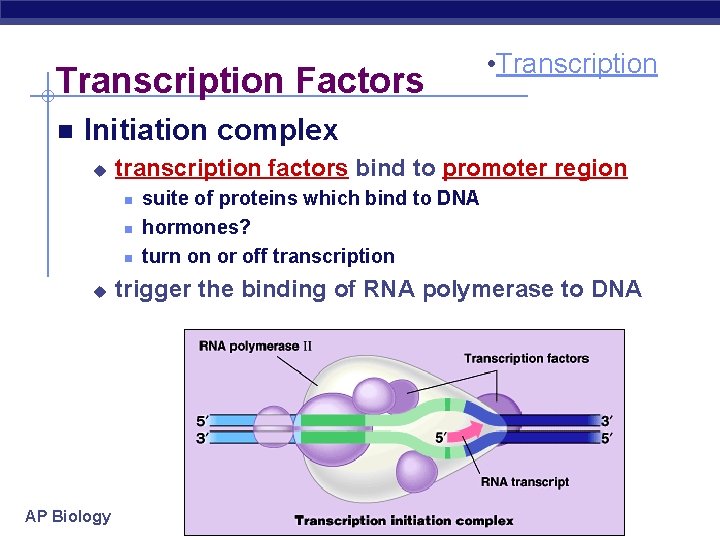
Transcription Factors • Transcription Initiation complex u transcription factors bind to promoter region u AP Biology suite of proteins which bind to DNA hormones? turn on or off transcription trigger the binding of RNA polymerase to DNA
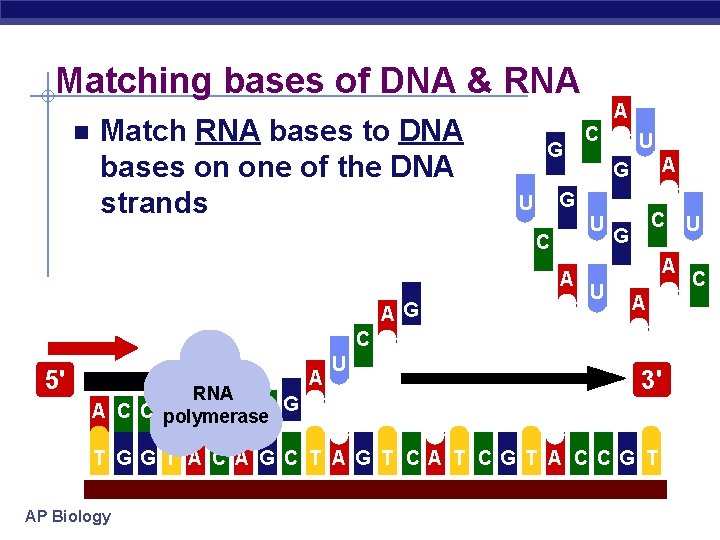
Matching bases of DNA & RNA Match RNA bases to DNA bases on one of the DNA strands G C U A G G U U C A AG A C G A U A C 5' RNA A C C polymerase G A U 3' T G G T A C A G C T A G T C A T CG T A C CG T AP Biology U C
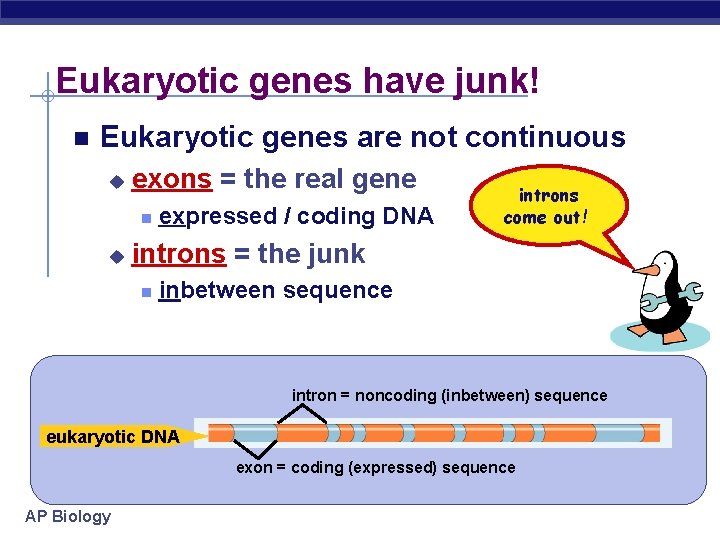
Eukaryotic genes have junk! Eukaryotic genes are not continuous u exons = the real gene u expressed / coding DNA introns come out! introns = the junk inbetween sequence intron = noncoding (inbetween) sequence eukaryotic DNA exon = coding (expressed) sequence AP Biology
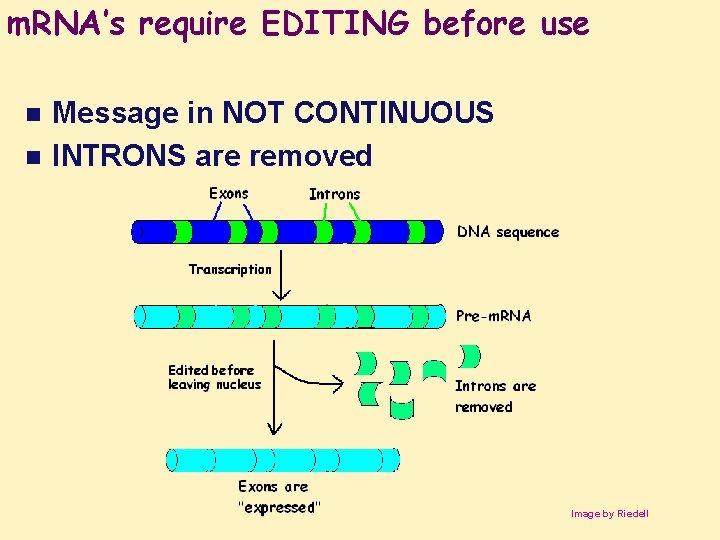
m. RNA’s require EDITING before use Message in NOT CONTINUOUS INTRONS are removed Image by Riedell
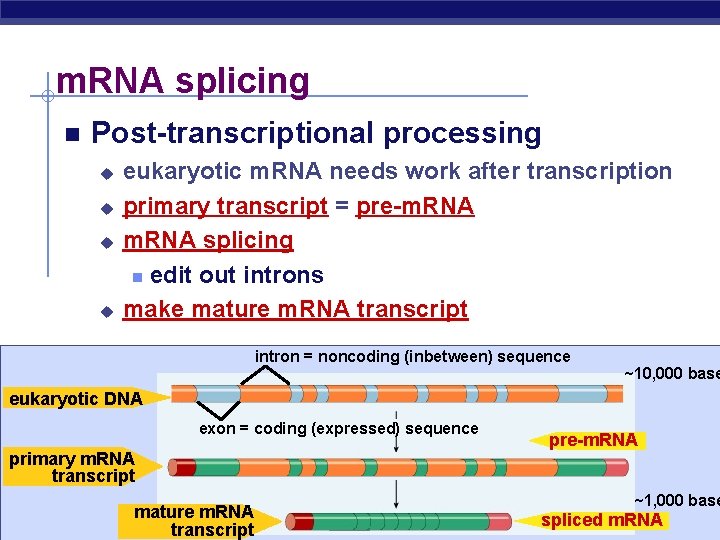
m. RNA splicing Post-transcriptional processing u u eukaryotic m. RNA needs work after transcription primary transcript = pre-m. RNA splicing edit out introns make mature m. RNA transcript intron = noncoding (inbetween) sequence ~10, 000 base eukaryotic DNA exon = coding (expressed) sequence primary m. RNA transcript AP Biology mature m. RNA transcript pre-m. RNA ~1, 000 base spliced m. RNA
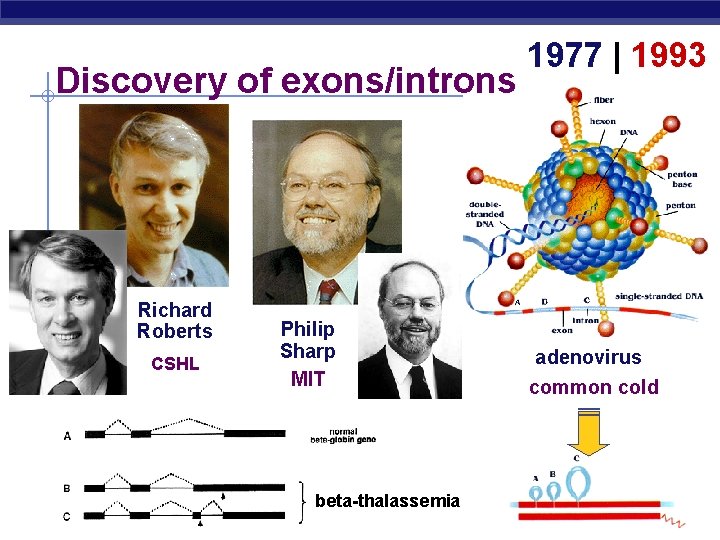
Discovery of exons/introns Richard Roberts CSHL AP Biology Philip Sharp MIT beta-thalassemia 1977 | 1993 adenovirus common cold
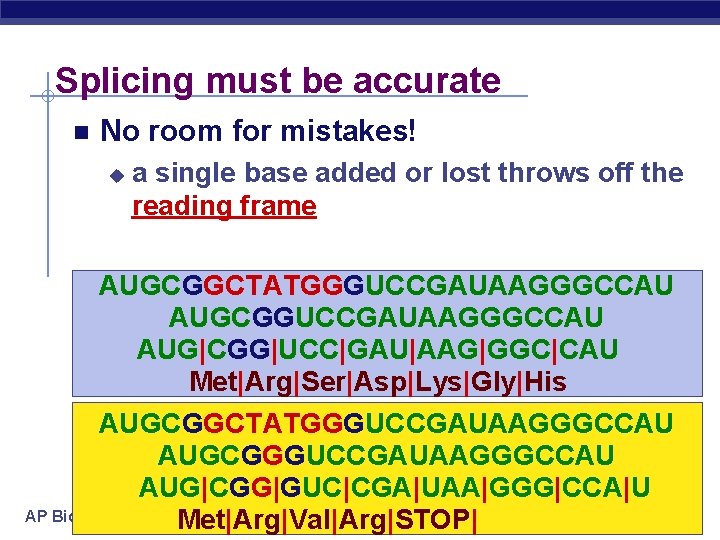
Splicing must be accurate No room for mistakes! u a single base added or lost throws off the reading frame AUGCGGCTATGGGUCCGAUAAGGGCCAU AUGCGGUCCGAUAAGGGCCAU AUG|CGG|UCC|GAU|AAG|GGC|CAU Met|Arg|Ser|Asp|Lys|Gly|His AUGCGGCTATGGGUCCGAUAAGGGCCAU AUGCGGGUCCGAUAAGGGCCAU AUG|CGG|GUC|CGA|UAA|GGG|CCA|U AP Biology Met|Arg|Val|Arg|STOP|
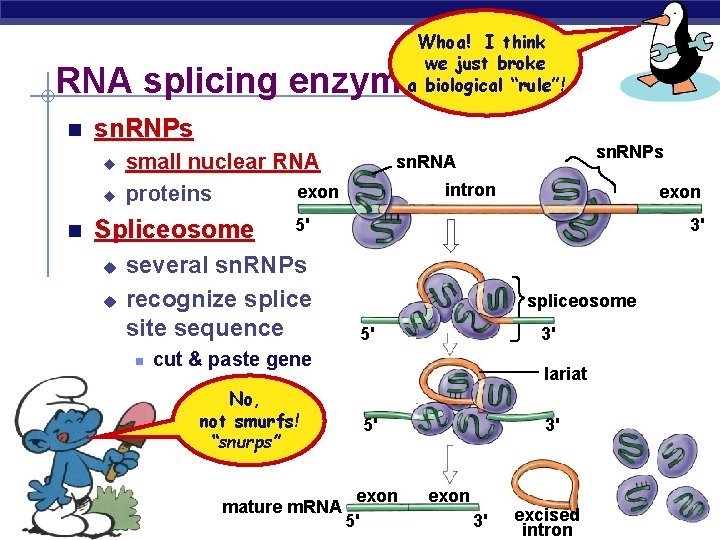
Whoa! I think we just broke a biological “rule”! RNA splicing enzymes sn. RNPs u u small nuclear RNA exon proteins Spliceosome u u exon 3' spliceosome 5' 3' cut & paste gene No, not smurfs! “snurps” AP Biology intron 5' several sn. RNPs recognize splice site sequence sn. RNPs sn. RNA mature m. RNA lariat 5' exon 5' 3' exon 3' excised intron
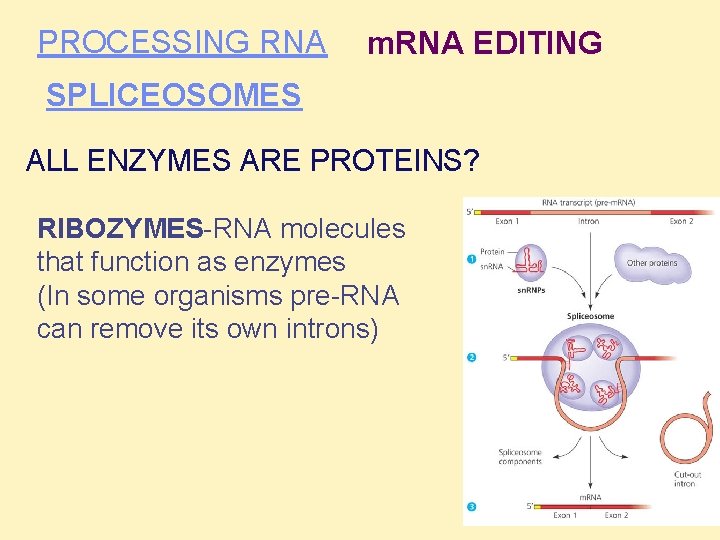
PROCESSING RNA m. RNA EDITING SPLICEOSOMES ALL ENZYMES ARE PROTEINS? RIBOZYMES-RNA molecules that function as enzymes (In some organisms pre-RNA can remove its own introns)
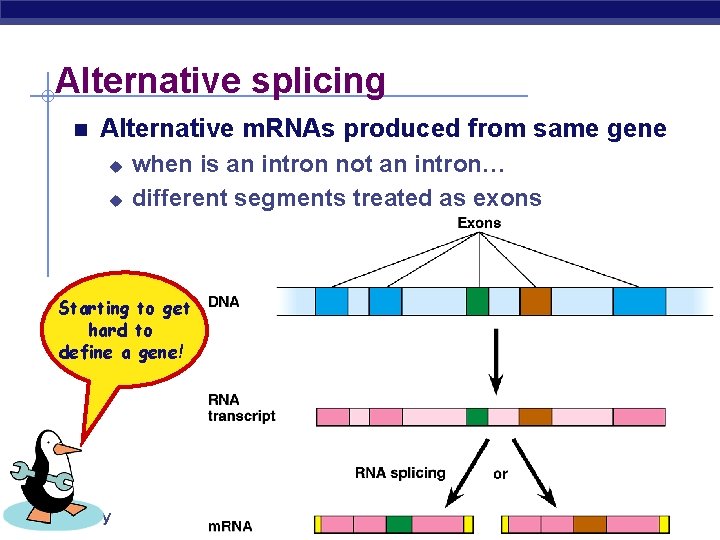
Alternative splicing Alternative m. RNAs produced from same gene u u when is an intron not an intron… different segments treated as exons Starting to get hard to define a gene! AP Biology
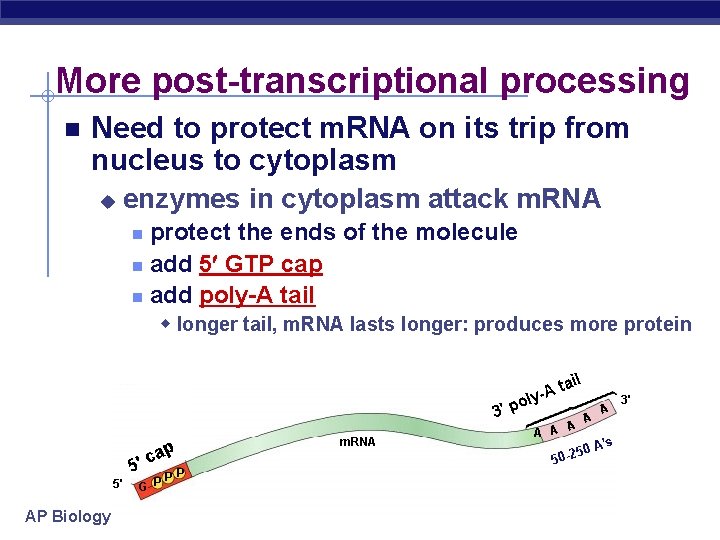
More post-transcriptional processing Need to protect m. RNA on its trip from nucleus to cytoplasm u enzymes in cytoplasm attack m. RNA protect the ends of the molecule add 5 GTP cap add poly-A tail w longer tail, m. RNA lasts longer: produces more protein ail o 3' p 5 5' AP Biology p a c ' P G P m. RNA P t A y l A A A s ’ 50 A 2 0 5 3'
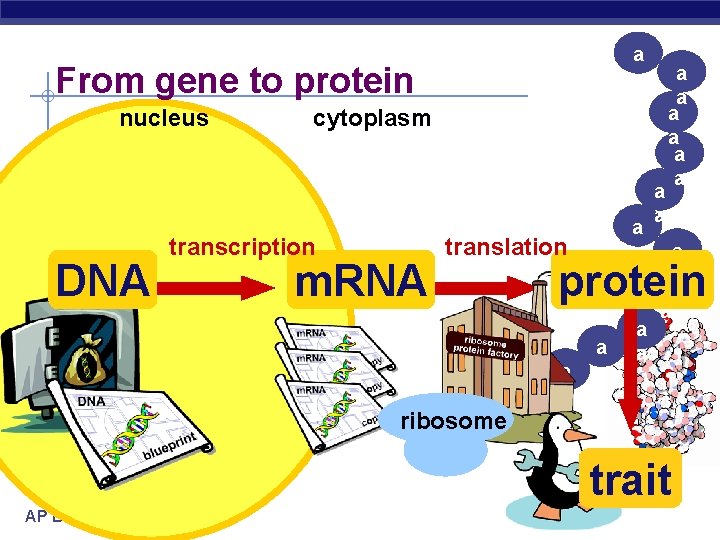
a a From gene to protein nucleus DNA cytoplasm transcription m. RNA a a translation a a a protein a a a a ribosome trait AP Biology
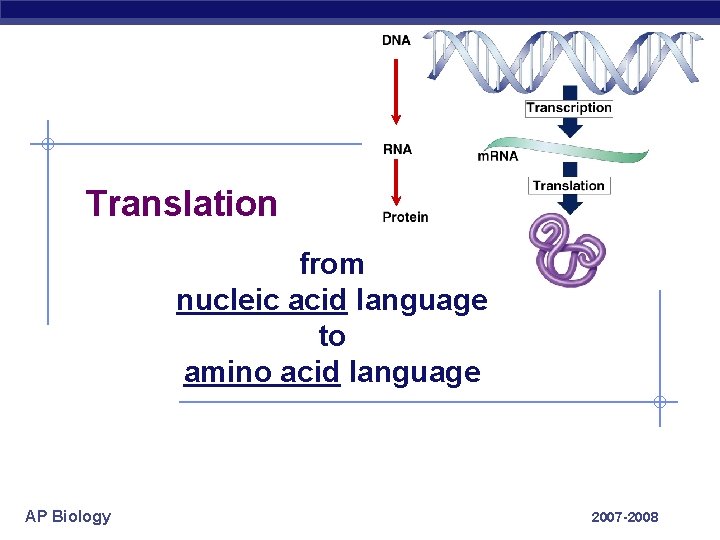
Translation from nucleic acid language to amino acid language AP Biology 2007 -2008
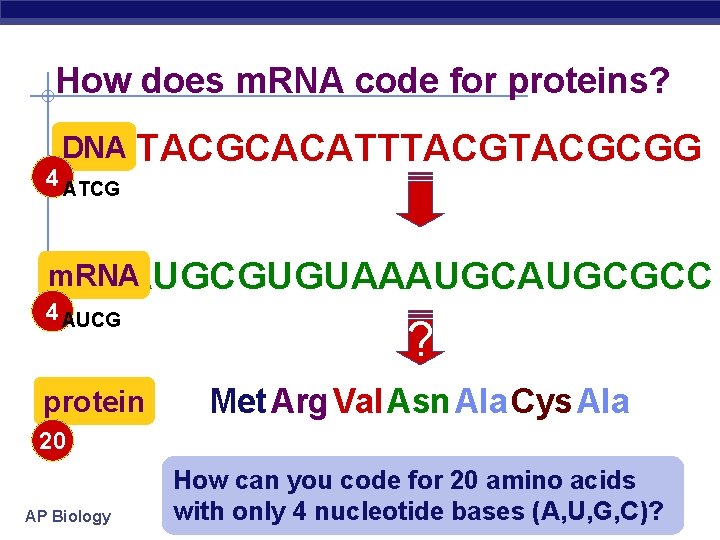
How does m. RNA code for proteins? DNA 4 ATCG TACGCACATTTACGCGG m. RNA AUGCGUGUAAAUGCGCC 4 AUCG protein ? Met Arg Val Asn Ala Cys Ala 20 AP Biology How can you code for 20 amino acids with only 4 nucleotide bases (A, U, G, C)?
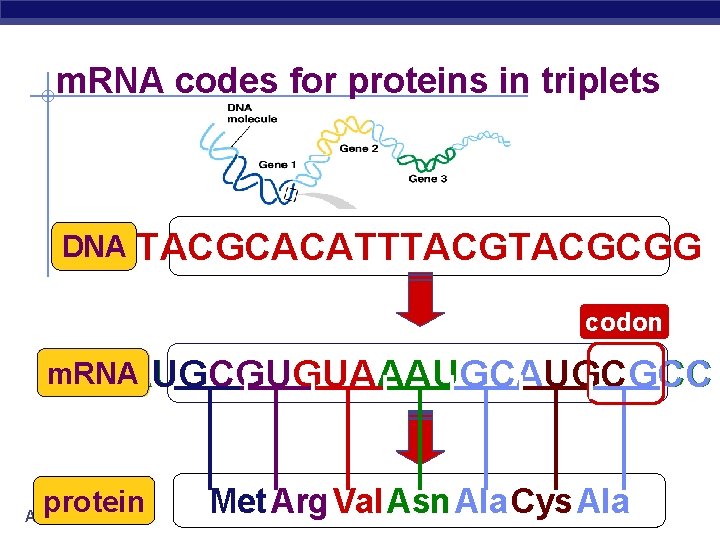
m. RNA codes for proteins in triplets DNA TACGCACATTTACGCGG codon m. RNA AUGCGUGUAAAUGCGCC ? protein AP Biology Met Arg Val Asn Ala Cys Ala
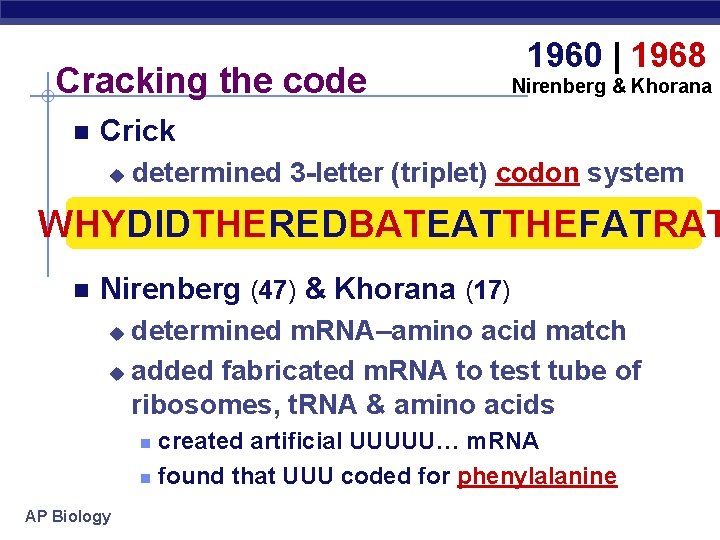
Cracking the code 1960 | 1968 Nirenberg & Khorana Crick u determined 3 -letter (triplet) codon system WHYDIDTHEREDBATEATTHEFATRAT Nirenberg (47) & Khorana (17) determined m. RNA–amino acid match u added fabricated m. RNA to test tube of ribosomes, t. RNA & amino acids u created artificial UUUUU… m. RNA found that UUU coded for phenylalanine AP Biology
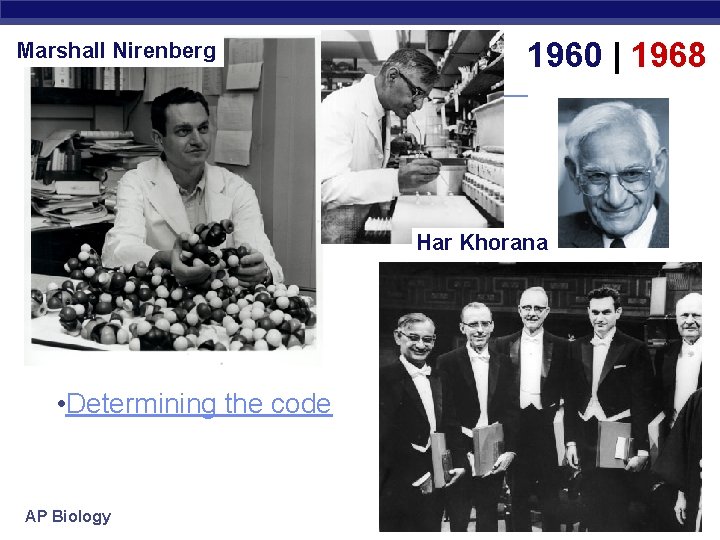
Marshall Nirenberg 1960 | 1968 Har Khorana • Determining the code AP Biology
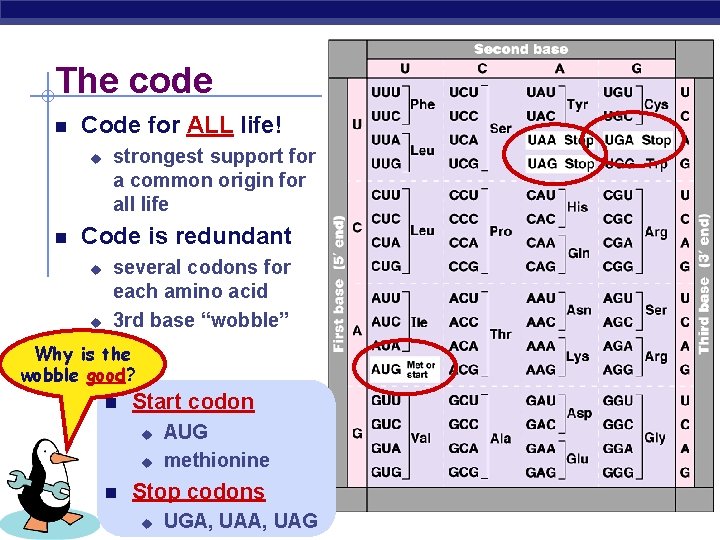
The code Code for ALL life! strongest support for a common origin for all life u Code is redundant several codons for each amino acid 3 rd base “wobble” u u Why is the wobble good? Start codon u u AP Biology AUG methionine Stop codons u UGA, UAG
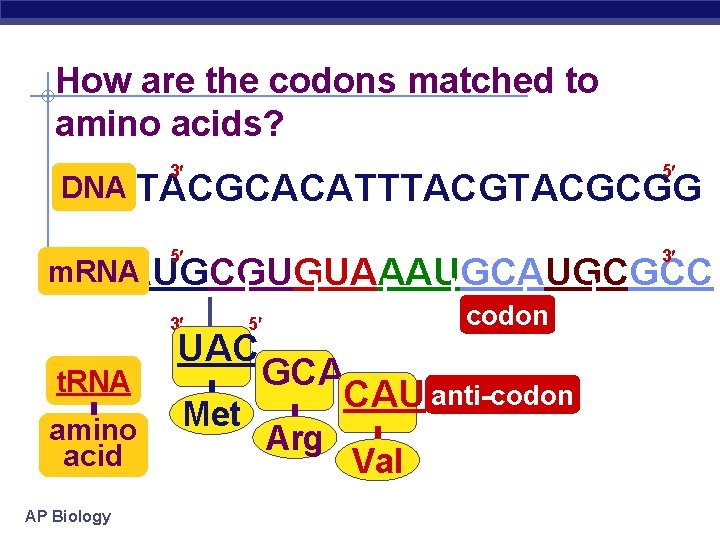
How are the codons matched to amino acids? DNA 3 5 5 3 TACGCACATTTACGCGG m. RNA AUGCGUGUAAAUGCGCC 3 t. RNA amino acid AP Biology codon 5 UAC GCA anti-codon CAU Met Arg Val
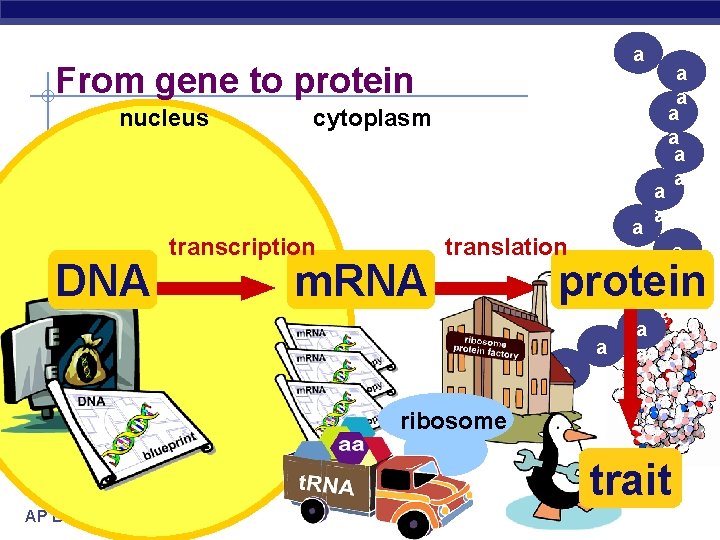
a a From gene to protein nucleus DNA cytoplasm transcription m. RNA a a translation a a a protein a a a a ribosome trait AP Biology
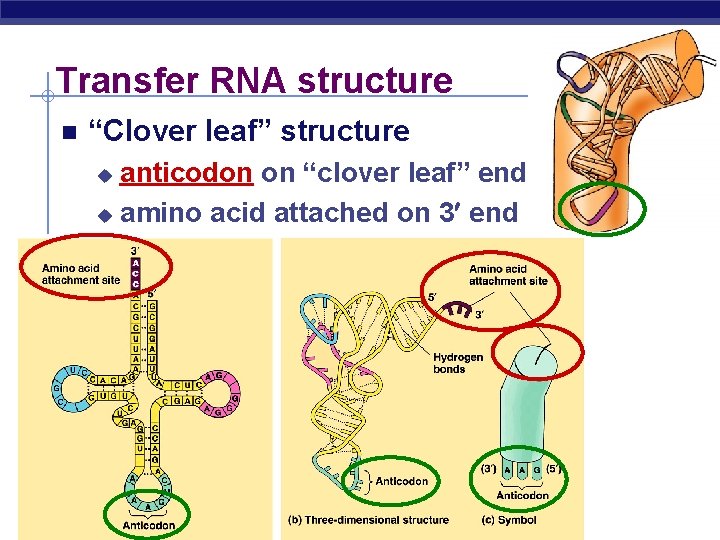
Transfer RNA structure “Clover leaf” structure anticodon on “clover leaf” end u amino acid attached on 3 end u AP Biology
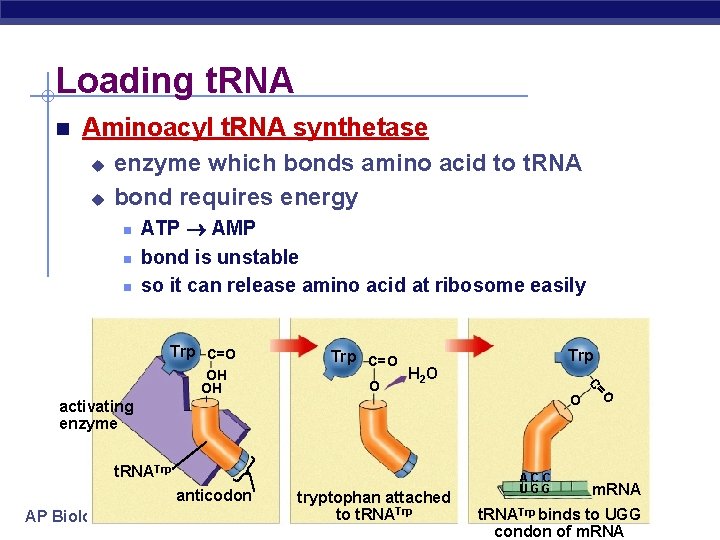
Loading t. RNA Aminoacyl t. RNA synthetase u u enzyme which bonds amino acid to t. RNA bond requires energy ATP AMP bond is unstable so it can release amino acid at ribosome easily Trp C=O H 2 O O activating enzyme t. RNATrp anticodon AP Biology tryptophan attached to t. RNATrp AC C UGG =O O Trp C OH OH Trp C=O m. RNA t. RNATrp binds to UGG condon of m. RNA
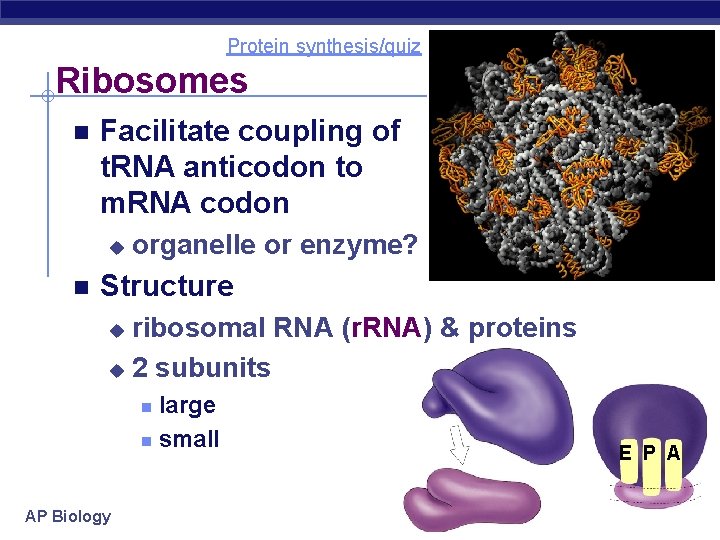
Protein synthesis/quiz Ribosomes Facilitate coupling of t. RNA anticodon to m. RNA codon u organelle or enzyme? Structure ribosomal RNA (r. RNA) & proteins u 2 subunits u large small AP Biology E P A
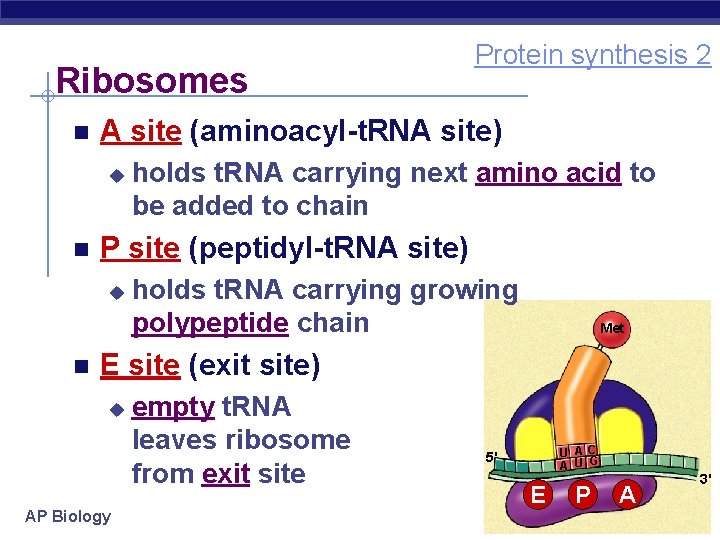
Ribosomes A site (aminoacyl-t. RNA site) u holds t. RNA carrying next amino acid to be added to chain P site (peptidyl-t. RNA site) u Protein synthesis 2 holds t. RNA carrying growing polypeptide chain Met E site (exit site) u AP Biology empty t. RNA leaves ribosome from exit site U A C A U G 5' E P A 3'
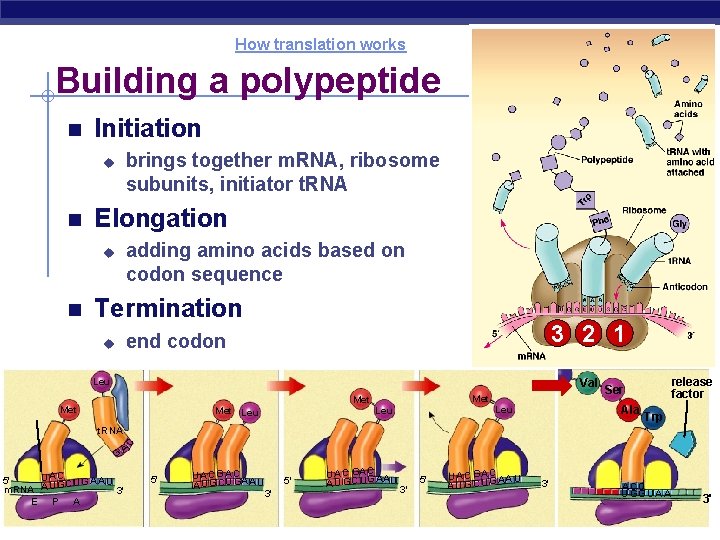
How translation works Building a polypeptide Initiation brings together m. RNA, ribosome subunits, initiator t. RNA u Elongation adding amino acids based on codon sequence u Termination 3 2 1 end codon u Val Leu Met Met Leu Ala Leu release factor Ser Trp A C t. RNA G U AC 5' CUGAA U m. RNA A U G 3' E P A AP Biology 5' U A C G A C AA U G CU G 5' 3' U A C GA C A U G C UG AAU 3' 5' U A C G A C AA U AU G C U G 3' A CC U GG U A A 3'
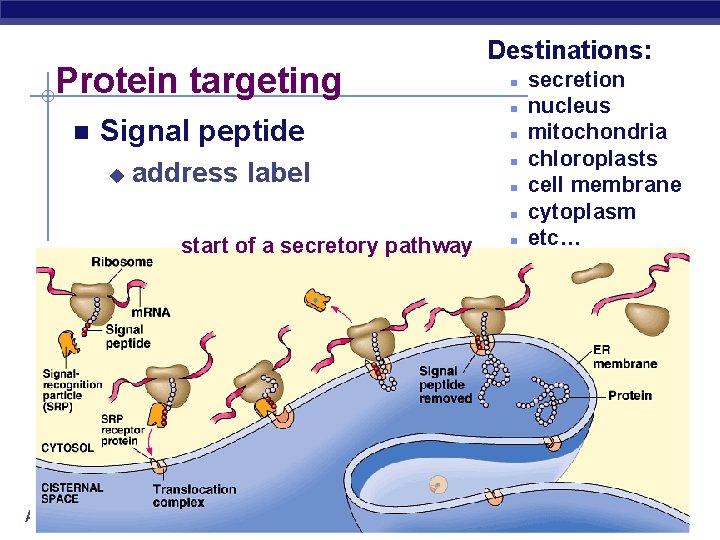
Protein targeting Signal peptide u address label Destinations: start of a secretory pathway AP Biology secretion nucleus mitochondria chloroplasts cell membrane cytoplasm etc…
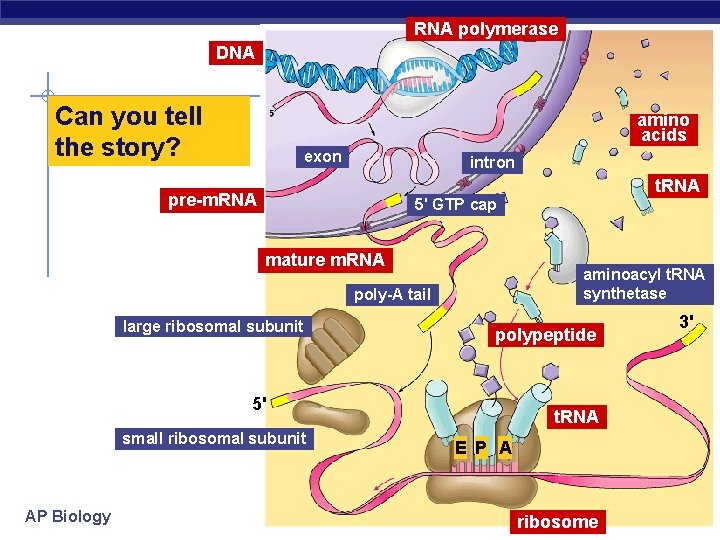
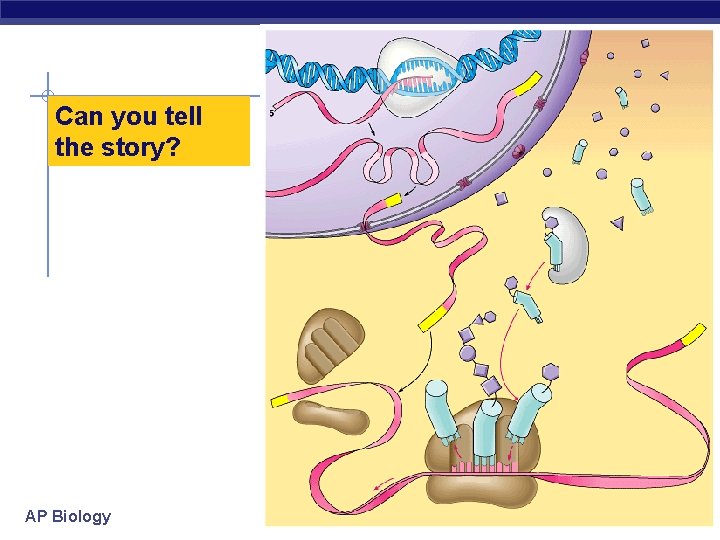
RNA polymerase DNA Can you tell the story? amino acids exon intron t. RNA pre-m. RNA 5' GTP cap mature m. RNA aminoacyl t. RNA synthetase poly-A tail large ribosomal subunit polypeptide 5' small ribosomal subunit AP Biology t. RNA E P A ribosome 3'
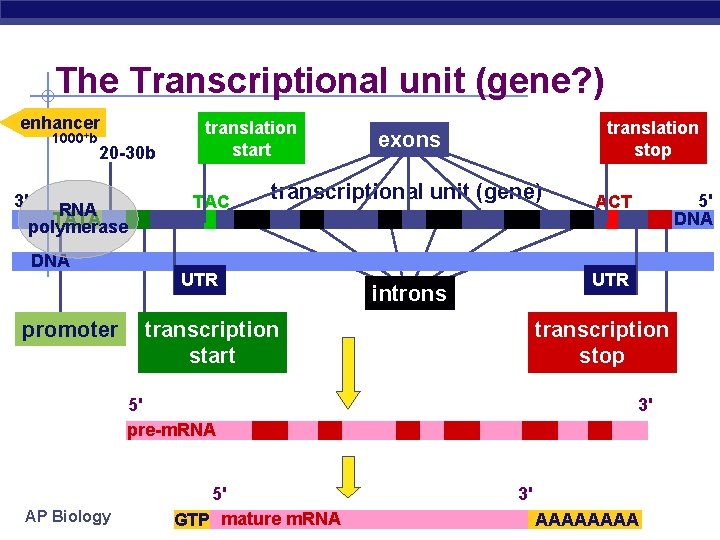
The Transcriptional unit (gene? ) enhancer 1000+b 3' 20 -30 b RNA TATA polymerase DNA promoter translation start TAC translation stop exons transcriptional unit (gene) UTR introns transcription start transcription stop 5' pre-m. RNA AP Biology 5' GTP mature m. RNA 5' DNA ACT 3' 3' AAAA
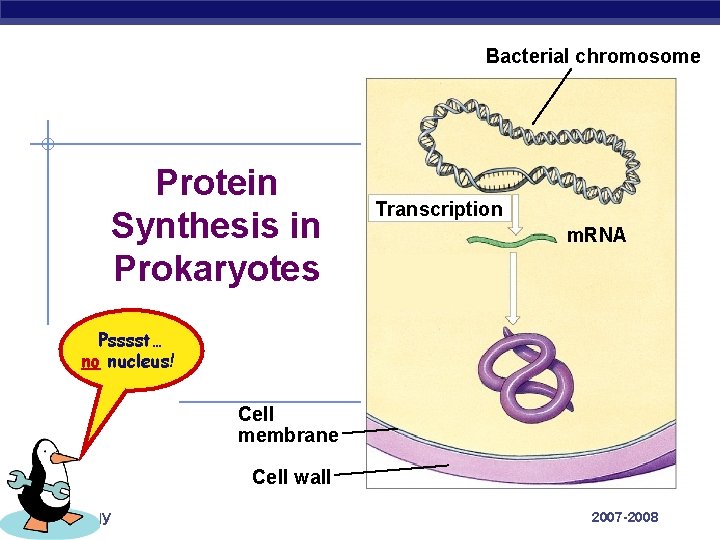
Bacterial chromosome Protein Synthesis in Prokaryotes Transcription m. RNA Psssst… no nucleus! Cell membrane Cell wall AP Biology 2007 -2008
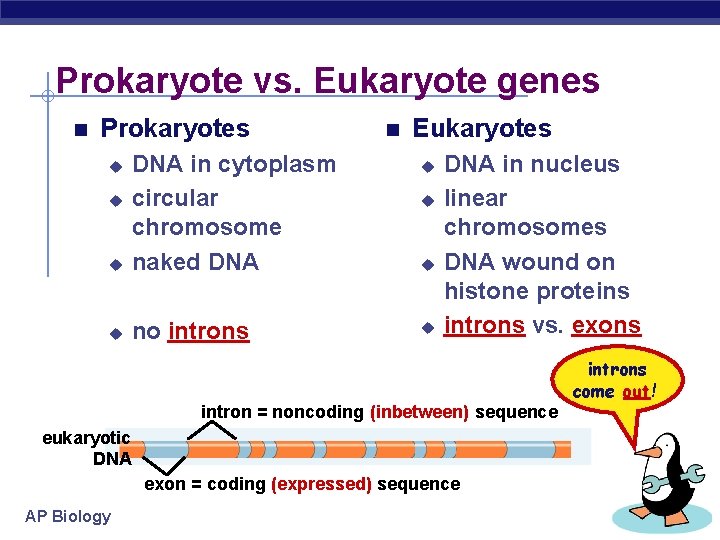
Prokaryote vs. Eukaryote genes Prokaryotes u DNA in cytoplasm circular chromosome naked DNA u no introns u u Eukaryotes u u DNA in nucleus linear chromosomes DNA wound on histone proteins introns vs. exons introns come out! intron = noncoding (inbetween) sequence eukaryotic DNA exon = coding (expressed) sequence AP Biology
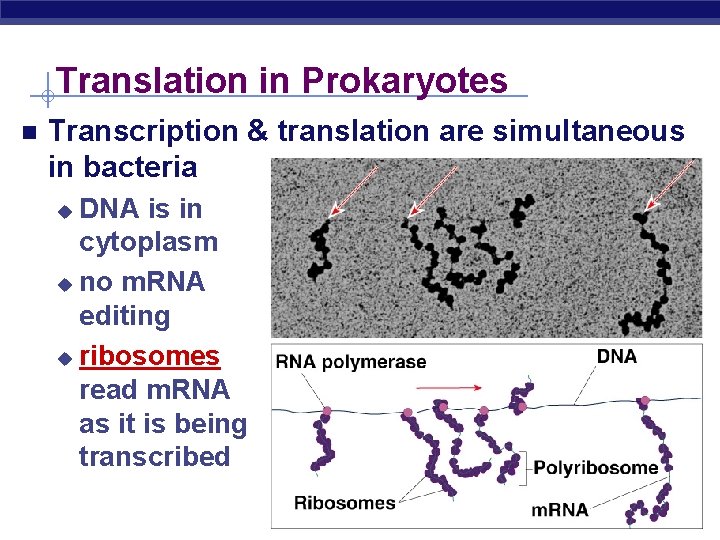
Translation in Prokaryotes Transcription & translation are simultaneous in bacteria DNA is in cytoplasm u no m. RNA editing u ribosomes read m. RNA as it is being transcribed u AP Biology
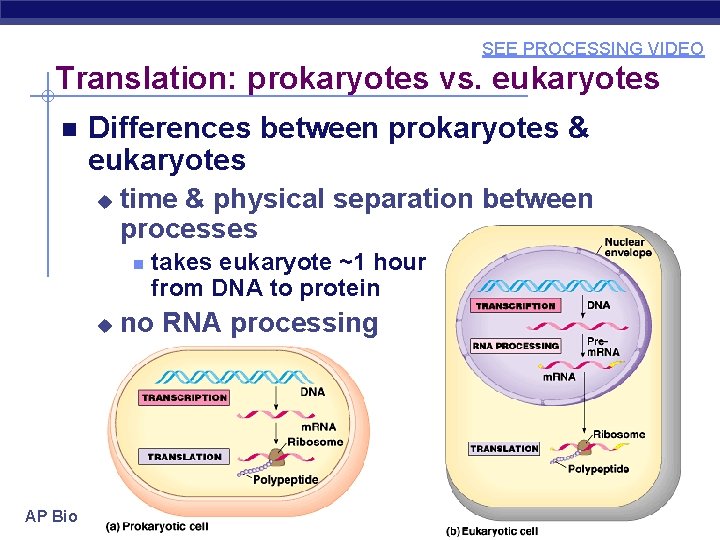
SEE PROCESSING VIDEO Translation: prokaryotes vs. eukaryotes Differences between prokaryotes & eukaryotes u time & physical separation between processes u AP Biology takes eukaryote ~1 hour from DNA to protein no RNA processing
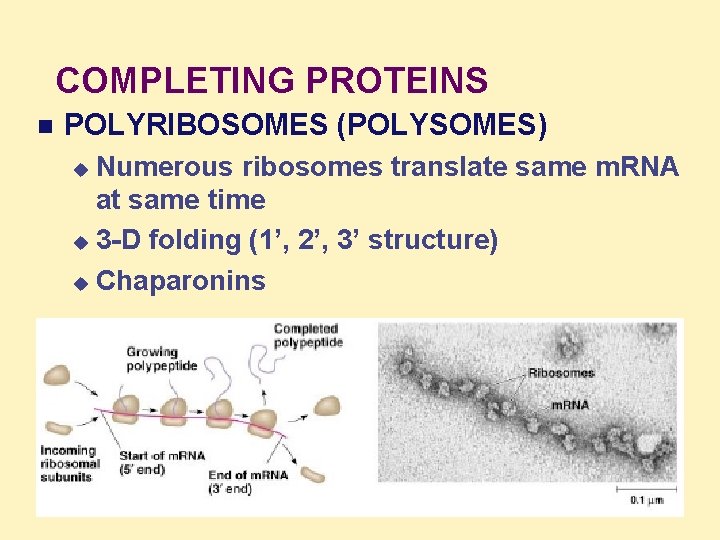
COMPLETING PROTEINS POLYRIBOSOMES (POLYSOMES) Numerous ribosomes translate same m. RNA at same time u 3 -D folding (1’, 2’, 3’ structure) u Chaparonins u
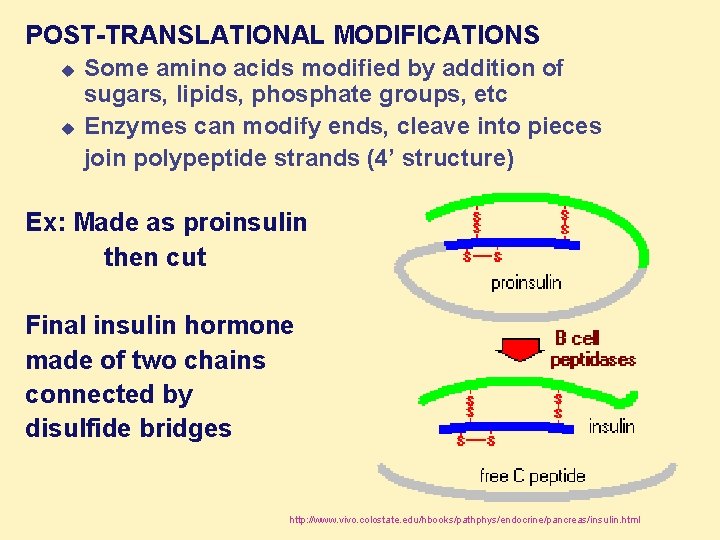
POST-TRANSLATIONAL MODIFICATIONS u u Some amino acids modified by addition of sugars, lipids, phosphate groups, etc Enzymes can modify ends, cleave into pieces join polypeptide strands (4’ structure) Ex: Made as proinsulin then cut Final insulin hormone made of two chains connected by disulfide bridges http: //www. vivo. colostate. edu/hbooks/pathphys/endocrine/pancreas/insulin. html
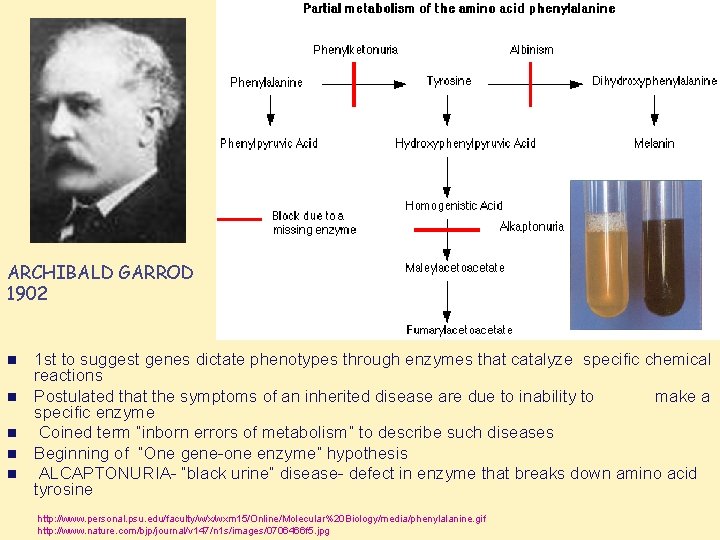
ARCHIBALD GARROD 1902 1 st to suggest genes dictate phenotypes through enzymes that catalyze specific chemical reactions Postulated that the symptoms of an inherited disease are due to inability to make a specific enzyme Coined term “inborn errors of metabolism” to describe such diseases Beginning of “One gene-one enzyme” hypothesis ALCAPTONURIA- “black urine” disease- defect in enzyme that breaks down amino acid tyrosine http: //www. personal. psu. edu/faculty/w/x/wxm 15/Online/Molecular%20 Biology/media/phenylalanine. gif http: //www. nature. com/bjp/journal/v 147/n 1 s/images/0706466 f 5. jpg
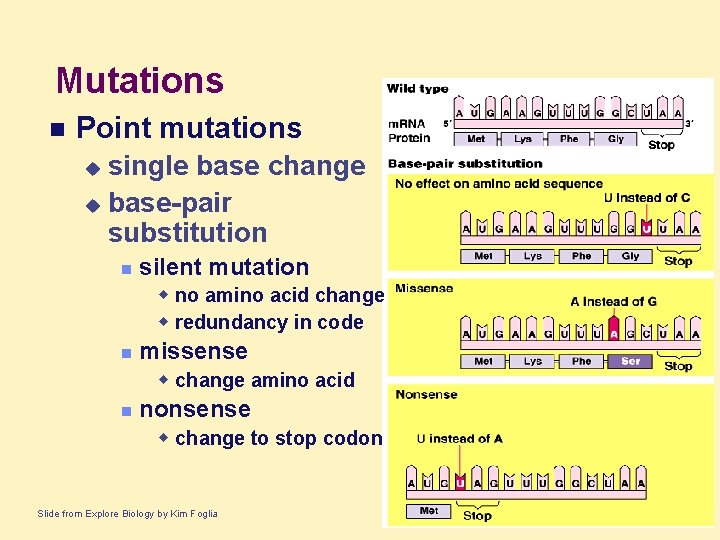
Mutations Point mutations single base change u base-pair substitution u silent mutation w no amino acid change w redundancy in code missense w change amino acid nonsense w change to stop codon Slide from Explore Biology by Kim Foglia
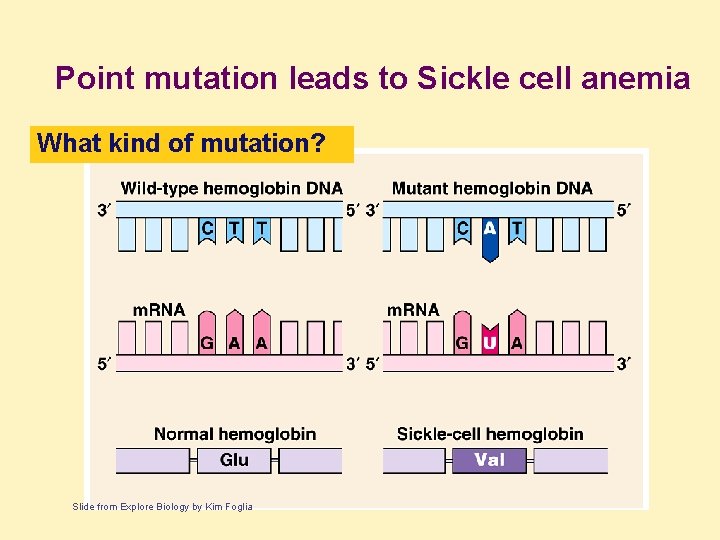
Point mutation leads to Sickle cell anemia What kind of mutation? Slide from Explore Biology by Kim Foglia
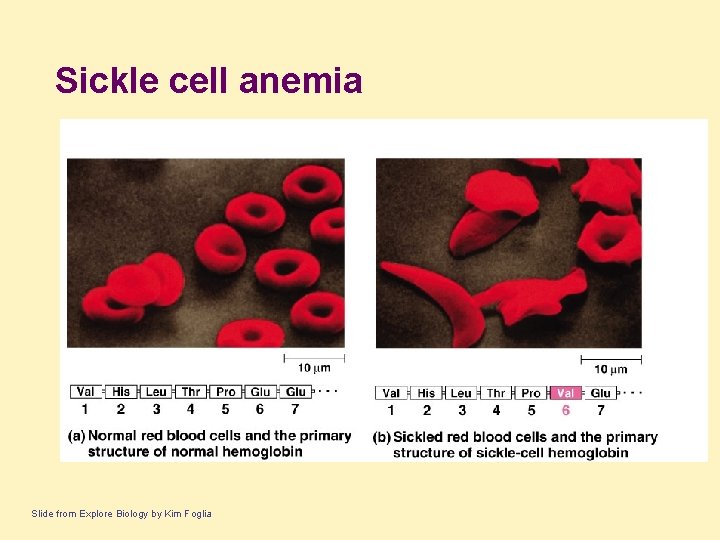
Sickle cell anemia Slide from Explore Biology by Kim Foglia
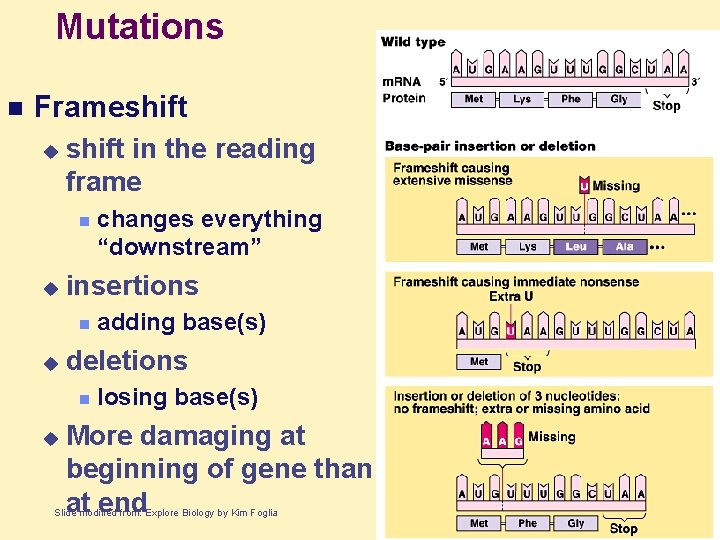
Mutations Frameshift u shift in the reading frame u insertions u adding base(s) deletions u changes everything “downstream” losing base(s) More damaging at beginning of gene than at end Slide modified from: Explore Biology by Kim Foglia
DNA → DNA ______ DNA → RNA ______ RNA→ Protein ______
WHAT IS A “GENE”? Mendel’s factors determine phenotype T. H. Morgan- genes located on specific chromosomes Beadle and Tatum’s “one gene-one enzyme” Became “One gene-one polypeptide” - Some proteins made of more than one polypeptide chain Ex: hemoglobin has 4 polypeptide chains Now: “one gene – one polypeptide or RNA” - Not all genes code for proteins
Can you tell the story? AP Biology
Any Questions? ? What color would a smurf turn if he held his breath? AP Biology 2007 -2008
- Slides: 58