
From Gene to Protein Overview The Flow of
- Slides: 66
From Gene to Protein
Overview: The Flow of Genetic Information �The DNA inherited by organisms leads to specific traits by dictating synthesis of proteins �The process by which DNA directs protein synthesis is called Gene Expression �Transcription �Translation In other words, Proteins are the link between genotype & Phenotype! We need to 1 st look back and examine how the fundamental relationship between genes and proteins was discovered
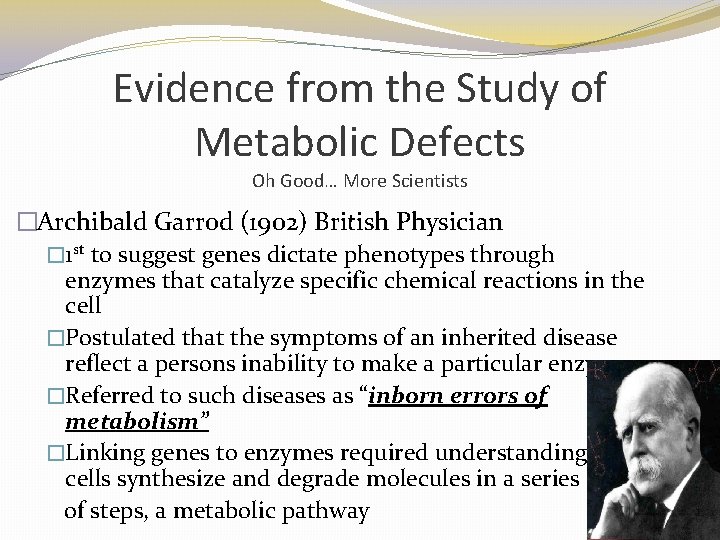
Evidence from the Study of Metabolic Defects Oh Good… More Scientists �Archibald Garrod (1902) British Physician � 1 st to suggest genes dictate phenotypes through enzymes that catalyze specific chemical reactions in the cell �Postulated that the symptoms of an inherited disease reflect a persons inability to make a particular enzyme �Referred to such diseases as “inborn errors of metabolism” �Linking genes to enzymes required understanding that cells synthesize and degrade molecules in a series of steps, a metabolic pathway
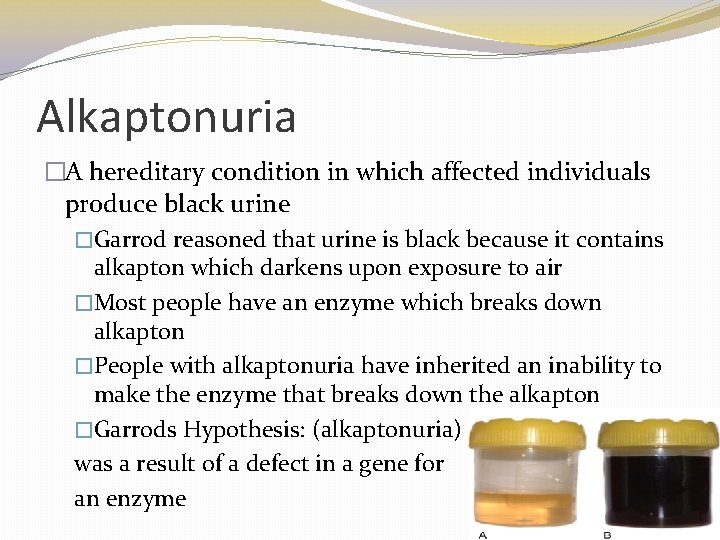
Alkaptonuria �A hereditary condition in which affected individuals produce black urine �Garrod reasoned that urine is black because it contains alkapton which darkens upon exposure to air �Most people have an enzyme which breaks down alkapton �People with alkaptonuria have inherited an inability to make the enzyme that breaks down the alkapton �Garrods Hypothesis: (alkaptonuria) was a result of a defect in a gene for an enzyme
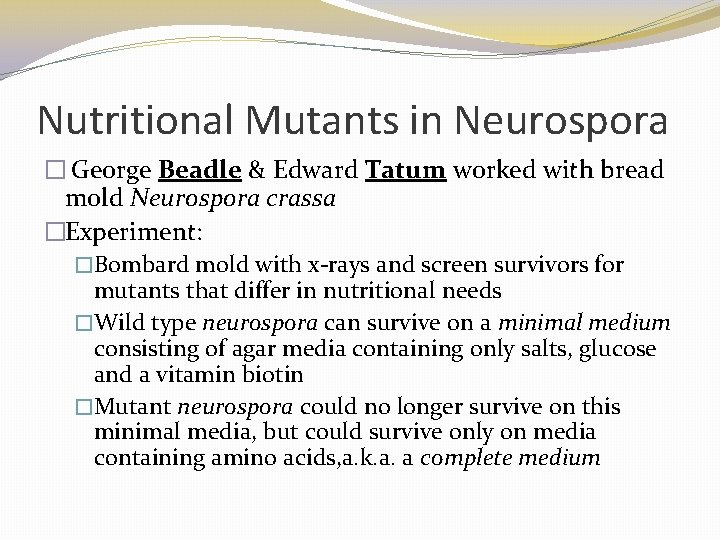
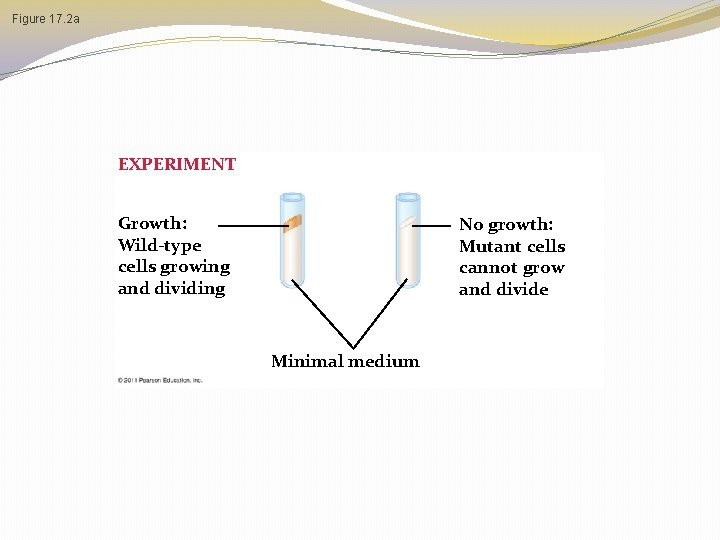
Nutritional Mutants in Neurospora � George Beadle & Edward Tatum worked with bread mold Neurospora crassa �Experiment: �Bombard mold with x-rays and screen survivors for mutants that differ in nutritional needs �Wild type neurospora can survive on a minimal medium consisting of agar media containing only salts, glucose and a vitamin biotin �Mutant neurospora could no longer survive on this minimal media, but could survive only on media containing amino acids, a. k. a. a complete medium
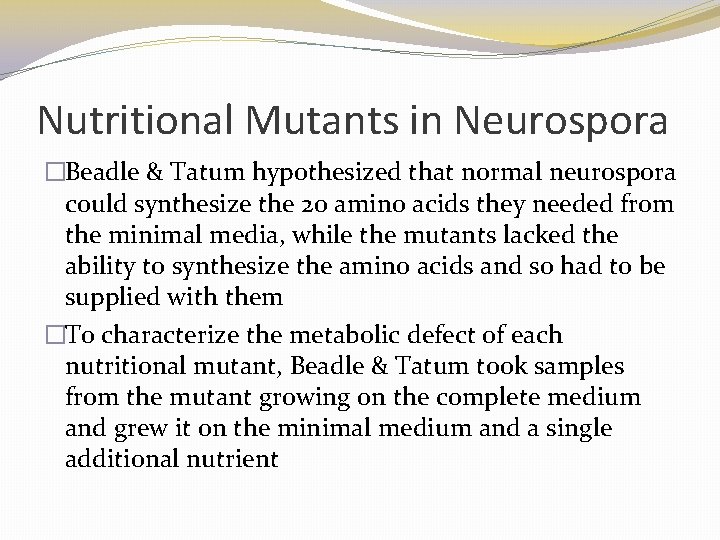
Nutritional Mutants in Neurospora �Beadle & Tatum hypothesized that normal neurospora could synthesize the 20 amino acids they needed from the minimal media, while the mutants lacked the ability to synthesize the amino acids and so had to be supplied with them �To characterize the metabolic defect of each nutritional mutant, Beadle & Tatum took samples from the mutant growing on the complete medium and grew it on the minimal medium and a single additional nutrient
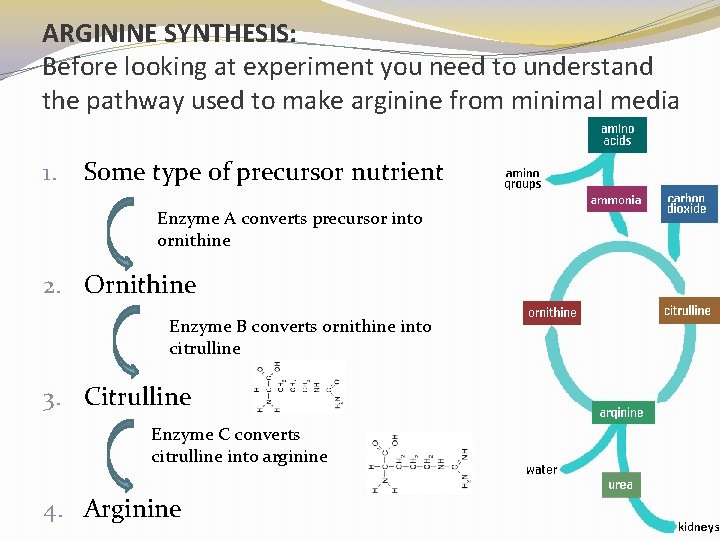
ARGININE SYNTHESIS: Before looking at experiment you need to understand the pathway used to make arginine from minimal media 1. Some type of precursor nutrient Enzyme A converts precursor into ornithine 2. Ornithine Enzyme B converts ornithine into citrulline 3. Citrulline Enzyme C converts citrulline into arginine 4. Arginine
Figure 17. 2 a EXPERIMENT Growth: Wild-type cells growing and dividing No growth: Mutant cells cannot grow and divide Minimal medium
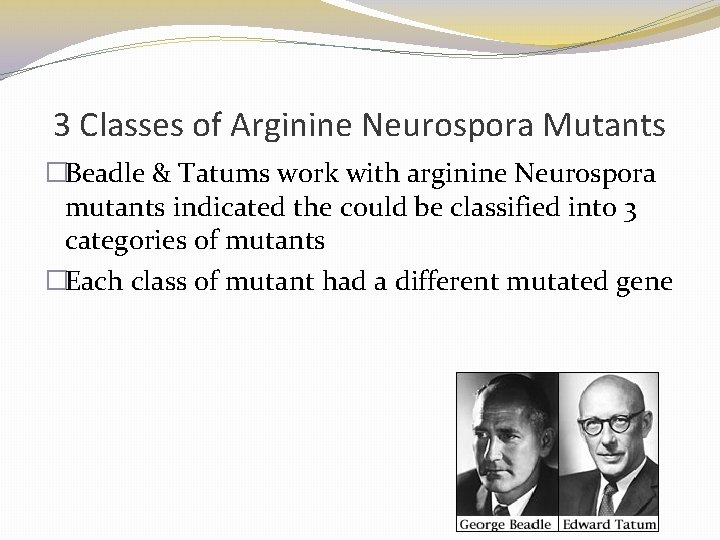
3 Classes of Arginine Neurospora Mutants �Beadle & Tatums work with arginine Neurospora mutants indicated the could be classified into 3 categories of mutants �Each class of mutant had a different mutated gene
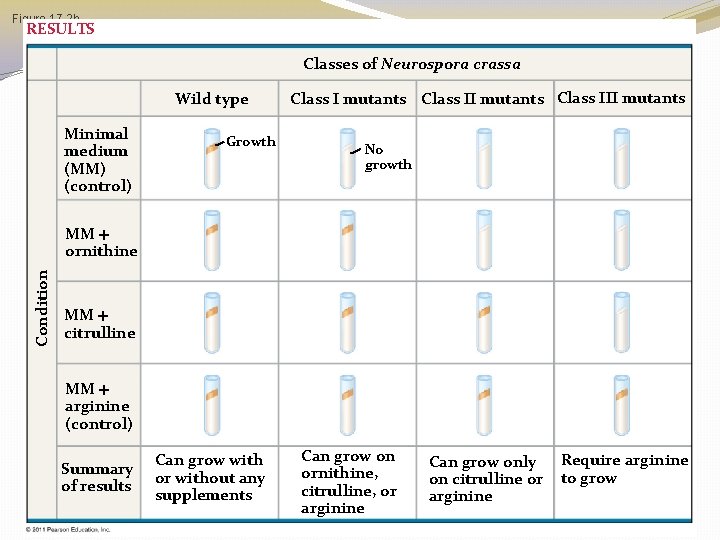
Figure 17. 2 b RESULTS Classes of Neurospora crassa Wild type Minimal medium (MM) (control) Growth Class I mutants Class III mutants No growth Condition MM ornithine MM citrulline MM arginine (control) Summary of results Can grow with or without any supplements Can grow on ornithine, citrulline, or arginine Can grow only on citrulline or arginine Require arginine to grow
Nutritional Mutants in Neurospora �The individual nutrient that allowed growth was indicative of the metabolic defect �For example; if the only sample that supported growth was the one containing arginine, the researchers could conclude that the mutant was defective in the pathway that wild type cells use to synthesize arginine �Beadle & Tatum didn’t stop there, they went on to characterize each mutants defect more specifically
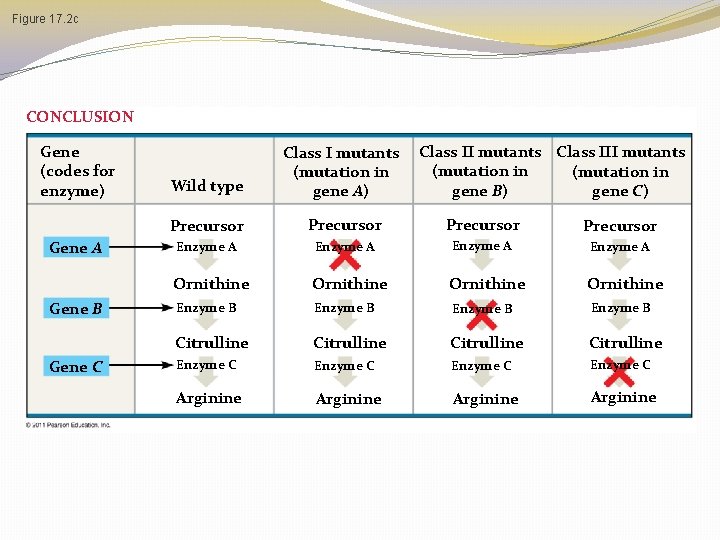
3 Classes of Arginine Mutants �These 3 classes of mutants must be blocked at different steps of the pathway! �It is reasonable to assume that each mutant class lacks a functional enzyme to catalyze the next step of the pathway �So which enzyme do each class of mutant probably not have?
Figure 17. 2 c CONCLUSION Gene (codes for enzyme) Gene A Gene B Gene C Class II mutants Class III mutants (mutation in gene B) gene C) Wild type Class I mutants (mutation in gene A) Precursor Enzyme A Ornithine Enzyme B Citrulline Enzyme C Arginine
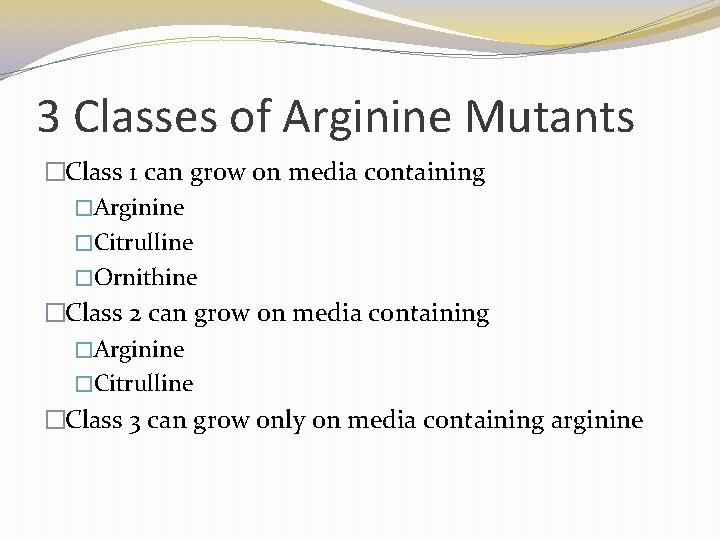
3 Classes of Arginine Mutants �Class 1 can grow on media containing �Arginine �Citrulline �Ornithine �Class 2 can grow on media containing �Arginine �Citrulline �Class 3 can grow only on media containing arginine
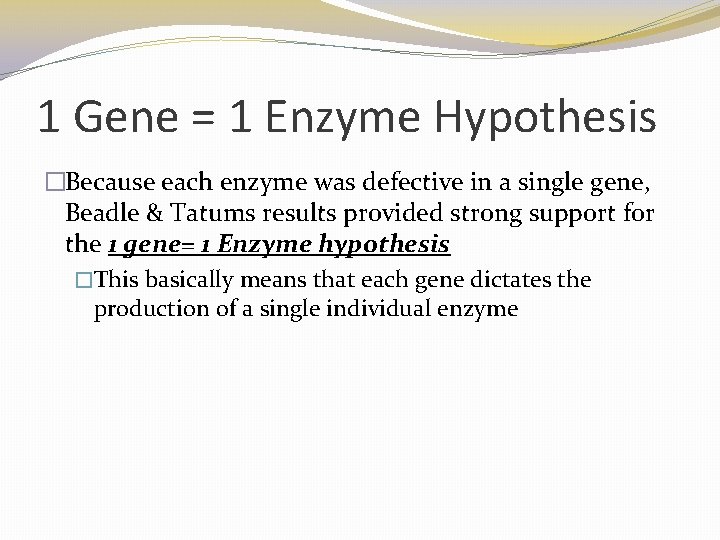
1 Gene = 1 Enzyme Hypothesis �Because each enzyme was defective in a single gene, Beadle & Tatums results provided strong support for the 1 gene= 1 Enzyme hypothesis �This basically means that each gene dictates the production of a single individual enzyme
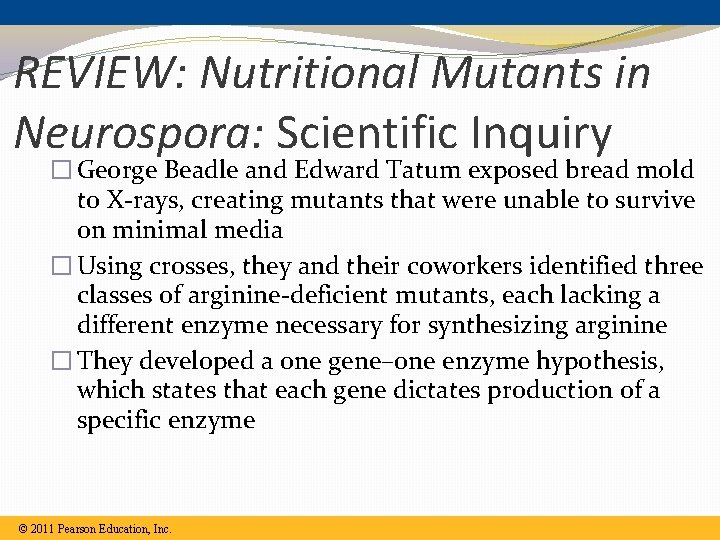
REVIEW: Nutritional Mutants in Neurospora: Scientific Inquiry � George Beadle and Edward Tatum exposed bread mold to X-rays, creating mutants that were unable to survive on minimal media � Using crosses, they and their coworkers identified three classes of arginine-deficient mutants, each lacking a different enzyme necessary for synthesizing arginine � They developed a one gene–one enzyme hypothesis, which states that each gene dictates production of a specific enzyme © 2011 Pearson Education, Inc.
The Products of Gene Expression: A Developing Story � Some proteins aren’t enzymes, so researchers later revised the hypothesis: one gene–one protein � Many proteins are composed of several polypeptides, each of which has its own gene � Therefore, Beadle and Tatum’s hypothesis is now restated as the one gene–one polypeptide hypothesis � Genes control phenotypes through the action of proteins is another contribution of their work © 2011 Pearson Education, Inc.
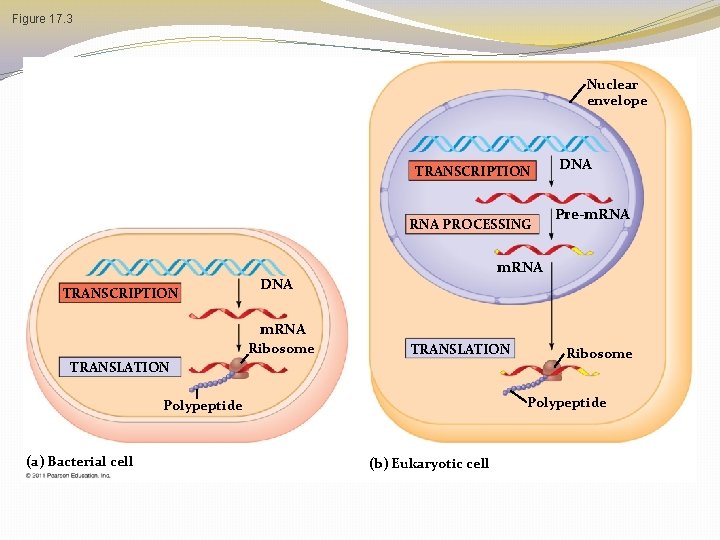
Basic Principles of Transcription and Translation � RNA is the bridge between genes and the proteins for which they code � Transcription is the synthesis of RNA under the direction of DNA (DNA to m. RNA in nucleus) � Transcription produces messenger RNA (m. RNA) � Translation is the synthesis of a polypeptide, using information in the m. RNA (m. RNA to protein) � Ribosomes are the sites of translation © 2011 Pearson Education, Inc.
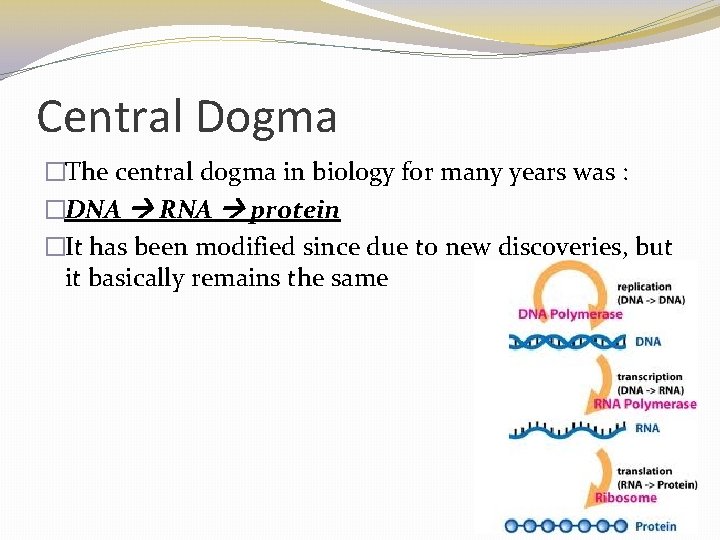
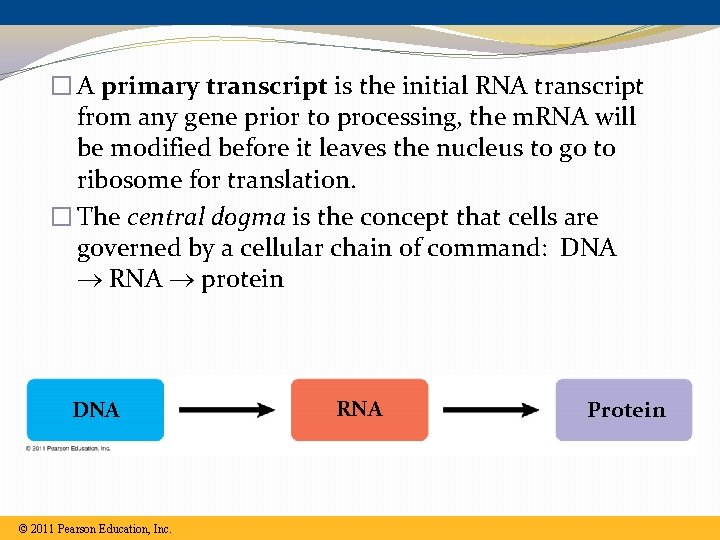
Central Dogma �The central dogma in biology for many years was : �DNA RNA protein �It has been modified since due to new discoveries, but it basically remains the same
Basic Principles of Transcription & Translation Transcription Translation �The synthesis of a complementary strand of RNA under the direction of DNA template �Same language as DNA nucleotides �Occurs in the nucleus � The synthesis of an amino acid chain (polypeptide) under the direction of RNA � Change in language from nucleotides to amino acids � Occurs outside of the nucleus on a ribosome � Secretory proteins are transcribed on ribosomes attached to the ER � Proteins for internal cell use are transcribed on free ribosomes
Why do we need an RNA intermediate? �In other words, why can’t we just use DNA as the template to build a polypeptide �Using RNA provides protection for DNA �Using an RNA intermediate allows for more then one polypeptide to be synthesized at once
� A primary transcript is the initial RNA transcript from any gene prior to processing, the m. RNA will be modified before it leaves the nucleus to go to ribosome for translation. � The central dogma is the concept that cells are governed by a cellular chain of command: DNA RNA protein DNA © 2011 Pearson Education, Inc. RNA Protein
Figure 17. 3 Nuclear envelope TRANSCRIPTION RNA PROCESSING TRANSCRIPTION DNA Pre-m. RNA DNA m. RNA Ribosome TRANSLATION Polypeptide (a) Bacterial cell Ribosome (b) Eukaryotic cell
Transcription Overview �DNA is transcribed into pre-messenger RNA by RNA Polymerase in the nucleus �Initiation �Elongation �Termination �This pre-m. RNA undergoes RNA processing yielding a finished m. RNA �This primary transcript is now ready to leave the nucleus and undergo translation
The Genetic Code � How are the instructions for assembling amino acids into proteins encoded into DNA? � There are 20 amino acids, but there are only four nucleotide bases in DNA © 2011 Pearson Education, Inc.
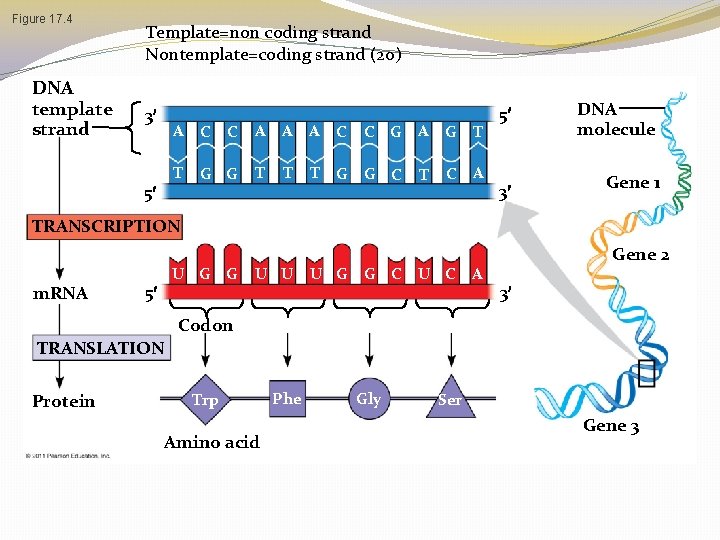
Codons: Triplets of Nucleotides � How many nucleotides correspond to an amino acid? � The flow of information from gene to protein is based on a triplet code: a series of nonoverlapping, threenucleotide words. � The words of a gene are transcribed into complementary nonoverlaping three-nucleotide words of m. RNA � These words are then translated into a chain of amino acids, forming a polypeptide © 2011 Pearson Education, Inc.
Figure 17. 4 DNA template strand Template=non coding strand Nontemplate=coding strand (20) 3 5 A C C A A A T G G T T T G C C G A G T G C C A T 5 DNA molecule 3 Gene 1 TRANSCRIPTION m. RNA U G G 5 U U U G G C U C A Gene 2 3 Codon TRANSLATION Protein Trp Amino acid Phe Gly Ser Gene 3
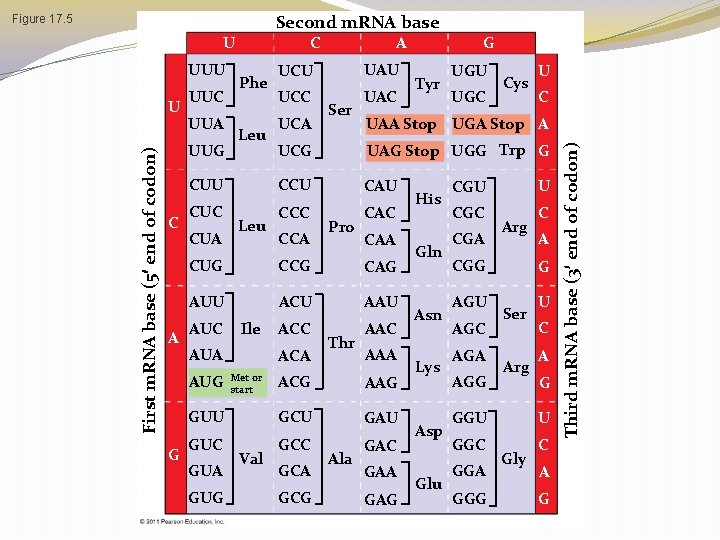
The Genetic Code �If each arrangement of 3 consecutive bases specifies one amino acid, it is possible to specify up to 64 amino acids (43) �There are only 20 amino acids, so this immediately indicates that there must be some redundancy within the code �This is an important safety that helps us survive mutations in our DNA!
Codons & Amino Acids �Each nucleotide triplet is called a codon, and each codon specifies only 1 amino acid �Obviously, each amino acid may be specified by more than one codon �Remember, this redundancy is important in our ability to survive DNA mutations �This means that a polypeptide containing 100 amino acids must have a minimum of how many nucleotides?
Second m. RNA base U UUU First m. RNA base (5 end of codon) U UUC UUA A Leu UAU UCC UAC UCA Ser Tyr UGU UGC Cys U C UAA Stop UGA Stop A UAG Stop UGG Trp G CUU CCU CAU CUC CCC CAC CUA Leu CCA Pro CAA CUG CCG CAG AUU ACU AAU AUC Ile AUA AUG G Phe UCU G UCG UUG C ACC ACA Met or start Thr AAC AAA ACG AAG GUU GCU GAU GUC GCC GAC GUA GUG Val GCA GCG Ala GAA GAG His Gln Asn Lys Asp Glu U CGC CGA Arg CGG AGU AGC AGA AGG C A G Ser Arg U C A G GGU U GGC C GGA GGG Gly A G Third m. RNA base (3 end of codon) Figure 17. 5
Evolution of the Genetic Code �The genetic code refers to the “code” of 1 codon specifying 1 amino acid �This genetic code thus far appears to be shared universally among all life forms, from bacteria to mammals �Slight variations exist in organelle genes and in some unicellular eukaryotes �“A shared genetic vocabulary is a reminder of the kinship that bonds life on Earth”
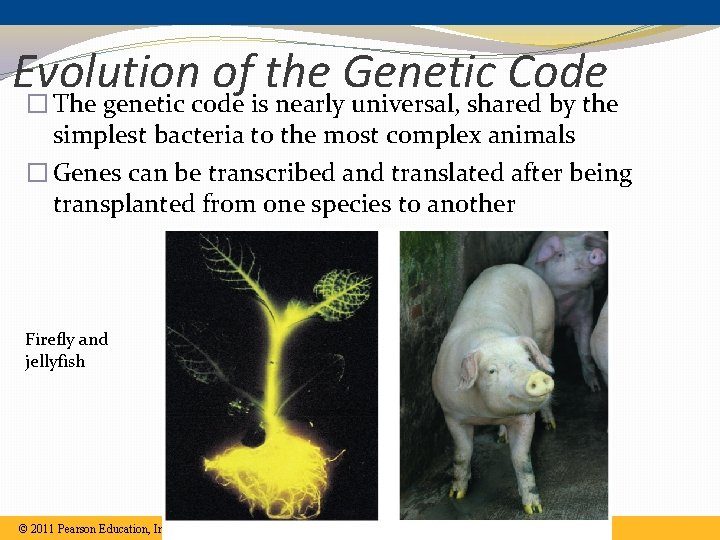
Evolution of the Genetic Code � The genetic code is nearly universal, shared by the simplest bacteria to the most complex animals � Genes can be transcribed and translated after being transplanted from one species to another Firefly and jellyfish © 2011 Pearson Education, Inc.
Cracking the Code �Marshall Nirenburg of the NIH began cracking the genetic code in the early 1960’s �He synthesized an artificial m. RNA consisting only of uracil, this way, no matter where translation began it would only have one reading option UUUUUUU… �He then put this in an artificial system designed to undergo translation and what he found was a polypeptide composed solely of the amino acid phenylalanine
Methionine �The codon AUG codes for the amino acid methionine �AUG is known as the start codon, and thus methionine is at the beginning of every polypeptide synthesized �That is not to say that every finished protein has methionine as its 1 st amino acid, methionine may be excised later during protein finishing
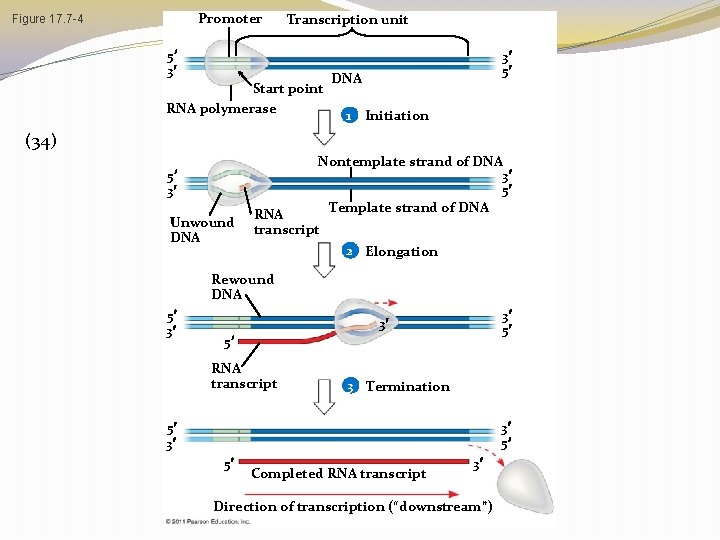
Molecular Components of Transcription � Transcription is the first stage of gene expression � RNA synthesis is catalyzed by RNA polymerase, which pries the DNA strands apart and hooks together the RNA nucleotides without a primer � RNA Polymerase does NOT need a primer and can start an existing strand from scratch � The RNA is complementary to the DNA template strand � RNA synthesis follows the same base-pairing rules as DNA, except that uracil substitutes for thymine © 2011 Pearson Education, Inc.
� The DNA sequence where RNA polymerase attaches is called the promoter; in bacteria, the sequence signaling the end of transcription is called the terminator � The stretch of DNA that is transcribed is called a transcription unit © 2011 Pearson Education, Inc.
Promoter Figure 17. 7 -4 Transcription unit 5 3 Start point RNA polymerase 3 5 DNA 1 Initiation (34) Nontemplate strand of DNA 3 5 Template strand of DNA 5 3 Unwound DNA RNA transcript 2 Elongation Rewound DNA 5 3 3 5 RNA transcript 3 Termination 3 5 5 3 5 Completed RNA transcript 3 Direction of transcription (“downstream”)
Special Sequences in DNA �Promoter: this is a sequence of DNA recognized by RNA Polymerase, marking where the gene begins �This is the site where RNA Polymerase actually attaches and initiates transcription �Terminator (prokaryotes only!) is a sequence that signals the end of transcription
Lingo Downstream Upstream �The direction of transcription is said to be downstream �The direction opposite of transcription is said to be upstream So is the promoter upstream or downstream of the terminator? Transcription Unit: the entire stretch of DNA that is transcribed is called the transcription unit
Transcription is Divided into 3 Stages �Initiation �RNA Polymerase recognizes and binds to promoter �Elongation �Termination �Stages of Transcription Animation
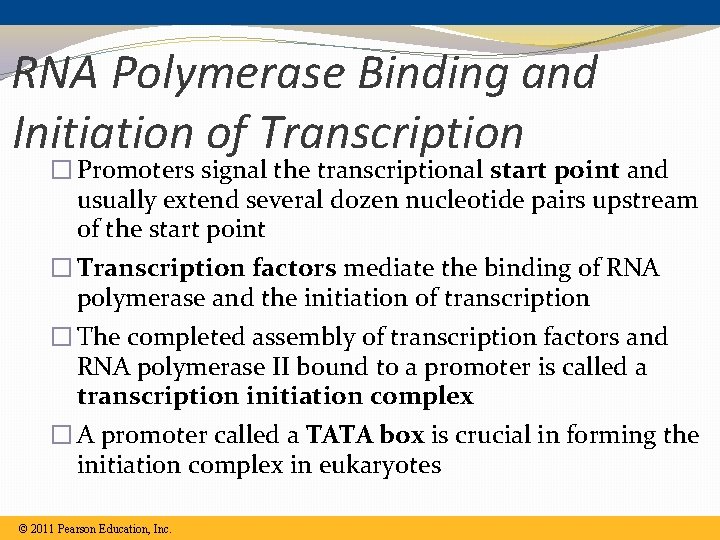
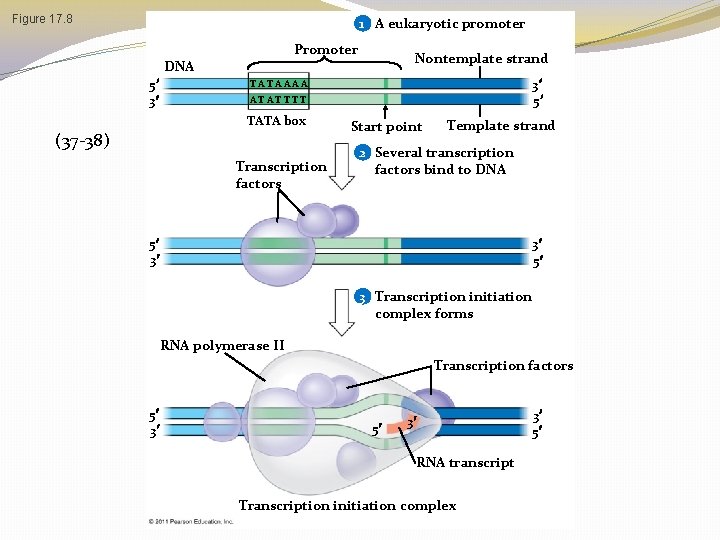
RNA Polymerase Binding and Initiation of Transcription � Promoters signal the transcriptional start point and usually extend several dozen nucleotide pairs upstream of the start point � Transcription factors mediate the binding of RNA polymerase and the initiation of transcription � The completed assembly of transcription factors and RNA polymerase II bound to a promoter is called a transcription initiation complex � A promoter called a TATA box is crucial in forming the initiation complex in eukaryotes © 2011 Pearson Education, Inc.
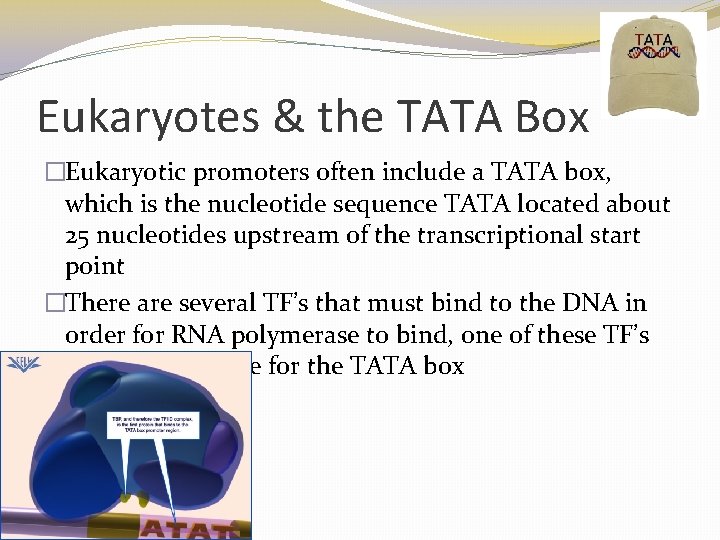
Eukaryotes & the TATA Box �Eukaryotic promoters often include a TATA box, which is the nucleotide sequence TATA located about 25 nucleotides upstream of the transcriptional start point �There are several TF’s that must bind to the DNA in order for RNA polymerase to bind, one of these TF’s has a binding site for the TATA box
Figure 17. 8 1 A eukaryotic promoter Promoter DNA 5 3 Nontemplate strand 3 5 TA T A A AA A T AT T TATA box (37 -38) Transcription factors Start point Template strand 2 Several transcription factors bind to DNA 5 3 3 5 3 Transcription initiation complex forms RNA polymerase II Transcription factors 5 3 5 3 RNA transcript Transcription initiation complex 3 5
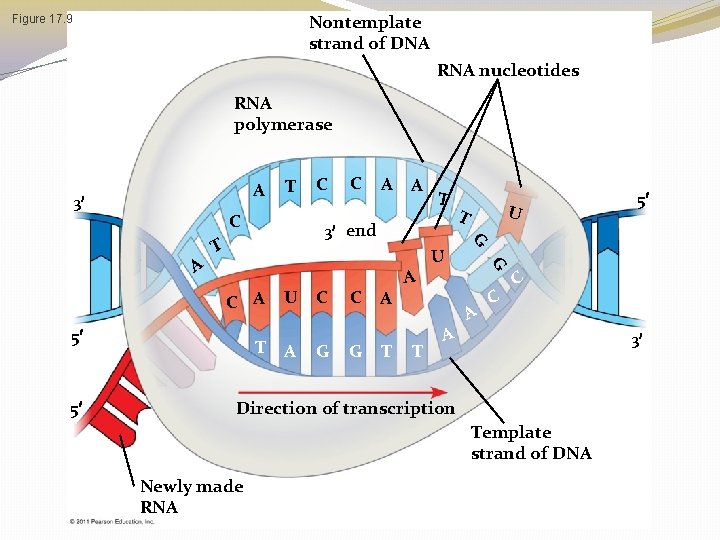
Elongation of the RNA Strand � As RNA polymerase moves along the DNA, it untwists the double helix, 10 to 20 bases at a time � Transcription progresses at a rate of 40 nucleotides per second in eukaryotes � A gene can be transcribed simultaneously by several RNA polymerases � Nucleotides are added to the 3 end of the growing RNA molecule © 2011 Pearson Education, Inc.
Nontemplate strand of DNA Figure 17. 9 RNA nucleotides RNA polymerase A 3 C C A A T 3 end T T U A C G A T U A U T G C A 5 C A C C 3 Direction of transcription Template strand of DNA Newly made RNA 5 G A 5 T
Elongation �As RNA Polymerase travels down the DNA strand it continues untwisting the DNA and adding nucleotides to the 3’end of a growing nucleotide chain �Unlike DNA replication where the newly synthesized daughter DNA stays associated with the parent DNA strand, the RNA disassociates immediately after the covalent linkage between sugars is made, and DNA reassociates back into its double helix �Transcription progresses at a rate of about 60 nucleotides / second
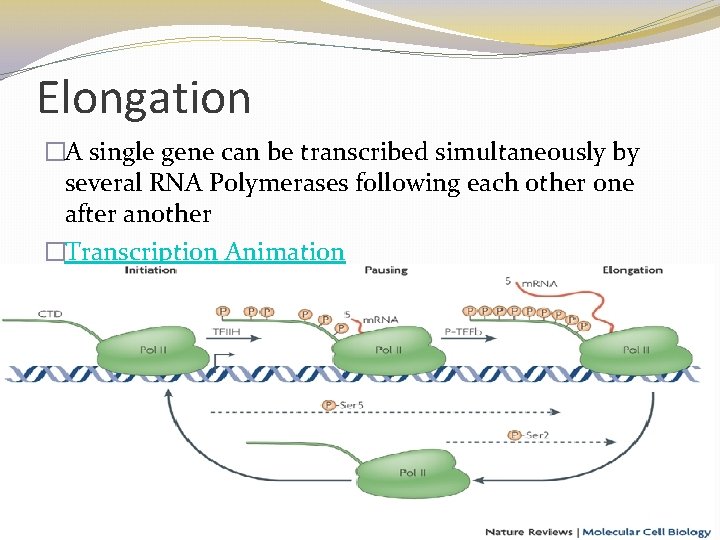
Elongation �A single gene can be transcribed simultaneously by several RNA Polymerases following each other one after another �Transcription Animation
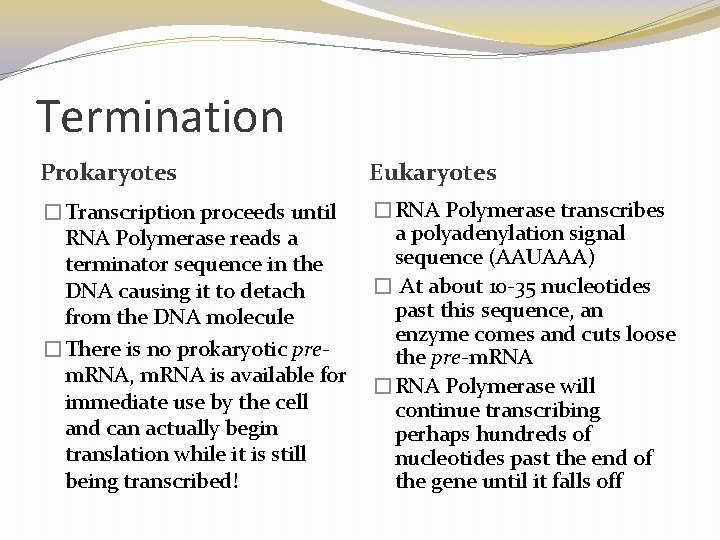
Termination of Transcription � The mechanisms of termination are different in bacteria and eukaryotes � In bacteria, the polymerase stops transcription at the end of the terminator and the m. RNA can be translated without further modification � In eukaryotes, RNA polymerase II transcribes the polyadenylation signal sequence; the RNA transcript is released 10– 35 nucleotides past this polyadenylation sequence © 2011 Pearson Education, Inc.
Termination Prokaryotes Eukaryotes �Transcription proceeds until RNA Polymerase reads a terminator sequence in the DNA causing it to detach from the DNA molecule �There is no prokaryotic prem. RNA, m. RNA is available for immediate use by the cell and can actually begin translation while it is still being transcribed! �RNA Polymerase transcribes a polyadenylation signal sequence (AAUAAA) � At about 10 -35 nucleotides past this sequence, an enzyme comes and cuts loose the pre-m. RNA �RNA Polymerase will continue transcribing perhaps hundreds of nucleotides past the end of the gene until it falls off
Concept 17. 3: Eukaryotic cells modify RNA after transcription � Enzymes in the eukaryotic nucleus modify pre-m. RNA (RNA processing) before the genetic messages are dispatched to the cytoplasm � During RNA processing, both ends of the primary transcript are usually altered � Also, usually some interior parts of the molecule are cut out, and the other parts spliced together © 2011 Pearson Education, Inc.
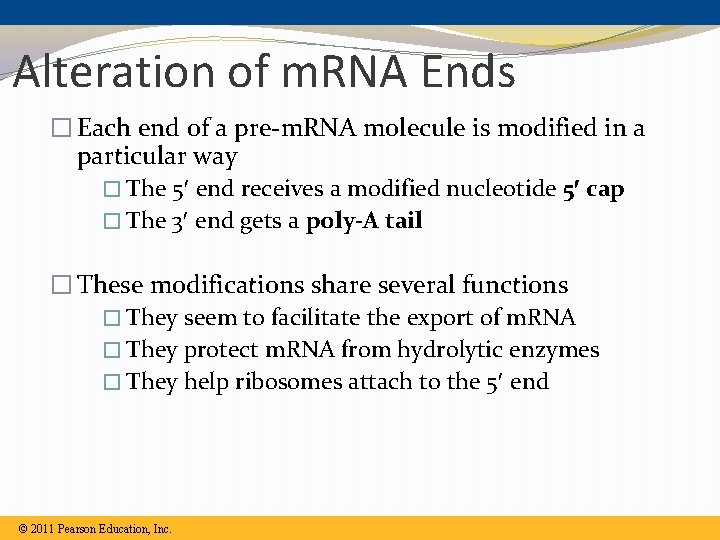
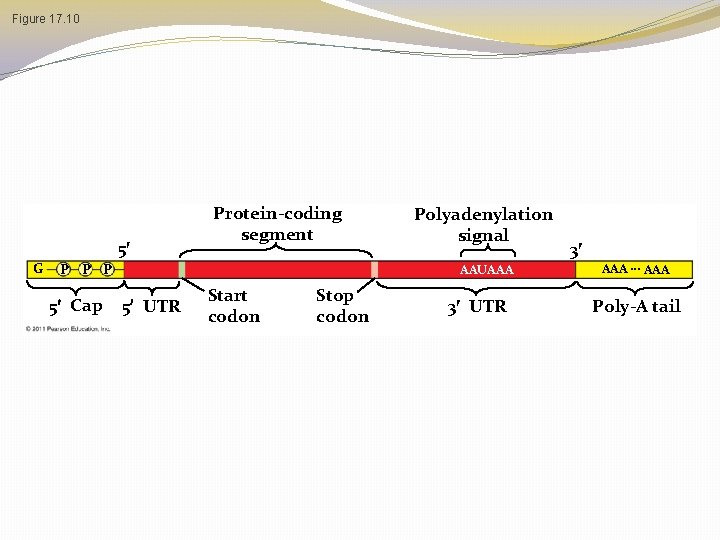
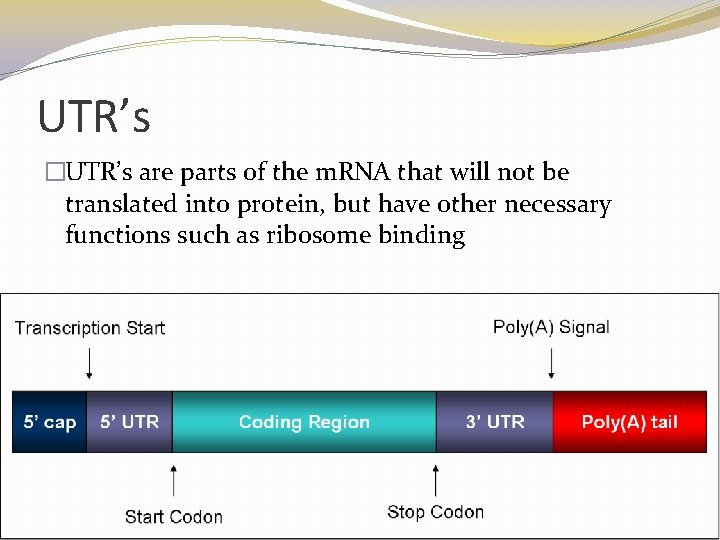
Alteration of m. RNA Ends � Each end of a pre-m. RNA molecule is modified in a particular way � The 5 end receives a modified nucleotide 5 cap � The 3 end gets a poly-A tail � These modifications share several functions � They seem to facilitate the export of m. RNA � They protect m. RNA from hydrolytic enzymes � They help ribosomes attach to the 5 end © 2011 Pearson Education, Inc.
Figure 17. 10 5 G Protein-coding segment P P P 5 Cap Polyadenylation signal AAUAAA 5 UTR Start codon Stop codon 3 UTR 3 AAA … AAA Poly-A tail
UTR’s �UTR’s are parts of the m. RNA that will not be translated into protein, but have other necessary functions such as ribosome binding
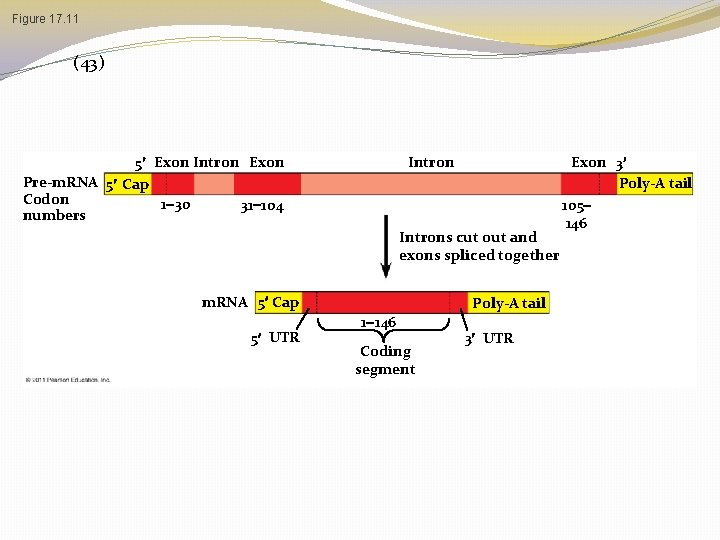
Split Genes and RNA Splicing � Most eukaryotic genes and their RNA transcripts have long noncoding stretches of nucleotides that lie between coding regions � These noncoding regions are called intervening sequences, or introns � The other regions are called exons because they are eventually expressed, usually translated into amino acid sequences � RNA splicing removes introns and joins exons, creating an m. RNA molecule with a continuous coding sequence © 2011 Pearson Education, Inc.
Figure 17. 11 (43) 5 Exon Intron Exon Pre-m. RNA 5 Cap Codon 1 30 31 104 numbers Introns cut out and exons spliced together m. RNA 5 Cap 5 UTR Poly-A tail 1 146 Coding segment 3 UTR Exon 3 Poly-A tail 105 146
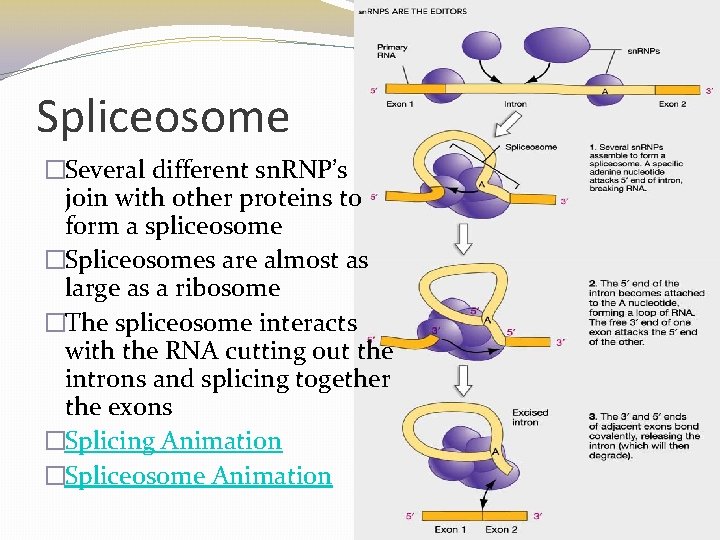
� In some cases, RNA splicing is carried out by spliceosomes � Spliceosomes are located in the nucleus � Spliceosomes consist of a variety of proteins and several small nuclear ribonucleoproteins (sn. RNPs) that recognize the splice sites � Snurps are composed of RNA and protein and recognize short sequences at the end of each intron that needs to be spliced. © 2011 Pearson Education, Inc.
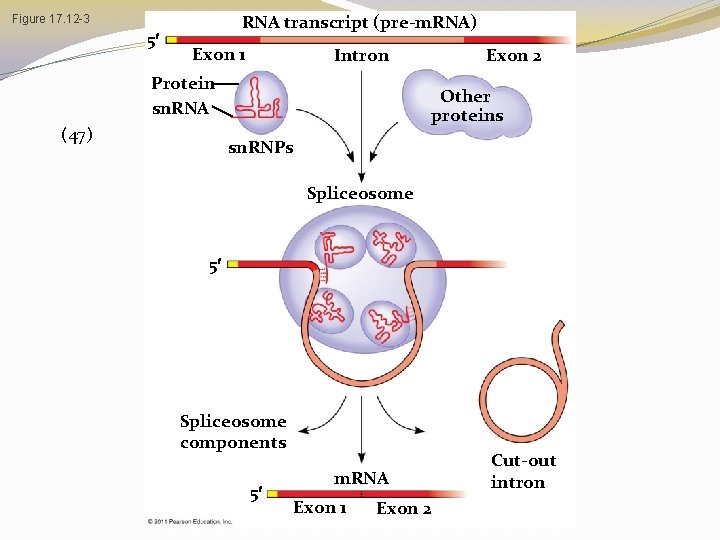
Spliceosome �Several different sn. RNP’s join with other proteins to form a spliceosome �Spliceosomes are almost as large as a ribosome �The spliceosome interacts with the RNA cutting out the introns and splicing together the exons �Splicing Animation �Spliceosome Animation
RNA transcript (pre-m. RNA) Figure 17. 12 -3 5 Exon 1 Intron Protein sn. RNA (47) Exon 2 Other proteins sn. RNPs Spliceosome 5 Spliceosome components 5 m. RNA Exon 1 Exon 2 Cut-out intron
Ribozymes � Ribozymes are catalytic RNA molecules that function as enzymes and can splice RNA � The discovery of ribozymes rendered obsolete the belief that all biological catalysts were proteins � In some species, there is no need for protein or even additional RNA molecules, the intron within the m. RNA catalyzes its own excision! © 2011 Pearson Education, Inc.
Ribozyme Mechanism �Because RNA is single stranded, one portion of an RNA molecule can base pair with another complementary portion of the same molecule �Some of the bases contain functional groups that may participate in catalysis �So… Not all biological catalysts are proteins after all!
� Three properties of RNA enable it to function as an enzyme � It can form a three-dimensional structure because of its ability to base-pair with itself � Some bases in RNA contain functional groups that may participate in catalysis � RNA may hydrogen-bond with other nucleic acid molecules © 2011 Pearson Education, Inc.
The Functional and Evolutionary Importance of Introns � Some introns contain sequences that may regulate gene expression � Some genes can encode more than one kind of polypeptide, depending on which segments are treated as exons during splicing � This is called alternative RNA splicing � Consequently, the number of different proteins an organism can produce is much greater than its number of genes © 2011 Pearson Education, Inc.
Alternative Splicing �A single gene can, in fact, code for more than one polypeptide, depending on which segments are treated as introns and which are treated as exons �Example: the differences between a male and female fruit fly are due mainly to alternative splicing of the same genes �Alternative splicing also provides a possible answer to why we humans get along as well as we do with such little genetic information (we really only have about double that of a fruit fly)
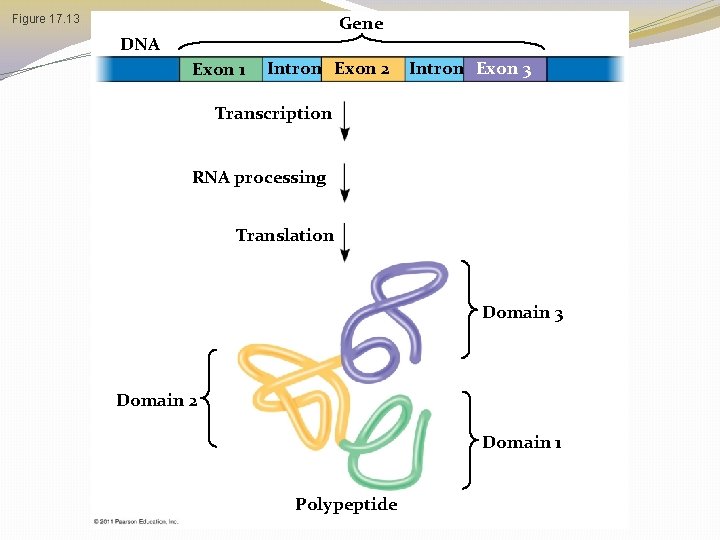
� Proteins often have a modular architecture consisting of discrete regions called domains � In many cases, different exons code for the different domains in a protein � Exon shuffling may result in the evolution of new proteins © 2011 Pearson Education, Inc.
Exon Shuffling �The presence of introns in a gene may facilitate the evolution of new and potentially useful proteins by increasing the probability of crossing over between the exons of different alleles! �Exon shuffling could lead to new proteins with novel combinations of functions (or it could lead to a completely nonfunctional product, and then you die � http: //highered. mcgraw-hill. com/sites/9834092339/student_view 0/chapter 16/animation__exon_shuffling. html
Gene Figure 17. 13 DNA Exon 1 Intron Exon 2 Intron Exon 3 Transcription RNA processing Translation Domain 3 Domain 2 Domain 1 Polypeptide