
From Gene to Protein Chapter 14 What do




- Slides: 23
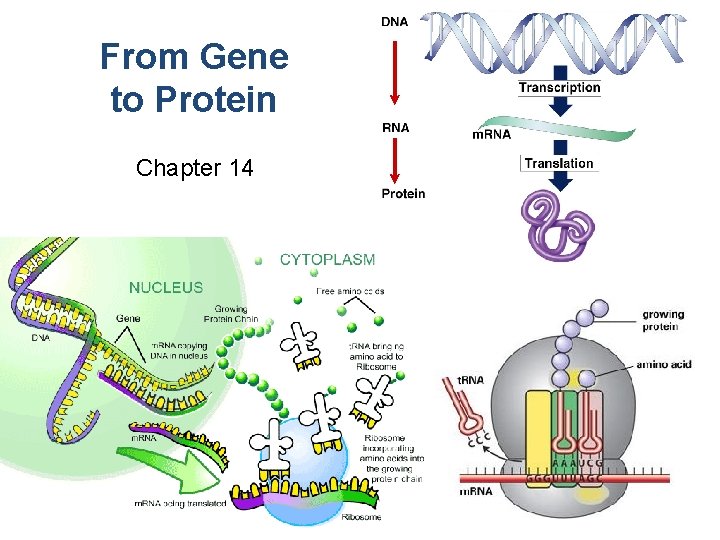
From Gene to Protein Chapter 14
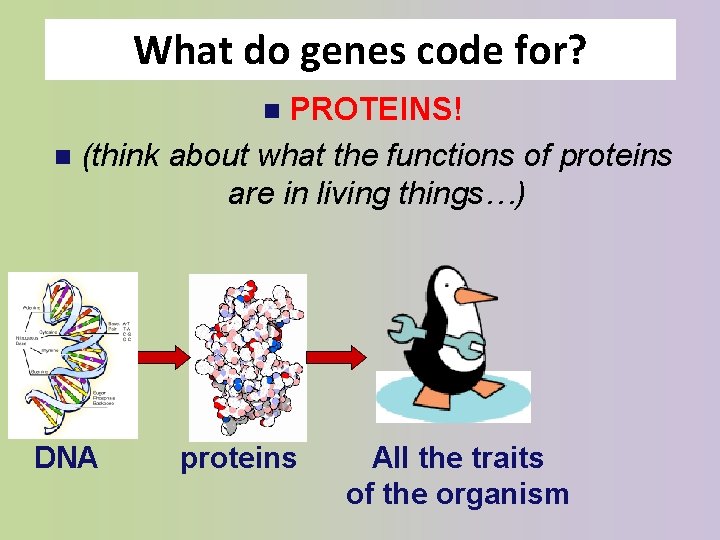
What do genes code for? PROTEINS! n (think about what the functions of proteins are in living things…) n DNA proteins All the traits of the organism
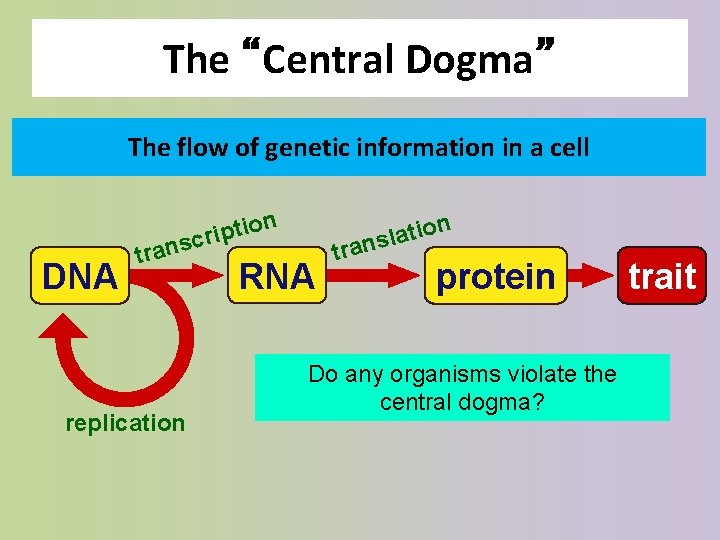
The “Central Dogma” The flow of genetic information in a cell DNA n io t p i r sc tran replication RNA tr n tio a l s an protein Do any organisms violate the central dogma? trait
Protein Synthesis: From gene to protein nucleus a a a cytoplasm a a DNA transcription m. RNA a a translation a a a protein a a a ribosome trait
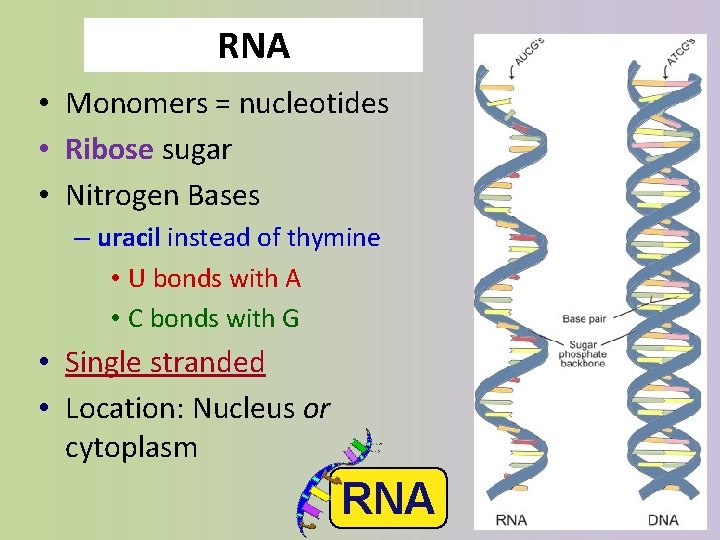
RNA • Monomers = nucleotides • Ribose sugar • Nitrogen Bases – uracil instead of thymine • U bonds with A • C bonds with G • Single stranded • Location: Nucleus or cytoplasm RNA
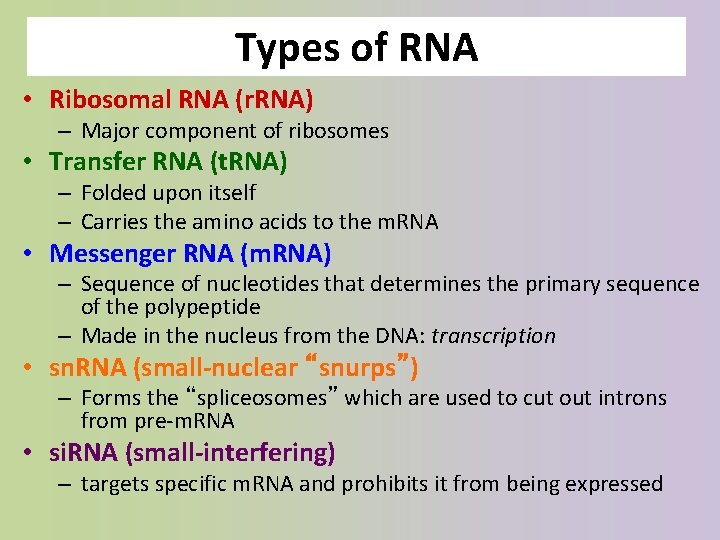
Types of RNA • Ribosomal RNA (r. RNA) – Major component of ribosomes • Transfer RNA (t. RNA) – Folded upon itself – Carries the amino acids to the m. RNA • Messenger RNA (m. RNA) – Sequence of nucleotides that determines the primary sequence of the polypeptide – Made in the nucleus from the DNA: transcription • sn. RNA (small-nuclear “snurps”) – Forms the “spliceosomes” which are used to cut out introns from pre-m. RNA • si. RNA (small-interfering) – targets specific m. RNA and prohibits it from being expressed
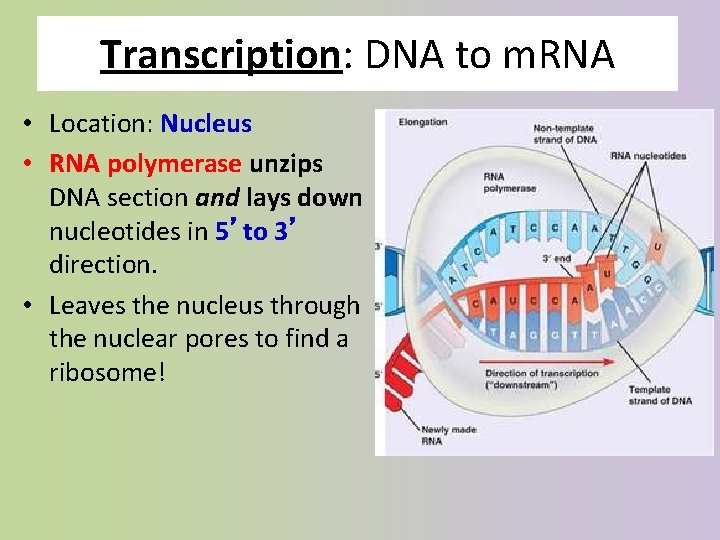
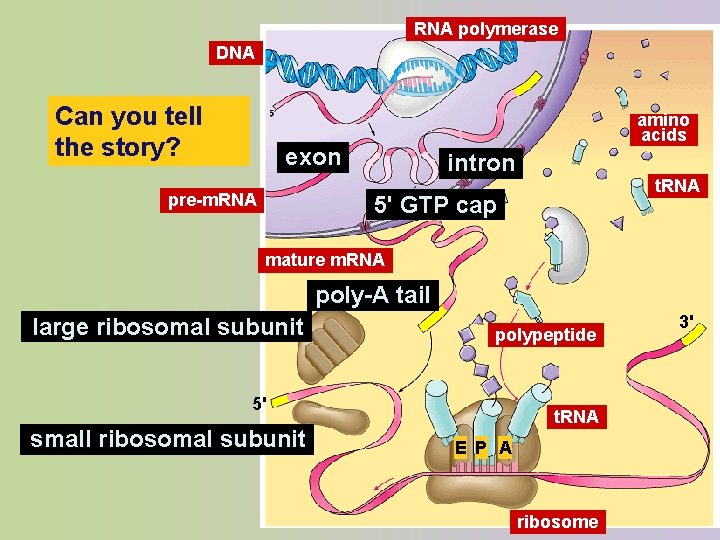
Transcription: DNA to m. RNA • Location: Nucleus • RNA polymerase unzips DNA section and lays down nucleotides in 5’to 3’ direction. • Leaves the nucleus through the nuclear pores to find a ribosome!
Coding strand = this is the protein needed or “sense strand” Template strand (noncoding) = this is the “anti-sense strand”
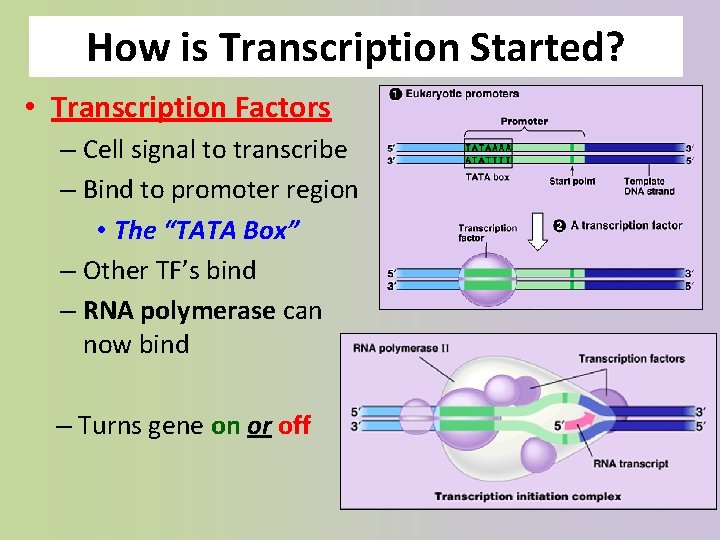
How is Transcription Started? • Transcription Factors – Cell signal to transcribe – Bind to promoter region • The “TATA Box” – Other TF’s bind – RNA polymerase can now bind – Turns gene on or off
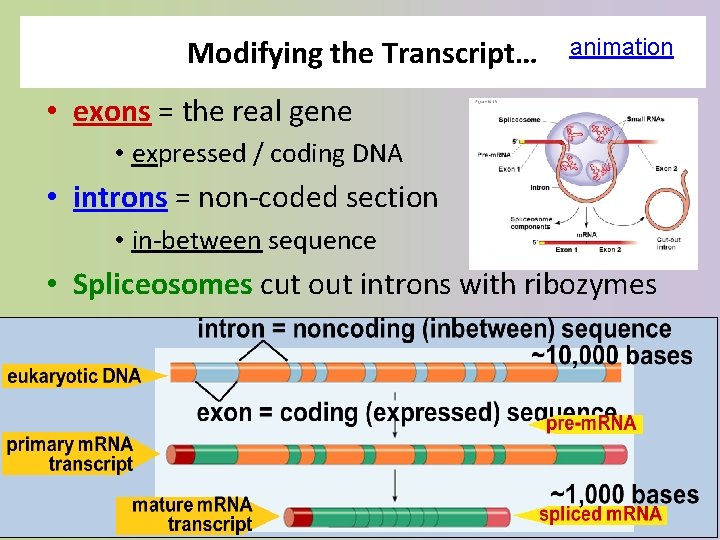
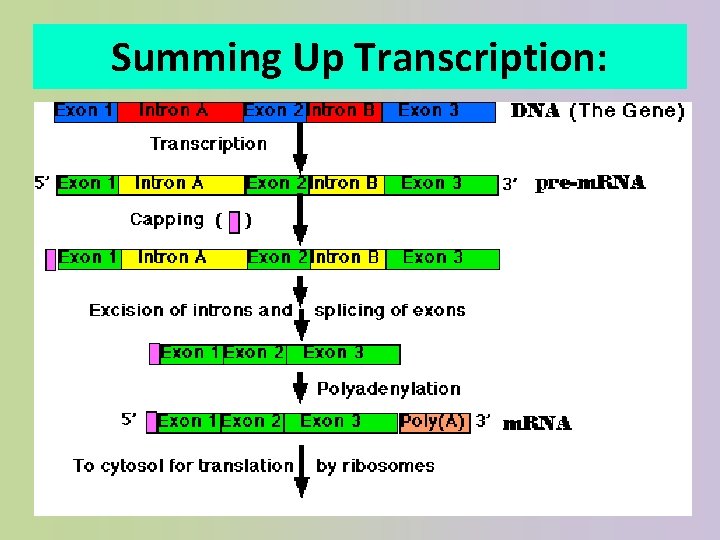
Modifying the Transcript… animation • exons = the real gene • expressed / coding DNA • introns = non-coded section • in-between sequence • Spliceosomes cut out introns with ribozymes intron = noncoding (inbetween) sequence eukaryotic DNA exon = coding (expressed) sequence
Alternative Splicing • • Same piece of DNA can become different proteins! Not all the exons may make it to the final product Intron presence can determine which exons stay or go Increases efficiency and flexibility making proteins Starting to get hard to define a gene!
Final m. RNA processing for Eukaryotes • Need to protect m. RNA moving to cytoplasm (enzymes in cytoplasm will attack m. RNA!) • add 5 GTP cap • add poly-A tail l o p 3' A il a t -A y A A m. RNA p a c ' 50 50 -2 5 5' G P P P A ’s 3'
Summing Up Transcription:
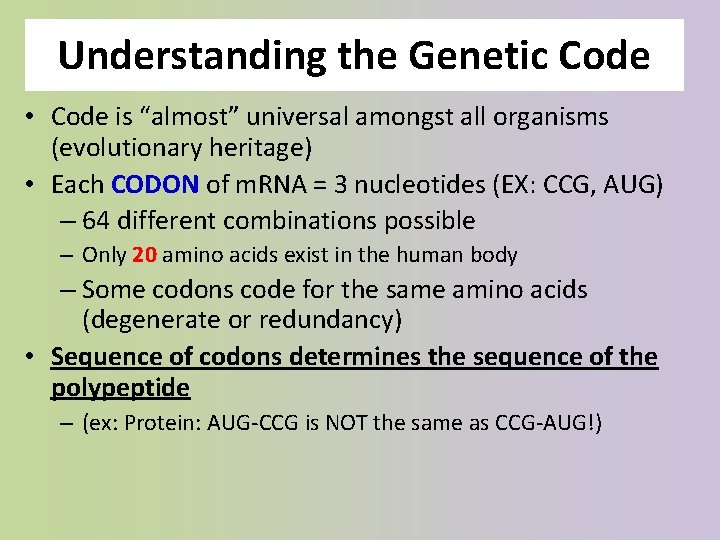
Understanding the Genetic Code • Code is “almost” universal amongst all organisms (evolutionary heritage) • Each CODON of m. RNA = 3 nucleotides (EX: CCG, AUG) – 64 different combinations possible – Only 20 amino acids exist in the human body – Some codons code for the same amino acids (degenerate or redundancy) • Sequence of codons determines the sequence of the polypeptide – (ex: Protein: AUG-CCG is NOT the same as CCG-AUG!)
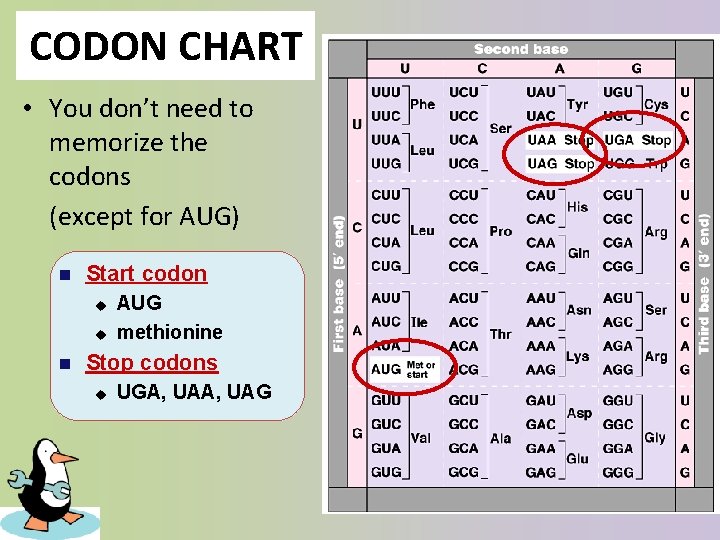
CODON CHART • You don’t need to memorize the codons (except for AUG) n Start codon u u n AUG methionine Stop codons u UGA, UAG
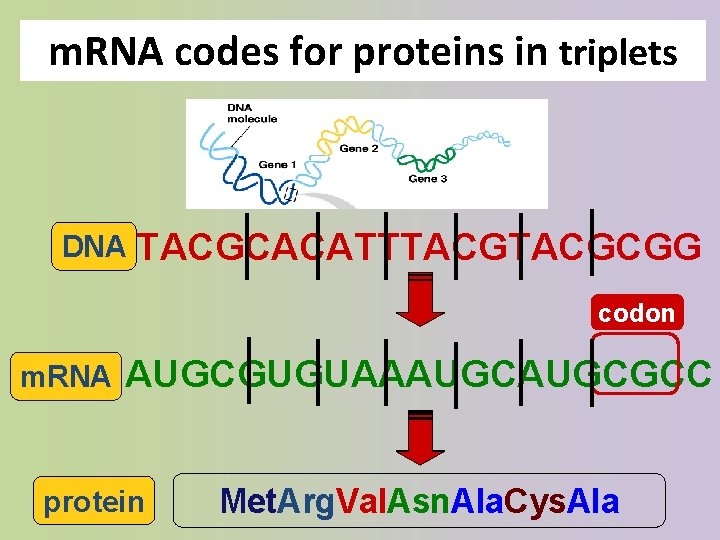
m. RNA codes for proteins in triplets DNA TACGCACATTTACGCGG codon m. RNA AUGCGUGUAAAUGCGCC ? protein Met. Arg. Val. Asn. Ala. Cys. Ala
TRANSLATION: Reading the code from m. RNA and creating a protein
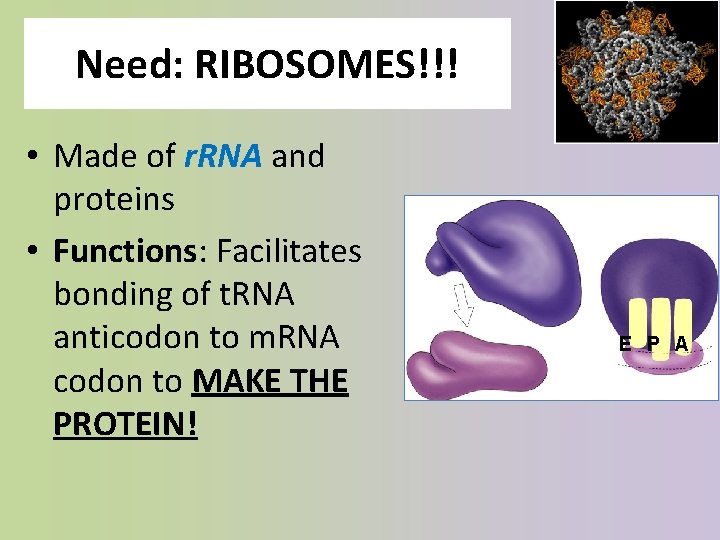
Need: RIBOSOMES!!! • Made of r. RNA and proteins • Functions: Facilitates bonding of t. RNA anticodon to m. RNA codon to MAKE THE PROTEIN! E P A
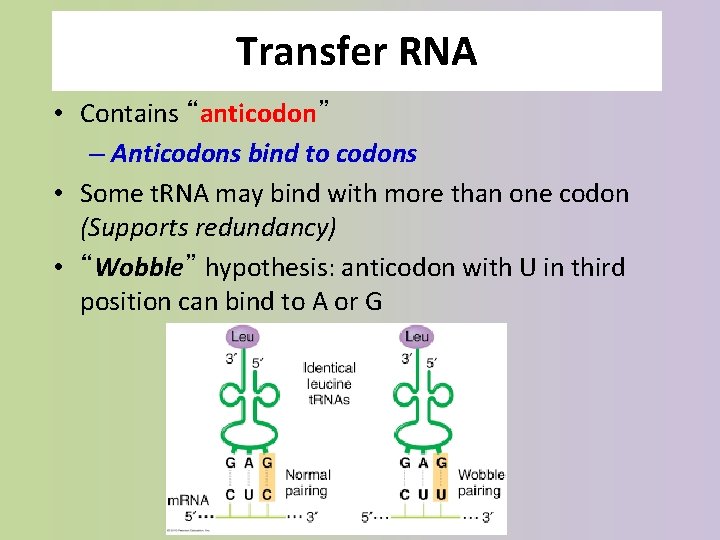
Transfer RNA • Contains “anticodon” – Anticodons bind to codons • Some t. RNA may bind with more than one codon (Supports redundancy) • “Wobble” hypothesis: anticodon with U in third position can bind to A or G
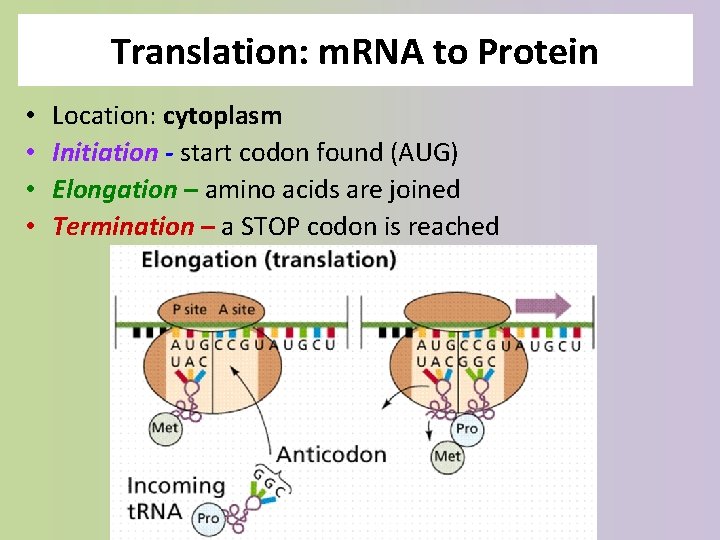
Translation: m. RNA to Protein • • Location: cytoplasm Initiation - start codon found (AUG) Elongation – amino acids are joined Termination – a STOP codon is reached
RNA polymerase DNA Can you tell the story? amino acids exon pre-m. RNA intron t. RNA 5' GTP cap mature m. RNA poly-A tail large ribosomal subunit polypeptide 5' small ribosomal subunit t. RNA E P A ribosome 3'
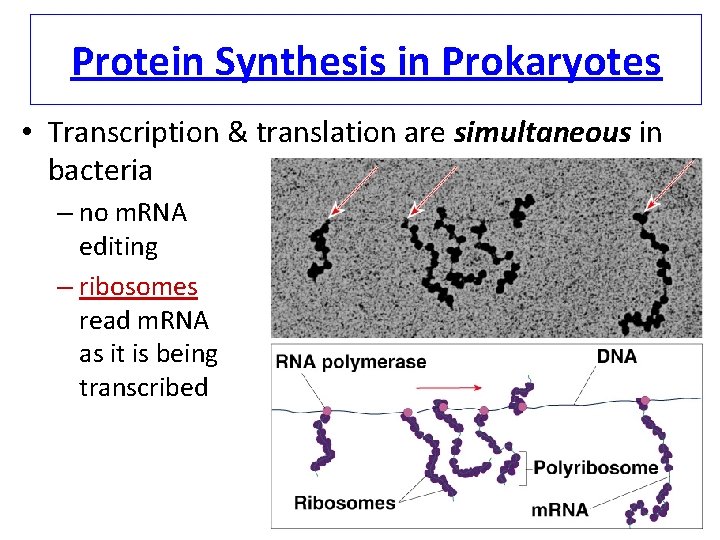
Protein Synthesis in Prokaryotes • Transcription & translation are simultaneous in bacteria – no m. RNA editing – ribosomes read m. RNA as it is being transcribed
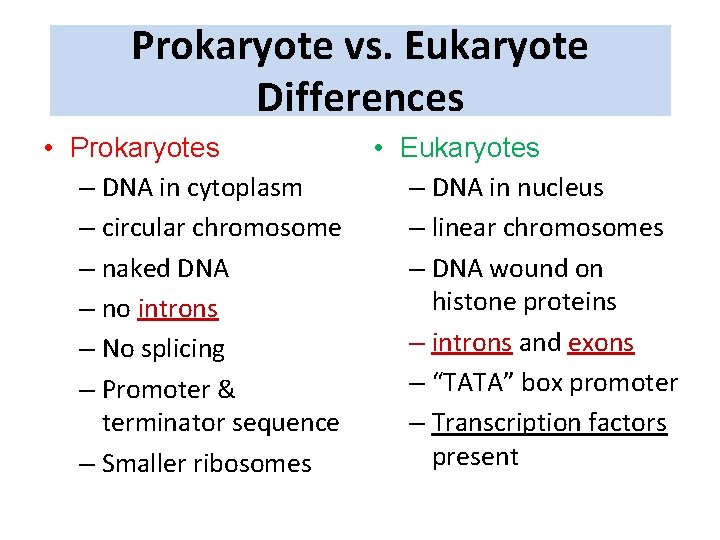
Prokaryote vs. Eukaryote Differences • Prokaryotes – DNA in cytoplasm – circular chromosome – naked DNA – no introns – No splicing – Promoter & terminator sequence – Smaller ribosomes • Eukaryotes – DNA in nucleus – linear chromosomes – DNA wound on histone proteins – introns and exons – “TATA” box promoter – Transcription factors present