
From Freud to Brazelton 100 Years of Child
From Freud to Brazelton: 100 Years of Child & Parenting Development Theories 1 by Dr. Marty Rossmann ©Learning Zone. Express
Why Study Child & Parenting Development Theories? ©Learning Zone. Express l Theories help people: – Organize their ideas about raising children. – Understand influences on parenting. – Discover more than one way to interact with children. – Analyze the benefits and consequences of using more than one theory. Sigmund Freud • Erikson • Maria Montessori Jean Piaget • Urie Bronfenbrenner • Lev Semenovich Vygotsky Abraham Maslow • Arnold Gesell • John Bowlby • Rudolph Dreikurs Lawrence Kohlberg • B. F. Skinner • Benjamin Spock Diana Baumrind • T. Berry Brazelton • Howard Gardner 2
Why Study the Selected Theories? ©Learning Zone. Express l 3 The selected theories: – Have been popular and influential. – Represent different approaches to parent-child interaction. – Offer help in the “real world” of daily child-rearing. – Make good common sense.
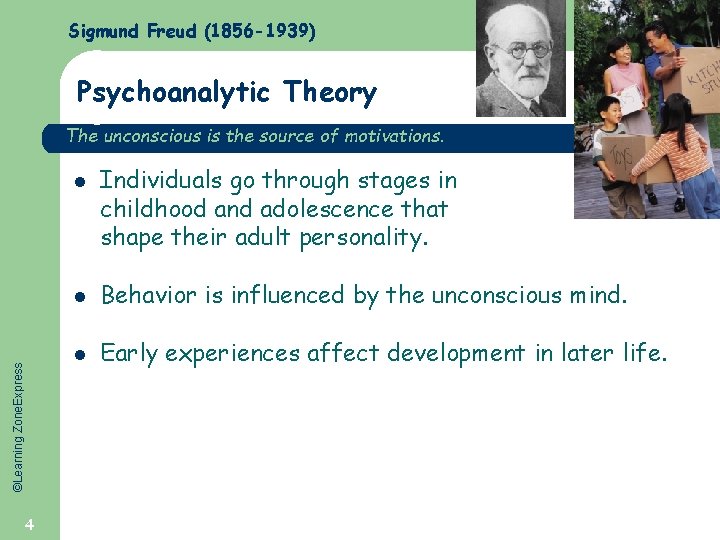
Sigmund Freud (1856 -1939) Psychoanalytic Theory The unconscious is the source of motivations. ©Learning Zone. Express l 4 Individuals go through stages in childhood and adolescence that shape their adult personality. l Behavior is influenced by the unconscious mind. l Early experiences affect development in later life.
Sigmund Freud (1856 -1939) Psychoanalytic Theory The unconscious is the source of motivations. The personality development of a child is complex. l Psychic Life Functions: – ID - present at birth; directs need gratification; ©Learning Zone. Express pleasure seeking; and pain avoidance. 5 – EGO - Responsible for contact with day to day reality; – SUPEREGO - Internal interpretation of the rules and predicts probable outcomes of behavior choices. values of the environment.
Sigmund Freud (1856 -1939) Psychoanalytic Theory The unconscious is the source of motivations. l Defense Mechanisms: – Repression - pushing depressing matters out of consciousness. – Sublimation - substituting acceptable ways of expressing feelings. – Regression - returning to an earlier way of adjusting to problems. – Compensation - substituting success in one area for failure in ©Learning Zone. Express another. 6 – Rationalization - giving a socially accepted reason for a behavior – Escape - leaving a distressing situation, either physically or that was not socially acceptable. psychologically.
Erikson (1902 -1994) Psychosocial Theory There are stages of psychological development. ©Learning Zone. Express l 7 Focus is on: – Developing a healthy personality. – Humans develop throughout their life span in eight stages. – Individuals need to develop identity at each stage. – Culture is a part of a person’s socialization. – If an individual does not achieve a stage, the consequences may be alterable later in life.
Erikson (1902 -1994) Psychosocial Theory There are stages of psychological development. l Psychosocial Stages: – Trust vs. Mistrust (0 -12 to 18 mos. ) l – Autonomy vs. Doubt (18 mos. to 3 years) ©Learning Zone. Express l – Child needs to develop self-control with firm, gradual and kindly support of parents so the child does not lose selfesteem. Initiative vs. Guilt (4 -6 years) l 8 Infant forms a loving, trusting relationship with parent or is frustrated and lacks self-confidence. Child gains skill in language and exploring and needs guidance from parents to proceed in life in a selfconfident, guilt-free way.
Erikson (1902 -1994) Psychosocial Theory There are stages of psychological development. l Psychosocial Stages: – Industry vs. Inferiority (7 -12+ years) l – Identity vs. Role Confusion (12 -18 years) ©Learning Zone. Express l 9 Child pursues and completes activities that produce something and gain recognition from parents, teachers and friends. Failure makes the child feel inadequate and inferior. The sense of “who I am” and what part I play in society (occupation, politics, sex roles, religion, etc. ) is determined. Parents have new expectations for the adolescent. Those who don’t develop effective steps toward a tangible future may be insecure, confused and lack self-esteem. (There are more stages for adults, not shown here. )
Maria Montessori (1870 -1952) Parents as Preschool Educators Parents guide their children’s development. l l l ©Learning Zone. Express l 10 l l Each child has an innate unique talent. Children should be guided with love and affection to expected behavior. Children should use hands-on activities to learn how to care for themselves and a home. Parents should be aware that learning takes place in a sequence. Parents should not be too quick to criticize or correct. Parents should encourage their child to do as much as possible on their own.
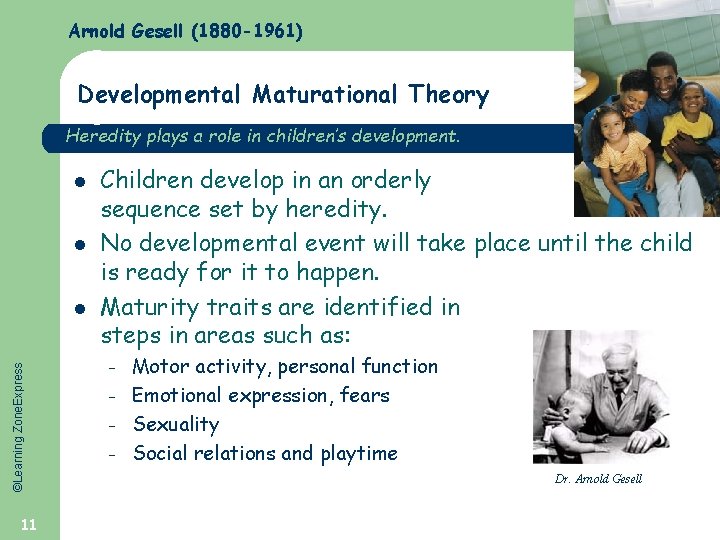
Arnold Gesell (1880 -1961) Developmental Maturational Theory Heredity plays a role in children’s development. l l ©Learning Zone. Express l 11 Children develop in an orderly sequence set by heredity. No developmental event will take place until the child is ready for it to happen. Maturity traits are identified in steps in areas such as: – – Motor activity, personal function Emotional expression, fears Sexuality Social relations and playtime Dr. Arnold Gesell
Jean Piaget (1896 -1980) Cognitive Development Theory Understanding & supporting a child’s learning. l Two processes are essential for development: – Assimilation l ©Learning Zone. Express – 12 Learning to understand events or objects, based on existing structure. Accommodation l Expanding understanding, based on new information.
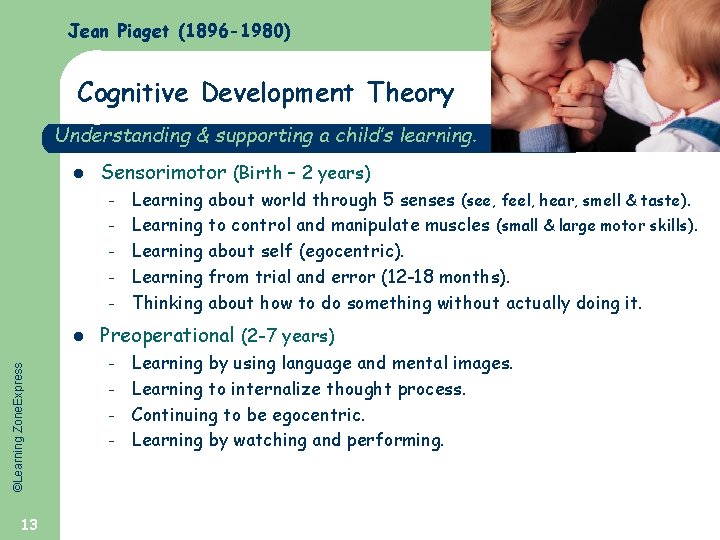
Jean Piaget (1896 -1980) Cognitive Development Theory Understanding & supporting a child’s learning. l Sensorimotor (Birth – 2 years) – – – ©Learning Zone. Express l 13 Learning about world through 5 senses (see, feel, hear, smell & taste). Learning to control and manipulate muscles (small & large motor skills). Learning about self (egocentric). Learning from trial and error (12 -18 months). Thinking about how to do something without actually doing it. Preoperational (2 -7 years) – – Learning by using language and mental images. Learning to internalize thought process. Continuing to be egocentric. Learning by watching and performing.
Jean Piaget (1896 -1980) Cognitive Development Theory Understanding & supporting a child’s learning. l ©Learning Zone. Express l 14 Concrete Operational (6 or 7 -12 years) – Learning to understand someone else’s point of view. – Learning to resolve problems with logic. – Learning conservation (amounts of liquid remain the same, even if the shape changes). Formal Operations (13 years – adult) – Thinking logically, abstractly, and hypothetically. – Testing theories by hypotheses. – Understanding right vs. wrong. – Glimpse of complexity of knowledge in teens leads some to believe they understand nothing and others to believe they are on the verge of understanding everything.
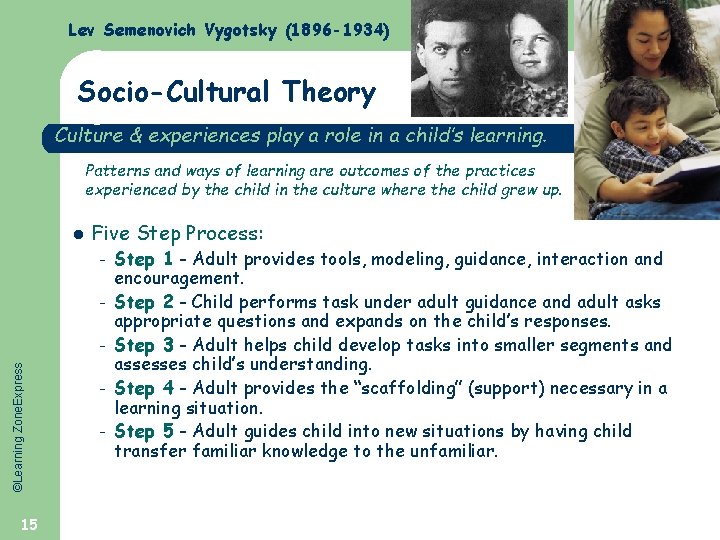
Lev Semenovich Vygotsky (1896 -1934) Socio-Cultural Theory Culture & experiences play a role in a child’s learning. Patterns and ways of learning are outcomes of the practices experienced by the child in the culture where the child grew up. l Five Step Process: – – ©Learning Zone. Express – 15 – – Step 1 - Adult provides tools, modeling, guidance, interaction and encouragement. Step 2 - Child performs task under adult guidance and adult asks appropriate questions and expands on the child’s responses. Step 3 - Adult helps child develop tasks into smaller segments and assesses child’s understanding. Step 4 - Adult provides the “scaffolding” (support) necessary in a learning situation. Step 5 - Adult guides child into new situations by having child transfer familiar knowledge to the unfamiliar.
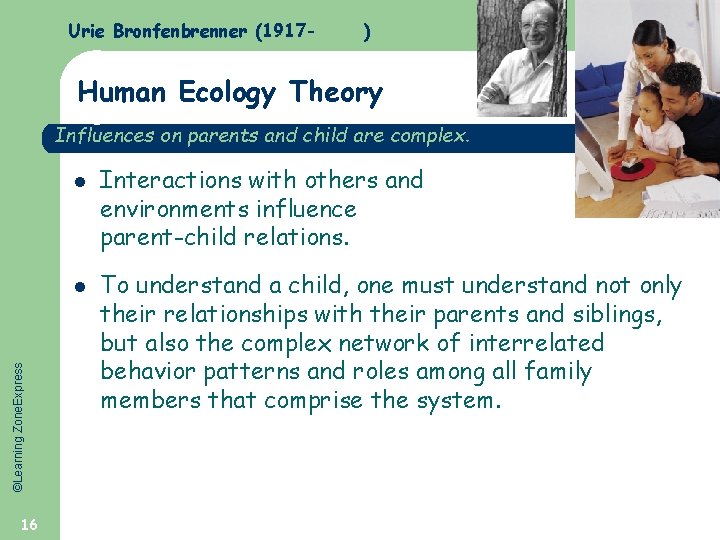
Urie Bronfenbrenner (1917 - ) Human Ecology Theory Influences on parents and child are complex. l ©Learning Zone. Express l 16 Interactions with others and environments influence parent-child relations. To understand a child, one must understand not only their relationships with their parents and siblings, but also the complex network of interrelated behavior patterns and roles among all family members that comprise the system.
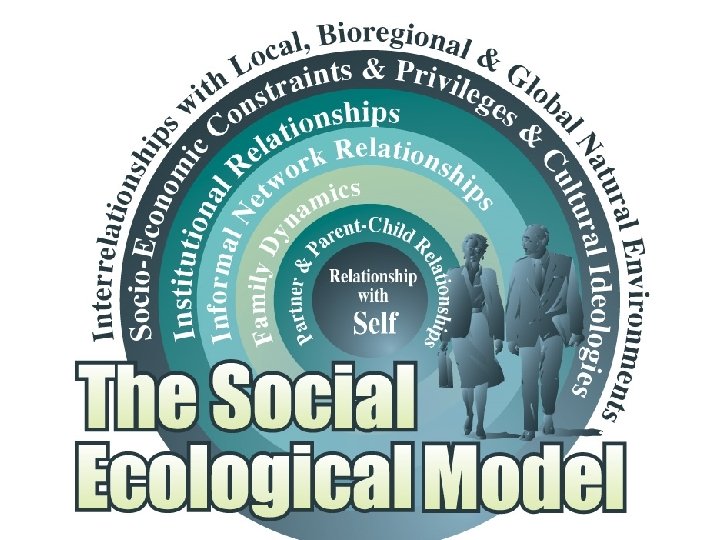
Urie Bronfenbrenner (1917 - ) Human Ecology Theory Influences on parents and child are complex. ©Learning Zone. Express l 18 Interactions among parts of the system impact parent-child relationships: – Child’s self esteem. – Relationships between parent(s) and child. – Relationships between parents. – Relationships among all family members. – Informal supports (such as neighbors). – Institutional relationships (such as faith community). – Socio-economic, culture and political influences. – Natural environments (such as air and water quality).
Abraham Maslow (1908 -1970) Human Needs Theory Human needs influence each person’s development. l l ©Learning Zone. Express l 19 Influence of a hierarchy of human needs on personality. Lower need must be filled before upper-level needs receive attention. Child’s genetic potential will not flourish unless they are nurtured by adults as the child grows.
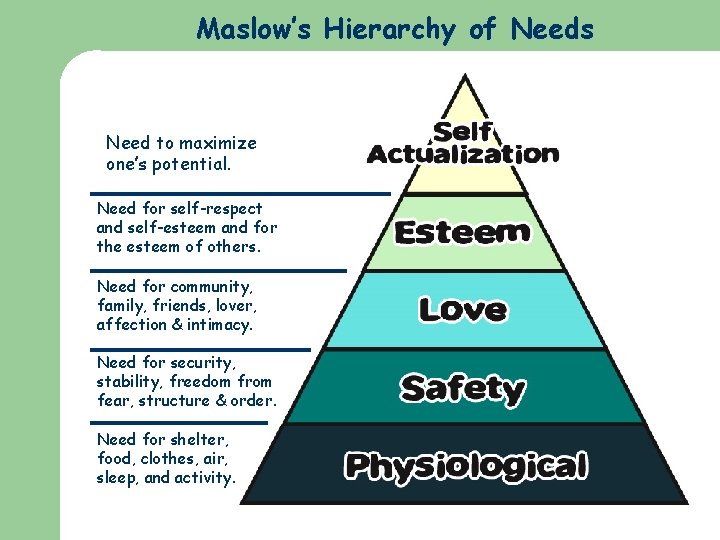
Maslow’s Hierarchy of Needs Need to maximize one’s potential. Need for self-respect and self-esteem and for the esteem of others. Need for community, family, friends, lover, affection & intimacy. Need for security, stability, freedom from fear, structure & order. Need for shelter, food, clothes, air, sleep, and activity.
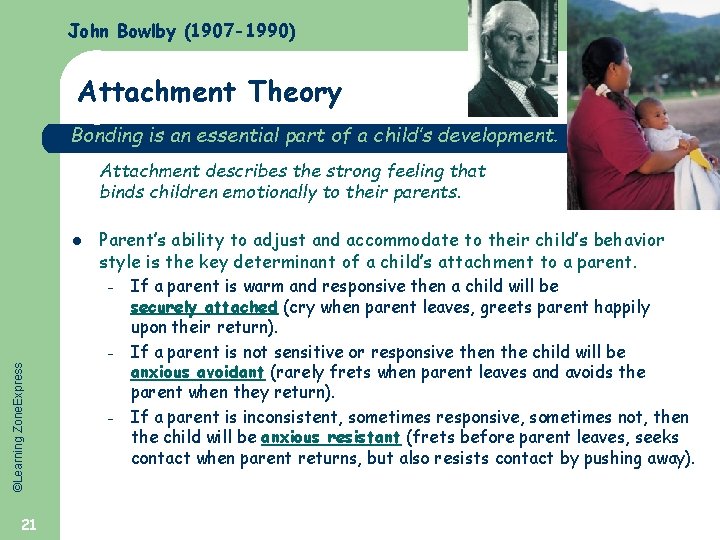
John Bowlby (1907 -1990) Attachment Theory Bonding is an essential part of a child’s development. Attachment describes the strong feeling that binds children emotionally to their parents. l Parent’s ability to adjust and accommodate to their child’s behavior style is the key determinant of a child’s attachment to a parent. – ©Learning Zone. Express – 21 – If a parent is warm and responsive then a child will be securely attached (cry when parent leaves, greets parent happily upon their return). If a parent is not sensitive or responsive then the child will be anxious avoidant (rarely frets when parent leaves and avoids the parent when they return). If a parent is inconsistent, sometimes responsive, sometimes not, then the child will be anxious resistant (frets before parent leaves, seeks contact when parent returns, but also resists contact by pushing away).
Rudolph Dreikurs (1897 -1972) Children of Challenge Principles to guide a parent raising a child. l l Children are motivated by a desire to belong. Children are expert observers, but make mistakes in interpreting what they observe. Children exhibit goal-seeking behaviors. Selected principles: ©Learning Zone. Express – 22 – – Understand the child’s goals — usually the goal will be for attention, power, revenge or to appear to be inadequate. Encourage the child. Avoid punishment and rewards.
Rudolph Dreikurs (1897 -1972) Children of Challenge Principles to guide a parent raising a child. – – – ©Learning Zone. Express – 23 – – Use natural and logical consequences. Be firm without dominating. Respect the child. Maintain routines. Sidestep power struggles. Refrain from over-protection. Follow through — be consistent. Listen. Have fun together. Talk WITH your child, not TO them. Establish a family council.
Lawrence Kohlberg ( 1927 -1987) Moral Development Theory Identifies steps toward character development. l Children are moral philosophers. Children experience a series of predictable stages in their moral reasoning. l Levels of Moral Development: l ©Learning Zone. Express – 24 Level 1 – Preconventional (4 -10 years) Decisions are based on consequences. l l Stage 1 - Children respond to threat of punishment. Stage 2 - Children learn that correct action brings reward.
Lawrence Kohlberg ( 1927 -1987) Moral Development Theory Identifies steps toward character development. – Level 2 – Conventional (10 years and older) Decisions are based on social rules and expectations. l l ©Learning Zone. Express – 25 Stage 3 - Children are concerned about other’s opinions and that “good” behavior pleases others. Stage 4 - Law and order are important. Level 3 – Postconventional (some adolescents and adults) Decisions are based on personal ethics of what is morally right. l l Stage 5 - Moral decisions are made through understanding that society’s rules are for everyone and were made by consensus. Stage 6 - Universal principles determine right from wrong.
B. F. Skinner (1904 -1990) Operant Conditioning Theory Role parents play in shaping child’s behavior. l l ©Learning Zone. Express l 26 Emphasizes the role of the parent in reinforcing (rewarding) the child’s behaviors. Consequences of a behavior lead to changes in its frequency. Behavior patterns will change if the child is rewarded, ignored or punished.
B. F. Skinner (1904 -1990) Operant Conditioning Theory Role parents play in shaping child’s behavior. l Conditioning functions: – – l Consequences include: ©Learning Zone. Express – 27 Shaping behavior - reinforcing a behavior “close” to the desired behavior. Chaining behavior - linking together a series of small steps toward the desired behavior. – – Positive reinforcement - something that causes an act to increase in the future, i. e. a child smiles and gets a hug. Negative reinforcement - child causes unpleasantness to cease, i. e. parents “lecture” stops when child cleans room. Punishment - unpleasant act by parent discourages behavior in the future, i. e. T. V. privileges taken away.
Benjamin Spock (1903 -1998) Baby and Child Care Encourages parents to trust themselves and enjoy their baby. l Parents should: – – – ©Learning Zone. Express – 28 – – – Understand there are great differences between individual children — and that some children are more difficult than others. Understand that parents have needs that should be met. Understand that it’s hard work to be a parent. Love and respect their children. Feed babies when they’re hungry. Let their tired babies cry, after checking to make sure they aren’t hungry, cold or need a diaper changed. Understand there is a need to be flexible.
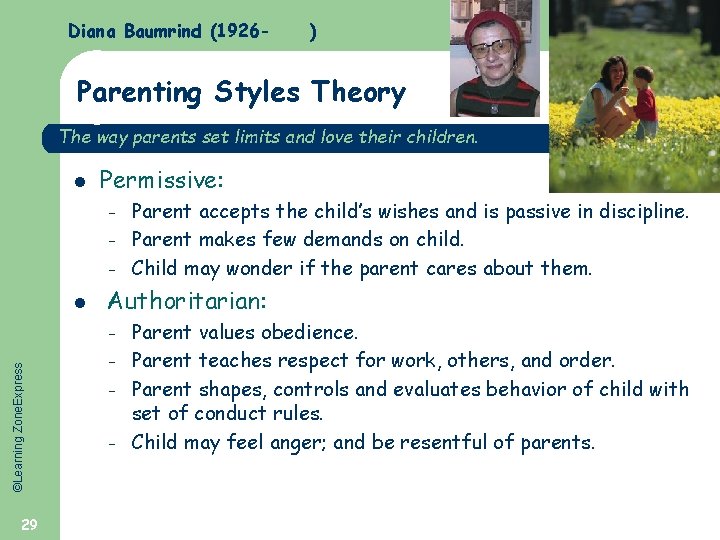
Diana Baumrind (1926 - ) Parenting Styles Theory The way parents set limits and love their children. l Permissive: – – – l Authoritarian: ©Learning Zone. Express – 29 Parent accepts the child’s wishes and is passive in discipline. Parent makes few demands on child. Child may wonder if the parent cares about them. – – – Parent values obedience. Parent teaches respect for work, others, and order. Parent shapes, controls and evaluates behavior of child with set of conduct rules. Child may feel anger; and be resentful of parents.

Diana Baumrind (1926 - ) Parenting Styles Theory The way parents set limits and love their children. l Authoritative: – – – ©Learning Zone. Express – 30 Parents encourage verbal give and take. Parents provide firm limits with love and support. Parents affirm child’s good attributes. Child feels cared about and knows family rules are consistently enforced.
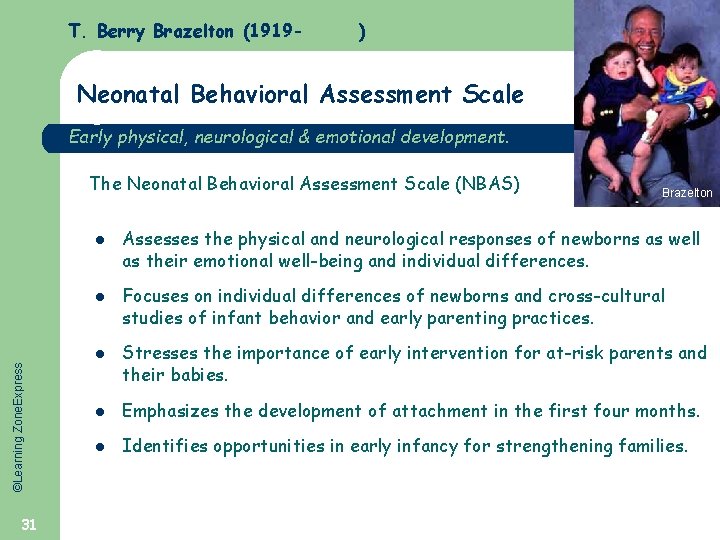
T. Berry Brazelton (1919 - ) Neonatal Behavioral Assessment Scale Early physical, neurological & emotional development. The Neonatal Behavioral Assessment Scale (NBAS) l l ©Learning Zone. Express l 31 Brazelton Assesses the physical and neurological responses of newborns as well as their emotional well-being and individual differences. Focuses on individual differences of newborns and cross-cultural studies of infant behavior and early parenting practices. Stresses the importance of early intervention for at-risk parents and their babies. l Emphasizes the development of attachment in the first four months. l Identifies opportunities in early infancy for strengthening families.
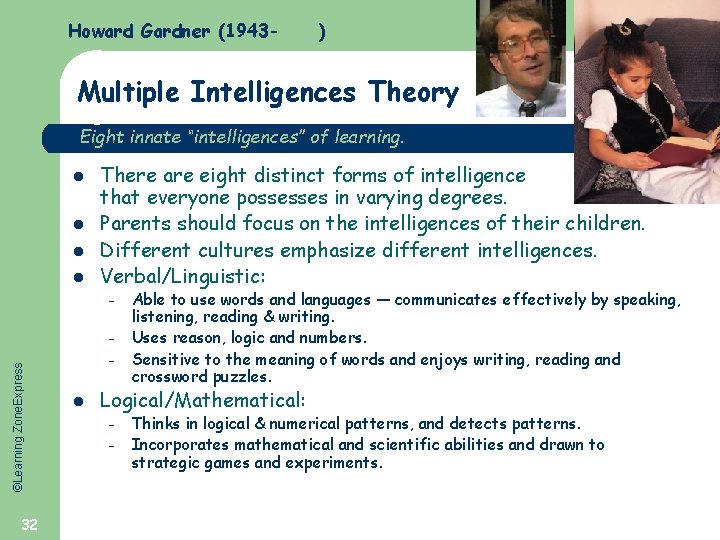
Howard Gardner (1943 - ) Multiple Intelligences Theory Eight innate “intelligences” of learning. l l There are eight distinct forms of intelligence that everyone possesses in varying degrees. Parents should focus on the intelligences of their children. Different cultures emphasize different intelligences. Verbal/Linguistic: – ©Learning Zone. Express – 32 – l Able to use words and languages — communicates effectively by speaking, listening, reading & writing. Uses reason, logic and numbers. Sensitive to the meaning of words and enjoys writing, reading and crossword puzzles. Logical/Mathematical: – – Thinks in logical & numerical patterns, and detects patterns. Incorporates mathematical and scientific abilities and drawn to strategic games and experiments.
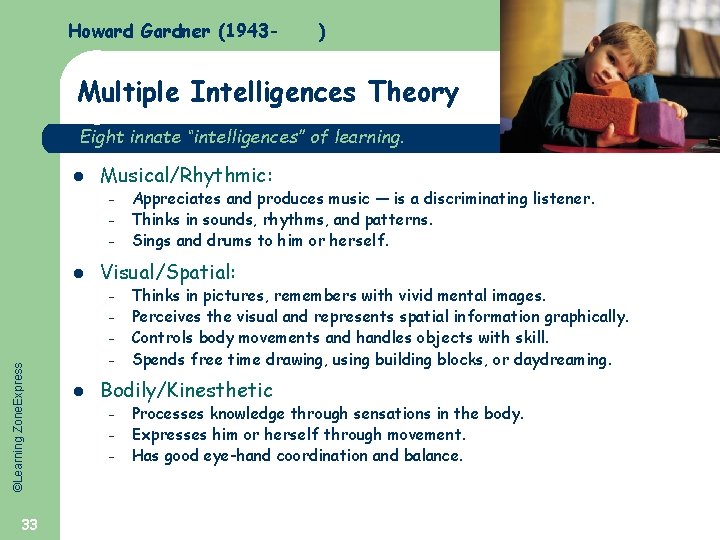
Howard Gardner (1943 - ) Multiple Intelligences Theory Eight innate “intelligences” of learning. l Musical/Rhythmic: – – – l Visual/Spatial: – – ©Learning Zone. Express – 33 – l Appreciates and produces music — is a discriminating listener. Thinks in sounds, rhythms, and patterns. Sings and drums to him or herself. Thinks in pictures, remembers with vivid mental images. Perceives the visual and represents spatial information graphically. Controls body movements and handles objects with skill. Spends free time drawing, using building blocks, or daydreaming. Bodily/Kinesthetic – – – Processes knowledge through sensations in the body. Expresses him or herself through movement. Has good eye-hand coordination and balance.
Howard Gardner (1943 - ) Multiple Intelligences Theory Eight innate “intelligences” of learning. l Interpersonal – – – l Intrapersonal – – ©Learning Zone. Express – 34 l Relates to others and understands other’s feelings and intentions. Detects differences among people. Likes to maintain peace and have everyone cooperate. Reflects on oneself and is aware of one’s inner state of being. Self-motivated and understands his/her role in relation to others. Understands one’s emotions can direct one’s behavior. Naturalist – – Advocates or practices naturalism — and recognizes dangerous species and categorizes new and different organisms. Identifies manmade species (“artificial taxonomies”) such as wearing apparel or cars.
Related Activities Complete one of the following activities: l l Study one theorist and present your findings to the class pretending YOU are that theorist. In a group of 3 or more, work with and observe young children (at daycare or playschool). Based on your observations: – – ©Learning Zone. Express l 35 l Determine which theories your group feels are most “valid”. OR come up with your own theory about child behavior. View a movie about parent-child relationships and write a review — include how theories apply to the story. Class Activity: – – Tape an index card with the name of a theorist and their theory on the back of each student. Students then ask questions that can be answered “yes” or “no” to try to guess which theorist is on their card.
Who am I? - Theorists Quiz Name each of the following theorists: 1. My theory states that human needs must be met at more basic levels before they move up to more complex levels. ©Learning Zone. Express 2. My theory states that children learn cognitively at four distinct levels. 36 3. My theory says that there are numerous distinct forms of intelligence that everyone possesses to some degree.
Who am I? - Theorists Quiz Name each of the following theorists: 4. My theory lists stages people travel through during their entire lifetime. ©Learning Zone. Express 5. I believed that freedom for children enables them to do things independently. 37 6. My theory about moral decisions goes through stages ending with the one when people make decisions based on what is morally right or wrong.
Web Resources l Here are some suggested web sites for additional information on child and parenting development: – http: //www. zerotothree. org/ l – http: //npen. crc. uiuc. edu/ l ©Learning Zone. Express – 38 National Parenting Education Network http: //www. pathfinder. com/Parent. Time/ l – Zero to Three National Center for Infants, Toddlers and Families Parent time http: //www. hec. ohip-state. edu/famlife/nnfr/pfp/ l Partners for Parenting database Please note that web sites are constantly changing and being updated. You may need to revise this list.
- Slides: 38