
From Fitts List to Modern Incremental Platforms for


![Automation[at Large] Definition: We speak about automation when a computer or another device executes](https://slidetodoc.com/presentation_image/fcbc51a0740772440bfc38cb5352fcbc/image-7.jpg "Automation[at Large] Definition: We speak about automation when a computer or another device executes")

![Mobile Network Generations ( Sharma 2013) Attribute→ Generation ↓ Time period Transfer rate [bps]](https://slidetodoc.com/presentation_image/fcbc51a0740772440bfc38cb5352fcbc/image-50.jpg "Mobile Network Generations ( Sharma 2013) Attribute→ Generation ↓ Time period Transfer rate [bps]")
- Slides: 58
From Fitt's List to Modern Incremental Platforms for Multiparticipant Decision. Making. by F. G. Filip The Romanian Academy, Bucharest 10/7/2020 F. G. Filip 1
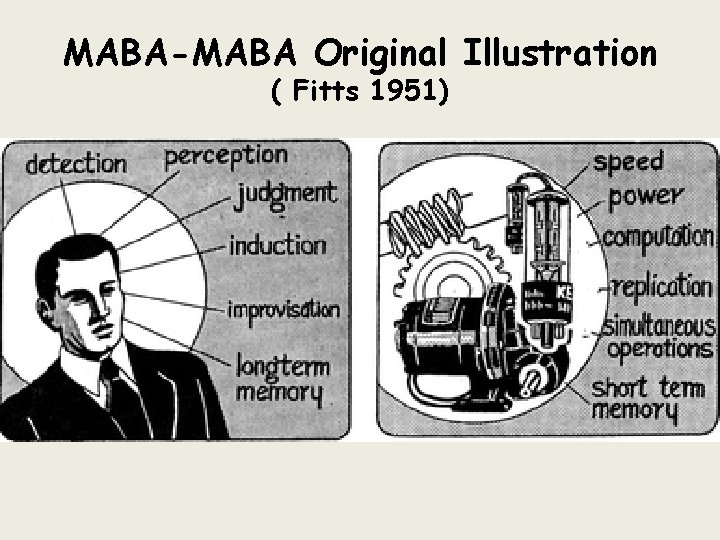
MABA-MABA Original Illustration ( Fitts 1951)
• This talk is about human collaboration to perform tasks of control and management enabled by modern information and communication technologies ( ICT) 10/7/2020 F. G. Filip 3
Contents • • • Men and Automation Cooperation Forms Enabling Technologies An Integrated Platform Conclusions References 10/7/2020 F. G. Filip 4
Contents • Men and Automation • Cooperation Forms • • Enabling Technologies An Integrated Platform Conclusions References 10/7/2020 F. G. Filip 5
The • • • • • Original Fitts’ (1951) MABA-MABA ( Men Are Best At-Machines Are Best At) List “Humans appear to surpass present-day machines in respect to the following: 1. Ability to detect a small amount of visual or acoustic energy 2. Ability to perceive patterns of light or sound 3. Ability to improvise and use flexible procedures 4. Ability to store very large amounts of information for long periods and to recall relevant facts at the appropriate time 5. Ability to reason inductively 6. Ability to exercise judgment” “Present-day machines appear to surpass humans in respect to the following: 1. Ability to respond quickly to control signals and to apply great force smoothly and precisely 2. Ability to perform repetitive, routine tasks 3. Ability to store information briefly and then to erase it completely 4. Ability to reason deductively, including computational ability 5. Ability to handle highly complex operations, i. e. to do many different things “at once. 10/7/2020 F. G. Filip 6
Automation[at Large] Definition: We speak about automation when a computer or another device executes certain functions that the man agent would normally perform. Remark: Automation has pervaded not only in most safety-critical systems, such as aviation, power plants, refineries, but also in transportation networks, banking, home robotized environments, entertainment, and even intelligent cloths. 10/7/2020 F. G. Filip 7
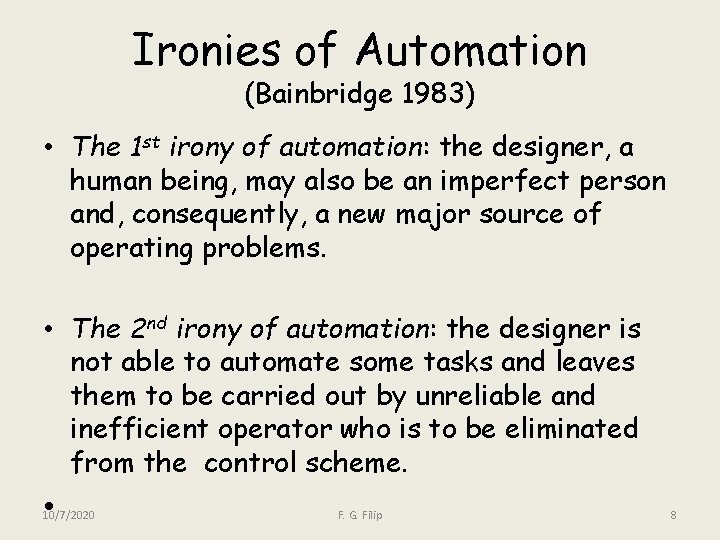
Ironies of Automation (Bainbridge 1983) • The 1 st irony of automation: the designer, a human being, may also be an imperfect person and, consequently, a new major source of operating problems. • The 2 nd irony of automation: the designer is not able to automate some tasks and leaves them to be carried out by unreliable and inefficient operator who is to be eliminated from the control scheme. • 10/7/2020 F. G. Filip 8
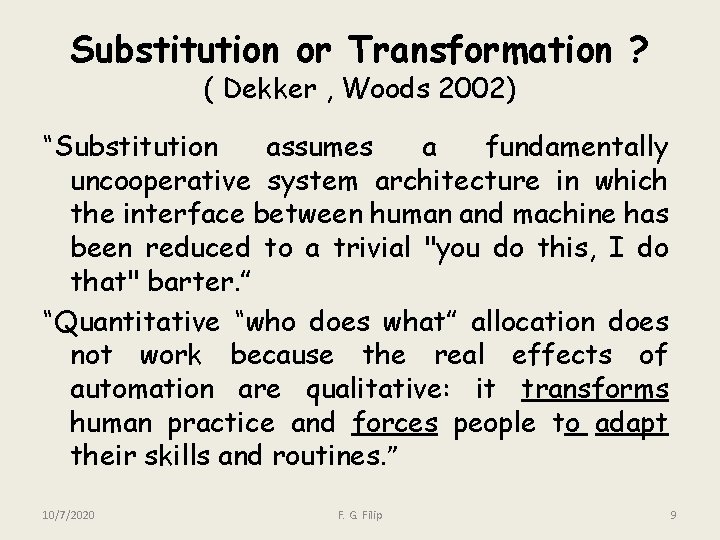
Substitution or Transformation ? ( Dekker , Woods 2002) “Substitution assumes a fundamentally uncooperative system architecture in which the interface between human and machine has been reduced to a trivial "you do this, I do that" barter. ” “Quantitative “who does what” allocation does not work because the real effects of automation are qualitative: it transforms human practice and forces people to adapt their skills and routines. ” 10/7/2020 F. G. Filip 9
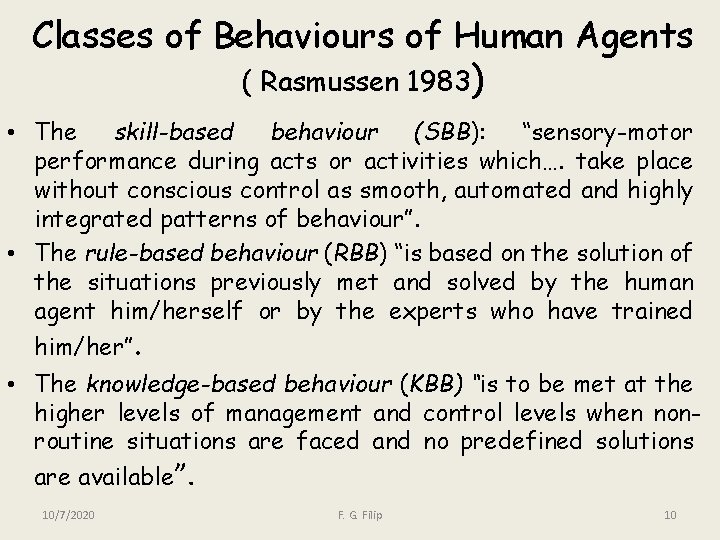
Classes of Behaviours of Human Agents ( Rasmussen 1983) • The skill-based behaviour (SBB): “sensory-motor performance during acts or activities which…. take place without conscious control as smooth, automated and highly integrated patterns of behaviour”. • The rule-based behaviour (RBB) “is based on the solution of the situations previously met and solved by the human agent him/herself or by the experts who have trained him/her”. • The knowledge-based behaviour (KBB) “is to be met at the higher levels of management and control levels when nonroutine situations are faced and no predefined solutions are available”. 10/7/2020 F. G. Filip 10
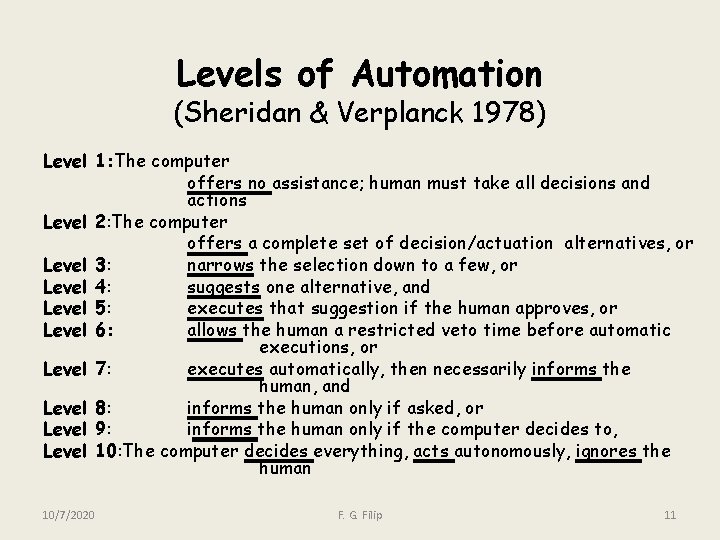
Levels of Automation (Sheridan & Verplanck 1978) Level 1: The computer offers no assistance; human must take all decisions and actions Level 2: The computer offers a complete set of decision/actuation alternatives, or Level 3: narrows the selection down to a few, or Level 4: suggests one alternative, and Level 5: executes that suggestion if the human approves, or Level 6: allows the human a restricted veto time before automatic executions, or Level 7: executes automatically, then necessarily informs the human, and Level 8: informs the human only if asked, or Level 9: informs the human only if the computer decides to, Level 10: The computer decides everything, acts autonomously, ignores the human 10/7/2020 F. G. Filip 11
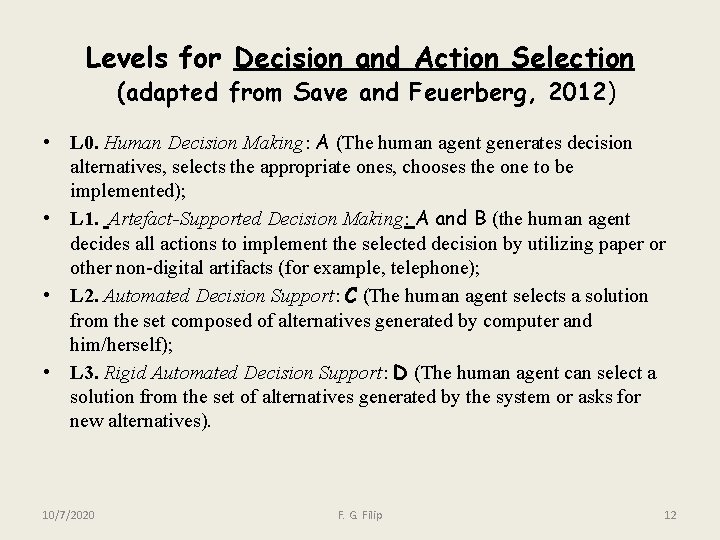
Levels for Decision and Action Selection (adapted from Save and Feuerberg, 2012) • L 0. Human Decision Making: A (The human agent generates decision alternatives, selects the appropriate ones, chooses the one to be implemented); • L 1. Artefact-Supported Decision Making: A and B (the human agent decides all actions to implement the selected decision by utilizing paper or other non-digital artifacts (for example, telephone); • L 2. Automated Decision Support: C (The human agent selects a solution from the set composed of alternatives generated by computer and him/herself); • L 3. Rigid Automated Decision Support: D (The human agent can select a solution from the set of alternatives generated by the system or asks for new alternatives). 10/7/2020 F. G. Filip 12
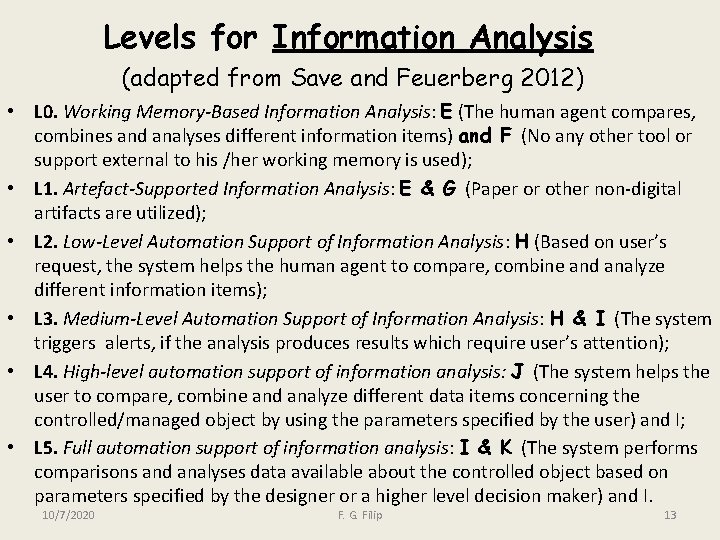
Levels for Information Analysis (adapted from Save and Feuerberg 2012) • L 0. Working Memory-Based Information Analysis: E (The human agent compares, combines and analyses different information items) and F (No any other tool or support external to his /her working memory is used); • L 1. Artefact-Supported Information Analysis: E & G (Paper or other non-digital artifacts are utilized); • L 2. Low-Level Automation Support of Information Analysis: H (Based on user’s request, the system helps the human agent to compare, combine and analyze different information items); • L 3. Medium-Level Automation Support of Information Analysis: H & I (The system triggers alerts, if the analysis produces results which require user’s attention); • L 4. High-level automation support of information analysis: J (The system helps the user to compare, combine and analyze different data items concerning the controlled/managed object by using the parameters specified by the user) and I; • L 5. Full automation support of information analysis: I & K (The system performs comparisons and analyses data available about the controlled object based on parameters specified by the designer or a higher level decision maker) and I. 10/7/2020 F. G. Filip 13
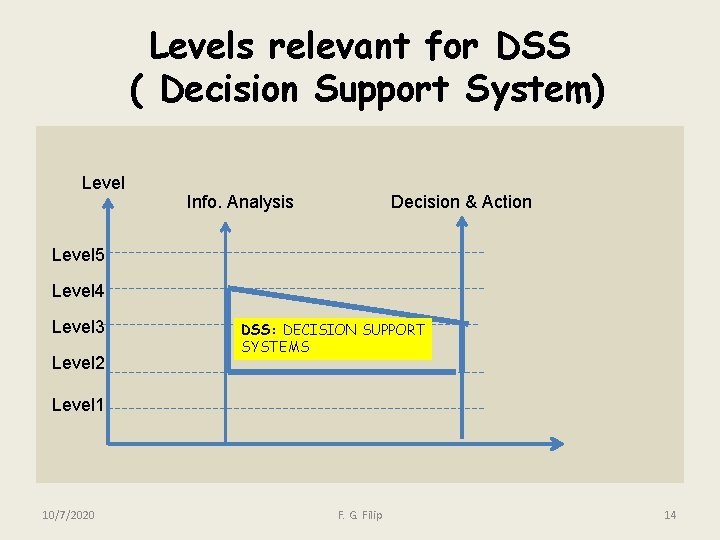
Levels relevant for DSS ( Decision Support System) Level Info. Analysis Decision & Action Level 5 Level 4 Level 3 Level 2 DSS: DECISION SUPPORT SYSTEMS Level 1 10/7/2020 F. G. Filip 14
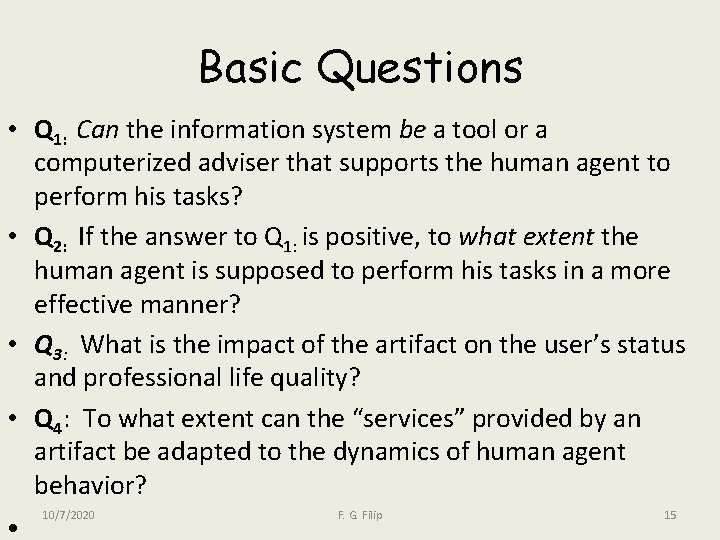
Basic Questions • Q 1: Can the information system be a tool or a computerized adviser that supports the human agent to perform his tasks? • Q 2: If the answer to Q 1: is positive, to what extent the human agent is supposed to perform his tasks in a more effective manner? • Q 3: What is the impact of the artifact on the user’s status and professional life quality? • Q 4: To what extent can the “services” provided by an artifact be adapted to the dynamics of human agent behavior? • 10/7/2020 F. G. Filip 15
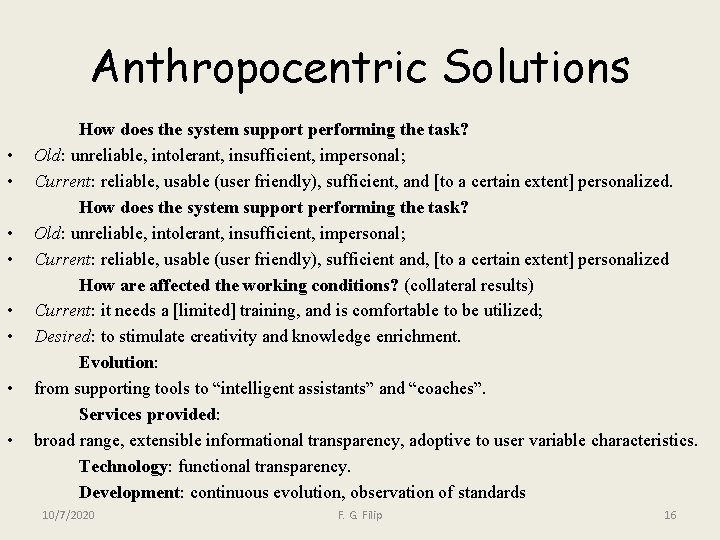
Anthropocentric Solutions • • How does the system support performing the task? Old: unreliable, intolerant, insufficient, impersonal; Current: reliable, usable (user friendly), sufficient, and [to a certain extent] personalized. How does the system support performing the task? Old: unreliable, intolerant, insufficient, impersonal; Current: reliable, usable (user friendly), sufficient and, [to a certain extent] personalized How are affected the working conditions? (collateral results) Current: it needs a [limited] training, and is comfortable to be utilized; Desired: to stimulate creativity and knowledge enrichment. Evolution: from supporting tools to “intelligent assistants” and “coaches”. Services provided: broad range, extensible informational transparency, adoptive to user variable characteristics. Technology: functional transparency. Development: continuous evolution, observation of standards 10/7/2020 F. G. Filip 16
Contents • Men and Automation • Cooperation Forms • • Enabling Technologies An Integrated Platform Conclusions References 10/7/2020 F. G. Filip 17
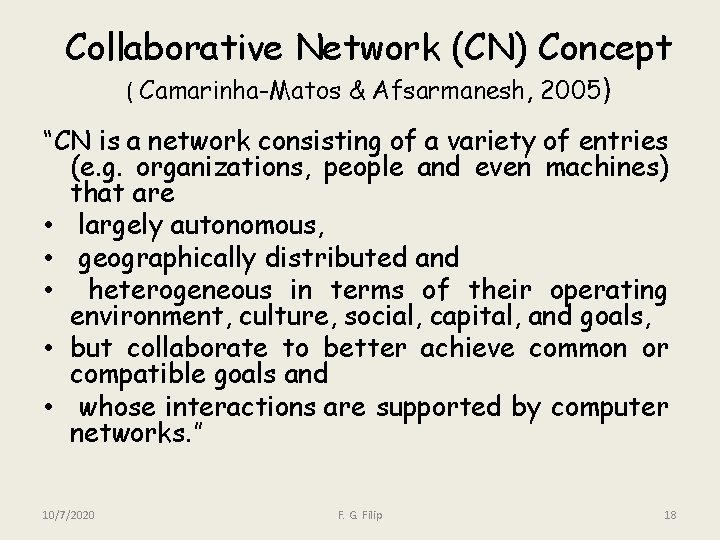
Collaborative Network (CN) Concept ( Camarinha-Matos & Afsarmanesh, 2005) “CN is a network consisting of a variety of entries (e. g. organizations, people and even machines) that are • largely autonomous, • geographically distributed and • heterogeneous in terms of their operating environment, culture, social, capital, and goals, • but collaborate to better achieve common or compatible goals and • whose interactions are supported by computer networks. ” 10/7/2020 F. G. Filip 18
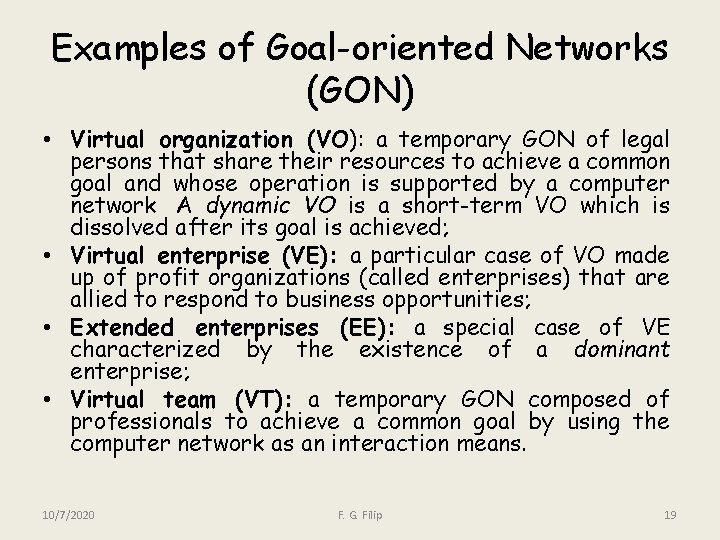
Examples of Goal-oriented Networks (GON) • Virtual organization (VO): a temporary GON of legal persons that share their resources to achieve a common goal and whose operation is supported by a computer network A dynamic VO is a short-term VO which is dissolved after its goal is achieved; • Virtual enterprise (VE): a particular case of VO made up of profit organizations (called enterprises) that are allied to respond to business opportunities; • Extended enterprises (EE): a special case of VE characterized by the existence of a dominant enterprise; • Virtual team (VT): a temporary GON composed of professionals to achieve a common goal by using the computer network as an interaction means. 10/7/2020 F. G. Filip 19
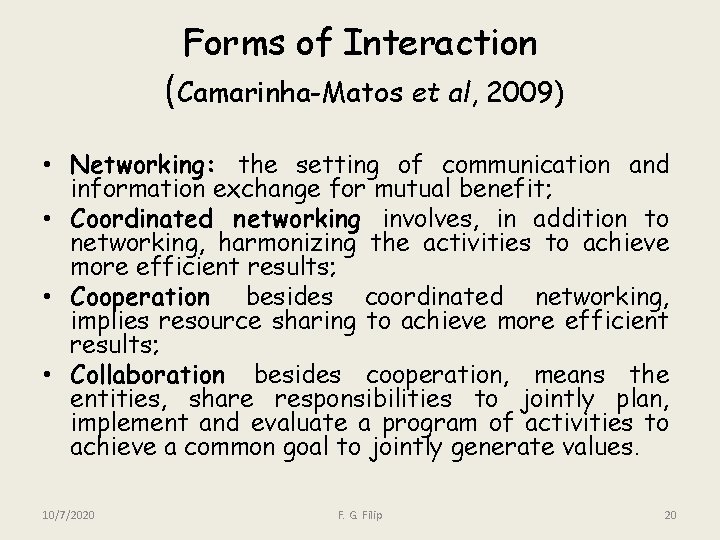
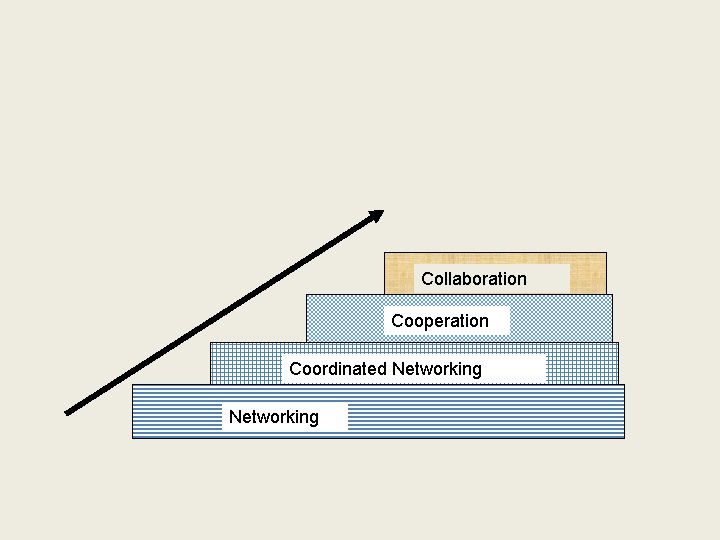
Forms of Interaction (Camarinha-Matos et al, 2009) • Networking: the setting of communication and information exchange for mutual benefit; • Coordinated networking involves, in addition to networking, harmonizing the activities to achieve more efficient results; • Cooperation besides coordinated networking, implies resource sharing to achieve more efficient results; • Collaboration besides cooperation, means the entities, share responsibilities to jointly plan, implement and evaluate a program of activities to achieve a common goal to jointly generate values. 10/7/2020 F. G. Filip 20
Collaboration Cooperation Coordinated Networking
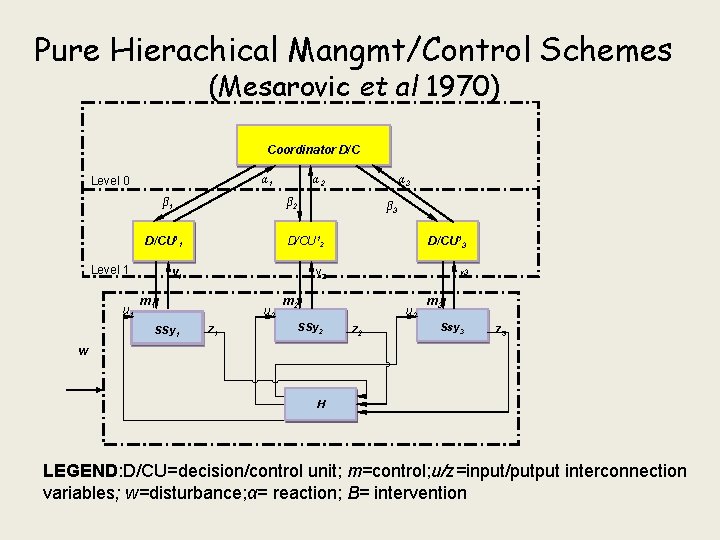
Pure Hierachical Mangmt/Control Schemes (Mesarovic et al 1970) Coordinator D/C α 1 Level 0 β 1 α 3 β 2 β 3 D/CU 11 D/CU 12 D/CU 13 y 1 y 2 y 3 Level 1 u 1 α 2 m 1 SSy 1 u 2 z 1 m 2 u 3 SSy 2 z 2 m 3 Ssy 3 z 3 w H LEGEND: D/CU=decision/control unit; m=control; u/z=input/putput interconnection variables; w=disturbance; α= reaction; Β= intervention
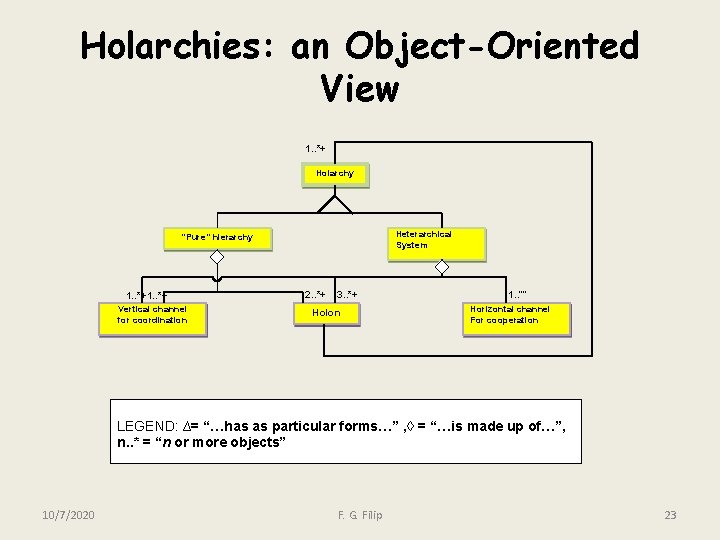
Holarchies: an Object-Oriented View 1. . *+ Holarchy Heterarchical System “Pure” hierarchy 1. . *+ Vertical channel for coordination 2. . *+ 3. . *+ Holon 1. . ”” + channel Horizontal For cooperation LEGEND: ∆= “…has as particular forms…” , ◊ = “…is made up of…”, n. . * = “n or more objects” 10/7/2020 F. G. Filip 23
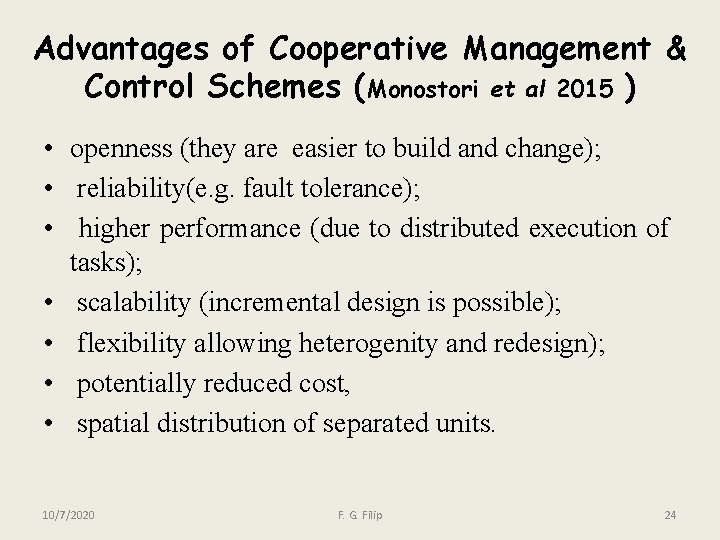
Advantages of Cooperative Management & Control Schemes (Monostori et al 2015 ) • openness (they are easier to build and change); • reliability(e. g. fault tolerance); • higher performance (due to distributed execution of tasks); • scalability (incremental design is possible); • flexibility allowing heterogenity and redesign); • potentially reduced cost, • spatial distribution of separated units. 10/7/2020 F. G. Filip 24
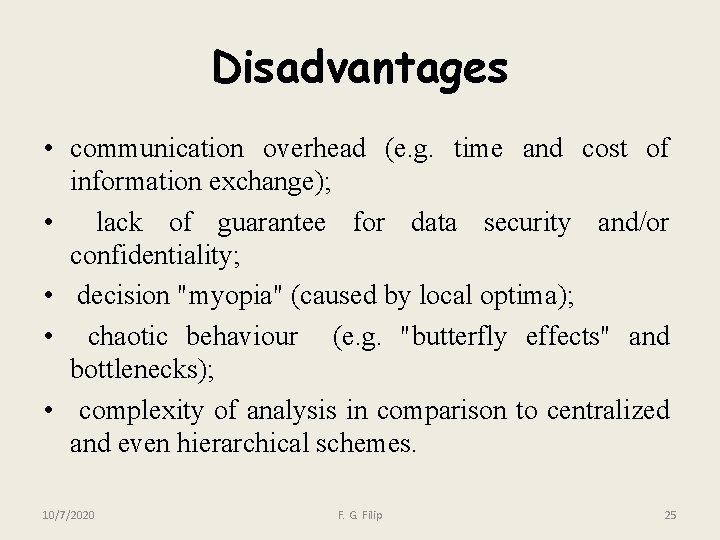
Disadvantages • communication overhead (e. g. time and cost of information exchange); • lack of guarantee for data security and/or confidentiality; • decision "myopia" (caused by local optima); • chaotic behaviour (e. g. "butterfly effects" and bottlenecks); • complexity of analysis in comparison to centralized and even hierarchical schemes. 10/7/2020 F. G. Filip 25
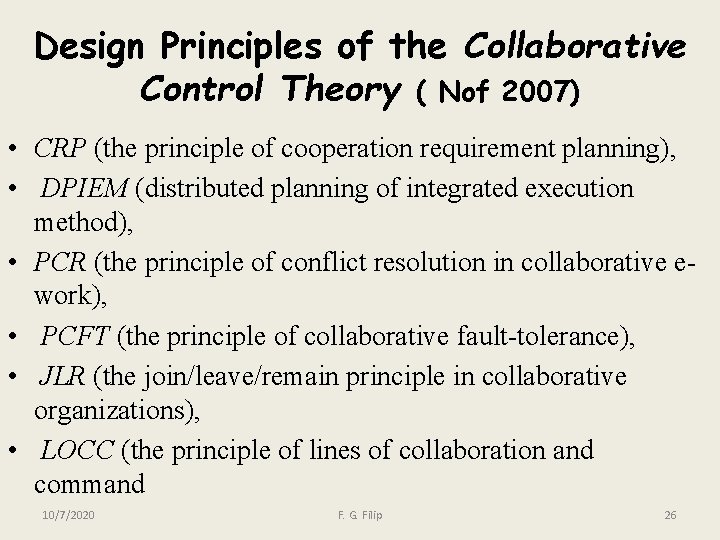
Design Principles of the Collaborative Control Theory ( Nof 2007) • CRP (the principle of cooperation requirement planning), • DPIEM (distributed planning of integrated execution method), • PCR (the principle of conflict resolution in collaborative ework), • PCFT (the principle of collaborative fault-tolerance), • JLR (the join/leave/remain principle in collaborative organizations), • LOCC (the principle of lines of collaboration and command 10/7/2020 F. G. Filip 26
Contents • Men and Automation • Cooperation Forms • Enabling Technologies • An Integrated Platform • Conclusions • References 10/7/2020 F. G. Filip 27
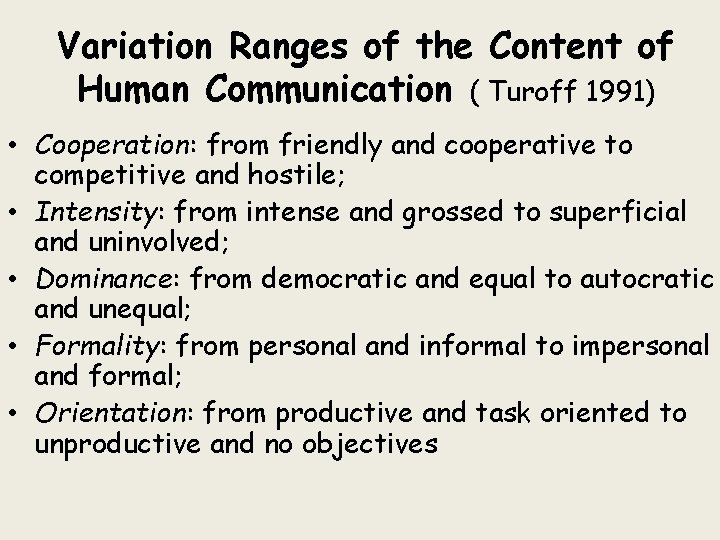
Variation Ranges of the Content of Human Communication ( Turoff 1991) • Cooperation: from friendly and cooperative to competitive and hostile; • Intensity: from intense and grossed to superficial and uninvolved; • Dominance: from democratic and equal to autocratic and unequal; • Formality: from personal and informal to impersonal and formal; • Orientation: from productive and task oriented to unproductive and no objectives
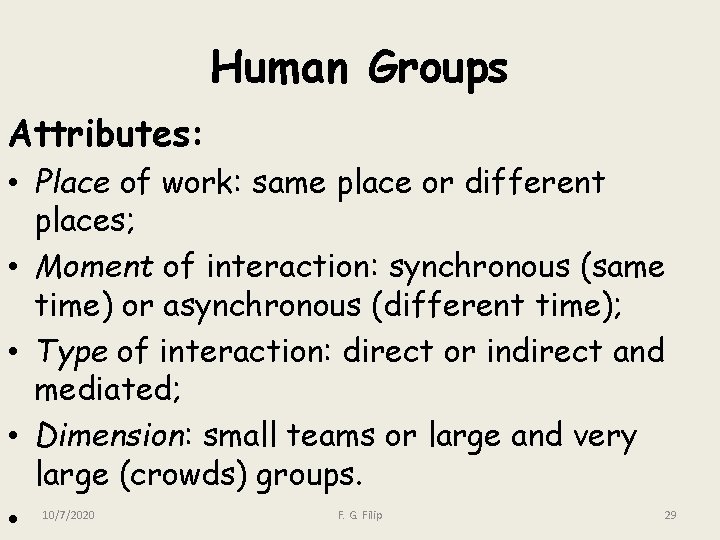
Human Groups Attributes: • Place of work: same place or different places; • Moment of interaction: synchronous (same time) or asynchronous (different time); • Type of interaction: direct or indirect and mediated; • Dimension: small teams or large and very large (crowds) groups. • 10/7/2020 F. G. Filip 29
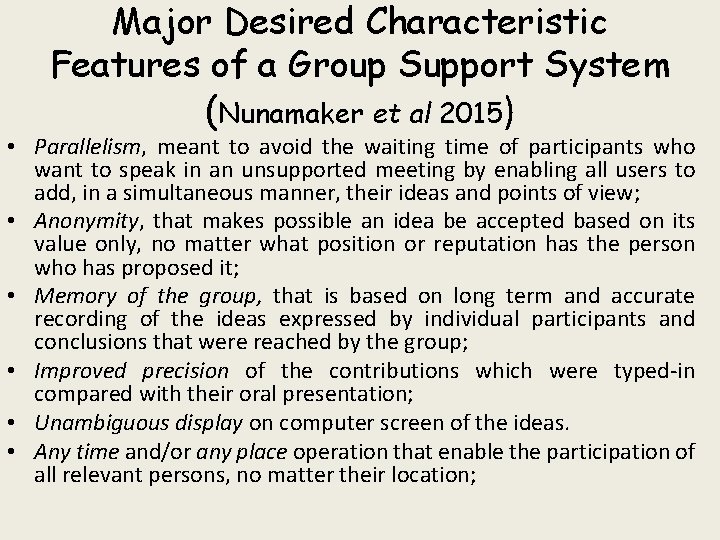
Major Desired Characteristic Features of a Group Support System (Nunamaker et al 2015) • Parallelism, meant to avoid the waiting time of participants who want to speak in an unsupported meeting by enabling all users to add, in a simultaneous manner, their ideas and points of view; • Anonymity, that makes possible an idea be accepted based on its value only, no matter what position or reputation has the person who has proposed it; • Memory of the group, that is based on long term and accurate recording of the ideas expressed by individual participants and conclusions that were reached by the group; • Improved precision of the contributions which were typed-in compared with their oral presentation; • Unambiguous display on computer screen of the ideas. • Any time and/or any place operation that enable the participation of all relevant persons, no matter their location;
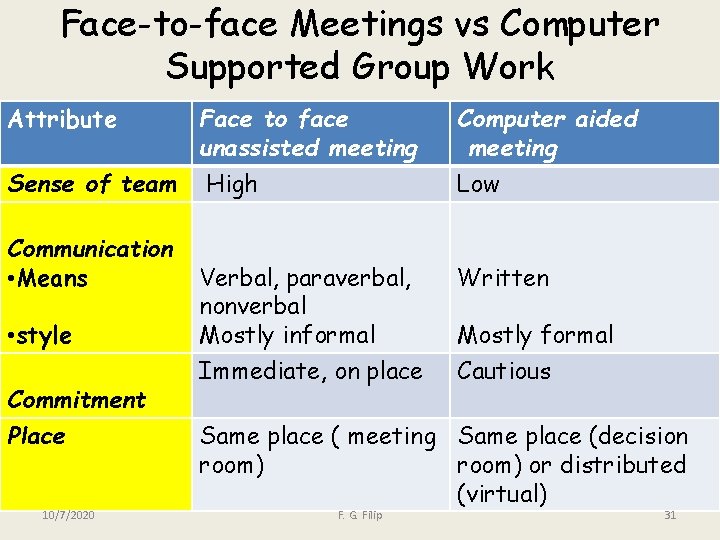
Face-to-face Meetings vs Computer Supported Group Work Attribute Face to face unassisted meeting Sense of team High Computer aided meeting Low Communication • Means Written • style Commitment Place 10/7/2020 Verbal, paraverbal, nonverbal Mostly informal Immediate, on place Mostly formal Cautious Same place ( meeting Same place (decision room) or distributed (virtual) F. G. Filip 31
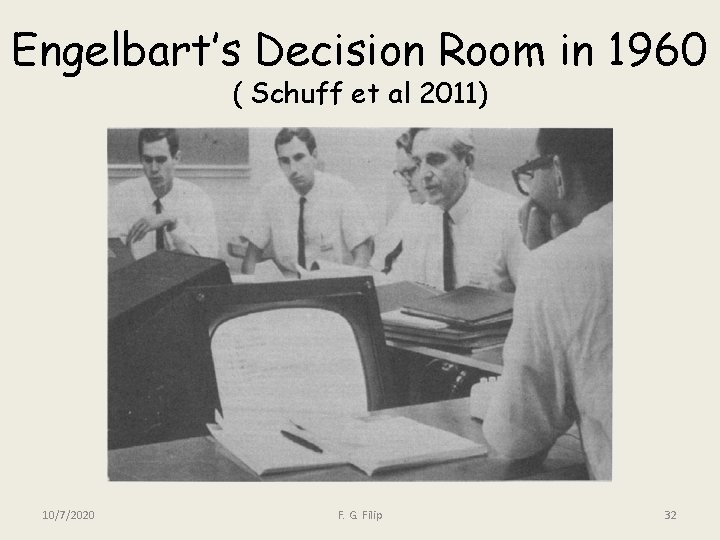
Engelbart’s Decision Room in 1960 ( Schuff et al 2011) 10/7/2020 F. G. Filip 32
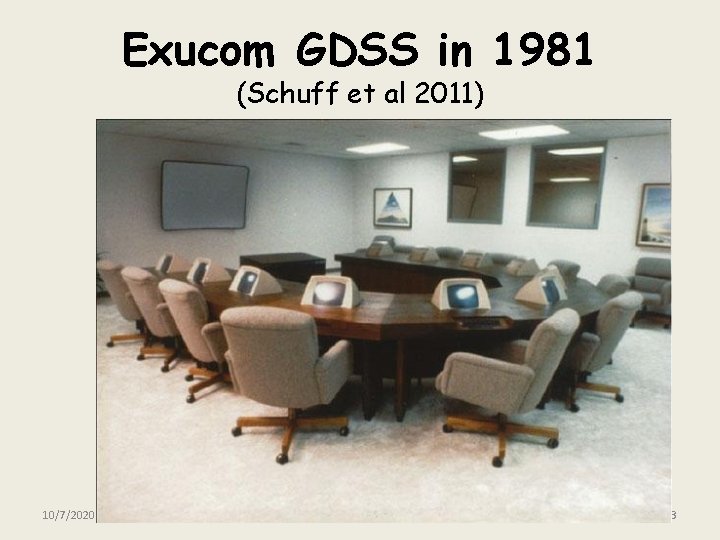
Exucom GDSS in 1981 (Schuff et al 2011) 10/7/2020 F. G. Filip 33
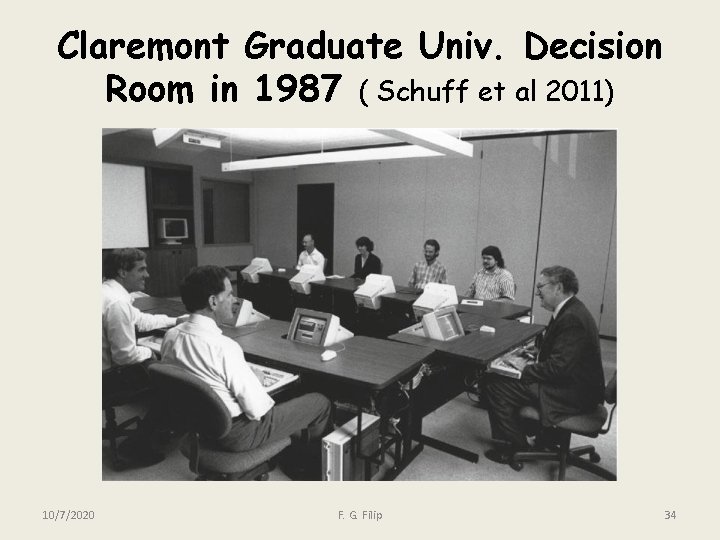
Claremont Graduate Univ. Decision Room in 1987 ( Schuff et al 2011) 10/7/2020 F. G. Filip 34
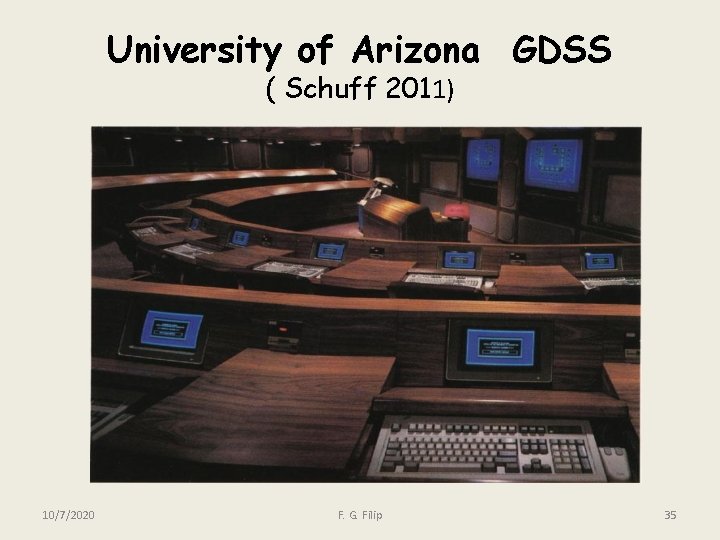
University of Arizona GDSS ( Schuff 2011) 10/7/2020 F. G. Filip 35
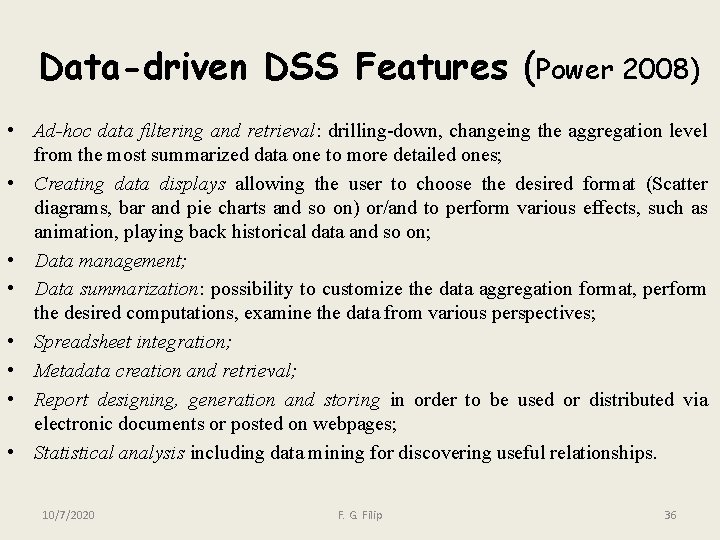
Data-driven DSS Features (Power 2008) • Ad-hoc data filtering and retrieval: drilling-down, changeing the aggregation level from the most summarized data one to more detailed ones; • Creating data displays allowing the user to choose the desired format (Scatter diagrams, bar and pie charts and so on) or/and to perform various effects, such as animation, playing back historical data and so on; • Data management; • Data summarization: possibility to customize the data aggregation format, perform the desired computations, examine the data from various perspectives; • Spreadsheet integration; • Metadata creation and retrieval; • Report designing, generation and storing in order to be used or distributed via electronic documents or posted on webpages; • Statistical analysis including data mining for discovering useful relationships. 10/7/2020 F. G. Filip 36
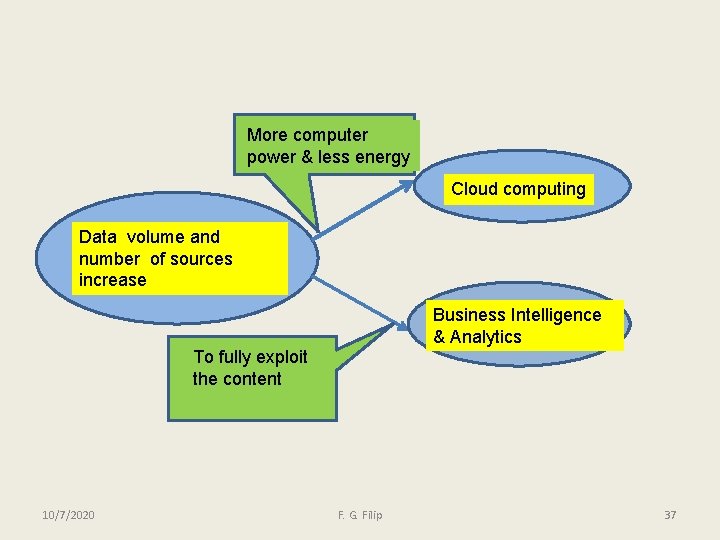
More computer power & less energy Cloud computing Data volume and number of sources increase Business Intelligence & Analytics To fully exploit the content 10/7/2020 F. G. Filip 37
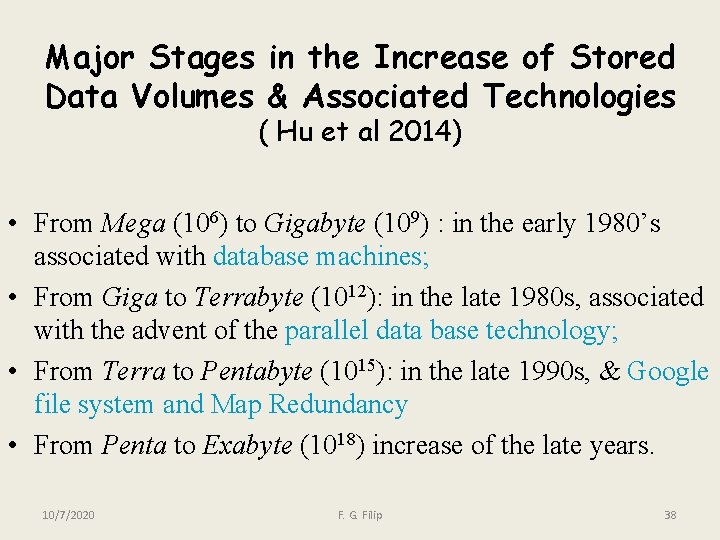
Major Stages in the Increase of Stored Data Volumes & Associated Technologies ( Hu et al 2014) • From Mega (106) to Gigabyte (109) : in the early 1980’s associated with database machines; • From Giga to Terrabyte (1012): in the late 1980 s, associated with the advent of the parallel data base technology; • From Terra to Pentabyte (1015): in the late 1990 s, & Google file system and Map Redundancy • From Penta to Exabyte (1018) increase of the late years. 10/7/2020 F. G. Filip 38
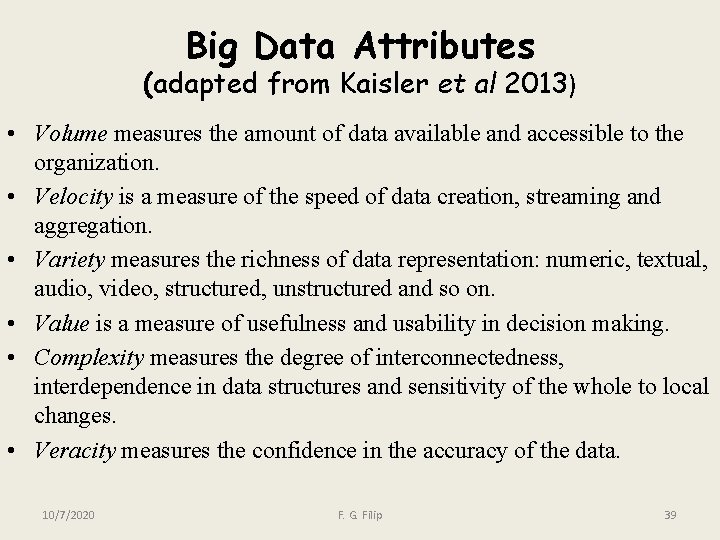
Big Data Attributes (adapted from Kaisler et al 2013) • Volume measures the amount of data available and accessible to the organization. • Velocity is a measure of the speed of data creation, streaming and aggregation. • Variety measures the richness of data representation: numeric, textual, audio, video, structured, unstructured and so on. • Value is a measure of usefulness and usability in decision making. • Complexity measures the degree of interconnectedness, interdependence in data structures and sensitivity of the whole to local changes. • Veracity measures the confidence in the accuracy of the data. 10/7/2020 F. G. Filip 39
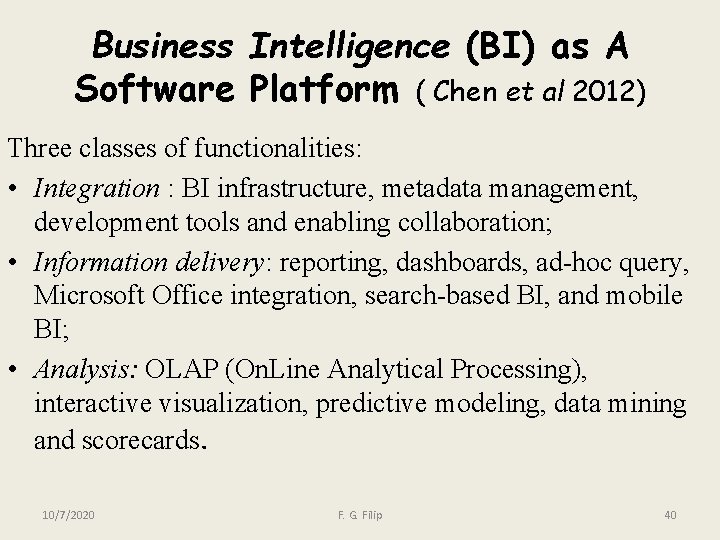
Business Intelligence (BI) as A Software Platform ( Chen et al 2012) Three classes of functionalities: • Integration : BI infrastructure, metadata management, development tools and enabling collaboration; • Information delivery: reporting, dashboards, ad-hoc query, Microsoft Office integration, search-based BI, and mobile BI; • Analysis: OLAP (On. Line Analytical Processing), interactive visualization, predictive modeling, data mining and scorecards. 10/7/2020 F. G. Filip 40
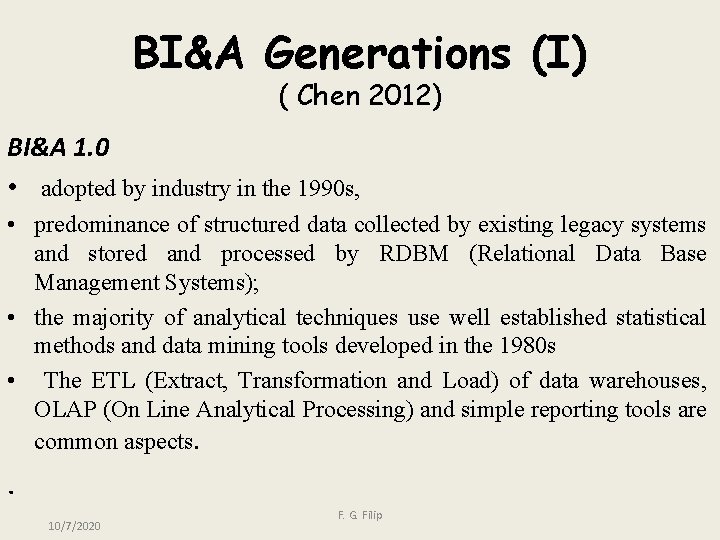
BI&A Generations (I) ( Chen 2012) BI&A 1. 0 • adopted by industry in the 1990 s, • predominance of structured data collected by existing legacy systems and stored and processed by RDBM (Relational Data Base Management Systems); • the majority of analytical techniques use well established statistical methods and data mining tools developed in the 1980 s • The ETL (Extract, Transformation and Load) of data warehouses, OLAP (On Line Analytical Processing) and simple reporting tools are common aspects. . 10/7/2020 F. G. Filip
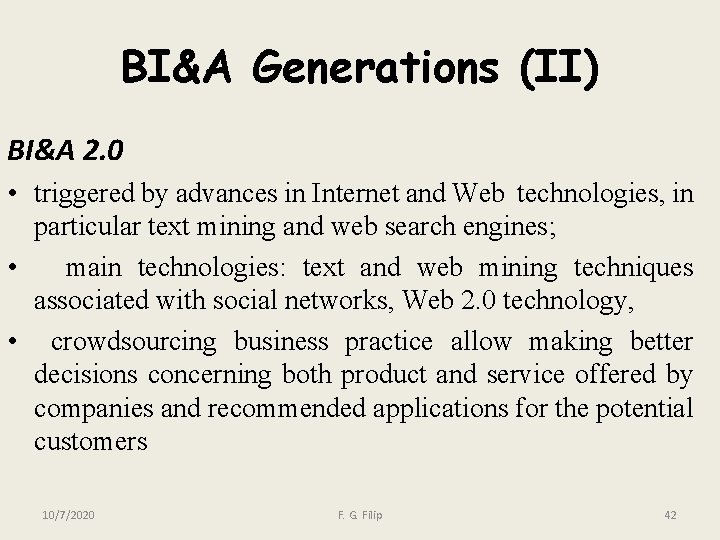
BI&A Generations (II) BI&A 2. 0 • triggered by advances in Internet and Web technologies, in particular text mining and web search engines; • main technologies: text and web mining techniques associated with social networks, Web 2. 0 technology, • crowdsourcing business practice allow making better decisions concerning both product and service offered by companies and recommended applications for the potential customers 10/7/2020 F. G. Filip 42
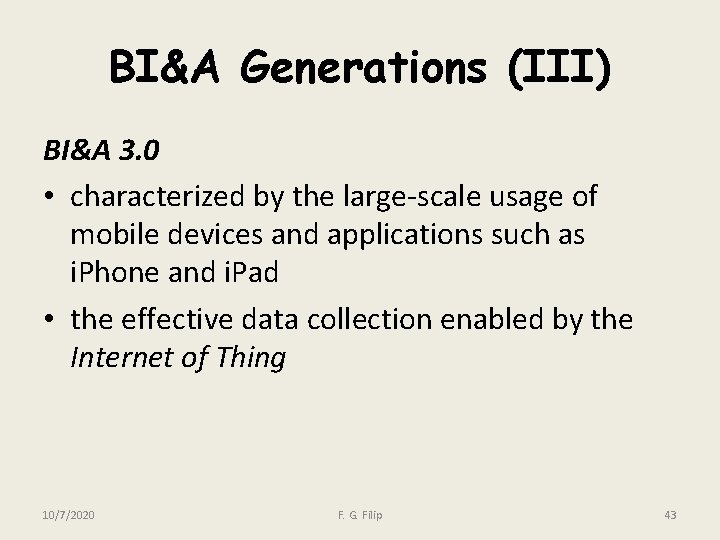
BI&A Generations (III) BI&A 3. 0 • characterized by the large-scale usage of mobile devices and applications such as i. Phone and i. Pad • the effective data collection enabled by the Internet of Thing 10/7/2020 F. G. Filip 43
Cloud Computing: the NIST view • Definition: “CC is a model for enabling ubiquitous, convenient, on-demand network access to a shared pool of configurable computing resources (e. g. , networks, servers, storage, applications, and services) that can be rapidly provisioned and released with minimal management effort or service provider interaction “(Mell & Grance 2011) • Service Models – Infrastructure as a Service (Iaa. S). – Platform as a Service (Paa. S). – Software as a Service (Saa. S) 10/7/2020 F. G. Filip 44
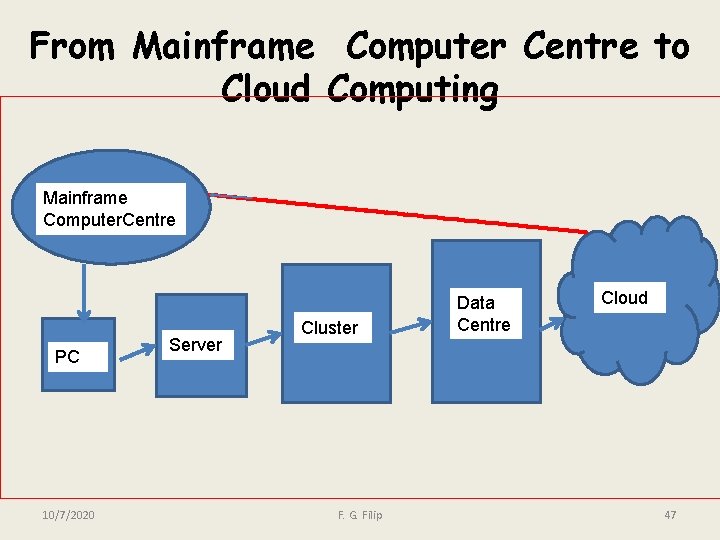
From Mainframe Computer Centre to Cloud Computing Mainframe Computer. Centre PC 10/7/2020 Server Cluster F. G. Filip Data Centre Cloud 45
A Remark • After all, cloud computing is just mainframe computing in a different way, which is how I learned how to compute when I was a young boy”. • From “The impact of disruptive technology: A conversation with Google executive chairman Eric Schmidt “(Mc. Kinsey&Company , 2013) 10/7/2020 F. G. Filip 46
From Mainframe Computer Centre to Cloud Computing Mainframe Computer. Centre PC 10/7/2020 Server Cluster F. G. Filip Data Centre Cloud 47
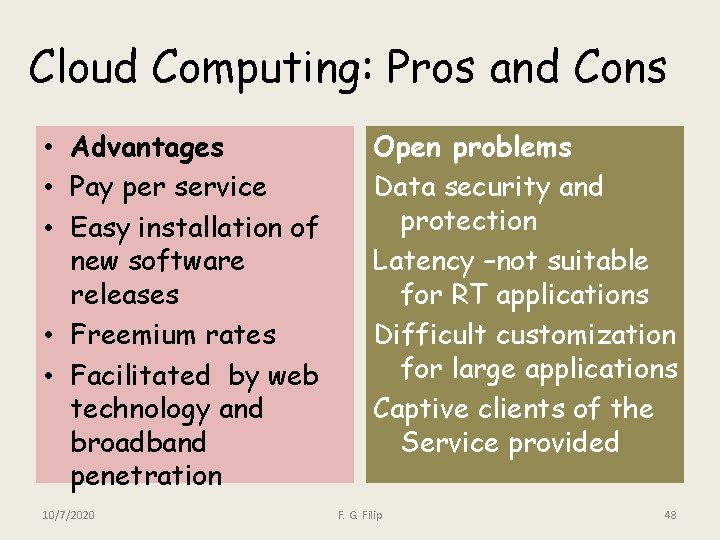
Cloud Computing: Pros and Cons • Advantages • Pay per service • Easy installation of new software releases • Freemium rates • Facilitated by web technology and broadband penetration 10/7/2020 Open problems Data security and protection Latency –not suitable for RT applications Difficult customization for large applications Captive clients of the Service provided F. G. Filip 48
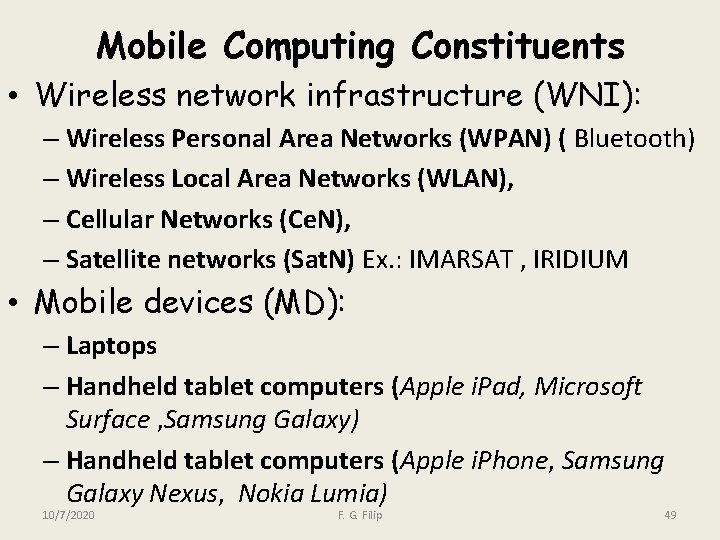
Mobile Computing Constituents • Wireless network infrastructure (WNI): – Wireless Personal Area Networks (WPAN) ( Bluetooth) – Wireless Local Area Networks (WLAN), – Cellular Networks (Ce. N), – Satellite networks (Sat. N) Ex. : IMARSAT , IRIDIUM • Mobile devices (MD): – Laptops – Handheld tablet computers (Apple i. Pad, Microsoft Surface , Samsung Galaxy) – Handheld tablet computers (Apple i. Phone, Samsung Galaxy Nexus, Nokia Lumia) 10/7/2020 F. G. Filip 49
Mobile Network Generations ( Sharma 2013) Attribute→ Generation ↓ Time period Transfer rate [bps] Technology used Service provided Multiplexing 1 G 1970 – 1980 2 K Analog Cellular Mobile Telephony (Voice ) FDMA 2 G 1990 – 2004 64 K Digital Celullar Digital voice, SMS, data TDMA, CDMA 3 G 2004 -2010 1 M CDMA 2000 Integrated HQ audio, video, data CDMA 4 G Now 1 G Wi. Fi, Wi. Max Dynamic info access CDMA 5 G 2020+ >1 G wwww Dynamic info access AI capabilities on devices CDMA 10/7/2020 F. G. Filip 50
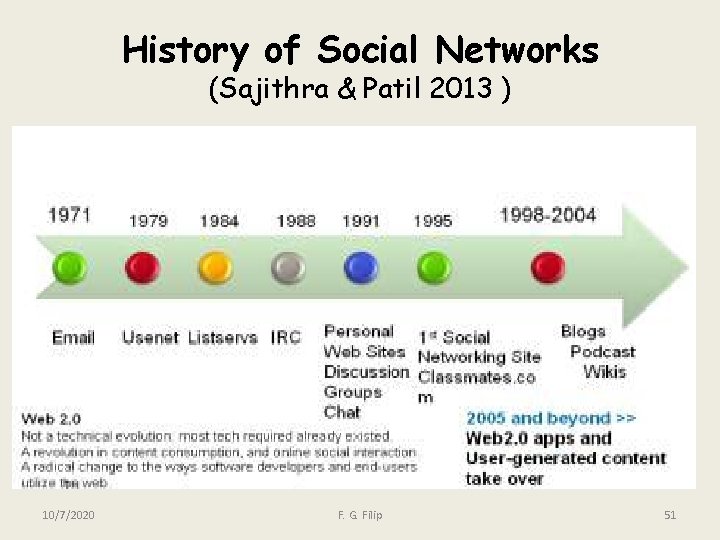
History of Social Networks (Sajithra & Patil 2013 ) 10/7/2020 F. G. Filip 51
Contents • Men and Automation • Cooperation Forms • Enabling Technologies • An Integrated Platform • Conclusions • References 10/7/2020 F. G. Filip 52
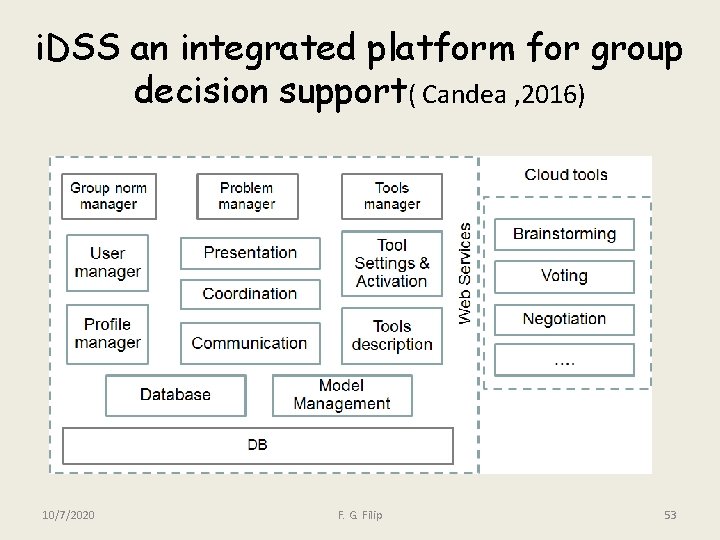
i. DSS an integrated platform for group decision support( Candea , 2016) 10/7/2020 F. G. Filip 53
Contents • • Men and Automation Cooperation Forms Enabling technologies An Integrated Platform • [Instead of] Conclusions • References 10/7/2020 F. G. Filip 54
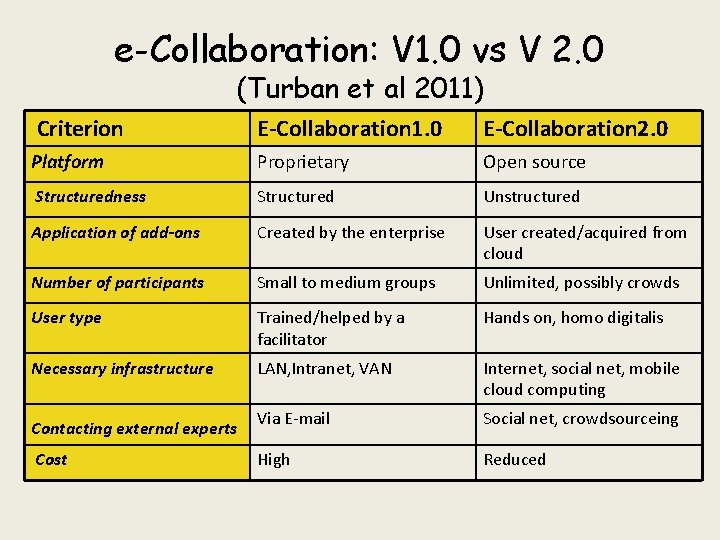
e-Collaboration: V 1. 0 vs V 2. 0 (Turban et al 2011) Criterion E-Collaboration 1. 0 E-Collaboration 2. 0 Platform Proprietary Open source Structuredness Structured Unstructured Application of add-ons Created by the enterprise User created/acquired from cloud Number of participants Small to medium groups Unlimited, possibly crowds User type Trained/helped by a facilitator Hands on, homo digitalis Necessary infrastructure LAN, Intranet, VAN Internet, social net, mobile cloud computing Contacting external experts Via E-mail Social net, crowdsourceing Cost High Reduced
Contents • • Men and Automation Cooperation Forms Enabling technologies Conclusions • References 10/7/2020 F. G. Filip 56
References (I) • • • Bainbridge L (1983) Ironies of automation. IFAC J. Automatica 19(6): 775 -779 Candea C( 2016) Ph D Thesis Camarinha-Matos L M, Afsarmanesh H (2005) Collaborative networks: a new scientific discipline. Journal of Intelligent Manufacturing, 16(4 -5): 439 -452 Camarinha-Matos L, M, Afsarmanesh H, Galeano N Molina A. (2009) Collaborative networked organizations. Concepts and practice in manufacturing enterprise. Computers & Industrial Engineering, 57(1): 46 -60 Chen H, Chiang R H L, Storey V C. (2012) Business Intelligence and Analytics: from Big Data to Big Impact. MIS Quarterly, 36(4), December: 1 -24 Dekker SW, Woods DD ( 2002) MABA-MABA or abracadabra? Progress on human– automation co-ordination. Cognition, Technology & Work, 4(4), pp. 240 -244. Fitts, P. M. (1951) Human engineering for an effective air navigation and traffic control system. Washington, DC: National Research Council. Hu H, Wen Y. Chua T-S, Li X (2014) Toward Scalable Systems for Big Data Analytics: A Technology Tutorial. IEEE Access: 652 -687. . Kaisler S, Armour F, Espinosa J. A, Money W (2013) Big Data: Issues and Challenges Moving Forward. In: 46 th Hawaii International Conference in System Sciences, IEEE Computer Society: p. 995 -104 Mell, P. , Grance, T. (2011). The NIST definition of Cloud Computing. Special publication 800 - 145 (http: //csrc. nist. gov/publications/nistpubs/800 -145/SP 800 -145. pdf )
References (II) • • • Mesarovic M D, Macko D Takahara I (1970) Theory of Hierarchical Multilevel Systems. Academic Press, New York Monostori, L. , Valkenaerts, P. , Dolgui, A. , Panetto, H. , Brdys, M. , Csáji, B. C. (2015). Cooperative control in production and logistics. Annual Reviews in Control, 39, 12 -29. Nof, S. Y. (2007). Collaborative control theory for e-work, e-production and e-service. Annual Reviews in Control, 31, 281 -292 Nunamaker, Jr. , J. F, Romero Jr. , N C, Briggs R O (2015) Collaboration Systems. Part II: Foundations. In: Nunamaker J F et al (eds). Collaboration Systems: Concept, Value and Use. Routledge, p. 9 -23. Power D J (2008) Understanding Data-driven Decision Support Systems. Information Systems Management, 25: 149 -157 Rasmussen J (1983) Skills, roles and knowledge, signal, signs and symbols and other distinctions in human performance model. IEEE Trans. Systems, Man and Cybernetics, SMC, 13(3): 257 -266 Sajithra K, 2 Dr. Rajindra Patil (2013). Social Media – History and Components, JOSR-JBM, 69 -74 Save L, Feuerberg B (2012) Designing human-automation nteractions: a new level of automation taxonomy (http: //hfes-europe. org ). Schuff D Paradice D, Burstein F, Power D J, Sharda R eds 2011 Decision Support : An Examination of the DSS Discipline. . Springer New York: Sheridan T B, Verplank W (1978) Human and Computer Control of Undersea Teleoperators. Man. Machine Systems Laboratory, Dept. of Mechanical Engineering, MIT, Cambridge, MA Turban E, Liang T P, Wu S P J (2011) A framework for adopting collaboration 2. 0 tools for virtual group decision making. Group Decision and Negotiation 20(2): 137 -154 Turoff M (1991). Computer-mediated communication requirements for group support. Journal of Organizational Computing and Electroning Commerce, 1(1): 85 -113 10/7/2020 F. G. Filip 58