
From Farm Gate to Consumer A Road Map
- Slides: 12
From Farm Gate to Consumer: A Road Map for Analyzing Competition Issues Arising from Increasing Concentration in Agribusiness PRESENTATION BY R. SHYAM KHEMANI, Ph. D (LSE, UK)* VII St. Petersburg International Legal Forum ST Petersburg, Russia May 15 -21, 2017
TOPICS TO BE DISCUSSED Ø Increasing Concentration in Agricultural Chemical & Seed Markets. Ø Factors Giving Rise to Increasing Concentration (M&A Activity). Ø Issues Re: Competition-Market Power. Ø Instruments for Addressing Competition-Market Power Issues. Ø Implications for Competition Policy in BRICS Countries. Ø Concluding Remarks.
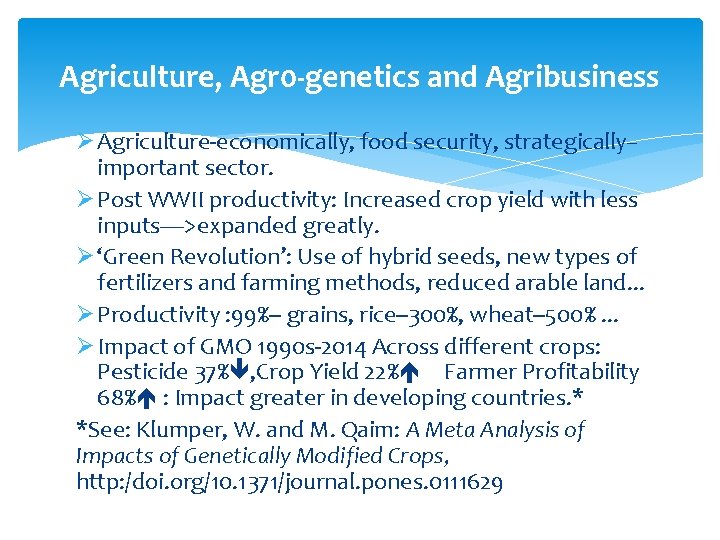
Agriculture, Agr 0 -genetics and Agribusiness Ø Agriculture-economically, food security, strategically– important sector. Ø Post WWII productivity: Increased crop yield with less inputs—>expanded greatly. Ø ‘Green Revolution’: Use of hybrid seeds, new types of fertilizers and farming methods, reduced arable land. . . Ø Productivity : 99%-- grains, rice--300%, wheat--500%. . . Ø Impact of GMO 1990 s-2014 Across different crops: Pesticide 37% , Crop Yield 22% Farmer Profitability 68% : Impact greater in developing countries. * *See: Klumper, W. and M. Qaim: A Meta Analysis of Impacts of Genetically Modified Crops, http: /doi. org/10. 1371/journal. pones. 0111629
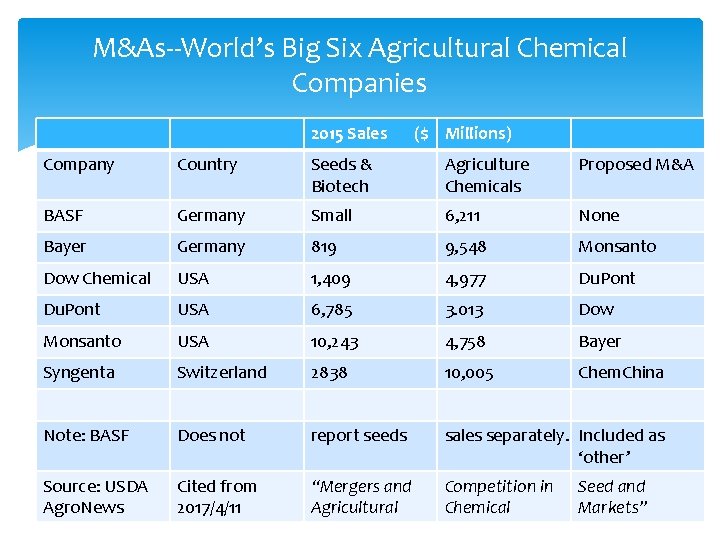
M&As--World’s Big Six Agricultural Chemical Companies 2015 Sales ($ Millions) Company Country Seeds & Biotech Agriculture Chemicals Proposed M&A BASF Germany Small 6, 211 None Bayer Germany 819 9, 548 Monsanto Dow Chemical USA 1, 409 4, 977 Du. Pont USA 6, 785 3. 013 Dow Monsanto USA 10, 243 4, 758 Bayer Syngenta Switzerland 2838 10, 005 Chem. China Note: BASF Does not report seeds sales separately. Included as ‘other’ Source: USDA Agro. News Cited from 2017/4/11 “Mergers and Agricultural Competition in Chemical Seed and Markets”
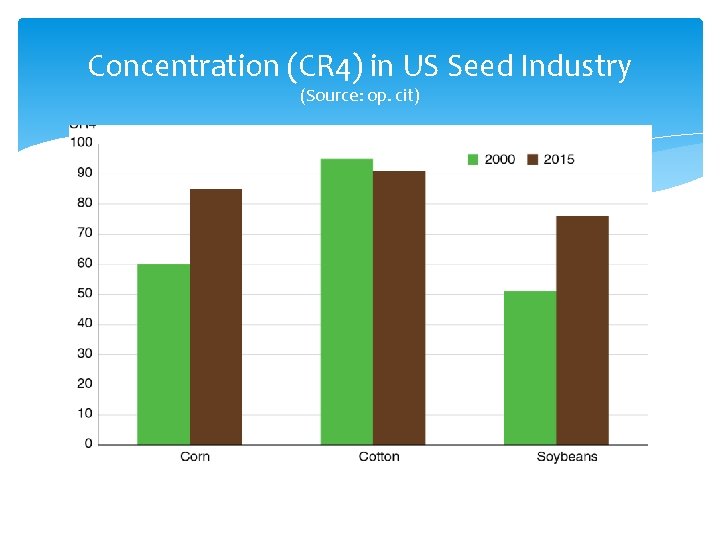
Concentration (CR 4) in US Seed Industry (Source: op. cit)
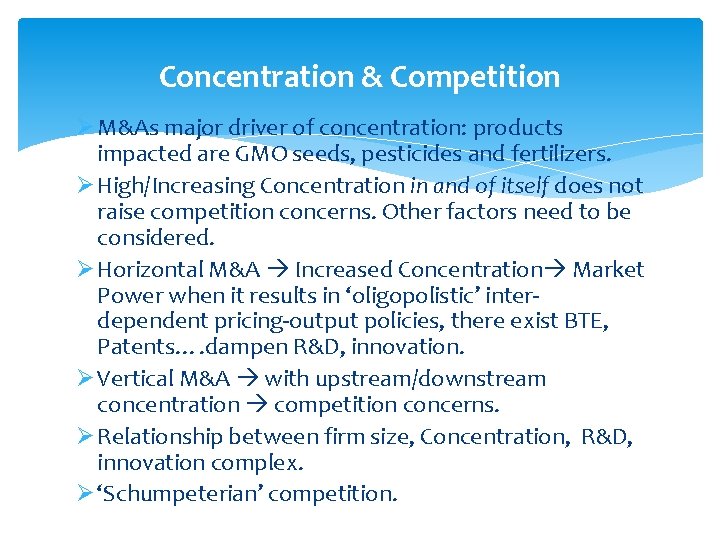
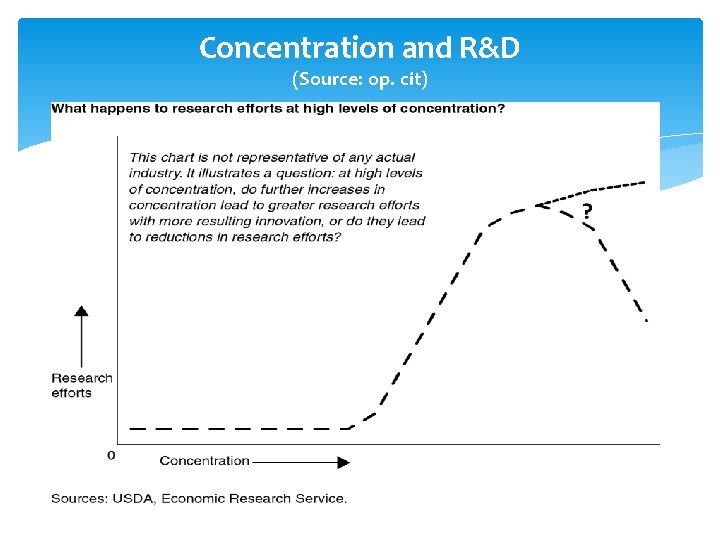
Concentration & Competition Ø M&As major driver of concentration: products impacted are GMO seeds, pesticides and fertilizers. Ø High/Increasing Concentration in and of itself does not raise competition concerns. Other factors need to be considered. Ø Horizontal M&A Increased Concentration Market Power when it results in ‘oligopolistic’ interdependent pricing-output policies, there exist BTE, Patents…. dampen R&D, innovation. Ø Vertical M&A with upstream/downstream concentration competition concerns. Ø Relationship between firm size, Concentration, R&D, innovation complex. Ø ‘Schumpeterian’ competition.
Concentration and R&D (Source: op. cit)
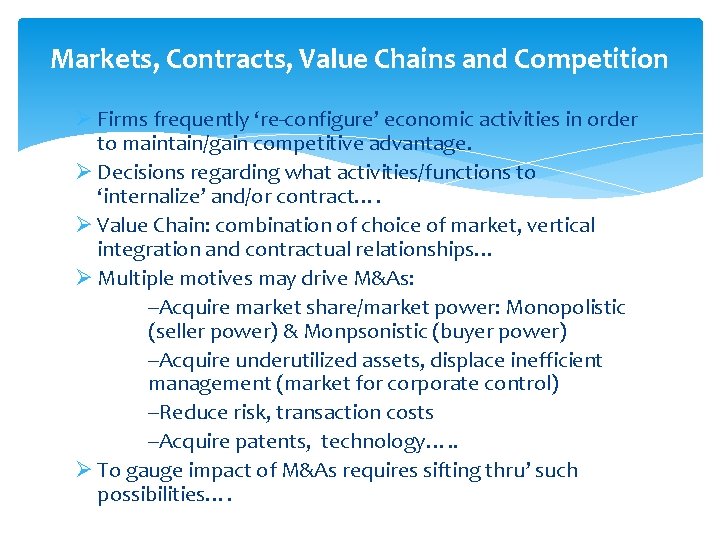
Markets, Contracts, Value Chains and Competition Ø Firms frequently ‘re-configure’ economic activities in order to maintain/gain competitive advantage. Ø Decisions regarding what activities/functions to ‘internalize’ and/or contract…. Ø Value Chain: combination of choice of market, vertical integration and contractual relationships… Ø Multiple motives may drive M&As: --Acquire market share/market power: Monopolistic (seller power) & Monpsonistic (buyer power) --Acquire underutilized assets, displace inefficient management (market for corporate control) --Reduce risk, transaction costs --Acquire patents, technology…. . Ø To gauge impact of M&As requires sifting thru’ such possibilities….
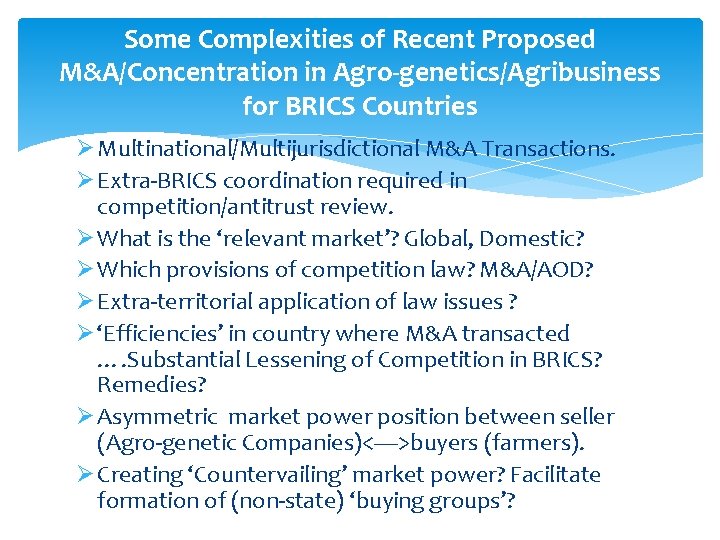
Some Complexities of Recent Proposed M&A/Concentration in Agro-genetics/Agribusiness for BRICS Countries Ø Multinational/Multijurisdictional M&A Transactions. Ø Extra-BRICS coordination required in competition/antitrust review. Ø What is the ‘relevant market’? Global, Domestic? Ø Which provisions of competition law? M&A/AOD? Ø Extra-territorial application of law issues ? Ø ‘Efficiencies’ in country where M&A transacted …. Substantial Lessening of Competition in BRICS? Remedies? Ø Asymmetric market power position between seller (Agro-genetic Companies)<—>buyers (farmers). Ø Creating ‘Countervailing’ market power? Facilitate formation of (non-state) ‘buying groups’?
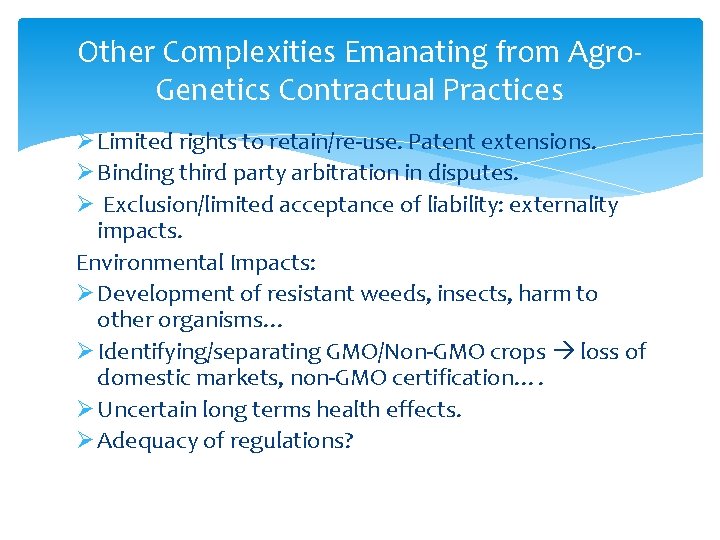
Other Complexities Emanating from Agro. Genetics Contractual Practices Ø Limited rights to retain/re-use. Patent extensions. Ø Binding third party arbitration in disputes. Ø Exclusion/limited acceptance of liability: externality impacts. Environmental Impacts: Ø Development of resistant weeds, insects, harm to other organisms… Ø Identifying/separating GMO/Non-GMO crops loss of domestic markets, non-GMO certification…. Ø Uncertain long terms health effects. Ø Adequacy of regulations?
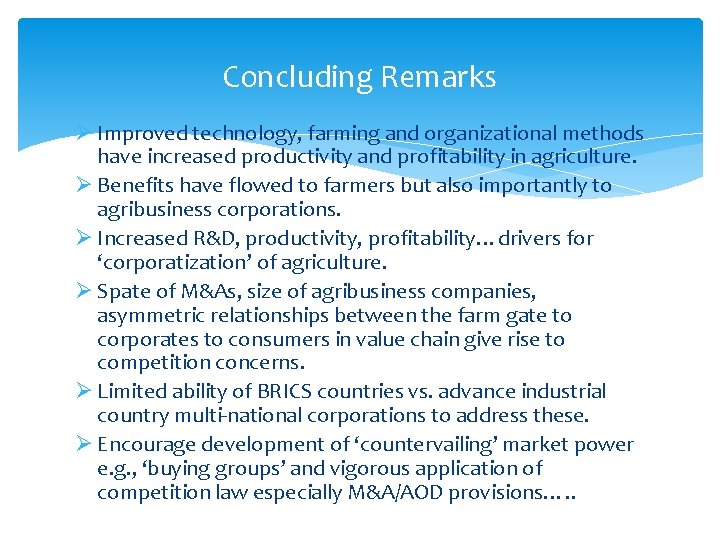
Concluding Remarks Ø Improved technology, farming and organizational methods have increased productivity and profitability in agriculture. Ø Benefits have flowed to farmers but also importantly to agribusiness corporations. Ø Increased R&D, productivity, profitability…drivers for ‘corporatization’ of agriculture. Ø Spate of M&As, size of agribusiness companies, asymmetric relationships between the farm gate to corporates to consumers in value chain give rise to competition concerns. Ø Limited ability of BRICS countries vs. advance industrial country multi-national corporations to address these. Ø Encourage development of ‘countervailing’ market power e. g. , ‘buying groups’ and vigorous application of competition law especially M&A/AOD provisions…. .
THANK YOU *Contact Address Shyam. Khemani@skpgroup. com or RSKhemani@gmail. com