
From Ed Batista ThomasKilmann Conflict Modes www edbatista
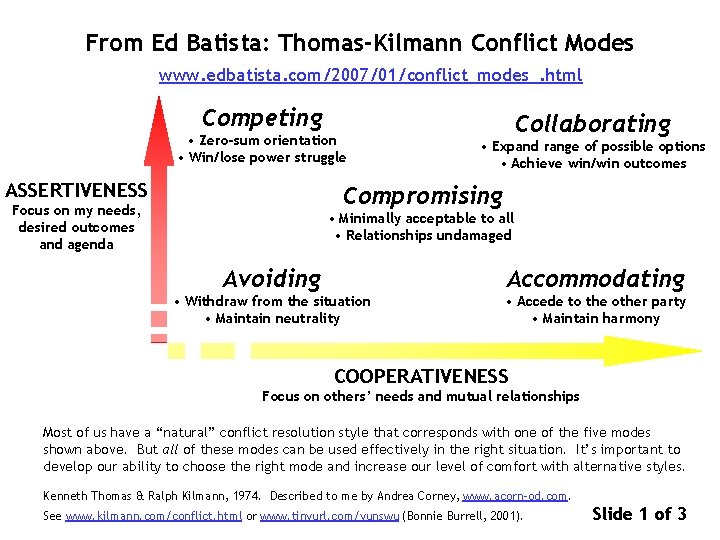
From Ed Batista: Thomas-Kilmann Conflict Modes www. edbatista. com/2007/01/conflict_modes_. html Competing • Zero-sum orientation • Win/lose power struggle ASSERTIVENESS Collaborating • Expand range of possible options • Achieve win/win outcomes Compromising Focus on my needs, desired outcomes and agenda • Minimally acceptable to all • Relationships undamaged Avoiding Accommodating • Withdraw from the situation • Maintain neutrality • Accede to the other party • Maintain harmony COOPERATIVENESS Focus on others’ needs and mutual relationships Most of us have a “natural” conflict resolution style that corresponds with one of the five modes shown above. But all of these modes can be used effectively in the right situation. It’s important to develop our ability to choose the right mode and increase our level of comfort with alternative styles. Kenneth Thomas & Ralph Kilmann, 1974. Described to me by Andrea Corney, www. acorn-od. com. See www. kilmann. com/conflict. html or www. tinyurl. com/yunswu (Bonnie Burrell, 2001). Slide 1 of 3
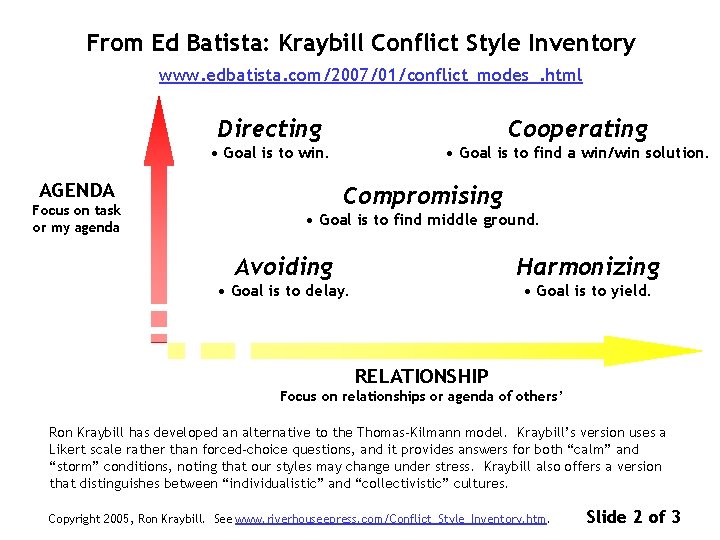
From Ed Batista: Kraybill Conflict Style Inventory www. edbatista. com/2007/01/conflict_modes_. html Directing Cooperating • Goal is to win. • Goal is to find a win/win solution. AGENDA Focus on task or my agenda Compromising • Goal is to find middle ground. Avoiding Harmonizing • Goal is to delay. • Goal is to yield. RELATIONSHIP Focus on relationships or agenda of others’ Ron Kraybill has developed an alternative to the Thomas-Kilmann model. Kraybill’s version uses a Likert scale rather than forced-choice questions, and it provides answers for both “calm” and “storm” conditions, noting that our styles may change under stress. Kraybill also offers a version that distinguishes between “individualistic” and “collectivistic” cultures. Copyright 2005, Ron Kraybill. See www. riverhouseepress. com/Conflict_Style_Inventory. htm. Slide 2 of 3
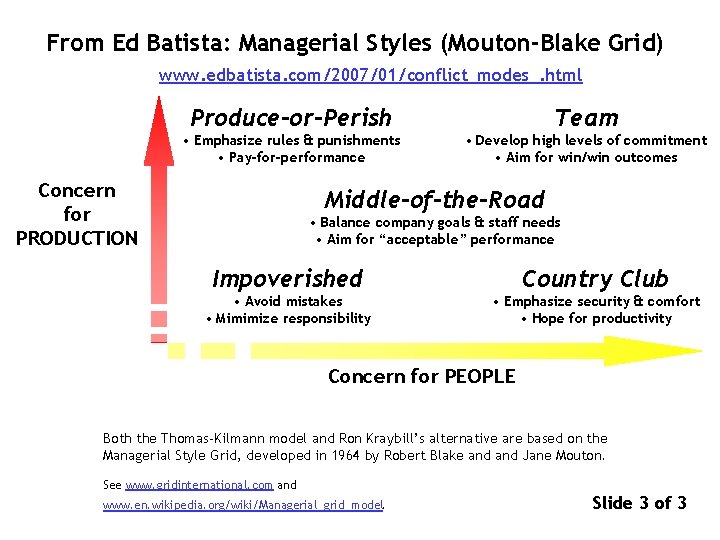
From Ed Batista: Managerial Styles (Mouton-Blake Grid) www. edbatista. com/2007/01/conflict_modes_. html Produce-or-Perish Team • Emphasize rules & punishments • Pay-for-performance • Develop high levels of commitment • Aim for win/win outcomes Concern for PRODUCTION Middle-of-the-Road • Balance company goals & staff needs • Aim for “acceptable” performance Impoverished Country Club • Avoid mistakes • Mimimize responsibility • Emphasize security & comfort • Hope for productivity Concern for PEOPLE Both the Thomas-Kilmann model and Ron Kraybill’s alternative are based on the Managerial Style Grid, developed in 1964 by Robert Blake and Jane Mouton. See www. gridinternational. com and www. en. wikipedia. org/wiki/Managerial_grid_model. Slide 3 of 3
- Slides: 3