
From Dyslexia Identification to Getting Services A Testing
- Slides: 14
From Dyslexia Identification to Getting Services: A Testing to Teaching Model Margaret “Peg” Kay, Ed. D Psychologist & Educational Advocate Millersville University – February 8, 2020
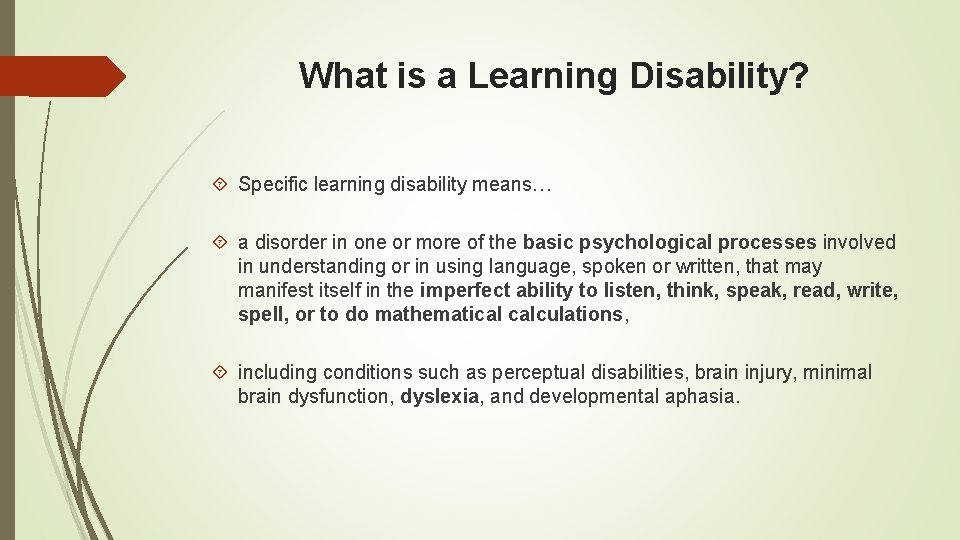
What is a Learning Disability? Specific learning disability means… a disorder in one or more of the basic psychological processes involved in understanding or in using language, spoken or written, that may manifest itself in the imperfect ability to listen, think, speak, read, write, spell, or to do mathematical calculations, including conditions such as perceptual disabilities, brain injury, minimal brain dysfunction, dyslexia, and developmental aphasia.
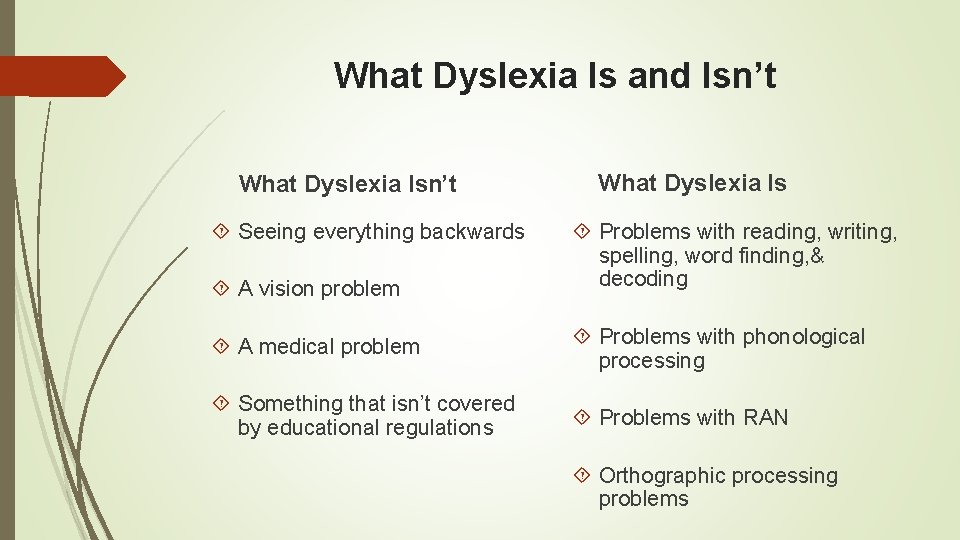
What Dyslexia Is and Isn’t What Dyslexia Isn’t Seeing everything backwards A vision problem What Dyslexia Is Problems with reading, writing, spelling, word finding, & decoding A medical problem Problems with phonological processing Something that isn’t covered by educational regulations Problems with RAN Orthographic processing problems
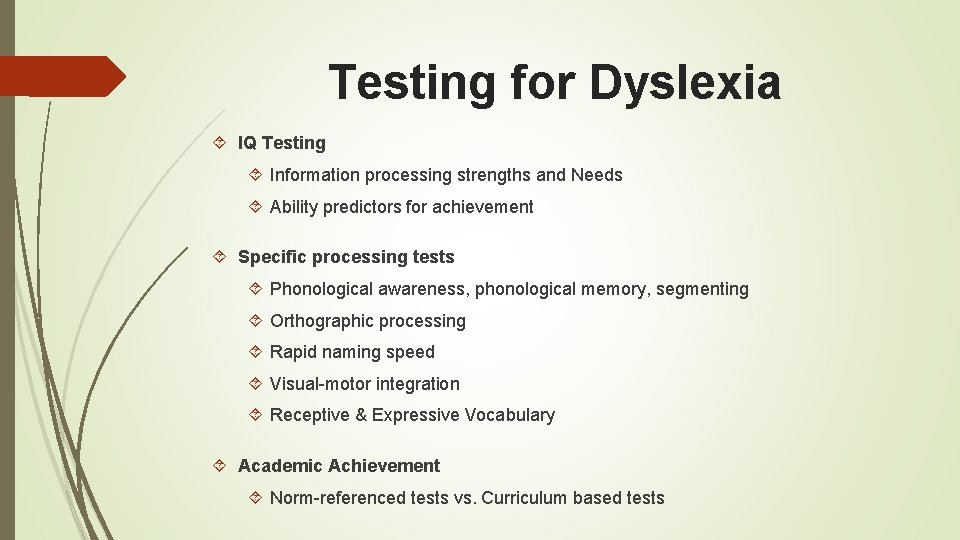
Testing for Dyslexia IQ Testing Information processing strengths and Needs Ability predictors for achievement Specific processing tests Phonological awareness, phonological memory, segmenting Orthographic processing Rapid naming speed Visual-motor integration Receptive & Expressive Vocabulary Academic Achievement Norm-referenced tests vs. Curriculum based tests
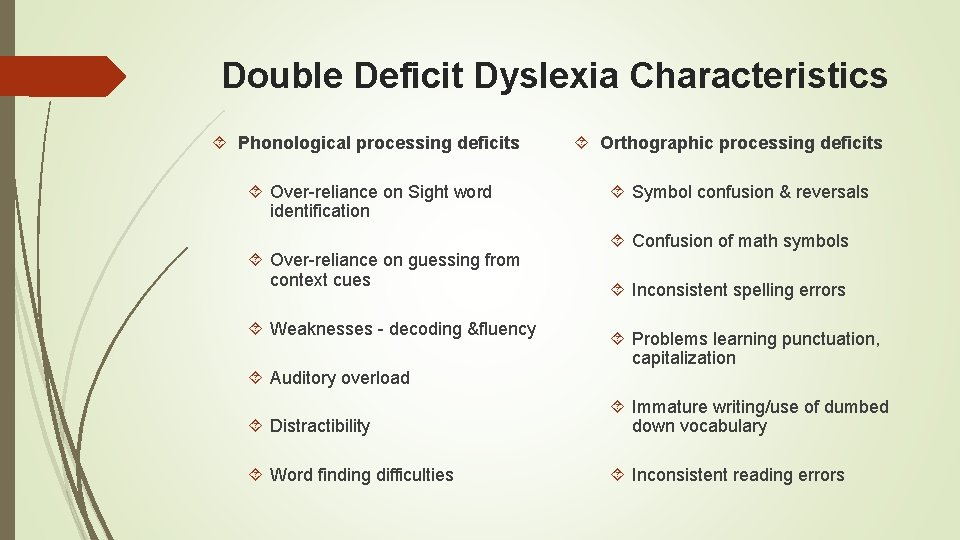
Double Deficit Dyslexia Characteristics Phonological processing deficits Over-reliance on Sight word identification Over-reliance on guessing from context cues Weaknesses - decoding &fluency Auditory overload Orthographic processing deficits Symbol confusion & reversals Confusion of math symbols Inconsistent spelling errors Problems learning punctuation, capitalization Distractibility Immature writing/use of dumbed down vocabulary Word finding difficulties Inconsistent reading errors
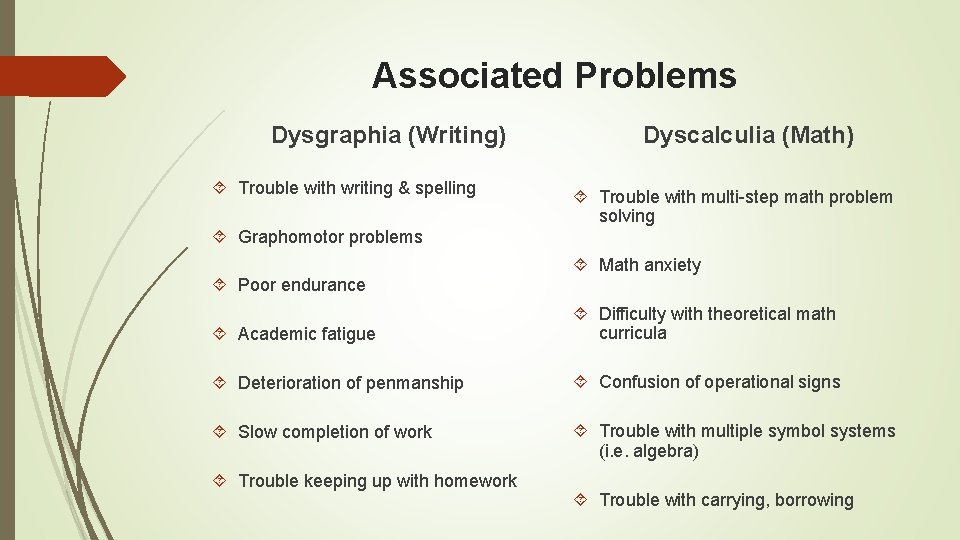
Associated Problems Dysgraphia (Writing) Trouble with writing & spelling Graphomotor problems Poor endurance Dyscalculia (Math) Trouble with multi-step math problem solving Math anxiety Academic fatigue Difficulty with theoretical math curricula Deterioration of penmanship Confusion of operational signs Slow completion of work Trouble with multiple symbol systems (i. e. algebra) Trouble keeping up with homework Trouble with carrying, borrowing
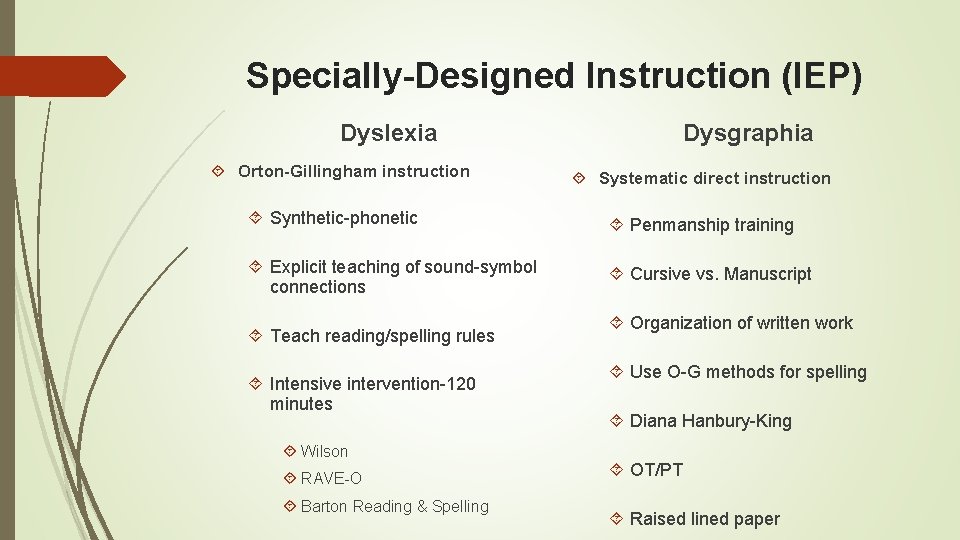
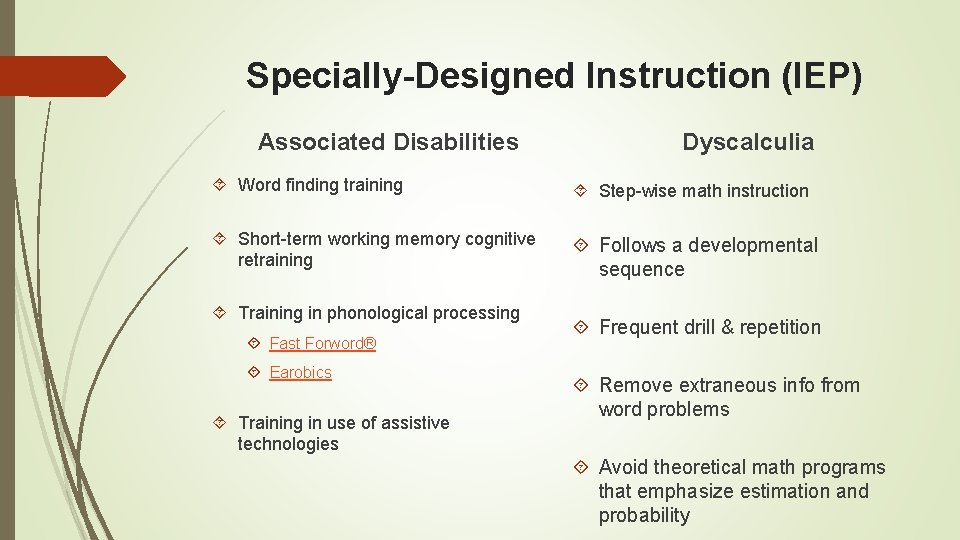
Specially-Designed Instruction (IEP) Dysgraphia Dyslexia Orton-Gillingham instruction Systematic direct instruction Synthetic-phonetic Penmanship training Explicit teaching of sound-symbol connections Cursive vs. Manuscript Teach reading/spelling rules Intensive intervention-120 minutes Wilson RAVE-O Barton Reading & Spelling Organization of written work Use O-G methods for spelling Diana Hanbury-King OT/PT Raised lined paper
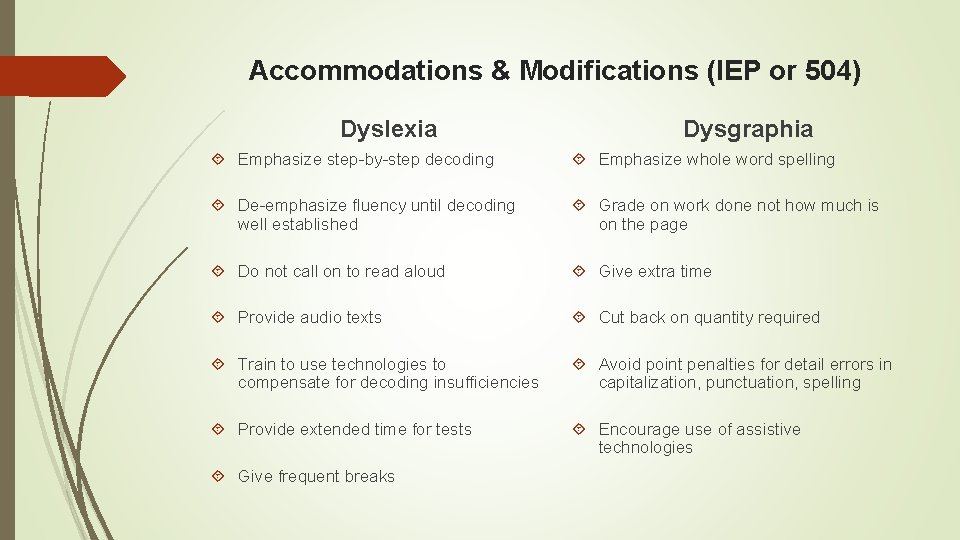
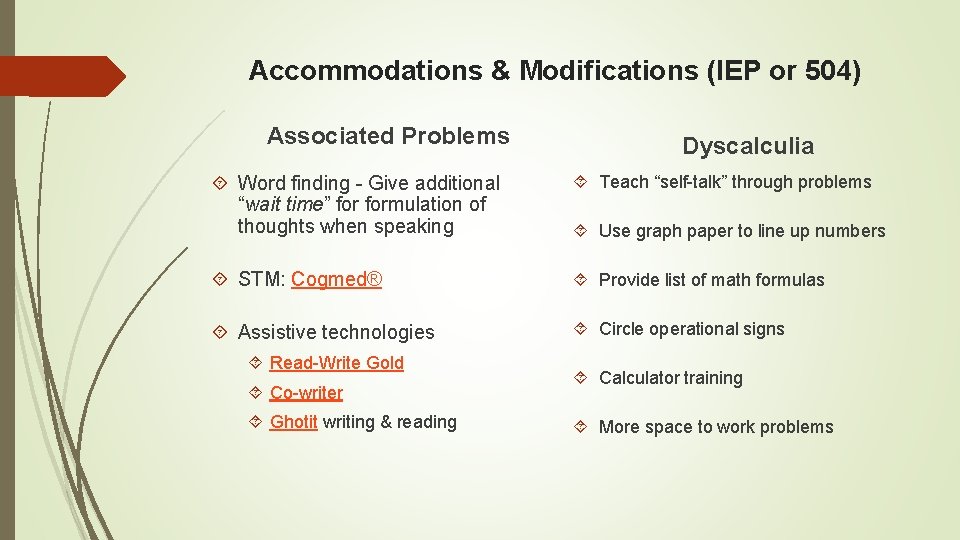
Accommodations & Modifications (IEP or 504) Dyslexia Dysgraphia Emphasize step-by-step decoding Emphasize whole word spelling De-emphasize fluency until decoding well established Grade on work done not how much is on the page Do not call on to read aloud Give extra time Provide audio texts Cut back on quantity required Train to use technologies to compensate for decoding insufficiencies Avoid point penalties for detail errors in capitalization, punctuation, spelling Provide extended time for tests Encourage use of assistive technologies Give frequent breaks
Specially-Designed Instruction (IEP) Associated Disabilities Dyscalculia Word finding training Step-wise math instruction Short-term working memory cognitive retraining Follows a developmental sequence Training in phonological processing Fast Forword® Earobics Training in use of assistive technologies Frequent drill & repetition Remove extraneous info from word problems Avoid theoretical math programs that emphasize estimation and probability
Accommodations & Modifications (IEP or 504) Associated Problems Dyscalculia Word finding - Give additional “wait time” formulation of thoughts when speaking Teach “self-talk” through problems STM: Cogmed® Provide list of math formulas Assistive technologies Circle operational signs Read-Write Gold Co-writer Ghotit writing & reading Use graph paper to line up numbers Calculator training More space to work problems
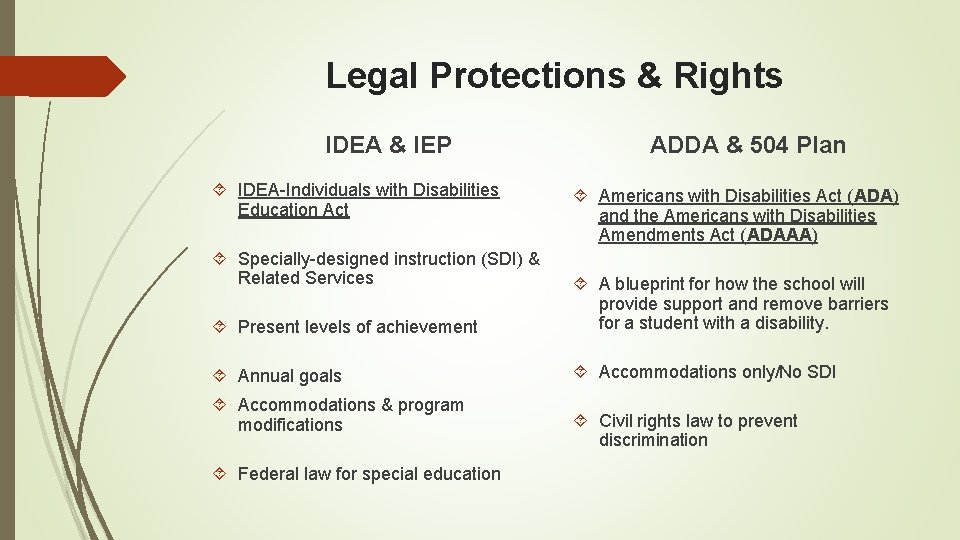
Legal Protections & Rights IDEA & IEP IDEA-Individuals with Disabilities Education Act Specially-designed instruction (SDI) & Related Services ADDA & 504 Plan Americans with Disabilities Act (ADA) and the Americans with Disabilities Amendments Act (ADAAA) Present levels of achievement A blueprint for how the school will provide support and remove barriers for a student with a disability. Annual goals Accommodations only/No SDI Accommodations & program modifications Federal law for special education Civil rights law to prevent discrimination
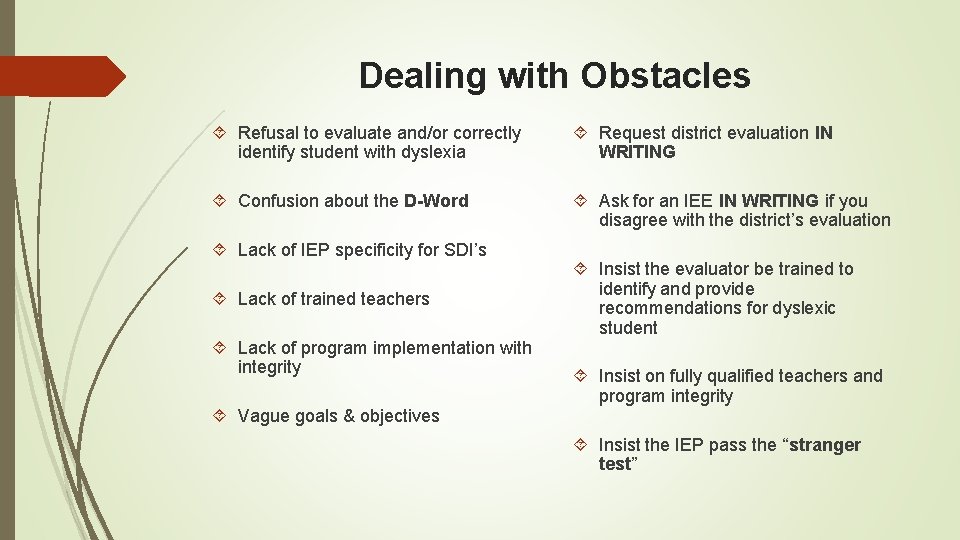
Dealing with Obstacles Refusal to evaluate and/or correctly identify student with dyslexia Request district evaluation IN WRITING Confusion about the D-Word Ask for an IEE IN WRITING if you disagree with the district’s evaluation Lack of IEP specificity for SDI’s Lack of trained teachers Lack of program implementation with integrity Vague goals & objectives Insist the evaluator be trained to identify and provide recommendations for dyslexic student Insist on fully qualified teachers and program integrity Insist the IEP pass the “stranger test”
Resources for Tachers The Reading Teacher’s Top Ten Tools Language Essentials for Teachers of Reading and Spelling – LETRS Knowledge and Practice Standards for Teachers of Reading Pearson Clinical Assessment Solutions: A Dyslexia Toolkit Your role in the dyslexia roadmap
See you in the Afternoon 2: 00 PM Breakout Session I – Stayer Hall What to do if your child shows signs of dyslexia Test early Intervene early Avoid a wait & see approach 3: 00 PM Breakout Session – Stayer Hall Dyslexia in PA – The battle over the “D” Word Dyslexia Pilot Project States with Dyslexia Statutes