
From DNA to Proteins Why are proteins important
- Slides: 22
From DNA to Proteins
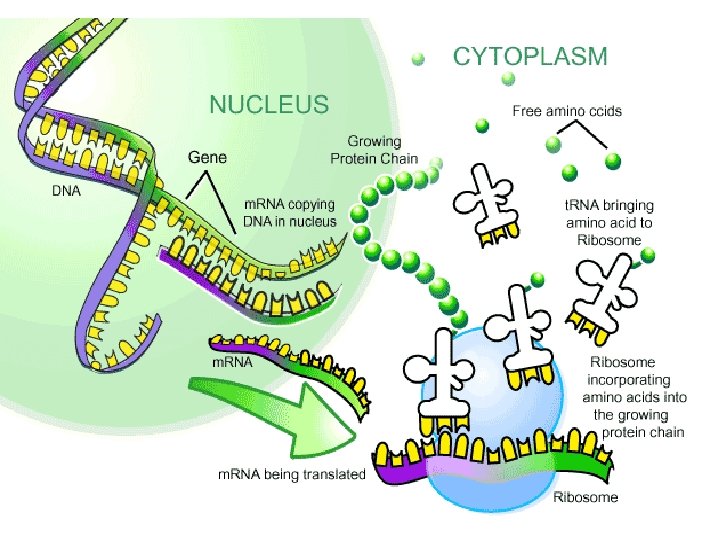
Why are proteins important? • Proteins fold into 3 D shapes to become key structures and regulators of cell functions – Some become the filaments in muscle tissue – Others become enzymes • Enzymes control chemical reactions that perform key life functions • DNA may have the code but RNA actually puts the protein together
What is the role of RNA? • They take the instructions from DNA on how the protein needs to be assembled and they assemble it.
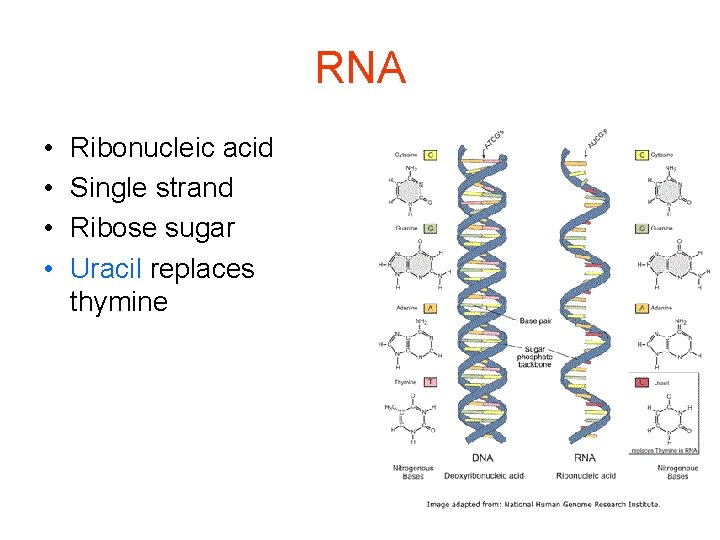
RNA • • Ribonucleic acid Single strand Ribose sugar Uracil replaces thymine
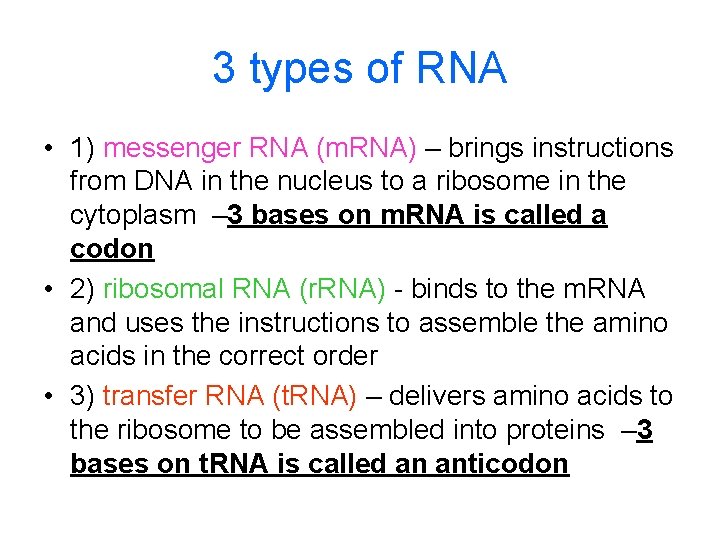
3 types of RNA • 1) messenger RNA (m. RNA) – brings instructions from DNA in the nucleus to a ribosome in the cytoplasm – 3 bases on m. RNA is called a codon • 2) ribosomal RNA (r. RNA) - binds to the m. RNA and uses the instructions to assemble the amino acids in the correct order • 3) transfer RNA (t. RNA) – delivers amino acids to the ribosome to be assembled into proteins – 3 bases on t. RNA is called an anticodon
Transcription • How does the information in DNA which is found in the nucleus, move to the ribosomes in the cytoplasm?
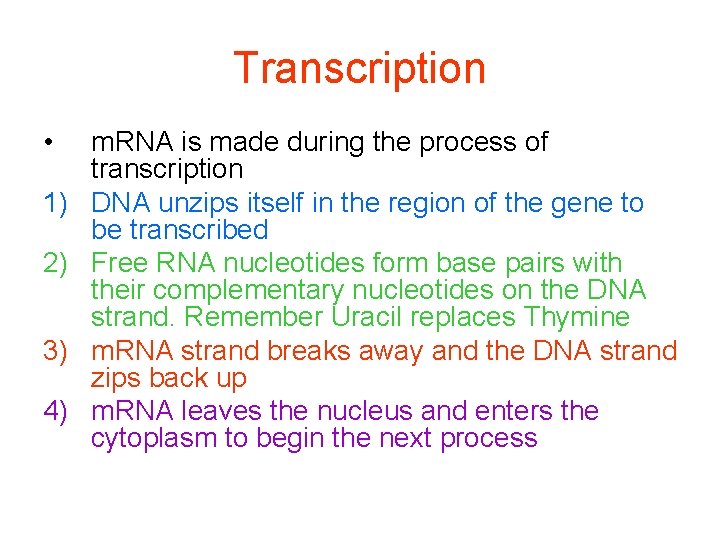
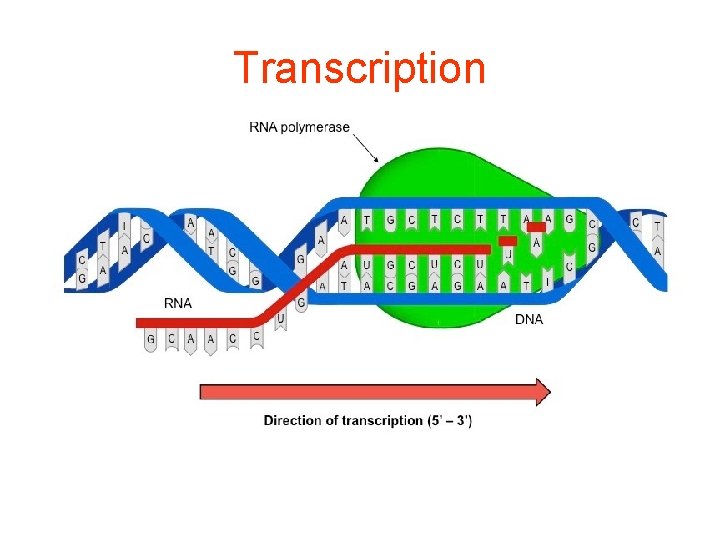
Transcription • 1) 2) 3) 4) m. RNA is made during the process of transcription DNA unzips itself in the region of the gene to be transcribed Free RNA nucleotides form base pairs with their complementary nucleotides on the DNA strand. Remember Uracil replaces Thymine m. RNA strand breaks away and the DNA strand zips back up m. RNA leaves the nucleus and enters the cytoplasm to begin the next process
Transcription
The Genetic Code • The nucleotide sequence transcribed from DNA to a strand of m. RNA acts as a genetic message, the complete information for the building of a protein.
The Genetic Code • Proteins contain chains of Amino Acids – There are 20 common Amino Acids • We need to get the code from m. RNA to the language of proteins. • But how can 4 bases form a code possible for all proteins?
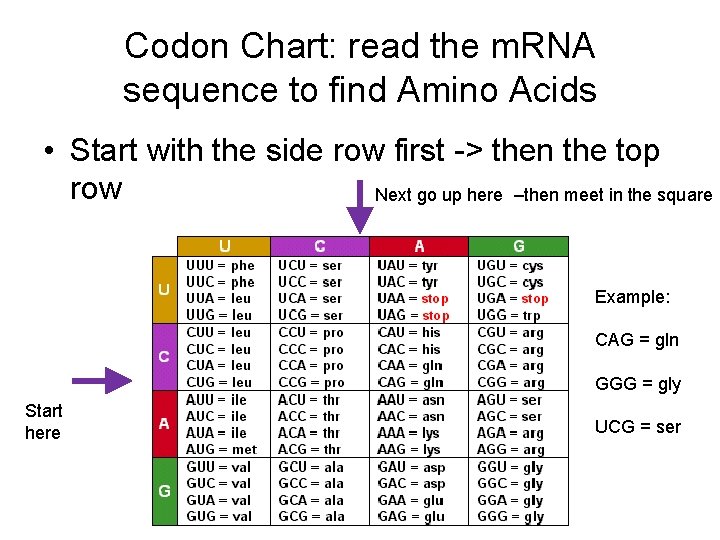
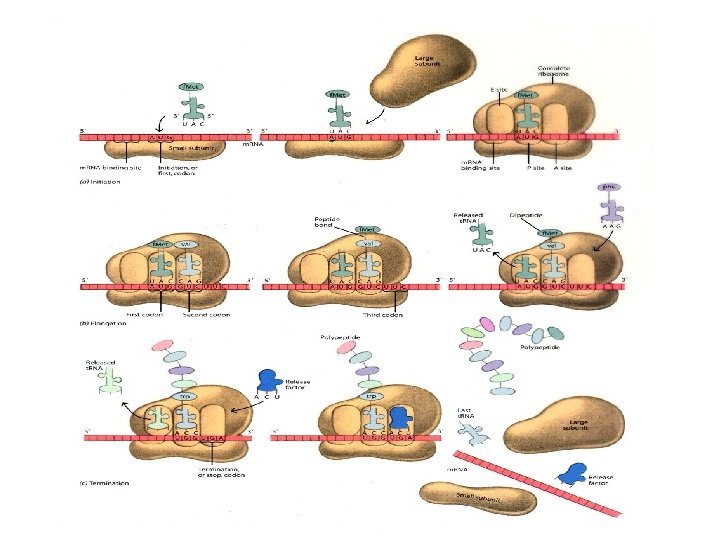
The Genetic Code • They discovered that every 3 nitrogenous base is called a codon – For example: UUU results in the AA phenylalanine being placed in a protein • Total of 64 different combinations possible • Some codons don’t code for a protein but are start or stop codons – AUG is the start codon (every protein must start with this) – 3 stop codons –UAA, UAG, UGA (every protein will stop with one of the stop codons(
The Genetic Code • More then 1 codon can code for the same thing • All organisms use the same genetic code • Complex proteins are built from the long chains of DNA carrying the genetic code
Codon Chart: read the m. RNA sequence to find Amino Acids • Start with the side row first -> then the top row Next go up here –then meet in the square Example: CAG = gln GGG = gly Start here UCG = ser
Translation: From m. RNA to Protein • How is the language of the nucleic acid m. RNA translated into the language of proteins?
Translation: From m. RNA to Protein • The process of converting the information in a sequence of nitrogenous bases in m. RNA into a sequence of amino acids in proteins is known as TRANSLATION • Translation takes place at the ribosome
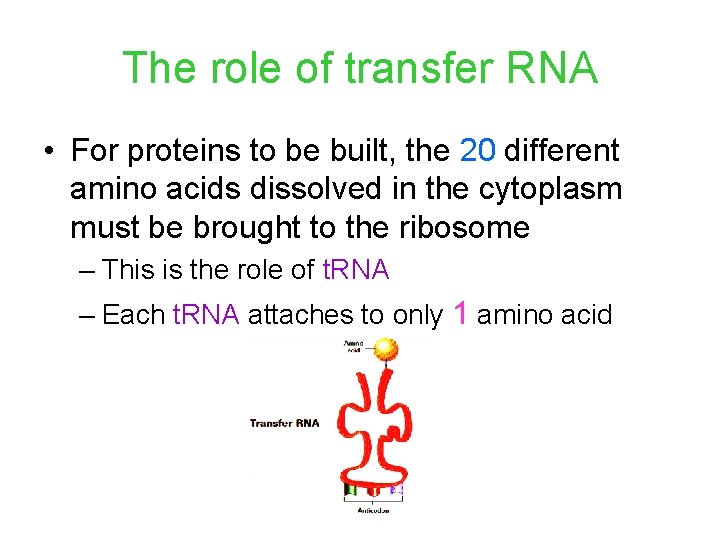
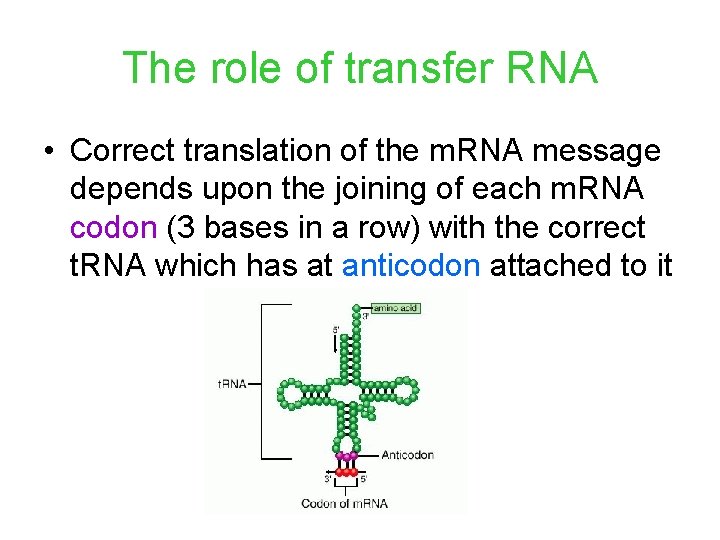
The role of transfer RNA • For proteins to be built, the 20 different amino acids dissolved in the cytoplasm must be brought to the ribosome – This is the role of t. RNA – Each t. RNA attaches to only 1 amino acid
The role of transfer RNA • Correct translation of the m. RNA message depends upon the joining of each m. RNA codon (3 bases in a row) with the correct t. RNA which has at anticodon attached to it
The role of transfer RNA • t. RNA carries only the amino acid that the anticodon specifies • For example: 1 t. RNA molecule for the amino acid cysteine has an anticodon of ACA. This anticodon binds to the m. RNA codon UGU.
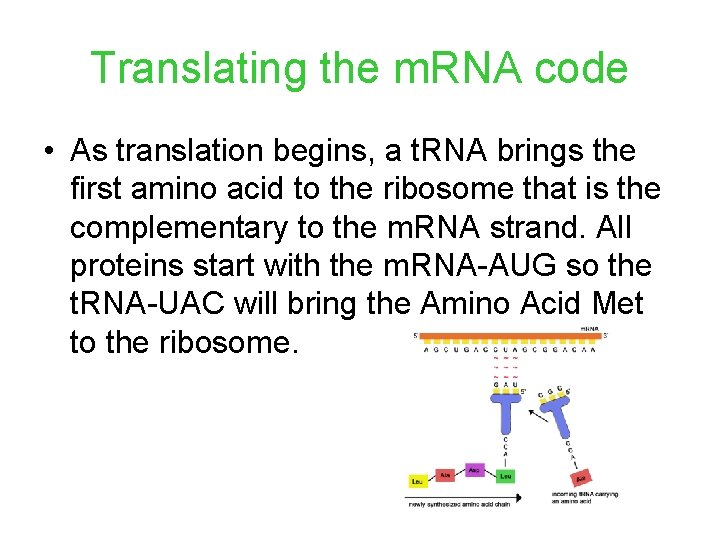
Translating the m. RNA code • As translation begins, a t. RNA brings the first amino acid to the ribosome that is the complementary to the m. RNA strand. All proteins start with the m. RNA-AUG so the t. RNA-UAC will bring the Amino Acid Met to the ribosome.
Translating the m. RNA code • Amino Acids link together by peptide bonds. • The ribosomes slide down the m. RNA chain to the next codon, and a new t. RNA molecule brings another amino acid. • The amino acids bond • This continues on until a stop codon has been read.