
From Discrete Mathematics to AI applications A progression
- Slides: 20
From Discrete Mathematics to AI applications: A progression path for an undergraduate program in math Abdul Huq Middle East College of Information Technology, Sultanate of Oman huq@mecit. edu. om and Narayanan T. Ramachandran Middle East College of Information Technology, Sultanate of Oman narayanan@mecit. edu. om 1
Approaches to AI n n n Can be approached in different ways. . AI as a branch of Computer Science AI’s strong links with May be thought of as Applied Math Clarification of Theoretical issues 2
AI and Math n n The term AI has its roots in Math Dominant role played by Mathematicians in the establishment of CS disciplines: Introduced by John Mc. Carthy, Prof. of Math, Dartmouth College There are Math departments with AI Groups Use of technology in traditionally strong Mathematical subjects 3
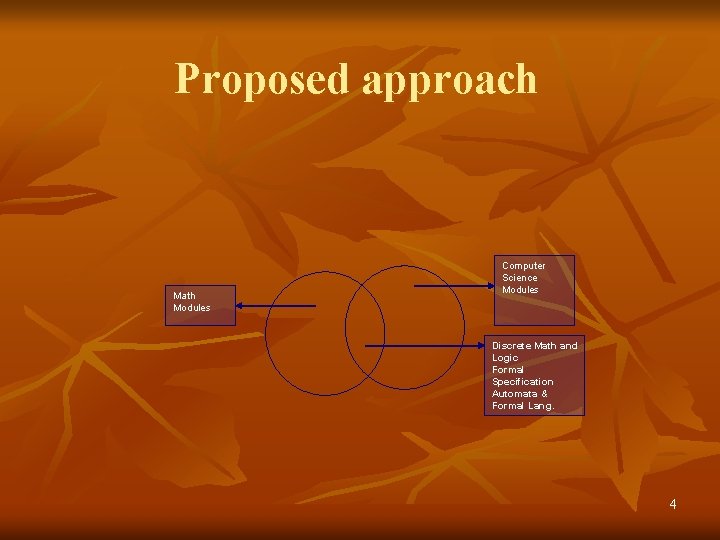
Proposed approach Math Modules Computer Science Modules Discrete Math and Logic Formal Specification Automata & Formal Lang. 4
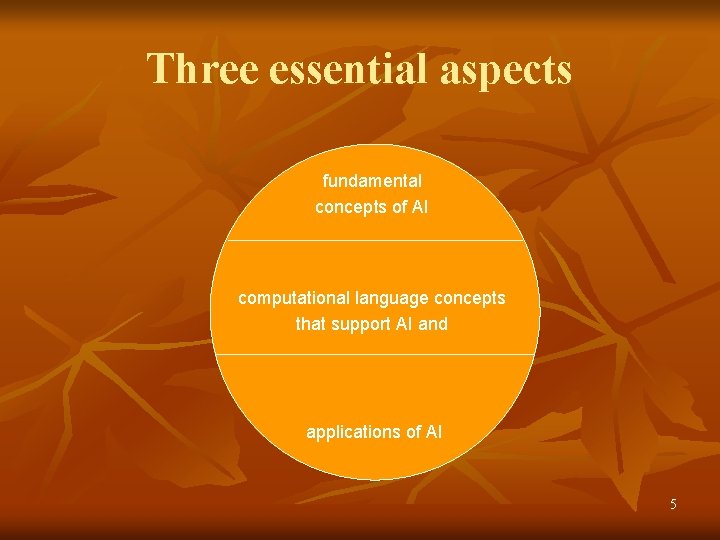
Three essential aspects fundamental concepts of AI computational language concepts that support AI and applications of AI 5
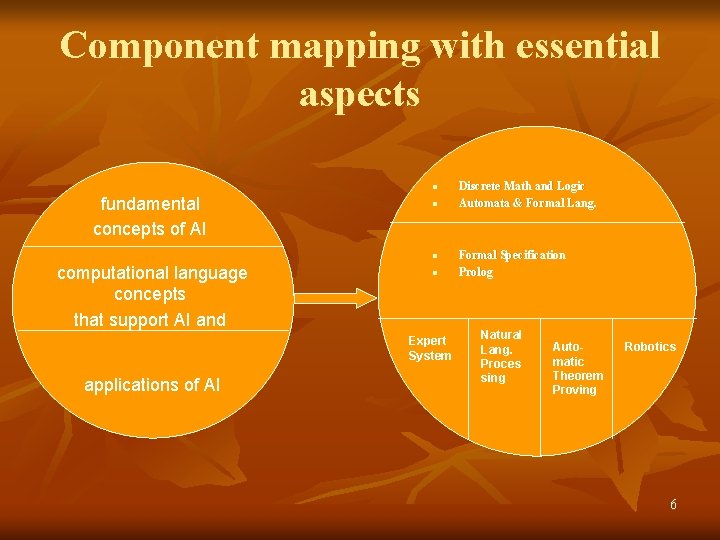
Component mapping with essential aspects n fundamental concepts of AI n n computational language concepts that support AI and n Expert System applications of AI Discrete Math and Logic Automata & Formal Lang. Formal Specification Prolog Natural Lang. Proces sing Automatic Theorem Proving Robotics 6
Discrete Math n n Data Structures Discrete Structures - Sets - Sequences - Relations 7
Logic n n n Propositional Logic Predicate Logics of higher order Fuzzy Logic Useful in Knowledge Representation There are researchers who consider logic as the most important factor in developing strategic, fundamental advances 8
VDM n n A formal specification language Specifies what needs to be done rather than how it is to be done Based on predicate logic Useful in program development and proving correctness of programs 9
Prolog n n Based on predicate logic A logic programming language Automatic Theorem Proving Developed into a general purpose programming language for AI applications 10
Key Features n n n n n Ensure a firm understanding of the basic tools and techniques that are required for AI applications Instill knowledge in a spectrum of related subjects Encourage Creativity in the process of developing solutions to a variety of problems Provide opportunities to convert complex scenarios into various solvable parts and identify a solution from a list of known options Increase ability to search for solutions Develop computational skills that are needed in the industry Develop the ability to reason logically, analytically and critically Ensure that there is clear understanding of the role of AI specialists Provide the necessary skills to appreciate different AI concepts, their use and rationale 11
Categories of modules • Fundamentals • Computation • Applications • General Education • Additional Modules • Projects 12
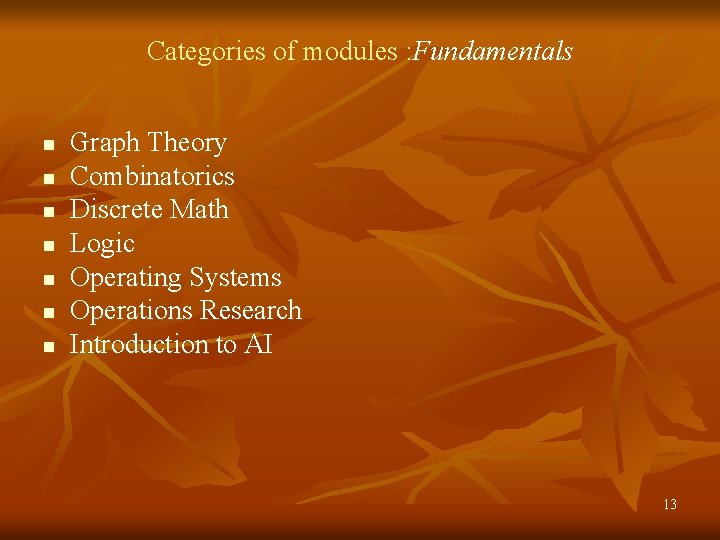
Categories of modules : Fundamentals n n n n Graph Theory Combinatorics Discrete Math Logic Operating Systems Operations Research Introduction to AI 13
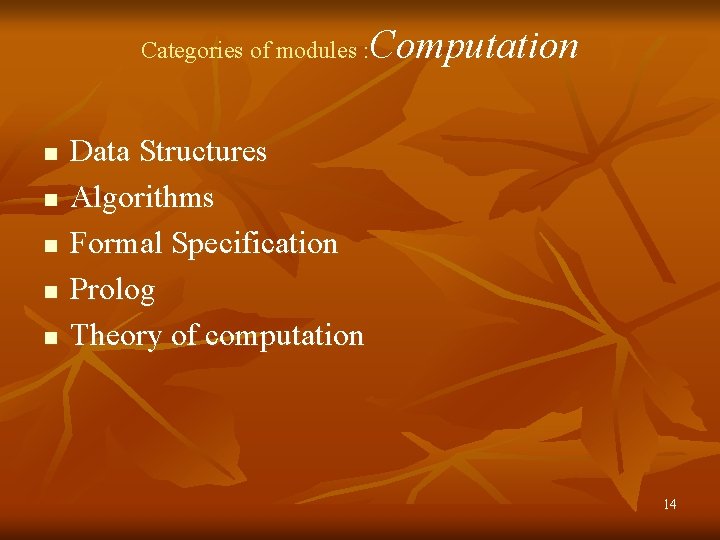
Computation Categories of modules : n n n Data Structures Algorithms Formal Specification Prolog Theory of computation 14
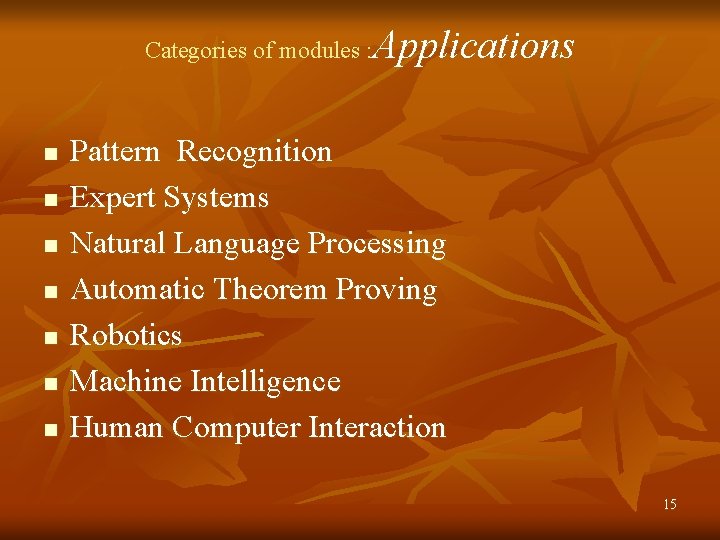
Applications Categories of modules : n n n n Pattern Recognition Expert Systems Natural Language Processing Automatic Theorem Proving Robotics Machine Intelligence Human Computer Interaction 15
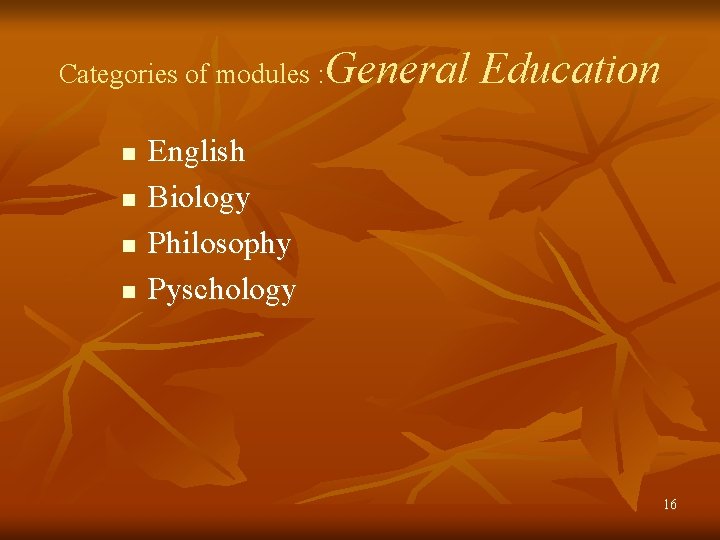
Categories of modules : General n n Education English Biology Philosophy Pyschology 16
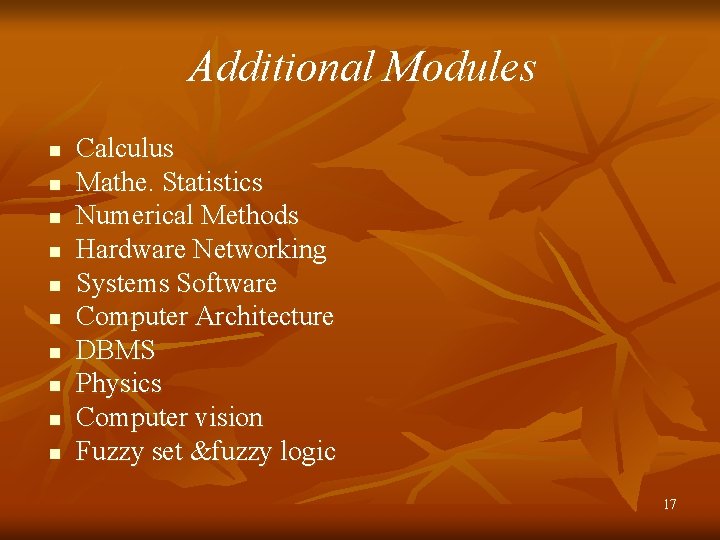
Additional Modules n n n n n Calculus Mathe. Statistics Numerical Methods Hardware Networking Systems Software Computer Architecture DBMS Physics Computer vision Fuzzy set &fuzzy logic 17
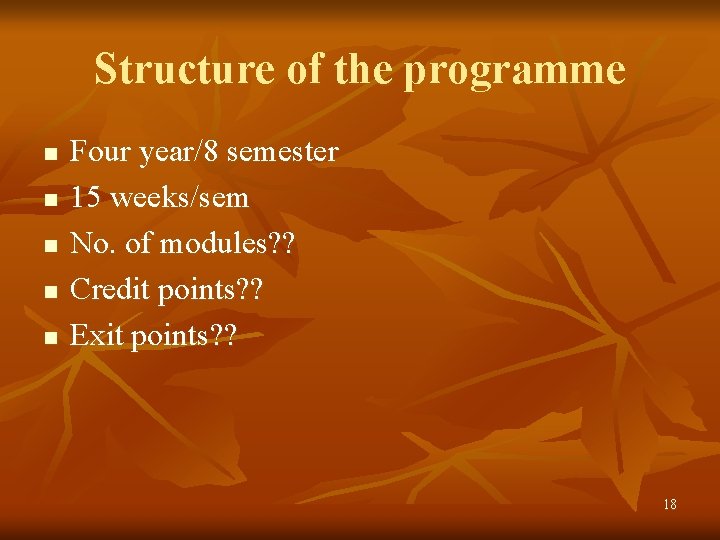
Structure of the programme n n n Four year/8 semester 15 weeks/sem No. of modules? ? Credit points? ? Exit points? ? 18
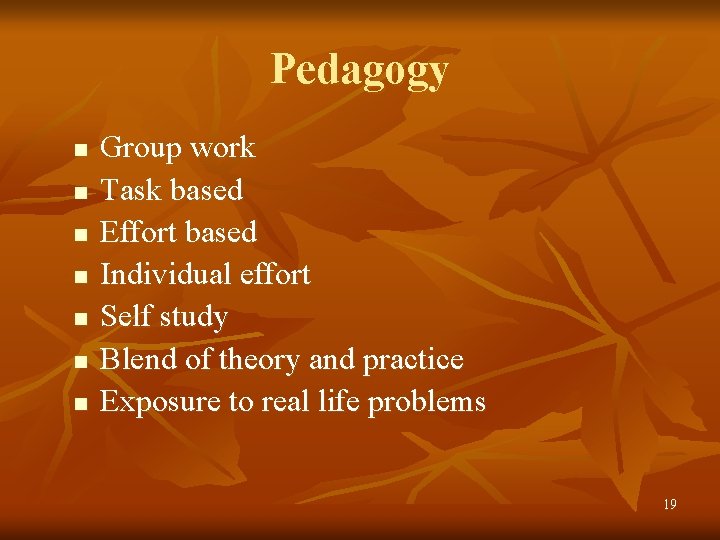
Pedagogy n n n n Group work Task based Effort based Individual effort Self study Blend of theory and practice Exposure to real life problems 19
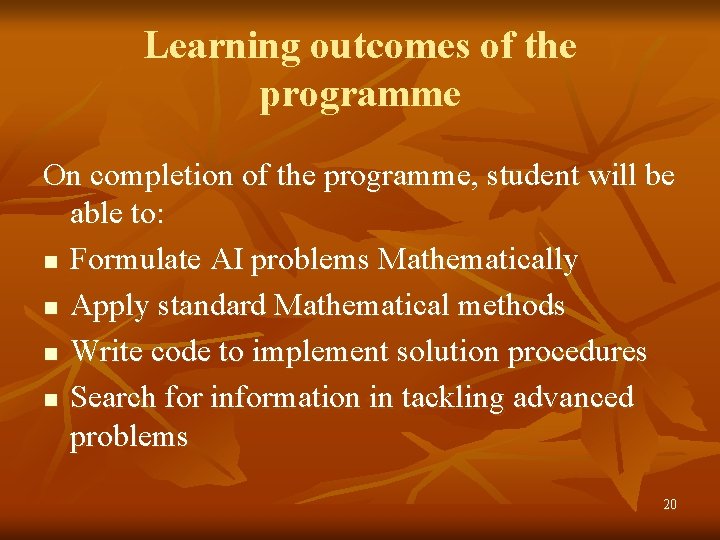
Learning outcomes of the programme On completion of the programme, student will be able to: n Formulate AI problems Mathematically n Apply standard Mathematical methods n Write code to implement solution procedures n Search for information in tackling advanced problems 20