
From Dirta to Wisdom January 27 2017 Tess

- Slides: 43
From Dirta to Wisdom January 27, 2017 Tess Settergren, MHA, MA, RN-BC Director, Nursing Informatics Cedars-Sinai Health System
Objectives Learners will be able to: • Describe the Data to Wisdom model • Discuss the “Nursing Knowledge: Big Data Science” national initiative • Analyze continual use benefits of coded EHR documentation elements
"If you cannot name it, you cannot control it, finance it, research it, teach it, or put it into public policy. “ Norma Lang, Ph. D, RN, FAAN, FRCN Classification for Nursing Practice, “ International Nursing Review, 39 no. 4, (1992): 109 -112.
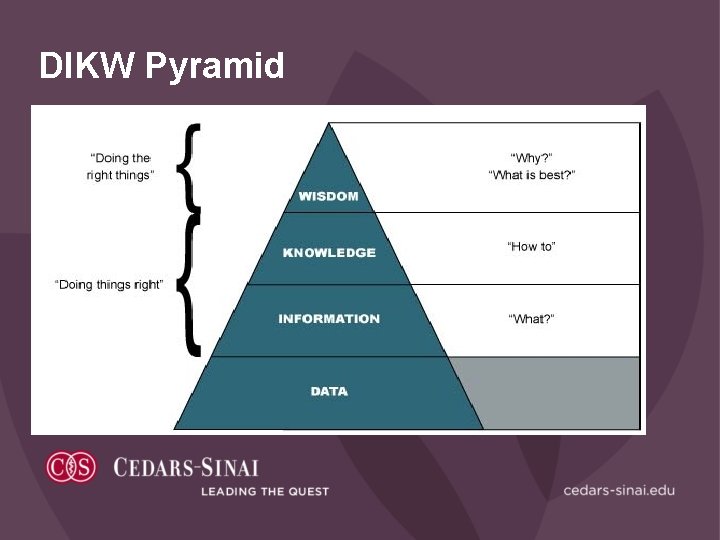
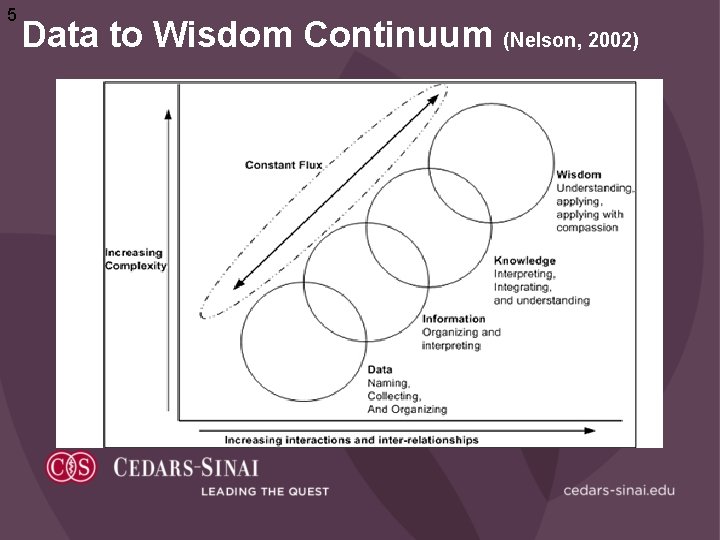
DIKW Pyramid
5 Data to Wisdom Continuum (Nelson, 2002)
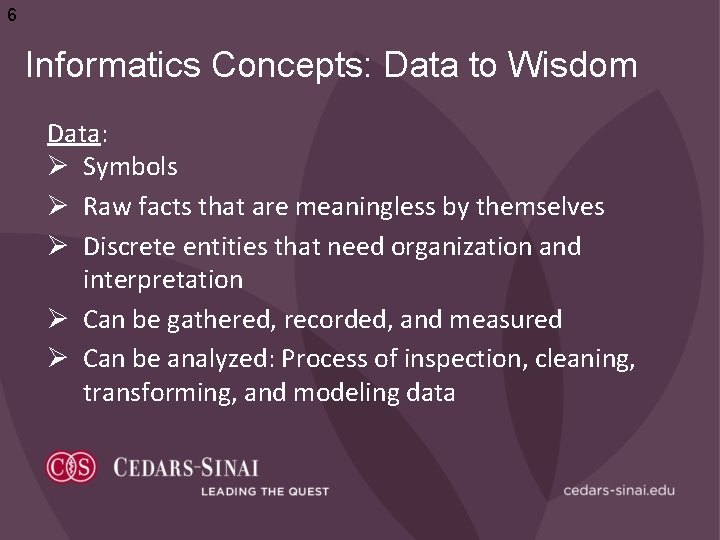
6 Informatics Concepts: Data to Wisdom Data: Ø Symbols Ø Raw facts that are meaningless by themselves Ø Discrete entities that need organization and interpretation Ø Can be gathered, recorded, and measured Ø Can be analyzed: Process of inspection, cleaning, transforming, and modeling data
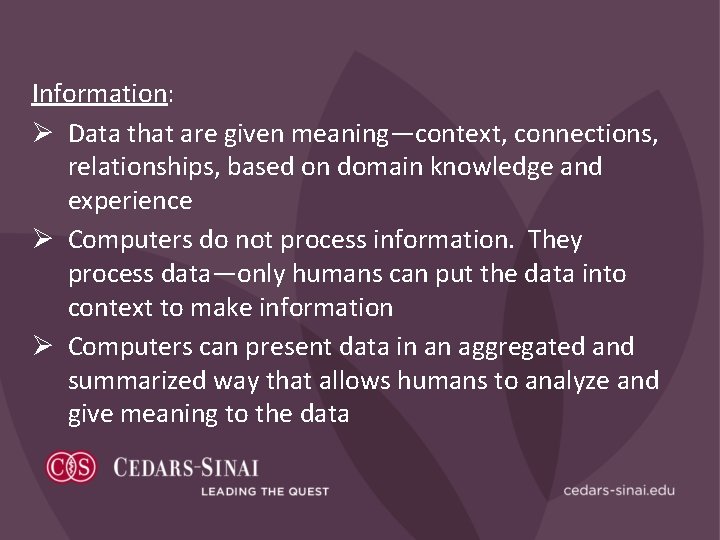
Information: Ø Data that are given meaning—context, connections, relationships, based on domain knowledge and experience Ø Computers do not process information. They process data—only humans can put the data into context to make information Ø Computers can present data in an aggregated and summarized way that allows humans to analyze and give meaning to the data
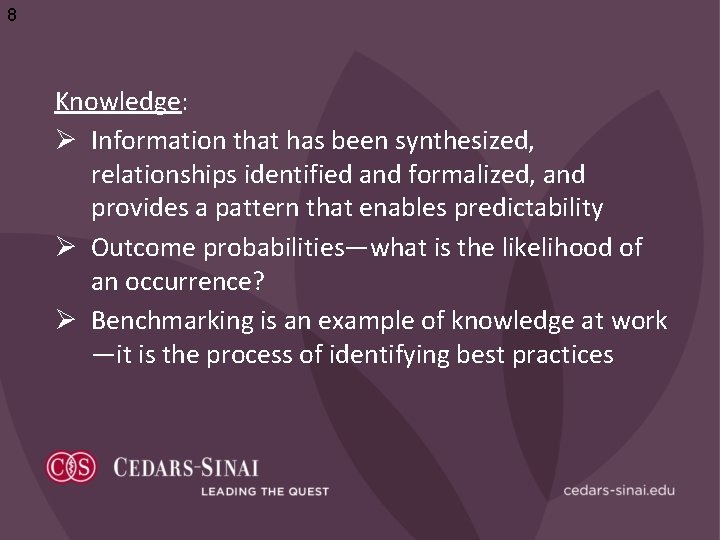
8 Knowledge: Ø Information that has been synthesized, relationships identified and formalized, and provides a pattern that enables predictability Ø Outcome probabilities—what is the likelihood of an occurrence? Ø Benchmarking is an example of knowledge at work —it is the process of identifying best practices
9 Wisdom: Ø Appropriate application of knowledge to the management and solution of human problems Ø Knowledge translated into action Ø Examples of Wisdom: § Expert Decision Support § Evidence-Based Practice Matney, Avant, Staggers. (Oct. 30, 2015). Toward an understanding of wisdom in nursing. OJIN 21 (2).
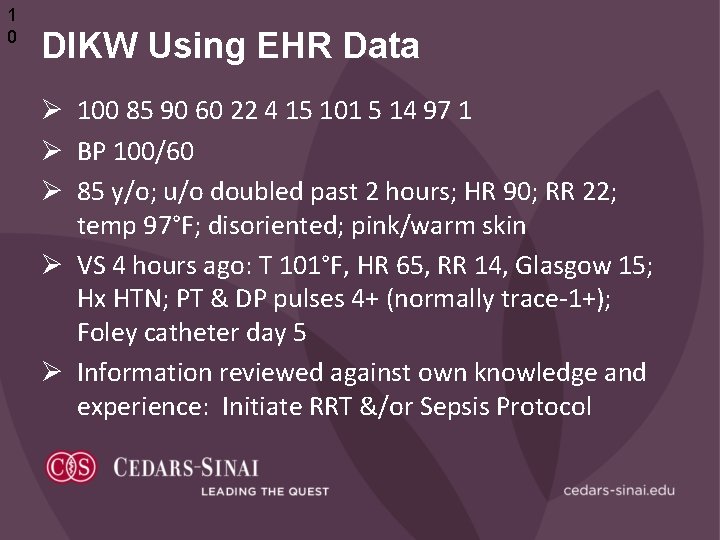
1 0 DIKW Using EHR Data Ø 100 85 90 60 22 4 15 101 5 14 97 1 Ø BP 100/60 Ø 85 y/o; u/o doubled past 2 hours; HR 90; RR 22; temp 97°F; disoriented; pink/warm skin Ø VS 4 hours ago: T 101°F, HR 65, RR 14, Glasgow 15; Hx HTN; PT & DP pulses 4+ (normally trace-1+); Foley catheter day 5 Ø Information reviewed against own knowledge and experience: Initiate RRT &/or Sepsis Protocol
Nursing Big Data Vision §Ability to share and compare nursing data across organizations. §Better quality outcomes will result from the standardization and integration of the information nurses enter in EHRs. §Leading to better health of individuals, families, communities, and populations.
National Action Plan • Conveners: Connie Delaney, Bonnie Westra • Working conferences with virtual workgroups taking action between annual meetings • All focused on the same vision • Strategic inclusion of stakeholders –Practice - leaders –Industry - software vendors, content vendors –Professional organizations • National – nursing, interprofessional, informatics –Academia – faculty, researchers *Proceedings: Available on UMN website
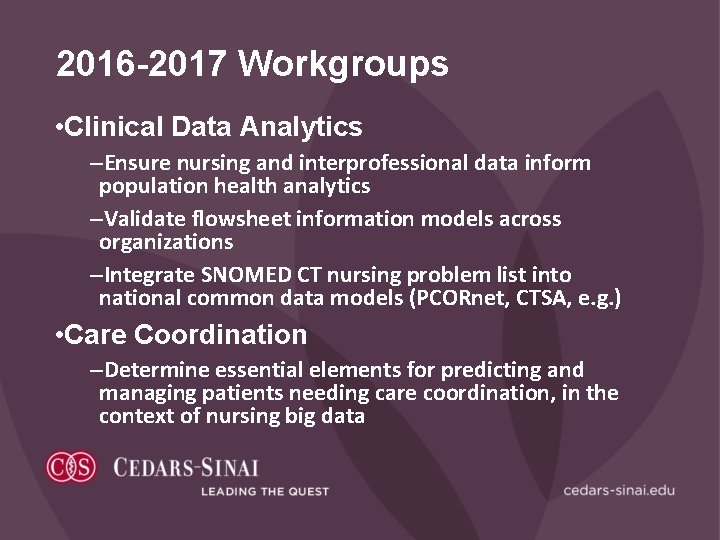
2016 -2017 Workgroups • Clinical Data Analytics –Ensure nursing and interprofessional data inform population health analytics –Validate flowsheet information models across organizations –Integrate SNOMED CT nursing problem list into national common data models (PCORnet, CTSA, e. g. ) • Care Coordination –Determine essential elements for predicting and managing patients needing care coordination, in the context of nursing big data
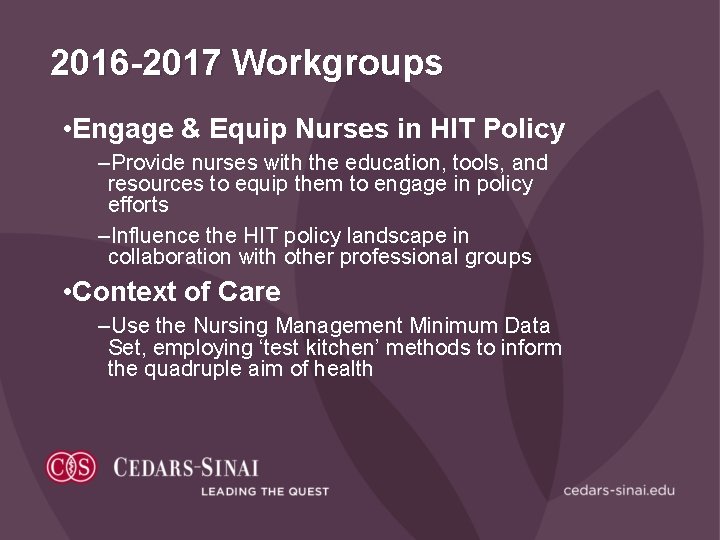
2016 -2017 Workgroups • Engage & Equip Nurses in HIT Policy –Provide nurses with the education, tools, and resources to equip them to engage in policy efforts –Influence the HIT policy landscape in collaboration with other professional groups • Context of Care –Use the Nursing Management Minimum Data Set, employing ‘test kitchen’ methods to inform the quadruple aim of health
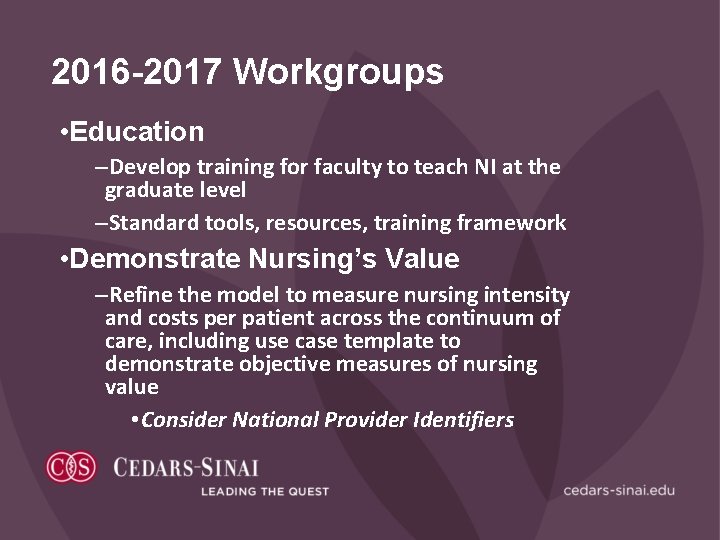
2016 -2017 Workgroups • Education –Develop training for faculty to teach NI at the graduate level –Standard tools, resources, training framework • Demonstrate Nursing’s Value –Refine the model to measure nursing intensity and costs per patient across the continuum of care, including use case template to demonstrate objective measures of nursing value • Consider National Provider Identifiers
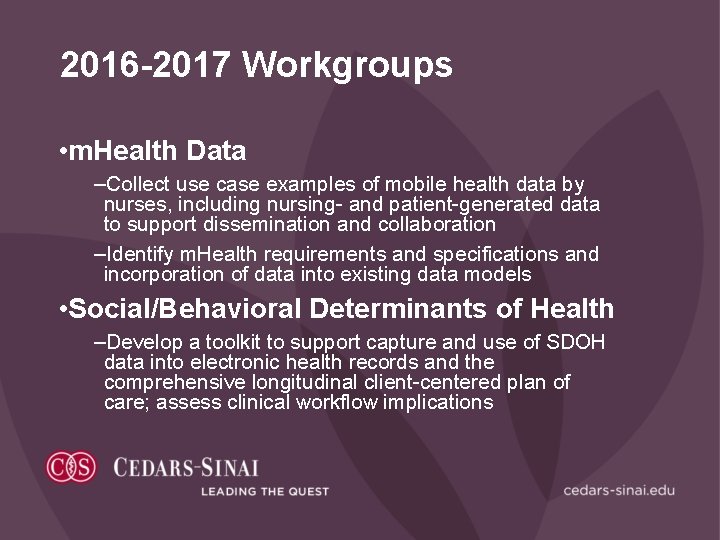
2016 -2017 Workgroups • m. Health Data –Collect use case examples of mobile health data by nurses, including nursing- and patient-generated data to support dissemination and collaboration –Identify m. Health requirements and specifications and incorporation of data into existing data models • Social/Behavioral Determinants of Health –Develop a toolkit to support capture and use of SDOH data into electronic health records and the comprehensive longitudinal client-centered plan of care; assess clinical workflow implications
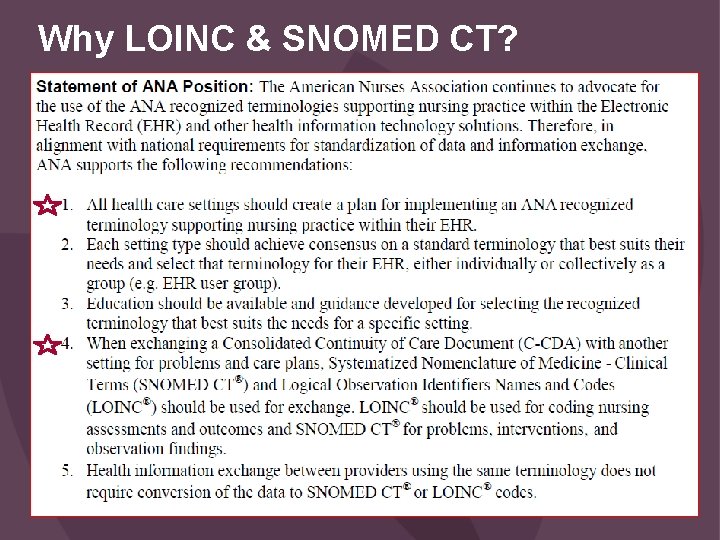
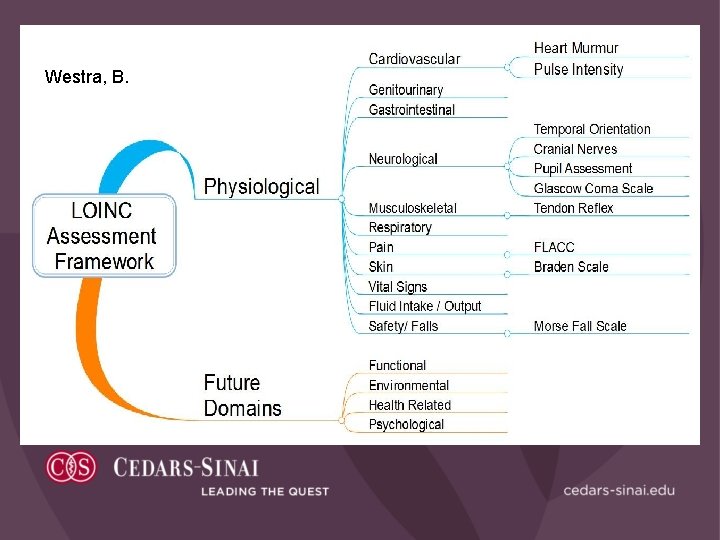
2016 -2017 Workgroups • Transform Nursing Documentation –Move from discipline-specific documentation silos toward a more useful representation of the patient story; continuum patient-centered documentation; decrease the documentation burden. –Create a repository to share workgroup products • Encode & Model Nursing Data –Implement coded nursing assessments using Logical Observation Identifiers Names and Codes (LOINC®) and SNOMED Clinical Terms® for electronic health records & develop governance for information model creation and curation
Transform Nursing Documentation §Explored the current challenges and opportunities for nursing documentation in EHR §Examined best practice exemplars of nursing documentation supported by clinical decision support producing positive outcomes §Formed subgroup to explore feasibility of creating a repository/ web resource for nursing documentation best practices, evidence based content and decision support exemplars to support knowledge sharing • Defined and explored Precision Nursing: Highly reliable, evidence based and personalized nursing practice that supports quality outcomes. Ann O’Brien, Kaiser-Permanente
Transform Nursing Documentation • Data silos create disconnects in care due to lack of views into each discipline’s contribution and insights. • Nursing documentation is primarily data entry without linkages to real time knowledge • It is challenging to access the right information at the right time within the nurse’s workflow and personalize care to each patient. • Clinical decision support relies on accurate and timely documentation but nurses may not always have the tools or Ann O’Brien, Kaiser-Permanente perceive the value.
Moving from Data to Knowledge • Goal: “By 2020, 90% of clinical decisions will be supported by accurate, timely, and up-to-date information and will reflect the best evidence available. ” (IOM 2015) • Creating a road map: –Simplify and speed documentation. (AMIA EHR 2020 Taskforce May 2015 JAMIA) –Ensure nursing data is accurate, complete and timely. –Promote biomedical device integration for decreasing duplicate documentation & non-value added tasks. –Create, standardize and share best practices, nurse-initiated protocols and clinical decision support tools. –Maximize clinical decision support to link data entry to evidence based, personalized care. –Develop real time dashboards and reminders to support nursing workflow and data visualization. Ann O’Brien, Kaiser-Permanente
Precision Nursing** Patient centered, highly reliable, evidence based and personalized nursing practice across the continuum of care that supports: • Quality outcomes • Safety • Decreased costs **Nursing Knowledge Big Data Science University of Minnesota Sponsor • Efficiency Transforming Nursing Documentation Workgroup 2016. • Nurse satisfaction Ann O’Brien, Kaiser-Permanente
Valuing Nursing & Nursing Data Pam Cipriano, President of the ANA • 2016 is the year of Patient Safety • 1 out of every 100 people in the US is a nurse • Nurses are the primary coordinators of care • Reinvent the plan of care so it is patient-centered, interoperable, longitudinal and meaningful. • Rediscover the patient’s story • Move away from episodic care and data
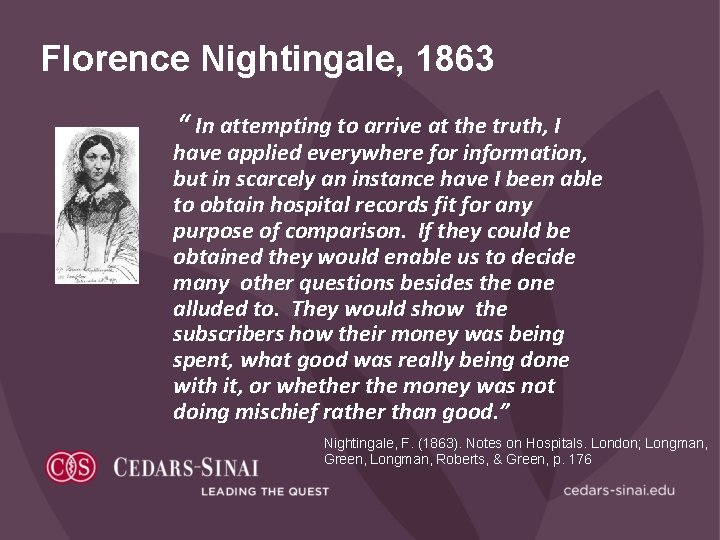
Florence Nightingale, 1863 “ In attempting to arrive at the truth, I have applied everywhere for information, but in scarcely an instance have I been able to obtain hospital records fit for any purpose of comparison. If they could be obtained they would enable us to decide many other questions besides the one alluded to. They would show the subscribers how their money was being spent, what good was really being done with it, or whether the money was not doing mischief rather than good. ” Nightingale, F. (1863). Notes on Hospitals. London; Longman, Green, Longman, Roberts, & Green, p. 176
Standardized Data Benefits v Measure the contributions of nursing, within the interprofessional team context v Support ‘Value of Nursing’ measurement v Enable e. CQMs v Enhance care coordination across the continuum (nursing data in CCD) v Enable cross-institutional nursing-sensitive outcomes studies and quality improvement initiatives
Semantic Interoperability The Office of the National Coordinator for HIT uses IEEE definition: “…the ability of systems to exchange and use electronic health information from other systems without special effort on the part of the user. ”
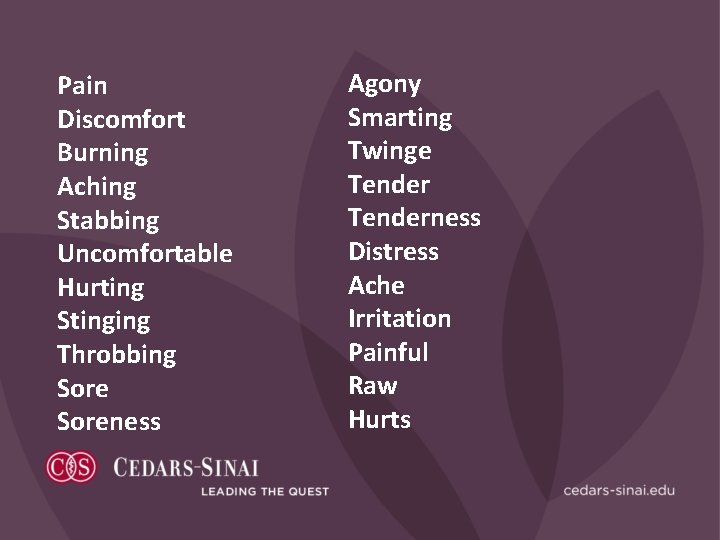
Pain Discomfort Burning Aching Stabbing Uncomfortable Hurting Stinging Throbbing Soreness Agony Smarting Twinge Tenderness Distress Ache Irritation Painful Raw Hurts
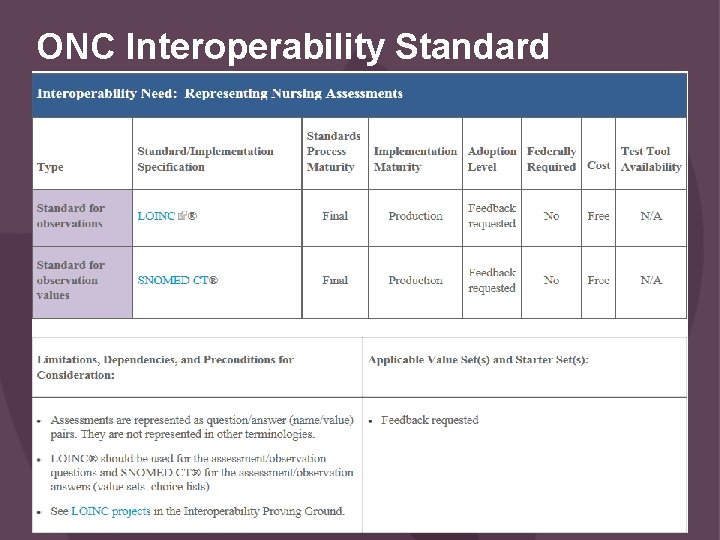
Encoding Workgroup Objectives: v Create a framework for organizing assessment data in Logical Observations, Identifiers, Names & Codes (LOINC) v Map observations (the ‘questions’) to LOINC v Map values (the ‘answers’) to SNOMED Clinical Terms (SNOMED CT) v Determine the LOINC coverage for frequently documented assessment observations & submit new concepts as needed v Determine SNOMED CT coverage for the frequently documented assessment values & submit new concepts as needed
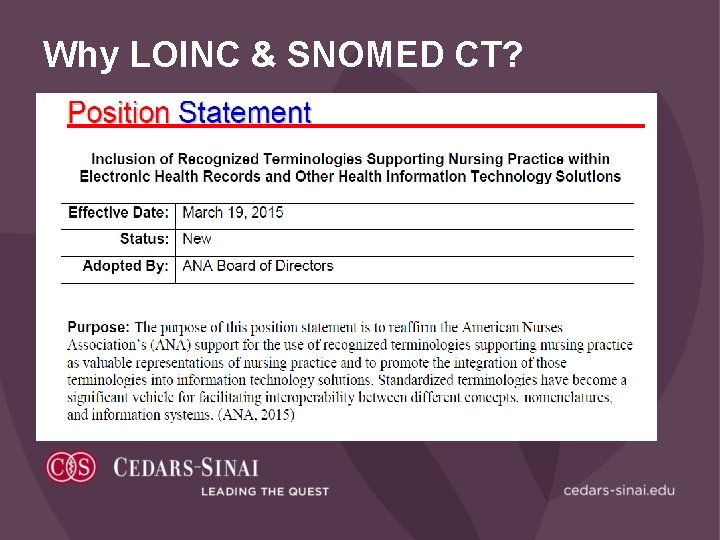
Why LOINC & SNOMED CT?
Why LOINC & SNOMED CT?
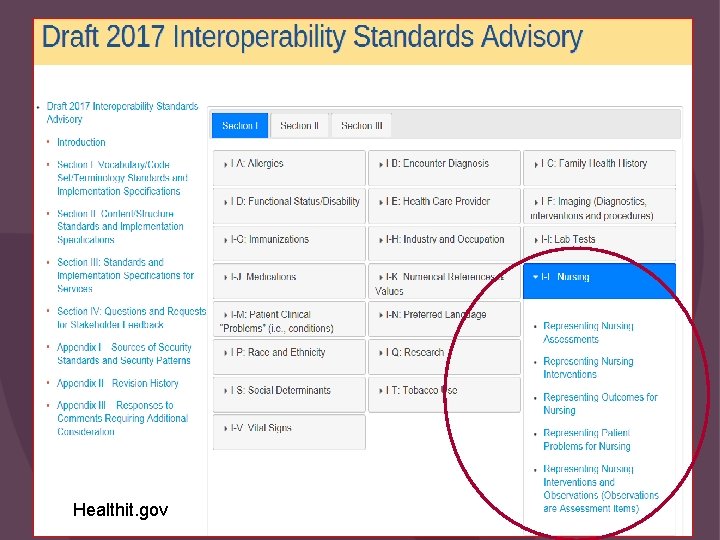
Healthit. gov
ONC Interoperability Standard
Westra, B.
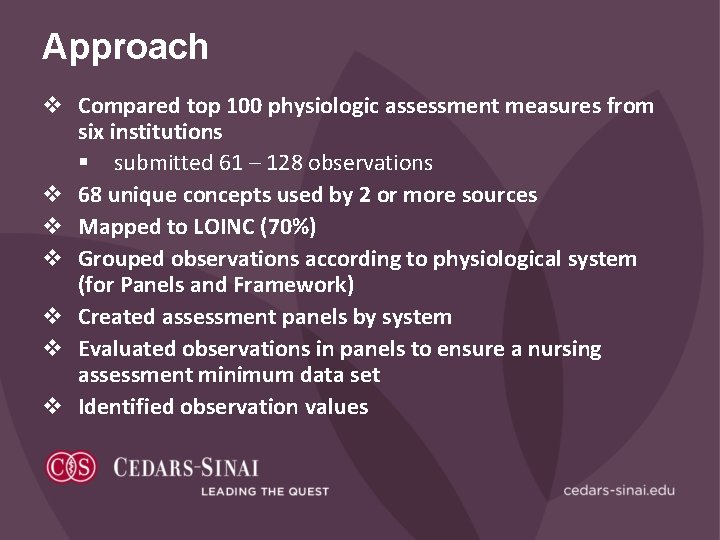
Approach v Compared top 100 physiologic assessment measures from six institutions § submitted 61 – 128 observations v 68 unique concepts used by 2 or more sources v Mapped to LOINC (70%) v Grouped observations according to physiological system (for Panels and Framework) v Created assessment panels by system v Evaluated observations in panels to ensure a nursing assessment minimum data set v Identified observation values
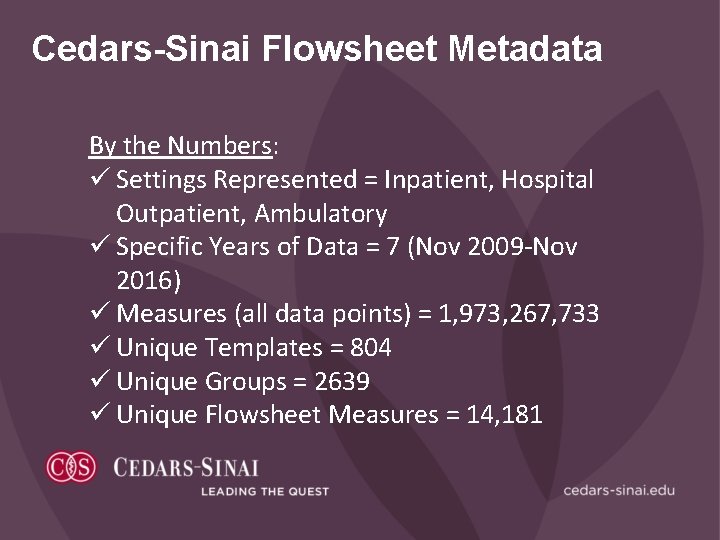
Cedars-Sinai Flowsheet Metadata By the Numbers: ü Settings Represented = Inpatient, Hospital Outpatient, Ambulatory ü Specific Years of Data = 7 (Nov 2009 -Nov 2016) ü Measures (all data points) = 1, 973, 267, 733 ü Unique Templates = 804 ü Unique Groups = 2639 ü Unique Flowsheet Measures = 14, 181
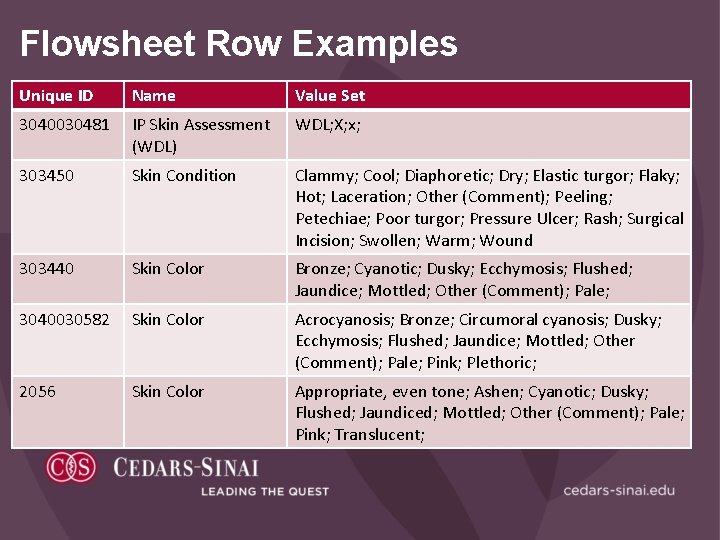
Flowsheet Row Examples Unique ID Name Value Set 3040030481 IP Skin Assessment (WDL) WDL; X; x; 303450 Skin Condition Clammy; Cool; Diaphoretic; Dry; Elastic turgor; Flaky; Hot; Laceration; Other (Comment); Peeling; Petechiae; Poor turgor; Pressure Ulcer; Rash; Surgical Incision; Swollen; Warm; Wound 303440 Skin Color Bronze; Cyanotic; Dusky; Ecchymosis; Flushed; Jaundice; Mottled; Other (Comment); Pale; 3040030582 Skin Color Acrocyanosis; Bronze; Circumoral cyanosis; Dusky; Ecchymosis; Flushed; Jaundice; Mottled; Other (Comment); Pale; Pink; Plethoric; 2056 Skin Color Appropriate, even tone; Ashen; Cyanotic; Dusky; Flushed; Jaundiced; Mottled; Other (Comment); Pale; Pink; Translucent;
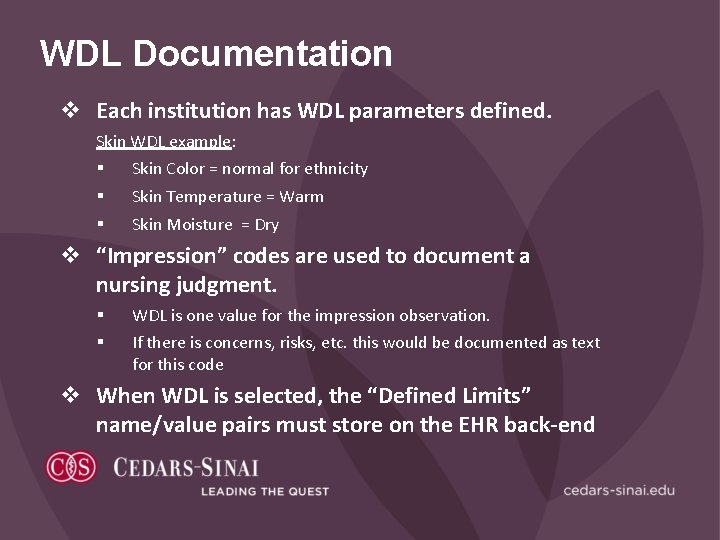
WDL Documentation v Each institution has WDL parameters defined. Skin WDL example: § § § Skin Color = normal for ethnicity Skin Temperature = Warm Skin Moisture = Dry v “Impression” codes are used to document a nursing judgment. § § WDL is one value for the impression observation. If there is concerns, risks, etc. this would be documented as text for this code v When WDL is selected, the “Defined Limits” name/value pairs must store on the EHR back-end
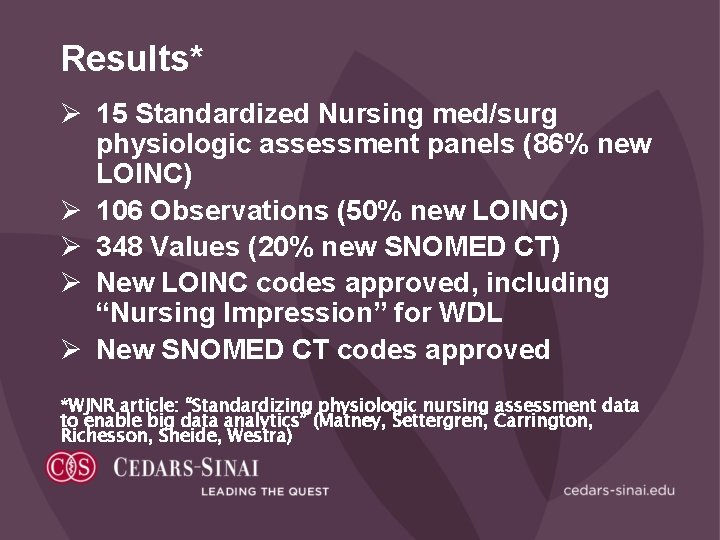
Results* Ø 15 Standardized Nursing med/surg physiologic assessment panels (86% new LOINC) Ø 106 Observations (50% new LOINC) Ø 348 Values (20% new SNOMED CT) Ø New LOINC codes approved, including “Nursing Impression” for WDL Ø New SNOMED CT codes approved *WJNR article: “Standardizing physiologic nursing assessment data to enable big data analytics” (Matney, Settergren, Carrington, Richesson, Sheide, Westra)
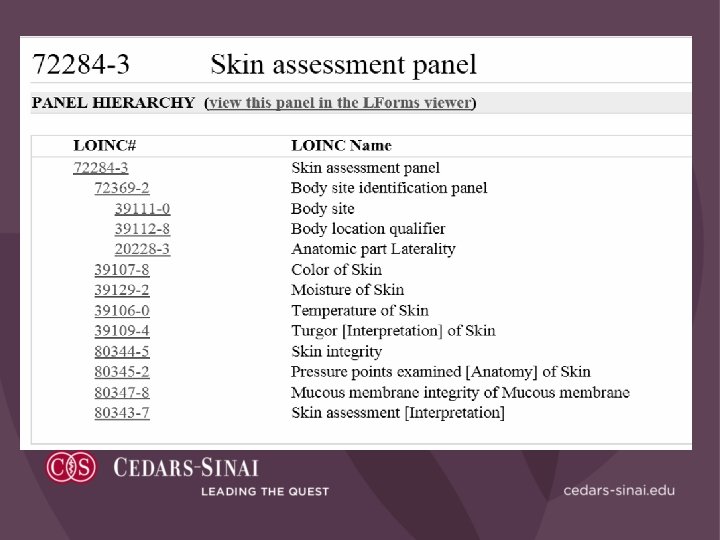
LOINC Panels (search. loinc. org)
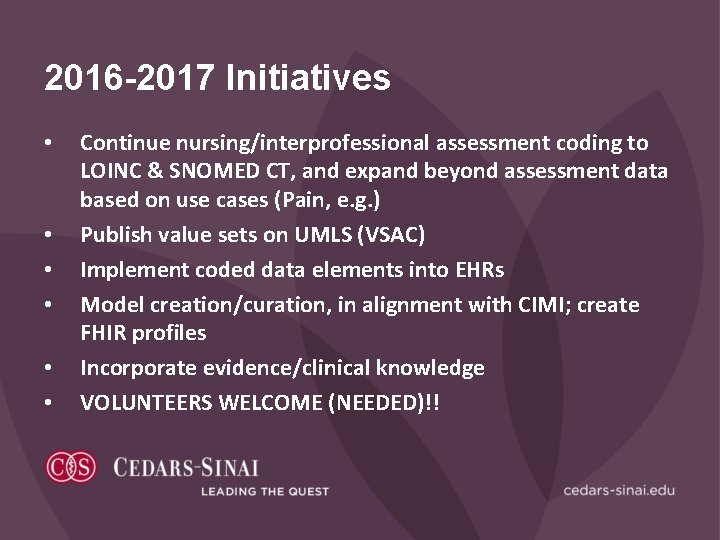
2016 -2017 Initiatives • • • Continue nursing/interprofessional assessment coding to LOINC & SNOMED CT, and expand beyond assessment data based on use cases (Pain, e. g. ) Publish value sets on UMLS (VSAC) Implement coded data elements into EHRs Model creation/curation, in alignment with CIMI; create FHIR profiles Incorporate evidence/clinical knowledge VOLUNTEERS WELCOME (NEEDED)!!
Thank you! Tess. Settergren@cshs. org
Selected References http: //www. nursing. umn. edu/centers/centernursing-informatics/events/2016 -nursingknowledge-big-data-science-conference http: //www. snomed. org/ http: //www. loinc. org/ (or search. loinc. org) https: //www. nlm. nih. gov/research/umls/quickstart. html https: //www. nlm. nih. gov/research/umls/Snomed/ nursing_problemlist_subset. html https: //www. healthit. gov/standards-advisory/draft -2017 http: //www. open. edu/openlearn/bodymind/health-sciences/the-joy-stats-thelady-data-visualisation