
From data to intelligence Strategic decision making through






- Slides: 20
From data to intelligence Strategic decision making through information system Prof. Amos DAVID (TOKI 2016) 1
Research questions • How can intelligence be derived from data/information? • What type of information system for enhancing strategic decision making? 2
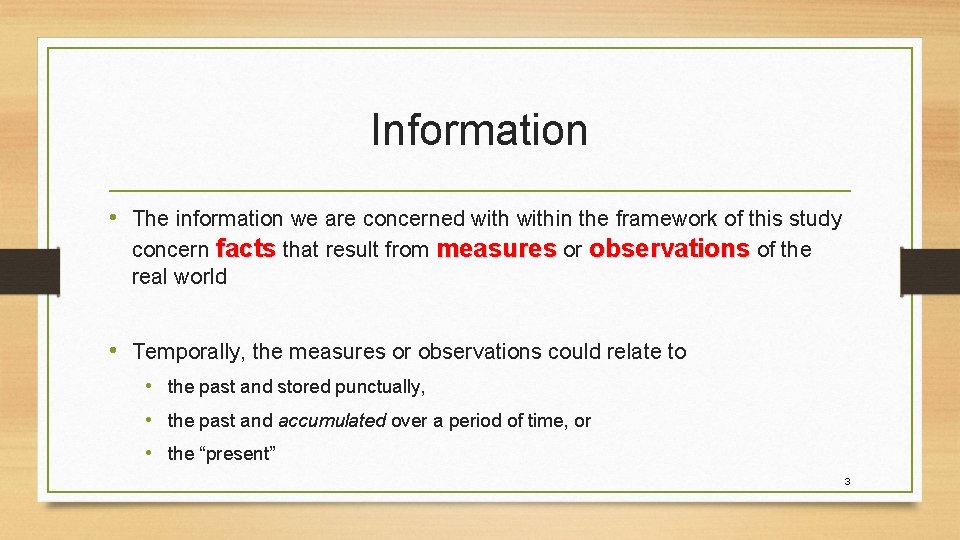
Information • The information we are concerned within the framework of this study concern facts that result from measures or observations of the real world • Temporally, the measures or observations could relate to • the past and stored punctually, • the past and accumulated over a period of time, or • the “present” 3
Concepts involved • Philosophy • Predictive analytics • Strategic decisions in management 4
From retrospective analysis to prospection • “Officials do not want to confront their own history, especially the history in the making of which they feel uncomfortable but, if you do not confront your past, you are going to mess up your future. ” • I’m pro-Biafra –Soyinka : http: //sunnewsonline. com/im-pro-biafrasoyinka/, 15/07/2016 5
• (Paulhac 2007), “It seems that the knowledge of history can therefore actually guide the understanding of the present and guide future action. Not as exact science, as shown by the shortcomings of forecasting and the historical analogy, but as empirical rich meaning and teachings” 6
Intelligence • Intelligence in a way or the other rely on the process of observation (comprehending our surroundings) and ensuring that the observation is transformed into knowledge ("catching on, " "making sense of things”, or "figuring out what to do”)” (TOKI 2014) 7
Deriving intelligence from accumulated information (experience or observations) • Use information system that will rely on the concept of data warehouse and observatory 8
Decision process • For the decision-maker, two main phases can be distinguished: • problem finding: determine the problem he considers to be confronted; • problem solving: responding to the problem previously formulated. 9
Comparison decision processes Rational method Decision making (2016) Competitive intelligence 1. 2. 3. 4. 5. 6. 7. 8. 9. 1. Identification of needs in the form of problems to solve or stakes (threat, risk, danger), 2. Identification of the types of result, 3. Identification of the types of necessary information to obtain the result, 4. Identification of the relevant information sources, 5. Validation of the information sources, 6. Collection of information, 7. Validation of the information collected, 8. Processing of the information collected for the calculation of indicators, 9. Interpretation of the indicators, 10. Decision making for the resolution of the identified problem 6. 7. 8. 9. Recognizing the need for a decision Diagnose the problem to set a goal Identify any alternatives Collect information Adapting a method of weighting the criteria Assign the criteria coefficients Assign grades for each option considered Choose an option Implement the decision and its follow-up Identify a problem or opportunity Gather information Analyze the situation Develop options Evaluate alternatives Select a preferred alternative Act on the decision 10
Architecture of an extended information system 11
Decision problem Information ressources B A Selection C Decision-maker E Matching (cognitive approach) • Observation • Elementary abstraction • Symbolization and reasoning • Creativity Results Information Base D Matching (Technical approach) • Exploration/navigation • Query • Cross-analysis with constraints • Annotation Analysis Value-added information (indicators) F Interpretation Decision G Information visualization 12
The concept of observatory and dashboard • Summarily, an observatory system is composed of sensors for collecting data. The data is fed into the observatory system after necessary transformation or restructuring. • An observatory system provides various modes of information visualization. These modes of visualization are grouped into dashboards. Generally, the dashboard is composed of one or more screens, each subdivided into two or more zones. 13
Illustration of a dashboards • Nigeria State Populations and Area with controller • Illustration using ISKO Membership Management system 14
Dynamic filters in tables 15
Technical components of the system • The use of a Content Management System called Drupal 16
php. My. Admin Db-drupal Database server File server Ext. Db 1 Ext. Dbn cdm-drupal Int. cdm Web server Mail server Site components Drupal components Node (Content) Content type Modules Theme Libraries Basic page Article … … Block Menu View
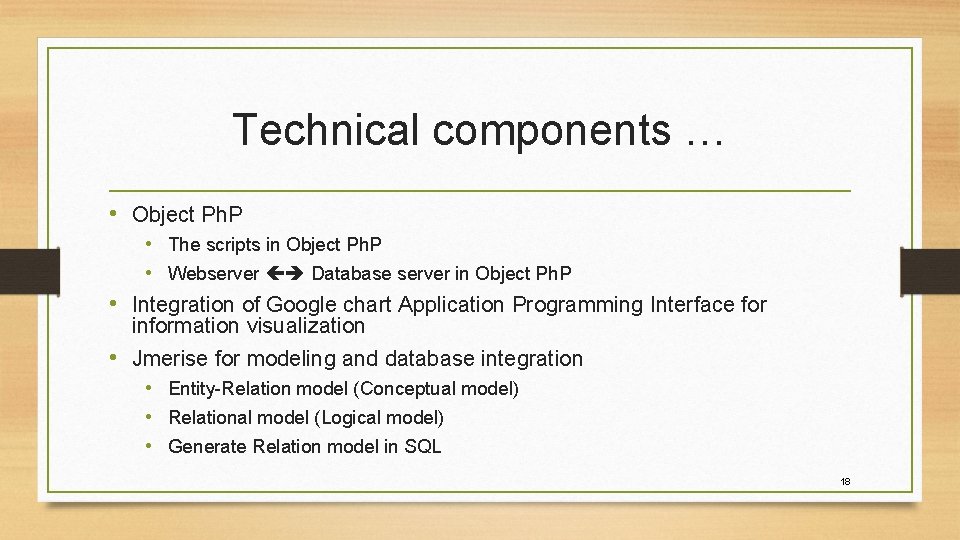
Technical components … • Object Ph. P • The scripts in Object Ph. P • Webserver Database server in Object Ph. P • Integration of Google chart Application Programming Interface for information visualization • Jmerise for modeling and database integration • Entity-Relation model (Conceptual model) • Relational model (Logical model) • Generate Relation model in SQL 18
Conclusion • The most important aspect of this approach is not the system alone but more importantly the first step in rational decision making, which is the identification and the specification of the decision problem. • The proposal is currently in use by more than 600 members of ISKO. 19
Thanks for your attention 20