
From data to information to knowledge l Data
- Slides: 24
From data to information to knowledge l Data that’s organized can be processed Ø Ø l Purpose of map in Markov assignment? Ø Ø l Is this a requirement? What does “organized” means Properties of keys? Comparable v. Hashable Tree. Set v. Hash. Set Ø Ø Speed v. order Memory considerations Compsci 100, Fall 2009 7. 1
Foundations for Hash- and Tree-Set l Typically linked lists used to implement hash tables Ø Ø Ø l List of frames for film: clip and insert without shifting Nodes that link to each other, not contiguous in memory Self-referential, indirect references, confusing? Why use linked lists? Ø Ø Ø Insert and remove without shifting, add element in constant time, e. g. , O(1) add to back • Contrast to Array. List which can double in size Master pointers and indirection Leads to trees and graphs: structure data into information Compsci 100, Fall 2009 7. 2
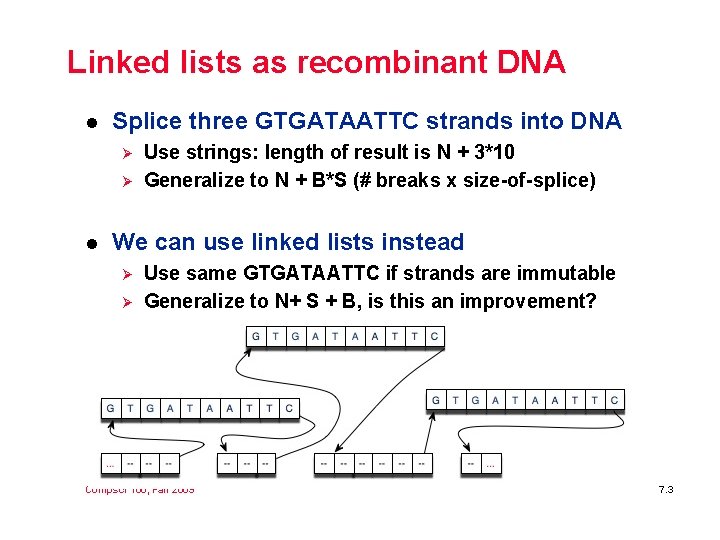
Linked lists as recombinant DNA l Splice three GTGATAATTC strands into DNA Ø Ø l Use strings: length of result is N + 3*10 Generalize to N + B*S (# breaks x size-of-splice) We can use linked lists instead Ø Ø Use same GTGATAATTC if strands are immutable Generalize to N+ S + B, is this an improvement? Compsci 100, Fall 2009 7. 3
Getting in front l Suppose we want to add a new element Ø Ø Ø l Suppose this is an important problem: we want to grow at the front (and perhaps at the back) Ø Ø l At the back of a string or an Array. List or a … At the front of a string or an Array. List or a … Is there a difference? Why? What's complexity? Think editing film clips and film splicing Think DNA and gene splicing Self-referential data structures to the rescue Ø References, reference problems, recursion, binky Compsci 100, Fall 2009 7. 4
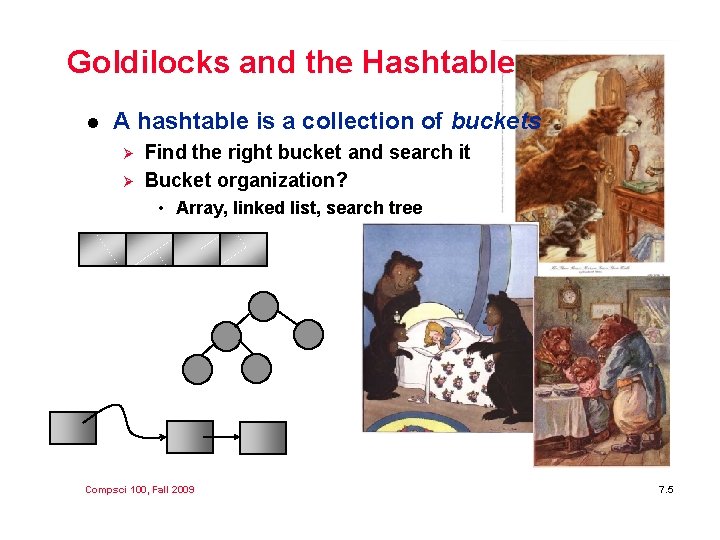
Goldilocks and the Hashtable l A hashtable is a collection of buckets Ø Ø Find the right bucket and search it Bucket organization? • Array, linked list, search tree Compsci 100, Fall 2009 7. 5
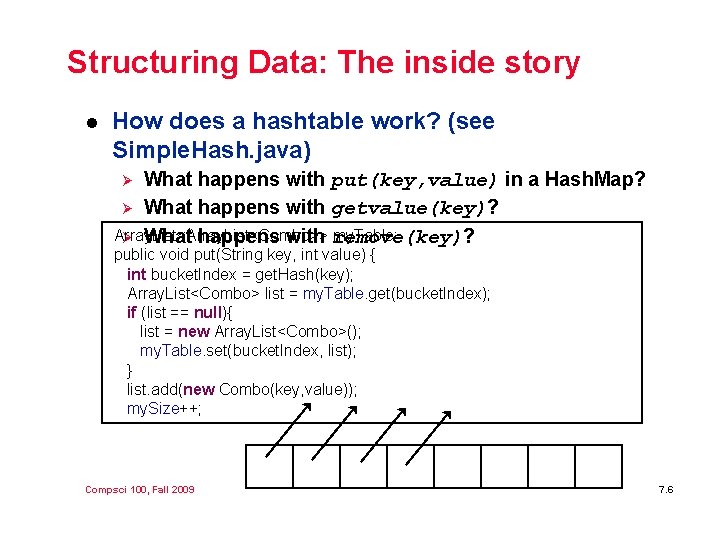
Structuring Data: The inside story l How does a hashtable work? (see Simple. Hash. java) What happens with put(key, value) in a Hash. Map? Ø What happens with getvalue(key)? Array. List<Combo>> my. Table; Ø What happens with remove(key)? Ø public void put(String key, int value) { int bucket. Index = get. Hash(key); Array. List<Combo> list = my. Table. get(bucket. Index); if (list == null){ list = new Array. List<Combo>(); my. Table. set(bucket. Index, list); } list. add(new Combo(key, value)); my. Size++; Compsci 100, Fall 2009 7. 6
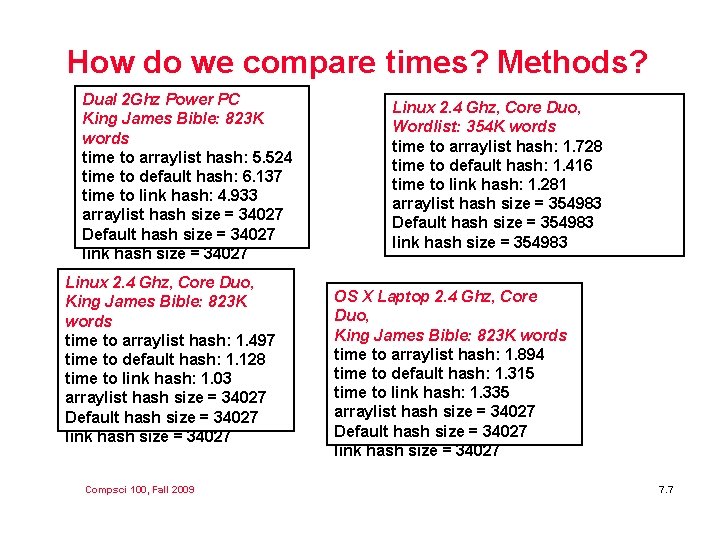
How do we compare times? Methods? Dual 2 Ghz Power PC King James Bible: 823 K words time to arraylist hash: 5. 524 time to default hash: 6. 137 time to link hash: 4. 933 arraylist hash size = 34027 Default hash size = 34027 link hash size = 34027 Linux 2. 4 Ghz, Core Duo, King James Bible: 823 K words time to arraylist hash: 1. 497 time to default hash: 1. 128 time to link hash: 1. 03 arraylist hash size = 34027 Default hash size = 34027 link hash size = 34027 Compsci 100, Fall 2009 Linux 2. 4 Ghz, Core Duo, Wordlist: 354 K words time to arraylist hash: 1. 728 time to default hash: 1. 416 time to link hash: 1. 281 arraylist hash size = 354983 Default hash size = 354983 link hash size = 354983 OS X Laptop 2. 4 Ghz, Core Duo, King James Bible: 823 K words time to arraylist hash: 1. 894 time to default hash: 1. 315 time to link hash: 1. 335 arraylist hash size = 34027 Default hash size = 34027 link hash size = 34027 7. 7
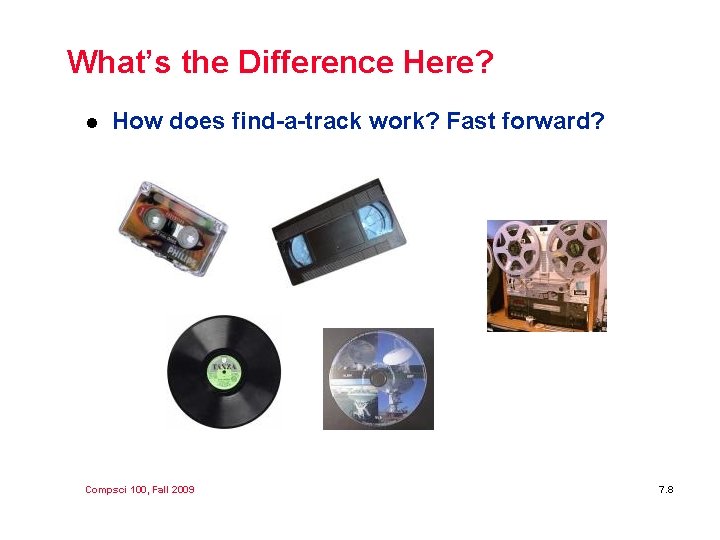
What’s the Difference Here? l How does find-a-track work? Fast forward? Compsci 100, Fall 2009 7. 8
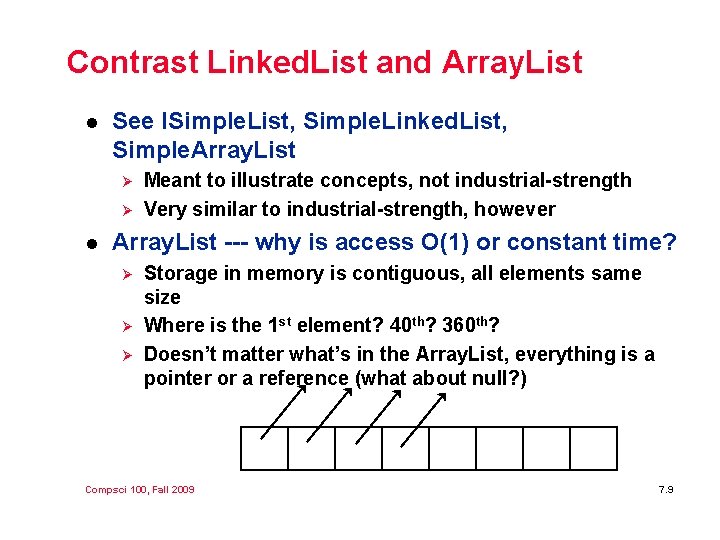
Contrast Linked. List and Array. List l See ISimple. List, Simple. Linked. List, Simple. Array. List Ø Ø l Meant to illustrate concepts, not industrial-strength Very similar to industrial-strength, however Array. List --- why is access O(1) or constant time? Ø Ø Ø Storage in memory is contiguous, all elements same size Where is the 1 st element? 40 th? 360 th? Doesn’t matter what’s in the Array. List, everything is a pointer or a reference (what about null? ) Compsci 100, Fall 2009 7. 9
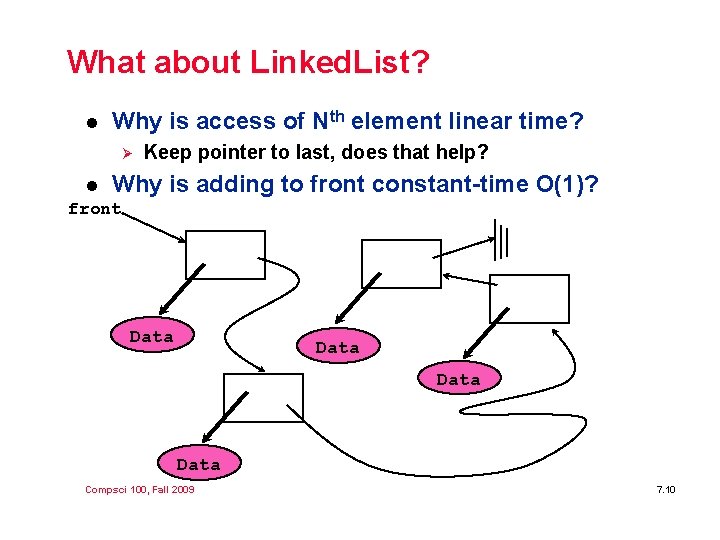
What about Linked. List? l Why is access of Nth element linear time? Ø Keep pointer to last, does that help? l Why front is adding to front constant-time O(1)? Data Compsci 100, Fall 2009 7. 10
Array. Lists and linked lists as ADTs l As an ADT (abstract data type) Array. Lists support Ø Constant-time or O(1) access to the k-th element Ø Amortized linear or O(n) storage/time with add • Total storage used in n-element vector is approx. 2 n, spread over all accesses/additions (why? ) Ø Adding a new value in the middle of an Array. List is expensive, linear or O(n) because shifting required l Linked lists as ADT Ø Constant-time or O(1) insertion/deletion anywhere, but… Ø Linear or O(n) time to find where, sequential search l Good for sparse structures: when data are scarce, allocate exactly as many list elements as needed, no wasted space/copying (e. g. , what happens when vector grows? ) Compsci 100, Fall 2009 7. 11
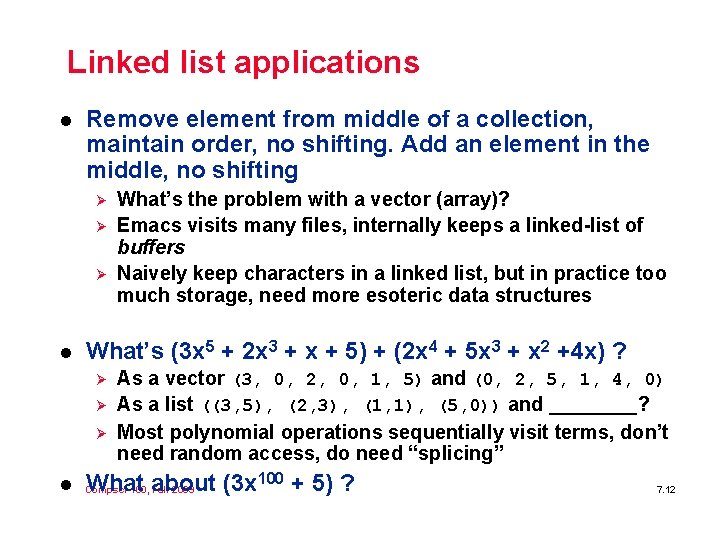
Linked list applications l Remove element from middle of a collection, maintain order, no shifting. Add an element in the middle, no shifting Ø Ø Ø l What’s (3 x 5 + 2 x 3 + x + 5) + (2 x 4 + 5 x 3 + x 2 +4 x) ? Ø Ø Ø l What’s the problem with a vector (array)? Emacs visits many files, internally keeps a linked-list of buffers Naively keep characters in a linked list, but in practice too much storage, need more esoteric data structures As a vector (3, 0, 2, 0, 1, 5) and (0, 2, 5, 1, 4, 0) As a list ((3, 5), (2, 3), (1, 1), (5, 0)) and ____? Most polynomial operations sequentially visit terms, don’t need random access, do need “splicing” What about (3 x 100 + 5) ? Compsci 100, Fall 2009 7. 12
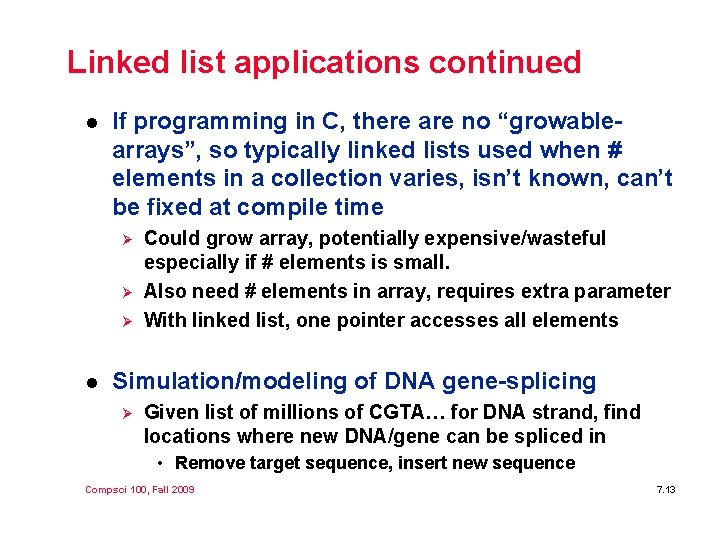
Linked list applications continued l If programming in C, there are no “growablearrays”, so typically linked lists used when # elements in a collection varies, isn’t known, can’t be fixed at compile time Ø Ø Ø l Could grow array, potentially expensive/wasteful especially if # elements is small. Also need # elements in array, requires extra parameter With linked list, one pointer accesses all elements Simulation/modeling of DNA gene-splicing Ø Given list of millions of CGTA… for DNA strand, find locations where new DNA/gene can be spliced in • Remove target sequence, insert new sequence Compsci 100, Fall 2009 7. 13
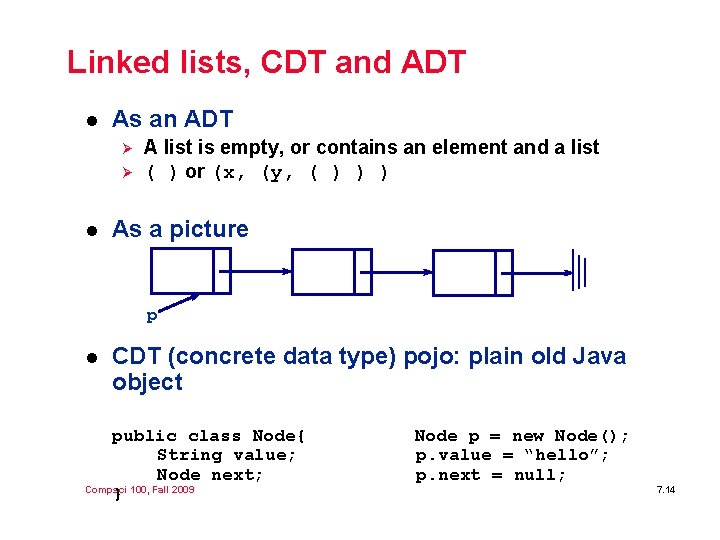
Linked lists, CDT and ADT l As an ADT Ø Ø l A list is empty, or contains an element and a list ( ) or (x, (y, ( ) ) ) As a picture p l CDT (concrete data type) pojo: plain old Java object public class Node{ String value; Node next; Compsci 100, Fall 2009 } Node p = new Node(); p. value = “hello”; p. next = null; 7. 14
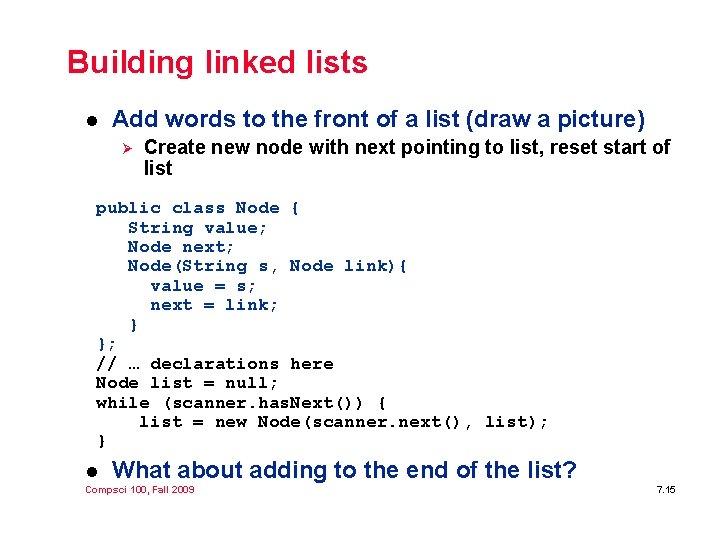
Building linked lists l Add words to the front of a list (draw a picture) Ø Create new node with next pointing to list, reset start of list public class Node { String value; Node next; Node(String s, Node link){ value = s; next = link; } }; // … declarations here Node list = null; while (scanner. has. Next()) { list = new Node(scanner. next(), list); } l What about adding to the end of the list? Compsci 100, Fall 2009 7. 15
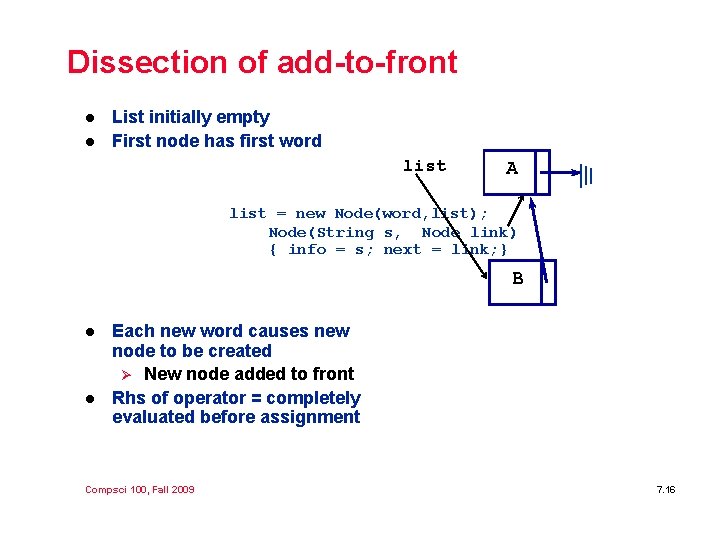
Dissection of add-to-front l l List initially empty First node has first word list A list = new Node(word, list); Node(String s, Node link) { info = s; next = link; } B l l Each new word causes new node to be created Ø New node added to front Rhs of operator = completely evaluated before assignment Compsci 100, Fall 2009 7. 16
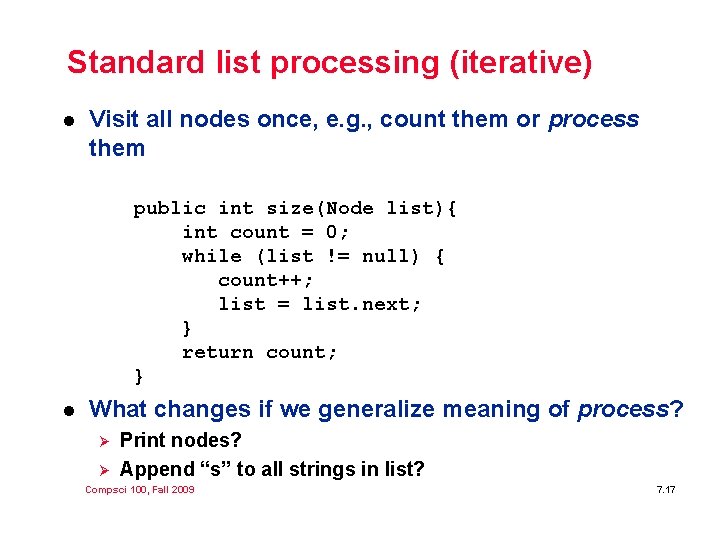
Standard list processing (iterative) l Visit all nodes once, e. g. , count them or process them public int size(Node list){ int count = 0; while (list != null) { count++; list = list. next; } return count; } l What changes if we generalize meaning of process? Ø Ø Print nodes? Append “s” to all strings in list? Compsci 100, Fall 2009 7. 17
Nancy Leveson: Software Safety Founded the field l Mathematical and engineering aspects Ø Air traffic control Ø Microsoft word "C++ is not state-of-the-art, it's only state-of-the-practice, which in recent years has been going backwards" l. Software and steam engines: once extremely dangerous? lhttp: //sunnyday. mit. edu/steam. pdf l. THERAC 25: Radiation machine that killed many people lhttp: //sunnyday. mit. edu/papers/therac. pdf Compsci 100, Fall 2009 7. 18
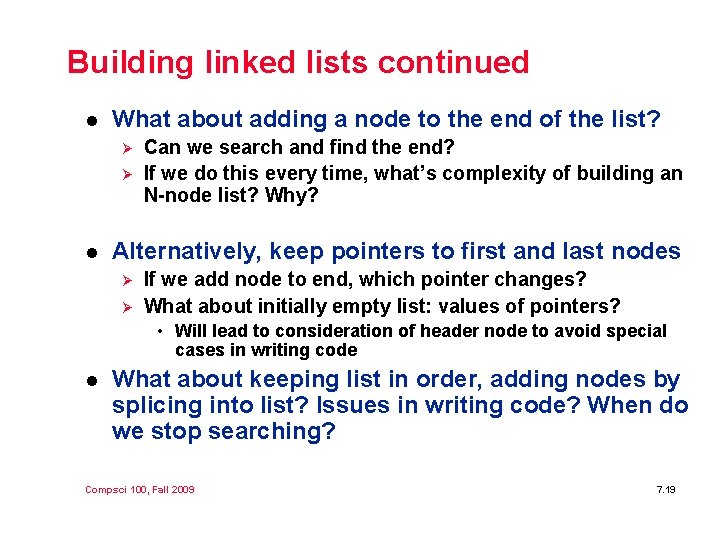
Building linked lists continued l What about adding a node to the end of the list? Ø Ø l Can we search and find the end? If we do this every time, what’s complexity of building an N-node list? Why? Alternatively, keep pointers to first and last nodes Ø Ø If we add node to end, which pointer changes? What about initially empty list: values of pointers? • Will lead to consideration of header node to avoid special cases in writing code l What about keeping list in order, adding nodes by splicing into list? Issues in writing code? When do we stop searching? Compsci 100, Fall 2009 7. 19
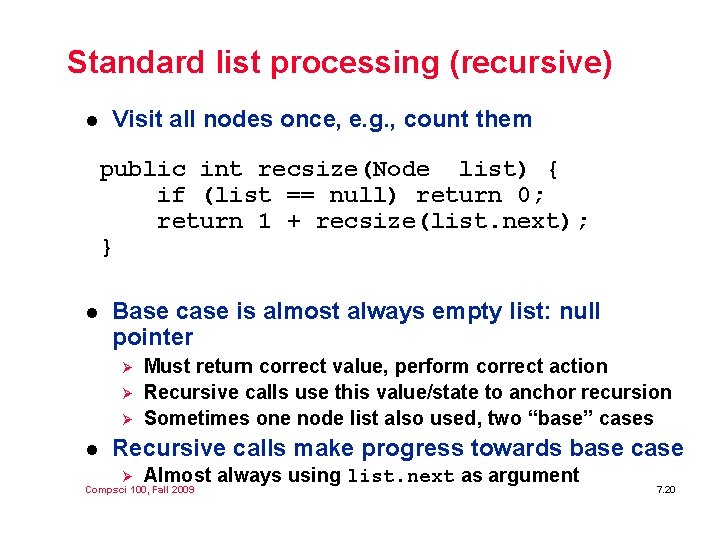
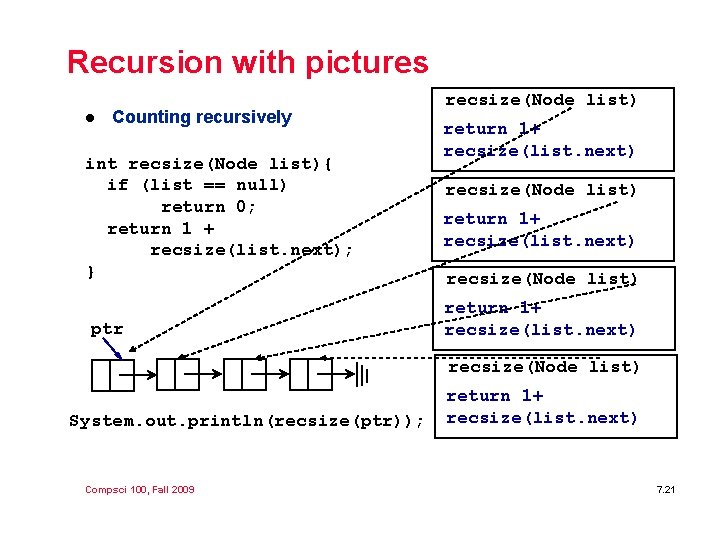
Standard list processing (recursive) l Visit all nodes once, e. g. , count them public int recsize(Node list) { if (list == null) return 0; return 1 + recsize(list. next); } l Base case is almost always empty list: null pointer Ø Ø Ø l Must return correct value, perform correct action Recursive calls use this value/state to anchor recursion Sometimes one node list also used, two “base” cases Recursive calls make progress towards base case Ø Almost always using list. next as argument Compsci 100, Fall 2009 7. 20
Recursion with pictures l Counting recursively int recsize(Node list){ if (list == null) return 0; return 1 + recsize(list. next); } ptr recsize(Node list) return 1+ recsize(list. next) recsize(Node list) System. out. println(recsize(ptr)); Compsci 100, Fall 2009 return 1+ recsize(list. next) 7. 21
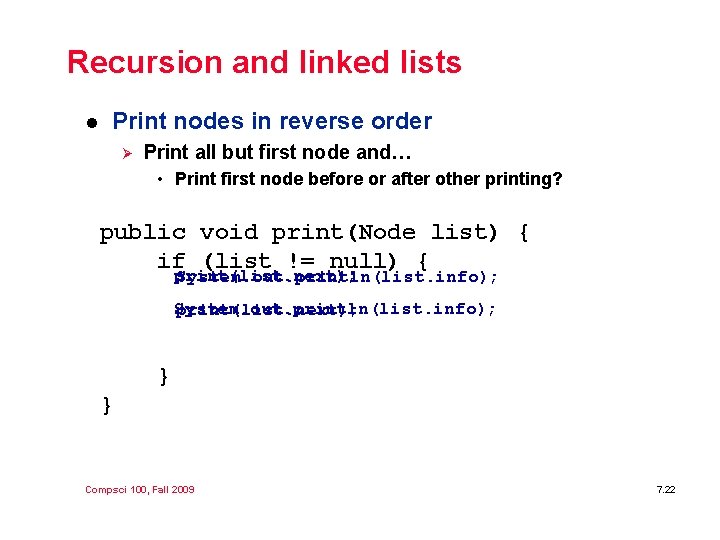
Recursion and linked lists l Print nodes in reverse order Ø Print all but first node and… • Print first node before or after other printing? public void print(Node list) { if (list != null) { print(list. next); System. out. println(list. info); print(list. next); } } Compsci 100, Fall 2009 7. 22
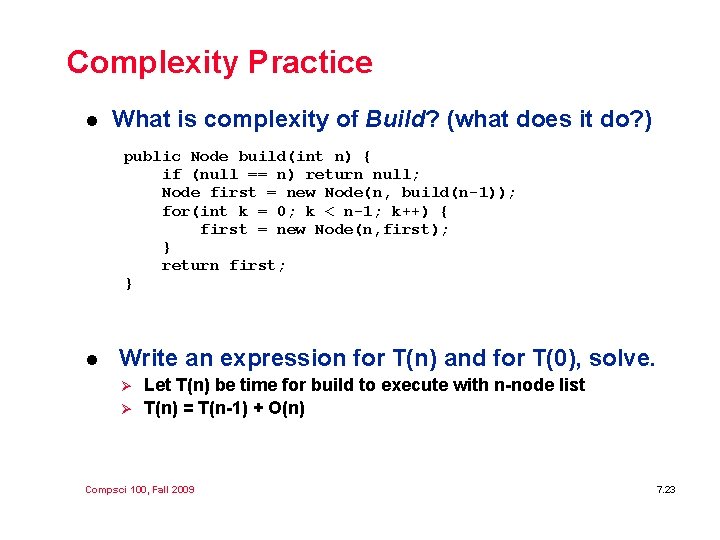
Complexity Practice l What is complexity of Build? (what does it do? ) public Node build(int n) { if (null == n) return null; Node first = new Node(n, build(n-1)); for(int k = 0; k < n-1; k++) { first = new Node(n, first); } return first; } l Write an expression for T(n) and for T(0), solve. Ø Ø Let T(n) be time for build to execute with n-node list T(n) = T(n-1) + O(n) Compsci 100, Fall 2009 7. 23
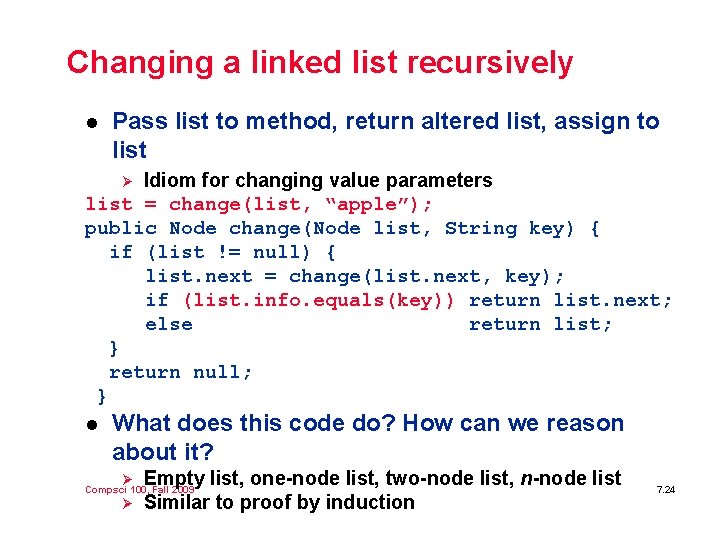
Changing a linked list recursively l Pass list to method, return altered list, assign to list Idiom for changing value parameters list = change(list, “apple”); public Node change(Node list, String key) { if (list != null) { list. next = change(list. next, key); if (list. info. equals(key)) return list. next; else return list; } return null; } Ø l What does this code do? How can we reason about it? Ø Empty list, one-node list, two-node list, n-node list Similar to proof by induction Compsci 100, Fall 2009 Ø 7. 24