
From Cookbook to Guidebook Remaking Traditional Biology Labs
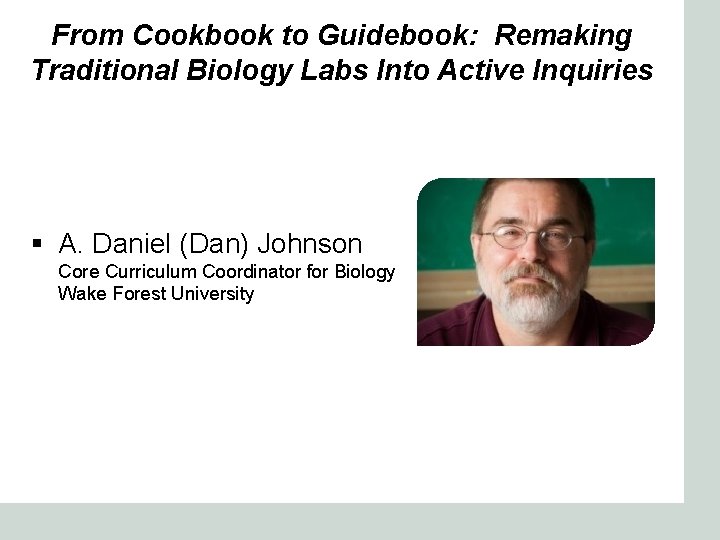
From Cookbook to Guidebook: Remaking Traditional Biology Labs Into Active Inquiries § A. Daniel (Dan) Johnson Core Curriculum Coordinator for Biology Wake Forest University

A. Daniel (Dan) Johnson Bio Dan has been the Core Curriculum Coordinator for biology since 1998 at Wake Forest University, where he holds the rank of teaching associate professor. While trained as a cardiovascular cell biologist, Johnson’s interests span the breadth of biology. He has spent nearly two decades designing, developing, and publishing inquiry-oriented biology laboratories and other active-learning instructional materials. In 2008, the National Science Teachers Association published his guide to inquiry instructional development for faculty, 40 Inquiry Exercises For the Biology Laboratory. In 2010 the College Board used this book as a guide for developing the new Advanced Placement biology curriculum. Johnson is a senior editor (and a regular contributor) for Tested Studies for Laboratory Teaching, an international open-access journal published by the Association for Biology Laboratory Education. Johnson with, a group of educators, students, developers, and others who create open-access resources that help more students learn science successfully, published Bio. Book in 2011. Their second project, Teaching Genetics with Dogs, was launched in 2012, and uses our familiar pets to teach genetics principles and engage students more deeply.
Webinar Funded by the U. S. Department of Labor This product was funded by a grant awarded by the U. S. Department of Labor’s Employment and Training Administration. The product was created by the grantee and does not necessarily reflect the official position of the U. S. Department of Labor. The Department of Labor makes no guarantees, warranties, or assurances of any kind, express or implied, with respect to such information, including any information on linked sites and including, but not limited to, accuracy of the information or its completeness, timeliness, usefulness, adequacy, continued availability or ownership.

From Cookbook to Guidebook: Turning Traditional Biology Labs into Active Inquiries A. Daniel (Dan) Johnson Assoc. Teaching Professor, Biology Co-Founder, The Adapa Project 2/6/2014
Overview § § § Setting the stage Old vs. new “Diffusion…” lab General design strategy Q&A Tips & tricks, common problems Icons* Take-home points General strategy Tools, tricks & tips *http: //commons. wikimedia. org/wiki/Crystal_Clear
Slides, Notes, Annotations § Slides available on CHEO wiki § Revised slides (Q&A follow-up, updated notes) to follow § Steps to modify for online-only format marked ‘N’
Setting the Stage § What are main lab design barriers? – Right mindset – Good, durable ideas – Hard design decisions
Setting the Stage § How do I get into the “inquiry mindset”?
Setting the Stage: Mindset § Remember main goal of inquiry Students should spend most of their time on: – Autonomous exploration – Authentic activities
Setting the Stage: Mindset Inquiry has different§ Outcome goals – Development process differs § Assessment process – More frequent, open-ended § Class structure, flow ’N’ – Messy, loud, less predictable § Management strategy ’N’ – Instructors must adapt in situ
Setting the Stage: Mindset § Picture a mentored research lab experience § What skills would you expect students to develop? § How would students get those skills? § How would students report their findings?
Setting the Stage: Mindset § Think coaching, not content delivery How will this lab… – Create positive challenges? – Identify weaknesses, & correct them? – Provide practice opportunities?
Setting the Stage § Where do I find good lab ideas?
Setting the Stage: Ideas § Look broadly for inspiration – Hardware, craft, pet, hobby stores – Science news feeds – Be a “catalog hoarder” – Maker websites, magazines – Citizen science programs – Consumer product claims – Ask students for ideas
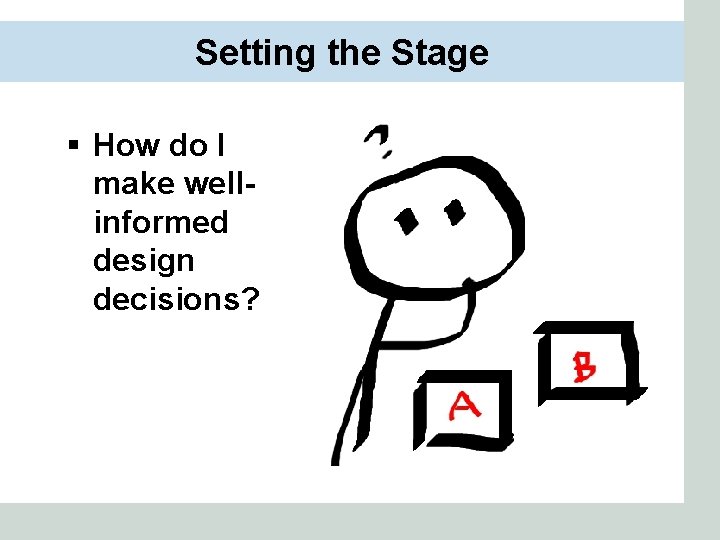
Setting the Stage § How do I make wellinformed design decisions?
Setting the Stage: Design Look for why current lab does not work § Think carefully whether to refine, renovate, or restart § Do not be afraid to start over – Good ideas are not always durable
Setting the Stage: Design § Refine – Start with existing inquiry lab (+ and – )
Setting the Stage: Design § Refine – Start with existing inquiry lab (+ and – ) § Renovate cookbook lab – Uses existing equipment, exercises (+) – Restricts design, backsliding risk ( – )
Setting the Stage: Design § Refine – Start with existing inquiry lab (+ and – ) § Renovate cookbook lab – Uses existing equipment, exercises (+) – Restricts design, backsliding risk ( – ) § Restart – Fewer design restrictions (+) – Longer planning, development ( – ) “ 50% rule”

Diffusion Through a Membrane: Original Version 1. Fill dialysis tubing “cell” with glucose, starch, or combined sol’n 2. Float in Lugol’s starch indicator 3. After 20+ minutes record: • Water inside “cell” is black (starch “+”) • Water outside “cell” is “+” w/glucose indicator solution 4. Report results (worksheet, lab rept. )

Problems With Original Lab 1. Dialysis tubing • Unfamiliar, less engaging • Cannot vary properties 2. Assays show diffusion indirectly; do not directly observe (Iodine sol’n – hazardous) 3. Students report known outcomes
Problems With Original Lab 4. Reinforces misconception that exercise = experiment 5. Where do students: • Experience “positive challenge”? • Exercise critical thinking? • Make their own decisions? • Discover “personally novel” knowledge?
One Possible Revision Strategy New lab has 5 stages: § Initial assessment § Open exploration phase § Initial group reporting § Guided inquiry phase § Final group reporting
Diffusion 2. 0: Initial Assessment Instructor’s Lead-In Questions ’N’ § What do you know about diffusion? (Assessing prior knowledge) § How do you know it? (Expect evidence) § Is ____ an example of diffusion? (Example vs. counter-example)
Diffusion 2. 0: Open Exploration Phase Student Directions Your 1 st challenge– § Create a novel visual demo of diffusion § Use any materials here in lab. ’N’ – Give materials list – Hold back the optional hints § You have until ___ to finish, report
Optional Hints to Guide Students § § § What will be diffusing substance? What will carry diffusing molecules? What will absorb color for observations? What can mimic membrane? What containers will you use? What will you need to quantify, and how will you do it?
Diffusion 2. 0: Available Materials § What are colored diffusible materials? – Offer both soluble, particulate colorants – Particulate: pigment based paint, some wood stains (see label) – Soluble: food coloring, pond dye, cherry soda, red wine, strong coffee
Diffusion 2. 0: Available Materials § What will carry, absorb color? – Liquids: water, vegetable or mineral oil – Solids: marshmallows, balsa wood, styrofoam, banana or other fruit cubes
Diffusion 2. 0: Available Materials § What can mimic cell membrane? – Latex vs. nitrile gloves – Saran wrap vs. plastic sandwich bag – Newspaper in 1 -10 layers – Brown vs. white paper towels, coffee filters – Porous plastic membrane (for wrapping vegetables) – House wrap
Available Materials Diffusion 2. 0: Available Materials § What containers are available? – Canning/jelly jars with lids, rings – Beakers, flasks (hard plastic is best) – Styrofoam or plastic cups
Available Materials Diffusion 2. 0: Available Materials § How to quantify color differences? – Paint sample or art color charts – Rulers – Serially diluted stock sol’ns § Miscellaneous std supplies – Rubber bands, parafilm – Strong string, dental floss – Duct, masking, clear tape

Diffusion: Initial Group Report Diffusion 2. 0: Initial Group Report § Use a general question template ’N’ – What did you do? – Why did you do it? – What did you see? – What does it mean? (Ex. : “how does it show diffusion? ”) § Add 1 -2 specific qus. directed at central question – “Based on the demos & data, is rate of diffusion constant? ”
Diffusion: Guided Inquiry Phase Diffusion 2. 0: Guided Inquiry Phase § Options A & B: – Background: rate of diffusion depends on factors like - • Area available • Concentration gradient • Properties of diffusing material • Distance • Temperature
Diffusion: Guided Inquiry Phase Diffusion 2. 0: Guided Inquiry Phase § Options A & B (cont. ): – Second challenge is to determine: • Option A (basic): how one factor affects rate of diffusion. • Option B (intermediate): which factor most affects diffusion. – You have until ____ to report to class
Diffusion: Guided Inquiry Phase Diffusion 2. 0: Guided Inquiry Phase § Option C (advanced): – Rate of diffusion determined by several factors. – Your second challenge is to determine which factors control how fast diffusion occurs – Work with others in lab to solve challenge ’N’ – You have until ____ to report what you discovered
Diffusion: Final Group Reporting Diffusion 2. 0: Final Group Reporting § Repeat general question template: – What did you do? – Why did you do it? – What did you see? – What does it mean? (Ex. : “how does it show diffusion? ) § Add 1 -2 specific qus. about: – Alternate explanations – Links to other lab units, topics
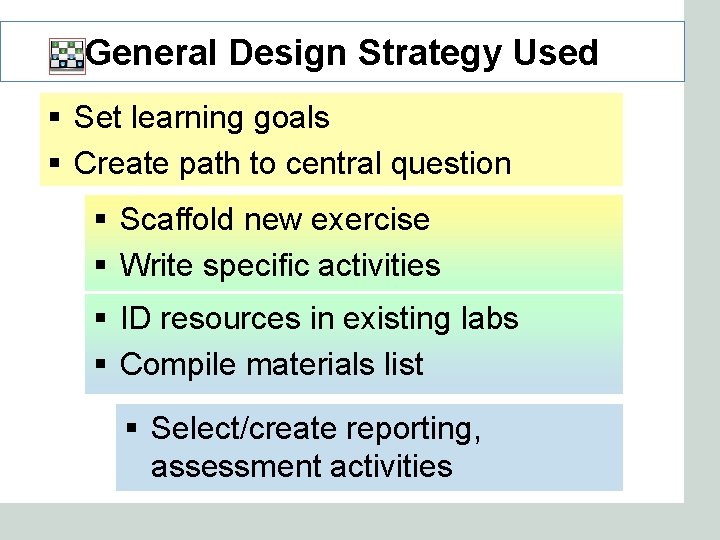
General Design Strategy Used § Set learning goals § Create path to central question § Scaffold new exercise § Write specific activities § ID resources in existing labs § Compile materials list § Select/create reporting, assessment activities
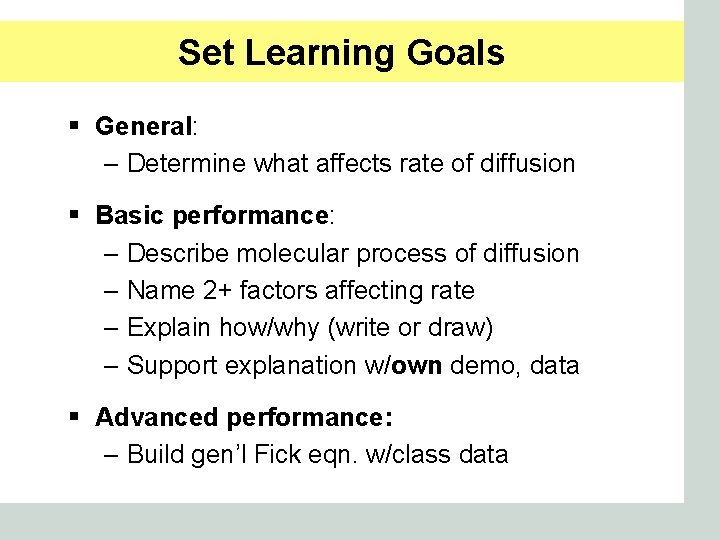
Set Learning Goals § General: – Determine what affects rate of diffusion § Basic performance: – Describe molecular process of diffusion – Name 2+ factors affecting rate – Explain how/why (write or draw) – Support explanation w/own demo, data § Advanced performance: – Build gen’l Fick eqn. w/class data
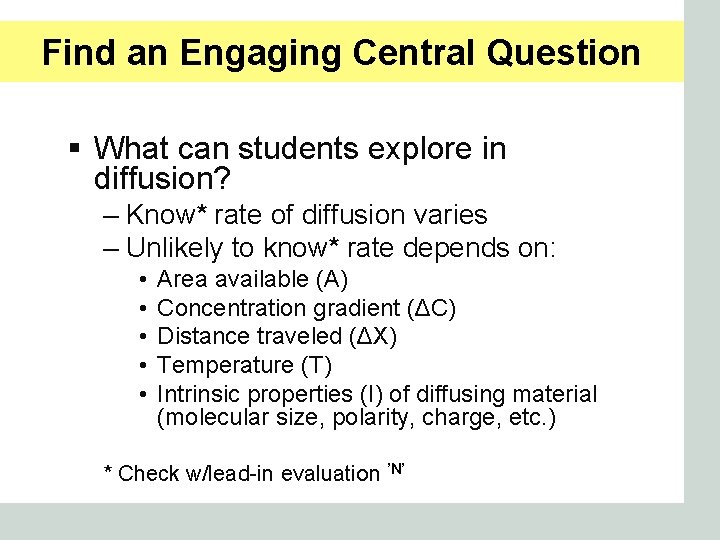
Find an Engaging Central Question § What can students explore in diffusion? – Know* rate of diffusion varies – Unlikely to know* rate depends on: • • • Area available (A) Concentration gradient (ΔC) Distance traveled (ΔX) Temperature (T) Intrinsic properties (I) of diffusing material (molecular size, polarity, charge, etc. ) * Check w/lead-in evaluation ’N’
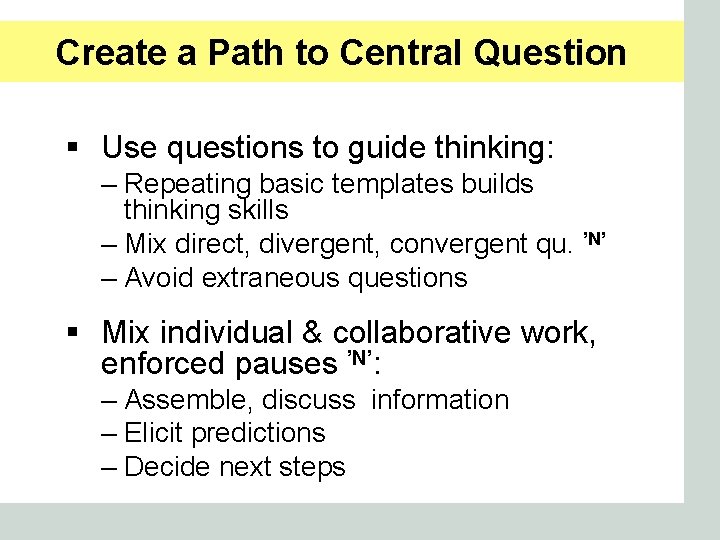
Create a Path to Central Question § Use questions to guide thinking: – Repeating basic templates builds thinking skills – Mix direct, divergent, convergent qu. ’N’ – Avoid extraneous questions § Mix individual & collaborative work, enforced pauses ’N’: – Assemble, discuss information – Elicit predictions – Decide next steps
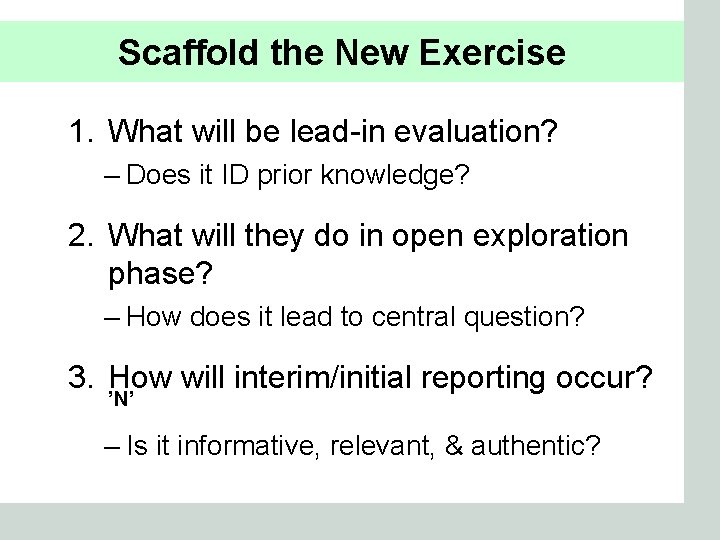
Scaffold the New Exercise 1. What will be lead-in evaluation? – Does it ID prior knowledge? 2. What will they do in open exploration phase? – How does it lead to central question? 3. How will interim/initial reporting occur? ’N’ – Is it informative, relevant, & authentic?
Scaffold the New Exercise 4. During guided inquiry: – What authentic question can they explore? – Can they explore it MULTIPLE WAYS? 5. How will they report outcomes? ’N’ – Is it authentic? – Does it foster collaborative thinking?
Pull Resources From Existing Labs § Think components, not exercises – Rarely useful “as is” – Most need revision, many are scrapped § Focus on: – Reusable model systems, assays – Collaborative reporting activities – Reusing equipment repeatedly – Formative, summative assessments
Compile Materials List § When writing a materials list: – List amts. req’d in blocks of 2 -4 students ’N’ – Add 25% extra for mistakes, repeats – Include: • Gen’l materials available for all labs • Detailed preparation instructions • Preferred vendors (& why) with catalog numbers
Decide on Assessment, Reporting § Activities, guide & follow-up qus. should: – Consolidate learning – Differentiate learning goals achieved – Match real-world uses
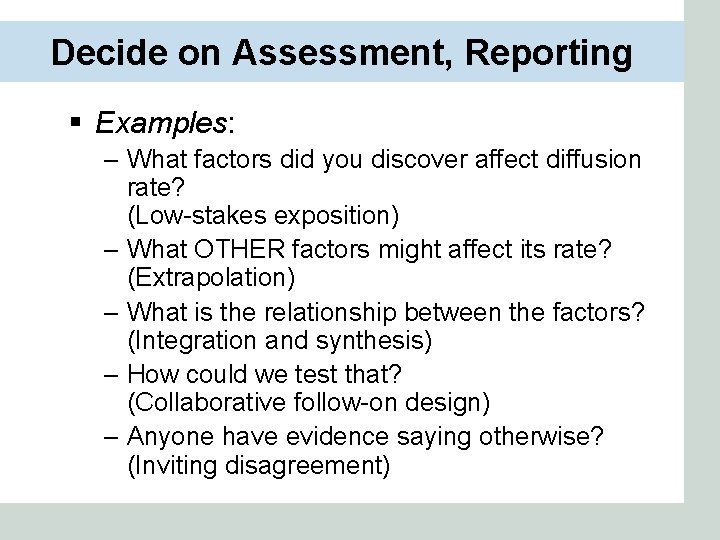
Decide on Assessment, Reporting § Examples: – What factors did you discover affect diffusion rate? (Low-stakes exposition) – What OTHER factors might affect its rate? (Extrapolation) – What is the relationship between the factors? (Integration and synthesis) – How could we test that? (Collaborative follow-on design) – Anyone have evidence saying otherwise? (Inviting disagreement)
In Summary § New lab is guided inquiry with multiple implementations – Adaptable design – Final form depends on local reqs. – ONE strategy of many options
Questions?
For Questions or More Information… Dan Johnson johnsoad@wfu. edu 336 -758 -5320
Supplemental Slides § Practical tips, tricks, tools § Common design mistakes
Practical Tips & Tricks: Design § Document rationale, goals for lab § Make copious notes, particularly about thought process – Goals & strategy should be clear to those NOT using inquiry. – Add notes to instructor’s suppl. § Every element must earn its place – Time is precious - assume “no” first – Think, plan “ideal to real”
Practical Tips & Tricks: Design Create reusable design templates § Ex. : a directed question template for experimental design – What are you doing? – Why are you doing it? – What do you think you will see? – If you see that, what will it mean? – If you do not see what you expect, what will it mean?
Practical Tips & Tricks Invite technology into lab § NANSLO labs have advanced digital cameras § Offer other options: – Students can use phones to document results.
Practical Tips & Tricks Give students time to struggle, fail, recover § Too much structure limits challenge § Example from demo lab: – Do not give hints for guided phase – Only give selectively as students reach barriers to progress ’N’
Common Lab Design Mistakes Poorly placed repetition § Expect students to transfer knowledge to lab ’N’ – Ex. : if instructor explains diffusion in lecture, reinforce in lecture • Class Q & A • Video or web simulation • Simple demo – Reserve lab time for active inquiry
Common Lab Design Mistakes Overloading available time § In 2 -3 hrs, students can complete 2 full activity cycles ’N’ – Adding more work reduces learning depth, retention time – If additional cycles are needed, make lab into a multi-week unit • Bonus: multi-week units tend to reduce overall lab operating costs
Common Lab Design Mistakes Ignoring instructor training § Those who never experienced inquiry as learners need to see it from student perspective – Novice instructors should “take” lab from experienced one § Provide contextual support materials – See slides on design documentation
- Slides: 57