
From Containers to Content to Context the Changing
- Slides: 50
From Containers to Content to Context: the Changing Role of Libraries in e. Science and e. Scholarship Prof. Dr. Stefan Gradmann Humboldt-Universität zu Berlin / School of Library and Information Science Präsident der Deutschen Gesellschaft für Informationswissenschaft und Informationspraxis (DGI) stefan. gradmann@ibi. hu-berlin. de 1
Overview The Poet, the Library and the Scriptorium How libraries and content were once closely connected The Gutenberg Parenthesis opens. . . Dissociation of container and content in the print paradigm … and closes again The end of the print paradigm Documents and Data in e. Science and e. Scholarship Context is king! An Opportunity for Libraries. . . … and what they need to do to be up to it From Containers to Content to Context 2
Overview The Poet, the Library and the Scriptorium How libraries and content were once closely connected The Gutenberg Parenthesis opens. . . Dissociation of container and content in the print paradigm … and closes again The end of the print paradigm Documents and Data in e. Science and e. Scholarship Context is king! An Opportunity for Libraries. . . … and what they need to do to be up to it From Containers to Content to Context 3
The Poet, the Library and the Scriptorium How libraries and content were connected before the Gutenberg Parenthesis From Containers to Content to Context 4
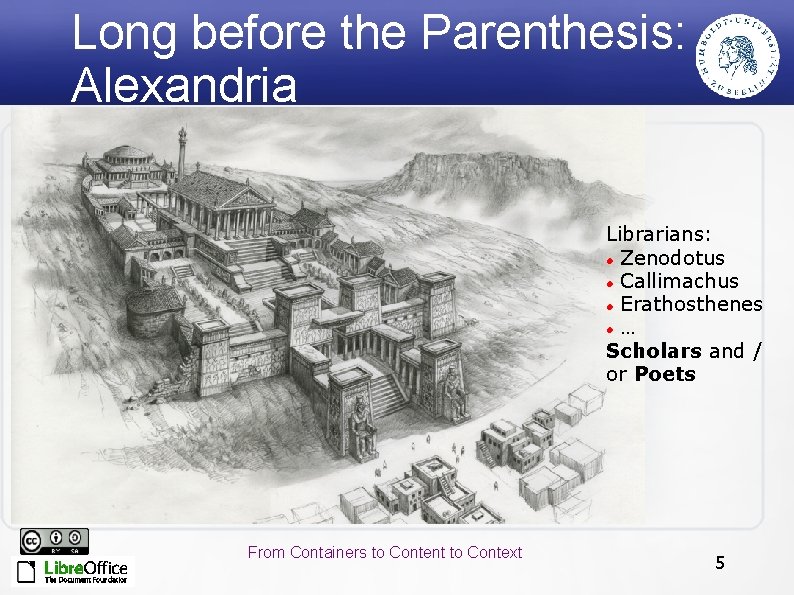
Long before the Parenthesis: Alexandria Librarians: Zenodotus Callimachus Erathosthenes … Scholars and / or Poets From Containers to Content to Context 5
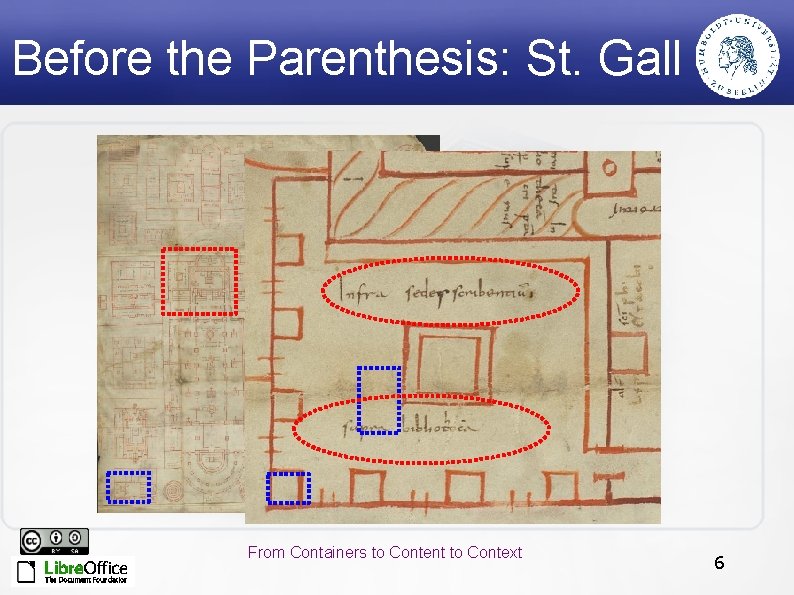
Before the Parenthesis: St. Gall From Containers to Content to Context 6
The Gutenberg Parenthesis Opens … Dissociation of container and content in the print paradigm From Containers to Content to Context 7
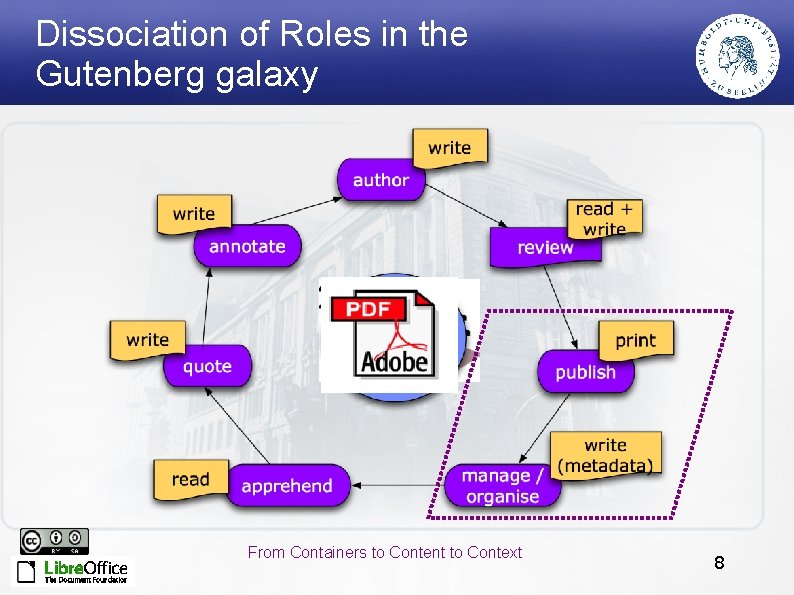
Dissociation of Roles in the Gutenberg galaxy From Containers to Content to Context 8
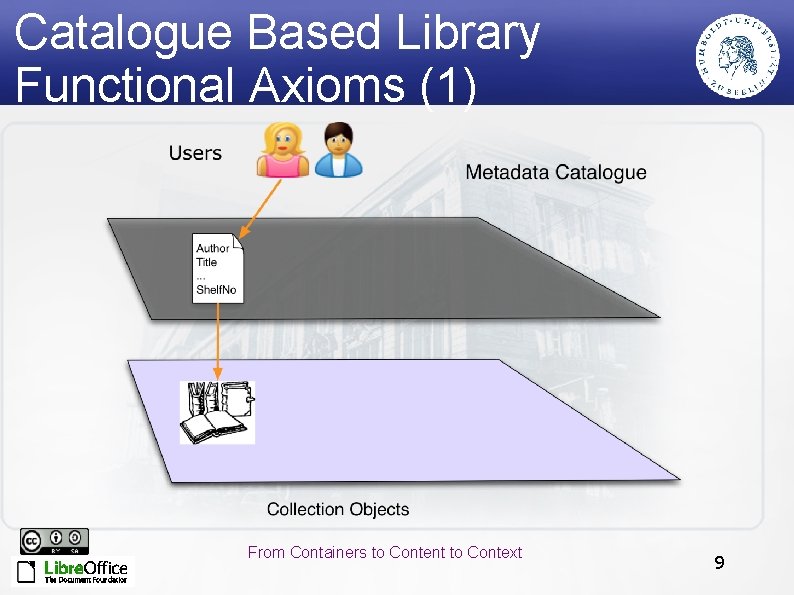
Catalogue Based Library Functional Axioms (1) From Containers to Content to Context 9
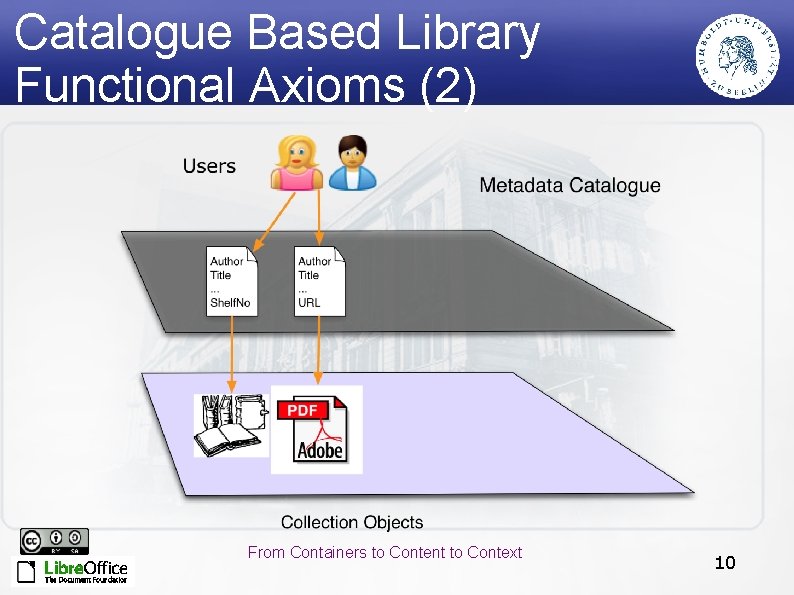
Catalogue Based Library Functional Axioms (2) From Containers to Content to Context 10
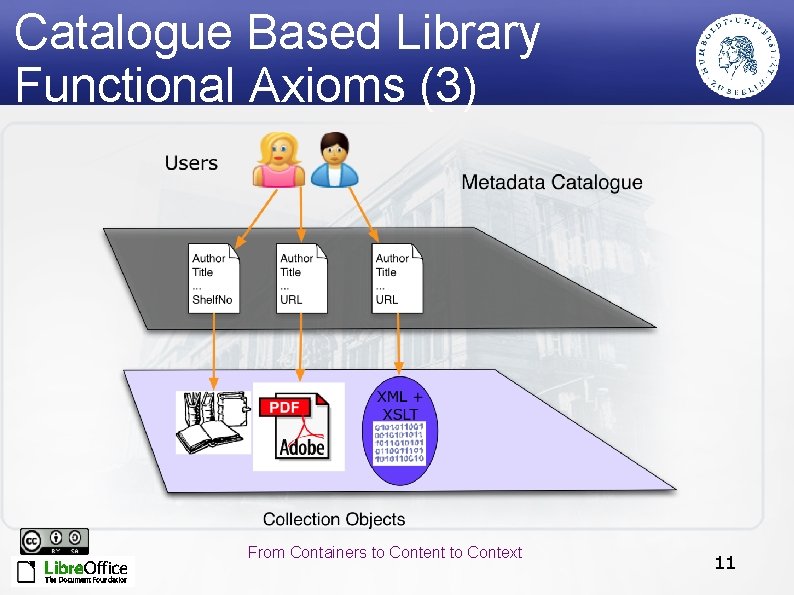
Catalogue Based Library Functional Axioms (3) From Containers to Content to Context 11
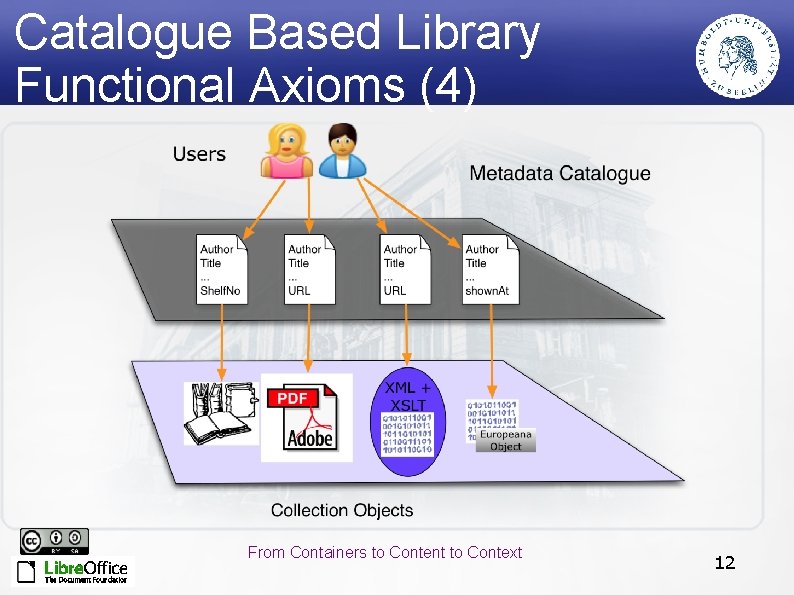
Catalogue Based Library Functional Axioms (4) From Containers to Content to Context 12
Library Functional Principles (5) Mediating access to information objects via catalogues Mediating links as pointers from metadata to objects Objects are part of a library collection An object to be used within a library typically is part of this library's collection Internal processing logic: focus on objects as information containers, not so much on the content of these containers and accordingly cataloguing is focussed on container attributes Functional macro-primitives are ingestion, storage, description and retrieval of information containers From Containers to Content to Context 13
… and closes again The end of the print paradigm From Containers to Content to Context 14
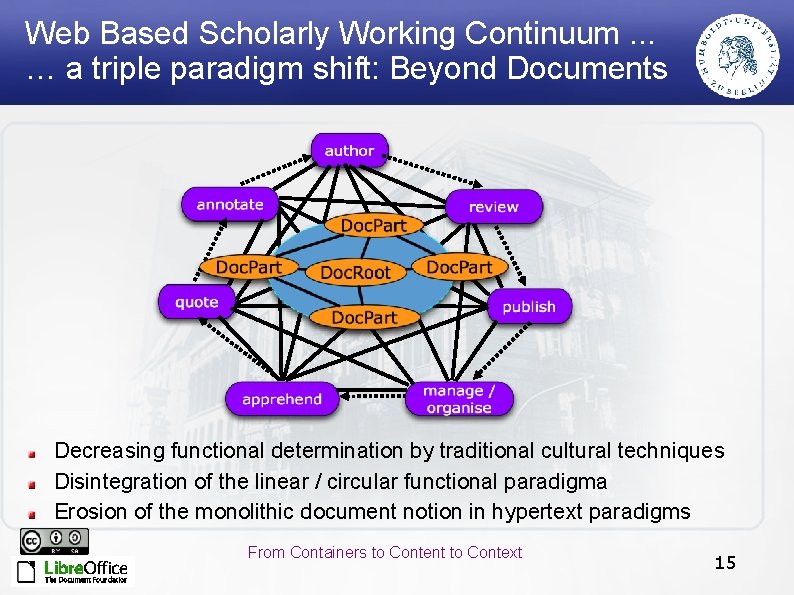
Web Based Scholarly Working Continuum. . . … a triple paradigm shift: Beyond Documents Decreasing functional determination by traditional cultural techniques Disintegration of the linear / circular functional paradigma Erosion of the monolithic document notion in hypertext paradigms From Containers to Content to Context 15
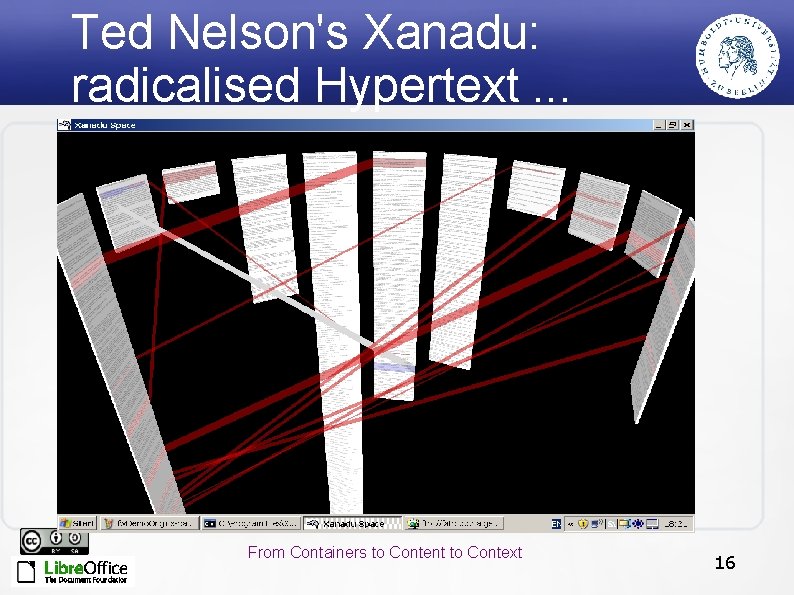
Ted Nelson's Xanadu: radicalised Hypertext. . . From Containers to Content to Context 16
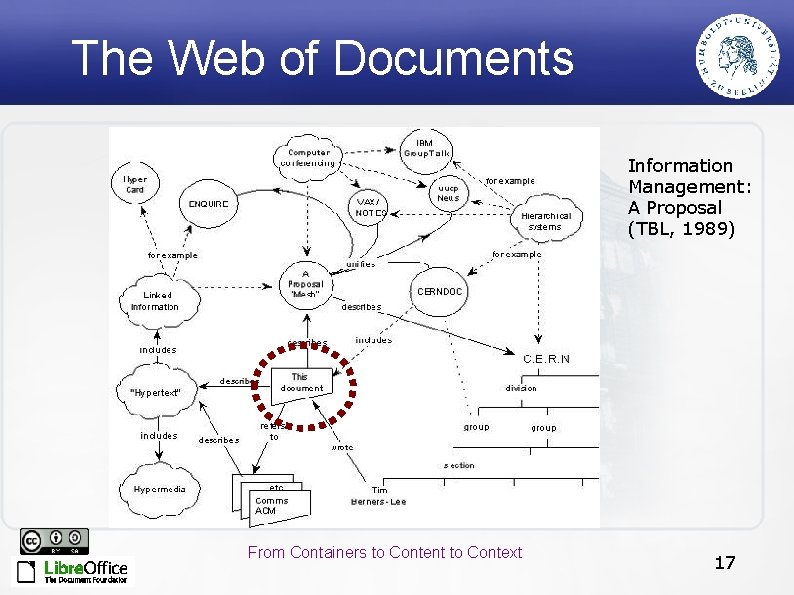
The Web of Documents Information Management: A Proposal (TBL, 1989) From Containers to Content to Context 17
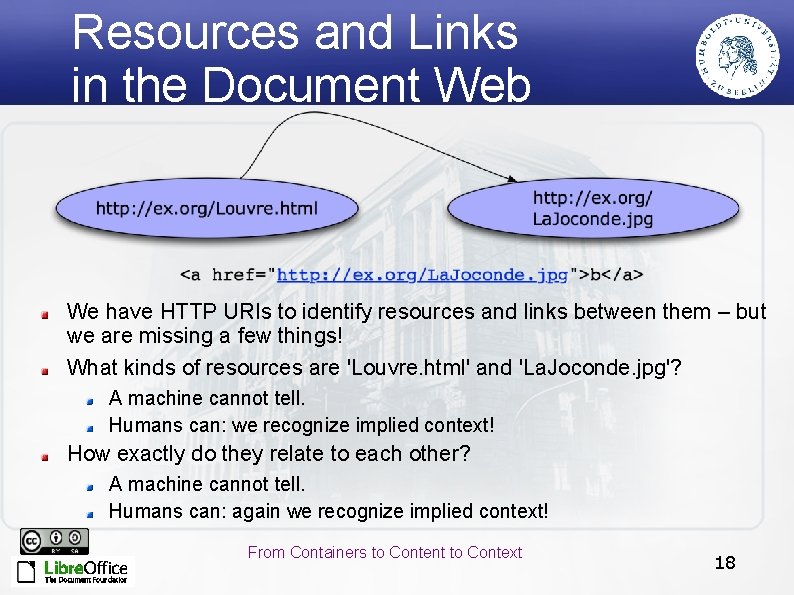
Resources and Links in the Document Web We have HTTP URIs to identify resources and links between them – but we are missing a few things! What kinds of resources are 'Louvre. html' and 'La. Joconde. jpg'? A machine cannot tell. Humans can: we recognize implied context! How exactly do they relate to each other? A machine cannot tell. Humans can: again we recognize implied context! From Containers to Content to Context 18
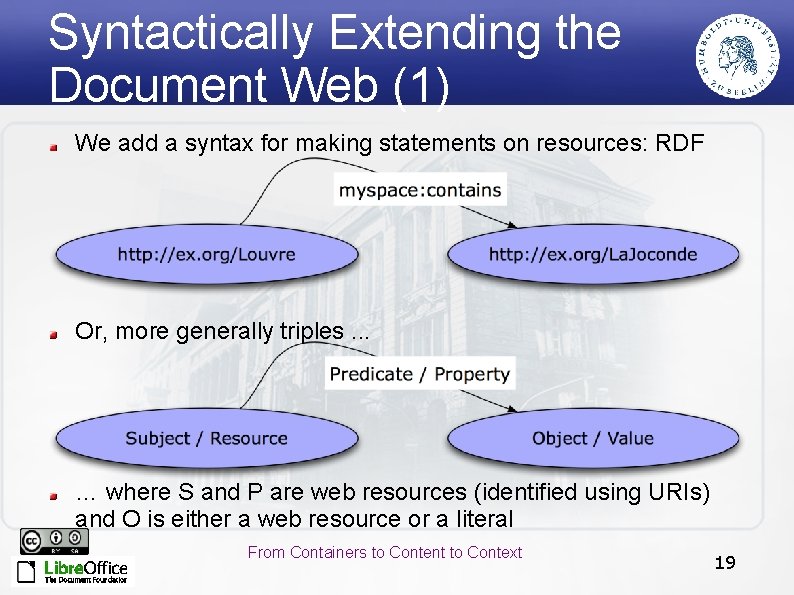
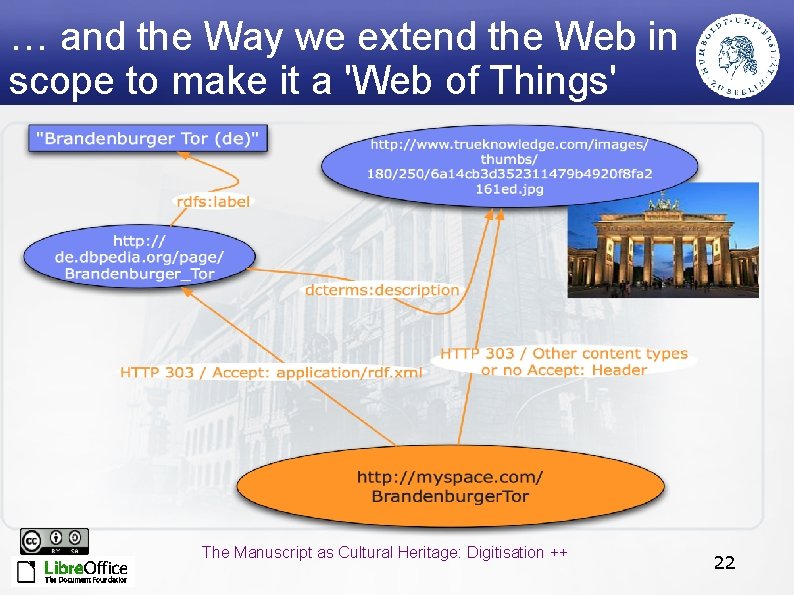
Syntactically Extending the Document Web (1) We add a syntax for making statements on resources: RDF Or, more generally triples. . . … where S and P are web resources (identified using URIs) and O is either a web resource or a literal From Containers to Content to Context 19
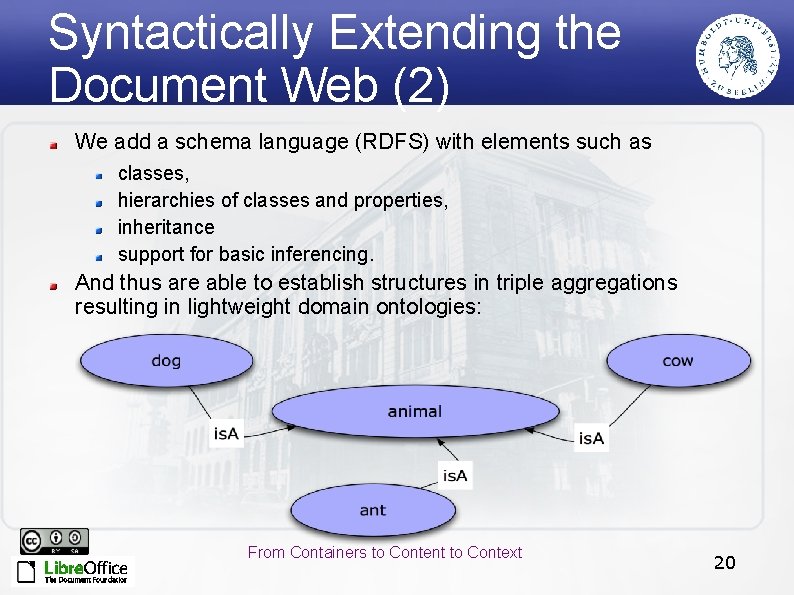
Syntactically Extending the Document Web (2) We add a schema language (RDFS) with elements such as classes, hierarchies of classes and properties, inheritance support for basic inferencing. And thus are able to establish structures in triple aggregations resulting in lightweight domain ontologies: From Containers to Content to Context 20
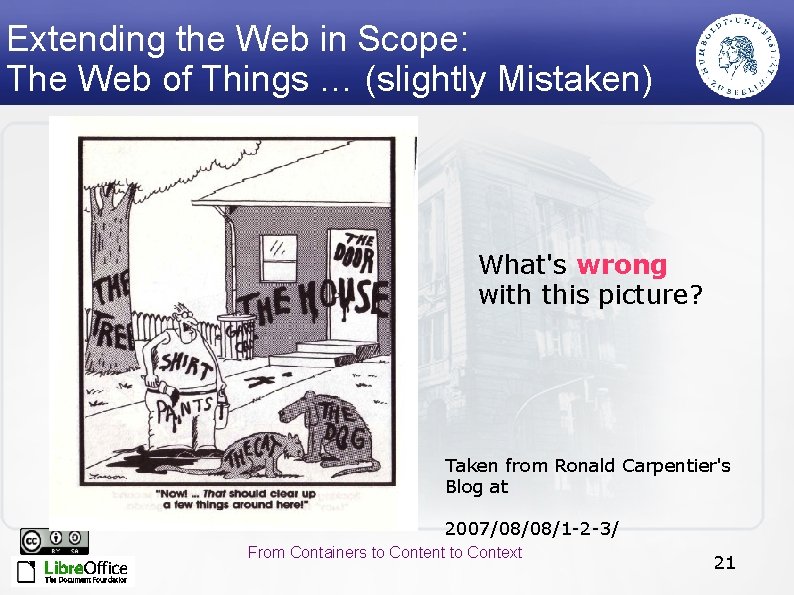
Extending the Web in Scope: The Web of Things … (slightly Mistaken) What's wrong with this picture? Taken from Ronald Carpentier's Blog at 2007/08/08/1 -2 -3/ From Containers to Content to Context 21
… and the Way we extend the Web in scope to make it a 'Web of Things' The Manuscript as Cultural Heritage: Digitisation ++ 22
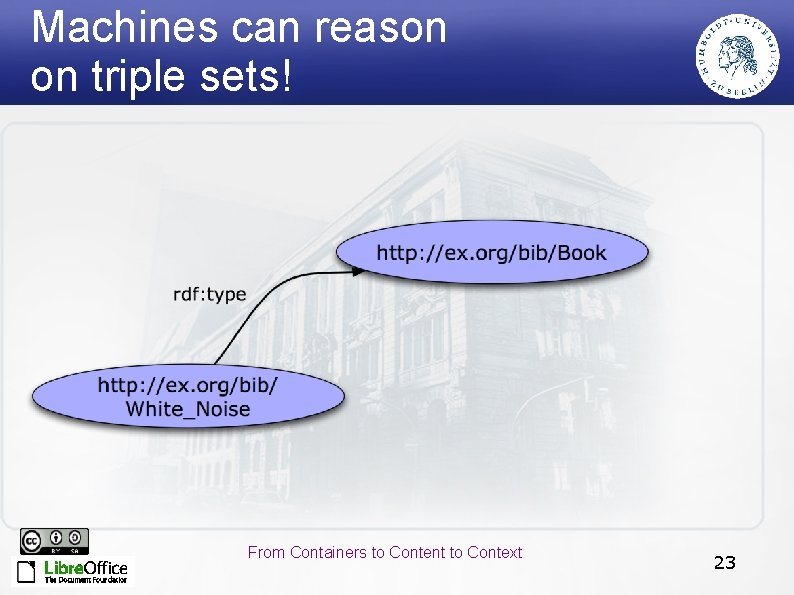
Machines can reason on triple sets! From Containers to Content to Context 23
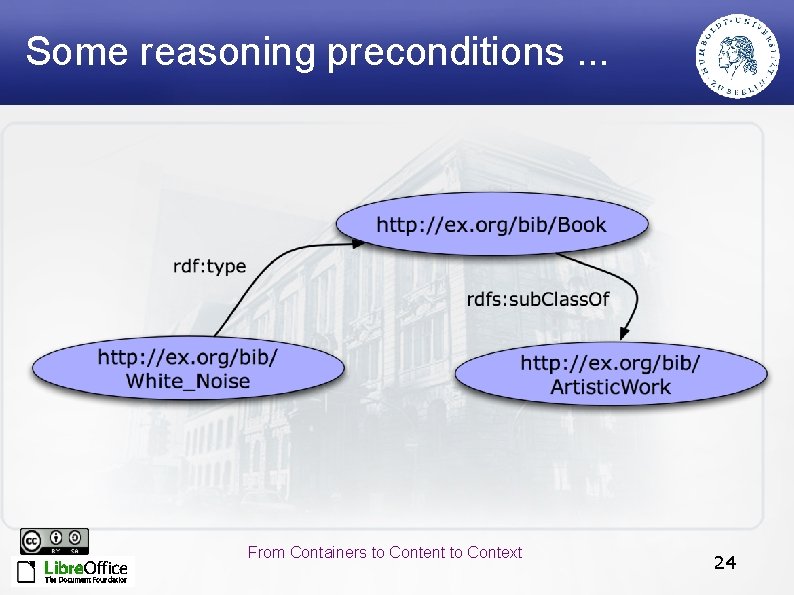
Some reasoning preconditions. . . From Containers to Content to Context 24
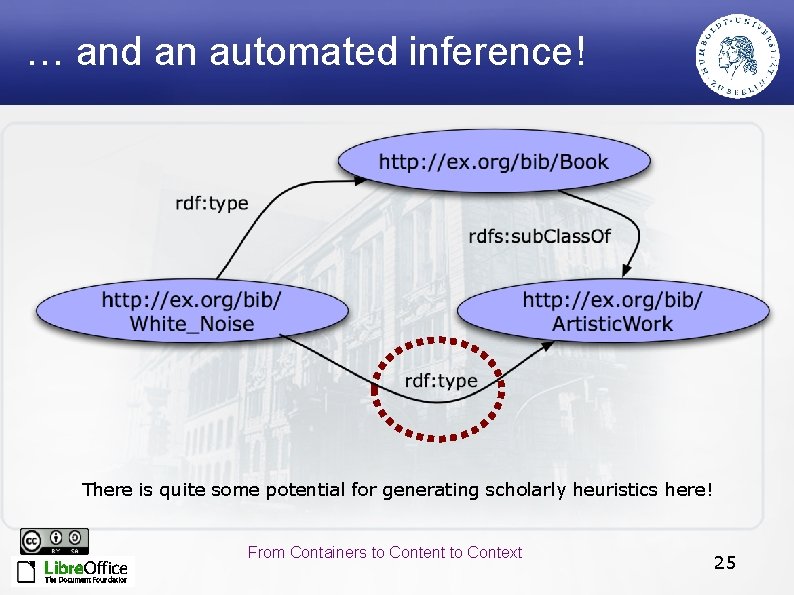
… and an automated inference! There is quite some potential for generating scholarly heuristics here! From Containers to Content to Context 25
Documents and Data in e. Science and e. Scholarship Context is king! From Containers to Content to Context 26
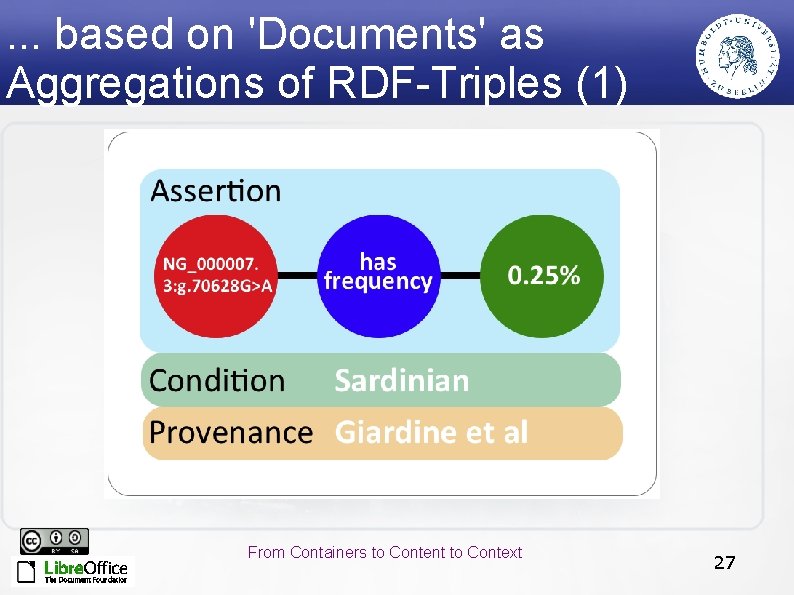
. . . based on 'Documents' as Aggregations of RDF-Triples (1) From Containers to Content to Context 27
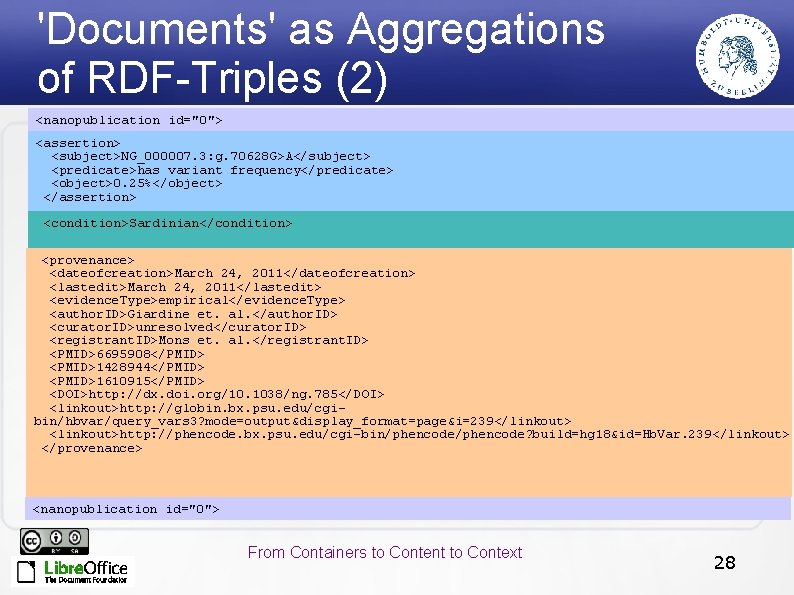
'Documents' as Aggregations of RDF-Triples (2) <nanopublication id="0"> <assertion> <subject>NG_000007. 3: g. 70628 G>A</subject> <predicate>has variant frequency</predicate> <object>0. 25%</object> </assertion> <condition>Sardinian</condition> <provenance> <dateofcreation>March 24, 2011</dateofcreation> <lastedit>March 24, 2011</lastedit> <evidence. Type>empirical</evidence. Type> <author. ID>Giardine et. al. </author. ID> <curator. ID>unresolved</curator. ID> <registrant. ID>Mons et. al. </registrant. ID> <PMID>6695908</PMID> <PMID>1428944</PMID> <PMID>1610915</PMID> <DOI>http: //dx. doi. org/10. 1038/ng. 785</DOI> <linkout>http: //globin. bx. psu. edu/cgibin/hbvar/query_vars 3? mode=output&display_format=page&i=239</linkout> <linkout>http: //phencode. bx. psu. edu/cgi-bin/phencode? build=hg 18&id=Hb. Var. 239</linkout> </provenance> <nanopublication id="0"> From Containers to Content to Context 28
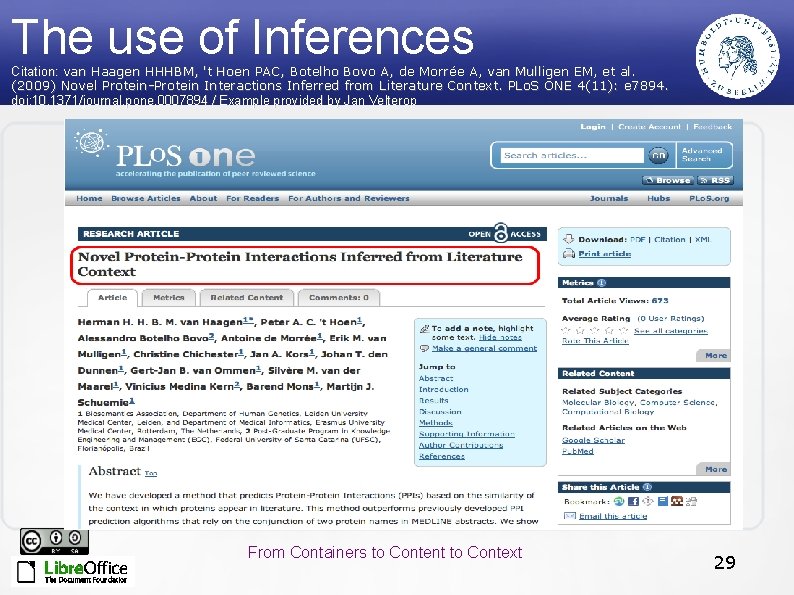
The use of Inferences Citation: van Haagen HHHBM, 't Hoen PAC, Botelho Bovo A, de Morrée A, van Mulligen EM, et al. (2009) Novel Protein-Protein Interactions Inferred from Literature Context. PLo. S ONE 4(11): e 7894. doi: 10. 1371/journal. pone. 0007894 / Example provided by Jan Velterop From Containers to Content to Context 29
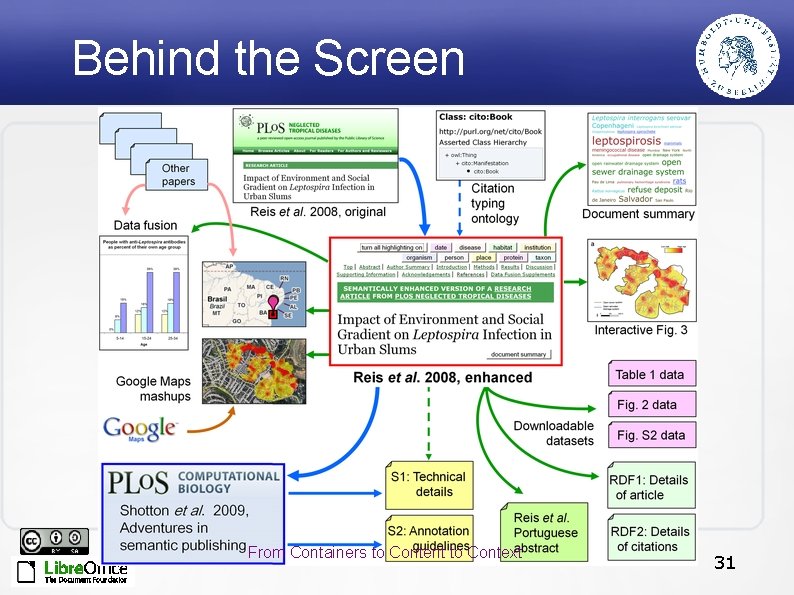
Semantic Publishing as Defined by Shotton et al. (2009 b) define semantic publication to include anything that enhances the meaning of a published journal article, facilitates its automated discovery, enables its linking to semantically related articles, provides access to data within the article in actionable form, or facilitates integration of data between articles. Example of an enhanced article From Containers to Content to Context 30
Behind the Screen From Containers to Content to Context 31
Semantic Enrichment Tools Generic: Open. Calais ( → Thomson Reuters) Temis () Collexis (http: //www. collexis. com/ → Elsevier) Specialised: Bio Taxon Finder (ml_services) Concept. Web. Alliance () (Biomedical, Jan Velterop) Shotton criticised by Roderic Page: “linking terms to HTML pages doesn't get us much further. Great for humans, not so good for computers. ” Too much focus on journal article format! → We need a little more! We need 'liquid documents'!! From Containers to Content to Context 32
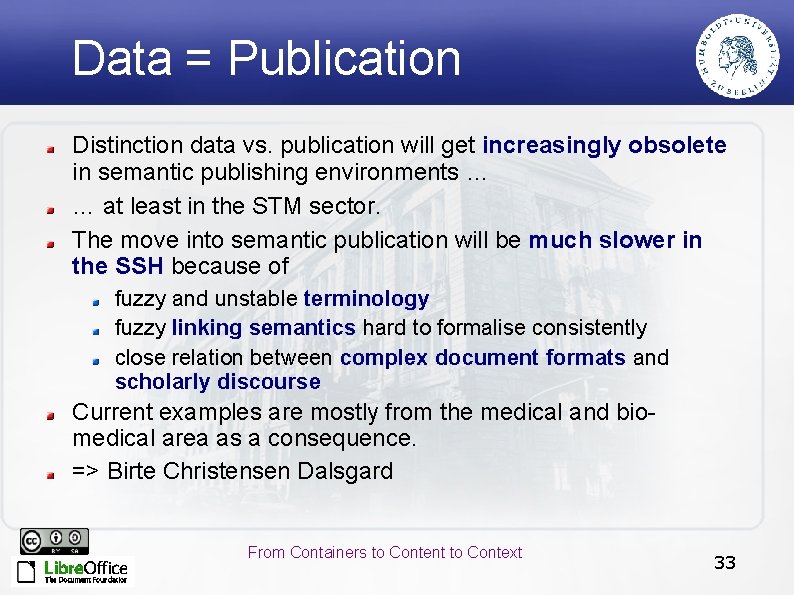
Data = Publication Distinction data vs. publication will get increasingly obsolete in semantic publishing environments … … at least in the STM sector. The move into semantic publication will be much slower in the SSH because of fuzzy and unstable terminology fuzzy linking semantics hard to formalise consistently close relation between complex document formats and scholarly discourse Current examples are mostly from the medical and biomedical area as a consequence. => Birte Christensen Dalsgard From Containers to Content to Context 33
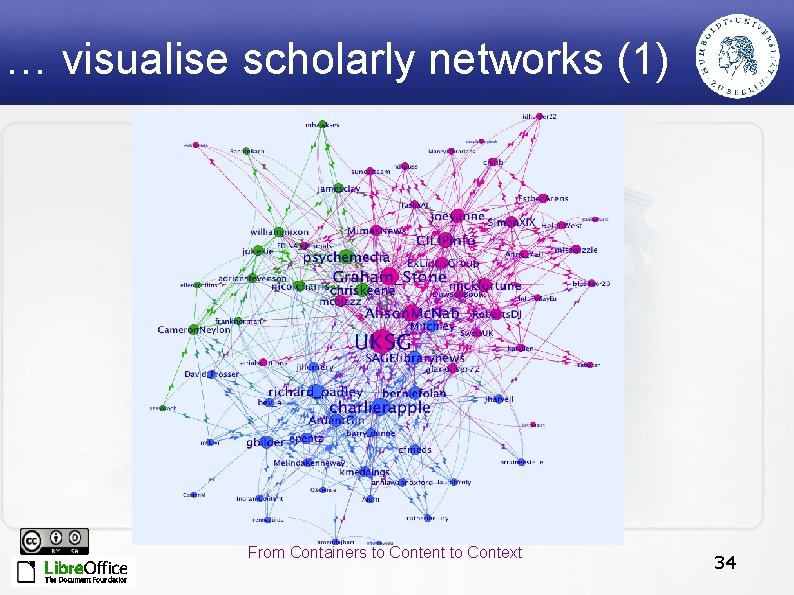
… visualise scholarly networks (1) From Containers to Content to Context 34
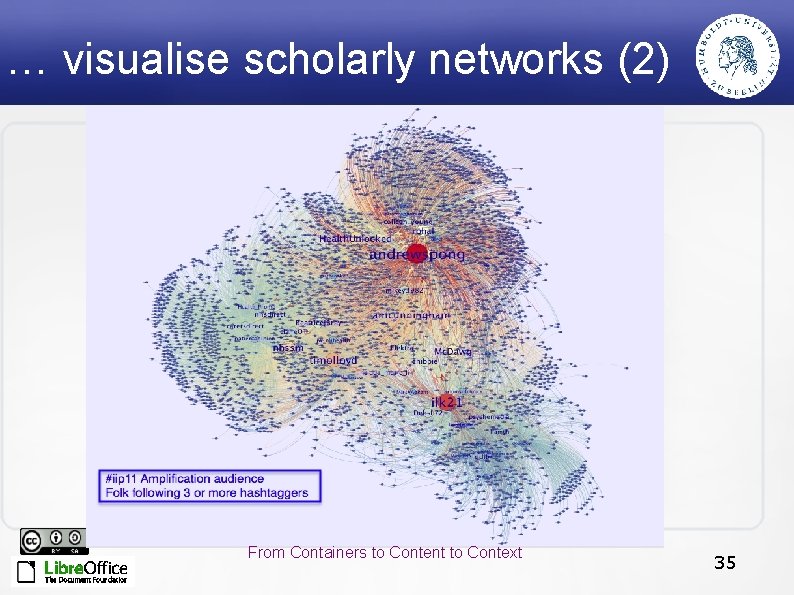
… visualise scholarly networks (2) From Containers to Content to Context 35
→ Visualise Cultural Context Mapping the Republic of Letters: https: //republicofletters. stanford. edu/#maps Or again a Finnish example (Kultuurisampo): http: //www. kulttuurisampo. fi/kulsa/historialliset. Kartat. shtml From Containers to Content to Context 36
An Opportunity for Libraries. . . … and what they need to do to be up to it From Containers to Content to Context 37
“What do you do with a million books? ” (G. Crane) Digitisation and (increasingly) semantic publishing result in growing quantity increased complexity Well beyond scholarly processing capacity (=reading faculty) Multiplication of collections or distributors is annoying → as few as possible. Ideally just one (? ) Scientists and Scholars will badly need help in three areas: Semantic abstracting, named entity recognition for “strategic reading” (Renear) Contextualisation of information objects Robust reasoning and inferencing yielding digital heuristics => Potential opportunities for libraries … From Containers to Content to Context 38
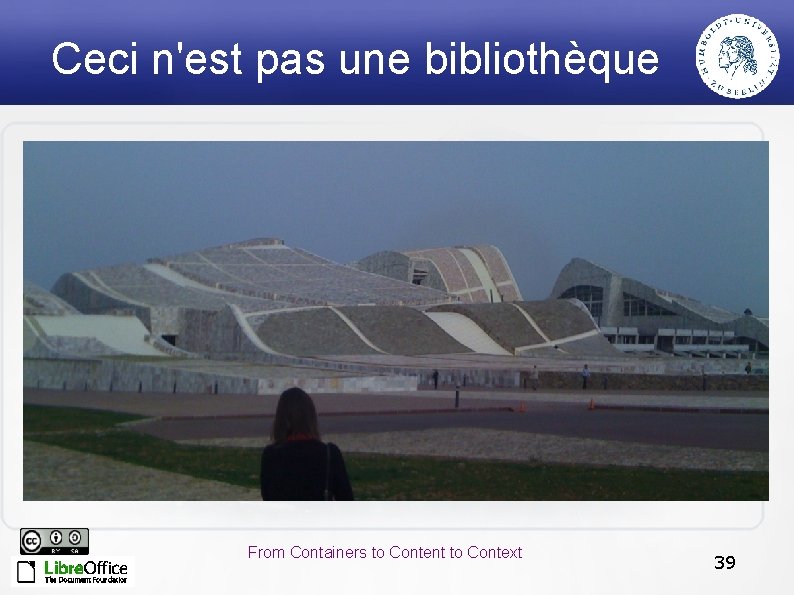
Ceci n'est pas une bibliothèque From Containers to Content to Context 39
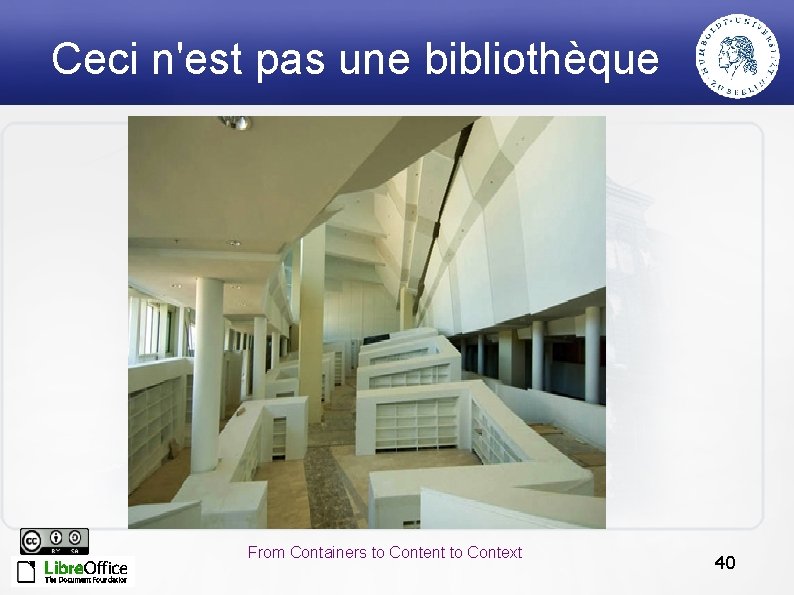
Ceci n'est pas une bibliothèque From Containers to Content to Context 40
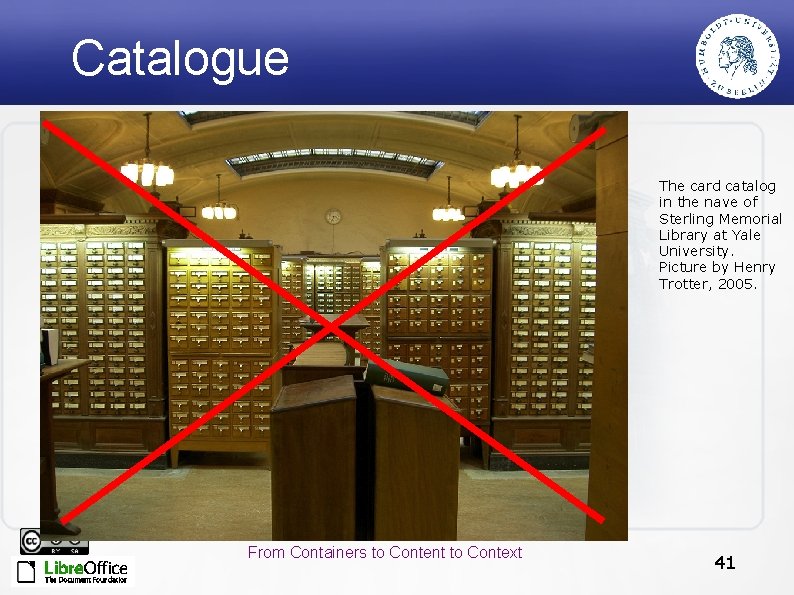
Catalogue The card catalog in the nave of Sterling Memorial Library at Yale University. Picture by Henry Trotter, 2005. From Containers to Content to Context 41
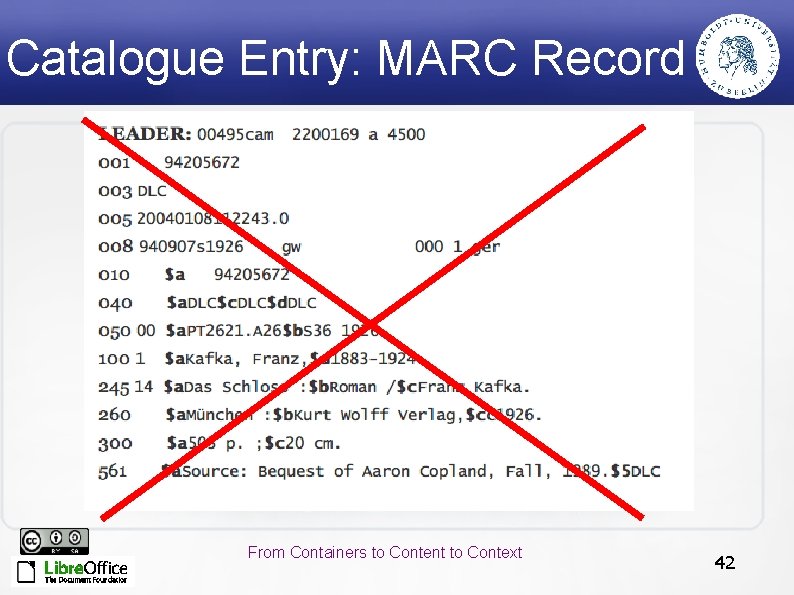
Catalogue Entry: MARC Record From Containers to Content to Context 42
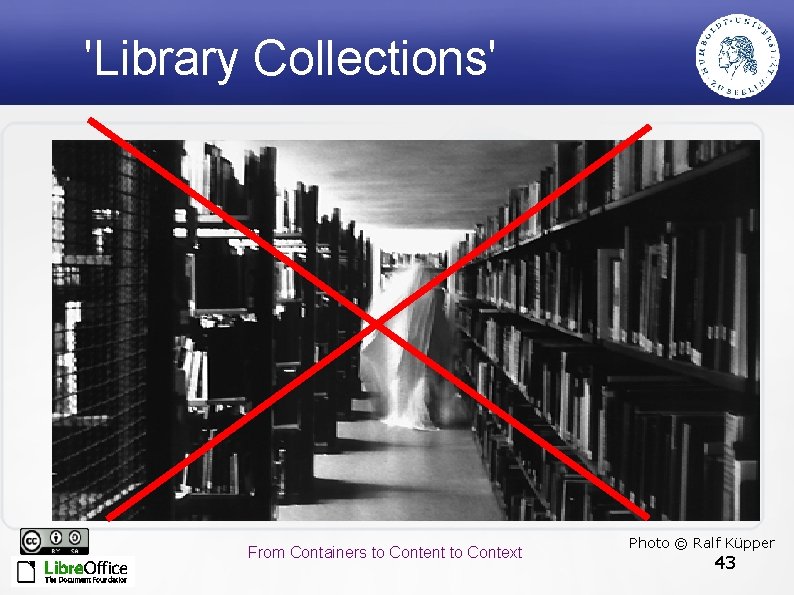
'Library Collections' From Containers to Content to Context Photo © Ralf Küpper 43
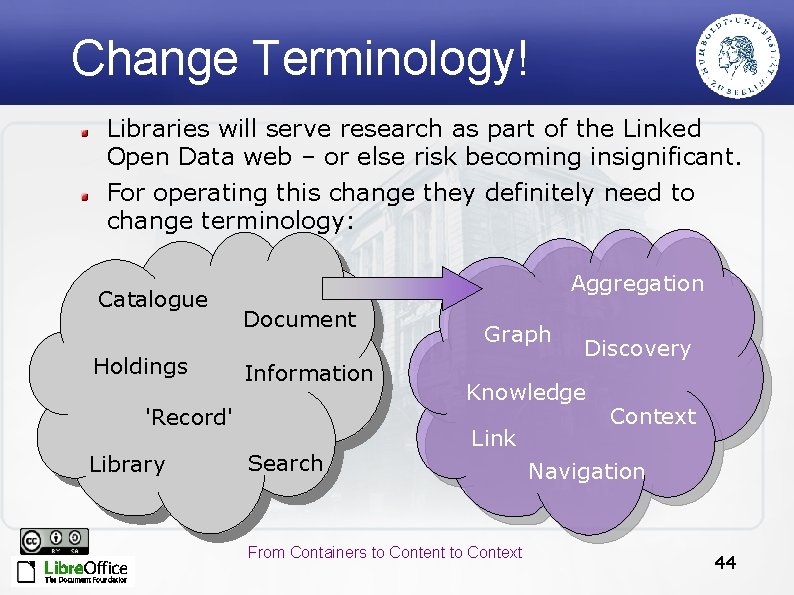
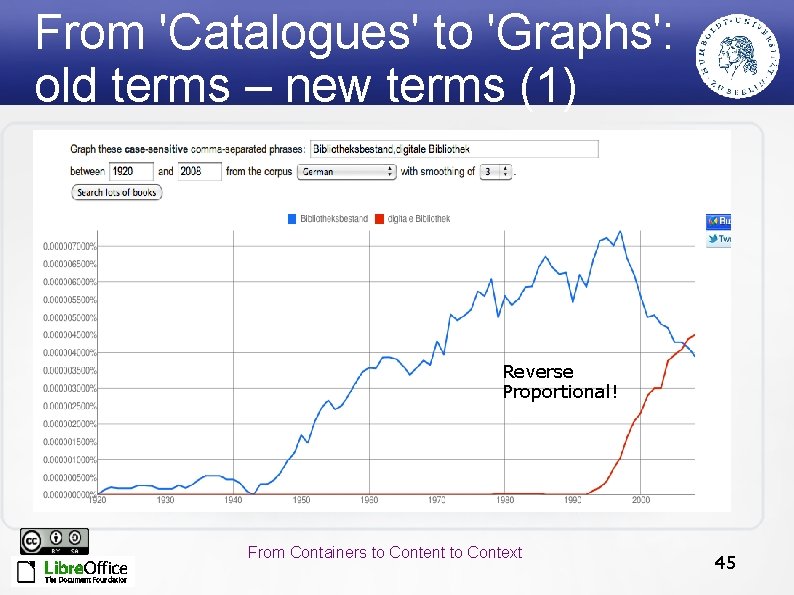
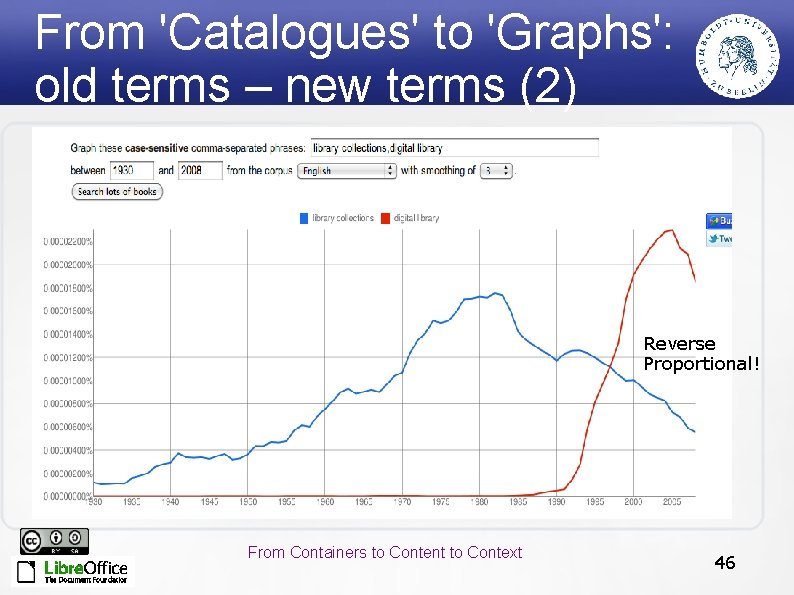
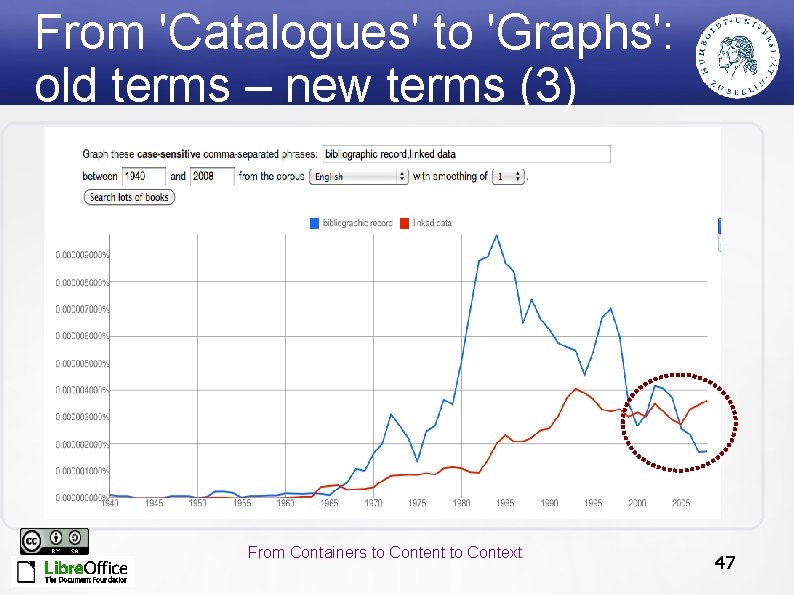
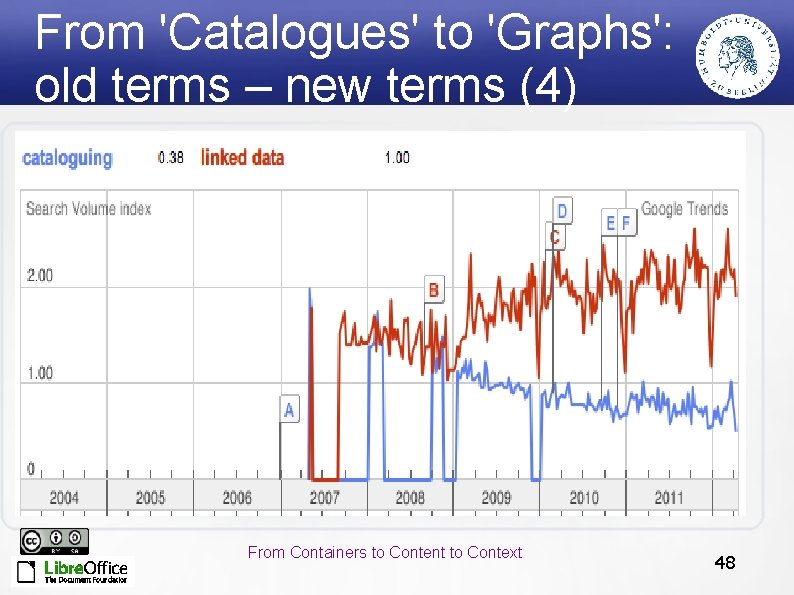
Change Terminology! Libraries will serve research as part of the Linked Open Data web – or else risk becoming insignificant. For operating this change they definitely need to change terminology: Catalogue Holdings Aggregation Document Information 'Record' Library Search Graph Discovery Knowledge Link From Containers to Content to Context Navigation 44
From 'Catalogues' to 'Graphs': old terms – new terms (1) Reverse Proportional! From Containers to Content to Context 45
From 'Catalogues' to 'Graphs': old terms – new terms (2) Reverse Proportional! From Containers to Content to Context 46
From 'Catalogues' to 'Graphs': old terms – new terms (3) From Containers to Content to Context 47
From 'Catalogues' to 'Graphs': old terms – new terms (4) From Containers to Content to Context 48
Sticking to empty metaphors. . . "What's in a name? That which we call a rose By any other name would smell as sweet. " (Shakespeare, Romeo and Juliet (II, ii, 1 -2)) Why then do we stick to emptied metaphors? … because they constitute identity (a very bad reason!) … because they guarantee institutional persistency (a fallacy!) … because we are afraid of substantial changes and believe in things changing only once we use new terms (dangerously childish!) … or simply because we do not have new terms yet? Let us then start looking for them! From Containers to Content to Context 49
Suggested Reading Gregory Crane (2006): What Do you Do with a Million Books? In: Dlib Magazine, Vol. 12, March. (http: //bit. ly/Jhz. F 90) Gutenberg Paranthesis Research Group / University of Southern Denmark: Position Paper (http: //bit. ly/Jj. GKb 6) David Parry: Burn the Boats/Books. Presentation to Digital Writing and Research Lab, Austin. (http: //bit. ly/JYLl. JV) David Shotton (2009 a): Semantic Publishing. The coming revolution in scientific journal publishing. Learned Publishing Volume 22, No 2, 85– 94, April 2009; doi: 10. 1087/2009202 David Shotton et al. (2009 b): Adventures in Semantic Publishing: Exemplar Semantic Enhancements of a Research Article (http: //bit. ly/Ig. T 5 Km) Barend Mons, Jan Velterop: Nano-Publication in the e-science era (http: //bit. ly/IISMGt) Alan Renear, Carol Palmer (2009): Strategic Reading, Ontologies and the Future of scientific Publishing. In: Science, August 2009, p. 828 – 832. Thank you for your patience and attention From Containers to Content to Context 50