
From Cloud to Storm What causes an isolated



- Slides: 64
From Cloud to Storm What causes an isolated storm? © 2019 University Corporation for Atmospheric Research. All Rights Reserved
Watching the Sky What causes storms to form? © 2019 University Corporation for Atmospheric Research. All Rights Reserved
Looking back What questions did we want to investigate on the Driving Question Board? © 2019 University Corporation for Atmospheric Research. All Rights Reserved
Think about the water cycle How do clouds form? • Explain to your partner how water on the Earth’s surface might end up as a cloud in the atmosphere. © 2019 University Corporation for Atmospheric Research. All Rights Reserved
Observations Step 1: What can we learn about storms by watching clouds in the sky? • Work in pairs or small groups, write down your ideas. © 2019 University Corporation for Atmospheric Research. All Rights Reserved
Sunny and stormy day time-lapse videos Step 2: What did you notice about the sunny day compared to the stormy day? • Observe the clouds in the time-lapse videos and record your observations. Sunny Day Video April 6, 2017 Stormy Day Video July 4, 2017 © 2019 University Corporation for Atmospheric Research. All Rights Reserved These videos were captured on Eagle Ridge above Lyons, Colorado near the Front Range of the Rockies.
Making sense Why do you think that the storm formed on one day and not the other? • Write down your ideas and be prepared to share with the class. © 2019 University Corporation for Atmospheric Research. All Rights Reserved
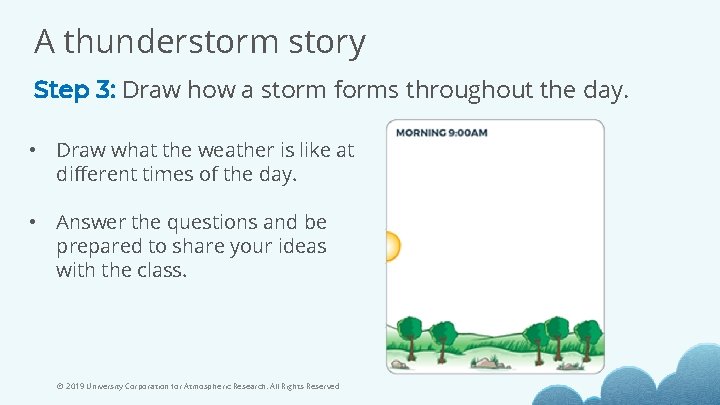
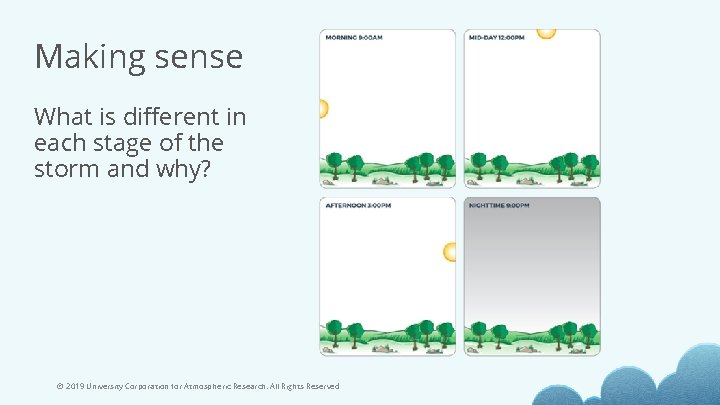
A thunderstorm story Step 3: Draw how a storm forms throughout the day. • Draw what the weather is like at different times of the day. • Answer the questions and be prepared to share your ideas with the class. © 2019 University Corporation for Atmospheric Research. All Rights Reserved
Making sense What is different in each stage of the storm and why? © 2019 University Corporation for Atmospheric Research. All Rights Reserved
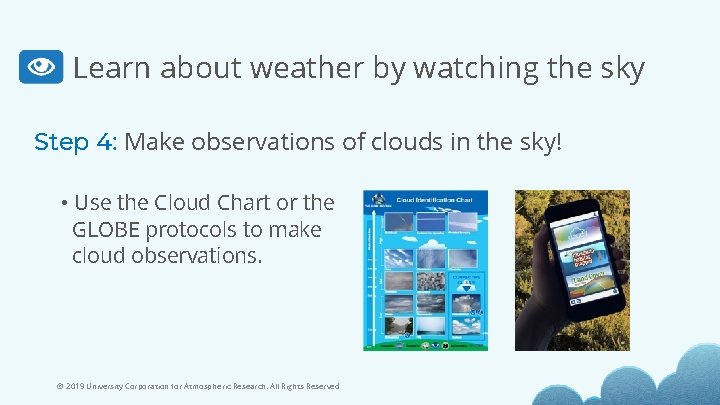
Learn about weather by watching the sky Step 4: Make observations of clouds in the sky! • Use the Cloud Chart or the GLOBE protocols to make cloud observations. © 2019 University Corporation for Atmospheric Research. All Rights Reserved
Temperature Clues How does temperature relate to cloud formation? © 2019 University Corporation for Atmospheric Research. All Rights Reserved
Looking back • If you could investigate the air up high compared to the air near the ground, what do you think you would see? • What are some measurements you would want to take of the air from different altitudes? • How might those measurements help us figure out how these clouds form? © 2019 University Corporation for Atmospheric Research. All Rights Reserved
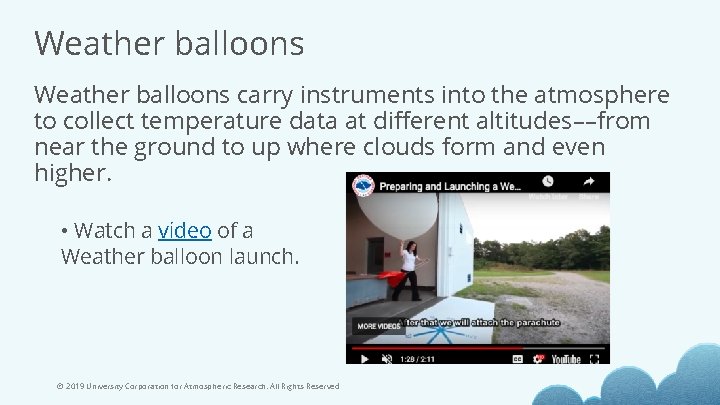
Weather balloons carry instruments into the atmosphere to collect temperature data at different altitudes––from near the ground to up where clouds form and even higher. • Watch a video of a Weather balloon launch. © 2019 University Corporation for Atmospheric Research. All Rights Reserved
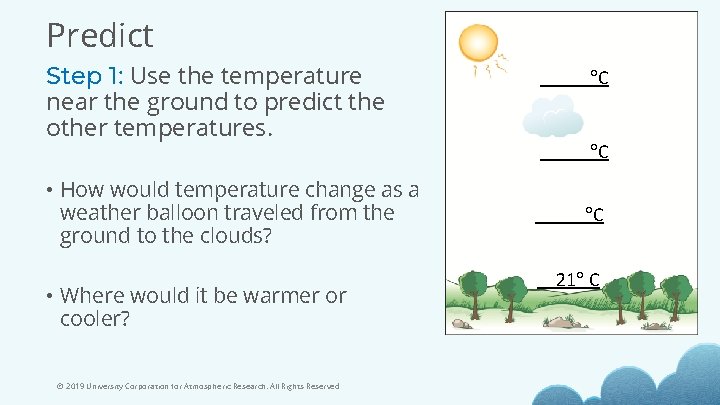
Predict Step 1: Use the temperature near the ground to predict the other temperatures. • How would temperature change as a weather balloon traveled from the ground to the clouds? • Where would it be warmer or cooler? © 2019 University Corporation for Atmospheric Research. All Rights Reserved C C C 21 C
Investigation: Virtual Balloons Step 2: Collect temperature data. • At a computer or tablet, open the Virtual Ballooning interactive. With this simulation you can launch virtual weather balloons and record the temperature at different altitudes in the atmosphere. • Simulation: https: //scied. ucar. edu/virtual-ballooning © 2019 University Corporation for Atmospheric Research. All Rights Reserved
Making sense Step 3: Analyze and interpret the data. • Describe the pattern you see in the temperature data from the ground to where storm clouds form. • Is this the pattern you predicted? Why or why not? • What do you think is causing the temperature pattern? • How does the temperature pattern relate to isolated storms forming? (Draw or write your ideas ) © 2019 University Corporation for Atmospheric Research. All Rights Reserved
Next steps • If we were able to look closely at different altitudes, from near the surface to high in the sky, what temperature pattern would you expect to see? • How do you think the results would compare if we measured temperature throughout a school day? © 2019 University Corporation for Atmospheric Research. All Rights Reserved
Looking back Explain what we observed in the Virtual Ballooning investigation that helps answer these questions: • If we zoomed in to this part of the altitude where we live, what temperature pattern would you expect to see? • How do you think the results would compare if we measured temperature across a school day? © 2019 University Corporation for Atmospheric Research. All Rights Reserved
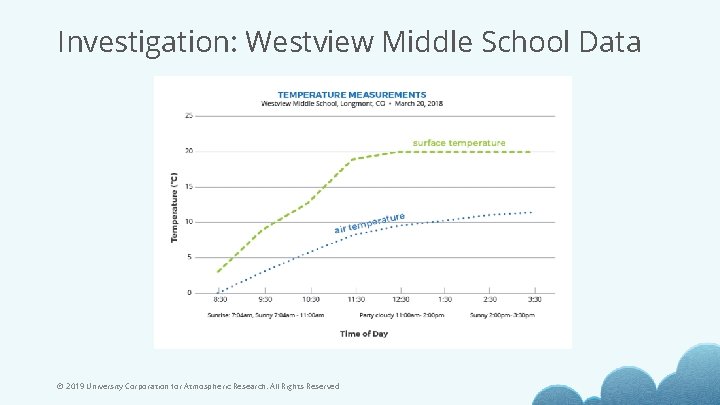
Investigation: Westview Middle School Data © 2019 University Corporation for Atmospheric Research. All Rights Reserved
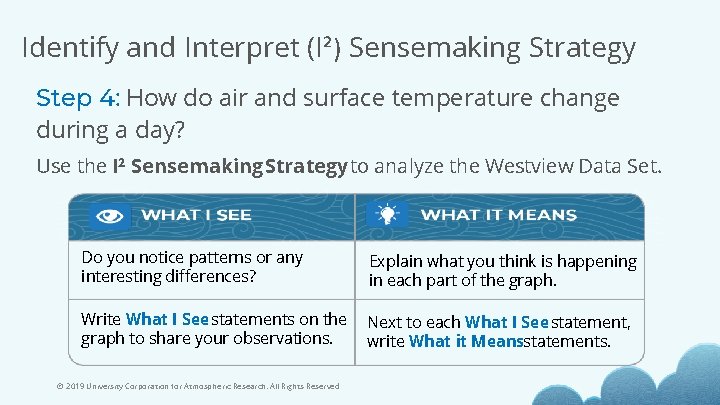
Identify and Interpret (I²) Sensemaking Strategy Step 4: How do air and surface temperature change during a day? Use the I 2 Sensemaking Strategy to analyze the Westview Data Set. Do you notice patterns or any interesting differences? Explain what you think is happening in each part of the graph. Write What I See statements on the graph to share your observations. Next to each What I See statement, write What it Meansstatements. © 2019 University Corporation for Atmospheric Research. All Rights Reserved
Conclusion What did you figure out by investigating the Longmont Data and Virtual Balloons? • Share these ideas and record them in the Model Idea Tracker. © 2019 University Corporation for Atmospheric Research. All Rights Reserved
Make a model Step 5: Make a model of how sunlight warms the atmosphere. Your model should explain: • How surface temperature is related to the sunlight • How air temperature is related to surface temperature • How the air temperature changes from the ground to higher altitudes • How you know the above three things using evidence from temperature data © 2019 University Corporation for Atmospheric Research. All Rights Reserved
Revise your model • Share your model with your group. • Ask clarifying questions of each other. • Revise your own model based on feedback from your group. © 2019 University Corporation for Atmospheric Research. All Rights Reserved
Making sense Step 6: How does your model relate to storms? There wasn’t a storm on the day when Westview Middle School collected surface temperature and air temperature data, but it did get cloudy in the afternoon. • How do you think temperature relates to the clouds forming? • What evidence from your model supports your answer? © 2019 University Corporation for Atmospheric Research. All Rights Reserved
Fuel for Storms What is different about a sunny day and a stormy day? © 2019 University Corporation for Atmospheric Research. All Rights Reserved
Looking back • How does temperature relate to clouds and isolated storms forming? © 2019 University Corporation for Atmospheric Research. All Rights Reserved
Looking forward: Brainstorm • How can one day be warm and sunny, while the next day is still warm but with an isolated storm? What is different about the two days? • What weather measurements might help to answer these questions? © 2019 University Corporation for Atmospheric Research. All Rights Reserved
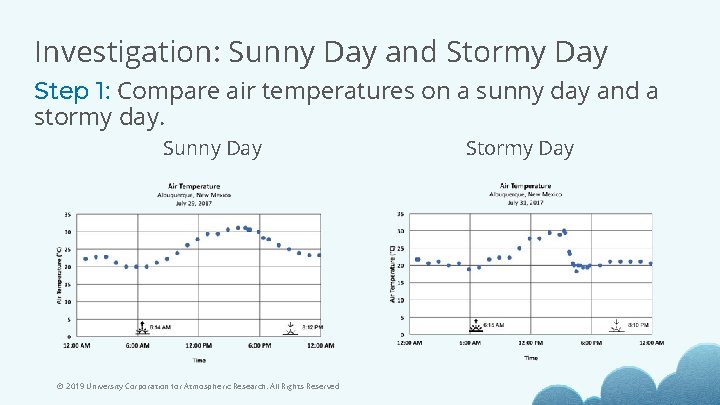
Investigation: Sunny Day and Stormy Day Step 1: Compare air temperatures on a sunny day and a stormy day. Sunny Day © 2019 University Corporation for Atmospheric Research. All Rights Reserved Stormy Day
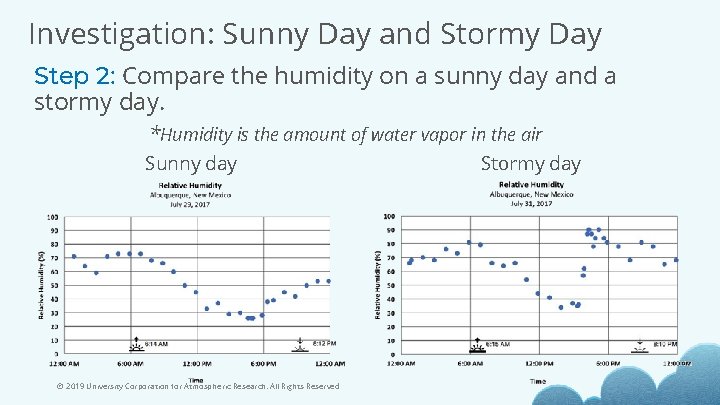
Investigation: Sunny Day and Stormy Day Step 2: Compare the humidity on a sunny day and a stormy day. *Humidity is the amount of water vapor in the air Sunny day © 2019 University Corporation for Atmospheric Research. All Rights Reserved Stormy day
Making sense When did the rain happen? • What were the temperature and humidity conditions that led to the rain event? • Describe the temperature and humidity before , during , and after the storm. © 2019 University Corporation for Atmospheric Research. All Rights Reserved
Conclusion What discoveries did your class make about the stormy day? • Share these ideas and record them in the Model Idea Tracker. © 2019 University Corporation for Atmospheric Research. All Rights Reserved
Next steps If we created a system with warm temperatures and lots of moisture, it would rain. But if we didn’t have warm temperatures or enough moisture, do you think it would rain or not? • Next we will try it out and see what happens. © 2019 University Corporation for Atmospheric Research. All Rights Reserved
Looking back What did we figure out about temperature and humidity patterns for a sunny day compared to a stormy day? • Discuss with a partner © 2019 University Corporation for Atmospheric Research. All Rights Reserved
Looking forward: Brainstorm How could we test different temperature and humidity conditions to create a ”sunny day” and a “stormy day” in a bottle? • What materials could we use? • What could we put in each bottle to create one with a “sunny day” and one with a “stormy day”? © 2019 University Corporation for Atmospheric Research. All Rights Reserved
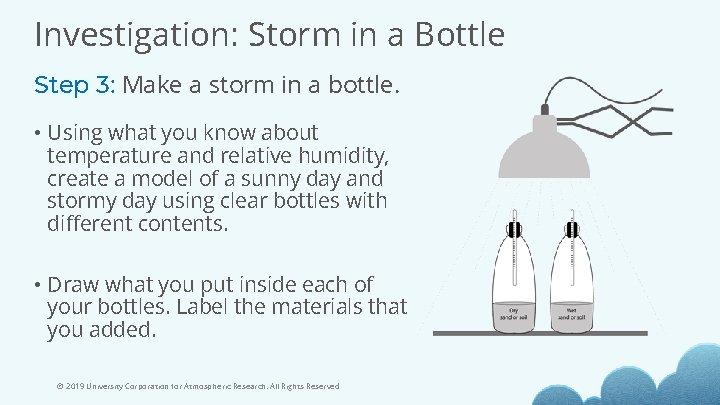
Investigation: Storm in a Bottle Step 3: Make a storm in a bottle. • Using what you know about temperature and relative humidity, create a model of a sunny day and stormy day using clear bottles with different contents. • Draw what you put inside each of your bottles. Label the materials that you added. © 2019 University Corporation for Atmospheric Research. All Rights Reserved
Review: Water evaporates from the ground as water vapor when it is heated by the Sun. Water vapor condenses back into water droplets in the sky, forming clouds. Water falls to the ground as precipitation when the air cannot hold any more water (100% humidity). © 2019 University Corporation for Atmospheric Research. All Rights Reserved
Investigation: Storm in a Bottle Step 3 (continued): Turn on the lamp to represent the Sun and observe the bottles for 20 minutes. • Add your observations about temperature and humidity for each bottle to the pictures. • Use the data table to record temperature and humidity changes in your bottles. © 2019 University Corporation for Atmospheric Research. All Rights Reserved
Making sense • Did the sunny day bottle match what you expected? If not, what happened? • Did the stormy day bottle match what you expected? If not, what happened? • Using evidence from the bottles and the temperature and humidity data, what conditions are best for storms? © 2019 University Corporation for Atmospheric Research. All Rights Reserved
Conclusion What discoveries did your class make from the Storm in a Bottle investigation? • Share these ideas and record them in the Model Idea Tracker. © 2019 University Corporation for Atmospheric Research. All Rights Reserved
Next steps How did the water from the bottom of the bottle get up on the sides of the bottle? © 2019 University Corporation for Atmospheric Research. All Rights Reserved
Air on the Move How does air move and change when a storm is forming? © 2019 University Corporation for Atmospheric Research. All Rights Reserved
Looking back • What happened to the water at the surface before it traveled to the top of the bottle? • What happened to the water at the top of the bottle? • How did that water get up there? Why would it go up? © 2019 University Corporation for Atmospheric Research. All Rights Reserved
Looking forward • How and why does the water vapor travel up? • What prior experiences do you have with warmed air or warmed water vapor that might help us explain this? © 2019 University Corporation for Atmospheric Research. All Rights Reserved
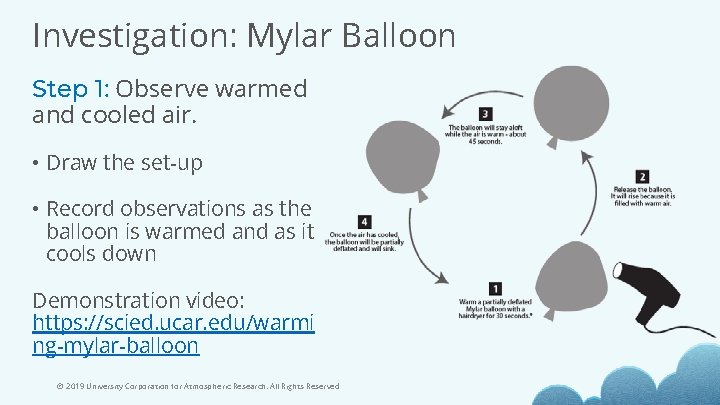
Investigation: Mylar Balloon Step 1: Observe warmed and cooled air. • Draw the set-up • Record observations as the balloon is warmed and as it cools down Demonstration video: https: //scied. ucar. edu/warmi ng-mylar-balloon © 2019 University Corporation for Atmospheric Research. All Rights Reserved
Making sense Why does the heated balloon go up? Think about what is happening inside the balloon. What is happening inside the balloon when the balloon starts to sink? © 2019 University Corporation for Atmospheric Research. All Rights Reserved
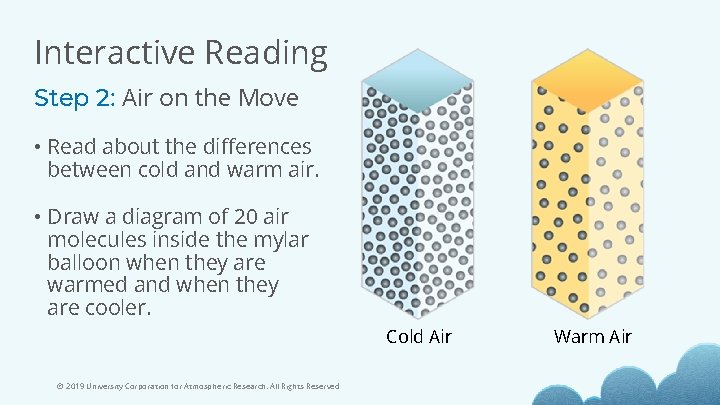
Interactive Reading Step 2: Air on the Move • Read about the differences between cold and warm air. • Draw a diagram of 20 air molecules inside the mylar balloon when they are warmed and when they are cooler. Cold Air © 2019 University Corporation for Atmospheric Research. All Rights Reserved Warm Air
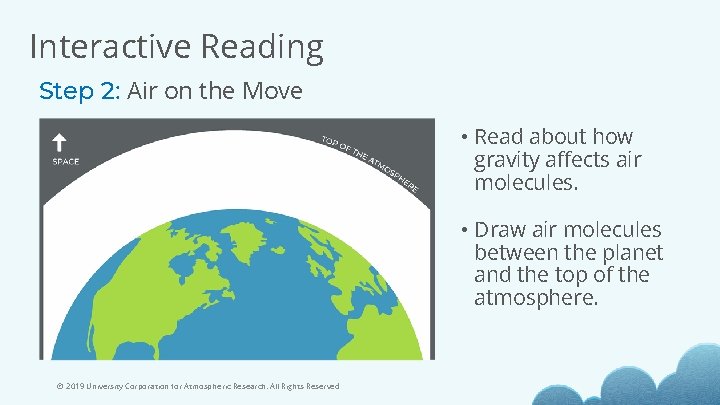
Interactive Reading Step 2: Air on the Move • Read about how gravity affects air molecules. • Draw air molecules between the planet and the top of the atmosphere. © 2019 University Corporation for Atmospheric Research. All Rights Reserved
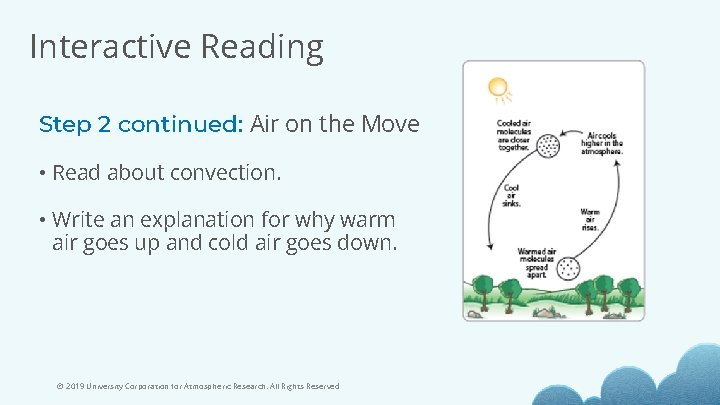
Interactive Reading Step 2 continued: Air on the Move • Read about convection. • Write an explanation for why warm air goes up and cold air goes down. © 2019 University Corporation for Atmospheric Research. All Rights Reserved
Conclusion Why does warm air go up and cool air go down? • Reflect on the reading as well as information from other activities we have done so far. • Share these ideas and record them in the Model Idea Tracker. © 2019 University Corporation for Atmospheric Research. All Rights Reserved
Taking stock The Driving Question Board • What questions can we now answer? What connections can you make? © 2019 University Corporation for Atmospheric Research. All Rights Reserved
Making sense What causes an isolated storm to form? • Revisit the stormy day time-lapse video (Stormy Day Video: July 4, 2017) • In groups, discuss the important things that happened for the storm to form. • What ideas from our Model Idea Tracker might help us explain what causes an isolated storm? © 2019 University Corporation for Atmospheric Research. All Rights Reserved
Make a model Step 3: Create a model to describe how precipitation happens in an isolated storm. Draw and write in the illustration. Make sure your model explains: • What happens to energy from the Sun that leads to the isolated storm? • What happens to water at the surface and clouds that lead to the isolated storm? • How do air temperature and humidity change as air moves from the ground to the cloud? • How does air move between the ground to where the storm forms? © 2019 University Corporation for Atmospheric Research. All Rights Reserved
Develop a Consensus Model • Use ideas from student models to draw a Consensus Model for the class to show what has to happen for an isolated storm to form. • Use data or other evidence from our investigations to support the ideas added to the Consensus Model. • Revise your student models to represent the class’ ideas in a way that makes sense to you. Use a different color pencil as you revise your model from Step 3. • Write your own explanation that goes with the model in Step 3. © 2019 University Corporation for Atmospheric Research. All Rights Reserved
Making a Thunderstorm Can we identify the best conditions for storms? © 2019 University Corporation for Atmospheric Research. All Rights Reserved
Driving Question Board What questions can we answer now? © 2019 University Corporation for Atmospheric Research. All Rights Reserved
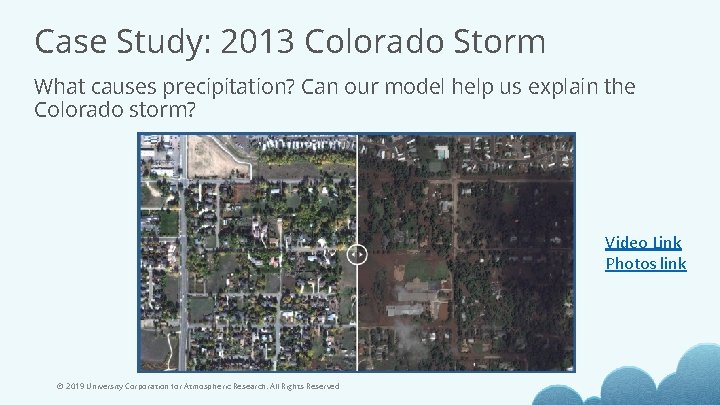
Case Study: 2013 Colorado Storm What causes precipitation? Can our model help us explain the Colorado storm? Video Link Photos link © 2019 University Corporation for Atmospheric Research. All Rights Reserved
Predict Step 1: Make predictions. • Use your model for an isolated storm, and what you know about temperature and humidity, to predict the very best conditions that would lead to an isolated storm. © 2019 University Corporation for Atmospheric Research. All Rights Reserved
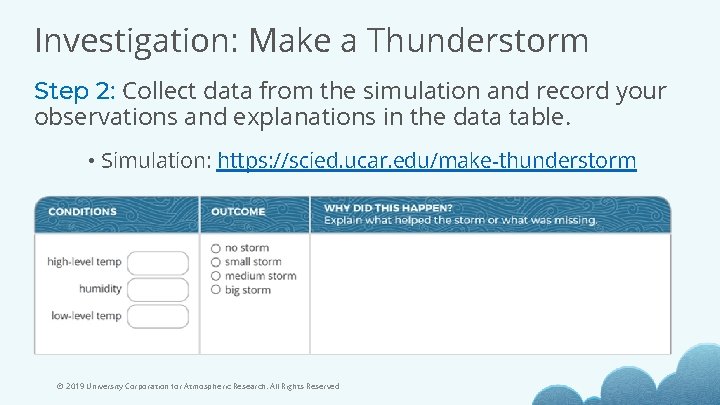
Investigation: Make a Thunderstorm Step 2: Collect data from the simulation and record your observations and explanations in the data table. • Simulation: https: //scied. ucar. edu/make-thunderstorm © 2019 University Corporation for Atmospheric Research. All Rights Reserved
Making sense What parts of our Consensus Model for an Isolated Storm do we want to confirm or revise? © 2019 University Corporation for Atmospheric Research. All Rights Reserved
Looking back What happens leading up to a storm? © 2019 University Corporation for Atmospheric Research. All Rights Reserved
Investigation: Data from Pompano, Florida Can our model help us determine when a rain event occurred? Step 3: Analyze the data. • When did it rain in Pompano, Florida? Circle on the graph. • Explain what conditions were likely leading up to this rain event and why you think the rain happened at this time? © 2019 University Corporation for Atmospheric Research. All Rights Reserved
Pompano, Florida rain event When did it rain? • The rain began at 12: 45 p. m. on July 21. How do we know? • The graph shows a significant increase in humidity and a significant decrease in temperature at that time. . © 2019 University Corporation for Atmospheric Research. All Rights Reserved
Driving Question Board What questions can we now answer? What new questions should we add? © 2019 University Corporation for Atmospheric Research. All Rights Reserved
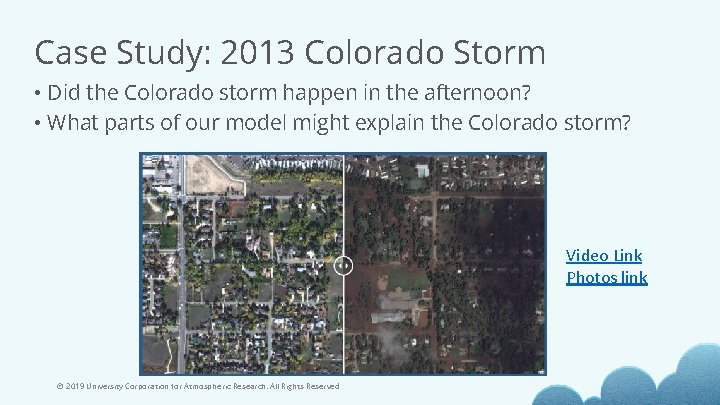
Case Study: 2013 Colorado Storm • Did the Colorado storm happen in the afternoon? • What parts of our model might explain the Colorado storm? Video Link Photos link © 2019 University Corporation for Atmospheric Research. All Rights Reserved