
From Childhood to Maturity Margaret Pritchard Houston Childrens
- Slides: 22
From Childhood to Maturity Margaret Pritchard Houston Children’s Mission Enabler, Diocese of St Albans
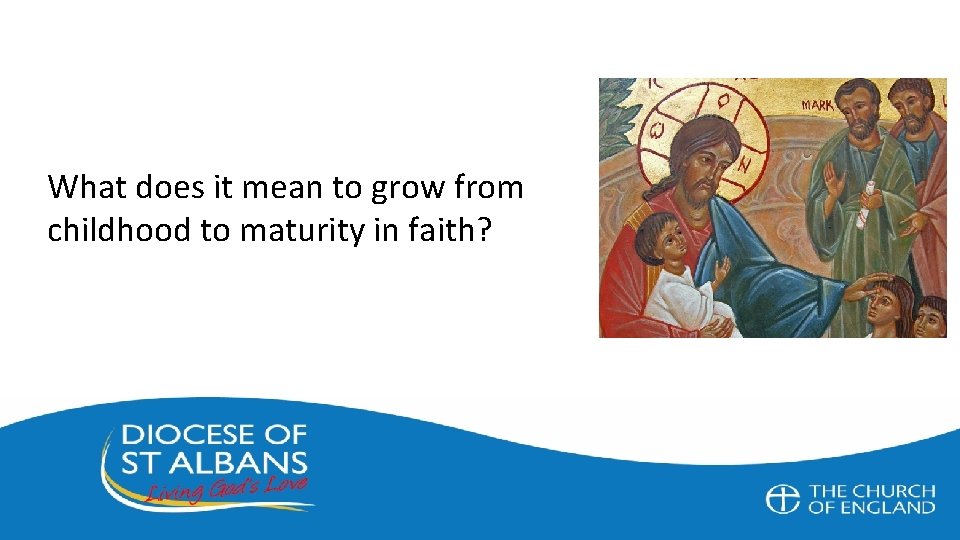
What does it mean to grow from childhood to maturity in faith?
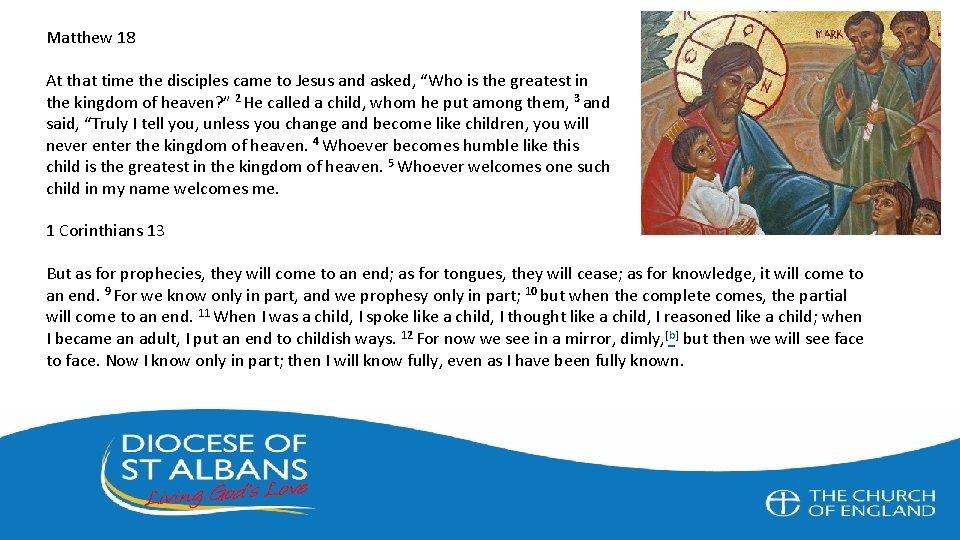
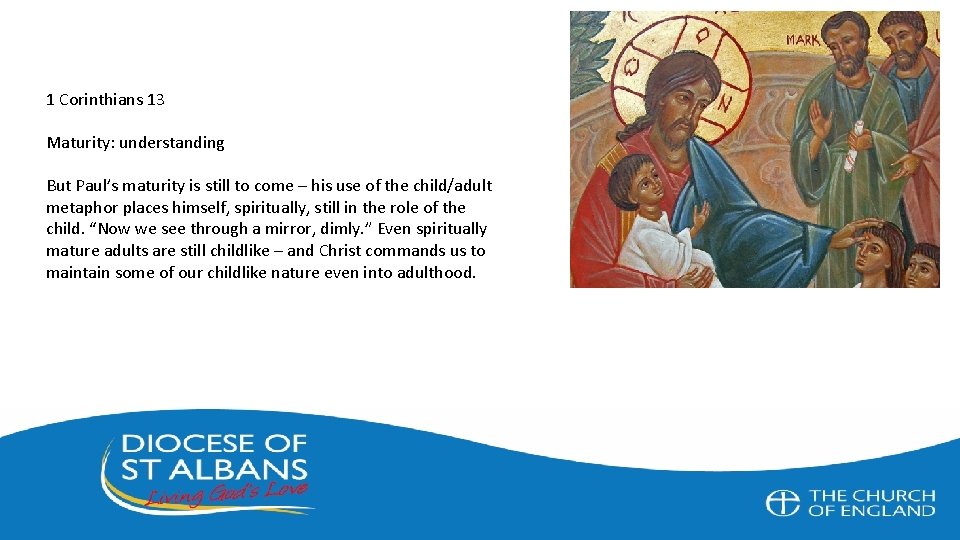
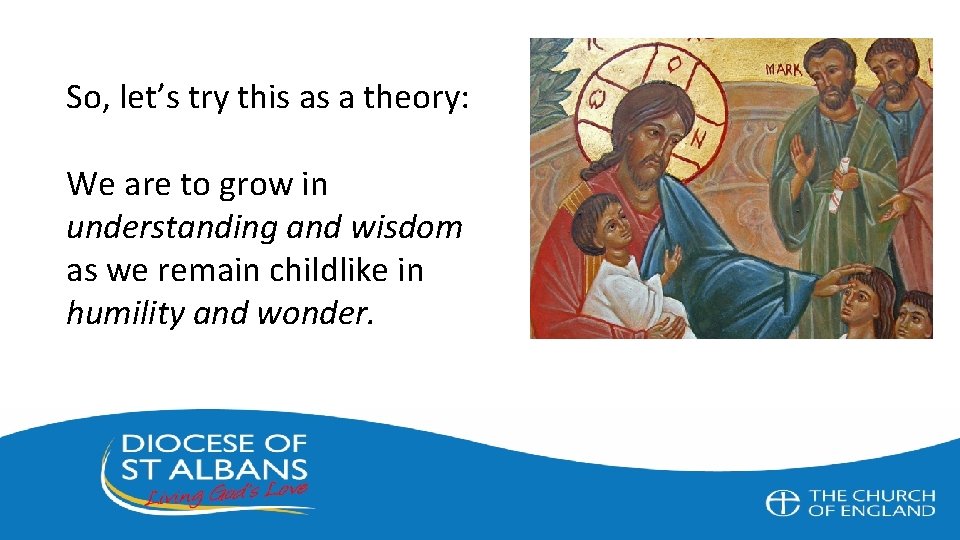
Matthew 18 At that time the disciples came to Jesus and asked, “Who is the greatest in the kingdom of heaven? ” 2 He called a child, whom he put among them, 3 and said, “Truly I tell you, unless you change and become like children, you will never enter the kingdom of heaven. 4 Whoever becomes humble like this child is the greatest in the kingdom of heaven. 5 Whoever welcomes one such child in my name welcomes me. 1 Corinthians 13 But as for prophecies, they will come to an end; as for tongues, they will cease; as for knowledge, it will come to an end. 9 For we know only in part, and we prophesy only in part; 10 but when the complete comes, the partial will come to an end. 11 When I was a child, I spoke like a child, I thought like a child, I reasoned like a child; when I became an adult, I put an end to childish ways. 12 For now we see in a mirror, dimly, [b] but then we will see face to face. Now I know only in part; then I will know fully, even as I have been fully known.
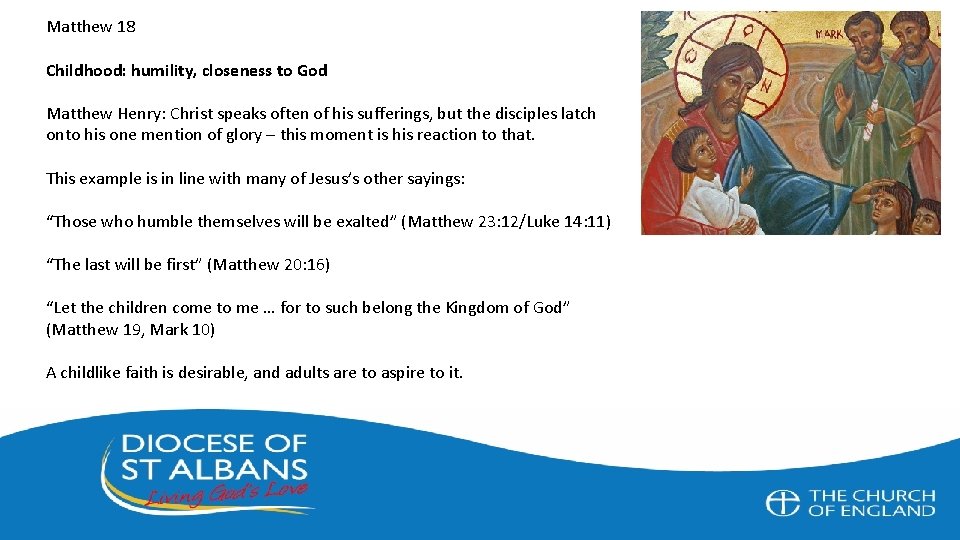
Matthew 18 Childhood: humility, closeness to God Matthew Henry: Christ speaks often of his sufferings, but the disciples latch onto his one mention of glory – this moment is his reaction to that. This example is in line with many of Jesus’s other sayings: “Those who humble themselves will be exalted” (Matthew 23: 12/Luke 14: 11) “The last will be first” (Matthew 20: 16) “Let the children come to me … for to such belong the Kingdom of God” (Matthew 19, Mark 10) A childlike faith is desirable, and adults are to aspire to it.
1 Corinthians 13 Maturity: understanding But Paul’s maturity is still to come – his use of the child/adult metaphor places himself, spiritually, still in the role of the child. “Now we see through a mirror, dimly. ” Even spiritually mature adults are still childlike – and Christ commands us to maintain some of our childlike nature even into adulthood.
So, let’s try this as a theory: We are to grow in understanding and wisdom as we remain childlike in humility and wonder.
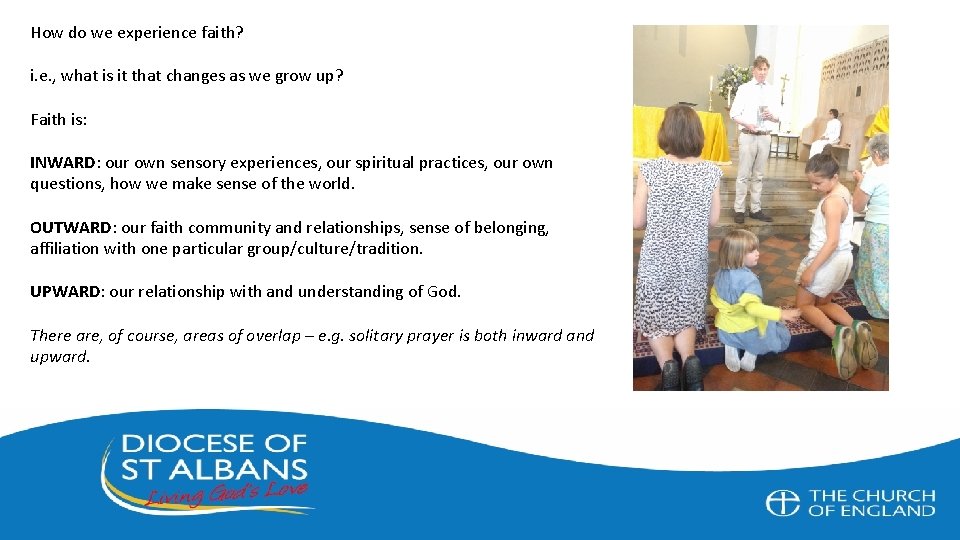
How do we experience faith? i. e. , what is it that changes as we grow up? Faith is: INWARD: our own sensory experiences, our spiritual practices, our own questions, how we make sense of the world. OUTWARD: our faith community and relationships, sense of belonging, affiliation with one particular group/culture/tradition. UPWARD: our relationship with and understanding of God. There are, of course, areas of overlap – e. g. solitary prayer is both inward and upward.
Development: 20 th-century developmental Psychology: We are heavily influenced by environment and experiences, but we are not blank slates. From a spiritual point of view, this means: • Children are born with an innate spirituality (Nye and Hayes). They know God and have experiences of faith, with or without us. • Children are active participants, not empty receptacles (Piaget, Montessori, etc). • Spirituality can develop in predictable ways (though there are, of course, individual differences). For it was you who formed my inward parts; you knit me together in my mother’s womb. I praise you, for I am fearfully and wonderfully made. Wonderful are your works; that I know very well. My frame was not hidden from you, when I was being made in secret, intricately woven in the depths of the earth. Your eyes beheld my unformed substance. - Psalm 139: 13 -16
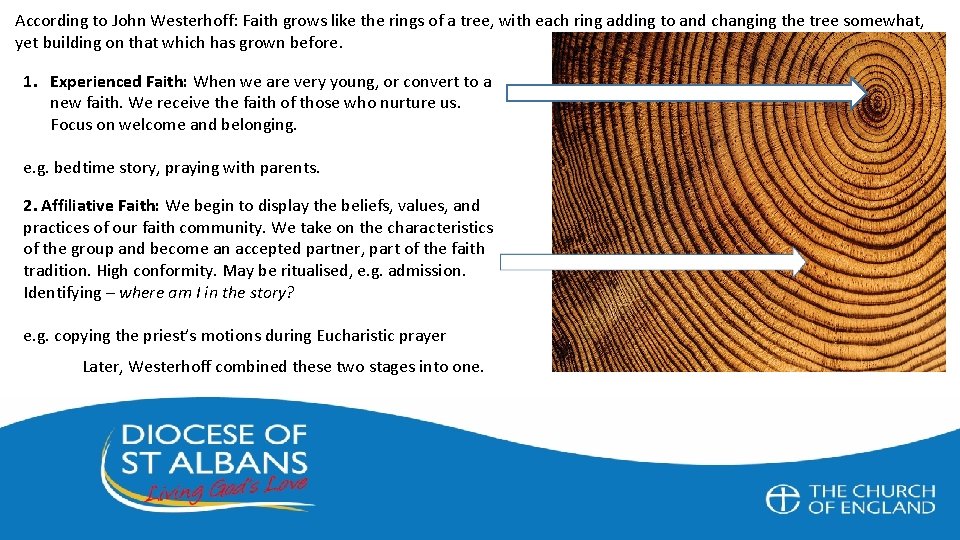
According to John Westerhoff: Faith grows like the rings of a tree, with each ring adding to and changing the tree somewhat, yet building on that which has grown before. 1. Experienced Faith: When we are very young, or convert to a new faith. We receive the faith of those who nurture us. Focus on welcome and belonging. e. g. bedtime story, praying with parents. 2. Affiliative Faith: We begin to display the beliefs, values, and practices of our faith community. We take on the characteristics of the group and become an accepted partner, part of the faith tradition. High conformity. May be ritualised, e. g. admission. Identifying – where am I in the story? e. g. copying the priest’s motions during Eucharistic prayer Later, Westerhoff combined these two stages into one.
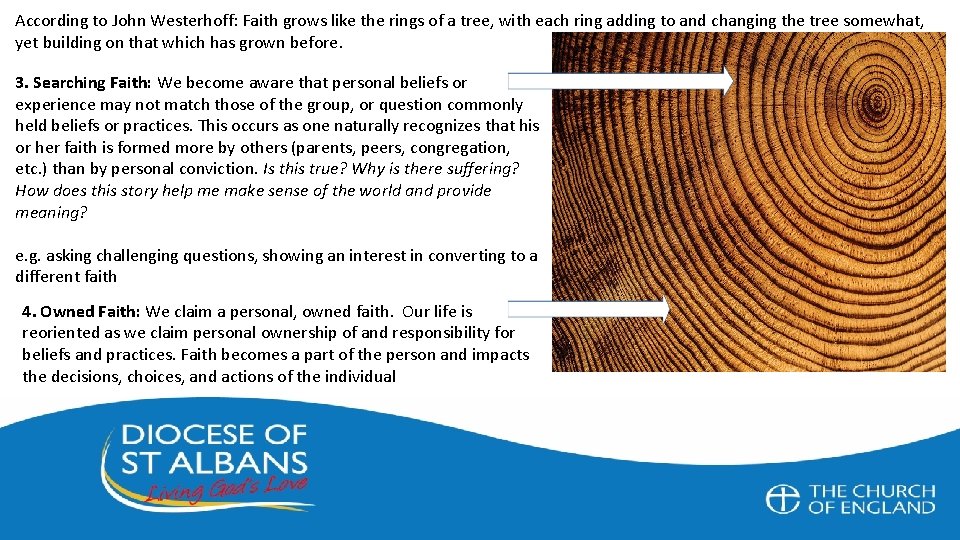
According to John Westerhoff: Faith grows like the rings of a tree, with each ring adding to and changing the tree somewhat, yet building on that which has grown before. 3. Searching Faith: We become aware that personal beliefs or experience may not match those of the group, or question commonly held beliefs or practices. This occurs as one naturally recognizes that his or her faith is formed more by others (parents, peers, congregation, etc. ) than by personal conviction. Is this true? Why is there suffering? How does this story help me make sense of the world and provide meaning? e. g. asking challenging questions, showing an interest in converting to a different faith 4. Owned Faith: We claim a personal, owned faith. Our life is reoriented as we claim personal ownership of and responsibility for beliefs and practices. Faith becomes a part of the person and impacts the decisions, choices, and actions of the individual
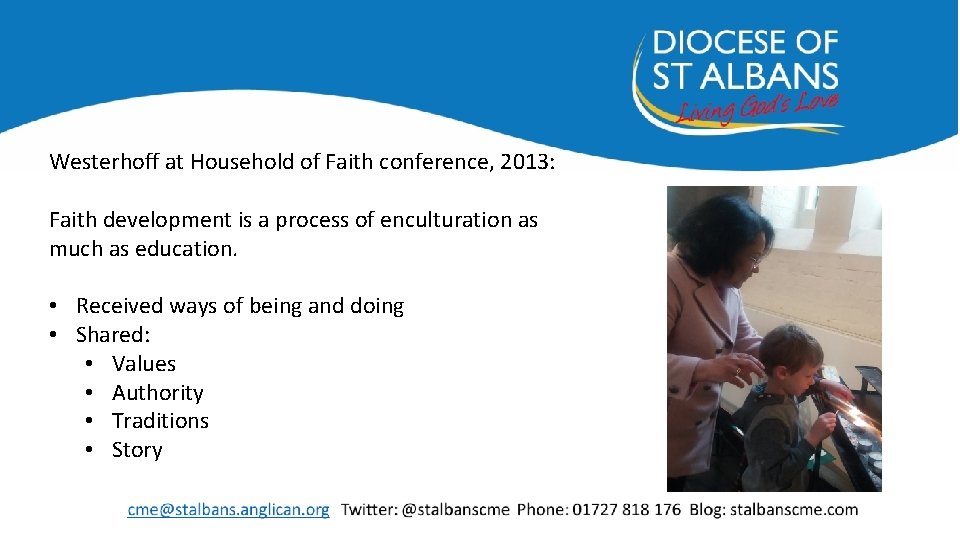
Westerhoff at Household of Faith conference, 2013: Faith development is a process of enculturation as much as education. • Received ways of being and doing • Shared: • Values • Authority • Traditions • Story
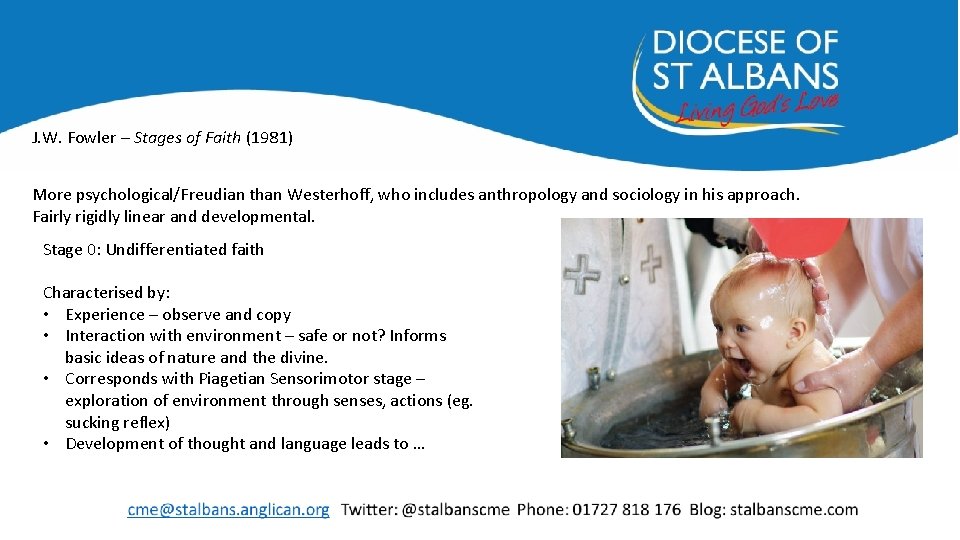
J. W. Fowler – Stages of Faith (1981) More psychological/Freudian than Westerhoff, who includes anthropology and sociology in his approach. Fairly rigidly linear and developmental. Stage 0: Undifferentiated faith Characterised by: • Experience – observe and copy • Interaction with environment – safe or not? Informs basic ideas of nature and the divine. • Corresponds with Piagetian Sensorimotor stage – exploration of environment through senses, actions (eg. sucking reflex) • Development of thought and language leads to …
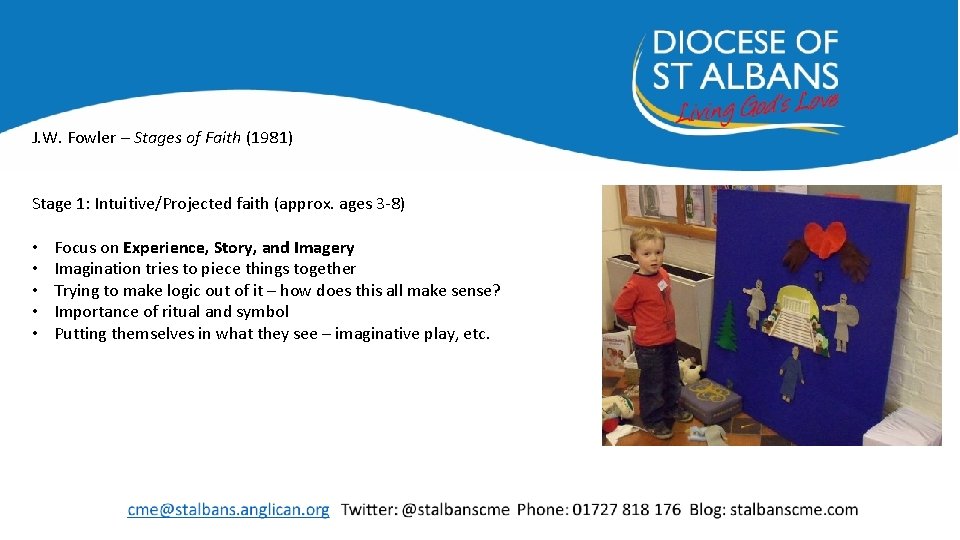
J. W. Fowler – Stages of Faith (1981) Stage 1: Intuitive/Projected faith (approx. ages 3 -8) • • • Focus on Experience, Story, and Imagery Imagination tries to piece things together Trying to make logic out of it – how does this all make sense? Importance of ritual and symbol Putting themselves in what they see – imaginative play, etc.
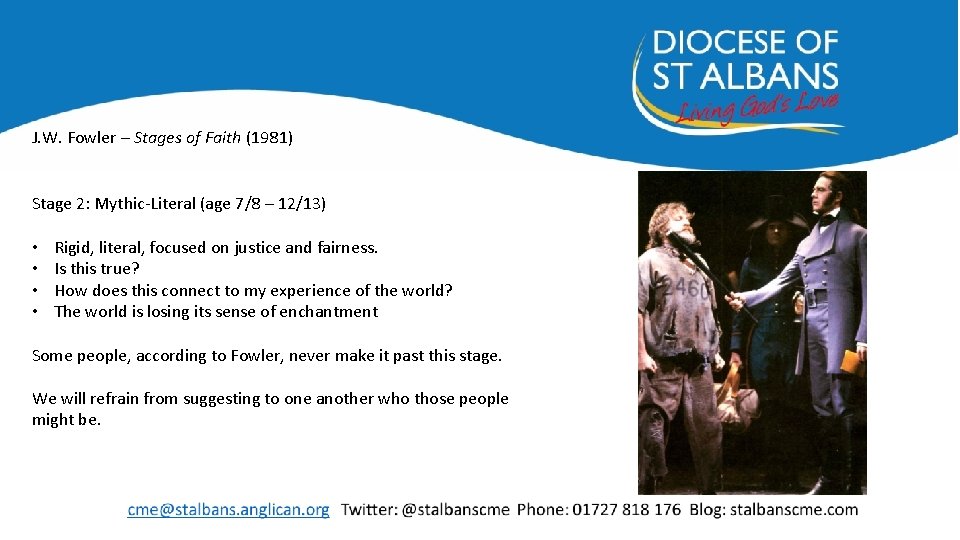
J. W. Fowler – Stages of Faith (1981) Stage 2: Mythic-Literal (age 7/8 – 12/13) • • Rigid, literal, focused on justice and fairness. Is this true? How does this connect to my experience of the world? The world is losing its sense of enchantment Some people, according to Fowler, never make it past this stage. We will refrain from suggesting to one another who those people might be.
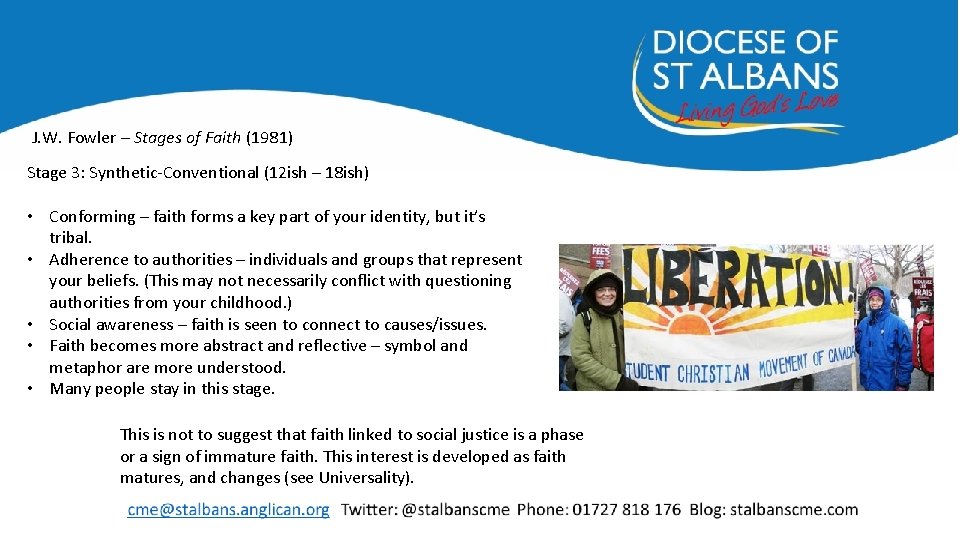
J. W. Fowler – Stages of Faith (1981) Stage 3: Synthetic-Conventional (12 ish – 18 ish) • Conforming – faith forms a key part of your identity, but it’s tribal. • Adherence to authorities – individuals and groups that represent your beliefs. (This may not necessarily conflict with questioning authorities from your childhood. ) • Social awareness – faith is seen to connect to causes/issues. • Faith becomes more abstract and reflective – symbol and metaphor are more understood. • Many people stay in this stage. This is not to suggest that faith linked to social justice is a phase or a sign of immature faith. This interest is developed as faith matures, and changes (see Universality).
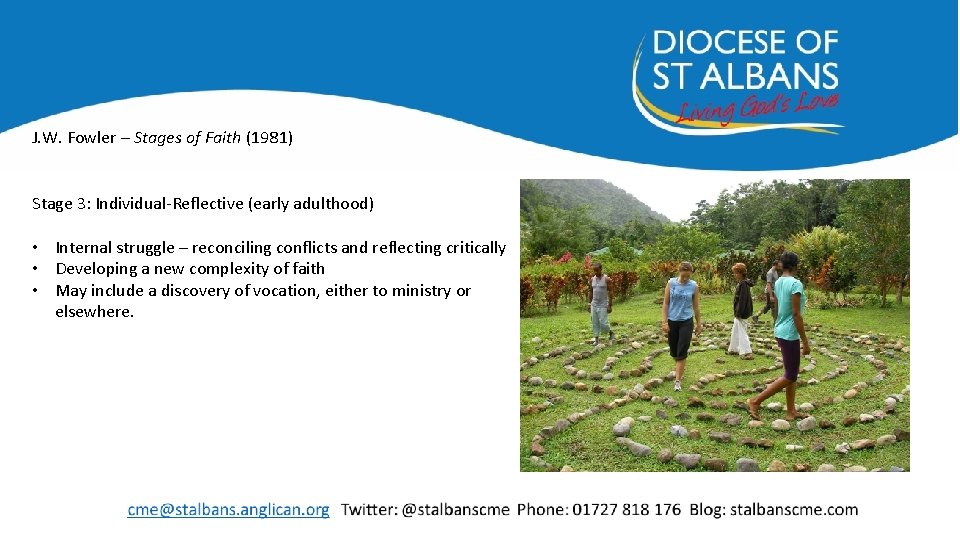
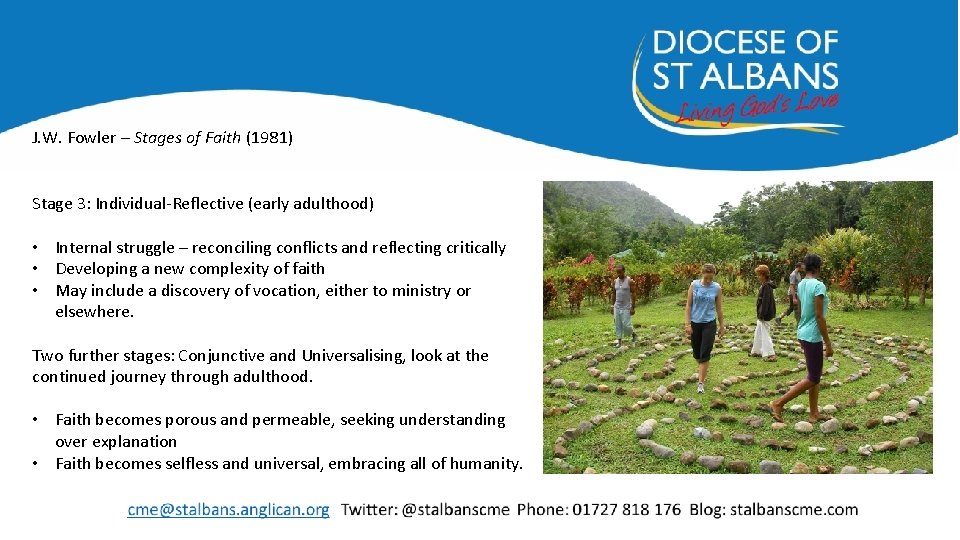
J. W. Fowler – Stages of Faith (1981) Stage 3: Individual-Reflective (early adulthood) • Internal struggle – reconciling conflicts and reflecting critically • Developing a new complexity of faith • May include a discovery of vocation, either to ministry or elsewhere.
J. W. Fowler – Stages of Faith (1981) Stage 3: Individual-Reflective (early adulthood) • Internal struggle – reconciling conflicts and reflecting critically • Developing a new complexity of faith • May include a discovery of vocation, either to ministry or elsewhere. Two further stages: Conjunctive and Universalising, look at the continued journey through adulthood. • Faith becomes porous and permeable, seeking understanding over explanation • Faith becomes selfless and universal, embracing all of humanity.
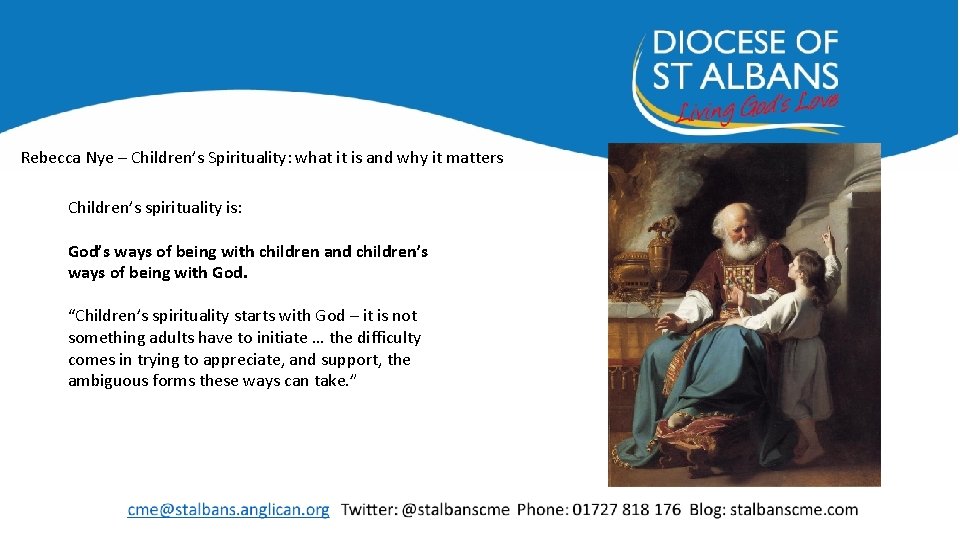
Rebecca Nye – Children’s Spirituality: what it is and why it matters Children’s spirituality is: God’s ways of being with children and children’s ways of being with God. “Children’s spirituality starts with God – it is not something adults have to initiate … the difficulty comes in trying to appreciate, and support, the ambiguous forms these ways can take. ”
Rebecca Nye – Children’s Spirituality: what it is and why it matters Reflecting, from a point of maturity, on childhood experiences of faith: “Being able now, as an adult, to fill in what was missing from your understanding at the time neither invalidates nor improves on the validity of that original sense. ” Childhood experiences of faith are: • Real • Formational • Part of the journey towards maturity • Different from adults’
Rebecca Nye – Children’s Spirituality: what it is and why it matters What creates healthy childhood experiences of faith Space Process Imagination Physical, auditory (silence), emotional – space to be apart and to be held in safety. Spirituality is on-going work. It’s not finished. Children’s spirituality is not about performative cuteness. Process is open-ended making of meaning, not “guess what the teacher wants” towards a pre-determined goal. Using imagination =/= our beliefs are imaginary. Imaginative play is one way children approach God. Relationship Between each of us and God (taken seriously, regardless of age/experience) and between each other. “The central factor is probably 'feeling safe, ' a feeling that it's okay to come closer. . . The 'safety' needs Intimacy to be well guarded -. . . life itself is not a gentle ride ” Trust Comfortable with different kinds of knowing/not knowing. Trust in: God, the child, the faith (Bible, liturgy, etc. )
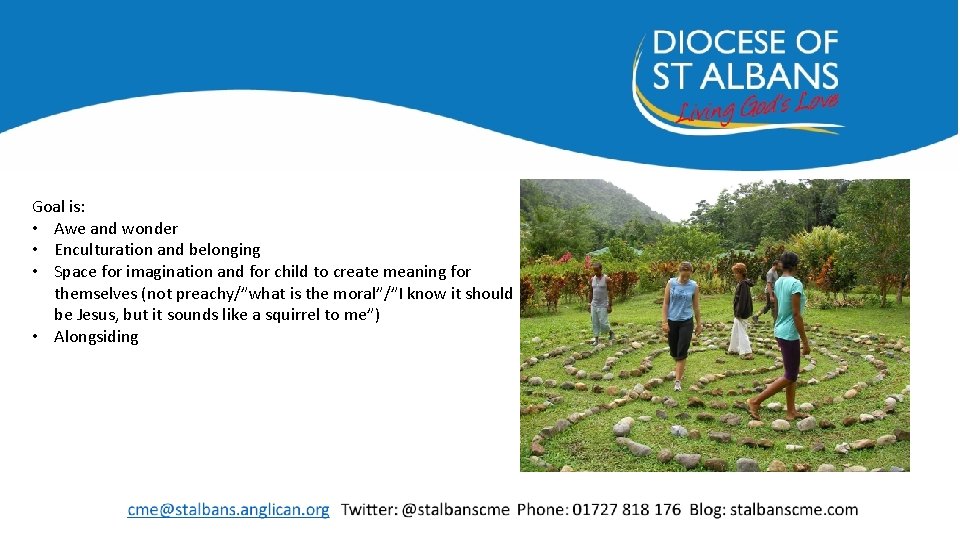
Goal is: • Awe and wonder • Enculturation and belonging • Space for imagination and for child to create meaning for themselves (not preachy/”what is the moral”/”I know it should be Jesus, but it sounds like a squirrel to me”) • Alongsiding
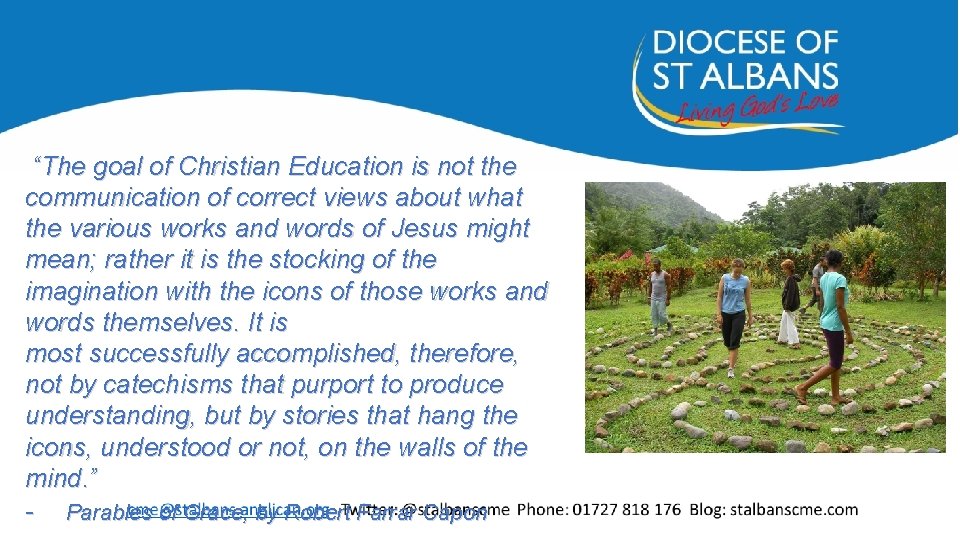
“The goal of Christian Education is not the communication of correct views about what the various works and words of Jesus might mean; rather it is the stocking of the imagination with the icons of those works and words themselves. It is most successfully accomplished, therefore, not by catechisms that purport to produce understanding, but by stories that hang the icons, understood or not, on the walls of the mind. ” - Parables of Grace, by Robert Farrar Capon